One Aussie Family Ripped Out 4,000 Hectares of Invasive Trees to Save a Lost Forest
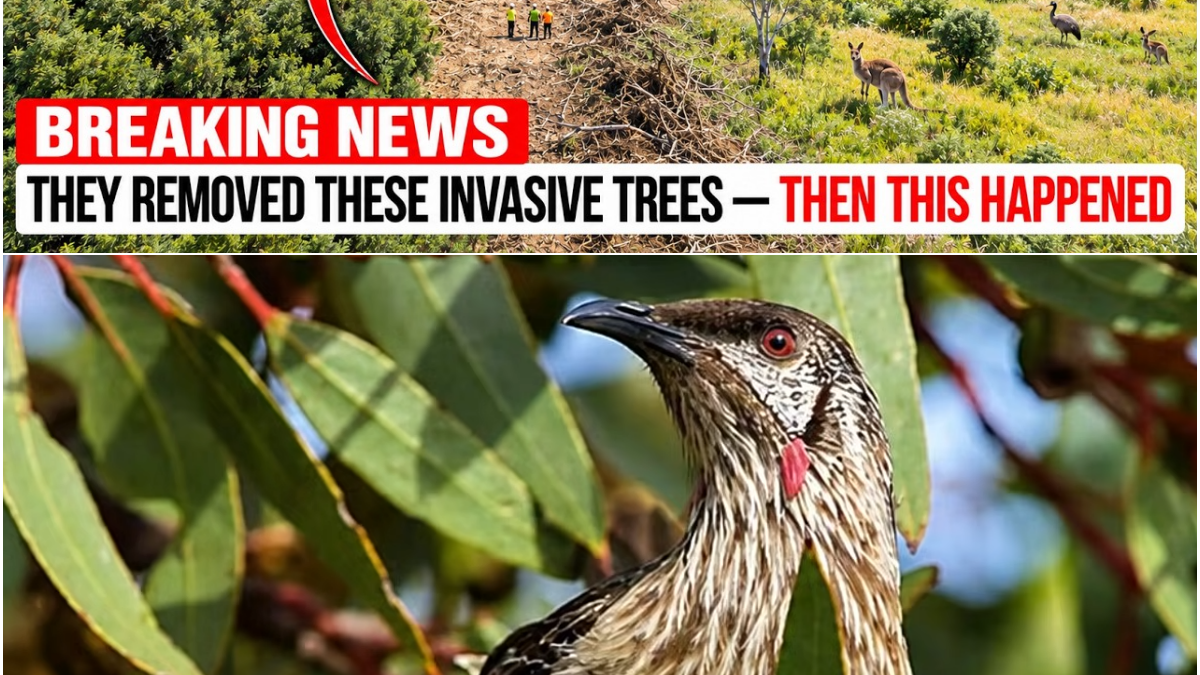
In 2010, on the western edge of Sydney, there was a farm that looked increasingly out of place.
Beyond its fences, the city was expanding. Roads were pushing outward, houses were appearing where paddocks had once stretched toward the horizon, and land that had supported families for generations was becoming worth millions as suburban real estate.
Only a handful of working farms remained in the district where more than a century earlier there had been around 150.
Then the Downes family walked into a New South Wales government office with an unusual proposal.
They did not want permission to build houses. They did not want another subdivision. They did not even want to plant a profitable crop.
They wanted to remove thousands of invasive olive trees and restore an ecosystem that had almost disappeared.
The trees had arrived generations earlier as a hedge. Over time, African olive had spread across the Cumberland Plain, creating dense shade beneath which native grasses and plants struggled to survive.
What looked from a distance like ordinary woodland was becoming something very different. The Downes family offered twenty three hectares of their own property as the first test site for a new biodiversity banking system.
Scientists were uncertain. Neighbors questioned the idea. The economics seemed strange. But the family continued.
They planned to remove the olives, restore the native ground layer, protect the land permanently, and see whether the old woodland could begin assembling itself again.
Fifteen years later, the question was no longer whether anything would happen. The more difficult question was what happens when the light finally reaches ground that has been waiting for it?
Brownlow Hill sat on land whose history reached back to an 1812 grant from Governor Macquarie.
The area had once been known as the cow pastures. For generations, the Downs family worked the property.
Jeremiah Downs leased the land in 1859 and purchased it in 1875. By the time Edgar Downs inherited the farm, the circumstances surrounding it had changed dramatically.
The city was approaching. Dairy deregulation in 2000 had transformed the economics of milk production.
The millennium drought had placed enormous pressure on farms across the region. A coal seam gas company had also sought an exploration license on the property, leading the family into a legal fight that eventually resulted in a heritage order protecting the land.
But Edgar Downs had been changing the farm long before biodiversity banking appeared. In 1985, he replaced synthetic fertilizers with poultry waste, horse manure, sawdust, and straw.
He installed subsurface drip irrigation. He stopped using chemical treatments. Instead of trying to control every part of the farm through external inputs, he began treating the soil itself as an active part of the system.
Years later, a soil scientist visiting Brownlow Hill described the difference in simple terms. The ground had once felt like terracotta.
Now it felt like chocolate cake. The soil’s water holding capacity had doubled. That transformation mattered because the restoration experiment that eventually began in 2010 was not starting with an empty idea.
The family had already spent twenty five years changing the way the property functioned. The landscape around them, however, had a much older story.
Before European settlement in 1788, Cumberland Plain Woodland covered a vast area west of Sydney Harbour.
Estimates vary, but the original range was somewhere between 100,000 and 125,000 hectares. The New South Wales Scientific Committee’s 2009 final determination used the lower estimate.
It was not dense foreSt. It was an open, grassy woodland. Grey box trees stood among forest red gums and narrow leaved ironbarks.
There was space between the trunks. Light reached the ground. Native grasses formed much of the lower layer.
Plants such as Pimelea spicata occupied the understory. The landscape had not remained that way by accident.
The Darug, Dharawal, and Gundungarra peoples had managed the Cumberland Plain with deliberate burning practices for many thousands of years.
The fires were low and seasonal. They reduced the buildup of woody growth and limited the spread of young trees and shrubs.
That helped preserve the open structure of the woodland. The grass layer remained exposed to sunlight.
The system was not simply a collection of trees. It was a relationship between light, grass, shrubs, animals, soil, and carefully timed fire.
When those practices were disrupted, the landscape began changing. Then clearing accelerated. Camden became one of the colony’s important food producing districts.
Trees were removed. Paddocks expanded. According to calculations cited by the scientific committee from Tozer’s 2003 analysis, clearing proceeded at roughly 1.2 percent per year.
Across two centuries, the result was extraordinary. Only about 9 percent of the original woodland remained intact.
Another 14 percent survived as isolated trees scattered through paddocks. The woodland was no longer a continuous system.
It had become fragments. Then another change arrived. African olive. It sounds almost harmless. The plant had originally been introduced as an ornamental hedge.
Peter Cuneo’s research for the Sydney Weeds Committee traced the history back to John Macarthur and his sons at Camden Park Estate.
In the 1820s, African olive was planted as a hedge around their vineyard. Those original plantings, now around two centuries old, still stand at Camden Park.
For more than a hundred years, the olive did not completely overwhelm the surrounding landscape.
There was an unexpected reason. Cattle. Grazing animals trampled young seedlings and browsed fresh growth.
The control was not designed as a weed management strategy. It was simply a side effect of farming.
Then farms began closing across the district during the 1980s. Cattle numbers fell. The natural pressure against young olives disappeared.
Birds carried seeds from one patch to another. Roads and power corridors became pathways for expansion.
African olive began occupying spaces where native woodland had already been weakened. A 2010 New South Wales key threatening process determination, using Cuneo’s 2009 satellite data, identified more than 1,900 hectares of dense olive within a single 721 square kilometer study area on the southern Cumberland Plain.
Across western Sydney, the total area exceeded 4,000 hectares. But the olive’s greatest advantage was not simply how quickly it spread.
It was what happened underneath it. Shade. Cuneo and Leishman at Macquarie University measured the difference.
Under dense African olive canopy, only about 4 percent of available light reached the ground.
In healthy Cumberland Plain Woodland, roughly 50 percent could reach the lower layer. The biological consequences were substantial.
Native plant diversity beneath the olive canopy was dramatically reduced. At the same time, the olive survived remarkably well under its own shade.
The result was a system in which one plant could thrive while much of the native ground layer disappeared beneath it.
For a while, restoration specialists also wondered whether the olive had changed the soil itself in ways that would remain long after removal.
Research published in 2024 by Listsberger and colleagues from Macquarie and Western Sydney suggested that the soil effects did not appear to persist in the same way after the invasive trees were removed.
That supported a different interpretation. Perhaps the main problem was not a permanent chemical change in the soil.
Perhaps the primary problem was simply that almost nothing else could function properly under such intense shade.
If so, removing the olive could reopen a door. But opening the door was not the same as rebuilding the room.
That was the challenge waiting for the Downes family. When New South Wales launched biodiversity banking in 2010, Brownlow Hill became part of a new experiment.
The basic idea was straightforward. A landowner could permanently protect native vegetation, manage the site, and generate biodiversity credits.
Developers required to offset habitat impacts could purchase those credits. The Downes family offered twenty three hectares as the first test case.
The arrangement created something unusual. Instead of earning money by clearing the land or selling it for development, the family could generate an income by protecting and restoring it.
Within five months, the Downes family had sold its first credits. The protection was not merely a promise.
A biodiversity stewardship agreement placed the commitment permanently on the land title. If the property changed hands, the covenant remained.
A portion of the money was placed into a state managed fund. That fund could provide annual payments for management work such as weed control, pest management, and ecological burning.
The family had effectively created a system that made restoration part of the property’s long term structure.
But first, there was an enormous practical problem. The olives had to go. Mature African olive stands can become extremely dense.
Cutting the trees and walking away is not enough. The plants can respond with vigorous regrowth.
Cuneo and Leishman’s work demonstrated that restoration crews needed to deal with the root system and returning shoots.
The effective method involved cutting the tree and applying herbicide to the fresh stump within minutes.
Then the site had to be monitored repeatedly. One treatment was not enough. The work had to continue.
At the Australian Botanic Garden at Mount Annan, professional restoration teams cleared seventeen hectares in a single year.
Even then, another twenty five hectares remained awaiting funding. The scale at Brownlow Hill was far larger.
The Downs family began working across approximately 450 hectares. And removing the olive exposed another problem.
What grows after the shade disappears? It would have been easy to imagine a simple answer.
Plant trees. Wait. Watch woodland return. But Cumberland Plain Woodland is not simply a forest waiting for more trees.
The ground layer matters enormously. Cuneo and Leishman’s three year experiment at Mount Annan tested several approaches.
Fire alone. Direct seeding. And fire combined with direct seeding. The results revealed how different restoration could be from ordinary tree planting.
Some native plants responded when fire reopened the system. But shrubs did not establish strongly enough.
Direct seeding restored perennial grasses and helped resist weed reinvasion. The combination of fire and direct seeding produced the strongest response.
More native cover appeared. Exotic plants were reduced. Olive seedlings had fewer opportunities to return.
The lesson was important. If the native seeds were still present, restoration could encourage them.
But in the most heavily invaded places, the native seed bank had already been severely depleted.
So where could new seed come from? Surviving remnants. Seeds had to be collected by hand from the remaining native patches.
The Royal Botanic Gardens at Mount Annan eventually established dedicated seed production areas for Cumberland Plain grasses because there was not enough wild seed available to restore the ecosystem at the required scale.
That created a difficult feedback loop. The less woodland that survived, the less seed remained.
The less seed remained, the harder restoration became. There was a point at which restoration could move from being difficult to being limited by biology itself.
The Downes family continued anyway. By 2021, the family reported five restoration sites operating. Around 140 hectares were under permanent covenant.
Another 163 hectares were in process. Those figures came from the family’s own reporting rather than an independent registry, but they appeared consistently across multiple sources.
The work also began involving animals. Partnerships with WIRES helped establish wallaby and wombat release pens on restoration sites.
As native vegetation returned, the landscape became more complicated. One of the first shrubs to appear was blackthorn, Bursaria spinosa.
It was native. It belonged there. Yet it presented a familiar problem. If fire did not manage it, blackthorn could close the canopy and shade out grasses.
The same basic ecological conflict created by African olive could appear through a native plant.
That seemed almost contradictory. But it revealed something important. Restoration was not about replacing bad plants with good plants.
It was about restoring the conditions under which the entire community could function. The woodland needed light.
It needed grasses. It needed shrubs. It needed trees. It needed animals. And it needed the disturbance pattern that had historically kept those components in balance.
That meant fire remained part of the story. The returning plants were only one sign.
Birds provided another. Ecologists watching the Cumberland Plain have paid attention to the noisy miner.
The noisy miner is native. But it thrives particularly well in open, simplified woodland. When it becomes dominant, the habitat can still be structurally damaged.
The quieter signal of recovery comes from smaller insectivores and nectar feeding species that depend on a more complex understory.
The returning birds are not simply visitors. They are indicators of the structure developing beneath them.
But some species are facing a problem that habitat restoration alone may not solve quickly enough.
The regent honeyeater is one example. Once, enormous flocks moved through southeastern Australia. Current estimates place the remaining population below 300 birds.
The swift parrot is estimated at roughly 500. BirdLife Australia has estimated that, at current rates of decline, the swift parrot could face extinction by 2031.
The glossy black cockatoo, the Cumberland Plain land snail, and several species of microbat also depend on habitat features that are becoming increasingly scarce.
Some woodland bird species have declined substantially over decades. Among 59 woodland bird species tracked on the plain over six decades, 20 showed declines.
Restoring habitat can create opportunities. But habitat is only one part of the equation when populations become extremely small.
The regent honeyeater provides a remarkable example. At very low population levels, young males may have difficulty learning the songs normally passed between generations.
Ross Crates and colleagues at the Australian National University documented the problem in research published in Proceedings of the Royal Society B in 2021.
About 12 percent of the remaining males, roughly 18 birds in the study population, were singing songs associated with other species rather than the traditional regent honeyeater song.
Females can respond differently to males with abnormal songs. The result can become a difficult cycle.
Fewer birds mean fewer opportunities to learn. Fewer opportunities to learn mean fewer correct songs.
And fewer correct songs can create additional challenges for reproduction. Then, in March 2026, Appleby and Crates reported a new development in Scientific Reports.
At Taronga Zoo, captive bred males were taught the traditional song using recordings and two wild born tutors.
More than half of the zoo bred males were subsequently singing the correct song. The example showed something that is easy to miss when looking only at maps of habitat.
An ecosystem is not only vegetation. It can contain behaviors. It can contain sounds. It can contain information passed from one generation to another.
Restoring trees cannot automatically restore every piece of what once existed there. At Brownlow Hill, another question was waiting.
Would the plants themselves eventually become a woodland again? Researchers at the UNSW Centre for Ecosystem Science had been following restoration plantings at Western Sydney Regional Park for more than twenty years.
Wilkins, Keith, and Adam published early results in Restoration Ecology in 2003. After ten years, more than twenty native species had established on retired pasture.
But the plant community had not converged with the composition of remnant woodland. The restored site still differed from intact habitat.
Even after two decades, there was no simple conclusion that planting alone had recreated the original plant community.
Yet insects offered a different signal. Moths and butterflies showed earlier signs of recovery. Pollination networks began forming again.
Something was happening. Whether the system would eventually converge with remnant woodland or develop into a new but functioning ecological community remained uncertain.
The time required to answer that question was longer than most human projects. A mature eucalypt does not produce a functional nesting hollow quickly.
Ecologists generally estimate that it can take somewhere around eighty to more than one hundred years for a eucalypt to develop the kind of hollow used by species such as black cockatoos and microbats.
A newly planted tree cannot provide that feature next season. It cannot be rushed with fertilizer.
It cannot be ordered from a nursery. The tree has to grow. Branches have to change.
Hardwood has to weather. Natural processes have to create the hollow. The restoration timeline is therefore measured in generations.
That reality becomes especially striking when standing at the edge of Brownlow Hill. On one side is recovering woodland.
On the other is suburban Sydney. The economic pressure is enormous. By 2026, property data placed the median house price in Camden Council above one million dollars.
Vacant lots were selling for roughly $750,000. The New South Wales Valuer General’s 2024 assessment showed industrial land values in Camden increasing by 20 percent in a single year, with Western Sydney Airport and metro construction contributing to the pressure.
The Downes family could have chosen a different path. They could have subdivided. Instead, they placed a permanent covenant over land.
The biodiversity market also created substantial values. ABC News reported in April 2021 that a single Cumberland Plain woodland credit had reached $33,000, roughly triple its value eighteen months earlier.
Transactions across the scheme exceeded $100 million. But the story of biodiversity banking contains a complication that cannot be ignored.
The same offset system that provides financial support for protecting habitat can also facilitate development elsewhere.
Greater Sydney Landcare raised concerns in its public submission regarding the draft Cumberland Plain Conservation Plan.
More than 10,000 hectares were approved for development under the plan, including authorization to clear 1,014 hectares of Cumberland Plain Woodland.
Government documents identified approximately 1,754 hectares of native vegetation in the relevant assessment. The New South Wales Scientific Committee criticized aspects of the methodology and described it as insufficiently precautionary.
A parliamentary inquiry in 2021 heard testimony questioning the effectiveness of the scheme. The Audit Office raised transparency concerns in 2022.
ABC News also reported claims that consultants were receiving substantial profits from biodiversity credit transactions.
Those criticisms do not erase the restoration occurring at Brownlow Hill. They reveal the tension surrounding the system that finances it.
A single credit market can produce money for conservation while also being connected to development that requires offsets.
Both realities can exist simultaneously. The Downes family itself has not been named in those criticisms.
Their story is about what happened on their property. And on that property, restoration became another form of farming.
The sixth generation divided its work. Henry continued with the farm. Clare diversified into film shoots and a festival called Secret Garden, which ran for eleven years and raised more than half a million dollars for charity.
Max became involved with biodiversity banking. The property developed multiple sources of income because no single activity could carry everything.
That mattered because restoration is not a one season project. The olives have to be monitored.
Regrowth has to be treated. Weeds have to be controlled. Pests have to be managed.
Fire has to be planned. Native seed has to be collected. Animals need habitat. And the permanent covenant has to remain meaningful long after the people who established it are gone from the property.
The Biodiversity Conservation Trust paid approximately 37 million dollars in annual management payments to stewardship sites across New South Wales in the year to mid 2025.
Those payments support the ongoing work. But permanent conservation still depends on institutions. It depends on funding.
It depends on ecological knowledge. It depends on future land managers honoring agreements written into property titles.
And it depends on a market continuing to provide resources for work that may take longer than a human lifetime to reach its full expression.
That is what makes Brownlow Hill unusual. The most important change was not immediately visible.
It was not a new building. It was not a new road. It was not a new crop.
It was light. When the olives were removed, sunlight returned to the ground. When sunlight returned, native grasses had an opportunity.
When grasses returned, insects found habitat. When insects returned, birds gained food. As vegetation became more complex, the possibilities for other species increased.
The process did not move in a perfect straight line. Native shrubs could become too dense.
Olive seedlings could return. Fire could be necessary. Some species might never return without active assistance.
Some trees would need decades before their hollows became useful. Some birds needed not only habitat but also the cultural knowledge contained in their songs.
Restoration was therefore not a switch. It was a chain of opportunities. The Downes family had started with an idea that seemed almost backwards.
They had valuable land on the edge of one of Australia’s fastest growing urban areas.
They could see houses approaching. They could see property prices rising. And instead of maximizing the amount of construction the land could support, they decided that some of it was more valuable left as woodland.
The irony was that the land did not become less valuable because they stopped developing it.
It gained another kind of value. The olives were removed. Native plants returned. Permanent protection was established.
The farm continued producing. The family developed other businesses. And a landscape that had been nearly overwhelmed by an introduced tree began moving back toward the ecological structure it had possessed before the modern pressures reshaped it.
There is still no guarantee that every missing species will return. There is no guarantee that every restored patch will eventually become indistinguishable from an old remnant.
There is no guarantee that a financial mechanism designed today will operate unchanged fifty years from now.
The science is still being gathered. The trees are still growing. The grasses are still spreading.
The birds are still moving through the recovering canopy. And the oldest part of the restoration remains almost invisible.
It is the decision itself. A family looked at land worth millions as suburban real estate and chose to put a permanent covenant across part of it.
They removed a tree that had once been planted as a hedge. They opened the ground to sunlight.
They planted native species where the seed bank was gone. They used fire where fire was necessary.
They accepted that some trees would need more than a century before they could provide the hollows certain animals require.
They watched birds return without pretending that every ecological problem had been solved. And they discovered that restoring a woodland was not about putting nature back exactly as it had been.
It was about giving the remaining pieces enough space, light, time, and protection to begin connecting again.
The story of Brownlow Hill therefore begins with olives but ends somewhere much larger. It is about what remains after an ecosystem has been reduced to fragments.
It is about whether those fragments still contain enough information to rebuild something functioning. It is about soil that can recover after years of intensive use.
It is about grasses that need light. It is about shrubs that need management even when they are native.
It is about birds whose survival depends on trees that will not develop their most important features for generations.
And it is about a family that decided the future value of its land did not have to be measured only in houses, roads, or buildings.
For a long time, the olives had covered the ground so completely that the woodland beneath them seemed almost forgotten.
Then the trees came out. The sunlight reached the soil. And slowly, quietly, the old landscape began answering back.
The question was never whether one family could recreate everything that had disappeared. No single property could do that.
The more important question was whether one restored patch could become a starting point. At Brownlow Hill, that answer is still being written in grass, leaves, roots, insects, birds, soil, fire, and time.
And perhaps that is the most revealing part of the experiment. Sometimes restoring a landscape does not begin with building something new.
Sometimes it begins by removing what is blocking the light.
Disclaimer: This content may be created by Al for entertainment purposes. Any resemblance to real persons, events, or places is coincidental.








