Ohio’s 1,300-Foot Serpent Mound No Longer Fits the History They Gave It
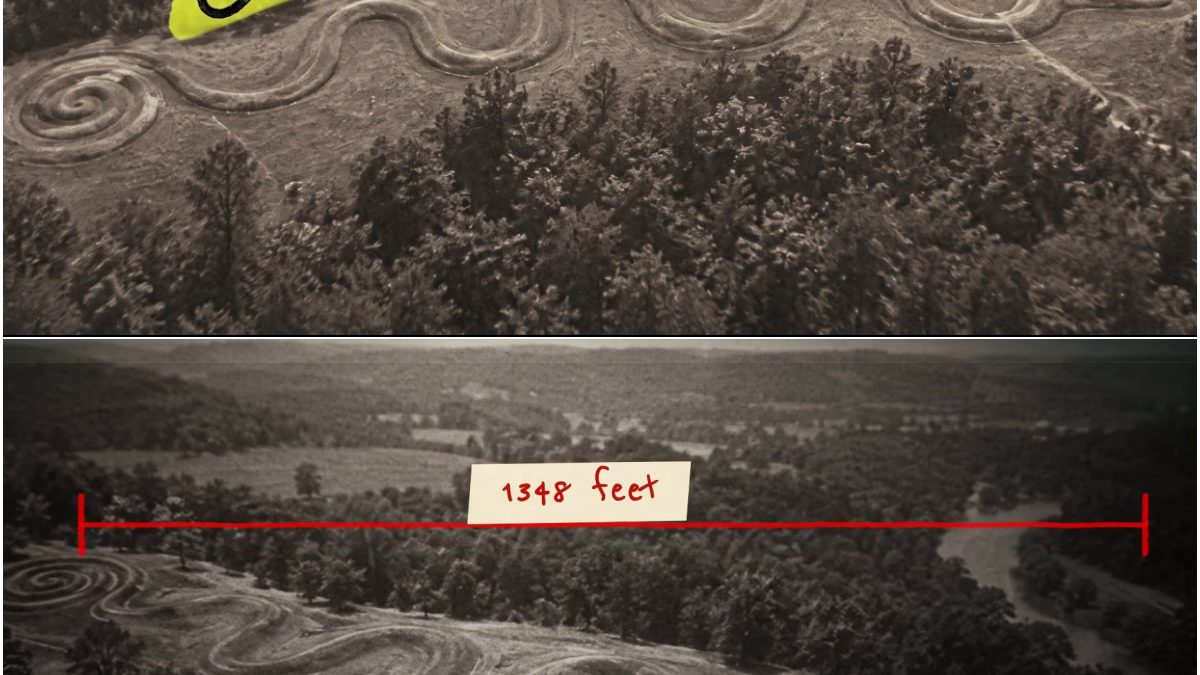
In October 1885, a Harvard professor arrived in southern Ohio carrying the expectations of a scholar and the curiosity of a man who suspected that the ground beneath his feet might hold a story far older than the country surrounding it.
Frederick Ward Putnam had traveled to Peebles station, where he arranged for a wagon to carry him into the hills of Adams County.
The journey led him toward a plateau overlooking Bush Creek, a quiet stretch of countryside that concealed one of the most unusual constructions in North America.
From the ridge, the landscape opened before him, revealing an enormous serpent shaped from earth and stone.
Its body stretched across the plateau in sweeping curves, its jaws opened around an oval mound, and its long coils followed a deliberate pattern that seemed impossible to understand from the ground.
Putnam had come to examine a place first mapped by Charles Whittlesey 52 years earlier, but seeing it in person was different from studying a survey.
The monument was so large that its shape only became clear from a higher viewpoint.
Its builders had created a serpent that seemed to move across the earth, yet they had left no explanation of their purpose.
Putnam would eventually spend his own money to protect the site, convinced that it deserved preservation even if its original meaning remained unknown.
He could not have known that the arguments surrounding its age, its builders, and its astronomical design would continue for generations.
More than a century later, the serpent still stretches across the same ridge, preserving questions that have never received universally accepted answers.
What did its builders understand about the land, the sky, and the history of the people who came before them?
The Great Serpent Mound is located in Adams County, Ohio, in a landscape where hills descend toward waterways and wooded valleys.
Its immense shape is difficult to appreciate from the ground. The raised earthwork measures approximately 1,348 feet from the tip of its tail to the front of its jaws, making it the largest known effigy mound in the world.
Its body rises roughly three to four feet above the surrounding plateau and measures about 20 feet across in many sections.
The construction is formed from yellow clay and riverstones, carefully arranged and packed into a continuous figure.
Its body bends through seven coils before reaching the head, where the open jaws appear to grasp an oval shape.
From above, the arrangement becomes unmistakable. The curves form the outline of a serpent, and the oval at its mouth gives the monument an appearance that has inspired centuries of interpretation.
Yet the people who built it did not have the advantage of modern aerial photography or satellite imagery.
They worked at ground level, shaping the landscape into a design whose complete form becomes clearest when viewed from a height.
That raises an important question about their planning. How did they organize such a large construction so that its overall shape remained coherent across the entire plateau?
The answer may lie partly in the way the monument was designed. Researchers have examined the direction of its head, the arrangement of its coils, and the orientation of its tail.
Some have argued that these features correspond to important positions of the sun throughout the year.
If the alignments are intentional, the serpent may have served a purpose beyond representing an animal.
The head is commonly associated with the summer solstice sunset. Around June 21, the sun reaches its northernmost setting position on the horizon.
The monument’s jaws are oriented toward that part of the sky, creating a possible relationship between the serpent and the annual movement of the sun.
The coils have also attracted attention from archaeoastronomers. William Roma, who studied the astronomical relationships of Ohio’s ancient earthworks, examined the serpent’s geometry and proposed several celestial correspondences.
The monument has been associated with solstice and equinox positions, while its tail’s spiral has been connected with the winter solstice sunrise.
These proposed relationships have helped establish the serpent as a subject of astronomical investigation. The idea is that its builders may have encoded observations of the sky into the form of the earthwork.
Rather than simply marking a place or representing a spiritual figure, the monument might have recorded important moments in the annual cycle.
However, interpreting such alignments requires care. A large structure can produce several apparent relationships with the horizon, especially when researchers examine numerous possible directions and celestial events.
Establishing that an alignment was intentional requires more than finding a close match. Researchers must also consider the monument’s original form, the accuracy of its measurements, and whether the proposed relationship would have mattered to the people who constructed it.
Even with those questions, the astronomical possibilities remain among the most intriguing aspects of the Great Serpent Mound.
Its size and shape suggest extensive planning, and its location gives researchers a reason to examine how the surrounding landscape may have influenced its design.
The plateau itself has another unusual feature. Beneath the monument lies a geological structure that has attracted scientific attention for well over a century.
In 1838, a Cincinnati geologist named John Lockach reportedly observed fractured and uplifted rock formations in the region.
The patterns did not appear to match the surrounding geology, and their origin was not immediately clear.
The anomaly eventually became associated with what geologists call a cryptoexplosion structure, a geological formation produced by an enormous impact or another sudden event that severely disturbed the underlying rock.
Investigations conducted much later identified the region around Serpent Mound as an ancient impact structure.
In 2003, a University of Cincinnati team led by Kenneth Tankersley examined the geological evidence and supported the interpretation that the structure was created by a meteorite impact.
The feature is estimated to be several miles across, and the rocks beneath the area show evidence of substantial disturbance.
The estimated age of the impact is extraordinarily ancient, measured in hundreds of millions of years.
It predates the construction of the mound by an immense span of time. The geological formation itself is not evidence that the mound’s builders understood meteorites or knew precisely what lay beneath the plateau.
But it gives the site a distinctive geological setting that researchers can investigate. The possibility that the builders deliberately selected this location because of its unusual geology remains unproven.
They may have chosen it for its elevation, visibility, access to nearby resources, ceremonial significance, or other reasons that are difficult to recover from the surviving evidence.
The geological anomaly makes the location interesting, but it does not establish what the builders knew about the ground beneath them.
To understand why the serpent became such an important subject, it is necessary to look beyond the monument itself.
Southern Ohio contains a remarkable concentration of ancient earthworks, including circles, squares, octagons, platform mounds, and long embankments.
The region’s archaeological landscape is far more extensive than a single serpent-shaped construction. In 1848, Ephraim George Squier and Edwin Hamilton Davis published Ancient Monuments of the Mississippi Valley.
The work was among the earliest major publications of the newly established Smithsonian Institution and documented hundreds of ancient sites across the eastern United States.
More than 200 distinct sites in Ohio alone appeared in their survey. The structures described in the volume were varied in form and scale.
Some consisted of enormous geometric enclosures. Others were raised mounds or carefully arranged embankments. Certain complexes included straight avenues connecting separate earthworks across considerable distances.
At Newark, Ohio, the ancient landscape included an enormous octagonal enclosure connected to a large circular enclosure.
The scale and precision of the structures have made them important examples of the region’s earthwork traditions.
Their arrangement has also attracted astronomical research, particularly concerning the lunar standstill cycle, which takes approximately 18.6 years to complete.
The Newark complex demonstrates that ancient communities in Ohio could organize large construction projects and create geometric arrangements that remain visible in the modern landscape.
Its structures were not isolated piles of earth. They were parts of an extensive built environment that required planning, labor, and knowledge of the surrounding terrain.
Other major sites, including the earthworks near Marietta, reveal similar investment in construction and spatial organization.
The remains point to communities that could coordinate substantial projects and maintain important places over time.
Archaeologists generally associate many of these monuments with three major cultural traditions: the Adena, the Hopewell, and the Fort Ancient culture.
The Adena tradition is usually dated to approximately 1,000 BC through 200 AD, while the Hopewell tradition is associated with roughly 200 BC through 500 AD.
Fort Ancient communities flourished much later, beginning around 1,000 AD and continuing into the period of European contact.
These are broad archaeological categories rather than names that necessarily reflect how the people identified themselves.
They help researchers organize evidence from different places and periods, but they cannot capture every aspect of the communities that built the earthworks.
The history of how Americans interpreted these monuments is itself an important part of the story.
During the nineteenth century, many European American scholars and settlers encountered enormous earthworks and struggled to understand their origins.
Some concluded that the structures must have been built by a vanished people unrelated to the Indigenous nations living in the region.
This idea became known as the mound builder theory. Its supporters proposed a variety of possible origins, sometimes connecting the earthworks to ancient Egyptians, Israelites, Europeans, or other imagined populations.
The proposed explanations differed, but many shared the assumption that the Indigenous peoples of North America could not have constructed the monuments.
That assumption reflected the racial and political beliefs of the period. As settlers expanded across Indigenous lands, the notion of a vanished, more advanced population helped separate the ancient achievements of the continent from the living Native American communities whose histories were tied to those places.
The theory also ignored the possibility that Indigenous societies had developed sophisticated traditions of engineering, astronomy, trade, and ceremonial construction.
Instead of beginning with the evidence of Indigenous history, many early writers looked overseas for explanations.
Squier and Davis documented the earthworks with extensive measurements and maps, providing valuable records of structures that have since been altered or destroyed.
Their observations helped establish the archaeological importance of the sites. Their interpretations, however, were influenced by the intellectual assumptions of their time.
In 1894, Cyrus Thomas of the Smithsonian’s Bureau of American Ethnology published a major report challenging the mound builder theory.
Drawing on fieldwork and comparisons across many archaeological sites, Thomas argued that the earthworks had been built by the ancestors of Indigenous peoples in the region.
His work represented an important correction to the claim that the monuments required a separate, vanished race.
The archaeological evidence supported Indigenous authorship, and later research has continued to demonstrate the complexity and diversity of Native American societies.
But identifying the builders as Indigenous peoples does not answer every question about the monuments.
It does not automatically explain how particular structures were designed, what ceremonies took place there, how astronomical observations were organized, or how knowledge was transmitted across generations.
The Great Serpent Mound illustrates the difference between identifying a cultural tradition and understanding the specific purpose of a construction.
Its original builders remain uncertain, and the archaeological debate over its age has complicated efforts to place it within a particular period.
When Frederick Ward Putnam excavated the site between 1886 and 1889, he recovered artifacts that he associated with the Adena tradition.
The nearby burial mounds and other archaeological evidence also influenced his interpretation. He concluded that the serpent belonged to the Adena period, an attribution that remained widely accepted for much of the twentieth century.
Under that interpretation, the monument was approximately 2,000 years old. It was understood as part of the same broad cultural world as the nearby Adena burial mounds and other earthworks in Ohio.
Then, in 1991, researchers Robert Fletcher, Terry Cameron, and William Roma examined samples associated with the mound’s construction.
Their radiocarbon results suggested that some of the material dated to approximately 1070 AD. The finding challenged the traditional Adena attribution and raised the possibility that the monument had been built much later than scholars had believed.
The proposed date placed the construction within the period associated with Fort Ancient communities rather than the Adena.
The result attracted attention because it dramatically changed the historical context in which the serpent was understood.
If the monument had been built around 1070 AD, it would belong to a very different period from the one Putnam had proposed.
Its creators would have lived in a landscape shaped by later cultural traditions, and the relationship between the serpent and the surrounding archaeological sites would need to be reconsidered.
The new interpretation was influential, but the dating question did not remain settled. In 2014, William Roma and archaeologist Jared Burks re-examined the evidence and proposed that the 1070 date might represent a later repair or reconstruction rather than the original construction of the serpent.
Their interpretation suggested that the core of the monument could date to approximately 300 BC, bringing it back into the Adena period.
Under this view, the earthwork may have been modified or maintained long after it was first built.
The possibility of repeated construction is important because ancient monuments were not always completed in a single event.
Communities could enlarge, repair, reshape, or reuse structures over long periods. Different layers of fill might therefore preserve evidence from different stages in a site’s history.
The disagreement between the proposed dates demonstrates the difficulty of interpreting a monument that may have undergone several episodes of construction.
A radiocarbon date can identify the age of the material sampled, but it does not automatically establish the date when the entire structure first appeared.
The Great Serpent Mound may have a complicated history in which the original design and later alterations belong to different periods.
More extensive sampling and a clearer understanding of the construction layers could help refine that history.
The uncertainty has also made the serpent a subject of broader speculation. Some writers have suggested that a much earlier date would change the established picture of ancient North America.
They have connected the monument with archaeological sites elsewhere in the world and proposed that its builders may have possessed knowledge or abilities that have not been fully recognized.
Such arguments often combine several different kinds of evidence: astronomical alignments, geological anomalies, unusual burial reports, and comparisons with symbols found in other cultures.
Each subject deserves careful examination, but combining them does not automatically produce a single explanation.
The astronomical evidence, for example, concerns the relationship between the earthwork and the sky. The geological evidence concerns the ancient formation beneath the plateau.
The dating dispute concerns the age of construction materials. The burial reports concern human remains found in associated mounds.
These questions are related by their location, but each requires its own methods and evidence.
The burial mounds near the Great Serpent Mound have also attracted attention. Three burial mounds are located within the state park, and two contained human remains when excavated.
Putnam’s work and later investigations helped establish the archaeological importance of these features. Some nineteenth- and twentieth-century accounts describe individuals whose skeletal dimensions were interpreted as unusually large.
Reports from Ohio and other parts of the eastern United States occasionally referred to skeletons that were said to indicate exceptional stature.
Among the examples cited in discussions of the subject are an 1872 report concerning a skeleton near Chesterville in Morrow County, and an 1876 account of discoveries near Conneaut in Ashtabula County.
Other historical reports described remains from areas around Marietta, Miamisburg, and Chillicothe. These accounts have sometimes been used to support claims that ancient Ohio was inhabited by a population of unusually tall people.
But the historical descriptions are not equivalent to a modern anthropological study. Measurements may have been inaccurate, excavators may have misidentified bones, and some accounts may have repeated earlier claims without independent confirmation.
Cyrus Thomas acknowledged reports of unusually large skeletons in his work, but questioned the reliability of many of them.
His caution reflected the difficulties of evaluating nineteenth-century excavation records, especially when the remains were not preserved with adequate documentation.
Some historical accounts suggest that skeletal material was sent to museums or other institutions for study.
However, claims about missing collections or unlocated remains require careful verification. An old reference to an accession or shipment does not establish that a particular skeleton was unusually large, nor does it prove that an institution concealed evidence.
Modern osteometric analysis could provide a more reliable way to examine any surviving specimens. Researchers could compare bone measurements with established population data and assess whether the remains were genuinely exceptional.
Where appropriate and ethically permissible, additional techniques might help investigate ancestry, diet, migration, or other aspects of the individuals’ lives.
Until such evidence is available, reports of unusually tall individuals should be treated as historical claims rather than proof of a separate population or lost civilization.
The same careful approach applies to the Great Serpent Mound’s possible astronomical purpose. The monument’s orientation and form are observable, and researchers can measure its relationship to the horizon.
But explaining what the builders intended requires more than identifying geometric correspondences. The summer solstice may have held ceremonial importance for the people who built the serpent.
The changing position of the sun could have helped mark seasons, organize agricultural activities, or structure communal events.
Yet without direct written records from the builders, the precise meaning of the monument remains uncertain.
The oval held within the serpent’s jaws is another source of interpretation. Some observers have described it as an egg, a sun, or another symbolic object.
Its position creates a distinctive composition, but its meaning cannot be established solely from its shape.
Serpents appear in many mythologies and religious traditions around the world. They can represent water, renewal, power, danger, fertility, or the relationship between different parts of the cosmos.
Their meanings vary widely, even among cultures that share similar imagery. Comparisons between the Ohio serpent and traditions from Egypt, Europe, Mesoamerica, or South Asia can be interesting, but resemblance does not establish historical contact.
Similar symbols can arise independently because people across different regions respond to common experiences and natural forms.
A serpent surrounding or approaching an oval may invite comparisons with stories about creation, celestial bodies, or cosmic order.
But those comparisons are starting points for questions, not proof that the builders of the Ohio monument shared a specific myth with distant societies.
The Newark earthworks provide another important example of the astronomical interests associated with Ohio’s ancient construction traditions.
Their large circles and octagonal forms have been examined for possible relationships with the lunar standstill cycle.
A lunar standstill occurs when the moon reaches its most northerly and southerly rising or setting positions over an approximately 18.6-year cycle.
The phenomenon is less familiar than the annual movement of the sun, but it can be observed through repeated attention to the horizon.
Researchers Ray Hively and Robert Horn examined possible lunar relationships at Newark in a 1982 study.
Their work helped establish the complex as a major subject of archaeoastronomy. The Newark structures demonstrate that some ancient communities in Ohio may have maintained detailed observations of celestial cycles.
Whether those observations were used for ceremonial scheduling, social organization, practical timekeeping, or several purposes remains a subject of interpretation.
The same possibility has encouraged researchers to ask whether other Ohio earthworks, including the Great Serpent Mound, were designed with the sky in mind.
The answer may not be identical for every site. Different communities could have used different methods and built monuments for different reasons, even when they shared a broad interest in the movement of celestial bodies.
The construction itself also deserves attention. Without metal tools, wheeled transport, or domesticated draft animals, ancient builders still created large and carefully shaped earthworks.
Their methods relied on human labor, knowledge of materials, and the ability to organize work over time.
The absence of modern equipment does not mean the absence of sophisticated engineering. Soil can be moved with baskets, wooden tools, digging sticks, and coordinated labor.
Straight lines can be established with simple measuring methods, and circular forms can be laid out using repeated distances and fixed points.
Mathematical knowledge does not require written equations. Communities can preserve geometric practices through instruction, experience, and repeated construction.
A design can be understood and reproduced through practical methods even when no written record survives.
The earthworks of Ohio provide evidence of communities capable of substantial organization and long-term planning.
Their achievements deserve to be studied on their own terms, without assuming that they required outside builders or an unknown civilization.
Frederick Ward Putnam recognized the importance of preserving the Great Serpent Mound even when he could not fully explain it.
In 1887, he purchased the site with private money and donated it to the state of Ohio.
His decision helped protect the monument from destruction and made it possible for future generations to visit and study it.
Two years before that purchase, he had stood on the ridge and seen the serpent spread across the plateau.
His first impressions became part of the site’s history, but the questions that confronted him have continued to evolve as new research methods have become available.
In April 1890, Putnam published an account of the monument in Century magazine. He described its construction and considered the possibility that its orientation might have astronomical significance.
That suggestion was an early indication that the serpent could be more than an animal effigy, although systematic astronomical investigations came much later.
The history of the monument is therefore not simply a story of ancient construction. It is also a story about changing interpretations.
Each generation has approached the site with different questions, different tools, and different assumptions about what ancient Indigenous communities could accomplish.
The nineteenth-century mound builder theory reflected a refusal to recognize the achievements of Indigenous peoples.
Its rejection was an important step toward a more accurate understanding of North American history.
But recognizing Indigenous authorship does not mean that every archaeological question has been answered. The challenge for modern researchers is to avoid replacing one oversimplified explanation with another.
The serpent does not need to be attributed to an unknown overseas civilization to be extraordinary.
Its scale, design, and possible astronomical relationships are significant within the history of Indigenous North America.
The same is true of the Newark earthworks, Grave Creek Mound, Miamisburg Mound, and the many other constructions spread across the region.
Their importance comes from what they reveal about the people who built them, maintained them, and gave them meaning.
The Grave Creek Mound in present-day West Virginia offers another example of the complexity of the region’s archaeological history.
The enormous conical structure rises about 62 feet and measures approximately 240 feet across at its base.
It contains a substantial volume of earth and is among the largest burial mounds in North America.
The mound has been associated with the Adena tradition, and its construction is generally placed within a broad period around the centuries before the Common Era.
Excavations revealed burial features and an inscribed sandstone tablet that became known as the Grave Creek tablet.
The tablet’s characters have been debated for generations. Some interpreters have compared them with writing systems from the Old World, while others have questioned whether the markings represent a genuine ancient inscription.
The possibility of forgery has also been raised. The tablet is an important historical artifact, but its uncertain interpretation does not establish contact between ancient Ohio communities and Mediterranean societies.
Such a claim would require a strong body of independent evidence, including secure archaeological context and a convincing demonstration of the inscription’s age and meaning.
The Miamisburg Mound, another major conical structure in Ohio, provides evidence of the labor and planning involved in monumental construction.
Its height and circular form demonstrate how communities could transform a landscape using earth-moving methods and organized work.
These sites belong to a broad tradition of construction that varied across time and place.
Their similarities may reflect shared cultural practices, regional interaction, or the repeated use of effective building methods.
Their differences are equally important because they can reveal how communities adapted monumental construction to local needs and beliefs.
The Great Serpent Mound stands out because of its distinctive form. Instead of a cone or geometric enclosure, it presents a recognizable figure stretched across a natural plateau.
Its curves and oval feature invite interpretation, while its scale makes it difficult to understand without a view from above.
It is tempting to imagine that every element of the monument must have been part of a single, perfectly unified plan.
But the possibility of repairs and modifications means that the serpent may preserve several moments in its history.
Its current form could reflect the decisions of more than one generation. If that is the case, the monument may have functioned as a place where inherited traditions were renewed.
Later communities could have maintained a structure whose original builders were no longer known to them, adding their own meaning while preserving its overall shape.
Such a history would not make the serpent less remarkable. It would make the monument an example of continuity, where people returned to an important place and maintained a relationship with a construction that had already become part of the landscape.
The possibility also offers a way to think about the conflicting radiocarbon dates. A sample associated with a later repair could accurately date that episode without identifying the monument’s first construction.
The 300 BC proposal and the 1070 AD result might therefore refer to different stages rather than competing dates for a single event.
Determining whether this explanation fits the evidence requires careful excavation records, secure samples, and a detailed understanding of the mound’s stratigraphy.
Researchers must be able to distinguish original construction materials from later additions and from natural processes that may have altered the site.
The geological setting introduces another layer of uncertainty. The impact structure beneath the plateau is an established feature of the landscape, but its relationship to the monument’s builders is unknown.
They may have recognized something unusual about the terrain, or they may have chosen the location for reasons unrelated to the ancient impact.
The distinction between what can be measured and what can be inferred is essential. The crater can be studied through geology.
The serpent can be measured through archaeology and surveying. The astronomical relationships can be assessed through archaeoastronomy.
The intentions of the builders, however, require interpretation based on all the available evidence. The most useful questions are therefore specific.
Which parts of the monument are original? What materials were used in each construction phase?
How does the serpent’s orientation compare with other ancient sites in the region? What evidence exists for ceremonial activity?
How did the surrounding communities change over time? These questions do not require an extraordinary explanation.
They require sustained research, careful documentation, and respect for the people whose history is being investigated.
The Great Serpent Mound continues to attract visitors because it brings together several kinds of mystery.
Its shape is immediately recognizable, yet its meaning is uncertain. Its age has been debated, its possible astronomical design remains a subject of study, and its location above an ancient geological structure invites further investigation.
Standing near the observation platform, a visitor can follow the serpent’s body as it bends across the plateau.
The head and oval create a striking focal point, while the coils guide the eye toward the distant tail.
The monument’s size becomes clearer with every step, but its complete form remains difficult to grasp from ground level.
Around the summer solstice, attention naturally turns toward the sunset. The relationship between the serpent’s head and the horizon provides an opportunity to consider how ancient people might have observed the sky.
Even if the exact intended purpose remains uncertain, the experience connects the monument to the broader human practice of tracking seasonal change.
The serpent’s continued presence is also a reminder of the importance of preservation. Putnam’s decision to protect the site helped ensure that it would remain available for future generations.
The earthwork has endured because people recognized its significance and took steps to maintain it.
Its preservation also carries a responsibility. Interpretations should distinguish evidence from speculation and should recognize Indigenous communities as the creators of the region’s ancient traditions.
The history of archaeology includes examples of mistaken assumptions that diminished Indigenous achievements. A careful account of the serpent should not repeat those mistakes.
There is no need to invent a vanished race to explain the monument’s existence. Indigenous societies developed complex traditions of construction, observation, and ceremony across North America.
The Great Serpent Mound belongs within that history, even as researchers continue to investigate its particular origins and functions.
Nor does acknowledging uncertainty mean abandoning curiosity. The unanswered questions are legitimate subjects for further research.
The precise sequence of construction, the significance of the oval, and the relationship between the earthwork and the sky remain worthy of examination.
The story of the serpent is strongest when its uncertainties are treated honestly. The 1885 visit, the 1887 preservation effort, the 1991 dating proposal, and the 2014 reassessment all belong to a history of investigation that has changed as new evidence has emerged.
The monument itself has not changed its place on the plateau. Its body still curves across the earth, its jaws still frame the oval, and the surrounding landscape still provides the horizon against which its possible alignments can be studied.
The people who built it left no written explanation that modern researchers can confidently connect to the structure.
Their intentions must be approached through the evidence they left behind, along with the broader histories of the Indigenous communities of the Ohio Valley.
Perhaps the serpent was a ceremonial monument. Perhaps it marked important seasonal events. Perhaps its construction involved several generations, each preserving and modifying a design that carried meaning beyond the lifetime of any individual builder.
These possibilities are not mutually exclusive, and the surviving evidence may eventually help clarify how they fit together.
What is clear is that the monument required knowledge, labor, and planning. It was not an accidental formation.
It was a deliberate construction that transformed a plateau into an enormous figure and made the surrounding landscape part of its design.
The serpent’s mysteries do not need to be solved all at once. They can be approached one question at a time, through better dating, careful mapping, archaeological research, and collaboration with Indigenous communities whose histories are connected to the region.
When Frederick Ward Putnam first saw the Great Serpent Mound in October 1885, he understood that it deserved protection even though its meaning was beyond his knowledge.
His decision allowed the monument to survive as a place where new generations could ask questions and develop better explanations.
Today, the most important part of that legacy may be the recognition that preservation and understanding are different tasks.
Protecting the earthwork ensures that its physical evidence remains available. Understanding it requires continued investigation and a willingness to revise interpretations when the evidence demands it.
The Great Serpent Mound is not simply a puzzle waiting for a dramatic solution. It is a surviving achievement of ancient Indigenous people, a monument whose scale and design deserve attention in their own right.
Its age may be clarified by future research, and its astronomical relationships may become better understood.
Its original meaning may remain partly beyond recovery, but that uncertainty does not diminish its importance.
The serpent still stretches across the plateau above Bush Creek, where its curves follow the contours of the land and its head faces the horizon.
The ancient impact structure beneath it remains part of the geological record, while the earthwork above it preserves evidence of human choices made long before the modern state of Ohio existed.
A visitor can stand where Putnam once looked out over the monument and see the same sweeping design.
The questions are not proof of a lost civilization or evidence that established archaeology has failed.
They are an invitation to understand the ingenuity of the people who built one of the most remarkable earthworks in the world.
And as the sun moves toward the horizon, the serpent offers a final reminder. The past is not empty simply because its builders left no written account that survives today.
Their knowledge, decisions, and traditions remain visible in the landscape. The task is to study those traces carefully, recognize the people responsible for them, and keep asking what the evidence can genuinely tell us.
Disclaimer: This content may be created by Al for entertainment purposes. Any resemblance to real persons, events, or places is coincidental.








