Nobody Wanted 12 Broken Looms — She Paid $5,000 and Built a Textile Empire
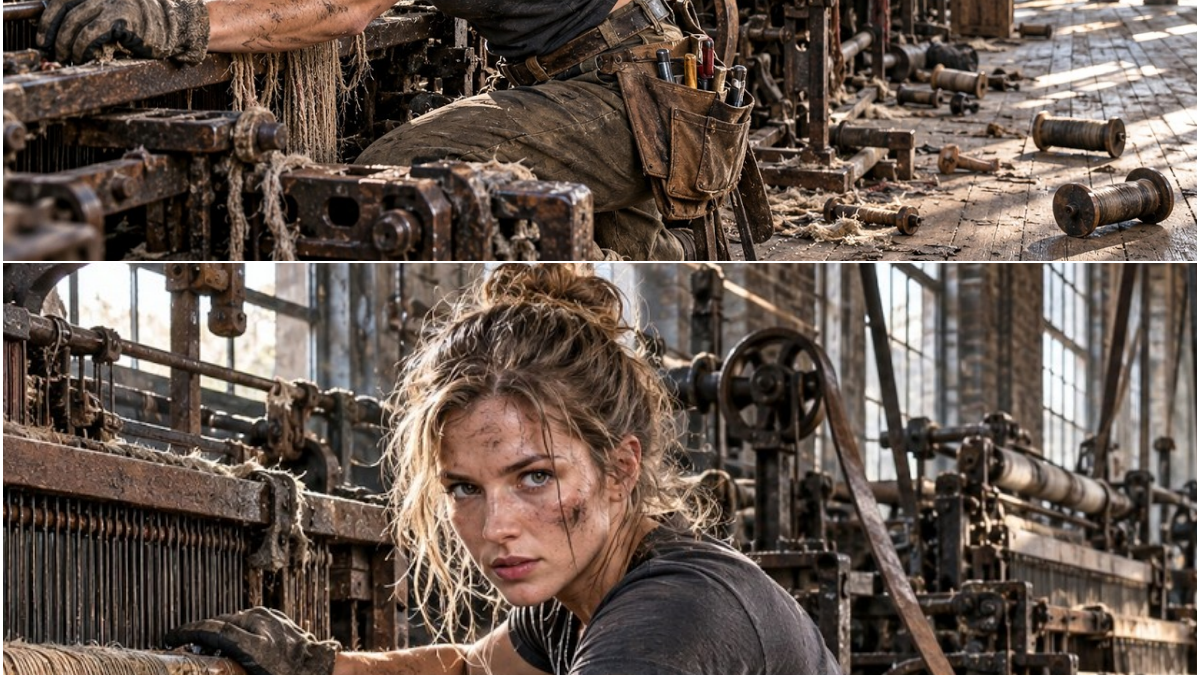
The dust in the old weave room looked like gold when the morning sun passed through the broken windows, but there was nothing precious about the building when Juny Marsh first stepped inside.
Twelve looms stood in two rows beneath a ceiling darkened by years of lint and machine oil.
Their cast iron frames were furred with dust, their belts had rotted, and their shuttles remained frozen in the middle of unfinished work.
Pigeons had made homes on the upper rails, leaving pale stains across the machinery. On the floor, scraps of cotton lay scattered around the feet of machines that had not moved in years.
Juny stood among them with five thousand dollars in her hand, counting the bills into Hutch Bellamy’s palm one hundred at a time.
She was twenty-seven, lean from years of physical work, with dark hair pulled through a faded hardware store cap and grease embedded in the creases of her knuckles.
Hutch had offered the looms as scrap, and he had expected her to change her mind before the money was counted.
Outside, two men loading copper pipe onto a flatbed laughed at the sight of her purchase.
Nobody had woven cloth in Carolton for years, they said. Juny did not answer. She placed one hand against the rusted reed of the nearest loom and imagined the shuttle moving again, crossing the threads with the same precise rhythm she remembered from childhood.
She could almost hear the old mill operating, almost feel the vibration through the floor.
Everyone else saw twelve useless machines. Juny saw a sound she had missed for years and a possibility nobody around her wanted to consider.
But could she bring an abandoned mill back to life with five thousand dollars and no formal training?
Carolton, North Carolina, had once been a place where the textile industry seemed as permanent as the hills surrounding it.
The town sat in the Piedmont, where the land rolled down from the foothills into stretches of red clay and wooded creek banks.
Three brick mills had once stood along the water, their whistles marking the hours and their machinery providing work for generations of families.
For decades, the mills had given the town its identity. Grandparents worked there, then parents, then children who expected to spend their adult lives in the same buildings.
The work was difficult, but it offered steady wages and a familiar routine. People knew which streets filled with workers at shift changes and which diners served breakfast before the morning whistle.
Then the industry began changing. During the 1980s and 1990s, overseas manufacturers expanded their production, and the economics of American textile manufacturing became increasingly difficult for small mills.
One by one, the Carolton operations reduced their workforces, cut shifts, and eventually closed. The final mill shut down in 2009.
By the time Juny reached high school, the whistles had gone silent. People under forty who could find opportunities in Charlotte or Raleigh often left.
Those who stayed found work wherever they could, sometimes taking jobs far from the skills they had learned in the mills.
Juny’s father, EMTT Marsh, had been part of that old world. He had run a loom repair crew at the final mill for eleven years, keeping machinery operating through worn bearings, broken belts, and the endless problems that came with production.
He understood the sound of a loom that was running properly and the particular noise that meant something was about to fail.
When the mill closed, he tried to find steady work. There were short contracting jobs, mechanic work, and a period driving a delivery truck that aggravated his back.
He continued working, but the dependable rhythm of mill life was gone. He was not a bitter man.
He had simply become careful. Juny had spent much of her childhood around his repair bays.
She watched him take machines apart, lay their components in order, and examine the smallest pieces before deciding what needed attention.
He taught her that a machine could appear ruined while still having useful parts, and that replacing everything was not always the same as repairing something properly.
She learned to recognize the difference between a broken component and a component that merely needed patience.
Her mother, Carlen, expressed her worry differently. She showed affection through food, sending Juny to work with foil-wrapped plates and asking whether she had eaten enough.
When Juny mentioned the mill at dinner, Carlen said less and prayed more, keeping a rosary in her apron pocket.
Neither parent understood why Juny wanted to buy abandoned looms. She had spent years rebuilding transmissions on the side, saving money from every job she could fit around her other responsibilities.
Five thousand dollars was the result of that work. It was not enough to purchase a modern textile business, but it was enough to buy the equipment Hutch Bellamy had been asked to clear from the old mill.
When Juny told her father what she intended to do, EMTT sat very still at the kitchen table.
“Jooney Bird, that mill ate men twice as smart as you,” he said. “I don’t want to watch it eat you, too.”
Juny understood his concern. She also knew that he was remembering the mill as it had been at the end, when machinery was aging, production was falling, and every repair seemed to lead to another problem.
She was looking at a different possibility. The twelve machines she had purchased were Draper shuttle looms, narrow-fabric models that appeared to date from the 1950s.
They were old even when the mill had closed. Their frames were heavy, their mechanisms were mechanical, and their production speeds were modest compared with modern equipment.
Hutch had offered them for five thousand dollars because the alternative was paying someone to remove them as scrap.
He did not bother recounting Juny’s money. “County will charge you to haul the scrap out of here if you don’t want it,” he had said.
“You sure you don’t want me to call it scrap money and save you the trouble?”
“I’m sure.” The men loading copper pipe laughed when they heard her answer. “Girl bought herself twelve broke looms,” one said.
“Ain’t nobody woven cloth in this county since Reagan,” the other replied. Juny ignored them.
She had no formal textile training and had never considered herself a weaver. She knew machinery, but she did not yet understand the entire process of producing cloth.
She had a few old maintenance manuals, a collection of tools, and a building full of equipment that had been left to deteriorate.
The first two months were a lesson in how much she did not know. She started with the bearings.
The metal races that allowed the main shafts to rotate had rusted solid in eleven of the twelve machines.
Years of dried grease and moisture had turned their interiors into a stubborn mass that resisted every attempt to move it.
Her first instinct was to apply more force. The bearing housing cracked. She had to drive forty minutes to a supply house in Hickory to find a replacement, spending a significant portion of what she had expected to use for the entire repair.
The mistake taught her something she would remember throughout the project. A seized bearing could not always be forced into cooperation.
After that, she soaked the parts in penetrating oil and allowed them to sit for days.
Sometimes she waited a full week, turning the shaft a few degrees at a time until the metal began to move freely.
The process was slow and frustrating. It also worked. Next came the drive belts, which the old manuals called picker straps.
These leather straps transferred motion from the mainline shaft and helped throw the shuttle across the loom.
All twelve sets had deteriorated. Some crumbled when she touched them. Others snapped as soon as she tried running the motors.
Replacing them required more than finding leather of the right thickness. The belts had to be adjusted carefully.
Too loose, and they slipped without producing enough force. Too tight, and they placed excessive strain on gears that were never designed for that kind of pressure.
Juny tightened one set too far. A gear tooth sheared off the take-up mechanism. She spent another afternoon studying the damaged drivetrain and eventually had a replacement part custom cut at a machine shop in Greensboro.
The bill was $240, an expense she had not included in her budget. The machinery taught her through consequences, and the consequences were expensive.
The shuttle presented another challenge. It was a boat-shaped wooden carrier holding a spool of thread called the pirn.
During weaving, it traveled across the opening between raised and lowered warp threads, carrying the weft from one side of the cloth to the other.
Its timing had to match the movement of the reed and the mechanisms that opened the shed.
If the shuttle arrived too early or too late, it could jam. If it struck the reed at the wrong angle, it could damage threads or parts of the loom.
Juny’s third week of testing produced a sharp report that made her jump backward. The shuttle had jammed against the reed, snapping nearly one hundred warp ends at once.
Cotton threads whipped loose across the machine. For several seconds, the room seemed filled with flying strands.
She sat on the floor, listening to the ringing in her ears. Then she got up and began tying the broken threads back together.
She had learned the weaver’s knot from a grainy training film made in 1962, which she found during a late-night search for practical instruction.
The film showed hands working patiently through damaged yarn, repairing each thread so the cloth could continue.
Juny followed the demonstration one end at a time. She was not alone in the mill, although she was the only person trying to make the looms work.
An orange tomcat with one damaged ear had been living in the building for years.
The previous liquidation crews had left him alone, and he regarded Juny’s arrival as the belated hiring of household staff.
She named him Bobin. He treated stray bobbins as personal toys, slept inside empty warp beams, and seemed to understand exactly when Juny had both hands occupied and could least afford a distraction.
He inspected her work by sitting nearby, then occasionally wandered across the floor with a bobbin in his mouth.
Sometimes he slept on finished cloth. Juny considered this an endorsement. As the mechanical work continued, she realized that repairing the looms was only part of the problem.
She also had to learn how to prepare the yarn and control the weaving process.
She needed someone who understood the work from experience. Her father mentioned Odessa Crane, who had woven cloth in the same room for thirty-one years before the mill closed.
Odessa lived four streets away in a small brick house with immaculate boxwoods. Juny drove over one evening carrying a legal pad of questions and a six-pack of ginger ale.
Odessa opened the door, examined the ginger ale, then looked at Juny. “I gave that mill thirty years,” she said.
“I am not giving it my retirement, too.” But she let Juny inside. Juny asked about warp preparation, tension, and the way yarn should be wound onto a beam.
Odessa listened with the expression of someone who had no intention of encouraging a project she had not yet decided to respect.
“Even tension across the whole beam or don’t bother beaming it at all,” she finally said.
“You wind one thread tighter than its neighbor, that thread will snap when it should stretch, and the ones around it will pucker when they shouldn’t.
Cloth that comes off an unevenly wound warp isn’t cloth. It’s kindling.” Then Odessa ended the conversation.
Juny wrote the words down exactly. She would not understand their full meaning until weeks later.
The warp consisted of the long threads running the length of the fabric. They were wound onto a beam at the back of the loom and stretched under tension through the heddles and toward the cloth roller at the front.
The weft, also called the filling, was the crosswise thread carried by the shuttle. The heddles lifted and lowered groups of warp threads to create an opening called the shed.
The shuttle passed through that opening, carrying the weft across the cloth. After each pass, the reed swung forward and pressed the new thread firmly into place.
Thousands of repeated movements gradually produced fabric. Juny’s first full warp contained two hundred yards of cotton yarn.
She rented a warping frame and spent an afternoon winding the yarn onto the beam.
She was impatient to see the loom running and did not check the tension carefully enough across the full width.
The result was a bolt of cloth that puckered along one edge from beginning to end.
It was unusable. The yarn had cost $140, and she had turned it into scrap in approximately six hours.
That evening, she sat with the ruined cloth in her lap and finally understood Odessa’s warning.
The problem was not simply that the threads had been wound unevenly. The problem was that every later stage depended on the original tension being correct.
Her second attempt was more careful. She checked the tension every few inches with a hand gauge.
She adjusted the yarn repeatedly, refusing to accept any section that felt noticeably different from its neighbors.
The process took three full days instead of one afternoon. This time, the cloth came off the loom flat and even.
Juny allowed herself an entire evening of satisfaction. Then the yarn began breaking. Two days later, ends were snapping loose every few minutes.
Nearly a third of the warp failed, and she had to cut the unfinished cloth away from the beam.
She spent longer diagnosing this failure. Eventually, she traced the problem to sizing, the thin coating applied to warp yarn before weaving.
Sizing helped bind the fibers together and protected them from friction as they passed through the heddles and reed.
The recipe in her manual was intended for a different, coarser yarn. It did not coat the cotton she had purchased properly.
She experimented with a thinner cornstarch mixture, adjusting the proportions and adding wax suited to the denim-weight yarn she was using.
Another warp was lost before she found a formula that held. Then the weather caused another setback.
She had left newly sized cloth drying near the loading dock when an early hard frost arrived overnight.
Moisture remained in the yarn, and the cold made the starch coating brittle. The next morning, the warp shredded during weaving.
After that, she kept a space heater running whenever sizing had not fully cured. The higher electric bill was another expense she had not planned for, but she understood that the alternative was wasting more yarn.
Color caused its own difficulties. Juny bought two batches of indigo-dyed cotton yarn several months apart, assuming that the blue would match closely enough.
She had woven twenty yards before holding the cloth up to the light and noticing a visible change down the middle.
The difference was subtle in individual threads but obvious across a full bolt. She learned to purchase dye lots in quantities large enough for entire production runs.
She began recording lot numbers, yarn weights, and every adjustment she made to the process.
It was unglamorous work, but it prevented expensive mistakes. Nearly five months passed before Juny had two looms producing reliable cloth.
By then, she had spent far more time repairing, adjusting, and learning than she had expected.
She had also discovered something important about the old machinery. The very qualities that had made the looms obsolete were the qualities that could make their cloth desirable.
Modern high-speed looms, including projectile and airjet machines, could produce fabric at speeds the old shuttle looms could never approach.
They were designed for efficiency, consistency, and enormous volumes. But the cloth made on Juny’s shuttle looms had a different structure.
The shuttle carried a continuous weft thread from one edge to the other and then back again.
At the edges, the thread turned around, forming a tightly finished border known as a selvage.
That self-edge did not require the extra stitching or binding that many modern fabrics needed to prevent fraying.
The old machines also produced a subtle irregularity in the weave. Tiny variations in tension and thread spacing gave the cloth a texture often described as slub.
It was not a defect in the sense that mattered to the customers Juny would eventually find.
It gave the fabric character. Modern production had made speed and uniformity widely available. Juny’s machines offered something different: a slow, textured fabric with a clean edge and a distinctive appearance.
The world had plenty of flawless commodity denim. It had far less cloth that looked like hers.
Her first sale came almost by accident. A small workwear company called Piedmont Trade Goods had posted on a fabric sourcing forum, looking for genuine American selvage denim in any available quantity.
The company made canvas aprons and heavy work pants for tradespeople. Juny nearly ignored the requeSt. She assumed the company wanted industrial volumes that she could not supply.
Then she attached photographs of her cloth and sent a message. The buyer replied within a day.
Piedmont purchased four bolts, totaling 160 yards, at eleven dollars a yard. The sale brought in $1,760.
After the cost of yarn and dye, it was not a large profit. Juny was still not paying herself for most of her hours.
But the sale proved that someone wanted the fabric. Commodity denim imported in enormous quantities could sell for around eighty cents to $1.20 a yard.
Juny’s cloth had sold for nearly ten times that amount because the buyer wanted the features that made it different.
Word moved through the small textile trade. Less than three months later, Deacon Fry called.
Fry ran a heritage denim label out of Winston Salem. His company had grown from a single market stall into a business with regional distribution.
He had heard about the young woman weaving selvage denim on restored mill looms and wanted to see the operation.
He walked through the weave room slowly, examining the equipment and handling a finished bolt.
Then he offered Juny a standing order. Twelve hundred yards a month at nine dollars a yard.
If she could maintain that volume, the contract would be worth well over $100,000 annually.
For a woman who had spent five months trying to make two looms work reliably, the offer was enormous.
There was one difficulty. Her twelve old looms, when operating properly, might produce roughly twenty to twenty-five yards a day each.
Even under ideal conditions, the entire room could potentially produce around 6,000 yards a month if every machine ran continuously and enough people were available to operate them.
Juny had two looms running. She was one person. Producing 1,200 yards a month by herself was already a challenge, and Fry’s longer-term ambitions involved considerably more fabric.
He suggested adding a modern projectile loom to supplement the old machines. It would produce cloth faster and make it easier to scale the business.
Juny agreed before fully considering what that would mean. For the next six weeks, she chased the contract.
She ran the old looms faster than their timing comfortably allowed. She tightened belts beyond the settings she knew Odessa would have approved.
She shortened the time between sizing and weaving to turn the warps over more quickly.
At first, the increased output felt like progress. Then the cloth began changing. The shuttle did not always land cleanly.
Small flaws appeared along the selvage. Juny started trimming or hiding imperfections instead of correcting the underlying problems.
Rushed sizing caused more broken ends. Every repair interrupted the natural rhythm of the weave.
The fabric began looking less distinctive and more inconsistent. Fry’s quality inspector flagged two shipments in a row.
Juny’s margins were shrinking, too. She was wasting more yarn, spending more hours on repairs, and receiving the same nine dollars a yard for cloth that was worse than the material she had sold to Piedmont Trade Goods.
The order that seemed capable of saving the mill was gradually destroying the quality that had made the business possible.
One night, unable to sleep, Juny sat on the floor of the weave room beneath a work light.
Bobin was asleep against her hip. She placed two swatches side by side. One was from the earlier Piedmont run, with its clean selvage and subtle texture.
The other was from the latest shipment to Fry, flatter and more uniform. They barely looked like products from the same machines.
Juny stared at them for a long time. She had been trying to make her old looms fast enough to compete with modern production.
In doing so, she had been turning them into slower, more expensive versions of the machines that had already transformed the textile industry.
She could not win that race. The looms had value because they did something the faster machines could not reproduce in quite the same way.
The next morning, she called Fry. “I can’t reliably make twelve hundred yards a month,” she told him.
“And I’m not installing a projectile loom to chase that volume.” There was a pause.
“I can offer you three hundred yards a month,” she continued. “Fourteen dollars a yard.
It will be my best cloth, made at the pace it needs.” Fry was quiet for a moment.
Then he surprised her. “Truth is,” he said, “the reason I wanted your cloth in the first place was because it didn’t look like anybody else’s.
I almost talked you out of the one thing you had.” He accepted the smaller order.
That conversation changed the direction of Juny’s business. Instead of relying on one buyer who wanted large quantities, she began building a list of customers who wanted modest, steady amounts of her particular fabric.
There were denim labels, independent clothing makers, leather workers who needed selvage cloth for reinforcement panels, and even a furniture upholsterer interested in the texture for a limited run of armchairs.
Each customer valued a different aspect of the material. Some wanted the finished edge. Others wanted the irregular texture.
Some cared about the old American machinery and the story behind the cloth. All of them understood that it could not be produced at commodity prices.
Juny stopped trying to compete with imported denim. She had never truly been competing with it.
Across her client list, she began averaging close to thirteen dollars a yard. Yarn and dye cost approximately three dollars a yard once she could buy in larger quantities.
With her production process stabilized and waste reduced, the mill finally began generating bankable profit.
She put nearly all of it back into the building. Her first hire was Marisol Vega, who had worked on the finishing floor at the last mill for nine years.
Since its closure, Marisol had been working shifts at a chicken processing plant an hour away.
When she entered Juny’s weave room and heard a loom running, she began to cry.
“Not from sadness,” she explained, wiping her face with her wriSt. “I just didn’t realize how much I missed that sound.”
Juny taught her to operate the two active looms. Within three months, Marisol could troubleshoot shuttle timing independently.
In some situations, she solved problems faster than Juny could. The additional help made it possible to restore three more looms.
The profits from Fry’s smaller contract and the growing client list helped pay for the repairs, and Juny purchased a proper warping frame instead of relying on rented equipment.
That year, she hired two more experienced mill workers. Grady Potit had run heddles for twenty years.
Ruth Anne Faulk had worked in cloth inspection and could identify a tension flaw from across the room without needing a gauge.
Both were in their fifties and had assumed their textile skills would never again be useful in Carolton.
They quickly proved how valuable their experience remained. Grady understood the relationship between the moving parts and the thread path.
Ruth Anne could identify problems before they became expensive failures. They were not simply additional workers.
They brought years of knowledge that Juny could not have learned from manuals alone. Two years after the first purchase, seven looms were running steadily.
The mill had a proper indigo dye line and a cutting and finishing table. Marisol was training two younger employees, both local residents in their twenties who had once assumed they would need to leave town to find work.
The operation was becoming a small but functioning textile business. By the third year, all twelve looms had been restored.
The weave room was producing approximately 2,200 yards of finished selvage cloth a month. Juny sold the output to eleven different brands and makers, many of whom were willing to wait for production because they wanted the specific fabric she made.
She still kept records in the same legal pad she had used when asking Odessa questions.
It contained measurements, production notes, yarn orders, repairs, dye lots, and observations about the behavior of each loom.
The mill’s annual revenue had climbed past $300,000. By the standards of the old textile industry, it was modeSt. The original mill had once operated at a scale Juny could not approach with twelve narrow looms.
But the new business was real, steady, and built around a product that customers were willing to pay for.
The doubters began to return, though rarely in dramatic fashion. Hutch Bellamy, who had sold Juny the looms as scrap, began calling her whenever he heard about another mill liquidation.
He would tell her what equipment was available before the auction notices became public. “Figured you’d want first look,” he said the third time he called.
“Seeing as you seem to know something the rest of us don’t.” Buck Ordway, who ran a modern digital textile printing operation in a clean warehouse across town, took longer to reconsider his opinion.
He had built his business around speed, flatness, and repeatability. He printed designs onto cloth made elsewhere, relying on modern equipment and efficient production.
One afternoon, he arrived at Juny’s mill holding a swatch of her denim. He turned it over in his hands.
“This selvage,” he said. “You think I could print on this and get the texture through the ink, not just flat on top of it?”
Juny looked at him. “You want to try?” Buck had come to understand that her cloth offered a surface unlike the uniform material he usually worked with.
The irregularities were not something to eliminate. They were part of the design. She agreed to a limited printing run.
Buck still teased her when they met at the diner, but the jokes had changed.
He treated her more like a colleague than a young woman who had purchased a room full of broken machinery.
Odessa Crane never accepted a paycheck. Yet she began appearing most afternoons, ostensibly to check whether Juny was still winding beams like an amateur.
She would sit on an overturned bobbin crate and listen to the looms. Sometimes she corrected a worker’s technique.
Sometimes she watched quietly for hours. Juny once caught her with her eyes closed, breathing in the smell of warm cotton and machine oil.
She did not interrupt. Her father’s return was slower and more complicated. EMTT had watched the business from a careful distance during its first year.
He helped when Juny asked, but he did not volunteer much advice. He had spent too many years watching the original mill struggle to believe that a small operation could succeed where a much larger one had failed.
He was afraid she would exhaust herself trying to recreate a world that no longer existed.
Then came the night all twelve looms ran together for the first time. Juny had not planned a celebration.
The last loom simply reached the point where it could run continuously, and the workers decided to test the entire room.
The building filled with sound. Twelve looms clattered in overlapping rhythms. The shuttles crossed their sheds, the reeds beat the weft into place, and the machinery vibrated through the floor.
Lint drifted through the shop lights, glowing in the warm air. The smell of cotton and oil settled into the room.
Bobin slept on a folded stack of finished cloth waiting to ship. He was entirely unbothered.
EMTT stood in the doorway for a long time without speaking. Then he walked to the nearest loom and watched the shuttle travel across the fabric.
“Timing’s good on that one,” he said. It was not a grand declaration. It was a mechanic’s observation, precise and meaningful.
He came back the following Saturday. After that, he returned most Saturdays, often carrying a stopwatch.
He timed shuttles, listened for changes in the rhythm, and quietly helped Juny diagnose problems.
He knew the machinery in a way she never would, because he had spent years keeping similar machines running when the mill was still operating.
His pride appeared in small comments and practical help. Juny understood that those things meant more to him than a speech would have.
She framed the first flawless bolt of cloth from loom number one and hung it on the wall of the office she had built inside an old parts closet.
That first bolt had taken weeks of repairs, adjustments, and mistakes. The bearing housing had cracked during the first week.
The drivetrain had needed rebuilding. The timing had been corrected more times than she could remember.
Yet the finished cloth was clean, even, and unmistakably different from anything produced by the fast machines she had once been tempted to imitate.
Sometimes she ran her thumb along its edge, feeling the tightly woven selvage. She remembered the two men who had laughed while loading copper pipe at the liquidation sale.
They had looked at twelve abandoned looms and seen only scrap metal, a removal problem, and a foolish young woman spending her savings on equipment nobody wanted.
They had not been entirely wrong about the condition of the machines. The looms were old, neglected, and expensive to repair.
But they had misunderstood what the machines could still do. The looms were not valuable because they were faSt. They were valuable because they were slow in a way that produced something distinctive.
They were not valuable because they were perfect. Their subtle irregularities gave the cloth a character that customers had learned to recognize and appreciate.
Juny had not brought the old textile industry back to Carolton in its original form.
She had built something smaller, more specialized, and suited to the equipment she owned. The mill no longer depended on enormous orders of identical cloth.
It depended on customers who wanted a particular texture, a particular edge, and a particular process.
It also depended on the people who had once worked in the old mills and still remembered how to handle the machinery.
Marisol, Grady, Ruth Anne, and the younger hires were not simply filling positions. They were rebuilding a kind of local knowledge that had nearly disappeared from the town.
The work was still demanding. The looms still required attention. Threads broke, belts needed adjustment, and every production run had to be planned carefully.
A single mistake in warp preparation could waste days of work. But the building was no longer silent.
The sound that Juny had remembered from childhood now filled the room again, not as an echo of the past, but as part of a business she had created.
The town had once believed that the closing of the last mill meant textile work had no future in Carolton.
Juny’s operation did not prove that every old mill could be reopened or that every obsolete machine held a hidden fortune.
It proved something more specific. An old machine could still have a purpose if someone understood what made it different.
A trade could remain valuable even when the industry around it changed. And a product that appeared imperfect in one market could become desirable in another.
Juny had started with five thousand dollars, twelve broken looms, and no formal training in weaving.
She had nearly lost her first warps to uneven tension, inadequate sizing, and weather. She had made expensive repairs, misjudged production capacity, and briefly chased a contract that threatened to erase the very qualities customers wanted.
She succeeded not because she avoided mistakes, but because she studied them closely enough to change her approach.
The most important decision was not restoring every machine. It was recognizing that the business did not need to produce the most cloth or the fastest cloth.
It needed to produce the right cloth. That understanding gave the mill its place in a market that had seemed completely closed to it.
Years after the first purchase, Juny still remembered the dust hanging gold in the morning light, Hutch counting the money without looking at it, and the laughter from the men loading copper pipe.
She remembered the broken bearings, the snapped threads, and the first clean bolt. She remembered the night all twelve looms ran together, her father standing in the doorway, and Bobin asleep through the entire performance.
The old building had become a working room again. The machinery had become useful again.
People who had once believed their skills belonged to another time had found a place to use them.
And Juny had learned that obsolete and worthless were not the same thing. Sometimes an industry throws something away because it cannot do the job the industry now needs.
That does not mean it cannot do a different job exceptionally well. The twelve looms had been too slow for commodity production.
Their cloth had too much character for buyers who wanted perfect uniformity. Their limitations had made them easy to discard.
But the same limitations made their finished fabric rare. Juny had been the only person in that dusty room who had imagined the sound of the looms running again.
She had also been the one willing to spend five months discovering what that sound could be worth.
And when the machines finally began producing cloth that people wanted, the town had to reconsider what it had assumed was finished.
The mill did not return to its former scale. It did not need to. It had found a new reason to operate, one bolt at a time, one careful warp at a time, with every shuttle crossing the shed and every reed beating another thread into place.
The building that had once represented the end of an industry had become the beginning of a different kind of business.
All because one woman looked at twelve rusted looms and decided they were worth listening to.
Disclaimer: This content may be created by Al for entertainment purposes. Any resemblance to real persons, events, or places is coincidental.








