No One Will Take Us In…” The Orc Apache Woman Knocked With Her Two Daughters — The Cowboy Opened…
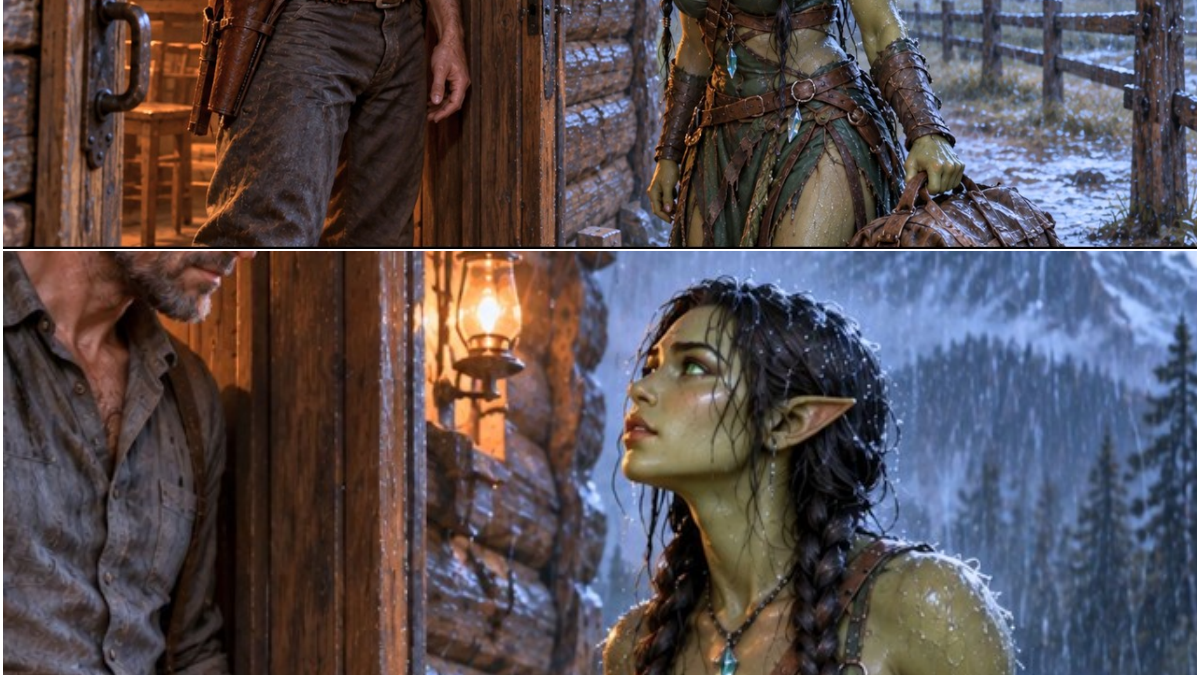
The rain struck the earth like a thousand iron nails, turning the valley into a black, freezing mire.
Inside a lonely cabin, fifty miles from the nearest paved road, Harlon sat beside his stove with a half empty bottle of rye and the familiar silence he had spent ten years protecting.
Then three heavy knocks shattered the night. They were slow, deliberate, and far too close to belong to the wind.
Harlon reached for his Winchester, worked the lever, and listened. Nobody came to his door at midnight without a reason, and most reasons were trouble.
He opened the door only wide enough to see the porch. Lightning revealed a towering figure standing in the storm, her broad shoulders blocking the doorway.
She was an orc woman, nearly six and a half feet tall, with olive gray skin, black hair braided in leather, and two blunt tusks rising over her lower lip.
Beneath her soaked coat, two young girls clung to her sides, trembling in the cold.
The woman met his rifle with eyes the color of wet slate. She did not beg.
She did not threaten. She simply explained that Red Creek had turned them away, and that every door behind them was now closed.
Harlon had spent a decade avoiding the world and its demands. Letting these strangers inside would bring both back to his doorstep.
Yet the youngest girl was shaking so badly she could barely stand, while the older one watched his gun with the exhausted acceptance of someone who expected nothing better.
So Harlon lowered his rifle and opened the door. But when the storm passed and the town came looking for them, what would he be willing to risk to keep them safe?
“Get in,” he said. The woman hesitated only briefly before stepping across the threshold. Her boots left deep tracks of mud on the floorboards as she guided the girls inside, keeping herself between them and the armed stranger.
Harlon shut the door, secured the deadbolt, and dropped the heavy wooden crossbar into place.
The cabin settled into a strange quiet. Rain hammered the roof, the stove crackled, and three unfamiliar people breathed heavily in the warmth.
“I’m Harlon,” he said, walking toward the kitchen. “Naomi,” the woman answered. “These are Ruth and Dina.”
Harlon did not offer his hand. He took three tin mugs from the shelf, poured the remains of his coffee into a saucepan, and set it over the stove.
“Take off those wet coats. There’s a blanket chest at the foot of the bed.
Use whatever you need. Sit by the stove.” Naomi did not move at once. Her eyes traveled around the cabin, taking in the single bed, the rifle beside the door, and the revolver resting on the table.
She was measuring the room, noting its exits and the position of every object that might matter if the situation changed.
Harlon let her look. He had nothing to hide, and he was too tired to pretend that either of them trusted the other.
Eventually, wet leather struck the floor. Naomi removed her coat and wrapped her daughters in a thick wool blanket patterned with red and brown designs.
Ruth sat beside her mother, holding a mug in both hands. Dina, the younger girl, buried her face against Naomi’s arm.
The girls drank slowly. The coffee was bitter and stale, but its warmth seemed to matter more than its taste.
Harlon watched the firelight move across Naomi’s arms. Pale scars crossed her skin, some narrow and straight, others jagged and uneven.
Her shoulders were enormous, and the muscles beneath her shirt suggested years of difficult work.
She was physically imposing enough to make the small cabin feel even smaller. Yet she sat almost motionless, her attention fixed on her daughters.
“You walked thirty miles in this?” Harlon asked. “We started yesterday morning, before the rain.”
“What happened in Red Creek?” Naomi stared into the stove. “The mill shut down. They dismissed the orc workers firSt. Then they came for our housing.
We were given twenty four hours to leave.” “You could have returned to the reservation.”
She turned toward him. “There is nothing there for us but dust and sickness. My husband has been gone for three years.
I will not take my daughters back to a place where they have no future.”
Harlon took a drink. The coffee tasted like burnt wood. “Town won’t welcome you if you settle around here.”
“I know.” “You got a plan?” “Keep walking weSt. California, perhaps.” “That’s a thousand miles of desert and badlands.”
“We will walk until we cannot.” Her answer was so plain that Harlon had nothing useful to say.
He looked at the girls. Ruth was watching him over the rim of her mug, studying his expression with an intelligence that seemed older than her years.
Dina had begun to nod off, her head resting against her sister. “I’ve got canned stew,” he said, standing.
“It isn’t much, but it’s hot.” Naomi’s shoulders relaxed by a fraction. “Thank you.” Harlon opened two cans and emptied them into a cast iron pot.
He added water, stirred the mixture, and placed it over the stove. Soon the smell of beef and salt filled the cabin, pushing aside the odor of wet wool and rain.
When the stew was ready, he ladled it into three wooden bowls and added hardtack biscuits.
Ruth accepted hers with trembling hands. She glanced at her mother, who gave a small nod.
The girl began eating immediately. Naomi ate more slowly, carefully chewing each mouthful. “You don’t talk much,” Naomi observed.
“Got nothing worth saying.” “Why did you let us in?” Harlon stopped beside the sink.
Beyond the window, the storm continued to batter the dark valley. He thought of the badge he had thrown into the dirt ten years earlier.
He remembered the faces of men he had confronted and the people he had been unable to protect.
He had come to this isolated patch of scrubland because he wanted no further responsibility for anyone.
“It’s raining,” he said. Naomi watched him for a moment. “That is all?” “That’s enough.”
He pulled another blanket from the chest and tossed it toward her. She caught it easily.
“Take the rug by the fire. The girls can have the cot. I’ll take the chair.”
“You are a strange man, Harlon.” “Just tired.” He lowered his hat over his eyes and settled into his rocking chair.
“Get some sleep. Tomorrow comes early.” When morning arrived, the silence woke him. The rain had stopped.
The fire had dwindled to glowing embers, and cold air had settled across the cabin.
Harlon pushed his hat back and looked toward the hearth. Ruth and Dina were curled together on the narrow cot, buried beneath blankets.
Naomi sat cross legged on the braided rug, watching the door. She had apparently spent much of the night awake.
Harlon stood, his joints protesting, and crossed to the window. He wiped condensation from the glass.
The storm had transformed the valley. Red mud covered the ground, and shallow pools reflected the pale morning sky.
Wet sage released a sharp, clean smell into the air. Beyond the cabin, the eastern ridge stood beneath a clear blue sky.
“I need to check the horses,” Harlon said, taking his heavy coat from a peg.
“I will help.” “You don’t have to.” “I ate your food. I work.” There was no invitation for argument in her voice.
Harlon nodded and opened the door. The cold rushed inside, but sunlight warmed his face as they walked toward the barn.
His boots sank into the mud. Naomi moved with surprising balance, her heavy frame barely disturbing the ground.
Inside, two quarter horses greeted them with restless movements. The barn smelled of hay, leather, and manure.
“Grain’s in the barrel,” Harlon said. “Pitchfork is against the wall.” Naomi lifted a heavy sack of grain and poured a measured amount into each trough.
Harlon began cleaning the stalls. They worked without conversation for nearly an hour. It was a comfortable silence, the sort that could exist between people who understood labor and did not feel compelled to fill every moment with words.
Harlon watched Naomi from the corner of his eye. She was strong, but strength was not the only thing that made her unusual.
She moved carefully, wasting neither effort nor attention. When one horse grew nervous, she spoke to it in a low, guttural language.
The animal gradually settled. “You know horses,” Harlon remarked. “My father bred them. Before the war, before the government took the herds.”
Harlon knew the broad history. The expansion westward had pushed the orc tribes from their traditional lands.
Treaties had been broken, settlements had spread, and the remaining reservation lands were often poor and difficult to farm.
Many orcs had eventually taken industrial work, where they were frequently treated as temporary labor rather than neighbors.
Naomi ran one enormous hand down the neck of Harlon’s roan. “He’s a good horse,” she said.
“Strong back. But his left foreleg bothers him in the cold.” Harlon looked at the animal.
“How did you know that?” “He favors his right side when standing. The muscle on his left shoulder is smaller.
You push him too hard over rocky ground.” Harlon studied the horse again. “I’ll be damned.”
Naomi gave him a small smile. It was the first he had seen, and it changed her expression.
The severity of her face softened, revealing something warm beneath the hard edges. They finished the work and returned to the cabin.
Ruth had managed to stoke the fire and was attempting to make coffee. The result smelled burnt, but Harlon poured himself a cup and drank it without complaint.
“We should leave soon,” Naomi said. “The mud will slow us, but we need to put distance between us and the town.”
Harlon looked through the window. A plume of dust was rising along the valley road.
He narrowed his eyes. The ground was still wet, but horses moving quickly could churn up the drier earth beneath the surface.
The dust was too large to belong to a single rider. “Hold on,” he said.
Naomi followed his gaze. Her expression changed instantly. The mother who had been quietly tending her daughters disappeared behind the alert stillness of a warrior.
Harlon took an old brass spyglass from the mantel and looked through it. “Three riders.
Coming hard.” The lead rider wore a long brown coat. A silver star shone on his cheSt.
Sheriff Wade. The sheriff had a reputation for enjoying the authority of his office and using it against anyone he considered an outsider.
He had never made much effort to conceal his dislike of the orc community. Naomi turned toward the girls.
“Get your coats. Go out the back window. Head for the trees. Do not stop running.”
“No,” Harlon said sharply. She spun toward him, her eyes bright with anger. “I will not let them take my daughters.”
“If they run, Wade will hunt them down.” “Then I will stop him.” “You’re on foot.
He’s got horses. There’s fifty miles of open brush between here and the ridge. You won’t get far.”
“Then I will fight.” Harlon believed she could overpower a man at close range. He also knew Wade had two deputies, both armed.
A confrontation could leave Naomi and the girls exposed, with no one to help them.
He looked at Ruth and Dina. They stood close together, frightened and silent. Naomi’s fists were clenched at her sides.
Harlon felt an old tightness return to his cheSt. It was a familiar sensation, one he had spent a decade trying to forget.
He walked to the corner and picked up his Winchester. He checked the action and made sure the rifle was ready.
Then he took his gun belt from the table and fastened it around his waiSt.
The Colt .45 settled into its worn holster. “You take the girls into the pantry,” he told Naomi.
“Keep them quiet. Stay out of sight.” “Harlon…” “Do it.” His voice had changed. The tired rancher had vanished, replaced by the man who had once worn a badge in a mining town in the Arizona Territory.
Naomi stared at him. She understood that something in him had shifted, and she did not waste time arguing.
She gathered her daughters and led them into the pantry. The door closed behind them.
Harlon walked outside and stood on the porch with his hands empty. The riders crossed his yard and pulled their horses to a halt.
Their animals breathed hard, steam rising from their coats. Wade sat on a large dapple gray.
He was thick around the middle, with a hard expression beneath the brim of his Stetson.
Boyd, a local ranch hand, rode beside him. The third man was barely twenty, clutching a double barreled shotgun as if it were the only thing keeping him upright.
Wade spat tobacco into the mud. “Morning, Harlon.” “Wade.” “Hell of a storm last night.”
“Needed the water.” Wade chuckled and looked past him toward the cabin. “Looks like you had company.”
“Pulled a stray calf out of the brush. Brought it inside so it wouldn’t freeze.”
Wade’s smile disappeared. “Don’t play me for a fool. Three greenkins came through town last night.
A female and two runts. The mill kicked them out. I told them to keep walking.”
“Sounds like you handled it.” “I thought I did. Then a stable boy saw them heading up this canyon.
There ain’t much up here but rock, scrub, and you.” “I haven’t seen them.” Boyd nudged his horse forward.
“We tracked them right to your property line.” “The rain washed out the tracks before dawn,” Harlon replied.
“You’re guessing.” Wade sighed. “I ain’t here to argue about the weather. I’m here to do a job.
The county doesn’t want vagrant orcs squatting on federal land. They cause trouble. They steal.
I’m going inside to have a look.” He swung one leg out of the saddle.
Harlon did not raise his voice. He did not draw his revolver. He simply squared his shoulders and let his right hand hang near the holster.
“You take one step onto my porch, Wade, and you won’t take another.” The sheriff froze.
The wind seemed to fall silent. The horses shifted nervously, their breath steaming in the cold air.
Boyd’s hand moved toward his rifle, then stopped. They knew Harlon’s history. Before buying his lonely ranch, he had worn a tin star in a silver mining town.
He had dealt with rustlers, thieves, and men who believed a badge was a license to take whatever they wanted.
Wade studied his face. He found no uncertainty there. “You’re protecting greenkins now?” “I’m protecting my front door.”
“You draw on a sworn officer for a piece of orc trash?” “I don’t care about your county politics.
I care about my peace and quiet. You’re trespassing.” Wade held his stare for a long moment.
He had three guns with him, but he understood the danger of trying to use them against a man who had spent years surviving armed confrontations.
He slowly returned his leg to the saddle. “You’re making a mistake, Harlon. A big one.
The whole town is angry about the mill closures. They won’t look kindly on a man hiding the enemy.”
“Get off my land.” “I’ll be back with a federal warrant and enough men to burn this shack to the ground.”
“Make sure you lead from the front.” Wade’s face tightened. He yanked his reins and turned his horse.
Boyd and the young deputy followed, both looking relieved to leave. Harlon watched them until they disappeared beyond the ridge.
He kept his hand near his holster until the valley was quiet again. Then he returned inside and secured the door.
Naomi stepped out of the pantry. She had heard every word. “He’s going to come back,” she said.
“I know.” Harlon pulled a canvas duffel bag from beneath the bed and began packing.
He added clothes, ammunition, and a small collection of supplies. Naomi watched him work. “We need to leave now,” she said.
“We need to pack the horses. We’ve got maybe three hours before he gathers a posse.”
“You are leaving your home?” Harlon looked around the cabin. The rough walls, the iron stove, the single chair, and the narrow bed had been his entire world for ten years.
He had told himself that this was the peace he wanted. Now he understood that he had been waiting in a place where nothing could reach him, and nothing could matter either.
“It’s a box,” he said quietly. “I’ve been sitting in it too long.” He handed Naomi a saddlebag.
“Get the girls. Have them gather whatever food is left. We ride north into the switchbacks.
They can’t track us easily over the rock.” Naomi remained still for a moment. “You are throwing away your life for us.”
Harlon met her eyes. “I threw it away a long time ago. Let’s see if I can do something useful with what’s left.”
By noon, the valley was behind them. They climbed into the high country, following a narrow trail through loose shale and frost covered sage.
The horses picked their way carefully along the steep incline. Naomi rode the pack animal, with Ruth and Dina tucked behind her beneath the heavy canvas of her coat.
Harlon rode ahead, leading the way. He knew Wade would not give up easily. The sheriff would probably gather men in town, make a show of his authority, and spend time convincing himself that the pursuit was justified.
But once the posse reached the trail, they would move quickly. The mountain offered Harlon one advantage.
Horses could not travel fast over the narrow switchbacks, and the rocky ground made tracking difficult.
For six hours, they spoke very little. The wind tore through the canyon. The horses breathed heavily, their iron shoes scraping against stone.
The trail grew narrower as the afternoon passed, with a cliff wall rising on one side and a steep drop opening on the other.
When the sun began to sink behind the peaks, Harlon signaled for a halt. They had reached a shallow overhang carved into the mountain by centuries of wind.
It was barely large enough to shelter the family, but it offered protection from the worst of the weather.
Harlon unsaddled the horses while Naomi helped the girls down. Ruth was shivering but refused to complain.
Dina had begun crying softly beneath her blanket. “Take them to the back of the cave,” Harlon said.
“Get them out of the wind. I’ll build a fire.” “A fire will draw them,” Naomi warned.
“If we don’t build one, the girls will be freezing before midnight.” He kept the fire small, building it against the stone wall where the rock could absorb some of the smoke and shelter the flame.
The warmth slowly spread through the overhang. He heated water, added dried beans and salt pork, and made a simple meal.
Naomi fed the girls first, watching until both had eaten enough. Ruth studied Harlon from across the fire.
“Are you an outlaw?” “No.” “The sheriff was afraid of you.” “Sheriffs get nervous sometimes.”
“Only when they’re afraid of outlaws.” Harlon considered the girl. “I used to do his job.
Only I didn’t care much for rules. Sometimes that makes a man harder to understand than a thief.”
Naomi placed a hand on Ruth’s shoulder. The girl fell silent and returned to her food.
After supper, Harlon checked the horses. His roan had stumbled over loose rock earlier, and he wanted to make sure the animal’s leg was not seriously injured.
He ran his hand down the left foreleg and found a shallow cut. “Let me,” Naomi said.
“I’ve got it.” “Your hands are shaking.” Harlon glanced down. His fingers were trembling from the cold and the strain of the day.
Naomi took a small leather pouch from her coat. Inside was a collection of crushed leaves with a sharp medicinal smell.
She mixed a pinch with water and made a thick paste. Then she knelt beside the horse.
The animal shifted nervously, but Naomi began humming in a low voice. The sound seemed to settle it.
She applied the paste to the cut with careful fingers. Harlon watched her work. “You know how to treat injuries, too?”
“I learned what was necessary.” When she finished, she stood and turned toward him. “You cut your hand.”
He looked down. A thin line of blood crossed his knuckles. He had not noticed the injury while gathering firewood.
Before he could dismiss it, Naomi reached for his wriSt. Her hand was enormous compared with his, rough from years of labor.
Yet her touch was gentle as she wiped the cut with a damp rag. Harlon went still.
It had been a long time since anyone had touched him with care. He had grown accustomed to solitude, to keeping his distance, to treating every kindness as something temporary.
Naomi focused on his hand, her slate eyes steady beneath the firelight. He noticed the scars on her arms again.
He thought about the miles she had walked in the rain, the way she had placed herself between her daughters and every danger they encountered, and the quiet discipline with which she met each new difficulty.
The world had taught him to see an orc as an enemy. It had taught Naomi that a man with a rifle might be another threat.
But neither of them had behaved according to those lessons. Naomi finished cleaning the cut, yet she did not release his wrist immediately.
Their eyes met. “Thank you,” Harlon whispered. “We are even,” she replied. She slowly let go.
Her fingers brushed his palm before she turned and returned to the fire. Harlon remained beside the horse for a long time, feeling the warmth of her touch long after she had walked away.
He had brought Naomi and her daughters into the mountains because he believed it was the right thing to do.
Now he found himself wanting something he had not allowed himself to want in years.
He wanted to know where they would go. And he wanted to be there. Dawn arrived as a weak gray light spilling over the jagged peaks.
Harlon was awake before the sun and stood at the edge of the overhang, looking down toward the valley.
A thick layer of fog filled the low ground. Nothing moved beneath it, but he did not trust the quiet.
Wade had pride, and pride could keep a man moving long after common sense suggested he should stop.
The horses looked exhausted. The roan favored its injured leg, though Naomi’s treatment had kept the cut clean.
Harlon knew they could not maintain the previous day’s pace indefinitely. Naomi was already packing the blankets.
“We need to reach the summit by noon,” Harlon said. “Once we cross the ridge, we’ll descend into another basin.”
“Different county?” “Different law.” “Can the horses make it?” “They have to.” They woke the girls, fed them the last of the hardtack, and began climbing.
The trail narrowed until it was little more than a shelf of rock. A cliff rose on their right, while a deep gorge opened on their left.
Harlon walked in front, leading the roan by the reins. Naomi followed with the pack horse, keeping herself between the animal and the drop.
The wind shrieked across the exposed mountainside. Grit stung their eyes, and the cold made every breath feel sharp.
They had been climbing for nearly two hours when Harlon heard a metallic clink below.
An iron horseshoe striking granite. He stopped and pressed himself against the cliff. Looking down through the thinning fog, he saw five riders following the lower trail.
Wade had returned with more men. A tracker rode in front, occasionally dismounting to examine the ground.
“They’re here,” Harlon said. Naomi looked down. “How long?” “Thirty minutes. Maybe less.” The summit was still a mile ahead.
The trail offered no cover, and if the posse reached the narrow shelf while they were exposed, the family would have nowhere to hide.
Harlon studied the terrain. They had just passed a sharp switchback where a rockslide had blocked most of the trail.
Three massive boulders created a narrow passage. It was a natural bottleneck. “Take the horses,” he said, handing Naomi the reins.
“Push them to the ridge. Don’t stop until you reach the trees on the other side.”
“What are you doing?” “I can hold them at the bottleneck.” Naomi looked at the riders below, then back at him.
“One man against five?” “I’ve got the high ground and a repeating rifle. I’ll slow them down.”
“You will not survive alone.” “I don’t intend to stay there all day.” “I will not leave you.”
“This isn’t a debate, Naomi.” His voice had become hard and commanding. It was the voice of the lawman he had once been, a man accustomed to making decisions while others waited.
“I didn’t bring you this far to watch your daughters get caught in the open.
Move.” Ruth gripped the saddle horn. Dina began to cry, sensing the danger in the adults’ voices.
Naomi stood motionless for a moment. Her jaw tightened, and the muscles of her neck shifted beneath her skin.
Then she took the reins. She did not say goodbye. She began leading the horses toward the summit, guiding the exhausted animals along the narrow trail with steady hands.
Harlon watched her for three seconds before turning back. He hurried to the bottleneck and climbed behind the boulders.
From there, a narrow gap in the stone gave him a clear view of the switchback below.
He checked his Winchester, made sure his Colt was ready, and placed spare ammunition on a flat rock beside him.
Then he waited. Ten minutes passed. The tracker rounded the bend, his eyes fixed on the ground.
Wade followed about a hundred yards behind, accompanied by three men Harlon did not recognize.
They looked like hired hands from the mining camps, men whose loyalty depended on the amount of money offered.
Harlon rested his rifle in the notch of the rock. He aimed at the tracker’s leg.
The rifle cracked, and the tracker dropped hard, his horse shying away. Harlon had not intended to strike a fatal blow.
A wounded man would slow the group and force Wade to make a decision. The canyon erupted into confusion.
Wade’s horse reared. The deputies scrambled for cover, while the hired men scattered behind rocks and trees.
“Sniper!” Wade shouted. “On the ridge!” Bullets began striking the boulders around Harlon. Small pieces of granite sprayed into his face.
He ducked, worked the lever, and fired again at a man attempting to move along the left side of the trail.
The shot struck the ground near the man’s boots. He stumbled backward and disappeared behind the canyon wall.
“It’s Harlon!” Wade yelled. “You’re finished!” Harlon did not answer. He fired twice toward the tree behind which Wade had taken cover.
The sheriff stayed down. The air filled with the sharp smell of gunpowder. Harlon settled into the familiar rhythm of the rifle, working the lever, aiming, and firing only when he had a clear opportunity.
Every minute mattered. Every minute gave Naomi and the girls more distance. But Wade soon understood that Harlon was alone.
“Spread out!” He ordered. “Covering fire. Jackson, take the right side!” The men began firing in turns while one of them climbed the rocks.
Harlon pressed himself against the boulder as bullets struck the stone above him. He heard boots scraping against shale.
Jackson was moving up the right flank. Harlon drew his Colt with his left hand, keeping the rifle close with his right.
He was trapped between the men below and the climber above. The sound of Jackson’s breathing grew louder.
Then a shadow crossed the top of the boulder. A massive hand reached over the rock and seized the back of Jackson’s coat.
The man let out a startled cry as he was hauled upward. Naomi stood above him.
She had hidden the horses beyond the summit and returned alone. Her canvas coat whipped in the wind, and her slate eyes were fixed on the man she held.
With one powerful movement, she threw him backward. He struck the rock wall and slid down into the dirt, unable to continue the climb.
Naomi dropped beside Harlon. “I told you to run,” he said. “You do not give me orders.”
She picked up Jackson’s rifle and checked it with practiced ease. “I protect my own.”
Before Harlon could reply, she leaned over the boulder and fired. One of Wade’s hired men was struck in the shoulder.
He fell back, shouting, and his companions scrambled to pull him out of the open.
Wade looked up. He saw Naomi standing beside Harlon, the rifle steady in her hands.
Her tusks showed as she tightened her jaw, and her broad shoulders filled the narrow space above the rocks.
The sheriff had lost the tracker’s help. Two men were now unable to continue, and the remaining riders were trying to advance uphill against two people who knew how to defend themselves.
Wade was accustomed to having the advantage. He was not accustomed to being challenged by someone who refused to retreat.
“Fall back!” He shouted. The men hesitated. “Get on your horses! Fall back!” They gathered their injured companions and began descending the trail.
Harlon kept his rifle trained on Wade until the sheriff disappeared into the fog. Only then did he lower it.
The sudden quiet seemed almost unnatural. He leaned against the granite, breathing hard. His hands had begun trembling again, and his left shoulder ached from the strain of holding the rifle.
Naomi sat beside him, the captured rifle resting across her knees. Her fingers were tight around the stock.
“You came back,” Harlon said. She looked at him. The fierce expression she had worn during the fight had faded.
Beneath it was the same deep exhaustion he had seen on his porch, but now there was something else in her eyes.
“I’m tired of running,” she said. Harlon reached across and placed his hand over hers.
“Me too.” They crossed the summit shortly after noon. The change in the landscape was immediate.
Behind them, the eastern mountains rose in jagged gray formations, cold and unforgiving. Ahead lay a broad basin of high desert, with patches of grass along the streams and scattered groves of pine and cedar.
The air was warmer. The wind carried the smell of dry earth and needles instead of froSt.
They continued until the afternoon light began turning the basin gold. Near a small creek, Harlon found a grove of ancient cedar trees that offered shelter from the wind.
They stopped there. The horses lowered their heads to drink. Ruth and Dina sat near the trees, too tired to speak.
Naomi built a fire while Harlon cleaned his Winchester. His left shoulder had swollen badly.
The movement of his arm had become stiff and painful, and he struggled to reach the lower parts of the rifle.
Naomi noticed. “Take your shirt off.” “It’s only a bruise.” “It is swelling. You won’t lift your arm tomorrow if you ignore it.”
Harlon sighed and set the rifle aside. He removed his coat and carefully pulled his shirt over the injured shoulder.
The skin was darkened with purple and black marks. Naomi took out her leather pouch and mixed the crushed leaves with water.
She applied the paste to the swollen area. Her hands were strong enough to make the treatment seem effortless, but she worked with surprising care.
The medicine smelled sharp and earthy. At first it burned, then the sensation settled into a dull warmth.
“You shoot well,” Naomi said. “So do you, for someone who doesn’t aim.” She made a rough sound that took Harlon a moment to recognize as laughter.
“My father said a gun is just a loud rock. You throw it where you want the man to fall.”
“Your father sounds practical.” “He was.” Her expression changed slightly. “The world is not built for practical people, Harlon.
It is built for men like Wade. Men who take what they want and call it law.”
“Wade’s a coward.” “Cowards only take what people let them.” Harlon looked toward the creek.
“You didn’t let him.” “Neither did you.” “It was my door.” Naomi finished treating his shoulder but left her hands resting there.
Their weight steadied him, anchoring him to the present instead of the memories that had followed him into the mountains.
She stepped around the log and stood in front of him. Harlon looked up. The firelight softened the hard lines of her face.
Her tusks, her broad jaw, and her slate gray eyes were unlike anything he had known in his former life.
Yet he found himself looking at her with a feeling that had nothing to do with fear or surprise.
She leaned down and kissed him. It was not a delicate kiss. It carried the strain of the storm, the danger of the mountains, and the relief of finding someone who understood the cost of standing alone.
Harlon reached up and held her close. For a long moment, the world beyond the cedar grove ceased to matter.
There was no sheriff, no posse, no hostile town, and no lonely cabin waiting behind them.
There were only two people who had spent years expecting nothing from anyone, suddenly discovering that they wanted to be together.
When they finally separated, Naomi rested her forehead against his. “Where are we going?” She whispered.
Harlon looked west, toward the broad stretch of unknown country. “California.” He did not know what awaited them there.
He did not know whether they would find work, land, or a place where Naomi and her daughters could live without being treated as unwanted strangers.
He only knew that the decision felt different from every choice he had made in ten years.
For once, he was not running away from something. He was moving toward someone. “California,” Naomi repeated.
She looked toward the fire, where Ruth had fallen asleep with her head resting against Dina.
The younger girl was still awake, watching the two adults with wide eyes. Naomi turned back to Harlon.
“We will need a home.” “We’ll find one.” “We will need work.” “I can handle that.”
“And the girls will need a place where they can learn without being afraid.” Harlon nodded.
“Then we’ll find that, too.” Naomi studied him, as if searching for the uncertainty he might be hiding.
“You cannot promise the world will change.” “No,” he said. “But I can promise I won’t turn you away when it gets difficult.”
She considered his words. Then she touched his cheek with one broad hand. “That is enough for tonight.”
She helped him pull his shirt back into place, carefully guiding the injured arm through the sleeve.
Her fingers moved slowly over the buttons, showing a dexterity that seemed at odds with her enormous hands.
“Sleep, Harlon,” she said. “I will take the first watch.” He wanted to argue, but the day had exhausted him.
He laid his coat beside the fire and stretched out on the ground. Naomi settled near the edge of the grove, her silhouette outlined against the darkening sky.
She watched the trees, the creek, and the distant trail, alert to every sound. Harlon closed his eyes.
For the first time in ten years, he did not feel the need to keep one hand near his gun.
The next morning, they would continue weSt. They would cross unfamiliar land, search for work, and find out whether the world beyond Wade’s county offered any room for a family like theirs.
There would be difficulties. There would be people who saw Naomi’s appearance before they saw her character, and people who judged Harlon for standing beside her.
The girls would have questions, and the adults would have to answer them honestly. But the mountain had changed something between them.
Naomi had returned when she could have escaped. Harlon had stood his ground when he could have chosen silence.
Neither had saved the other alone. They had survived because they had begun to trust one another.
The next days would not be easy, but they would no longer face them as strangers.
As the fire settled into glowing embers, Harlon listened to the soft sounds of his new companions sleeping.
He thought about the cabin he had left behind, the years he had spent hiding from responsibility, and the unexpected knock that had brought him back into the world.
He had believed solitude was the only peace available to him. Now he understood that peace could also be found in the presence of people who trusted him enough to stay.
And somewhere beyond the mountains, beyond the sheriff’s reach, beyond the old rules that had kept them apart, there might be a place where Ruth and Dina could grow up without being turned away from every door.
For the first time in a decade, Harlon had a reason to find it.
Disclaimer: This content may be created by Al for entertainment purposes. Any resemblance to real persons, events, or places is coincidental.








