No One Wanted The Paralyzed Apache Woman — Until The Cowboy Said, “She’s Mine Now.”
The Arizona sun did not rise so much as arrive, already angry, already heavy, already pressing its bright weight against the desert.
By the middle of the morning, the ground had turned hard beneath Nala, the cracked earth holding the heat like a stone holds the memory of fire.
Above her, vultures circled slowly over the white sky, patient shadows moving where the air barely seemed to breathe.
Eight months ago, she would have noticed them only as part of the landscape. Now she counted them because counting gave her mind something useful to do.
Five. She closed her fingers around the knife resting in her palm. Her body could no longer carry her across the desert, but her mind still traveled every ridge, every wash, every hidden spring she had ever known.
She remembered the routes between the Dragoon Mountains and the San Pedro River. She remembered where water sometimes remained beneath shaded rock.
She remembered how clouds changed color before a storm. Most of all, she remembered the night everything had changed.
She remembered the soldiers arriving from two directions with impossible precision. She remembered the chief standing strangely calm while everyone else scrambled for safety.
She remembered being carried away afterward and left behind when the band moved again. And now she heard something beneath the wind.
Hooves. Six riders were coming from the south. Nala tightened her grip on the knife and watched the dust rise.
Whoever those riders were, what would they find when they reached her? Eight months earlier, Nala had been known as the finest pathfinder among the Churikawa.
At twenty six, she could cross ground that looked impossible to everyone else. She could read broken grass, disturbed dust, bent branches and faint marks in stone as easily as another person read a letter.
She knew the desert because she had spent her whole life listening to it. Then the soldiers came.
They arrived from the north and east at nearly the same moment, cutting off the two routes that should have offered the safest escape.
Nala had noticed it immediately. The attack had not been random. Someone had known where the band would be.
She remembered looking toward the chief. His face had not shown surprise. That detail stayed with her.
For the next three days, the band moved while she was carried between camps. Her injury had changed what her body could do.
The man who examined her had spoken quietly to the chief, explaining that her legs would not return to their former strength.
The conversation that followed had been practical. Too practical. She understood why. A group trying to survive could not easily carry someone who could no longer travel independently.
The chief eventually came to her and spoke about rest, spirits and the path ahead.
Nala listened. She also watched his face. There was something behind his words. Something he did not want her to understand.
She understood anyway. When the band prepared to move again, her younger brother Takashim looked at her several times.
He was twenty two, still young enough that his emotions moved visibly across his face.
Nala gave him one small shake of her head. Go. He understood. He left with the others.
Nala remained beneath the desert sky with a half full water skin and a knife.
She did what she had always done when circumstances became difficult. She calculated. She rationed the water.
She remembered every possible source within twenty miles. She considered the seasonal creek to the east, the shaded spring to the northwest and the damp ground beneath certain rock formations.
None of them could be reached. The first night passed slowly. The second day brought heat that seemed to press directly through her skin.
By afternoon, the edges of the world began to shimmer. Sounds seemed to come from places where no one stood.
She heard her mother’s voice. She heard children laughing. She heard footsteps that disappeared when she turned her head.
Still, she kept thinking. Still, she kept counting. On the third morning, the water skin was empty.
Nala lay beside the dead saguaro and stared upward. The knife rested in her open palm.
She began to sing. The song had belonged to her grandmother, a song about completing a journey and acknowledging everything that had come before it.
Her voice was dry and rough, but she remembered every note. Then she heard the hooves.
She stopped singing. A cloud of dust moved across the southern horizon. Six riders. They approached slowly at first, then pulled their horses into a loose half circle around her.
They were ranch hands, not soldiers. Their clothes were worn from work, their faces hardened by the sun.
Several looked at Nala with open curiosity. One laughed. Another spoke to the others. Nala did not understand every word, but she understood enough.
They were deciding whether she was worth stopping for. She held the knife loosely. She did not raise it.
She did not lower it either. Then she noticed the sixth rider. He had remained several yards behind the others.
His name, she would soon learn, was Beckett Ror. He was older than the men around him, weathered by years outdoors.
His clothes were plain. His expression was tired rather than curious. He studied Nala for a long moment.
Then he dismounted. One of the other men warned him. Beckett ignored him. He approached carefully, stopping several feet away.
“I am not going to hurt you,” he said. Nala watched his hands. He did not reach for his gun.
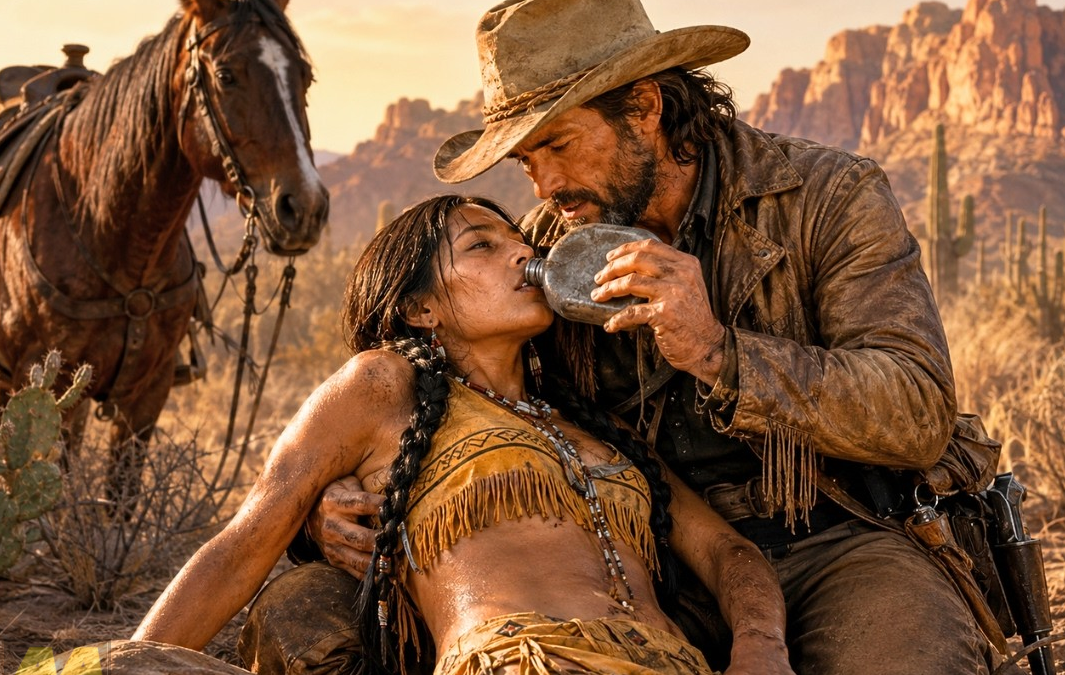
Instead, he slowly opened one saddlebag and removed a canteen. The sound of water moving inside it changed everything.
Nala stared at it. Beckett held it out. She did not take it immediately. She studied his face.
She had spent her life reading faces. His did not show amusement, contempt or the satisfaction of rescuing someone weaker.
He simply looked tired. Nala reached for the canteen. She drank slowly. Beckett waited. When she finished, he nodded toward her legs.
“Can you move?” Nala shook her head. He understood. “I am going to carry you.”
Her hand tightened around the knife. He noticed. “If you use that, we both have a problem,” he said quietly.
“I would rather solve the first problem without creating another.” Nala looked at him. Then she dropped the knife into the duSt.
Beckett crouched and lifted her carefully. She weighed less than she should have. He did not comment.
He carried her to his horse, settled her into the saddle and climbed up behind her.
He kept enough distance to make it clear that he understood she needed space. “My ranch is two hours west,” he said.
“Can you manage that?” Nala straightened. She held the saddle horn. Beckett took that as an answer.
They rode weSt. The desert changed gradually as the afternoon moved toward evening. Nala recognized the formations around them.
She recognized a dry wash, a ridge shaped like a kneeling figure and a narrow hollow where the temperature always dropped after sunset.
Beckett noticed her looking. “You know this country?” She nodded. He did not ask more.
That became the first thing Nala noticed about him. He did not fill silence simply because silence existed.
Twice during the ride, he offered her water. Each time she drank. Each time he said nothing.
When they finally reached his ranch, the sun was low. There was a small house, a barn, a corral with three horses and a well.
Beckett carried her inside. The house was simple and orderly. Everything had a purpose. There were no unnecessary decorations.
Except for one photograph. Nala saw it immediately. A woman stood beside a little girl, both smiling toward the person who had taken the picture.
Beckett noticed her looking. “My wife and daughter,” he said. Nala looked at him. He did not explain further.
She understood enough. He gave her bread, dried meat and preserved peaches. She ate slowly.
Beckett sat across the room and looked toward the window. “My name is Beckett Ror,” he said.
“Nala.” He nodded. “You do not have to tell me anything else.” That night, he slept on the floor.
Nala took the bed. She did not trust him yet. But she trusted his actions a little more than she had trusted them an hour earlier.
Morning came with birds in the cottonwood near the well. Beckett was already outside. Nala pulled herself from the bed and made her way to a chair.
It was not graceful. It did not need to be. She had spent eight months learning what her body could still do.
She no longer wasted energy pretending the limits were not there. Beckett came inside carrying water.
“Coffee?” He asked. “Some.” He prepared breakfaSt. Later, he told her he needed to inspect the east fence.
“There is food on the second shelf,” he said. “Water by the window.” Then he hesitated.
“I will leave my rifle.” Nala looked at him. He looked back. She understood the meaning.
He was giving her control over her own safety. He left. Nala watched him ride away.
Then she began working. She cleaned the table. She swept the floor. She repaired a loose button on his coat.
She organized the supplies within reach. She could not reach everything, but she stopped expecting herself to do everything.
When Beckett returned, he stood in the doorway. “You did not have to do that.”
“I know.” He looked at the repaired button. Then at the clean table. Then at the pot on the stove.
“What is that?” “Food.” He almost smiled. They ate. Their quiet had changed. It was no longer the silence between strangers.
It had become something else. Something neither of them had named. Over the following weeks, Nala became part of the rhythm of the ranch.
She learned where Beckett kept flour, dried meat, beans and coffee. He learned how she liked the window left open in the morning.
She mended his shirts. He built a safer arrangement for her to move between the house and barn.
They began teaching each other words. “Lamp.” “Lamp.” “Window.” “Window.” He pointed toward himself. “Beckett.”
Nala smiled faintly. “I know that one.” He laughed. Then she pointed toward herself. “Nala.”
He repeated it carefully. She taught him one word from her language. “Shikis.” “What does that mean?”
She smiled. “My friend.” He repeated the word. He nearly got it right. That was when something between them shifted.
Not dramatically. Not suddenly. It simply became easier to sit in the same room. Then they went to Ashford Crossing.
Beckett warned her that the town might not welcome her. Nala insisted on going. She would not remain hidden.
When they entered town, people stopped to watch. Nala sat straight on the horse. She did not lower her eyes.
Inside the general store, the owner stared at her. Beckett looked directly at him. “She has a name,” he said.
“It is Nala. Treat her with respect.” The owner swallowed and nodded. Outside, Delwood Vance was waiting.
He was well dressed and polite. His smile was pleasant. That was what made Nala watch him carefully.
Vance offered Beckett a generous price for the ranch. Beckett refused. Vance smiled. “I am patient,” he said.
Then he walked away. Sheriff Grove Parish later found Beckett and warned him. “Vance is dangerous,” the sheriff said.
“Be careful.” Nala watched Parish carefully. He looked like an honest man. But honesty alone did not guarantee power.
On the ride home, Beckett explained that Vance had pressured other landowners in the county.
Nala understood. She had seen similar methods before. The trouble began quietly. A fence post was pulled from the ground.
A gate was left open. A calf was found at the edge of the pasture.
Nothing was random. Vance was sending a message. Nala helped Beckett prepare. She showed him hidden approaches.
She pointed out low washes where riders could remain unseen. She arranged tin cans near the western gate so they would make noise if someone opened it.
Beckett listened. He never dismissed her because of her injury. That mattered. Then Edna Parish arrived.
She was direct, practical and warm. She examined Nala’s back and brought medicine. During the conversation, Edna asked what Nala knew about Delwood Vance.
Nala explained what she remembered about the attack eight months earlier. Edna became quiet. She told Nala that Grove had records containing Vance’s name.
A military contract from September 1876 connected Vance to information provided about the location of Apache camps.
Nala went still. The pieces finally connected. The attack had been too precise. The chief had known.
Someone had supplied information. And Vance’s name was now attached to a document. Nala told Beckett the next morning.
He listened without interruption. When she finished, he walked to the window. “This was never just about my land,” he said.
“No.” He looked back at her. “Then we need more than tin cans.” She nodded.
The rain came that evening. They sat at the table while it struck the roof.
Beckett opened a box he had kept hidden. Inside was an old letter from his wife Eleanor.
He had carried it for three years without opening it. “She wrote about taking in a child,” he said.
Nala listened. “She believed there was always room for someone who had nowhere else to go.”
He looked down at the letter. “She saw things clearly.” Nala looked at the photograph.
“I think I would have liked her.” Beckett smiled sadly. “I think she would have liked you.”
The next challenge came from Vance. A formal notice arrived giving Beckett thirty days before the county would review the land deed.
Vance was using the legal system now. Beckett had no lawyer. Nala remembered Edna’s information.
“The federal records matter,” she said. “If Vance’s name appears in those documents, Grove can use them.”
They went to the Parish home. Grove studied the notice. He admitted that a county hearing could be controlled by Vance’s influence.
But a federal inquiry was different. Nala offered to testify. Grove looked at her. “You understand what that means?”
“Yes.” She told him exactly what she had seen. The northern approach. The eastern approach.
The Juniper Stand. The timing. The chief’s strange calm. The precision of the soldiers’ movements.
Grove wrote everything down. When she finished, he sat back. “This is enough to request a federal inquiry,” he said.
It would take time. But it would create time. And sometimes time was exactly what a person needed.
Then the riders appeared. Sixteen at firSt. Then seventeen. They gathered along the northern ridge above the ranch.
Beckett tightened his hold on the reins. Nala counted them again. “Seventeen.” “There is another behind the rock,” she said.
Beckett looked forward. “You are right.” “Do not turn toward them.” He followed her instruction.
They rode normally toward the gate. The riders expected panic. They did not get it.
At the ranch, Grove had already arrived with a federal marshal carrying the documents. Vance had come prepared for intimidation.
He had not prepared for witnesses, records and a federal inquiry. When he approached, Beckett met him at the gate.
“You should have taken my offer,” Vance said. “No.” Vance looked toward Nala. She met his eyes.
“You know what I saw,” she said. His pleasant expression changed. Only slightly. But Nala saw it.
That was enough. The marshal stepped forward. “Delwood Vance, we need you to come with us.”
Vance looked toward the men on the ridge. They did not move. The federal papers had changed the situation.
His influence over the county did not extend everywhere. One by one, the riders lowered their weapons and backed away.
The ranch became quiet again. Grove took the documents. Beckett stood beside Nala. Neither of them celebrated.
They simply breathed. Later, Takashim came to the ranch. Nala recognized him immediately. He was older than the brother she remembered, even though only months had passed.
He embraced her carefully. “You came back,” he said. “I was always here.” He looked at Beckett.
Then back at her. The band needed her. They needed the pathfinder she had once been.
Takashim asked her to return. Nala listened. She understood the need. She understood the responsibility.
For most of her life, she had been whatever others required. The best pathfinder. The useful daughter.
The dependable sister. The person who solved problems. But now she had to make a choice that belonged only to her.
That evening, she sat beside Takashim near the fire. “I am not coming back,” she said.
He looked at her. “Not now. Not for this.” She explained that she had spent her life becoming useful to everyone else.
She had never asked what she wanted. Now she was asking. Takashim was quiet. Then he nodded.
“You want to stay here?” “Yes.” “Because of Beckett?” Nala looked toward the dark outline of the ranch.
“Not because he rescued me.” She paused. “I stay because when I ask myself where I want to be, the answer is here.”
Takashim looked at her for a long time. Then he smiled. It was small. But it was real.
“Come find me when the valley is settled,” Nala said. “I will.” “And tell me how everyone is.”
“I will.” They sat quietly for a while. Then Takashim left. Nala returned to the ranch.
Beckett was waiting at the table. “I told him I am not going back,” she said.
Beckett did not answer immediately. Nala moved to her chair by the window. “I need you to understand something,” she continued.
“I am not staying because I owe you. I am not staying because you rescued me.
I am not staying because you gave me food or a bed or a place to sit.”
He listened. “I am staying because this is where I want to be.” Beckett looked toward the photograph of Eleanor and the little girl.
Then back at Nala. “Eleanor used to say the best decisions were sometimes the ones you could not explain completely.”
Nala looked at him. “She sounds wise.” “She was.” Outside, the stars appeared over the desert.
Nala watched them through the window. For the first time in eight months, tomorrow did not feel like something she had to survive.
It felt like something she could choose. The next morning was ordinary. That was what made it beautiful.
Beckett made breakfaSt. Nala made coffee. The horses moved quietly in the corral. Birds argued in the cottonwood.
The east fence still needed repair. The tin cans at the western gate still needed resetting.
There were shirts to mend. There was food to prepare. There were documents to organize.
There were things that remained uncertain. But uncertainty no longer frightened Nala in the same way.
She had learned that a life did not have to return to its former shape to remain valuable.
She had learned that strength could look different. Sometimes strength was crossing a desert. Sometimes it was surviving a long morning.
Sometimes it was accepting help. Sometimes it was saying no. Sometimes it was saying yes.
And sometimes it was simply sitting beside a window and allowing yourself to notice the light.
Beckett finished washing the dishes. He dried his hands and came to stand beside her.
He did not block her view. He stood beside the window. Their hands rested on the sill.
For a while, neither moved. Then Nala placed her hand over his. He did not pull away.
Outside, the desert stretched beneath the October morning. The rocks turned gold. The cottonwood moved softly in the breeze.
A jack rabbit crossed the far side of the fence and stopped for a moment before continuing toward the open land.
Nala watched it disappear. She did not know everything that would come next. She did not know how long the federal inquiry would take.
She did not know what the Churikawa valley would look like when Takashim returned. She did not know what she and Beckett would eventually call the quiet understanding that had grown between them.
She only knew that she was here. She was still learning herself. She was still discovering what her life could become.
And for now, that was enough. The Arizona sun climbed higher. This time, Nala did not feel that it was punishing her.
It was simply morning. And she was still here.
Disclaimer: This content may be created by Al for entertainment purposes. Any resemblance to real persons, events, or places is coincidental.








