No One Dared Approach the Dragon’s Nest — She Left Wildflowers Each Morning Until It Followed Home
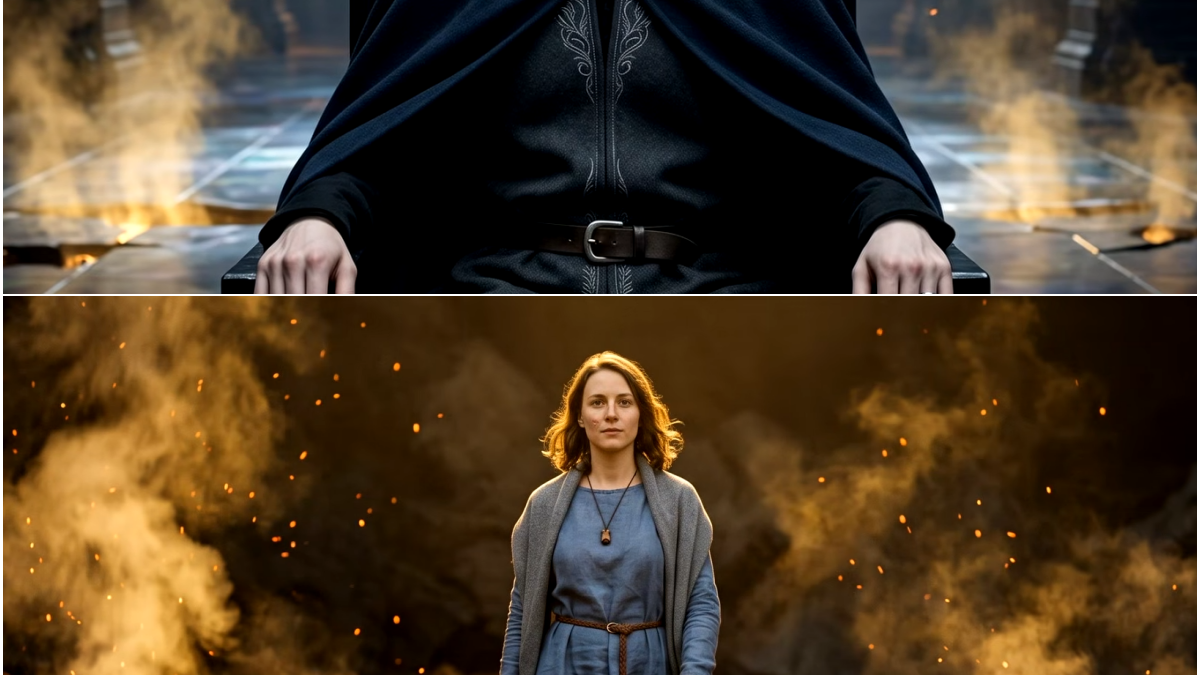
For years, the people of the mountain province spoke of the creature above the clouds as though it belonged to another age entirely.
They said the emperor had abandoned the capital because grief had changed him into something no longer capable of hearing ordinary words.
They said five delegations had climbed the narrow trail and returned frightened, carrying stories of scorching warnings and a ruler who wanted nothing from the world below.
They said the mountain itself had become his fortress, and that anyone foolish enough to approach would discover why the imperial court had stopped trying.
Ellen Ror had heard every version of the story since childhood. None of them explained why the creature sometimes appeared at the far edge of the upper trail at sunrise, standing perfectly still while the valley woke below.
None explained why he never pursued the farmers who kept their distance, or why the terraces beneath his mountain remained untouched.
And none explained the strange feeling Ellen had whenever she looked toward that distant figure and imagined what it must be like to spend year after year with an entire province afraid to come close.
She had never met the emperor. She had never expected to. Then one quiet morning, carrying a small bundle of flowers that would otherwise have been left behind after the harvest, Ellen stopped at the foot of the forbidden trail and looked toward the mountain.
The flowers were ordinary. The gesture was smaller still. But if everyone else had been wrong about the creature above the clouds, what would happen if someone finally approached him without asking for anything at all?
Emperor Kais had left the capital during the first difficult year of his reign. He had not announced an abdication.
He had not surrendered his crown. He had simply withdrawn. The reason was known to the council, though the people knew only fragments of it.
Kais had inherited the imperial throne from his father while still young enough to believe that long service and familiar faces meant something permanent.
The ministers surrounding him had served the previous emperor for decades. They knew the court, the provinces, the treasury, the military roads, the old alliances and every weakness hidden beneath the empire’s polished surface.
Kais trusted them because he had been raised to trust them. That trust nearly cost him everything.
A coalition of senior ministers had quietly shaped the young emperor’s decisions from the beginning of his reign.
Information was withheld. Reports were altered. Advice was offered with reassuring smiles while decisions were guided toward outcomes that strengthened the ministers themselves.
At the center of the arrangement stood Vessel, his father’s closest adviser. Kais had trusted Vessel more than anyone.
Vessel had taught him how to sit in council, how to listen before answering, how to recognize the difference between an ambitious governor and a useful one.
He had spoken to Kais with the patient warmth of an older mentor and had remained beside him through the uncertainty that followed the old emperor’s passing.
Only later did Kais understand that much of the guidance he had depended upon had been designed to weaken his authority.
A few loyal officials discovered enough of the scheme to warn him. The attempted seizure of power was stopped before its full design could take shape, but the damage had already been done.
Kais could restructure a council. He could replace ministers. He could rewrite procedures and establish safeguards.
What he could not easily rebuild was truSt. After the conspirators were removed, every council meeting became an exercise in suspicion.
Kais watched hands resting on polished tables. He listened to pauses between words. He studied smiles that once would have seemed ordinary.
Had Vessel smiled like that? Had he paused like that? Had the warning been there all along?
Sleep became difficult. Then it became rare. The physicians found no physical explanation for what troubled him.
The problem was inside his thoughts, where every memory seemed to carry a second meaning that had not been visible at the time.
Within the year, Kais withdrew from the imperial capital entirely. He transferred daily administration to a Regency Council and traveled into the province’s most remote mountain reaches.
There, carved into the face of a high cliff, stood an old imperial nest that had once served as a retreat for rulers who wanted solitude during the changing seasons.
Kais made it permanent. The trail leading to the nest was narrow, exposed and difficult.
Clouds frequently covered the upper slopes. The wind could change without warning. The first delegation arrived several months after his withdrawal.
They were courteous. They brought formal letters. They carried messages from the council asking the emperor to return.
Kais refused. The second delegation received the same answer. The third was met with a warning so fierce that the officials turned back before reaching the neSt.
The fourth delegation returned shaken. The fifth was the worSt. Its lead diplomat came away with minor burns from a warning blast that struck close enough to make the entire group retreat down the mountain in haste.
After that, the council stopped sending large delegations. The mountain became a boundary. No official map recorded it.
No imperial decree formally declared it forbidden. Yet everyone understood. Farmers redirected livestock paths around the lower slopes.
Travelers avoided the old trail. Children were warned never to climb beyond the marked stones.
The story grew. In one village, people said the emperor had become a mountain dragon.
In another, they claimed an ancient creature had taken possession of the young ruler. Some said Kais had lost all interest in ordinary life.
Others believed he was waiting for the right moment to return and reclaim the empire personally.
The stories changed with every retelling. Ellen Ror listened to them all while growing up on the flower terrace her parents had left behind.
She had lost her parents when she was young and had been raised partly through the kindness of neighbors and partly through her own stubborn ability to keep working.
The terrace was not wealthy. It produced modest flowers used by local households, shrines and merchants traveling through the province.
Ellen knew every stone wall. Every irrigation channel. Every place where the soil needed extra attention after heavy rain.
She knew which flowers could be spared from harvest and which had to remain. She also knew the lower mountain paths better than most people because several of her terraces sat close to the old boundary.
That was why she began noticing something that did not fit the stories. The mountain was quiet.
Not peaceful exactly. Quiet. There was a difference. Whenever Ellen looked toward the upper slopes, she sometimes saw a large dark shape standing far above the terraces.
It never approached the village. It never descended toward the farms. It simply watched. The longer she observed it, the less monstrous it seemed.
There was something almost lonely about the way it stood against the sky. One morning, Ellen gathered a small bundle of flowers.
They were not the finest flowers from the terrace. Those were reserved for customers. These were slightly uneven blooms that would otherwise be composted after the morning harveSt.
She carried them toward the foot of the forbidden trail. Her neighbors noticed. “Where are you going with those?”
“To the mountain.” “You know that trail is forbidden.” “I am not climbing it.” “What are you planning to do?”
Ellen looked at the flowers. “I am leaving these here.” Her neighbor stared at her.
“For the mountain dragon?” “For whoever lives there.” “That creature drove away five delegations.” “I am not a delegation.”
“That is not the reassuring argument you think it is.” Ellen smiled faintly. She placed the flowers at the foot of the trail.
Then she walked away. She did not wait for a response. She did not call toward the mountain.
She did not attempt to cross the boundary. The next morning, she returned. She brought another small bundle.
Then she returned the morning after that. Soon it became a habit. Summer flowers became autumn flowers.
The mornings grew colder. The flowers changed again. Ellen continued. “You are tempting fate,” a neighbor told her one morning.
“Flowers are hardly a declaration of war.” “You do not know what that creature wants.”
“No.” “You are not afraid?” Ellen considered the question. “I think I am more curious than afraid.”
“What if it approaches?” “Then I will step back.” “What if it speaks?” “Then I suppose I will listen.”
Her neighbor shook his head. “You have strange ideas about mountains.” “Perhaps.” For several weeks, nothing happened.
Then, nearly two months after the first flowers, Ellen saw a dark shape near the upper bend.
She stopped. The figure was enormous. Even at that distance, there was no mistaking the creature’s size.
Ellen stood quietly. The creature did not move. She continued toward the usual spot. She placed the flowers on the ground.
Then she walked toward her terrace. The following morning, the creature was still there. The next morning, it had moved slightly closer.
Ellen did not change her routine. Eventually, she began speaking. “I do not know if you understand me.”
The creature watched. “I am not here to trouble you.” Nothing. “I leave these because I thought someone living alone on this mountain might appreciate something pleasant.”
The creature remained still. “I will keep doing it if you do not mind.” Still nothing.
So Ellen began talking about ordinary things. The harveSt. The weather. A dispute over a village well.
A broken irrigation channel. The early froSt. The flowers that had unexpectedly bloomed late. She never asked the creature to answer.
One particularly cold morning, she said, “I talk to myself rather often when I work alone.
You are simply a quieter audience.” The creature remained at the upper bend. But it did not leave.
Weeks passed. Its position changed by small amounts. Each morning, it came a little closer.
By late autumn, Ellen could see scars along one side of its face. She never asked about them.
She never asked about the council. She never asked about Vessel. She simply continued leaving flowers.
“I do not actually know your name,” she said one morning. The creature looked at her.
“The village calls you the mountain dragon. I have always thought that sounded terribly impersonal.”
The creature’s eyes remained fixed on her. “I do not need you to tell me.”
She smiled. “I suppose I have simply become curious.” The first real surprise came in early winter.
Ellen arrived at the trail and found the upper bend empty. For a moment, she wondered whether the creature had finally decided that her presence was unwelcome.
Then she reached the terrace. A large figure stood beside the gate. Ellen stopped. The creature lowered its head slightly.
“I did not want to startle you farther up the trail,” he said. Ellen stared.
His voice was rough, as though it had not been used regularly in a very long time.
She set down her gardening tools. “You speak.” “I do.” “I had begun to suspect I was going to spend the rest of my life giving morning reports to a mountain.”
Something close to amusement passed across his expression. “I heard the villagers call you Ellen.”
“You know my name?” “I have heard it.” “I do not remember telling you.” “I listened.”
Ellen smiled. “That makes two of us.” The creature looked toward the flowers. “You have brought them every morning.”
“Yes.” “Why?” “Because I wanted to.” “That is all?” “That is all.” He seemed genuinely confused.
Ellen studied him carefully. “And you are?” He hesitated. “Kais.” She repeated the name quietly.
“Kais.” The creature nodded. “It has been a long time since anyone said it without adding a title.”
“Then I will try not to add one.” “You are not frightened?” “I suppose I would be more frightened if you had wanted me gone.”
Kais lowered his head. “I did not.” “Then I suppose we have established something useful.”
“What?” “That I can bring flowers without causing an imperial incident.” For the first time, Kais laughed.
It was quiet and unfamiliar, but unmistakably a laugh. That morning, he followed Ellen around the terrace.
He kept his distance. She showed him the winter flowers. He listened. The next morning, he returned.
And the morning after that. Soon Kais arrived at the terrace gate almost every morning.
The arrangement became ordinary before either of them realized it had become important. Ellen worked.
Kais watched. Sometimes they spoke. Sometimes they did not. There were mornings when Ellen talked continuously while Kais listened.
There were other mornings when Kais spoke for nearly an hour. He told her about the capital.
He told her about his father. He told her about the council. Eventually, he spoke about Vessel.
“I believed him,” Kais said one morning. Ellen was trimming a row of winter flowers.
“I know.” “You could not know.” “I know what it sounds like when someone is surprised that trust failed.”
Kais looked at her. “My entire education prepared me to rule an empire. No one prepared me for discovering that someone I depended upon had been guiding me toward a place where I would have less authority.”
Ellen placed the shears aside. “You were young.” “I was emperor.” “Those are not mutually exclusive.”
Kais considered that. “No.” He looked toward the mountain. “I spent years believing that if I examined every gesture carefully enough, I could prevent it from happening again.”
“Did it work?” “No.” “Then perhaps you can stop examining every gesture.” “That sounds dangerously simple.”
“It is probably difficult.” “I think you may be right.” Their friendship grew slowly. Kais began visiting the lower village.
At first, people hid behind doors. Then they watched from windows. Then children began appearing at the edge of the terrace.
One morning, a small boy approached while Ellen was carrying flowers. He looked at Kais.
Kais looked back. The boy asked, “Are you really the mountain dragon?” Ellen waited. Kais lowered his head.
“No.” The boy frowned. “What are you, then?” “Kais.” The boy considered this. “Are you dangerous?”
Kais glanced at Ellen. “Sometimes.” The boy nodded as though this were a satisfactory answer.
“My father says you breathe fire.” “I can.” “Can you show me?” “No.” “Why?” “Because your mother would probably be unhappy.”
The boy thought about that. “That is probably true.” He ran away. Ellen laughed. Kais watched him go.
“I have not spoken to a child in years.” “You survived.” “I did.” “You may be improving.”
“I hope so.” Winter passed. Spring came. The Regency Council sent another letter. This one was not a demand.
It was a report. The empire needed its emperor. Several disputes had accumulated. Provincial governors were waiting for decisions.
The council itself had begun to divide over questions that required imperial authority. Kais read the letter several times.
Then he folded it. “I think I should return.” Ellen looked at him. “Do you want to?”
“I am afraid.” She nodded. “That sounds honeSt.” “I thought I would never be able to return.”
“Perhaps you do not have to return as the person who left.” Kais looked at her.
“What does that mean?” “You have changed.” “So have you.” “I have mostly learned which flowers survive froSt.”
“That is considerably more practical than imperial education.” Ellen smiled. “Then take practical advice.” “What advice?”
“Do not give one person enough authority to become your entire understanding of the world.”
Kais was quiet. Then he nodded. “I will remember that.” He returned to the capital the following spring.
Ellen went with him. The city had changed. So had he. The council expected the frightened young emperor who had disappeared into the mountains.
Instead, they found a ruler who listened carefully but no longer surrendered judgment to any single adviser.
Kais restructured the council. No minister would again control the flow of information without oversight.
Important decisions required independent reports. Financial records were reviewed by separate offices. Advisers were rotated.
Authority was distributed. Kais did not attempt to erase what had happened. He built safeguards around it.
Ellen never sought a court position. She continued tending flowers. Yet Kais asked her opinion often.
“You do not have to agree with me,” he told her. “I know.” “You may tell me when I am wrong.”
“I already do.” “That is why I ask.” The court slowly learned that Ellen was different from every adviser.
She did not flatter him. She did not demand influence. She did not ask for favors.
When she disagreed, she simply said so. One evening, Kais found her arranging flowers beside a palace window.
“You still keep flowers everywhere.” “They make rooms less severe.” He looked at the arrangement.
“Do you remember the first morning?” “Yes.” “I thought you might eventually ask me for something.”
“I did not.” “I know.” He smiled. “That was the strangest part.” Ellen turned toward him.
“I never understood why it was strange.” “Because I had spent years surrounded by people who approached me with requests.
Even kindness usually carried a purpose.” “And the flowers?” “Expected nothing.” “They still do not.”
“I know.” He looked at her for a long moment. “That is why I trust you.”
Ellen smiled. “I am glad.” The years that followed were quieter. Kais became a more deliberate ruler.
The empire stabilized. The council changed. The mountain remained. Every year, when spring returned, Kais and Ellen visited the old nest together.
They would walk the narrow trail. The flowers were always different. Sometimes Ellen carried them.
Sometimes Kais did. Neither spoke much during those visits. They did not need to. One year, standing outside the old nest, Kais looked toward the valley.
“I once believed this mountain was where my life ended.” Ellen looked at him. “And now?”
“Now I think it was where I finally learned how to begin again.” She placed a small flower in his hand.
“Then perhaps the mountain served its purpose.” Kais smiled. “Perhaps you did.” Ellen shook her head.
“I only brought flowers.” “You did more than that.” “I did not ask you to return.”
“I know.” “I did not ask you to trust me.” “I know.” “I did not ask you to become emperor again.”
“I know.” She looked toward the valley. “I simply kept showing up.” Kais closed his fingers gently around the flower.
“That was enough.” Years later, the official histories described Kais as a ruler who had endured a difficult beginning, reformed the imperial council and restored stability after a period of uncertainty.
They mentioned the mountain retreat. They mentioned the Regency Council. They mentioned the reforms. They did not explain the flowers.
The villagers remembered differently. They remembered a young woman who walked toward a forbidden trail every morning carrying small bundles of ordinary blooms.
They remembered a mountain emperor who eventually came down. They remembered children who stopped being afraid.
And they remembered that the greatest change had not begun with a speech, a decree or a grand delegation.
It had begun with someone leaving something beautiful at the edge of a lonely road and expecting nothing in return.
Ellen and Kais married within the year after his return. They insisted on a modest ceremony on the terrace.
There were no elaborate court celebrations. No great procession. Only the people who mattered to them, the flowers Ellen had tended herself and the mountain standing quietly beyond the valley.
Afterward, Kais continued to rule from the capital. Ellen continued to tend her terrace. And whenever the pressures of court became too heavy, they returned to the mountain.
The nest remained untouched. It became a private reminder of the years when Kais had believed trust was something he could never recover.
He had been wrong. Not because everyone deserved his truSt. Not because betrayal had somehow become unimportant.
He had simply learned that trust did not have to be restored all at once.
Sometimes it began with a small gesture. Sometimes it grew through ordinary mornings. Sometimes it required nothing more complicated than someone standing nearby without asking for anything.
And sometimes, after years of silence, a lonely emperor only needed one person willing to leave flowers at his door and walk away.
Kais never forgot the first bundle. Ellen never forgot that he had finally spoken. And the mountain, which had once been known throughout the province as a place no sensible person approached, became something else entirely.
A place where an emperor had learned that kindness could exist without calculation. A place where trust had returned one morning at a time.
And a place where a few ordinary flowers had quietly changed the course of an empire.
Disclaimer: This content may be created by Al for entertainment purposes. Any resemblance to real persons, events, or places is coincidental.








