New York Finally Found a Rat Killer That Works — And It Isn’t an Animal
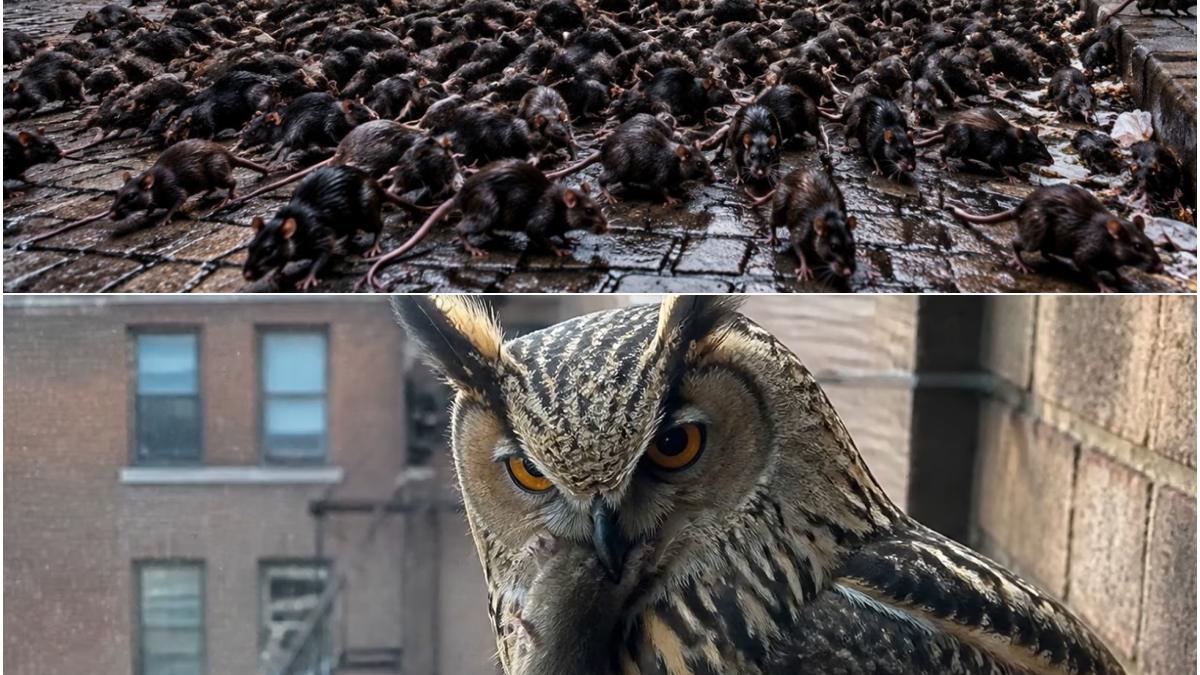
For four nights in February 2024, something extraordinary happened on the Upper West Side of Manhattan.
The traffic continued rolling through the avenues. Sirens still echoed between the buildings, and people still hurried through the cold with their collars raised.
But one familiar sound disappeared from the rooftops. An enormous owl with orange eyes, whose calls had become part of the neighborhood’s nighttime life, was suddenly silent.
For nearly a year, he had perched above West 89th Street, hunted through Central Park, and watched over a city that had never been designed for him.
People opened their windows when they heard him. Photographers waited beneath the trees, hoping for a glimpse of his enormous wings.
Strangers gathered outside apartment buildings after midnight, looking upward as though the city had acquired a secret guardian.
His name was Flaco. He had escaped from the Central Park Zoo in February 2023, after spending his life in captivity.
Nobody expected him to survive for long. Yet he learned to hunt, found shelter among the rooftops, and became one of New York’s most recognizable wild animals.
Then, on February 23, 2024, he struck the side of an apartment building and fell into a courtyard.
The collision was only part of the story. Inside his body, investigators found several kinds of rat poison, along with evidence of a serious infection.
The city had celebrated him as a wild creature returning to nature, but the city itself had become part of what threatened him.
How could an animal that seemed to have conquered Manhattan become so vulnerable to the very streets he had learned to navigate?
The answer reaches far beyond New York, across oceans and into the backyards of Australia.
It involves a war against rats that has lasted for generations, a collection of chemicals that became more powerful as rats adapted, and a remarkable discovery made by scientists during the Second World War.
It also involves an unexpected weapon, one that does not need claws, teeth, poison, or even a living predator.
It is something ordinary enough to stand beside a kitchen door without attracting attention. A bin with a lid.
To understand why such a simple object could matter more than decades of chemical warfare, we first have to understand the animal that humans have spent so long trying to defeat.
The brown rat is not originally from New York, and it is not native to Australia.
Its ancestors came from the grasslands and river valleys of northern Asia, spreading westward through the Middle East and Europe along the same routes used by people carrying grain, building ships, and trading goods.
Rats traveled in sacks, barrels, cargo holds, and the hidden spaces beneath wooden floors. They followed human civilization because human civilization provided everything they needed.
Its scientific name is Rattus norvegicus, the Norway rat, although Norway has little to do with its origins.
The name became established after an eighteenth century naturalist incorrectly believed the animal had arrived in Britain aboard Norwegian timber ships.
Even its name reflects how easily people can misunderstand the creature living beside them. By the time European settlers expanded their trade networks, brown rats had already become extraordinarily successful travelers.
They reached cities around the world, often arriving unnoticed until their numbers became impossible to ignore.
But once they established a colony, they did not necessarily continue spreading at random. They learned the local streets, the locations of food, the safest hiding places, and the routes between them.
A researcher at Fordham University named Matthew Combs spent two years trapping rats across Manhattan and studying their DNA.
His findings, published in 2017, revealed something surprising. New York’s rats were still genetically connected to populations from Britain and France.
Their ancestors had probably arrived between 1750 and 1770, when New York was still a British colony.
For roughly two and a half centuries, ships had continued arriving from nearly every corner of the world.
They carried people, merchandise, food, and countless opportunities for new animals to reach the city.
Yet Manhattan’s established rat population retained a strong genetic connection to its earliest European arrivals.
Even stranger, Combs found that Manhattan contained two genetically distinct rat populations. Uptown rats and downtown rats had become separated, with Midtown acting as a barrier between them.
The commercial landscape, with its different streets, buildings, and limited residential food sources, helped keep the populations apart.
A rat living in the East Village could be genetically distinguishable from one living in the West Village.
That might seem impossible in a city where people travel across neighborhoods every day, but rats do not experience the city as humans do.
A rat colony often remains concentrated within a relatively small area, sometimes only a few hundred meters across.
A rat is born into a neighborhood, learns its hiding places, discovers its food sources, and usually spends its life close to home.
The streets are not simply roads between destinations. They are the boundaries of a familiar territory.
That behavior would eventually become central to understanding how to control rats. But for generations, the people responsible for managing them focused on a different part of the animal.
They focused on how to kill it. Brown rats possess a collection of physical abilities that make them exceptionally difficult to exclude from human environments.
Their front incisors never stop growing. To prevent them from becoming dangerously long, rats must constantly gnaw.
Wood, plastic, electrical insulation, softer concrete, and even some metal materials can become targets. Their bodies are flexible enough to squeeze through remarkably narrow openings.
A rat can push its skeleton through a gap about the width of a thumb, provided its head can fit.
It can climb rough walls, swim, and travel through drainage systems. In cities, pest controllers have sometimes found rats emerging from toilets after navigating plumbing.
Their reproductive capacity adds another advantage. A female can become pregnant again shortly after giving birth.
Pregnancy lasts about three weeks, and litters often contain around eight young, sometimes more. Her daughters may begin reproducing when they are only a few months old.
Under favorable conditions, a small number of rats can establish a large population surprisingly quickly.
They do not need wilderness or abundant natural vegetation. They need food, water, shelter, and enough protection to raise their young.
Cities provide all four. For much of the twentieth century, the standard response was to attack the rats directly.
If they were multiplying rapidly, people reasoned, then a sufficiently powerful poison should be able to remove them.
During the Second World War, a new chemical seemed to offer exactly that possibility. In Baltimore, Maryland, a scientist named Kurt Richter developed a poison called Antu.
It was considerably more toxic to rats than many of the substances previously available. The city began using it in organized campaigns, distributing bait across neighborhoods in an effort to reduce infestations.
The operation involved large numbers of workers, including Boy Scouts who helped scatter bait in parts of East Baltimore.
The first results appeared spectacular. In one instance, workers collected more than 360 dead rats from a single city block.
Residents saw the piles and imagined the problem disappearing. For a moment, the campaign looked like a decisive victory.
But the apparent success did not laSt. Dogs and cats began suffering from exposure. Several children required medical treatment after contact with the poison.
And within months, the rats returned in enormous numbers. Neighborhood after neighborhood experienced the same pattern.
The initial decline was followed by a rapid recovery, until populations approached their previous levels.
The city had removed large numbers of rats without removing the conditions that supported them.
One scientist working in the same building was studying the problem from a different perspective.
His name was David Davis, and he was an ecologist interested in the lives of wild rats.
Instead of looking only at the numbers killed during poisoning campaigns, he trapped and marked individual animals, following their movements, survival, and reproduction.
Davis began noticing a pattern among the rats that remained after poisoning. Their circumstances had changed, but not in the way the city expected.
The survivors now had access to the same food and shelter, but there were fewer animals competing for those resources.
The neighborhood had become easier to live in. That discovery would challenge the central assumption behind modern rat control.
Yet the world was already looking for a stronger chemical, and the idea that sanitation might matter more than poison struggled to compete with the promise of a quick solution.
After the war, another compound entered the picture. Warfarin belonged to a family of chemicals called anticoagulant rodenticides.
These substances interfere with vitamin K, which the body needs to produce proteins responsible for blood clotting.
Without those proteins, the body gradually loses its ability to stop internal bleeding. The animal becomes progressively weaker as the effects develop.
The method had an important advantage over earlier poisons. Rats are naturally cautious about unfamiliar food.
If they eat something new and become sick immediately, they can associate the illness with the bait and avoid it in the future.
Anticoagulants generally act slowly enough that the animal does not make that connection. For a time, warfarin seemed to offer a reliable answer.
Then rats began developing resistance. By the 1970s, resistant populations had appeared in several places.
Some rats could survive doses that would have affected other animals. Once again, chemists responded by making the poison stronger.
The result was a newer group known as second generation anticoagulant rodenticides. Compounds such as brodifacoum, bromadiolone, difenacoum, difethialone, and flocoumafen became important tools in professional and consumer pest control.
These substances were designed to remain effective even against some populations resistant to older products.
Some could kill after a single feeding. They also remained in the body for a long time, particularly in the liver.
That persistence was considered an advantage for pest management. But it created another problem. A poisoned rat does not necessarily disappear immediately.
It may remain alive for days, sometimes more than a week, while becoming weaker and less coordinated.
It may move into exposed areas during daylight, behaving in ways that a healthy rat would normally avoid.
To a predator, the animal can look unusually easy to catch. A hawk hunting above a city might see a rat crossing an open patch of pavement.
An owl searching through a garden might find one moving slowly beside a fence. A fox or another mammal might encounter a rat that would ordinarily have escaped.
The predator catches it, eats it, and receives a dose of the chemical stored inside its body.
If that predator eats several contaminated animals, the chemicals can accumulate. Some compounds persist for months, meaning an animal can carry residues long after the original exposure.
The rat poison does not remain neatly contained within the rat population. It moves through the food web.
And in New York, the consequences became increasingly visible in the very birds that people had come to admire.
In the early 1990s, a red-tailed hawk with unusually pale plumage established a nest on a stone ledge overlooking Central Park.
New Yorkers named him Pale Male. His choice of home was extraordinary only from a human perspective.
Red-tailed hawks normally nest in trees or on cliffs. A tall apartment building overlooking a large park offered the same essential features: a high nesting site, a broad view, and access to prey below.
Pale Male raised chick after chick on the ledge. Bird watchers arrived with telescopes, photographers documented the nest, and his presence became a celebrated example of wildlife adapting to an urban environment.
Then, in December 2004, building management removed the neSt. The response was immediate. Protesters gathered along Fifth Avenue, and the dispute attracted international attention.
The city had become emotionally invested in the hawks, and people wanted them to remain.
Within weeks, a steel cradle was installed on the ledge, giving the birds a place to rebuild.
They returned. Red-tailed hawks became increasingly familiar across New York. They nested on bridges, church steeples, hospital ledges, and buildings near parks.
Their success seemed to demonstrate that wildlife could not only survive in the city but flourish there.
It was tempting to imagine that these birds might help control the rats. A natural predator had moved into the city, and its preferred prey included rodents.
But the relationship was not as simple as it appeared. Between 2012 and 2018, researchers examined red-tailed hawks found dead or dying in New York City.
They tested the livers of 72 birds for anticoagulant rodenticides. Eighty-nine percent carried the chemicals.
Many had been exposed to second generation compounds, including brodifacoum, bromadiolone, and difethialone. In around four out of every ten examined birds, internal bleeding associated with anticoagulant exposure was considered a likely cause of death.
The hawks that people had fought to protect were being exposed to the same poisons used against rats.
The problem was not limited to New York. At a wildlife clinic at Tufts University in Massachusetts, every red-tailed hawk tested between 2017 and 2019 carried anticoagulant rodenticides.
Most had been exposed to more than one compound. The second problem was ecological. Even if the hawks had been perfectly healthy, they were unlikely to solve the city’s rat problem.
Red-tailed hawks generally hunt during the day. Brown rats are mostly active at night. Hawks can catch rats, but their opportunities are limited, and the animals most likely to be exposed in daylight may be the ones already weakened by poison.
The city was therefore creating a dangerous imbalance. It was exposing predators to contaminated prey while doing little to change the resources that allowed rat populations to recover.
Then another bird arrived, and the city watched a similar story unfold on an even more intimate scale.
In February 2023, someone cut through the mesh of an enclosure at the Central Park Zoo.
Inside was a Eurasian eagle owl, one of the largest owl species in the world.
The owl had arrived at the zoo as a chick and had spent his life in captivity.
He had not needed to find his own food, navigate the city, or learn the demands of hunting in darkness.
After the enclosure was opened, he flew into Manhattan. His name was Flaco. Many people expected him to struggle.
An owl raised in captivity might not have the experience needed to survive independently. Finding prey, selecting a safe roost, and avoiding the hazards of a densely built city would all require skills he had never been forced to develop.
But Flaco adapted. Within weeks, he was catching rats in Central Park. He began using the city’s trees, rooftops, water towers, and fire escapes as places to reSt. His enormous silhouette appeared above familiar streets, and his calls carried across apartment courtyards.
People followed his movements. Photographers watched him from sidewalks. Residents opened their windows to listen.
His presence became a shared neighborhood experience. After years in which New Yorkers had faced uncertainty and disruption, Flaco offered a rare kind of wonder.
He was an animal that seemed to have escaped the boundaries of human control and discovered a life of his own.
He survived for nearly a year. Then, in February 2024, the calls stopped. For four nights, people waited for the familiar sound.
On February 23, Flaco struck the side of an apartment building on West 89th Street and fell into the courtyard below.
The collision caused serious trauma, but the investigation revealed that his health had already been compromised.
The Wildlife Conservation Society released the results of his examination about a month later. Flaco had a severe pigeon herpes virus infection, likely acquired through eating the city’s feral pigeons.
The infection had affected several organs and tissues, including his liver, spleen, bone marrow, and brain.
He also carried four different anticoagulant rodenticides. The veterinary findings indicated that his infection, chemical exposure, and physical trauma were all serious concerns.
Any one of the three conditions could have been fatal. Together, they may have left him impaired and contributed to the collision.
Flaco had learned to hunt in a city full of rats. But those rats were part of a food system contaminated by the same chemicals used to control them.
His story made the hidden cost of rodenticide use difficult to ignore. The response included a proposed measure in the New York legislature known as the Raptors Act.
The bill sought to restrict public sales of second generation anticoagulant rodenticides across the state and limit their use near wildlife habitat.
Flaco was named in its opening pages. At the time described in the original account, the legislation was still moving through the state capital and had not become law.
But the debate was no longer confined to New York. Across the Pacific, Australian researchers had been finding evidence of the same problem in native wildlife.
And one of the people who helped bring the issue into focus was a young American scientist who arrived in Western Australia with a concern about the products sitting on supermarket shelves.
In 2015, PhD candidate Mike Law approached ecologist Rob Davis at Edith Cowan University in Perth.
Law came from Pennsylvania and had a particular interest in owls. He was alarmed by the difference between the rules he knew in the United States and the availability of powerful rat baits in Australia.
In America, consumer access to some of the strongest products had already been restricted. In Australia, compounds such as brodifacoum could still be purchased over the counter.
Law questioned why a household product capable of contaminating wildlife was so readily available. Davis was initially skeptical, but he agreed to supervise the research.
Law chose the southern boobook, one of Australia’s familiar small owls. Its rounded body and brown plumage make it easy to overlook during the day, but at night its repeated calls can be heard across suburbs and bushland.
He contacted wildlife carers and veterinarians throughout Western Australia. When a boobook arrived dead or seriously unwell, he asked them to send it for testing.
Seventy-three owls were examined. Seventy-three percent carried anticoagulant rodenticides. Around eighteen percent had liver concentrations considered lethal.
The results were troubling, but another pattern was even more surprising. The highest exposure was not necessarily found in places where agricultural baiting was most intense.
Instead, owls living closer to houses and suburbs tended to carry more poison. The danger was not simply coming from distant farms.
It was coming from ordinary residential environments. A shed, a garage, a garden, or a small patch of land beside a house could become part of the pathway.
Rats ate bait, owls ate rats, and the chemicals moved from one animal to another.
Law also found something important in the liver samples. Some owls carried compounds that were supposed to be restricted to licensed professional users rather than sold in ordinary household boxes.
That detail suggested the problem might not be solved simply by removing the most powerful products from supermarket shelves.
Professional pest control could still introduce the same chemicals into the environment. Meanwhile, researchers and wildlife carers were discovering similar contamination in other Australian species.
Around Margaret River in the far southwest, a community group called Owl Friendly Margaret River had been celebrating the presence of masked owls near the edge of town.
These large, secretive birds are related to barn owls and can be difficult to observe.
Three masked owls were submitted for testing. One had suffered a serious injury, while two had been struck by cars.
All three carried high levels of rat poison, and one had concentrations approaching lethal levels.
Further investigations added to the evidence. Researchers examined masked owls in Tasmania, wedge-tailed eagles, tawny frogmouths, and other predators and scavengers.
Some birds were exposed through their own hunting, while others could receive contaminated prey indirectly.
The concern extended beyond birds. Goannas, quolls, possums, domestic dogs, and cats were also among the animals affected by rodenticide exposure.
Reports from studies of masked owls suggested that more than nine in every ten tested birds had been exposed to these poisons.
For scientists, the pattern was increasingly difficult to dismiss as an isolated problem. Wildlife carers saw the consequences in animals arriving for treatment.
Conservation groups gathered evidence. Researchers published findings and called for regulatory changes. Among the organizations pushing for action was BirdLife Australia.
For years, the strongest household rodenticides remained available, even as the evidence of secondary poisoning grew.
The problem was not that the chemicals failed to kill rats. It was that they could also harm the animals that ate those rats.
Then, in December 2025, the national regulator moved toward a major change. On December 16, the Australian Pesticides and Veterinary Medicines Authority published a proposed decision concerning second generation anticoagulant rodenticides.
Its assessment identified real and current risks to native wildlife from the way these products were being used.
On March 10, 2026, the authority certified that the products should become restricted chemicals, available only to trained and licensed users.
On March 24, 2026, the registration of every second generation rodenticide product in Australia was suspended for twelve months.
Retailers began responding. Coles and Woolworths started removing the products, while Bunnings committed to clearing them from its shelves by June 30.
For Rob Davis, who had once been skeptical of his student’s concerns, the decision represented a change he had not been certain he would witness during his career.
BirdLife Australia described it as one of the major conservation gains for Australian wildlife in recent years.
The change mattered. Restricting access to powerful poisons could reduce the number of contaminated rats available to predators.
It could also reduce the chance that household users would place persistent chemicals in gardens, sheds, and other places frequented by wildlife.
But the transition was not perfectly straightforward. Some existing stock could continue to be sold under revised instructions.
Reports also indicated that at least one major supermarket chain had restocked discounted baits weeks after the suspension began.
And Law’s research raised a second concern. Even when consumer products were restricted, professional pest control could remain a source of exposure.
New York had already demonstrated why that distinction mattered. Consumer restrictions had existed in the United States for more than a decade, yet the majority of tested dead hawks in the city still carried anticoagulant rodenticides.
The chemicals had not disappeared. They had continued entering the environment through other routes. Removing powerful baits from ordinary shelves was an important step, but it could not by itself remove every source of contamination.
Nor could it address the underlying reason rats were thriving. To understand that reason, we have to return to Baltimore and the work of David Davis.
Davis had watched rats survive poisoning campaigns and noticed that the survivors often experienced a sudden improvement in their living conditions.
The food remained available. The shelter remained intact. But there were fewer rats competing for both.
He and his colleagues measured what happened next. Among surviving females, pregnancy rates roughly doubled during the months following poisoning campaigns.
The reduction in population density had created an opportunity for rapid reproduction. The poison had removed animals, but it had not removed the conditions supporting them.
The surviving rats simply filled the available space. Davis reached a conclusion that challenged the central logic of rat control.
Killing rats, he argued, merely makes room for more rats. The number of rats a neighborhood can support depends heavily on the food and shelter available there.
Ecologists call this carrying capacity. A habitat with plentiful resources can support a larger population than one with limited resources.
If poison reduces a population while leaving food and shelter unchanged, the neighborhood may soon support another large population.
The survivors reproduce, newcomers may move in, and the numbers recover. Davis and his colleagues decided to test a different approach.
They established an experimental area of Baltimore where they did not rely on poisoning. Instead, they concentrated on sanitation and the removal of resources.
Food waste had to be stored properly. Rubbish piles and old materials were cleared. Damaged fences and other potential shelters were addressed.
Officers were hired to enforce the rules. The results were striking. Rat numbers in the sanitation area fell dramatically and remained low during much of the experiment.
There was one notable exception, a spike in late 1948. The explanation was not a new poison or a sudden change in rat behavior.
The city’s rubbish collectors had gone on strike. Waste accumulated. Food became easier to reach.
And the rat population responded. It was an unusually clear demonstration of the relationship between sanitation and rodent numbers.
When the food supply was controlled, the population declined. When rubbish accumulated again, the rats returned.
The experiment took place in the late 1940s. Yet the lesson was largely overshadowed during the decades that followed.
Cities continued investing in chemical control, often treating rats as though their numbers could be permanently reduced by removing enough individuals.
The underlying resources remained available, and the same neighborhoods repeatedly experienced infestations. Eventually, New York began revisiting the basic conditions that Davis had identified.
For generations, the city had put much of its household rubbish into black plastic bags and left them along the curb for collection.
Every evening, sidewalks could become lined with piles of waste. New York produces roughly 20,000 tons of rubbish every day.
Much of that material includes food scraps, discarded meals, and packaging carrying traces of food.
To a rat, a plastic rubbish bag is not a nuisance waiting for a sanitation truck.
It is a source of calories. The bags also create easy access. A rat does not have to travel far from its burrow to find something to eat.
In a city where many colonies remain close to their home territory, the nearest pile of rubbish can be enough to sustain a local population.
In 2022, the city began a major effort to change its waste practices, which the sanitation department called the trash revolution.
The first changes involved the time when rubbish could be placed outside. Unless waste was stored in a sealed container, the setout time was pushed back from four in the afternoon to eight at night.
Collection schedules were adjusted toward midnight, reducing the number of hours bags remained on the street.
In August 2023, food-related businesses across New York City were required to place their rubbish in lidded containers.
Restaurants, delis, bars, and grocery stores all had to change how they stored waste. Later, in late 2024, the requirements expanded to residential buildings with up to nine units.
That covered a large share of the city’s homes. In West Harlem, the city also tested a different system.
Instead of leaving individual bags along the curb, residents used large sealed containers installed on the street.
There was nothing glamorous about the approach. No dramatic hunting scene. No new technology capable of rewriting the rules of biology.
Just a more deliberate way of keeping food waste out of reach. Yet the results offered a measurable indication that the strategy could work.
In December 2024, the first full month in which smaller residential buildings were required to use bins, reported rat sightings across the city fell by 23 percent compared with the same month a year earlier.
The following month, reports fell by 24 percent. In the West Harlem container pilot, local officials reported that rat sightings dropped by more than half.
By August 2025, citywide sightings were down by around 16 percent year over year. Those numbers were encouraging, but they were not a complete measure of the rat population.
They came from reports to the city’s complaint system. They measured how often residents reported seeing rats, not the total number of rats living beneath the streets or inside buildings.
New York has never conducted a true census of its rat population. The figures often repeated in public discussions, such as estimates of two million or three million rats, are uncertain.
David Davis himself challenged the old claim that there was one rat for every New Yorker.
His estimate from the late 1940s was closer to a quarter of a million. Even with those limitations, the sanitation changes represented a different way of thinking about the problem.
Instead of trying to remove rats faster than they could reproduce, the city was trying to make neighborhoods less capable of supporting large colonies.
Progress was uneven. By 2026, some districts had recorded declines in sightings approaching half, while reports in the Lower East Side, East Village, and Chinatown had risen by nearly 40 percent.
The city’s first rat czar, Kathleen Corradi, left her position in September 2025. She cautioned that it was too early to declare victory, while emphasizing that the science pointed toward reducing accessible food as a route to lasting population control.
Some residents continued to report seeing rats as frequently as before. For them, citywide statistics did not necessarily reflect the conditions on their particular block.
New York had not eliminated its rats. But it had begun addressing the resources that allowed them to thrive.
And that brings the story back to Australia, where a different part of the same problem is now becoming clearer.
Australia has taken a major regulatory step by restricting the strongest second generation rat poisons.
That change can reduce exposure for owls and other native wildlife. But the experience of New York shows why restrictions alone cannot finish the job.
If rats continue finding food and shelter in gardens, sheds, compost heaps, and rubbish areas, they will continue reproducing.
If professional pest control still uses persistent compounds, predators may still encounter contaminated prey. And if households leave food accessible, the local environment will continue supporting the animals people are trying to control.
The most important part of the solution may therefore be much closer than the offices where regulations are written.
It may begin in an ordinary backyard. A bag of chicken feed left open overnight can become a dependable food source.
Fallen fruit beneath a tree can provide a meal. An uncovered compost heap can attract animals.
A dog bowl left outside can become an invitation. A pile of timber against a fence can create a protected nesting place.
Each small feature adds to the resources available on a street. Together, they help determine how many rats that street can support.
The practical changes are straightforward. Store food in sealed containers. Clear fallen fruit. Use a compost bin that prevents access.
Keep rubbish secured. Lift or organize piles of timber and other materials that can provide shelter.
If a rat must be caught, a properly placed snap trap can remove an individual without introducing persistent poison into the food chain.
It is not a replacement for sanitation, but it avoids the secondary poisoning risks associated with anticoagulant baits.
And the scale of the effort matters. A single clean yard can help, but neighboring properties also influence the same local population.
Rats do not recognize property lines, and a colony can move through the spaces between buildings.
When several households reduce food and shelter together, the entire block becomes less suitable. That is the principle David Davis identified more than eighty years ago.
It does not depend on a new chemical or a spectacular invention. It depends on changing the environment that supports the rats.
There is another reason the approach matters. Every rat that eats bait can become a potential source of exposure for an owl, hawk, or other predator.
When poison is removed from that pathway, predators have a better chance of hunting without receiving a hidden dose of chemicals with each meal.
Australian researchers will continue testing boobooks and masked owls in the years ahead. The liver samples collected after the March 24, 2026 suspension will help show whether restricting consumer products reduces contamination, or whether exposure continues through professional use and other routes.
The answer is not yet known. But one thing is already clear. The predators that could help control rodents have not disappeared from Australian suburbs.
They are still hunting in gardens, parks, gullies, and wooded streets. Their calls still travel across neighborhoods after dark.
For years, people treated these animals as though they were separate from the problem. They were wildlife living near the city, while rat control belonged to the world of chemicals and pest management.
In reality, the predators were part of the same system. They were eating the rats, and the rats were carrying substances introduced by humans.
Flaco’s story made that connection visible in one extraordinary bird. His escape, survival, and presence above Manhattan captured the imagination of a city.
But the dangers he encountered were not unique to him. The same contamination had been found in hawks, owls, and other predators that lived less dramatically among us.
His life also revealed something hopeful. A creature raised in captivity could learn to hunt, navigate a complicated environment, and survive in a place where nearly everyone expected him to fail.
The tragedy was that the city he had learned to live in was still full of hazards that people had created without fully understanding their consequences.
Australia now has an opportunity to reduce one of those hazards. Removing powerful poisons from ordinary shelves is a significant change, but it is only one part of a wider effort.
The chemicals must also be managed responsibly by licensed users, and the food sources that sustain rats must be reduced.
The work begins with choices that seem small. A lid on a bin. A sealed container for feed.
A cleared corner of a yard. A trap placed carefully instead of poison scattered where wildlife might encounter it.
None of these actions looks like a grand victory. But together, they can change the conditions of an entire neighborhood.
And somewhere above a Perth suburb, a Sydney gully, or a Hobart backyard, a southern boobook may be waiting on a branch or roofline.
It may hear movement in the grass and turn its head toward the sound. It may drop silently into the dark and catch a rat that would otherwise have remained hidden.
That owl is not a substitute for good sanitation, and it cannot solve a city’s rodent problem by itself.
But it is part of a living system that people can either support or undermine.
For decades, we tried to win the war against rats by making the weapons stronger.
The rats adapted, the food remained, and the poisons moved through the food chain. Now, the more durable answer is beginning to look surprisingly ordinary.
Make food harder to reach. Make shelter less available. Use control methods that do not contaminate the animals sharing the environment.
The wild was never entirely absent from our cities and suburbs. It was there above the streetlights, in the trees, on the rooftops, and in the darkness behind our homes.
The question is whether we can change our habits enough to let it do its work.
Disclaimer: This content may be created by Al for entertainment purposes. Any resemblance to real persons, events, or places is coincidental.








