Mysterious Out Of Place Artifacts Found Underground
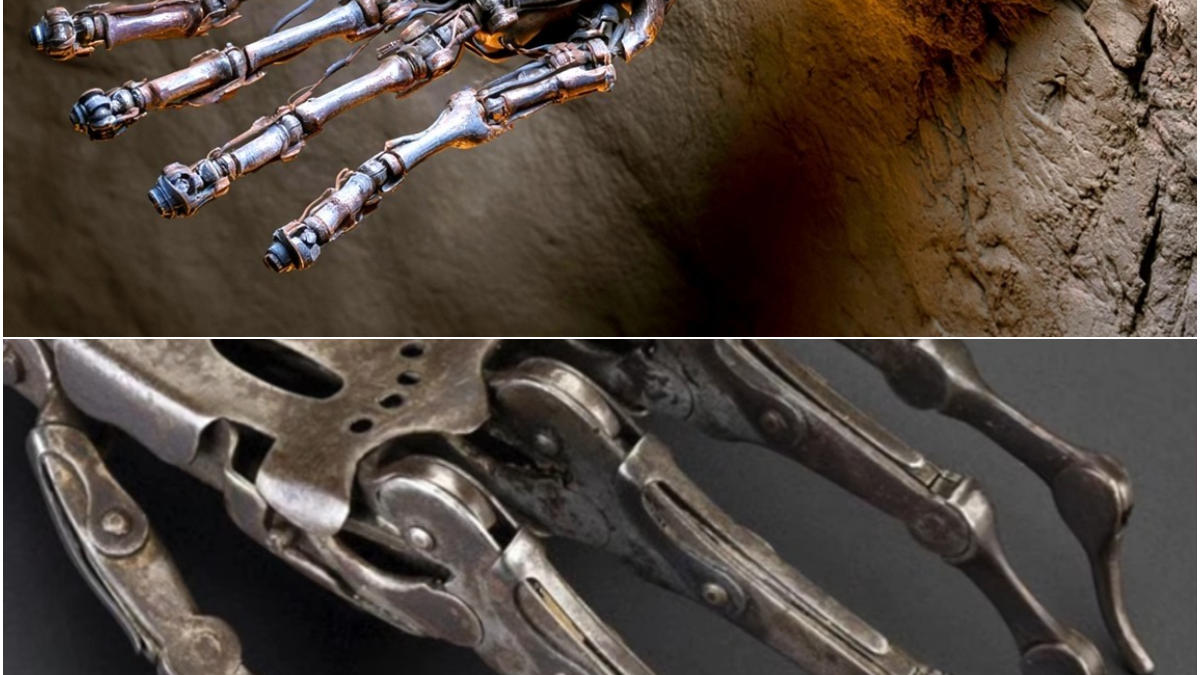
Imagine walking into a museum and finding an artificial arm that looks less like a medical device and more like the unfinished skeleton of a machine from another century.
Its fingers are made from carefully fitted metal sections. Its wrist can move. Its elbow bends through a mechanical joint.
Across the palm is a perforated metal plate, light enough to reduce weight but strong enough to hold its shape.
There is no famous inventor attached to it. No confirmed owner. No complete story explaining why someone in the Victorian era would have needed such an elaborate mechanism.
The object simply remains, preserved as an unanswered question. Now travel thousands of miles away and hundreds of years backward in time.
In Central and South America, tiny gold ornaments were created with such unusual shapes that modern observers have compared them with aircraft.
They were made long before modern aviation, yet enlarged replicas based on their forms have reportedly flown as model aircraft.
Were their makers simply transforming familiar animals into symbolic designs, or were they attempting to represent something more unusual?
Then, in Bolivia, a stone figure carries markings that some researchers have compared with writing from ancient Mesopotamia.
The Picotia monolith was photographed and examined more closely in December of 2001, and its weathered symbols raised a question that still has no universally accepted answer.
What exactly were the people who created these objects trying to preserve? Three mysteries, separated by centuries and continents, appear to have almost nothing in common.
Yet each involves the same unsettling idea, that something carefully constructed can survive long after the knowledge that created it has become difficult to understand?
The first clue is waiting quietly in London, inside a collection where an object from the Victorian era has survived almost entirely without a story attached to it.
Hidden among the collections of the Science Museum Group in London is a remarkable artificial arm whose construction seems far more sophisticated than the historical information surrounding it.
The object was created sometime between 1850 and 1910, a period when engineering was advancing rapidly and craftsmen were learning how to produce increasingly precise mechanical devices.
Yet despite the quality of the arm, neither its maker nor the person who once possessed it has been securely identified.
That uncertainty makes the object unusual before its mechanical details are even considered. The arm begins with a leather upper section that would have connected the mechanism to its owner.
Below that, the construction changes completely. Instead of relying primarily on wood or simple leather components, the surviving structure consists of metal pieces arranged to imitate the proportions and movements of a human arm.
The elbow contains a mechanical joint. The wrist is capable of rotation and flexing. And the fingers are individually articulated.
Each finger is assembled from numerous small sections, arranged in a way that resembles the separate bones and joints of an actual hand.
The design suggests that considerable thought went into reproducing natural movement rather than merely creating a rigid replacement.
Across the palm is another curious feature, a perforated metal plate. The holes remove unnecessary material while allowing the structure to remain strong.
It is a simple engineering principle, but in this context it reveals something important. Whoever constructed the arm was thinking about weight, strength, movement, and mechanical efficiency at the same time.
This was not simply a shaped piece of metal. It was a mechanical system. During the 19th century, artificial limbs could be made from combinations of wood, leather, and metal.
Many were designed primarily around durability and basic function. The mysterious arm, however, belongs to a more ambitious tradition of mechanical craftsmanship.
Its creator would have needed knowledge of metallurgy. The creator would also have needed an understanding of joints and mechanical movement.
And beyond that, the proportions of the human arm and hand had to be understood closely enough for the components to fit together in a convincing arrangement.
The result almost looks like a mechanical skeleton created before the technologies that would later make electrically powered prosthetics possible.
There is something especially striking about seeing such an object today because modern observers already know what robotic limbs can look like.
Motors, sensors, processors, and artificial joints have made mechanical movement part of everyday technological language.
The Victorian arm predates all of that. It belongs to a world of steam engines, manually operated machines, precision tools, workshops, and craftsmen producing complicated mechanisms piece by piece.
Yet the arm seems to belong to a later technological age. Its fingers are not simply shaped like fingers.
They are constructed to behave like them. Its wrist is not merely positioned like a wriSt.
It incorporates a mechanical system intended to reproduce movement. The elbow is not simply a fixed bend.
It is a joint. That complexity naturally raises the question of why such a device was made.
One possibility is that it belonged to someone with enough financial resources to commission a highly specialized artificial limb.
A custom device containing so many carefully fitted parts would have required substantial labor. It may have been created for a wealthy individual who wanted something more sophisticated than the ordinary artificial limbs available at the time.
The articulated hand could potentially have helped hold lightweight objects. It might have assisted with supporting a cane or other personal item.
Its mechanical structure may also have allowed it to appear more natural beneath formal clothing.
But there is another possibility. Perhaps the arm was never intended to represent the final answer to artificial limb design.
Perhaps it was an experiment. Victorian Britain was filled with fascination for mechanical movement. Engineers and inventors built automatons that could walk, write, play instruments, or imitate other human activities.
Machines capable of reproducing natural movements attracted enormous attention because they appeared to cross a boundary between the mechanical and the human.
Seen in that environment, the artificial arm becomes even more intriguing. It may have been part of an attempt to discover how closely machinery could imitate the movement of a human body.
The lack of a confirmed maker makes that possibility difficult to investigate. There is no clear maker’s mark connecting the object with a particular workshop or engineer.
There is also no securely identified owner. The historical trail simply becomes quiet. The arm remains.
Its components remain. Its craftsmanship remains. But the person who imagined it and the person who used it are no longer securely connected to the surviving object.
And that is what makes it so compelling. The mystery is not necessarily that the mechanism could have existed.
The mystery is that something so carefully constructed could have left behind so little information about its own creation.
The story changes completely when the investigation moves away from Victorian Britain and toward the ancient cultures of Central and South America.
Here the mystery is not an artificial limb. It is gold. Small gold ornaments associated with ancient cultures have attracted attention for generations because several of them possess shapes that look remarkably mechanical to modern eyes.
They are generally connected with pre Colombian artistic traditions, including those associated with the Quimbaya and Deis cultures.
At first glance, there is nothing impossible about that. Ancient artists regularly transformed animals into symbolic forms.
Birds, bats, insects, fish, and other creatures appeared in artwork, jewelry, ceremonial objects, and ornaments.
Their forms could be exaggerated, simplified, combined, or transformed into shapes that did not correspond perfectly to any living creature.
But some of these tiny gold objects have produced a different reaction. Their silhouettes appear streamlined.
Their bodies can look compact. Some possess pointed forward sections. Broad forms extend from their sides.
At the rear are smaller projections and a central extension. To modern eyes, these features can resemble components of an aircraft.
The comparison became especially powerful when researchers began asking a different question. What would happen if the objects were not treated only as symbolic ornaments, but as possible aerodynamic designs?
That question led to experiments. Scientists, aviation researchers, and aerospace engineers became involved in efforts to reproduce the unusual gold forms at larger scales.
Instead of making tiny decorative copies, they created enlarged models based closely on the proportions and geometry of the original objects.
The results were extraordinary to watch. The replicas looked like small aircraft. Their broad side structures resembled swept wings.
Their bodies were streamlined. Their rear sections appeared to provide stabilizing surfaces. Their pointed fronts gave them an unmistakably machine like appearance.
And then came the part that transformed the discussion. The reconstructed models were reportedly flown.
When equipped with the components required for model aircraft, the enlarged replicas demonstrated aerodynamic flight and remained controllable before returning safely to the ground.
For anyone seeing photographs of the experiments, the effect is striking. The original objects are tiny, delicate gold ornaments.
The enlarged versions stand beside their creators at a scale that makes the similarities to modern aircraft much easier to notice.
Yet the fact that a model can fly does not automatically establish that the ancient objects were intended to represent aircraft.
That distinction is important. A shape created for symbolic or artistic reasons can sometimes produce useful aerodynamic properties without its original maker possessing modern aviation technology.
Nature itself provides countless examples of forms that are aerodynamic without being machines. Ancient artists were also capable of creating highly stylized representations that combine characteristics from several animals or symbolic traditions.
The traditional interpretation therefore remains connected to the rich artistic world of pre Colombian America.
The objects may represent animals. They may represent spiritual beings. They may combine recognizable features into symbolic forms.
Their creators possessed advanced metalworking skills, and those skills alone can explain why the objects are so precise.
Using lost wax casting, ancient craftspeople could produce elaborate gold forms with delicate details and carefully controlled shapes.
The technique required knowledge of materials, temperatures, molds, and finishing processes. These were not accidental shapes.
They were intentionally created. That much is clear. The larger mystery is what the shapes were intended to communicate.
Alternative researchers have suggested that the objects could preserve representations of machines or technologies encountered by their creators.
Some have proposed a forgotten technological tradition. Others have imagined contact between ancient American peoples and visitors whose capabilities were very different from those normally associated with the period.
Those interpretations remain controversial. The objects themselves cannot provide a simple explanation. They do not contain a written label explaining what the artist had in mind.
Instead, the mystery exists in the gap between what the objects physically resemble and what their original cultural meaning may have been.
That gap is where the imagination becomes powerful. A tiny gold ornament can look like an aircraft when placed beside an aircraft.
A modern observer can immediately recognize familiar shapes. But recognition is not the same as proof.
The ancient maker may have been representing an animal that simply happens to resemble a machine from a later age.
Or the object may preserve an idea whose original meaning has been loSt. The uncertainty is part of what has kept these artifacts famous.
And then the trail leads to Bolivia, where the mystery is no longer about shape alone.
It is about symbols. Near the ancient landscape surrounding Tijuanaku stands the Picotia monolith, an unusual stone monument discovered in 1960 at Picotia, approximately 6 km from Tijuanaku.
The monument portrays a standing male form. Its hands rest against its thighs. At first, it might appear to be another ancient stone figure, weathered by centuries of exposure and transformed by time.
But its surface contains markings. Those markings became the center of the mystery. Across the back, legs, thighs, and hands are repeated forms that appear organized rather than randomly distributed.
The weathering of the stone makes them difficult to examine, but their arrangement has encouraged researchers to consider whether they might represent some kind of structured symbolic system.
The question became more serious during the early 21st century. In December of 2001, an expedition led by Bolivian archaeologist Bernardo Biardos photographed and documented the markings in greater detail.
The photographs provided researchers with additional material to examine. Instead of seeing the surface as nothing more than decoration, some investigators began asking whether the repeated symbols might represent an ancient form of writing.
That interpretation led to one of the most controversial claims associated with the monument. Researcher Clyde Winters proposed that some of the markings resembled protosumerian writing from ancient Mesopotamia.
According to his interpretation, the inscriptions described an oracle known as Putaki and contained references to wisdom, righteousness, and divine protection.
If that interpretation were accepted, the implications would be enormous. It would suggest that ideas or writing traditions associated with civilizations separated from South America by enormous distances and oceans had somehow reached the region.
But that is precisely where the mystery becomes more complicated. A resemblance between symbols does not automatically establish a historical connection.
Ancient writing systems can contain repeated geometric forms. Simple shapes can appear independently in different cultures.
And weathering can alter a carving until a mark begins to resemble something it originally was not.
The Picotia monolith has suffered centuries of exposure. Its surface is no longer as clear as it would have been when the markings were first created.
That makes interpretation extremely difficult. Yet the possibility remains fascinating. What if the markings really are writing?
What if they are instead religious symbols? Could they represent astronomical information? Could they record a story?
Could they be purely decorative? Or could they belong to a symbolic system that modern researchers have not yet identified?
The monument does not provide an easy answer. Another controversial object makes the story even more complicated.
The Fuente Magna Bowl is another Bolivian artifact whose markings have been compared with ancient Mesopotamian writing.
Placed alongside the Picotia monolith, it has encouraged theories involving forgotten navigation, migration, and cultural exchange.
The two objects do not prove such connections. But they do demonstrate how quickly a mysterious symbol can open an enormous historical question.
A mark on stone is only a mark until someone understands its meaning. Once researchers begin seeing a possible writing system, the entire object changes.
It becomes a potential message from another era. The problem is that messages are only useful when the language is understood.
Imagine finding a book written in an unknown script. The pages could be perfectly preserved.
The symbols could be arranged into obvious lines. The writing could be repeated in consistent patterns.
Yet without a key, the meaning would remain inaccessible. The Picotia monolith presents a similar problem.
Its markings have survived. Their original explanation has not. That is what connects the stone figure to the mysterious gold ornaments and the Victorian artificial arm.
Each object preserves evidence of human creativity. Each contains details that can still be observed.
And each raises questions that the surviving evidence cannot completely answer. The artificial arm tells us that someone in the period between 1850 and 1910 understood mechanical construction well enough to produce an unusually sophisticated prosthetic device.
But the identity of that maker remains uncertain. The gold ornaments demonstrate that ancient craftspeople possessed remarkable control over metallurgy and lost wax casting.
But the intended meaning of their unusual shapes remains debated. The Picotia monolith preserves a system of markings that some researchers believe could represent writing.
But centuries of weathering have made the original message difficult to determine. None of these mysteries requires an impossible explanation.
That may actually make them more interesting. The Victorian arm can be understood as the product of an inventive craftsman working during a period of rapid mechanical development.
The Quimbaya and Deis artifacts can be understood within ancient artistic traditions that frequently transformed animals and symbolic forms.
The Picotia monolith can be understood as a monument whose markings belonged to a cultural system that is not yet fully understood.
Yet each object also demonstrates how fragile historical knowledge can be. The person who built the arm may once have been known.
The owner may once have been identified. The ancient artist who shaped the gold may have known exactly what the object represented.
The people who carved the Picotia monolith may have understood every mark placed upon its surface.
For them, none of these things would have been mysterious. The mystery appeared later. It appeared when the original context disappeared.
That is one of the strangest features of archaeology and historical technology. Sometimes the object survives more successfully than the explanation.
A mechanism can outlast its inventor. A symbol can outlast its language. An ornament can outlast the culture that understood its meaning.
And when that happens, later generations are left with fragments. The artificial arm is perhaps the clearest example.
Its components still reveal how it worked. The leather upper section shows how it connected to its user.
The metal joints show the intended range of movement. The articulated fingers reveal the ambition of the design.
The perforated palm demonstrates an awareness of weight and structural strength. Even without knowing the maker, the engineering can still be examined.
But engineering tells only part of the story. It cannot tell us who stood in front of the craftsman and asked for the arm.
It cannot tell us what the owner expected it to do. It cannot tell us whether the device was a successful everyday tool or an ambitious experiment that never became widely accepted.
That missing human story is what makes the object feel strangely incomplete. The gold ornaments produce the same feeling in another way.
Their physical construction can be studied. The gold can be analyzed. The casting technique can be examined.
The shapes can be measured. The aerodynamic properties of enlarged replicas can be tested. But none of those experiments can automatically tell us what the original artist intended.
A modern aircraft can be built from a similar shape and successfully flown. That demonstrates something about the shape.
It does not necessarily demonstrate something about the ancient culture. The same principle applies to the Picotia monolith.
A symbol that resembles an ancient Mesopotamian character may invite comparison. But comparison alone does not reconstruct the entire historical journey that would be required to establish a connection.
That is why these objects remain fascinating without requiring certainty. They sit between evidence and interpretation.
They give researchers something tangible to examine while withholding the final explanation. And perhaps that is why the most mysterious objects are not always the strangest ones.
Sometimes the most compelling artifact is simply something that should have a straightforward history but does not.
A mechanical arm should have a maker. A valuable custom device should have an owner.
A carefully crafted gold ornament should have a known cultural purpose. A carved monument should have a readable symbolic tradition.
When those links disappear, the objects become isolated fragments. The arm in London is a fragment of Victorian engineering.
The golden ornaments are fragments of ancient artistic traditions. The Picotia monolith is a fragment of an ancient symbolic world.
Together, they form a reminder that history is not a complete record waiting neatly inside museums.
It is a collection of surviving pieces. Some pieces fit. Some pieces almost fit. And some appear to belong to a larger picture that has not yet been recovered.
The artificial arm may eventually be connected to a forgotten workshop. A maker’s mark may be discovered in an old catalogue.
A historical document may reveal the identity of the person who commissioned it. The gold artifacts may receive new archaeological interpretations as researchers learn more about the cultures that created them.
And future study of the Picotia monolith may clarify whether its markings represent writing, religious imagery, astronomical information, or something else entirely.
Until then, the objects remain where they have always been, quietly waiting for someone to look again.
The Victorian arm waits in London with its metal fingers frozen in a gesture created more than a century ago.
The gold ornaments continue to display shapes that seem strangely familiar to modern eyes. The Picotia monolith continues to carry markings across its weathered surface.
None of them can explain themselves. None can tell us exactly who made them. None can guarantee that the interpretations surrounding them are correct.
But perhaps that is the most important part of their story. The past does not always disappear completely.
Sometimes it leaves behind a mechanism. Sometimes it leaves behind a symbol. Sometimes it leaves behind a tiny piece of gold that looks strangely like something from a world that should not yet have existed.
And sometimes the greatest mystery is not how these objects survived, but how much knowledge may have once surrounded them that has simply failed to survive with them?
Disclaimer: This content may be created by Al for entertainment purposes. Any resemblance to real persons, events, or places is coincidental.








