My Alien Roommate Has a Secret Need—And She Decided I Was the Perfect Solution
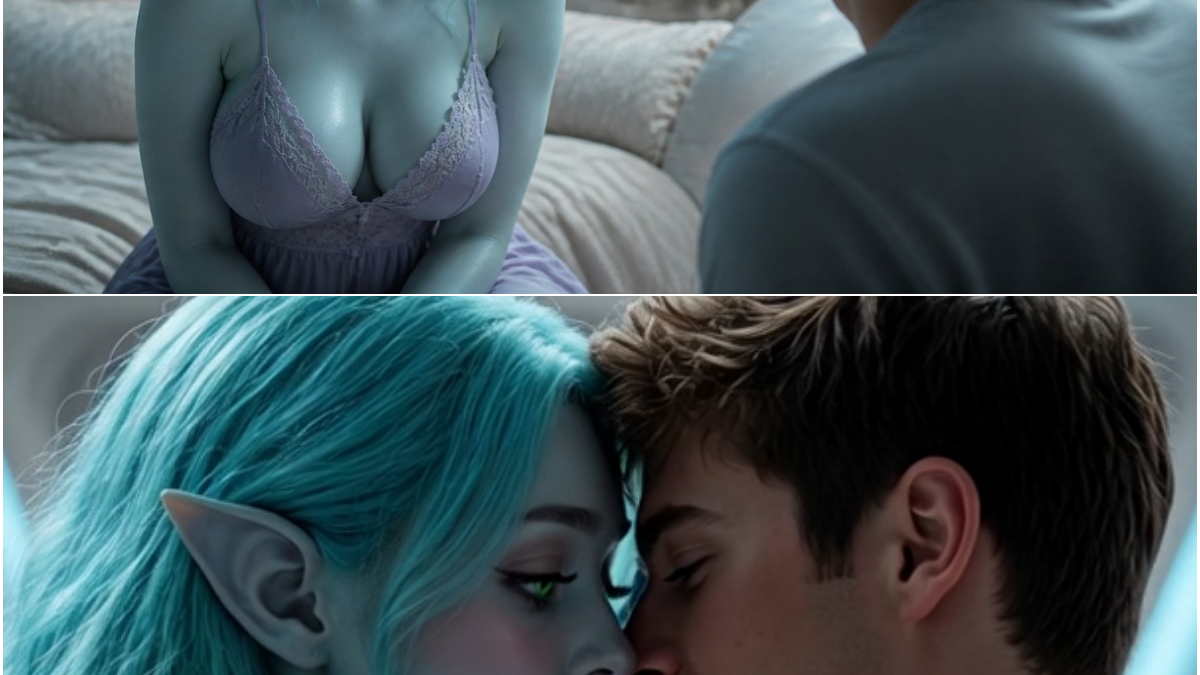
At 600 station time on a Tuesday morning, Declan Mercer received a housing notification that would quietly change the shape of his life.
The message contained three things: apartment 7 Gamma 12, his new roommates name, and a cheerful link to the conquered guide to interspecies cohabitation.
Declan ignored the guide. He had already learned that no bureaucratic document could prepare a person for sharing a home with someone whose biology followed rules that human experience had never needed to consider.
His new roommate was Ilasa Marin, a Silvari cultural liaison assigned to the Silvari delegation.
Declan knew enough about Silvari physiology to understand that their hearing was extraordinarily sensitive. He knew less about what that meant inside an ordinary apartment.
He would learn soon enough. He would learn that a door could be too loud.
That a dropped bag could become an unbearable shock. That silence could be more complicated than the absence of sound.
And eventually, he would discover something stranger still, something hidden beneath the careful distance Ilasa kept between herself and everyone around her.
What happens when the one person who can finally hear you is also the one person whose voice your body has been waiting for?
Declan Mercer was twenty nine years old when the housing lottery assigned him apartment 7 Gamma 12.
He was five feet ten inches tall, medium build, carefully groomed, and almost permanently tired.
The tiredness came with his profession. Declan was an acoustic engineer in the conquered environmental systems division on station 7, a position that required him to spend long shifts studying sounds most people never noticed.
Atmospheric processors. Structural vibrations. Electrical hums. Ventilation systems. Transit corridors. Machinery resonance. The station was home to seven species, and each species experienced sound differently.
The station had been designed to accommodate everyone. That was the official description. Declan considered it incomplete.
The station had been designed for a mathematical average. There was a difference. Humans could tolerate certain frequencies that bothered other species.
Some species barely noticed low vibrations that made others uncomfortable. Some needed warmth. Some preferred cooler environments.
Some slept during what humans considered daytime. Others were active during the stations quietest hours.
The conquered administration had solved the housing problem with an algorithm. The algorithm did not care about biology.
It did not care about sleep cycles. It did not care about culture. It simply assigned apartments.
The system had been created because the conquered founding charter prohibited species based residential separation.
The intention had been admirable. Different species were supposed to learn how to share space.
The result was that humans were paired with Dravinci, Rishani with Velisure, and Declan Mercer with Ilasa Marin.
Declan had grown up in Portland, Oregon. His father, Thomas Mercer, had worked as a recording engineer at Jackpot Studios for twenty six years.
His mother, Grace Yamamoto, had been a licensed family therapist in Portland for twenty years.
From his father, Declan learned to listen. From his mother, he learned to notice what people did not say.
Thomas had always insisted that hearing and listening were different. “Hearing happens automatically,” he used to tell Declan in the studio.
“Listening is a choice.” Declan had taken that lesson seriously. His childhood bedroom had been unusually quiet.
His father had treated the walls with acoustic panels after six year old Declan complained that the room sounded wrong.
Thomas measured the standing waves, identified the resonant frequencies, and changed the room. He never laughed at the complaint.
Instead, he listened. By twelve, Declan could identify the pitch of a refrigerator from another room.
By sixteen, he was helping his father at Jackpot Studios. By twenty two, he had earned his degree in acoustic engineering from Portland State.
Then the conquered environmental systems division offered him a position on station 7. He accepted because the station was an acoustic disaster waiting to be solved.
Three years later, he was still solving it. When he received his housing assignment, he expected another ordinary roommate arrangement.
He was wrong. Ilasa arrived three days after Declan moved into apartment 7 Gamma 12.
She carried two cases. She stood in the doorway for several seconds before entering. Declan noticed immediately.
She was fifty six, slight and precise in her movements. Her skin was pale lavender with a silver undertone that changed subtly beneath different lighting.
Her eyes were deep amethyst with tiny gold flecks surrounding the pupils. Her hair was silver and reached the middle of her back.
Her ears were longer than human ears, tapering toward gentle points and angling slightly forward.
Declan understood what that meant. Directional hearing. He had studied Silvari anatomy. He extended his hand.
“Declan Mercer. Acoustic engineer. I work in environmental sound management.” Ilasa looked at his hand.
Then at his face. Then back at his hand. “I am Ilasa Marin,” she said.
“Cultural liaison for the Silvari delegation.” She did not take his hand. “I apologize. The Silvari do not initiate physical contact.”
“No problem.” Declan lowered his hand. “Portland handshake rules are flexible.” Something changed in her expression.
Only slightly. “You are from Portland?” “Oregon.” “I have heard of it.” “Rain, music, and people who apologize when someone else bumps into them.”
Ilasa almost smiled. AlmoSt. “Then perhaps this arrangement will be tolerable.” That was the first thing she said that sounded honeSt.
Declan gave her space. He did not ask why she seemed nervous. He did not ask about her previous roommates.
He did not ask why her eyes kept moving around the apartment. He simply helped place her belongings in the spare bedroom.
The first two weeks were quiet. Very quiet. At first, Declan assumed Ilasa was simply private.
Then he began noticing patterns. She always sat in the chair farthest from the atmospheric processor.
She positioned herself away from the exterior wall. She closed doors with extraordinary care. She never dropped anything.
She rarely walked directly behind him. She seemed to calculate every movement before making it.
One morning, Declan closed a cabinet. He used one hand. The door made a soft click.
Ilasa flinched. The movement was so small that most people would never have seen it.
Declan did. His mother had taught him that involuntary reactions were often more honest than words.
He said nothing. Instead, he changed his habits. He replaced his ceramic mug with a silicone one.
He began wearing soft shoes inside the apartment. He lowered the volume of his personal communicator.
He closed cabinets with both hands. He placed objects down rather than setting them down.
He started controlling every movement. Ilasa noticed. Of course she noticed. Her ears moved toward every sound.
But gradually, something changed. She stopped flinching when the door sealed. She began spending more time in the shared living room.
She occasionally sat near him while he worked. She still kept her distance. But the distance no longer felt like fear.
It felt like caution. Then came the fifteenth day. Declan returned from a twelve hour calibration shift.
He was exhausted. His tool bag was heavy. He dropped it on the kitchen counter.
The sound was ordinary to him. A short, harmless thump. Then he heard something from Ilasas bedroom.
A sharp involuntary sound. Declan froze. He knew the sound of distress. His professional training told him one thing.
His mothers training told him another. Both reached the same conclusion. Something was wrong. “Ilasa?”
Silence. He lowered his voice. “Are you all right?” The bedroom door opened. Ilasa stood there.
Her lavender skin looked unusually pale. Her hands were gripping the doorframe. She was trembling.
“I am fine.” “You are not.” “I assure you.” “That sound was not nothing.” Her expression became carefully neutral.
“It was a sensitivity response.” “To the bag?” “Yes.” Declan stared at her. “How loud was it to you?”
She hesitated. Then she answered. “The Silvari auditory system operates across a frequency range approximately four times wider than the human range, with sensitivity approximately ten times greater.”
Declan understood immediately. “You heard that as extremely loud.” “Yes.” “How loud?” “Your sixty to seventy decibel conversational environment can register to me at a level comparable to approximately one hundred and ten decibels.”
Declan looked at the counter. Then at her. “You have been living here with that sensitivity?”
“Yes.” “And you never told me?” Ilasa looked away. “Because telling is usually the beginning of the end.”
Declan said nothing. She continued. “I have had three roommates before you.” He waited. “They all responded the same way.”
“How?” “At first, guilt.” Her voice remained calm. “Then accommodation. They whispered. They walked carefully.
They stopped inviting people over. They changed their routines.” “And eventually?” “They became frustrated.” Declan understood.
“They resented having to be quiet.” “Yes.” “And then they requested reassignment.” “Yes.” The room became silent.
Ilasa looked at him. “I did not want to begin the same process with you.”
Declan thought about his father. He remembered Thomas standing behind a mixing console. Hearing every tiny detail.
Adjusting levels. Changing a room until the instrument sounded exactly as it was supposed to sound.
He thought about his mother. People tell you everything, Grace used to say. They tell you through words.
They tell you through silence. They tell you through the spaces between the two. Declan looked around apartment 7 Gamma 12.
“This is not a roommate problem.” Ilasa blinked. “It is an acoustic engineering problem.” “You cannot engineer my biology away.”
“I do not intend to.” He pointed toward the walls. “I intend to engineer the apartment.”
She stared at him. “What?” “You heard me.” The next morning, Declan submitted requisitions to station maintenance.
Acoustic dampening panels. Vibration isolation mounts. Soft close magnetic door assemblies. Sound absorbing composites. Low vibration lighting.
Environmental processor modifications. His supervisor read the request twice. “You are modifying a residential apartment?”
“Yes.” “For a diplomatic liaison?” “For a Silvari auditory sensitivity profile.” His supervisor looked at the numbers.
Then at Declan. “Forty decibels of wall isolation?” “Yes.” “Twenty two decibel ambient noise floor?”
“That is the target.” “You know this is residential housing?” “I know.” “Declan, this is more sophisticated than some diplomatic conference rooms.”
“I know.” His supervisor sighed. “Fine.” Declan spent three evenings working. He measured every wall.
Every vent. Every surface. Every vibration source. He identified frequencies produced by the atmospheric processor.
He isolated the kitchen counter. He replaced the door hardware. He treated the lighting system.
He reduced structural transmission. He adjusted the air circulation system. He wrapped tools in vibration absorbing material.
He worked quietly. Not because Ilasa asked him to. Because the entire purpose was to create a space where she did not have to ask.
On the third evening, she came home. She opened the door. Then stopped. Declan looked up.
She remained there for eleven seconds. He counted. He could not help it. He was an engineer.
“What did you do?” “Calibration.” “To the entire apartment?” “Yes.” She stepped inside. Her ears moved.
She listened. There was almost no background noise. The atmospheric processor barely whispered. The walls absorbed the stations vibrations.
The doors closed without impact. The kitchen counter no longer transmitted contact through the structure.
Ilasa slowly removed her coat. “What is the ambient level?” “Twenty two decibels.” She looked at him.
“Twenty two?” “Twenty two.” Her eyes closed. For several seconds, she simply stood there. Then she whispered.
“No one has ever made the world quiet for me.” Declan did not know what to say.
So he told the truth. “Your hearing is not a problem.” Her eyes opened. “It is not?”
“It is a capability.” She looked around. “I have spent twenty seven years compensating for it.”
“I know.” “I have learned to make myself smaller.” “I know.” “I have learned to produce almost no sound.”
“I know.” “I have learned to live around everyone else.” Declan nodded. “This apartment does not require you to do that.”
Something shifted in her face. She laughed. It was barely louder than a whisper. It was the first time Declan had heard her laugh.
It was also the first time he realized how beautiful silence could sound when someone finally felt safe inside it.
Weeks passed. The apartment became a place neither of them had expected. Declan learned to speak at what his father called studio voice.
It was not a whisper. It was controlled speech. The voice of a person who understood exactly how far the sound needed to travel.
Ilasa began talking more. They discussed music. Culture. Portland. Silvari traditions. Station politics. Food. Architecture.
Sound. Ilasa taught Declan that Silvari could identify direction through sound with remarkable accuracy. Declan showed her how human recording engineers used microphones to recreate spatial perception.
She listened to recordings from Earth. He listened to Silvari music. Eventually, Ilasa told him why her family name was Marin.
She waited until the apartment was quiet. “The Silvari have a concept called the marin.”
Declan listened. “It is a harmonic bond.” “A partnership?” “More than that.” She touched the edge of her cup.
“Two voices become complementary.” Declan remained still. “The vocal systems adjust naturally. The fundamental frequencies change.
The harmonics become aligned.” “You can hear it?” “We can.” “Can humans?” “Not in the way we do.”
She looked at him. “My family name comes from the first Silvari scholars who documented the phenomenon.”
Declan smiled. “That sounds important.” “It is.” She paused. “There is something else.” He waited.
“The marin can occur between species.” Declan said nothing. “It is extraordinarily rare.” “How rare?”
“No documented case has existed.” He looked at her. “Until now?” Ilasa did not answer immediately.
Instead, she studied him. “When you speak to other humans, your voice is different.” “How?”
“You project.” “That is normal.” “When you speak to me, you do not.” Declan thought about it.
“Studio voice.” “Yes.” She said the words softly. “Your fundamental frequency is approximately one hundred and twelve hertz.”
Declan frowned. “How do you know that?” “I can hear it.” “And yours?” “Two hundred and twenty four.”
Declan became very still. The numbers formed a relationship he knew instantly. One hundred twelve.
Two hundred twenty four. One to two. An octave. He stared at her. “You are my octave.”
Her eyes brightened. “Yes.” The apartment seemed even quieter. “The marin begins with harmonic compatibility,” Ilasa said.
“The octave is the simplest relationship.” Declan remembered his father. Every recording session. Every carefully tuned instrument.
Every room measured to exact specifications. He remembered his mother. The words are the melody.
The silence is the harmony. The truth is in the harmony. “You have known since the calibration.”
“Yes.” “Why did you not tell me?” Her expression became fragile. “Because telling is the beginning of the end.”
Declan shook his head. “Not this time.” She looked at him. “Not this time?” “I am not requesting reassignment.”
Her eyes widened. “I am not counting down to the moment this becomes inconvenient.” She breathed slowly.
“I am staying.” Ilasa closed her eyes. Then she asked the quietest question he had ever heard.
“Say something.” Declan leaned forward slightly. “At what volume?” “At the volume you use when you speak to me.”
He smiled. “I am staying.” Her hands trembled. Not from discomfort. Not from pain. From something entirely different.
She lifted her face. “Again.” “I am staying.” She breathed in. Then she produced a single note.
Two hundred twenty four hertz. Pure. Clear. Soft. Declan answered. One hundred twelve hertz. The two tones met.
The relationship was simple. One. Two. The foundation. The octave. The harmony. For a moment, neither spoke.
They did not need to. Then Ilasa reached for his hand. It was the first time she had initiated physical contact.
Her fingertips rested against his. “You built a quiet room for me,” she whispered. “You needed one.”
“You built it before you understood why.” “I build rooms for people.” Her smile appeared.
“And now?” Declan looked at her. “Now I know who I built this one for.”
The next evening, Declan called Portland. The connection took three seconds to stabilize. Thomas Mercer appeared on screen from Jackpot Studios.
Grace sat beside him. Thomas looked at his son. “You changed something.” Declan smiled. “How can you tell?”
“The background.” Declan laughed. His father leaned closer. “Your noise floor is lower.” “Twenty two decibels.”
Thomas stared. “That is studio grade.” “Better than some studios.” Thomas looked pleased. “Who are you calibrating for?”
“My roommate.” “The Silvari?” “Yes.” Thomas became intensely interested. Grace looked at Declan instead of the equipment readings.
“You look different.” Declan knew immediately that he was in trouble. “I am fine.” “That was not my question.”
Thomas smiled. Grace continued. “You look settled.” “I am.” “Tell us about her.” Declan did.
He explained the hearing sensitivity. The apartment modifications. The quiet environment. The conversations. The harmonic relationship.
Thomas became silent. Then he smiled. “You calibrated for the instrument.” Declan nodded. “Her hearing is not an instrument.”
Thomas gave him a look. “You know what I mean.” Grace smiled. “And the person behind the instrument?”
Declan paused. “She matters.” Grace nodded. “That is what I thought.” Six weeks after the apartment calibration, Ilasa informed the Silvari cultural authority that the marin had formed.
The response was immediate. They requested verification. The ceremony took place in the Silvari delegations meditation chamber.
Declan entered and immediately understood the purpose of the room. It was not designed for speaking.
It was designed for listening. The ambient level was fifteen decibels. Four senior Silvari observers stood beside Velerin, Ilasas supervisor.
Ilasa stood beside Declan. Her lavender skin reflected the soft lighting. Her silver hair fell over her shoulders.
Her amethyst eyes remained fixed on him. Velerin stepped forward. “The verification requires no words.”
Declan nodded. “The voices will establish the relationship.” Ilasa looked at him. Then she began.
Two hundred twenty four hertz. The tone filled the room. Declan waited. Then answered. One hundred twelve.
The two tones met. The observers listened. Their ears adjusted. Their attention sharpened. No one moved.
The frequencies continued. One. Two. The simplest harmonic relationship. The first harmony. The foundation of countless sounds.
Then the senior observer spoke. “Confirmed.” Another followed. “Harmonic relationship verified.” A third said. “Permanent resonance.”
Velerin looked at Ilasa. Then at Declan. “The marin is recognized.” Ilasa reached for Declans hand.
This time, there was no hesitation. Their fingers intertwined. The ceremony ended without applause. There was no need for it.
The sound had already said everything. Later, they returned to apartment 7 Gamma 12. The station continued around them.
Transit systems moved. Atmospheric processors turned. Doors opened and closed. Thousands of people spoke. Machines hummed.
Lights vibrated. The station was never truly silent. But their apartment was. Twenty two decibels.
A quiet room. A room built for ears that heard everything. Declan stood near the window.
Ilasa joined him. “Do you regret accepting the housing assignment?” She asked. He smiled. “The worst housing lottery in the galaxy?”
“Yes.” “I think it made one mistake.” “What mistake?” “It assigned us randomly.” Ilasa laughed softly.
“Was it random?” “According to the algorithm.” “And according to you?” Declan looked at her.
He thought about his father. He thought about his mother. He thought about sound and silence.
He thought about the apartment. The quiet. The octave. The first note. The second. The space between them.
“I think the algorithm was measuring the wrong thing.” “What should it have measured?” “Compatibility.”
Ilasa rested her head lightly against his shoulder. “And what did it find?” Declan listened.
Not to the station. Not to the machinery. Not to the atmospheric processors. To her breathing.
To the faint vibration of her voice. To the silence that followed. He smiled. “It found the right frequency.”
Ilasa closed her eyes. The apartment remained quiet. Not empty. Not lonely. Quiet. And somewhere between one hundred twelve hertz and two hundred twenty four hertz, between sound and silence, between two people who had been placed together by an indifferent system, something had become perfectly calibrated.
Not the apartment. Them.
Disclaimer: This content may be created by Al for entertainment purposes. Any resemblance to real persons, events, or places is coincidental.








