Michigan Dogman Sightings Just Hit a 40-Year High — The Territory Map Is Alarming
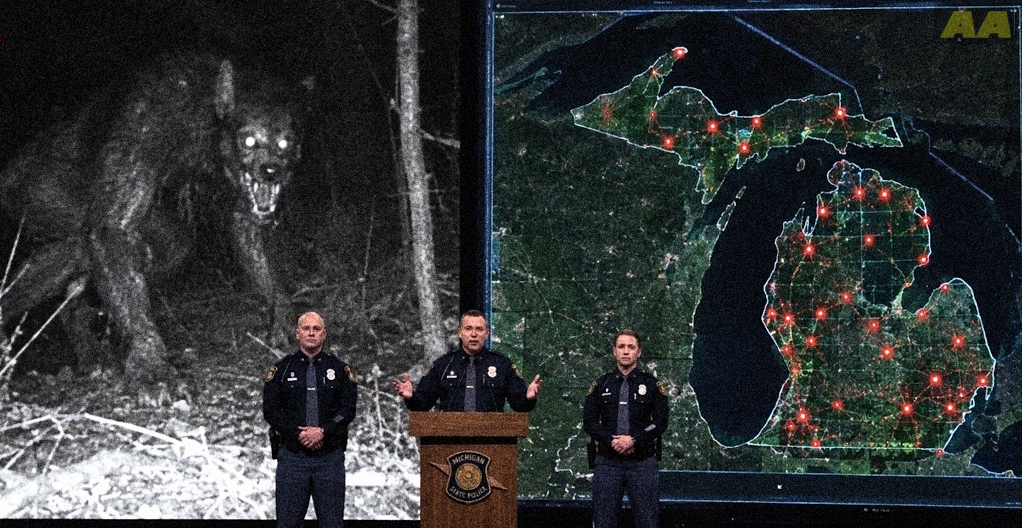
On the night of April 1st, 1987, a radio station in Traverse City was about to create something that would outlive the joke that gave it a name.
The studio was ordinary, the equipment familiar, and the broadcast was supposed to be nothing more than an April Fool’s Day prank.
Then Steve Cook pressed play. The song described a creature no wildlife agency had ever recorded, no scientist had ever classified, and no field guide had ever mentioned.
It supposedly had the body of a man and the head of a dog. It supposedly had been seen near the Manasty River in 1887.
It supposedly returned every ten years in years ending with the number seven. Cook had invented all of it.
He even invented the songwriter credited with the recording, giving the fictional name Bob Farley to a creature that existed only in his imagination.
Yet within weeks, the telephone lines at WTCM FM began filling with people who said they had seen something strangely similar.
Some described a huge animal standing beside roads. Others remembered glowing eyes in the woods.
Some insisted they had encountered something walking upright. The joke had lasted only a few minutes.
The story would last for decades. And as the years passed, older sightings appeared, photographs surfaced, maps were drawn, and a grainy piece of film was presented as evidence that something had been moving through Michigan long before that radio broadcaSt.
But if the creature had never existed before 1987, how did so many people come to believe they had already seen it?
The answer begins inside that radio studio. Steve Cook had not set out to create a monster that morning.
He was a disc jockey at WTCM FM in Traverse City, Michigan, and April 1st gave him the perfect excuse to make something ridiculous.
He wrote a novelty song called The Legend on Air. The lyrics told a story that sounded remarkably specific.
Lumberjacks near the Manasty River in 1887 supposedly encountered a strange animal. There were 11 men near a swamp.
They initially thought they had found an ordinary dog. They chased it toward a hollow log, and one of the lumberjacks pushed a stick inside.
Then the animal revealed itself. It was not a normal dog. It had the body of a man and the head of a dog.
Cook added other locations and incidents to make the story sound older and more authentic.
Buckley appeared in the lyrics. Bair appeared. Bowowers Harbor appeared. A supposed 1917 incident involved a sheriff discovering a driverless wagon, strange tracks in the dust, and four horses lying nearby.
The details were deliberately concrete. That was what made the prank work. A vague story about a monster might have sounded ridiculous.
A story containing real Michigan communities, dates, occupations, roads, rivers, and supposed witnesses sounded different.
It had the texture of local history. Cook recorded the song with simple keyboard music and credited it to Bob Farley, a songwriter who did not exiSt.
The creature did not exist either. But listeners did not all understand that. The broadcast went out on April 1st, 1987, and the reaction arrived faster than anyone expected.
The station telephone began ringing. People called to describe strange things they believed they had seen.
Some callers sounded amused. Others sounded completely serious. A few claimed they had encountered something that matched Cook’s description almost perfectly.
Within weeks, The Legend became one of the station’s most requested recordings. Cook began selling cassette copies for $4 each and donated the proceeds to a local animal shelter.
What had begun as a joke had developed into something else. People had taken a fictional creature and placed it into their own memories.
Over the following decades, Cook said he personally received more than a hundred reports from people convinced they had encountered the Dogman.
He never presented those reports as scientific evidence. In fact, he remained deeply skeptical. But his position contained an important distinction.
He did not necessarily believe that every person who contacted him had invented their experience.
Someone might have genuinely seen an animal. Someone might have genuinely heard something strange in the woods.
Someone might have seen a shape beside a road at night and remembered the encounter vividly.
The question was what they had actually encountered. Once the Dogman story existed, it gave uncertain experiences a ready made explanation.
A person who once might have said, “I saw something strange beside the road,” could now say, “I saw the Dogman.”
That difference mattered. Folklore researchers have a name for one part of this process. Ostension describes the point at which people begin acting out, interpreting, or experiencing real events through the framework of an existing legend.
A fictional story can therefore create genuine reactions. The story does not need to be true for the experiences surrounding it to become real to the people involved.
Imagine driving down an isolated Michigan road late at night. The headlights illuminate something large beside the pavement.
For a moment, there is a shape. Perhaps it is a coyote. Perhaps it is a wolf.
Perhaps it is a dog. Perhaps it is an animal affected by mange and missing much of its normal coat.
Perhaps the headlights catch a bear standing upright for several seconds. Perhaps the distance makes its proportions impossible to judge.
The vehicle continues forward. The image remains in memory. Then someone tells the driver about the Dogman.
Suddenly, an old unexplained moment has a name. That name can change the way the memory is understood.
Another related practice is called legend tripping. People travel deliberately to locations connected with stories because they hope to experience something themselves.
The road becomes famous because of the story. People visit because the road is famous.
More people visit. More unusual sounds and movements are noticed. More stories are reported. The legend grows.
It becomes a cycle that can continue without requiring the original creature to exiSt. The same process helps explain why Michigan’s Dogman story became so much larger than the few minutes of radio programming that created it.
As the years passed, older stories began appearing around the legend. Some were said to come from 1887.
Others were placed in 1938, 1950s, and 1967. The 1887 account became especially important because it matched the date and location from Cook’s original song.
Two lumberjacks were supposedly confronted by a creature with a manlike body and canine head in Wexford County.
Another story involved Robert Fortney, who supposedly encountered five wild dogs near Paris, Michigan in 1938, with one of the animals reportedly moving on two legs.
Other reports were connected to Alagen County, the Manasty area, and Cross village. Taken together, these stories created the impression of a creature with a history stretching back many decades before the radio broadcaSt.
But there was a problem. Independent documentation from before 1987 never emerged to establish that these specific Dogman stories existed in that form before Cook wrote his song.
No period newspaper article confirming the 1887 story appeared. No police report from the period established it.
No diary or other contemporary document surfaced to demonstrate that the same creature had been described before the radio prank.
That does not prove that nobody in Michigan ever encountered an unusual animal before 1987.
It establishes something narrower and more important. The specific historical version of the Dogman legend, complete with its famous dates and locations, cannot be independently traced to a source older than Cook’s song.
That distinction is easy to lose once a legend has been repeated for decades. Every repetition makes the story feel older.
Every website copies another website. A date gets repeated. A town name gets repeated. A supposed witness becomes part of the narrative.
Eventually, a story created in a radio studio can begin to look like something that had always existed.
Then came another generation of reports. A teenage girl in 1993 reportedly encountered a large creature with a doglike head inside a barn.
In 1994, a driver reportedly struck what appeared to be a deer, only for the animal to be absent afterward, with gray fur reportedly left behind on the vehicle.
These accounts were intriguing. They were also limited. There was no independently verified specimen. There was no veterinary examination establishing an unknown species.
There was no physical evidence that could be conclusively connected to a Dogman. The stories remained personal testimony.
Then the internet changed everything. In September 2007, a grainy film began circulating under the name The Gable Film.
It was presented as an old 8mm home movie. The story attached to it claimed that a family picnic had been interrupted by a strange creature and that the footage had been recorded decades earlier by a man named Gable.
The film looked old. That was the point. The image was rough. The camera shook.
The footage had the visual imperfections people associated with old home movies. The creature appeared wolflike or doglike as it moved across the frame before approaching the camera.
For viewers encountering it without the surrounding history, the footage looked like the kind of accidental discovery that could have been hidden for decades.
It spread across early internet communities. People discussed it. Others analyzed it. Some treated it as evidence.
But the story behind the footage was not what it appeared to be. The Gable Film had been deliberately produced by Mind Stage Productions and directed by Micah Grusa.
It had been designed to imitate an old home movie. Even its visual imperfections were part of the construction.
The connection to the original Dogman story made the situation even more remarkable. Cook was directly connected with the creation and promotion of the footage.
The same man who had invented the Dogman legend in 1987 later became involved with one of the most famous pieces of supposed visual evidence associated with it.
Yet the film continued circulating. In 2009, it reached an even larger audience when it appeared during a segment on Fox News’s Hannity program, where researcher Linda Godfrey discussed the footage and the broader legend.
By then, the clip had taken on a life far beyond the circumstances in which it had been created.
The lesson was not simply that people could be fooled by a convincing film. It was that once a piece of folklore gains momentum, information about its origin can become less influential than the story people want the evidence to support.
Michigan was not the only place where reports of a wolf or doglike creature had become part of regional folklore.
Across Lake Michigan in Wisconsin, another legend was developing. It became known as the Beast of Bray Road.
In the late 1980s, journalist Linda Godfrey began investigating strange animal reports near a rural road outside Elhorn, Wisconsin.
At first, she approached the accounts with skepticism. But after speaking with witnesses, she became convinced that many of them were describing their experiences sincerely.
Her reporting eventually became a book titled The Beast of Bray Road. One of the accounts involved a girl named Heather, who was sledding with friends near Elhorn in late December 1990 when she reportedly saw a large silver furred creature that briefly stood upright before moving after the group.
Godfrey also examined clawlike marks associated with another reported encounter. She did not claim that those marks proved an unknown creature existed.
She said she could not determine exactly what had caused them. That distinction was important.
A witness can be sincere without being correct about what they saw. A physical mark can be genuine without revealing its source.
A strange animal can exist without being a new species. Godfrey later compared some Michigan reports with the Wisconsin Beast of Bray Road stories, helping connect the two legends.
In her 2019 book, I Know What I Saw, she described the Manistee National Forest as a major center of Dogman reports within Michigan.
That description was later repeated widely online. But it was still a characterization from an individual researcher, not an official designation by a wildlife agency.
Skeptical explanations generally focused on animals already known to inhabit the region. Gray wolves were one possibility.
Coyotes were another. And one condition in particular could dramatically change the appearance of a wild canine.
Mange. A coyote or wolf suffering from advanced mange can lose large amounts of fur.
Its skin can become thickened and darkened. Its body can become thinner. Its head may appear disproportionately large.
Its movement can become unusual. Seen briefly at night, especially from a moving vehicle, such an animal can look radically different from the healthy coyote or wolf a person expects to see.
Michigan has large stretches of forest where encounters with wildlife can be brief and poorly illuminated.
That makes identification difficult. Black bears provide another possible explanation for some reports. A bear can stand upright on its hind legs.
Someone seeing one briefly from a distance could interpret its shape differently depending on lighting, terrain, and expectation.
None of these explanations automatically resolves every Dogman report. Some witnesses describe unusually humanlike faces.
Others describe prolonged movement on two legs. Others insist they saw something that looked nothing like an ordinary animal.
Those details are precisely why folklore survives. There is always another story that appears to resist the easiest explanation.
But the lack of a perfect explanation for every report is not the same thing as evidence for a new species.
Then there is the most unusual feature of Cook’s original story. The ten year cycle.
According to the song, the creature returned in years ending with the number seven. 1887.
1888. 1889. 1890. 1891. 1892. 1893. The pattern was built into the legend from the beginning.
And because it was part of the story, it created its own future calendar. Every decade offered another opportunity to revive the Dogman.
As 2017 approached, interest naturally returned. Then 2027 became the next expected year in the fictional cycle.
That does not establish that anyone is deliberately manufacturing every new report. It simply means the legend contains a built in mechanism for renewed attention.
A story predicts that something will appear in a certain year. People remember the prediction.
The year arrives. People begin looking. People who are already familiar with the story become more alert to unusual animals and strange sounds.
Reports appear. The reports become evidence that the legend is active again. The cycle reinforces itself.
This is one reason claims about dramatic increases in sightings require careful examination. There is no official Michigan wildlife program tracking Dogman reports.
The Michigan Department of Natural Resources does not maintain a scientific Dogman population database. There is no peer reviewed wildlife survey establishing a growing population.
There is no government map showing a verified Dogman territory. Instead, there is an enormous online community.
Thousands of people discuss reports. Websites collect stories. Social media pages publish submissions. A Reddit community devoted to the subject has grown to more than 24,000 members.
Maps can be created from these reports. But a map made from voluntary online submissions measures something specific.
It measures where people are reporting experiences. It does not automatically measure where an unknown animal population exists.
The difference is crucial. Suppose one thousand people become interested in the Dogman during a particular year.
More people will submit reports. A map will acquire more points. A chart will show an increase.
But the increase could reflect interest rather than wildlife. The forest may be exactly the same.
The number of unusual animals may be exactly the same. Only the number of people looking for the Dogman may have changed.
Northern Michigan provides the perfect setting for that process. The northwestern Lower Peninsula contains extensive forests, including the Manistee National ForeSt.
There are rural roads, isolated stretches of woodland, small communities, and areas where a person can spend an entire night without seeing another vehicle.
Wild animals genuinely live there. Wolves exiSt. Coyotes exiSt. Black bears exiSt. Domestic dogs wander beyond their yards.
Animals affected by illness or injury can look unfamiliar. At night, distance removes detail. A shape moves.
A sound comes from the trees. A pair of eyes reflects headlights. The brain has seconds to decide what it is seeing.
If the person already knows the Dogman story, the legend is waiting. The most interesting part of the story may therefore have nothing to do with whether a creature with a human body and dog head is hiding somewhere in Michigan.
The more revealing question is how a creature that began as an April Fool’s joke became embedded in the cultural memory of an entire region.
Cook supplied the name. He supplied the appearance. He supplied the dates. He supplied the locations.
He supplied the ten year cycle. Listeners supplied their experiences. The internet supplied permanence. The Gable Film supplied an apparent visual artifact.
Researchers supplied interviews and comparisons. Enthusiasts supplied maps. And the Michigan wilderness supplied countless opportunities for something genuinely strange to be seen for only a few seconds.
Each part strengthened the next. By the time people began talking about the Dogman as though it had always been part of Michigan history, the original joke had become difficult to separate from the folklore that followed it.
That is what makes the story so unusual. The mystery is not necessarily hidden in the foreSt.
Part of it is sitting in plain sight in an old radio recording. A fictional songwriter named Bob Farley.
A fictional creature. A fictional 1887 encounter. A fictional ten year cycle. All of it created by a real radio DJ on April 1st, 1987.
And yet the people who called the station afterward were real. Their memories were real.
Their fear or excitement was real. Their encounters with animals and strange shapes were real experiences from their perspective.
The uncertainty lies in the interpretation. Maybe someone saw a wolf. Maybe someone saw a coyote affected by mange.
Maybe someone saw a bear standing upright. Maybe someone saw a large dog at an impossible angle.
Maybe some reports remain unexplained. But unexplained does not automatically mean unknown species. The same principle applies to the old stories.
Their existence as stories is real. Their existence as independently documented historical events before 1987 remains unestablished.
The Gable Film exists as a piece of footage. Its history as a deliberately constructed production also exists.
The online reports exiSt. The absence of scientific verification exists alongside them. And the ten year cycle exists because Cook placed it there at the beginning.
The Dogman therefore occupies a strange place between fiction and personal experience. It began as something invented.
Then people began seeing the world through it. Once enough people shared the same framework, the creature no longer needed a physical body to continue growing as folklore.
It needed only another dark road. Another unfamiliar sound. Another pair of eyes caught in headlights.
Another person who had never heard the story before and later heard someone explain what they might have seen.
Then the name would be there. Dogman. A name powerful enough to turn uncertainty into a story.
And perhaps that is the most enduring mystery of all. Not whether a creature with a wolf head is secretly moving through Michigan forests, but why a story created for a single April Fool’s Day broadcast became so convincing that decades later, people were still searching the darkness for the creature that had never been there in the first place?
Disclaimer: This content may be created by Al for entertainment purposes. Any resemblance to real persons, events, or places is coincidental.








