Maine Tore Out 2 Dams and Millions of Fish Came Roaring Back — What Happened to the River Is Unreal
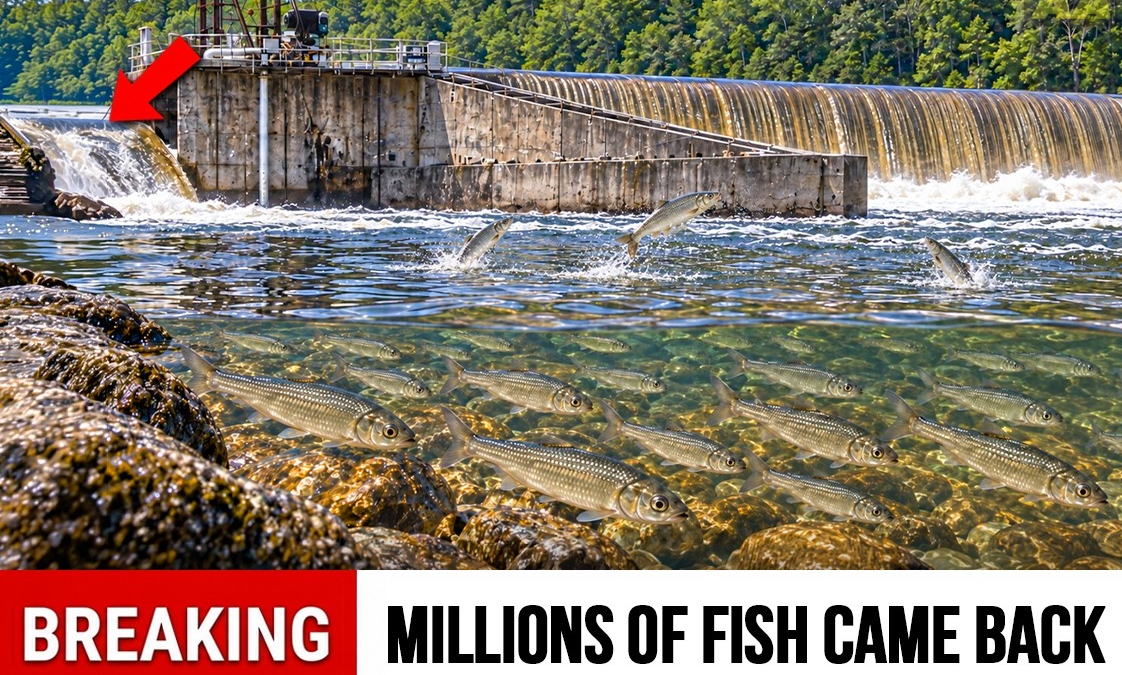
In the spring of 2023, Jason Valier was sitting at his desk inside the main Department of Marine Resources office when a number on his computer screen forced him to stop and look twice.
The season’s count from the Milford Dam fish lift on the Ponobscot River was far beyond what he expected.
He checked the records again. Then he checked the calibration logs. He searched for a software problem, an instrument error, anything that could explain the strange result.
Finally, he called a colleague and asked for the same data to be pulled independently.
The number remained the same. Nearly 6 million alewives had passed through the Ponobscot River that year.
Thirteen years earlier, in 2010, the VZY Dam fish counter had recorded only two. Two fish in an entire river system that once carried millions every spring.
Now the river was carrying them again, silver bodies moving upstream through a watershed stretching from the shadow of Mount Katardin toward Ponobscot Bay.
The difference was so enormous that it seemed almost impossible to describe. Something had changed beneath the surface of Maine.
Something that engineers, biologists, conservationists, Indigenous leaders, government officials, and communities had spent years trying to restore.
And when the fish finally began returning in numbers nobody had expected, the river seemed to reveal a question that had been waiting beneath the dams for generations, what happens when a river is finally allowed to remember what it was?
For thousands of years, the Ponobscot River had functioned as more than water moving toward the Atlantic.
It was a living corridor between two worlds. The river begins near the Canadian border in the highlands of northern Maine, passes beneath the shadow of Mount Kataden, the state’s highest peak at 5,268 feet, and travels roughly 240 miles before reaching Ponobscot Bay near Bucksport.
Its watershed covers approximately a third of Maine, an immense landscape of forests, tributaries, wetlands, lakes, and waterways.
Before the large dams arrived in the 1830s, this system was one of the great biological highways of northeastern North America.
Every spring, enormous numbers of fish traveled from the ocean into freshwater. Atlantic salmon once returned in runs estimated between 75,000 and 100,000 fish.
River herring, including alewives and blueback herring, could number between 14 and 20 million. American shad traveled more than 100 miles upstream toward spawning grounds.
Atlantic sturgeon and short nose sturgeon moved through the lower river, while striped bass, rainbow smelt, tomcod, sea lamprey, and American eels occupied different parts of the system.
Eleven species of sea run fish used the Ponobscot as a connection between saltwater and freshwater.
And the Ponobscot people had lived with that river for thousands of years. The river was central to their food, movement, culture, and identity.
Indian Island, approximately 10 miles upstream from the Head of Tide, served as a traditional springtime gathering place.
The fish arriving from the sea were not simply another part of the ecosystem. They were part of the rhythm of life.
Salmon announced the arrival of spring. Alewives could be used to fertilize gardens. Shad had been harvested for thousands of years, with archaeological evidence from ancestral settlements showing that these fish had long been part of the human relationship with the river.
Chuck Luring Jr., director of natural resources for the Ponobscot nation, described the river as both a highway and a food source.
Fish had made up a substantial part of the community’s diet. Then the walls began appearing.
The first large dam on the Ponobscot was constructed in 1834 to provide power for sawmills during Maine’s timber boom.
More followed. By the early 1900s, dams were being converted for hydroelectric generation, while additional structures continued to appear throughout the twentieth century.
At its peak, more than 100 dams occupied the Ponobscot watershed. Each one changed the river.
A fast flowing channel became a slower impoundment. Water temperatures changed. Sediment accumulated. Habitat that had once provided cold, oxygen rich conditions for migratory fish became increasingly fragmented.
The effects multiplied with every barrier. Salmon runs declined. Shad became increasingly scarce. Sturgeon lost access to historic habitat.
River herring that had once arrived in the millions were reduced to tiny remnants. The industrial history of the river added another layer of damage.
Paper mills discharged waste into the water. Clear cutting destabilized riverbanks and increased sediment in tributaries.
Timber drives sent enormous quantities of logs downstream, disturbing streambeds and altering the smaller pools that young fish depended on.
The Ponobscot gradually became something very different from the river that had existed before the dams.
By the early 2000s, fewer than 1,000 Atlantic salmon were returning each year. The Gulf of Maine population of Atlantic salmon had been listed as endangered under the Endangered Species Act in 2000.
Then came the number that would eventually become one of the clearest symbols of how far the system had fallen.
Two. In 2010, the VZY Dam fish counter recorded two alewives. Not two thousand. Not two hundred.
Two. But the loss was larger than the disappearance of fish. Alewives and shad function as biological carriers of nutrients.
They spend much of their lives in the ocean, then transport nitrogen, phosphorus, carbon, and other marine derived nutrients into freshwater when they migrate upstream.
Those nutrients enter the food web in many ways. Predators consume the fish. Insects feed on their remains.
Birds gather around the migration routes. Aquatic organisms benefit from the nutrients entering the river.
The effects move outward through the ecosystem. When the fish disappeared, that annual transfer of ocean nutrients largely disappeared with them.
The river was missing a biological conveyor belt that had operated for thousands of years.
By the end of the twentieth century, restoring that connection seemed extraordinarily difficult. Then, in 1999, Pennsylvania Power and Light Corporation, known as PPL, purchased a series of dams on the Ponobscot River.
The acquisition triggered a federal relicensing process under the Federal Energy Regulatory Commission. For conservation groups, that process created an opportunity.
Instead of spending decades fighting dam owners through individual legal battles over fish passage, what if the organizations involved could create a different kind of agreement?
What if some dams were removed entirely while other dams were upgraded so that hydroelectric production could continue?
The idea required every major participant to compromise. Conservation groups had to accept that some dams would remain.
The hydropower company had to accept that other dams would be removed. The Ponobscot Indian nation had to place trust in a process involving institutions connected to a river that had been altered for nearly two centuries.
State and federal officials had to participate despite the political and economic disagreements surrounding the plan.
At the center of the effort was Laura Rose Day. Trained in wildlife management and environmental and energy law, Rose Day had arrived in Maine in 1998 as watershed program director for the Natural Resources Council of Maine.
She had helped complete the removal of Edwards Dam on the KBc River in 1999, an important New England example of a major dam being removed.
She then turned toward the Ponobscot. For five years, negotiations continued. In June 2004, the Ponobscot River Restoration Trust formally signed an agreement with PPL.
The goals were ambitious but specific. Restore sea run fisheries on the Ponobscot River while maintaining hydropower production.
The trust included the Ponobscot Indian Nation, American Rivers, the Atlantic Salmon Federation, Maine Orderon, the Natural Resources Council of Maine, Trout Unlimited, and the Nature Conservancy.
Dam owners, state agencies, federal agencies, conservation organizations, and the Indigenous community were now connected by the same agreement.
The plan did not have universal support. Maine Governor Paul Leage publicly criticized it. At a press event in 2012, he said, “I think it is irresponsible for our country to be taking out hydro dams.
I think we need to put more in.” Some residents worried about changing water levels, reduced lakefront access, and changes to landscapes they had known for generations.
Laura Rose Day later recalled that some of the most important conversations were not about engineering diagrams or ecological models, but about people’s personal relationships with the river.
Those relationships mattered because the project was about to change a landscape that communities had lived beside for generations.
In December 2010, the Ponobscot River Restoration Trust purchased three dams from PPL’s successor, Black Bear Hydro Partners, for approximately $25 million.
The three structures were the VZY, the Great Works, and the Howland. The plan called for the VZY and Great Works dams to be removed while the Howland Dam would receive a nature like fish bypass.
At the same time, Black Bear Hydro would upgrade six other dams, increasing their generating capacity so that the total hydroelectric production on the Ponobscot would remain approximately the same.
It was not a simple choice between technology and nature. It was an attempt to redesign the entire system around both.
On June 11, 2012, work began at the Great Works Dam. Dan Kusners, the water resources program manager for the Ponobscot Indian Nation, had brought his sons to the river about a week before.
They stood in front of the aging structure for a photograph. They had just come from a little league game and were behaving like children, unaware of the historical importance of the moment.
Kusners understood. The dam had stretched approximately 1,000 feet across the Ponobscot River between Oldtown and Bradley.
Crews from RF Jordan and Sons Construction used two excavators fitted with hydraulic jackhammers to break apart the fishway section piece by piece.
A third excavator removed the rubble and placed it into dump trucks. The work continued through the year.
In November, the demolition was complete. The next major moment came on July 22, 2013.
The VZY Dam was breached. The structure had been approximately 830 feet long and stood between the towns of VZY and Edington near Bangor.
Built in 1912, it had blocked the river’s connection with the sea for more than a century.
When the opening was created, sections of concrete broke away and water dropped approximately 32 feet toward the riverbed.
More than 300 people watched from the banks. John Banks, director of natural resources for the Ponobscot Indian Nation, later described the river as though it had paused before beginning to move freely again.
The Ponobscot Indian Nation held a sacred ceremony with drumming during the breaching. For the community, this was not simply the removal of an industrial structure.
It represented the reopening of a relationship that had been interrupted for generations. Chief Kirk Francis of the Ponobscot Indian Nation explained that the health of the river was deeply connected to the cultural survival of the tribe.
The Howland Dam required a different solution. Located on the Piscatiquist River at its confluence with the Ponobscot, the Howland Dam had strong local opposition to complete removal.
So the project changed direction. Engineers designed a nature like fish bypass channel, essentially an artificial stream built around the dam.
Instead of forcing fish through a conventional ladder, the channel used rocks, bends, changes in elevation, and flowing water to imitate the characteristics of a natural river.
Construction was completed in late 2015. The bypass became fully operational in 2016. The entire Ponobscot River restoration project cost approximately $62 million.
That investment reconnected nearly 2,000 miles of rivers and streams with the sea. The expectations were cautious.
Biologists knew that ecosystems rarely recover overnight. They expected gradual improvement. They did not expect what came next.
Within months of the VZY Dam removal, fish began appearing in sections of the river where they had been absent for generations.
Alewives were among the first major signals. In 2012, the year the Great Works Dam came down, the alewife count at the Milford Dam fish lift was still modeSt.
By 2015, only two years after the VZY Dam was removed, the combined alewife count in the Ponobscot system had reached nearly 1 million.
Oliver Cox, a fisheries biologist who heads the Maine Department of Marine Resources division of sea run fisheries and habitat, described the number as a major change.
But the river was not finished. The numbers continued climbing. By 2020, alewife and blueback herring returns had exceeded 2 million.
Then came 2023. Nearly 6 million river herring entered the Ponobscot watershed. The same river where the VZY counter had recorded only two alewives in 2010 was now carrying millions.
The recovery was so rapid that it challenged expectations about how quickly a heavily altered river could respond once major barriers were removed.
The herring were not alone. American shad also began reclaiming sections of the river. Before the dam removals, only 16 adult shad had passed through the VZY dam fishway during the entire period from 1978 through 2012.
Sixteen fish in 34 years. After the barriers were removed, annual shad counts at the Milford Dam surpassed 10,000 by 2022.
For the first time in decades, fishermen around Bangor were asking about catching shad because enough fish had returned to make the question meaningful again.
Short nose sturgeon also moved upstream beyond the former VZY Dam site. For a species that had been restricted from historic portions of the river for generations, the reopening of that habitat represented an enormous change.
Atlantic sturgeon began appearing in areas where people had not seen them for years. Then the effects spread beyond the fish themselves.
Striped bass followed the herring. Eagles and ospreys found more food. River otters returned to stretches where sightings had become unusual.
Kingfishers appeared along the banks. Waterfowl, including Barrows Golden Eye, found feeding opportunities in riffles that had previously been submerged beneath impoundments.
Freshwater mussels benefited because some species depend on migratory fish to transport their larvae upstream.
Insects feeding on fish remains became part of the renewed food chain. The river was not simply receiving fish.
It was receiving nutrients. Millions of bodies carried material from the Atlantic into the interior of Maine, creating an annual pulse that had been greatly diminished for generations.
A restored herring run could therefore influence animals far beyond the water. On the Sebasticook River, another Ponobscot tributary where alewife runs had been restored after a different dam removal, wildlife biologist Charlie Todd from the Maine Department of Inland Fisheries and Wildlife documented a major eagle aggregation and the highest breeding density of ospreys anywhere in the state.
The restored fish run had become a food source large enough to influence entire bird populations.
Now a similar process was unfolding on the much larger Ponobscot. By 2025, the statewide alewife count across Maine’s rivers had reached approximately 20 million.
The Ponobscot had become a major part of that transformation. The river itself was changing too.
Where the Great Works Dam had once stood between Oldtown and Bradley, water now moved over exposed bedrock, creating rapids and pools.
Paddlers could travel from Oldtown toward the sea without encountering the former dam. The Ponobscot Nation was selected to host the American Canoe Association Whitewater National Championships for three years, bringing hundreds of paddlers to sections of river that had been hidden beneath impounded water.
Scientific measurements also showed changes. Research published by the US Geological Survey documented a 31 percent average increase in fish assemblage similarity between newly connected reaches.
In simple terms, sections of the river that had been separated for more than a century were beginning to resemble parts of the same functioning ecological system again.
But the Ponobscot story is not simply a story about a perfect restoration. One species in particular reminds us how complicated recovery can be.
Atlantic salmon have not returned at the same pace as the herring. The Ponobscot now hosts the largest remaining run of wild Atlantic salmon in the United States, but the numbers remain far below their historical levels.
In 2014, only 248 salmon returned to the river. The number improved during later years, reaching approximately 1,500 in 2023, the best result since 2011.
By June 2026, 714 salmon had already been counted, exceeding the entire 2025 total. The trend shows improvement, but the historical comparison remains enormous.
The river once supported annual salmon runs estimated between 75,000 and 100,000. Fishing for these Atlantic salmon remains prohibited because the population is still endangered.
The challenge extends far beyond the Ponobscot. Atlantic salmon spend one to three years at sea before returning upstream.
Conditions in the North Atlantic influence whether young salmon survive long enough to make that journey.
Ocean temperatures are changing. The distribution of prey is shifting. Marine survival has declined across much of the North Atlantic.
Restoring the river can reopen spawning habitat. It cannot control the ocean. The Ponobscot also remains heavily modified.
More than 100 dams still exist throughout the watershed. The two main stem removals reopened only about 15 kilometers of river.
Important cold water habitat in the northern Ponobscot remains affected by upstream barriers, including areas of the west branch that could be important for future salmon recovery.
Dan Tierney, NOAA Fisheries Atlantic salmon recovery coordinator, has emphasized that salmon returns vary substantially from year to year.
The long term goal of restoring much larger salmon returns therefore requires more than simply removing two dams.
It requires continued work on connectivity, habitat, water temperature, and conditions in the Atlantic. And that brings the story back to the difficult question of what happens when ecological restoration meets human communities.
The Ponobscot agreement worked partly because it created a way to preserve hydroelectric production while removing selected barriers.
Not every river offers the same opportunity. Hydropower supplies roughly half of Maine’s renewable electricity generation.
Dams also support local economies, tax bases, industries, recreation, and established ways of life. On the Kbec River, proposals to remove four hydropower dams between Waterville and Scowaggan have faced strong opposition.
Sappy North America operates a paper mill in Scowaggan employing more than 700 people and relies on the impoundment created by the nearby Shaw Dam.
Sappy has said the mill would be unable to operate if the dam were removed and water levels declined.
State Representative Joel Stetkiss, whose constituents include Sappy workers, warned that removing the dam could create significant economic consequences for the area.
In Dova Foxcraftoft, residents voted in a referendum to keep a town owned dam on the Piscatiquist River even though it no longer generated electricity, choosing continued maintenance instead of removal.
These conflicts show why river restoration cannot be reduced to a simple story of tearing down every barrier.
For some communities, a dam is an obstacle to fish. For others, it is part of an economic system, a familiar landscape, or an important source of electricity.
Linda Swaka, a resident of VZY who lives beside the Ponobscot, described that tension clearly.
“It is hard to give up water access when the river’s water level drops out of reach of your dock,” she said.
At the same time, she recognized possibilities created by the restored river, including fishing, paddling trails, walking paths, and waterfront parks.
The same landscape can represent loss to one person and opportunity to another. That tension makes the Ponobscot restoration unusual.
The project did not solve every conflict. It created a framework in which different interests could remain at the same table.
And the physical evidence of the agreement is now visible in the river. Return to the former VZY Dam site between VZY and Edington.
There was once an 830 foot concrete structure and a 32 foot drop. Now there is moving water.
The current passes over gravel and cobble. Riffles form where the river accelerates. Pools develop where the channel deepens.
In spring, millions of alewives move upstream through the current. Striped bass gather below the rapids.
Ospreys circle overhead. Along the mud, raccoon tracks appear where animals have come down toward the shallows.
A few miles upstream at Indian Island, members of the Ponobscot people can paddle a traditional birchbark canoe toward the sea without encountering the same chain of barriers that once interrupted that journey.
For nearly two centuries, that connection had been broken. Now it exists again. Dan Mccau, a fisheries biologist with the Ponobscot Nation’s Department of Natural Resources, stood near the former VZY Dam site and watched the water moving through the restored channel.
He called the result fantastic. The word could have described the engineering. It could have described the numbers.
But what mattered most was the return itself. The fish. The birds. The wildlife along the banks.
The movement of water through a channel that had once been blocked. The Ponobscot had not been rebuilt in the same way someone might rebuild a machine.
The river had been given an opportunity to reorganize itself. First came the opening. Then the water moved into places it had not reached freely for generations.
Gravel became exposed. Rapids returned. Migratory fish followed the current. Predators followed the fish. Nutrients followed the migration.
The food web began reconnecting. The transformation from two alewives to nearly 6 million was not simply a remarkable number.
It demonstrated what had remained possible beneath decades of fragmentation. The 2023 count did not erase the history of the river.
It did not restore the old salmon runs overnight. It did not remove every dam.
It did not resolve the economic questions surrounding hydropower. It did not eliminate the challenges created by a changing ocean.
But it proved something important about ecological recovery. A damaged system can sometimes respond with extraordinary speed when one of its most fundamental barriers is removed.
The Ponobscot had been separated into pieces. The restoration began putting those pieces back into communication.
For the Ponobscot people, the change carried another meaning. This was the same river their ancestors had depended upon for thousands of years.
The same waterway that had once carried salmon, shad, alewives, eels, sturgeon, and countless other forms of life.
The same corridor that had once connected the Atlantic with the forests and lakes of interior Maine.
For generations, that connection had been interrupted by concrete and steel. Then the barriers began coming down.
And the fish came back. The scale of the change is difficult to imagine until the numbers are placed beside each other.
Two in 2010. Nearly 1 million by 2015. More than 2 million by 2020. Nearly 6 million in 2023.
Twenty million alewives across Maine by 2025. Those numbers are not just measurements on a fisheries spreadsheet.
They represent millions of individual journeys upstream. Each fish entering freshwater carries material from the ocean.
Each migration creates food for other animals. Each return connects saltwater with freshwater. Each season repeats an ecological process that had existed long before the dams were built.
The Ponobscot did not need to be taught how to perform that process. The pathway simply had to be reopened.
The $62 million project required years of negotiation, engineering, construction, funding, disagreement, compromise, and persistence.
It involved conservation organizations, a hydropower company, state and federal agencies, and the Ponobscot Indian Nation.
The final result was not a perfect restoration. It was something more realistic and perhaps more powerful.
A functioning river given room to function again. Jason Valier could not have known, when he first looked at that 2023 number, that nearly 6 million alewives would become a symbol of everything that had changed.
He had only been checking a count. Then he checked it again. And again. The number remained.
Nearly 6 million fish had passed through the Milford Dam fish lift. Thirteen years earlier, the count at the VZY Dam had been two.
Between those two numbers was a story about a river, a people, an industry, a landscape, and a restoration effort that refused to accept that the condition of the river had to remain permanent.
The Ponobscot still has unfinished work ahead. Atlantic salmon remain endangered. Upstream barriers remain. The ocean continues to change.
Communities still debate the future of hydropower. Some dams may remain. Others may eventually be removed.
Different rivers will require different solutions. But when spring arrives and the river begins filling with silver again, the lesson is visible without a chart or a scientific model.
The water moves. The fish follow. The eagles gather. The osprey circle. The river carries nutrients inland.
The forest receives them. And somewhere beneath the sound of rapids that had been hidden for generations is the clearest evidence of all that restoration can sometimes begin with a remarkably simple act.
Remove the wall, and give the river room to remember.
Disclaimer: This content may be created by Al for entertainment purposes. Any resemblance to real persons, events, or places is coincidental.








