“I’ve Seen Better Men Than You Fall Faster,” Calamity Jane Whispered to Tombstone’s Fastest Guns
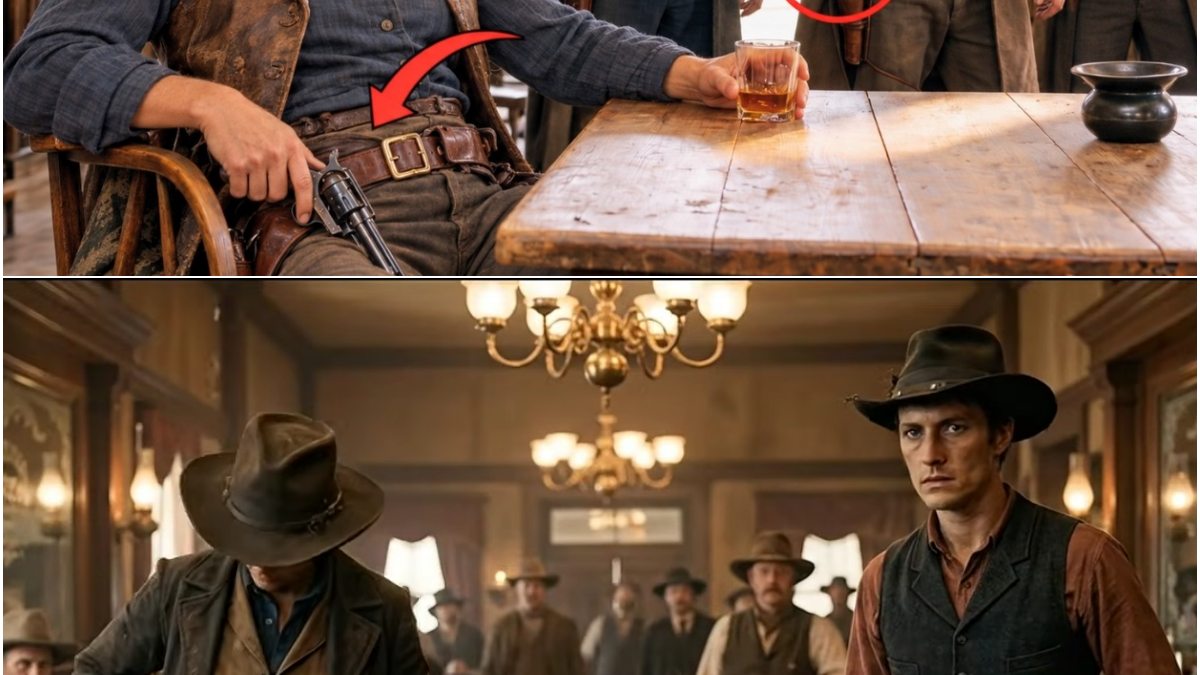
Ror’s hand dropped toward his holster. Calamity Jane did not move. Around them, the Crystal Palace had fallen silent.
The piano stopped first, then the cards, then the conversations that had filled the room only moments earlier.
Three of Tombstone’s fastest guns sat at one table. One woman stood across from them, looking as though she had nowhere else to be and nothing to fear.
Jane leaned forward slightly, lowering her voice until only the men at the nearest tables could hear her.
“I’ve seen better men than you fall faster.” Vain smiled. Ror smiled too. Thorp did not.
That difference mattered more than either of the other men understood. Tombstone had spent years arguing over which of the three was quickest with a revolver.
Jane had spent six weeks learning something much more useful. She knew which man would draw first, which would fire too soon, and which might have enough sense to stop before the room became impossible to control.
Ror’s fingers twitched. Jane noticed. Thorp noticed too. Vain was watching the wrong thing. That was when Jane understood that the hours of questions, the miles of riding, and the careful attention she had paid to three dangerous reputations had brought her exactly where she needed to be.
The gunfight had already begun, although nobody had fired yet. Six weeks earlier, nearly two hundred miles away, a young woman named Sarah Hrix had written a letter with shaking hands.
Jane could not have known then how much depended on the words inside it, or how far she would have to go to make someone listen.
The letter was three pages long. Jane read it once at her table, then again beside the window, and twice more before she put it away.
The handwriting told its own story. Some words leaned downhill as though the writer had run out of strength halfway through a sentence.
Others had been written over so heavily that the paper was nearly torn. Sarah had tried to keep the letter orderly, but fear had interrupted her more than once.
The Hrix family had lived on the same piece of land for seventeen years. It was not rich land, and it had never been easy to work.
The soil demanded patience, the seasons could be unforgiving, and the family had spent years repairing what weather and time wore down.
But the land was theirs. Their home stood beside a narrow road used by wagons traveling toward a mining district farther weSt.
That road had become valuable when a mining company discovered a promising vein and decided it needed a reliable route for moving equipment and supplies.
The easiest access crossed the Hrix property. The company first offered money. Sarah’s father refused.
The family had no interest in selling the land that supported them, and the offer did not account for what losing the road would mean to their daily lives.
The offers became threats. Fence posts were broken. Cattle were turned loose. A gate that had been repaired twice was found smashed again.
Then, one evening, three men rode to the property. Cyrus Vain, Elias Thorp, and Bo Ror.
They burned the barn. They frightened the family and made it clear that refusing the company would bring more trouble.
Ror had pointed his pistol at Sarah’s father. When the family dog barked and rushed between him and the youngest children, Ror fired at it.
Sarah’s letter described what followed, but one sentence stayed with Jane long after she had finished reading.
“My little brother still hides when horses stop outside the house.” Jane read that sentence again.
She knew what it meant when a child began measuring every ordinary sound against the possibility of another frightening visit.
She had seen families change their routines, lower their voices, and stop looking strangers in the eye because they believed nobody would protect them.
The local sheriff had taken statements. He had listened to the family and written down what they remembered.
But the mining company denied hiring anyone. There was no signed order connecting the three men to the company, no written instruction to frighten the family, and no witness willing to risk speaking against people with money and influence.
Sarah had written to Jane for a reason. Jane carried no badge and possessed no authority to arrest anyone.
She could not promise that a territorial marshal would agree with her, and she could not guarantee that the company would answer for what had happened.
But her reputation traveled ahead of her. It was not always clean, and it was not always accurate.
Still, violent men paid attention when they heard her name. Jane did not ride straight to Tombstone.
That would have been a poor decision. Three men with reputations like Vain, Thorp, and Ror had not kept them by being careless.
They knew how to recognize a challenge, and they understood how quickly a public confrontation could turn against someone who had not prepared.
Instead, Jane began with questions. Who had hired the men? Who had paid them? Who else had been threatened?
Who had seen them after the barn burned? Who drank too much? Who bragged when he thought nobody important was listening?
Who watched the door? Who drew a weapon when someone laughed? The first useful answer came from a freight clerk who remembered seeing a company agent pay Vain in cash after the Hrix barn burned.
The clerk could not prove what the money was for, but he remembered the date and the amount.
He also remembered that Vain had been in a hurry to leave. The second answer came from Mary Sutter, a widow whose land had also been pressured.
She had refused to sell a small stretch of property that stood between the company’s proposed route and a supply road.
Soon afterward, strangers had appeared near her home, asking questions about her family and making remarks about how difficult it could be to keep a property when powerful people wanted it.
The third answer came from a rancher who showed Jane a letter threatening outside enforcement if he did not sell.
The handwriting belonged to a mining company superintendent. The letter did not name Vain, Thorp, or Ror, but it helped establish that the company had been using pressure to get what it wanted.
None of this was enough to bring down a company. Jane understood that. But it was enough to show that the Hrix family was not the only one being frightened into surrendering property.
It was also enough to make testimony dangerous. Anyone who spoke could expect questions, visits, and perhaps a sudden loss of business.
Jane copied names, dates, amounts, and places into a small notebook. She kept the original documents separate and made careful copies of the statements she had been given.
She did not want to depend on memory when the time came to explain what she knew.
Then she turned her attention to the three men themselves. Ror was the easiest to understand, at least at firSt. He was twenty-four years old, quick with his hands, and proud of the fear his name created.
He had gained his reputation after a saloon quarrel at seventeen, when he drew his revolver before the other man had finished speaking.
For the next seven years, he had made certain that people remembered the story. Men in Tombstone said Ror could draw before most people had finished deciding whether they were being insulted.
Jane discovered that he often drew when he thought someone was laughing at him. He could not stand humiliation.
He wanted the room to know that nobody could make him look foolish and walk away without consequences.
That made him faSt. It also made him predictable. Vain was thirty-nine, broader through the shoulders, and much quieter.
He liked to let another man move first, then react. Witnesses described his draw as astonishingly quick, but their stories shared a detail Jane found more interesting than the speed itself.
Vain watched hands. His eyes followed the first movement of another person’s body, and his revolver seemed to answer before his mind had finished considering the situation.
He trusted his reaction. Against ordinary men, that could be enough. Against someone who understood his habits, it could become a weakness.
Thorp was forty-two. He was not the fastest of the three, nor the loudest, nor the one most eager to make an impression.
He was, however, the best shot. He drank less than the others, spoke only when he had something to say, and watched a room as though he were studying a map.
Jane worried about Thorp more than the other two. A hotheaded man could be pushed into a mistake.
A man who reacted to every movement could be tricked into following the wrong one.
But a patient man had to be given a reason to choose badly, and Thorp did not seem to need applause.
She began to understand the arrangement between them. Ror started trouble. Vain finished it. Thorp survived it.
Together, they covered one another’s weaknesses. Separately, they were more exposed. Jane would have to separate their decisions without necessarily separating their bodies.
Two days before entering Tombstone, she stopped at a settlement south of Benson. Ror had passed through the previous month, and the bartender remembered him.
“He doesn’t like laughter,” the bartender told her. “Especially when he thinks it’s aimed at him.”
“What happened?” “A cowhand laughed at a joke from the other end of the bar.
Ror thought it was about him.” “And?” “Drew before anybody could explain.” “Did he shoot?”
“Into the wall.” “Why?” “Because the cowhand froze.” Jane glanced at the bullet scar above the shelf.
It had been left there by a man who wanted a room to fear him again.
Ror had not drawn because he had been threatened. He had drawn because he could not tolerate the possibility that someone might find him ridiculous.
That was useful. Vain took longer to study. Jane found a freight driver who had seen him interrupt a robbery outside a way station.
The driver had expected her to be impressed by the story. “He was fast,” the man said.
“Fastest thing I ever saw.” “What made him move?” “The other fellow reached.” “Which hand?”
The driver thought for a moment. “Right.” “Was Vain watching him?” “Like a hawk.” “Did the robber fake the draw?”
“No. He was reaching for his gun.” Jane nodded. That fit the other accounts. Vain was not merely quick.
He was reactive, and he trusted what he saw. If a man reached for a weapon, Vain answered.
He did not need to wait for a threat to become certain. Thorp was harder.
Nobody had a good story about him losing control. That absence was information in itself.
Eventually Jane found a stage guard who had watched Thorp face a drunk in Tucson.
“What did Thorp do?” Jane asked. “Nothing.” “Nothing?” “The man called him a coward. Called him old.
Told him he was slow.” “And Thorp?” “Finished his drink.” “What happened afterward?” “The drunk left.”
Jane smiled. That was the man she had to worry about. Thorp had already shown that he could endure an insult without turning it into a conteSt. He would not be easy to provoke, and he would not necessarily follow the other two simply because they were moving.
So Jane changed her plan. She would not try to beat three men at the same thing.
She would make each of them face a different decision. Ror would have to fight his pride.
Vain would have to fight his reflex. Thorp would have to weigh the numbers. Only one of those battles required Jane to be faster.
And if she had calculated correctly, it would last less than a second. Jane reached Tombstone beneath a hard afternoon sun.
Dust lay pale over the street, and heat shimmered above the roofs. Horses stood with their heads low beside the hitching rails.
The town smelled of manure, coal smoke, whiskey, and sunbaked wood. Wagons creaked through the streets while men moved between shops and saloons, carrying the ordinary business of a place that had grown around mines, money, and the people who came looking for both.
Jane had been in Tombstone less than an hour when she stepped into the Bird Cage for her first drink.
Before the whiskey touched her lips, she heard the triangle’s name. Two miners were arguing near the bar.
“Vain’s fastest,” one said. “Thorp shoots straighter,” the other replied. “Ror’s meaner than either of them.”
A third man joined in. “Put all three together, and there isn’t a man in Arizona stupid enough to challenge them.”
Jane finished her whiskey and set the glass down. “Where do I find all three at once?”
The bartender stared at her. One of the miners laughed. Jane looked at him, and the laughter stopped.
The answer traveled faster than she did. By sundown, Cyrus Vain knew Calamity Jane was asking for him.
Thorp knew too. So did Ror. Jane expected them to come together. Separately, they could disappear into different corners of the territory, deny what they had done, or arrange for someone else to answer her questions.
Together, they would perform. Men who lived on reputation rarely resisted an audience. The Crystal Palace was full when Jane arrived.
That was no accident. The three men had chosen a place where people could watch them, and where any public challenge would become a story before the evening was over.
Vain sat facing the front doors. Thorp had the wall behind him. Ror sat sideways, positioned so everyone could see his holster.
Three glasses and one bottle stood on the table. A deck of poker cards lay untouched between them.
Jane pushed through the swinging doors. The piano stumbled over two notes, then continued. Conversations shifted around her, but nobody openly stopped to stare.
Vain stood firSt. “Heard you were looking for us.” “Saved me time,” Jane said. Ror leaned back in his chair.
“Heard you’re supposed to be faSt.” “People say a lot.” “You here to test it?”
“No.” The answer bothered him. Jane saw it in the slight change around his mouth and the way he adjusted his shoulders.
Thorp spoke before Ror could continue. “Sarah Hrix.” Jane looked at him. “Good.” The smart one knew why she was there.
“Yes,” she said. Vain’s smile faded slightly. “She write you?” “She did.” Ror laughed. “Family should have taken the money.”
Jane looked at him. That was the first small push. “Family should have had a barn left to put it in.”
Ror’s expression changed. Vain sat back down, but his eyes remained on her. “You came two hundred miles over a burned barn?”
Vain asked. “No.” Jane reached inside her coat. All three men shifted. She removed folded papers and placed them on the table.
Thorp’s eyes dropped firSt. There were copies of statements, names, dates, payment records, and the beginnings of a pattern.
Three other families appeared in the notes. So did the freight clerk’s account and the letter from the mining superintendent.
Vain looked at the papers. “What’s that supposed to be?” “The beginning.” “Of what?” “Whatever a territorial marshal decides it is once the people paying you can’t pretend you don’t exiSt.”
Ror’s chair scraped backward. Jane saw his right shoulder move. “Not enough yet,” she said.
Thorp placed one hand flat on the table. “Sit.” Ror looked at him. “I’m sitting.”
“Stay that way.” Jane almost smiled. Thorp was already doing what she expected: weighing the situation instead of reacting to the insult.
Vain picked up one paper and examined it. “This proves nothing.” “Then you shouldn’t be worried.”
He set it down. Jane continued. “The Hrix family wants its property left alone. The other families want the same thing.”
“And if we say no?” Ror asked. Jane looked directly at him. “You already did.”
The piano stopped. The player simply lifted his hands from the keys, but the room noticed.
A poker game near the window paused. Someone behind Jane set down a bottle. Silence spread through the Crystal Palace, table by table.
Ror looked around. Too many eyes were on him. Exactly what Jane wanted. Men like Ror made worse decisions when witnesses were present.
He had built his reputation on making other people hesitate. Now the room was waiting to see whether he would hesitate himself.
Vain understood the danger. He leaned slightly toward Ror. “Bo.” Ror ignored him. Jane leaned forward.
“I spent six weeks asking about you boys.” Ror smirked. “Flattered?” “You shouldn’t be.” She pointed toward him.
“You draw when your pride gets hurt.” The smile disappeared. Then she turned to Vain.
“You watch the first man move and react before you think.” Vain’s eyes narrowed. Finally, she looked at Thorp.
“And you’re the only one at this table who knows being alive tomorrow matters more than being admired tonight.”
Thorp’s face did not change, but his eyes did. Jane lowered her voice. “I’ve seen better men than you fall faster.”
Vain smiled. Ror smiled too. Thorp did not. “Men who earned their names with skill,” Jane continued, “not by frightening families for money.”
Ror’s hand moved closer to his holster. Jane’s eyes dropped toward it. “You boys mistake fear for respect.”
Ror leaned forward. “Careful.” “Bullets don’t care,” Jane said. That did it. Ror stood so quickly that his chair kicked backward.
His hand dropped toward his revolver. He fired before the Colt was fully level. The shot smashed a whiskey glass on the bar behind Jane.
Glass burst across the wood and scattered into the sawduSt. Jane was already moving. Her revolver came up.
The first shot struck Ror across the gun wriSt. His fingers opened, and his weapon hit the floor.
Ror shouted and stumbled backward. At the same instant, Vain drew exactly as Jane expected.
He had reacted to Ror faster than most men could have moved at all. His Colt cleared leather, and his attention fixed on Jane.
She turned toward him. Vain fired. The bullet tore through the edge of her coat and buried itself in the saloon wall.
The fabric snapped against her side, close enough to make her feel the movement of it.
She did not look down. Her revolver answered. The bullet caught Vain high in the shoulder.
He jerked backward and crashed into the table. The bottle toppled. Whiskey spread across the cards and dripped into the sawduSt.
Thorp’s hand had moved too. His fingers were around the grip. His movement was controlled, neither hurried nor hesitant.
He had watched the first two men spend their decisions, and he had not yet made his own.
Jane kept her revolver steady. For the first time that evening, she felt the danger sharpen instead of fade.
Thorp was the best shot of the three. He was also the only one who had not wasted his first decision.
If he committed now, there would be no angry draw, no hurried correction, no reflexive shot fired at the wrong moment.
There would be one deliberate choice. Jane could feel sweat cooling between her shoulder blades.
She kept her stance firm and her eyes on his. Thorp looked at her revolver, then at the angle of her body, then at the overturned chair beside Ror.
He was calculating exactly what she had spent six weeks learning about him. Jane knew what he saw.
Ror had fired first and lost control of his weapon. Vain had reacted and been struck.
Jane had fired twice and remained standing. Her coat was torn, but she was still facing them with her revolver ready.
Thorp had one chance to turn two bad decisions into a third. Jane said nothing.
That silence was part of the plan. If she threatened him, pride might enter the calculation.
If she mocked him, the room might push him toward proving something. If she moved suddenly, Vain’s reaction might influence him.
So she gave him nothing except the facts already lying on the floor. Thorp looked at Ror, who was holding his wrist against his cheSt. Then he looked at Vain, whose injured shoulder had pulled him away from the table.
Finally, he looked back at Jane. His hand remained on the Colt. “Your turn,” Jane said.
Thorp studied her eyes. For a moment, the whole room seemed to narrow to the space between his hand and the weapon.
Then he slowly lifted his fingers away from the grip. “Not today,” he said. Jane nodded once.
“That’s why you’re the smart one.” Ror cursed from the floor. Vain tried to sit upright, his face pale.
Thorp looked at both of them, and the years of their shared reputation seemed to collapse into the few seconds it had taken to expose their different instincts.
Jane lowered her revolver only after she was certain Thorp had stepped away from his.
She kicked Ror’s weapon farther across the floor, then watched Vain’s hands. “Anybody else want to find out what six weeks of preparation looks like?”
No one answered. The bartender moved firSt. He ducked behind the bar for a clean cloth.
A man near the wall finally exhaled. Someone else quietly pushed a chair out of the way.
Jane looked at Thorp. “Sit.” He sat. Ror held his wrist against his cheSt. Vain leaned against the edge of the table, breathing carefully.
“You planning to finish us?” Vain asked. “No.” Ror looked up. “Then what was all this?”
Jane glanced at his injured hand. “A warning.” “That’s your warning?” “You got the gentle version.”
Thorp almost laughed. AlmoSt. “What do you want?” He asked. Jane placed the copied papers back on the table.
“The Hrix family gets the money back.” Vain frowned. “That’s our money.” Jane glanced at his shoulder.
“Doesn’t look like it from here.” “And then?” Thorp asked. “Then you tell the marshal who hired you.”
Ror laughed through his pain. “You want us to turn on the company?” “I want you to decide whether they pay enough for you to keep taking the trouble twice.”
Silence settled over the table. Thorp looked at Vain, then at Ror, then at the papers.
“How much do you have?” “Enough to start questions.” “Not enough to finish them.” “No.”
Thorp understood. “You need us.” “I need somebody who can connect the money to the orders.”
Vain’s jaw tightened. “And if we refuse?” Jane looked at Thorp. He answered before she could.
“Then she sends what she has anyway. The company denies us, says we acted alone, and we take the blame.”
Vain stared at him. Thorp continued, his voice quiet. “They can replace us. We can’t replace the years we’ll spend answering for this.”
Jane watched the men absorb the truth. She had not expected them to become friends with the families they had frightened.
She had not expected an apology to repair everything. She needed the men to understand that their employer’s money was not a shield they could carry forever.
“You’re listening,” she said to Thorp. He leaned back slowly. “What happens if we cooperate?”
“That’s for the law to decide.” Ror cursed again. Jane looked down at him. “Save your strength.”
“For what?” “Explaining to a marshal why frightening a family and shooting its dog was necessary business.”
Ror looked away. For the first time, something other than anger crossed his face. It was not enough to undo what he had done, but Jane recognized the change.
The bartender returned with cloth. A doctor was sent for, and the room slowly began to move again.
Nobody tried to turn the incident into a celebration. There were no cheers and no applause.
The people in the Crystal Palace had seen enough to understand that the three men who had once dominated every argument about speed had not been as untouchable as they seemed.
Jane stayed until the doctor arrived. She wanted Ror’s wrist examined and Vain’s shoulder treated.
She did not do it out of affection. She wanted both men able to speak clearly when the marshal came asking questions.
By midnight, a deputy had taken statements from the people who had witnessed the confrontation.
Thorp agreed to speak further. Vain remained angry, but his certainty had weakened. Ror said little.
The money paid for the Hrix job was gathered into an envelope. It was not all there.
Ror had spent some, and Vain had spent some too. Thorp covered the difference from his own funds.
That surprised Jane. “Why?” She asked him. He shrugged. “Want this finished?” “It won’t be.”
“I know,” he said. “But this part can be.” Jane studied him. He did not look proud of himself.
He did not look relieved, either. He looked like a man who had finally understood that his next decision mattered more than the reputation he had spent years protecting.
Two days later, Jane left Tombstone. She did not ride out as a conqueror, and nobody arranged a parade.
She carried papers in one saddlebag and the Hrix money in another. But the story traveled ahead of her anyway.
By the time she reached the first station north, a bartender already knew a version of what had happened.
“Heard you finished all three,” he said. “Two got shot,” Jane replied. “What happened to the third?”
“He saved himself a bullet.” The bartender blinked, as though that answer had not occurred to him.
Jane ordered a drink and let the story settle into whatever shape it would take.
Three weeks later, a territorial marshal came to Tombstone asking questions. He did not arrive because Jane had single-handedly defeated a mining company.
She had not. He came because names now connected payments to threats, and because other families had begun to speak.
One family came forward, then another. Four more followed. Their statements did not make every question easy to answer.
Some details were uncertain, and the company continued to deny that it had ordered anyone to frighten landowners.
But silence had become more difficult to maintain. People who had once believed they were alone began to understand that their experiences were part of a larger pattern.
No empire collapsed overnight. No wealthy man suddenly appeared in a courthouse to confess everything.
The company did not surrender simply because three hired men had changed their minds. But it now had to answer questions in rooms where guns did not decide who was right.
Jane did not stay to watch all of it. She rode north toward the Hrix property.
When she arrived, Sarah was repairing the fence. Behind the house, the barn was rising again.
New timber stood in place of the damaged structure, and fresh boards waited beside the unfinished roof.
The work had begun, though there was still plenty to do. The dog was gone.
Jane noticed the empty place near the porch where a water bowl still sat. Sarah saw her coming and froze.
Then she recognized the rider and hurried toward the gate. “You found them?” Jane dismounted.
“Yes.” “All three?” “Yes.” Sarah looked past her, as though expecting to see something that would explain what had happened in Tombstone.
“They’re alive,” Jane said. Sarah’s expression changed. Jane could not tell whether the first feeling was relief or disappointment.
Perhaps Sarah could not tell either. The men had frightened her family, damaged their home, and left a child afraid of horses stopping outside.
It was difficult to know what a person should feel when the people responsible were still out in the world.
Jane took the envelope from her coat. “This is the money they were paid for your family.”
Sarah stared at it. “You got it back?” “Most of it.” Jane held it out.
Sarah did not take it immediately. “My father won’t accept charity.” “It isn’t charity.” “Then what is it?”
“Expensive guilt.” Sarah let out a short laugh. It was the first Jane had heard from her.
She finally accepted the envelope but did not open it. Her eyes moved toward the half-built barn.
“My little brother still hides when horses stop outside.” Jane remembered the sentence from the letter.
“Does he?” “Every time.” Jane nodded. “May take a while.” Sarah looked at her carefully.
“They really were the fastest guns in Tombstone?” “People said so.” “And you were faster?”
Jane glanced toward the barn. “No.” Sarah frowned. “Then how did you beat all three?”
Jane thought about the weeks of questions. The freight clerk, the widow, the rancher, and the stage guard.
She remembered the bartender’s account of Ror’s anger, the driver’s description of Vain’s reflex, and the quiet story of Thorp finishing his drink while another man tried to provoke him.
“I knew which one would make the first mistake.” “That’s all?” “That was enough.” Sarah opened the envelope.
Inside was the money and a copy of Thorp’s signed statement. She read the first lines, and her hands began to shake.
Jane watched her. The movement reminded her of the letter, of words leaning downhill and sentences written over twice.
But this time the shaking did not come from the same place. “What happens now?”
Sarah asked. “The marshal asks questions.” “And the company?” “They answer some.” “And if they lie?”
“More people talk.” Sarah nodded slowly. It was not a clean ending. The barn was still unfinished, the family still had to rebuild its routines, and the company had not suddenly become harmless.
But there was a beginning where there had been only fear and silence. Jane mounted again before sunset.
Sarah stood by the fence, holding the envelope against her cheSt. “Miss Jane?” Jane turned.
“My father said something after the barn burned.” “What?” “He said men like that win because everybody is afraid to be firSt.”
Jane looked at her. Sarah continued. “You were firSt.” Jane shook her head. “No.” Sarah frowned.
Jane nodded toward the letter tucked into her saddlebag. “You were.” Then she rode away.
Tombstone kept telling the story. Of course it did. Some versions said Ror never cleared leather.
He had. Some said Vain fired twice. He had not. Some said Thorp begged Jane to spare him.
He never did. Other versions described Jane standing untouched while bullets passed close enough to brush her clothing.
That part was closer to the truth, though it left out how carefully she had studied the men before entering the room.
The truth was less theatrical than the legend. Ror fired because Jane knew pride could pull his hand faster than judgment.
Vain fired because Jane knew he would react to Ror. Thorp did not fire because Jane knew he valued survival more than applause.
Three men. Three different weaknesses. One room. Jane had not needed to be faster than all three.
She needed to understand them before they understood her. That was the part most retellings missed.
Speed was visible. Preparation was not. People remembered the draw, the broken glass, the sudden silence, and the moment the three men lost control of the room.
They forgot the weeks before it: the questions, the names, the dates, the small details that made a violent man predictable.
Ror believed reputation made him dangerous. Vain believed reflex made him unbeatable. Thorp survived because he understood the one thing his partners had ignored.
There was always a moment before a confrontation became impossible to control. Sometimes that moment lasted several minutes.
Sometimes it lasted only a breath. Sometimes it was the narrow space between a hand touching leather and a smarter man deciding not to follow.
Jane had whispered, “I’ve seen better men than you fall faster.” She had not meant faster with a gun.
She meant faster in judgment, faster in pride, faster in the terrible little decisions people make when they have spent too long believing fear and respect are the same thing.
The triangle had ruled Tombstone’s imagination because people kept asking the wrong question. Who was fastest?
Jane had asked another. Who was easiest to predict? That question had ended their hold over the town, at least for a while.
Ror never regained the same reputation. Vain became quieter. Thorp gave testimony that cost the mining company more than any confrontation could have, and Sarah’s family rebuilt the barn.
That mattered more than any of the three men. Months later, someone asked Jane whether she had really faced Tombstone’s three fastest guns at once.
She looked at him over the rim of her glass. “Depends what you mean by at once.”
The man smiled. “You know what I mean.” Jane finished her drink. “Ror drew firSt.”
“And Vain?” “Then Vain.” “And Thorp?” Jane looked at him for a moment. “Thorp was the only one fast enough to stop.”
That was the answer.
Disclaimer: This content may be created by Al for entertainment purposes. Any resemblance to real persons, events, or places is coincidental.








