ITALY Released Thousands Of Predators Into The Adriatic — The Cause Was Not What Anyone Expected
In June, somewhere off the Italian coast, the boat slowed until its engine became almost silent.
Below the hull, the Adriatic stretched beneath the morning light, blue near the horizon and darker around the submerged structures where fish moved between cracks and shadows.
On deck, the crew worked carefully around containers filled with seawater. Inside those containers were thousands of creatures so small and delicate that they barely looked like the animals they would eventually become.
They were young octopuses. The crew opened the containers and released them into the sea.
One group disappeared into the water. Then another. By the end of the summer, something close to 130,000 young octopuses would be placed into the Adriatic.
The image was irresistible. An army entering the sea. Eight armed soldiers sent against an invasion.
Predators unleashed to fight a creature that had transformed Italian shellfish farming. But the real story was far stranger.
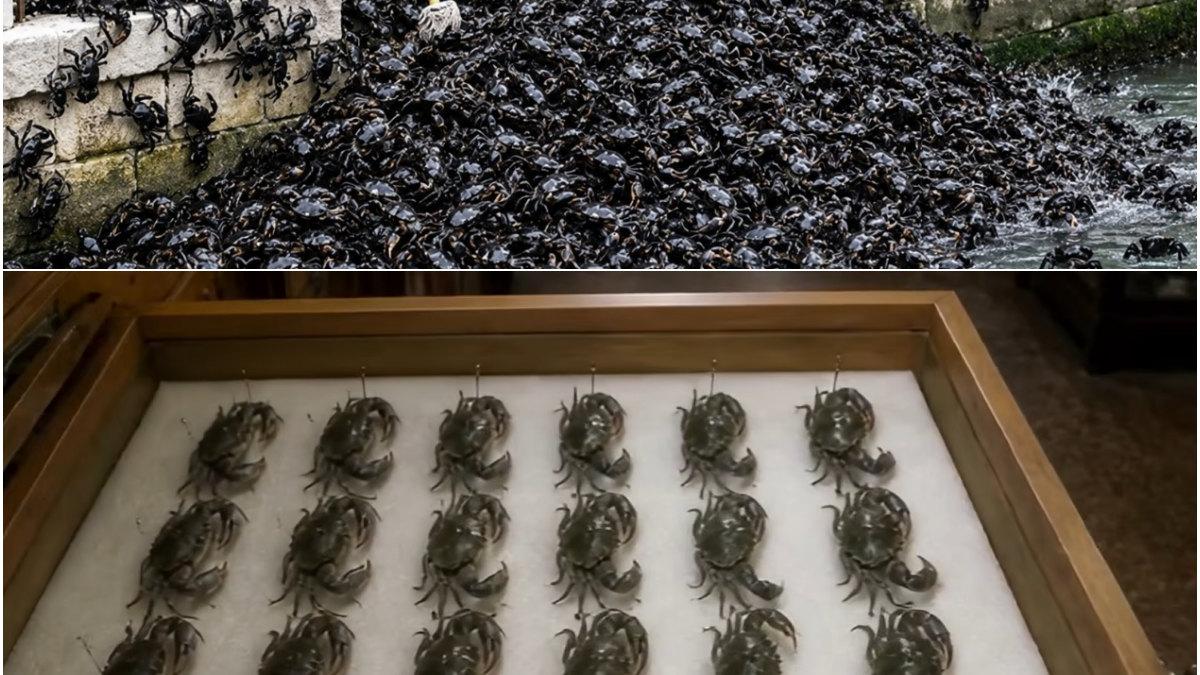
Because the animal everyone feared had not suddenly appeared in Italy. Blue crabs had already been recorded there decades earlier.
In a museum drawer in Venice, preserved specimens collected around the lagoon in 1949 and 1950 had been quietly waiting for the future.
For roughly forty years, almost nothing happened. The crabs appeared occasionally. Then they disappeared again.
They remained a curiosity in old records and a few museum collections. Then the Adriatic changed.
The water became warmer. The river became saltier during an extraordinary drought. The lagoons became more favorable to the crab.
The shellfish industry became increasingly dependent on a clam that had itself been introduced from another part of the world.
And suddenly, an animal that had once been little more than a footnote became one of the most important forces along the northern Italian coast.
So why were thousands of octopuses being released into the sea? The answer began long before the boat opened those containers.
It began with a crab in a museum drawer. The Northern Adriatic is a landscape shaped by water.
At the mouth of the Po River, freshwater spreads toward the sea through a complicated network of channels, marshes, mudflats, shallow lagoons, and islands.
The boundaries between river and ocean are never completely fixed. Some places are fresher. Some are saltier.
Some change dramatically with the seasons. And beneath the surface of those shallow waters lies an industry that has supported coastal communities for generations.
The Po Delta and surrounding lagoons are shellfish country. Scardovari, Sacca di Goro, the valleys around the delta, and other shallow coastal areas became centers of clam and mussel cultivation.
In an ordinary year, these lagoons could produce around 16,000 tons of clams. That represented more than half of Italy’s production and a substantial share of European production.
Thousands of people depended directly or indirectly on the shellfish economy. Boats, processing facilities, cooperatives, transport companies, restaurants, equipment suppliers, and families all depended on the rhythm of the water.
The system looked simple from above. Clams grew beneath the sediment. Growers waited. When the animals reached harvestable size, they were collected.
Then the next generation needed to establish itself. That cycle had to continue. If recruitment failed for one season, the consequences could be serious.
If it failed for several seasons, the entire system could begin to unravel. Then the blue crab population changed.
The Atlantic blue crab had not originated in the Northern Adriatic. Its natural range was on the other side of the Atlantic.
Yet the species had appeared in Italian waters decades earlier. The old museum specimens proved it.
They were collected in 1949 and 1950. There they remained, preserved and labeled while the surrounding ecosystem continued changing.
The early sightings did not immediately produce an ecological crisis. For decades, the crab remained uncommon enough that most people had little reason to think about it.
It appeared. It vanished. It returned occasionally. Then, during the early 1990s, reports began appearing again around the lagoon.
Still, the animal did not immediately transform the region. That period mattered because it showed that the presence of a species does not automatically produce an ecological explosion.
A population can remain small for years. It can reproduce without becoming dominant. It can exist quietly until conditions change.
Ecologists sometimes describe such a period as a lag phase. The species is present. The population is capable of increasing.
But something is holding it back. Then the environment changes. In the Northern Adriatic, several changes began lining up.
Temperature was one. The blue crab can tolerate a broad range of conditions, but research described in the source material showed that its feeding activity performs particularly well around the middle twenties Celsius, with feeding strongest around 25 to 28 degrees.
As Mediterranean waters warmed, the number of places and days offering favorable conditions increased. The window became larger.
The crab had more opportunities. Then came 2022. Northern Italy experienced an extraordinary drought. The Po River fell to exceptionally low levels.
As freshwater flow weakened, seawater moved farther upstream. A salt wedge traveled deep into parts of the delta.
Some branches of the river experienced marine influence far beyond what would normally occur. For blue crabs, this mattered enormously.
Female crabs require suitable salinity for reproduction. The drought had changed parts of the river delta into something closer to an extended nursery.
The following year brought heavy rainfall and flooding. That created another opportunity. Young crabs and larvae could be transported through the interconnected waterways.
The environment that had once limited the crab was becoming more favorable. Warmer conditions extended the season.
Milder winters reduced the seasonal pressure that had once limited the population. A species that had spent decades waiting suddenly found itself in a landscape capable of supporting rapid expansion.
Then the numbers began to change. For shellfish growers, the difference was immediate. Blue crabs are powerful predators.
They can feed on clams and mussels. They can move across shallow sediment. They can enter shellfish beds and consume animals that growers had spent months raising.
The pressure was not theoretical. The farms were being affected. Clam production in parts of Veneto and Emilia Romagna collapsed.
Mussel operations were affected as well. Scardovari mussels, protected by a geographical designation and built into the identity of the region, became part of the wider crisis.
By the middle of 2024, Italian growers associations were estimating losses of around 100 million euros.
Later estimates became even larger. Hundreds of operators left the sector. Workers entered state support programs.
Others simply stopped operating. The government responded with extraordinary measures. In September 2024, Enrico Katarino, a former prefect of Rovigo and Ravenna, was appointed extraordinary commissioner for the blue crab.
His mandate extended through the end of 2026. Millions of euros were allocated to the response.
Large quantities of crabs were captured. The government and fishing industry looked for ways to remove them, contain them, or turn them into a commercial product.
But there was a problem. The crab could reproduce faster than people could remove it.
A large female could carry around 1.5 million eggs. Some individuals carried closer to three million.
The numbers were difficult to comprehend. Removing thousands of crabs sounded enormous. But one mature female represented a future population.
The more scientists studied the species, the clearer the scale became. This was not simply a matter of removing an animal from a few shellfish beds.
The animal had established itself in an environment that had become unusually favorable. And there was another uncomfortable truth.
The shellfish industry itself was not based entirely on native species. The Manila clam had become one of the foundations of the Northern Adriatic aquaculture economy.
It originated along the coasts of Japan, Korea, China, and eastern Russia. In 1983, it was deliberately introduced into the Northern Adriatic as an aquaculture species.
The reason was practical. Native clam stocks were already under pressure from heavy exploitation. The fishery was struggling.
A replacement species was introduced. The Manila clam performed extraordinarily well. Research led by Fabio Pranovi and colleagues later described it as the most successful of the non-native marine invertebrates established in the Venice Lagoon.
The new clam became commercially important. But its success also altered the lagoon. Other filter feeding bivalves declined in distribution and abundance.
Hydraulic dredging, used to harvest the clams, repeatedly disturbed the sediment. The floor of the lagoon itself was being physically reshaped.
The system had changed before the blue crab became abundant. This is why the simple version of the story is incomplete.
It is tempting to describe an original Italian shellfish ecosystem being attacked by a foreign predator.
But the actual history is more complicated. An introduced clam had replaced struggling native shellfish.
A new harvesting system had transformed the sediment. Climate and water conditions changed. A crab that had been present for decades found increasingly favorable conditions.
The collapse was the product of an altered ecosystem encountering a species that could exploit those changes.
That distinction did not make the losses less serious for the families depending on the lagoons.
But it changed the question. The problem was no longer simply how to remove the crab.
The deeper question was how to restore balance. And that led researchers toward an animal that had always belonged to the Adriatic.
The common octopus. At first, the idea sounded almost theatrical. Release octopuses to control blue crabs.
The image immediately suggested a biological battle. But researchers were thinking about something much more ordinary.
Predator and prey. The common octopus was already part of the Mediterranean food web. It did not need to be imported.
It did not need to be genetically modified. It did not need to be taught how to hunt.
It already knew. The challenge was producing enough young octopuses to make a meaningful experiment possible.
That problem led researchers to a laboratory on the Italian coaSt. The building was associated with years of research into marine reproduction.
One of its important research subjects had been the European eel. The eel is one of the most mysterious animals in marine biology.
It spends much of its life in European waters but travels to the Sargasso Sea to reproduce.
For generations, researchers struggled to understand its reproduction well enough to maintain the entire early life cycle under controlled conditions.
Scientists working at the laboratory in Cesenatico, including groups associated with research into eel reproduction, developed techniques for managing delicate marine larvae.
They learned how sensitive young animals could be. They learned how temperature, salinity, light, water movement, food, and oxygen had to remain within narrow ranges.
They learned how to keep fragile animals alive through the earliest stages of development. That knowledge became valuable for another species.
The octopus. The research groups involved in marine reproduction began working with common octopus. The animal was familiar to Mediterranean fishermen, but raising it through its earliest life stages was anything but simple.
The young animals that leave their eggs do not immediately resemble the powerful octopuses people recognize.
They begin as tiny, nearly transparent larvae. They drift and swim through the water column.
Their bodies are delicate. Their food must be appropriate. Their surroundings must remain stable. A small mistake can affect an entire batch.
The researchers therefore spent years learning how to rear them. Then they asked a different question.
What happened when young octopuses encountered blue crabs? In laboratory trials, the answer was striking.
Young octopuses approached crabs and attacked them despite the difference in size. Researchers observed octopuses taking on blue crabs weighing around half a kilogram.
The encounters demonstrated something important. The octopus did not need to be larger than the crab to be a capable predator.
It had a completely different set of tools. The octopus could alter its color and texture.
It could approach through complex habitat. Its arms could move independently. Instead of attacking from one direction, it could surround its prey.
The crab’s claws were designed to defend against threats approaching from particular angles. The octopus did not need to respect those angles.
It could reach from several directions at once. Once it secured the crab, its beak and radula allowed it to process hard prey.
Its saliva also contributed to the process. Researchers estimated that an adult octopus of around one kilogram under favorable conditions could consume several medium sized blue crabs in a day.
That did not mean a handful of octopuses could solve the entire Adriatic problem. The mathematics did not work that way.
The blue crab population was enormous. Female crabs could produce millions of eggs. Octopuses had their own limitations.
But the predator was native. That mattered. The project did not involve releasing an unfamiliar species into an ecosystem already under pressure.
Instead, researchers were attempting to strengthen a predator that had always been part of the region.
The project became known as Octoblue. It began in 2024. The early work focused on laboratory research.
Researchers had to understand reproduction. They had to study the relationship between octopuses and blue crabs.
They had to determine how young octopuses behaved. They had to understand what happened after release.
The first releases came in June 2026. On June 11 and June 17, young octopuses were placed into the sea.
More followed through AuguSt. The total approached 130,000. But there was a reason for using such a large number.
Most would not reach adulthood. That was not necessarily evidence of failure. It reflected the natural biology of the species.
Only a small percentage of larvae were expected to survive the early stages. The strategy therefore depended on numbers.
If enough young octopuses entered suitable habitat, some could survive. Some could mature. Some could reproduce.
And eventually, perhaps, a stronger local predator population could develop. But releasing an animal into the sea is not the same thing as giving it a home.
That became the next challenge. Octopuses need shelter. On soft, featureless sediment, suitable dens can be scarce.
An octopus without a secure shelter is vulnerable. Research on octopus ecology showed that the availability of solid material for shelter can limit where these animals establish themselves.
The blue crab, meanwhile, was thriving in shallow, muddy lagoons. Those lagoons were precisely the environments where suitable octopus shelter could be limited.
So the researchers did something unusual. They built homes. Near Cesenatico, artificial dens made from materials such as cement and clay were placed on the seabed.
The structures created cavities. Places to hide. Places to reSt. Places where an octopus could establish a territory.
Other release sites included submerged structures that had already become covered with marine life. The strategy was not to throw thousands of octopuses into the middle of the worst affected clam beds and hope for the beSt.
It was more cautious. Build habitat. Release native predators. Monitor them. See whether they survive.
See whether they establish themselves. See whether they begin influencing blue crab populations. The difference between that approach and the dramatic headlines was enormous.
The octopuses were not an army. They were a biological experiment. And the scientists involved understood the uncertainty.
An octopus is an opportunistic predator. It does not exist to eat blue crabs. It eats whatever prey is abundant and accessible.
Mollusks can form a major part of its diet. In some environments, bivalves dominate its feeding.
That raised an obvious concern for shellfish growers. What happens if the octopuses discover that farmed shellfish are easier to find than blue crabs?
Nobody could honestly guarantee that they would ignore the clams and mussels. That was one of the reasons the project had to remain controlled.
The second complication was competition among octopuses themselves. They are solitary animals. They establish territories.
When shelter becomes scarce and food becomes limited, larger individuals can consume smaller ones. The population regulates itself partly through these interactions.
That means simply releasing more animals cannot guarantee a larger adult population. The environment has to support them.
Food has to be available. Shelter has to be available. Water conditions have to remain suitable.
The release sites therefore mattered enormously. And this is where the project became less like a dramatic biological attack and more like a carefully designed ecological teSt.
The researchers were not promising eradication. They were investigating containment. They were asking whether a native predator could help apply pressure near the edges of a rapidly expanding crab population.
That distinction was crucial. The blue crab had already demonstrated how powerful a species could become when environmental conditions changed in its favor.
Now scientists wanted to see whether a native predator could respond to that same opportunity.
But there was an even deeper lesson in the story. The blue crab was not behaving like an unstoppable creature because it had somehow become stronger than every other animal.
It was responding to conditions. Warmer water gave it more favorable periods. Reduced river flow increased salinity in parts of the delta.
Flooding redistributed young animals. Milder winters reduced seasonal limits. The crab had not invented those conditions.
The ecosystem had changed around it. The animal simply took advantage. That is why the museum drawer matters.
Those preserved crabs from 1949 and 1950 prove that the species was not a sudden arrival in 2023.
The animal had been present. The environment was what changed. For decades, the crab remained a minor component of the ecosystem.
Then the balance shifted. The same principle can be seen in the shellfish industry. The Manila clam did not arrive by accident.
It was deliberately introduced because people needed a productive shellfish. The species succeeded because the altered lagoon could support it.
Hydraulic dredging changed the sediment. Aquaculture changed the distribution of shellfish. Climate changed water temperatures.
Drought changed salinity. Floods moved organisms through the delta. Each decision and environmental shift became part of the next stage.
By the time the blue crab became the center of attention, the system was already profoundly different from the ecosystem that had existed generations earlier.
That makes restoration complicated. There is no single moment to return to. There is no untouched version of the lagoon waiting beneath the surface.
The goal is not simply to press a button and return everything to the paSt.
The goal is to create a functioning future. The octopuses are part of that experiment.
So are the artificial dens. So are the crab fisheries. So are the efforts to develop commercial uses for captured crabs.
So are the changes in lagoon management. No single action can carry the entire burden.
The same reality can be seen in the blue crab’s native range. In the Chesapeake Bay, the crab has lived alongside predators for generations.
Researchers have spent decades studying what happens to young blue crabs. Their findings show that other blue crabs themselves can be major predators of juveniles.
Fish can also consume them in some areas. The system is complicated. Even in its native habitat, blue crab populations rise and fall.
That is important because it shows that predators do not function like a simple switch.
Add predator. Subtract prey. Problem solved. Real ecosystems do not behave like equations with only two variables.
Temperature matters. Shelter matters. Food matters. Salinity matters. Competition matters. Disease matters. Currents matter. Fishing matters.
Every species is part of a network. That is why Octoblue is being watched so closely.
If the young octopuses survive, researchers will learn something. If they struggle, that will also provide information.
If they establish territories, that will matter. If they begin feeding heavily on blue crabs, researchers will measure it.
If they prefer other prey, that will matter too. If they begin interacting with shellfish farms, the risks will have to be examined.
Nothing about the project guarantees a particular outcome. That uncertainty is not a weakness. It is the reason the project exists.
The first young octopuses disappeared into the Adriatic in June 2026. More followed through July and AuguSt.
To someone watching from the boat, the releases might have looked almost insignificant. A small transparent creature slipping into an enormous sea.
Then another. Then thousands more. The Adriatic was far too large for any individual release to transform immediately.
But that was never the point. The point was whether enough animals could survive long enough to become part of the ecosystem.
Somewhere beneath the surface, young octopuses were searching for shelter. Some would find cavities. Some would find submerged structures.
Some would encounter prey. Some would not. Researchers would continue monitoring the sites. Divers would search.
Fishermen would report sightings. Data would accumulate slowly. Perhaps the releases would produce a measurable effect.
Perhaps they would not. The blue crab would continue to challenge the shellfish industry. The growers would continue searching for solutions.
The government would continue its emergency response. The lagoons would continue changing with temperature, river flow, storms, and human activity.
And the octopuses would continue doing what octopuses have always done. Hunt. Hide. Move. Adapt.
Wait. The most important thing about the story is that the crab was never really the beginning.
Neither was the octopus. The story began much earlier, when people altered the relationship between the lagoon and its inhabitants.
A native shellfish declined under heavy exploitation. A new clam was introduced. The new species became extraordinarily successful.
Harvesting methods reshaped the sediment. The climate warmed. The Po experienced extraordinary drought. Saltwater moved farther inland.
The crab found conditions it could exploit. The population expanded. The shellfish industry suffered. Then people looked for a predator.
They found one already living in the same sea. That is why the boat in June matters.
The crew were not releasing monsters. They were attempting to restore a relationship. A relationship that may have existed quietly for centuries.
The common octopus had been part of the Mediterranean ecosystem long before modern shellfish farms, before hydraulic dredges, before emergency commissions, before climate records, and before the blue crab became a headline.
Now scientists were asking whether that old relationship could become useful again. The answer will not arrive in one summer.
The young octopuses need time. The researchers need measurements. The crab population needs to be tracked.
The shellfish beds need to be watched. The artificial shelters need to be inspected. The ecosystem needs to be allowed to reveal what actually happens.
That is the strange beauty of the project. Nobody can completely control the result. People can release animals.
They can build shelters. They can measure temperature. They can count crabs. They can monitor shellfish.
But once the animals enter the sea, the ecosystem takes over. That is where science ends and ecology begins.
The museum drawer in Venice tells the story from the beginning. Two old specimens from 1949 and 1950.
A species present but largely unnoticed. Decades passed. Then the environment shifted. The crab became abundant.
And now, more than seventy years after those first specimens were collected, another animal is being given a chance to reshape the balance.
The young octopuses released in 2026 cannot know any of this. They do not know about the shellfish growers.
They do not know about the government commissioner. They do not know about the museum specimens.
They do not know about the drought of 2022. They do not know that 130,000 of them were released because an ecosystem had changed around a crab that had been waiting for its opportunity.
They simply enter the water. They search for food. They search for shelter. They grow.
And somewhere among the submerged structures and artificial dens, one of them may eventually become the predator the researchers hoped to restore.
Not an army. Not a weapon. Not a creature sent to conquer an enemy. Just an animal returning to a role it already knew.
The Northern Adriatic has changed many times. People changed it. Climate changed it. Species changed it.
Water changed it. The next chapter will be written by all of them together. And beneath the surface, where the water moves slowly over the old lagoon floor, the first signs of that chapter may already be taking shape.
A small shelter. A young octopus inside it. A blue crab passing nearby. And for the first time in years, a predator waiting exactly where the changing sea has made room for it.
Disclaimer: This content may be created by Al for entertainment purposes. Any resemblance to real persons, events, or places is coincidental.








