ISRAEL Poisoned Its Fields For Thirty Years — Nobody Expected What Moved In
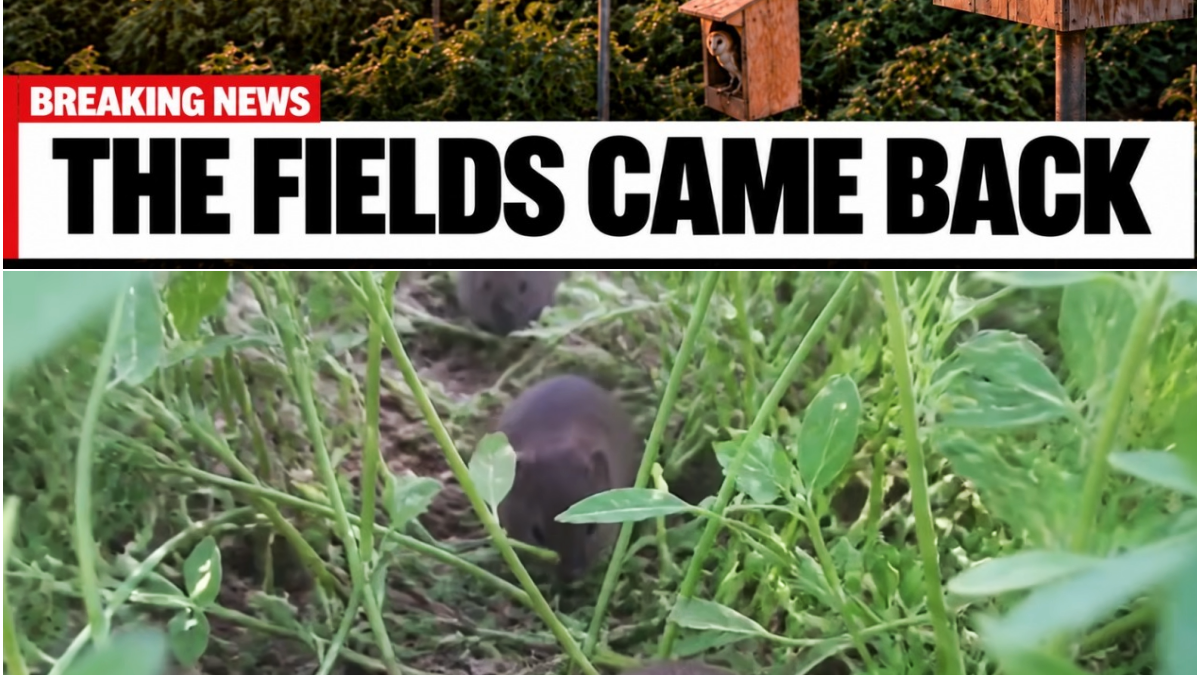
The first thing to disappear was not the rodents. It was the alfalfa. Across the Hula Valley, green fields that had once seemed almost impossible in such a dry region began showing strange signs.
Stalks collapsed along the irrigation lines. Patches of crop weakened and flattened. Beneath the surface, small tunnels ran through the soil in every direction.
Farmers already knew what they were looking at. They had seen it before, year after year, for decades.
The voles were back. For nearly thirty years, farmers had responded the same way. Bait was placed beside pipelines and around fields.
Aircraft passed overhead in the early morning. Chemical treatments became stronger, more frequent, and more expensive.
Still, the rodents returned. Then, in the spring of 1983, something appeared in an alfalfa field that looked almost ridiculous compared with the machinery and chemicals surrounding it.
Fourteen wooden boxes. They were simple plywood shelters mounted on poles, each with a small opening cut into the front.
There were no traps inside. No chemicals. No complicated technology. Just fourteen boxes standing quietly above the crop.
The farmers who walked out to inspect them did not see a solution. They saw a university experiment.
But the people who placed those boxes believed the fields were missing something. Not another chemical.
Not another machine. Something alive that had always belonged there. What happened after those fourteen boxes were installed would eventually change how farmers across the region thought about rodent control, but why could a few wooden boxes accomplish what decades of increasingly expensive treatments could not?
For generations, farmers across the Middle East had lived with the Levant vole. The animal was small, compact, short tailed, and easily overlooked.
It lived across a narrow region stretching through southern Turkey, Syria, Lebanon, Israel, and northwestern Jordan.
It was not a remarkable animal at first glance. It did not have the size of a fox or the power of a large predator.
It did not need much space. It simply reproduced quickly when conditions were favorable. And that was enough.
Vole populations did not always rise gradually. They could remain relatively low and then increase dramatically when food, shelter, and weather aligned.
Suddenly the ground could seem alive with movement. Burrows appeared. Plants were cut near their bases.
Roots were damaged. Fields that had looked healthy only weeks earlier could become difficult to manage.
The problem was not new. A scientific review published in 1977 described the Levant vole as the only vole in the Middle East with serious economic importance and connected it with major rodent outbreaks recorded in the region since ancient times.
The history mattered because it challenged a simple explanation. It was easy to blame modern agriculture.
Modern irrigation had transformed large parts of the region. Water could be moved across dry country.
Fields could remain productive through seasons that would once have limited agriculture. But the vole problem had existed long before those systems.
Modern farming had not created the animal. In some ways, modern farming had even reduced certain outbreaks.
Wetlands were drained. Some crops were replaced with varieties less vulnerable to rodents. Deep plowing repeatedly destroyed burrow systems and disrupted the animals’ shelter.
The old cycle depended on disturbance. Fields were turned. Vegetation disappeared. Burrows were broken apart.
The vole population had to begin again. Then farmers expanded their use of perennial crops.
One of the most important was alfalfa. Alfalfa was valuable because it could remain in the soil for years.
It produced rich forage. It supported livestock. It did not need to be replanted after every harveSt.
For farmers, that permanence was an advantage. For voles, it was something else entirely. It was a permanent home with food always nearby.
The soil remained largely undisturbed. The vegetation stayed dense. Moisture was available. The burrow system could remain intact.
The animals no longer faced the repeated destruction that deep plowing had once caused. And farmers could not simply plow the field to reset the population.
Doing that would destroy the crop they were trying to protect. The very feature that made alfalfa valuable also made it particularly difficult to defend.
Israeli alfalfa fields were expected to remain productive for several years. In areas heavily affected by voles, farmers sometimes abandoned fields much sooner.
The economic pressure became enormous. So the chemical campaign continued. Bait was placed. More bait was placed.
Aircraft were used. Treatments were repeated. The chemicals became stronger. The costs increased. Yet one basic problem remained.
A bait is useful only when the animal chooses to eat it. That sounds obvious.
But it became one of the most important facts in the entire story. Voles living inside alfalfa fields already had access to abundant, attractive food.
They did not have to travel far. They did not have to search for something unfamiliar.
They were surrounded by what they wanted. The chemical bait was competing against an entire field of fresh vegetation.
The result was predictable. The treatment could suppress part of the population, but it did not remove the underlying conditions that allowed the animals to return.
In the winter of 1975, a major outbreak moved through alfalfa in the northern Hula Valley.
The problem covered several square kilometers. It was no longer one damaged field. It was a landscape problem.
And the response was familiar. More chemicals. More applications. More effort. The approach made sense from a narrow perspective.
If rodents were damaging crops, remove the rodents. But ecosystems do not always obey narrow solutions.
A treated vole did not simply vanish from the landscape. It could become slow. It could move into the open.
It could become easier for a predator to catch. And the Hula Valley was surrounded by one of the world’s great bird migration corridors.
Hundreds of millions of birds pass through Israel during seasonal migrations. They move between Europe, Asia, and Africa, funneling through a relatively narrow region.
The fields beneath them offered food. When rodents became exposed after chemical treatment, predators encountered unusually easy prey.
Foxes hunted them. Jackals hunted them. Wild cats hunted them. Snakes took them. Birds of prey took them.
Owls took them. The chemical treatment therefore did not remain confined to the field. It entered the food web.
Natural predators could be exposed while feeding on affected rodents. That created an ecological problem on top of an agricultural one.
The very animals that could naturally suppress the vole population were being placed under pressure.
The farmers were paying to reduce the predators that had been controlling rodents without requiring another application.
It became a cycle. The chemicals provided temporary relief. Predators declined. The remaining rodents reproduced.
The problem returned. More treatment followed. For nearly thirty years, the pattern continued. Then scientists began looking at the problem differently.
Instead of asking what could be added to the field, they asked what was missing from it.
The answer was already flying above the valley. Barn owls. The barn owl was native to the region.
It had not been imported. It did not need to be bred somewhere else and transported into Israel.
It was already part of the landscape. For centuries, the birds had nested in hollow trees, rock crevices, old structures, barns, and other sheltered places.
Then agriculture changed. Old trees disappeared. Traditional barns were replaced. Buildings became sealed. Unused structures were removed.
The fields became cleaner and more organized. That was useful for farming. It was not useful for an owl looking for somewhere to raise a family.
The landscape still contained rodents. It simply contained fewer places for the predators to reproduce.
The shortage was not necessarily owls. The shortage was housing. That insight changed the entire approach.
Instead of releasing predators, scientists began providing nesting sites. The experiment eventually took shape at Kibbutz Sde Eliyahu in the Beit She’an Valley.
The work was associated with Yossi Leshem, a zoologist at Tel Aviv University who had spent years studying migration and raptors.
The idea had existed since the 1970s. But in 1983, it became a practical field experiment.
Fourteen wooden boxes were installed across roughly three square kilometers. They were not sophisticated. Plywood.
A roof. A small entrance. A place for an owl to shelter and raise young.
Farmers were skeptical. Compared with aircraft, chemical applications, and decades of conventional rodent control, fourteen wooden boxes seemed almost absurdly simple.
Then the owls arrived. They found the boxes. They occupied them. They raised young. The response was so strong that the numbers began telling a story of their own.
Across breeding seasons from 2002 to 2006, average occupancy remained above half. Across those five years, nearly nine out of ten boxes were used at least once.
More than eight out of ten breeding attempts produced at least one fledgling. The boxes were not forcing owls into an unnatural behavior.
They were supplying something the birds had been missing. A place to live. A place to raise young.
A place close to the food that already existed. The difference was profound. The researchers had not introduced a new predator.
They had not created a new food chain. They had restored a connection that agriculture had disrupted.
The fourteen boxes became hundreds. Eventually, the network spread throughout the valley. Around three hundred boxes were installed across the wider region within a generation.
But the project encountered a problem that had nothing to do with ecology. The boxes were sometimes removed.
Farmers would take them down. Some were destroyed. The reason was not that the owls were failing.
It was belief. Across parts of the region, owls had long been associated with bad omens and misfortune.
The association was ancient. It was embedded in folklore. For generations, the owl had been interpreted through stories and traditions that had little connection to its role in agriculture.
To a scientist, an owl was a rodent predator. To a farmer raised with a different cultural understanding, an owl could mean something else entirely.
That difference could not be solved by publishing another scientific paper. The researchers had to find another way.
And the solution came from one of the least glamorous objects in the entire project.
An owl pellet. Owls swallow much of their prey whole. They cannot digest every part.
Fur and bones remain. The owl compresses those indigestible materials into a pellet and later regurgitates it.
Under an owl’s nesting box, these pellets can accumulate. Scientists began taking them into classrooms.
Children received the pellets. They opened them carefully. They separated the material. Inside were tiny bones.
Small skulls. Remains of rodents. The connection became visible. The owl was not an abstract symbol.
It was an animal consuming the same rodents that were damaging the farms. Children could see the evidence with their own hands.
Then the children went home. The message traveled through families. Schools became part of the conservation effort.
Universities became involved. Community organizations participated. Awareness programs expanded into Jordan and other areas. The project was no longer just about installing boxes.
It was about changing the relationship between farmers and the predator living above their fields.
That turned out to be just as important as the biology. An owl cannot control rodents if the farmer removes the owl’s neSt.
A nest cannot produce young if the box is too hot. A box cannot function if one side of a valley uses it while the neighboring fields continue using heavy chemical treatments.
The project therefore had to solve several problems at once. The first was cultural. The second was environmental.
The third was political. And the fourth was simply engineering. The engineering problem appeared during hot weather.
A wooden box mounted on an exposed pole in the Jordan Valley could become dangerously hot.
An owl might occupy it. But a nest box that overheated could become unsuitable for chicks.
Researchers compared different placements. Boxes in trees stayed cooler. Boxes on shaded poles performed better than boxes exposed to direct sun.
Boxes in open sunlight were the most challenging. The solution was not dramatic. Better placement.
More shade. Improved construction. In some cases, reflective materials and redesigned roofs were used. The lesson was simple.
The idea was right. The details still mattered. Then another challenge appeared. The project was crossing borders.
Owls did not recognize political boundaries. A bird nesting on one side of a valley could hunt on another side that night.
A bird could cross from Israeli farmland into Jordanian fields. It could move through areas associated with Palestinian agriculture.
The bird cared about prey. It did not care about lines drawn on maps. This created a difficult reality.
If one farmer continued heavy chemical treatment while another relied on owls, the owl population could still be affected.
The benefits could not remain neatly inside one property. The project had to become regional.
In December 2002, cooperation expanded into Jordan through the Amman Center for Peace and Development, with Mansur Abu Rashid helping advance the work.
Nest boxes were installed along the Jordan Valley. Farmers from Israel, Jordan, and Palestinian communities became involved.
The work was agricultural rather than ideological. The shared goal was practical. Reduce rodent damage.
Protect crops. Lower costs. Reduce dependence on chemical treatment. Alexandra Roulin, a Swiss biologist from the University of Lausanne, later became involved as a scientific collaborator.
His participation reflected an unusual feature of the project. A Swiss scientist could sometimes move between communities with fewer historical associations than local participants carried.
But the project did not depend on pretending that political differences did not exiSt. It depended on focusing on something everyone could understand.
A farmer needs a healthy field. An owl needs a nesting place. A vole needs food.
The relationships between those facts could be studied without resolving every other disagreement in the region.
That practical focus allowed the project to continue. Then came another scientific correction. For years, stories circulated about kestrels supposedly tracking vole urine trails because the markings fluoresced under ultraviolet light.
It was an attractive idea. A small falcon hovering over a field. A hidden map of rodent trails glowing beneath it.
A predator reading a landscape invisible to people. But later research challenged the explanation. Measurements suggested that the amount of ultraviolet reaching the eyes of kestrels was not enough to support the popular version of the story.
The actual behavior of the birds appeared more complicated. That correction was important because it demonstrated how science develops.
A fascinating observation can become widely repeated. Then another team measures the system more carefully.
The explanation changes. The predator remains. The biology becomes more accurate. And the barn owl never needed such a dramatic explanation.
Its hunting abilities were already extraordinary. The owl’s face forms a broad facial disk that helps collect sound.
Its ears are positioned asymmetrically. Sounds reach the two ears at slightly different times. The owl can use those differences to determine where a sound is coming from.
It can hunt in darkness. It can locate prey beneath vegetation. Its feathers are specially adapted to reduce the sound of flight.
The result is a predator capable of approaching prey with remarkable quietness. A breeding pair can consume thousands of rodents during a season.
The numbers vary with conditions, but the basic relationship is powerful. One pair of owls can remove large numbers of rodents from the agricultural landscape without a farmer buying another container of chemical bait.
And the owls reproduce. A successful nest produces young. Those young disperse. Some establish territories nearby.
Others move farther away. The predator population becomes part of the agricultural system. The farmer does not have to manufacture it every season.
That was the breakthrough. The goal was never to make chemicals disappear overnight. In years when vole populations rise exceptionally fast, owls may not consume rodents quickly enough to prevent serious crop damage.
The population of rodents can sometimes increase faster than predators can respond. During those outbreaks, farmers may still need other tools.
The important change was not the complete abandonment of chemical control. It was the change in the default.
Chemical treatment could become the exception rather than the foundation. That difference eventually appeared in national agricultural statistics.
Rodenticide use in Israeli agriculture fell by more than 48 percent according to figures attributed to the country’s agriculture ministry.
The decline was associated with the expansion of the barn owl program. Farmers using owl based control did not experience worse rodent problems than farmers relying on conventional approaches, while their costs could be lower.
The nest box network expanded dramatically. Thousands of boxes were eventually installed. The idea traveled beyond the original valley.
Jordan developed its own network. Palestinian agricultural communities participated. Cyprus and Greece joined in 2015.
Morocco became involved in 2021. Other countries explored similar approaches. The original fourteen boxes had become part of an international model.
But the story never became as simple as fourteen boxes defeating thirty years of chemistry.
Real ecosystems rarely provide endings that clean. The owl population still depends on habitat. The boxes need maintenance.
Some locations work better than others. Extreme weather can interfere. Rodent populations can surge. Chemical treatments may return when outbreaks become severe.
And political instability can disrupt cooperation. In Gaza, the Palestinian branch of the program was suspended because of the conflict.
Along the Lebanese border, fires and other disturbances affected land and nesting structures. Some boxes disappeared.
Some burned. Some could no longer be reached. The biology did not stop being true.
But biology does not operate outside human society. A predator cannot hunt in a field it cannot safely reach.
A nest box cannot be maintained when people cannot access it. A regional ecological project cannot function if cooperation becomes impossible.
The strength of the program was therefore not that it solved every problem. It was that it created a system capable of working when conditions allowed.
That distinction matters. For thirty years, the agricultural response to voles had largely been additive.
More bait. More applications. More aircraft. More expensive chemistry. More frequent treatments. The owl approach was different.
It restored something. The predator had already been there. The ecosystem already knew what to do with it.
The farmer simply provided a place for it to reproduce. That is why the fourteen boxes mattered.
They were not fourteen weapons. They were fourteen opportunities. The owls did the reSt. There was no need to teach them where the voles lived.
There was no need to train them to recognize the crop. There was no need to convince them that a vole was food.
Their behavior had developed over thousands of generations. All the researchers had to do was remove one obstacle.
Shelter. Once that obstacle disappeared, the rest of the relationship began repairing itself. The farmers benefited.
The owls benefited. The fields benefited. And the chemical burden could be reduced. The lesson was larger than one valley.
Agriculture often creates simplified landscapes. A field becomes a crop. A pipeline becomes an irrigation system.
A rodent becomes a peSt. A predator becomes a nuisance or a symbol. The more complicated relationships disappear from view.
Then a problem emerges. The instinctive response is to attack the visible problem. But sometimes the visible problem is only the final part of a much longer chain.
The vole was visible. The missing predator was not. The chemical treatment was visible. The ecological damage it caused was harder to see.
The empty nesting places were almost invisible. Yet that missing shelter was part of the problem.
The owl boxes changed the equation by restoring a relationship rather than replacing it with another chemical intervention.
That is what makes the story of the Hula Valley so unusual. The solution was not invented from nothing.
It was already flying over the fields. It had simply lost its home. For decades, farmers had treated the vole as the enemy.
Scientists eventually began treating the entire system as the problem. That difference changed everything. A vole is not evil.
An owl is not a miracle. A chemical is not automatically the answer or automatically the problem.
Each is part of a larger ecological relationship. The question is what happens when those relationships are disturbed.
And what happens when one of them is restored. Tonight, somewhere above the Jordan Valley, a barn owl may leave its nest box as darkness settles over the alfalfa.
The bird will not know about the decades of research. It will not know about the fourteen boxes installed in 1983.
It will not know about the farmers who once doubted the idea. It will not know about the classrooms where children opened pellets and discovered tiny skulls.
It will not know about the scientists who crossed borders carrying plans for wooden boxes.
It will not know about the statistics showing that chemical use has fallen. It will simply fly.
Below it, the alfalfa will move in the night wind. Somewhere beneath the leaves, a vole will shift through the vegetation.
The owl will listen. Then it will turn toward the sound. Nothing about that moment will look like a technological revolution.
There will be no aircraft. No laboratory. No complicated machine. Just a bird using the abilities it has always possessed.
And that may be the most important part of the entire story. For thirty years, the farmers tried to solve the problem by adding something new.
The answer came when they restored something old. Fourteen wooden boxes were enough to begin.
The rest was already waiting in the fields.
Disclaimer: This content may be created by Al for entertainment purposes. Any resemblance to real persons, events, or places is coincidental.








