“I’ll Take Her!” — The Cowboy’s Shocking Choice Left the Entire West Speechless
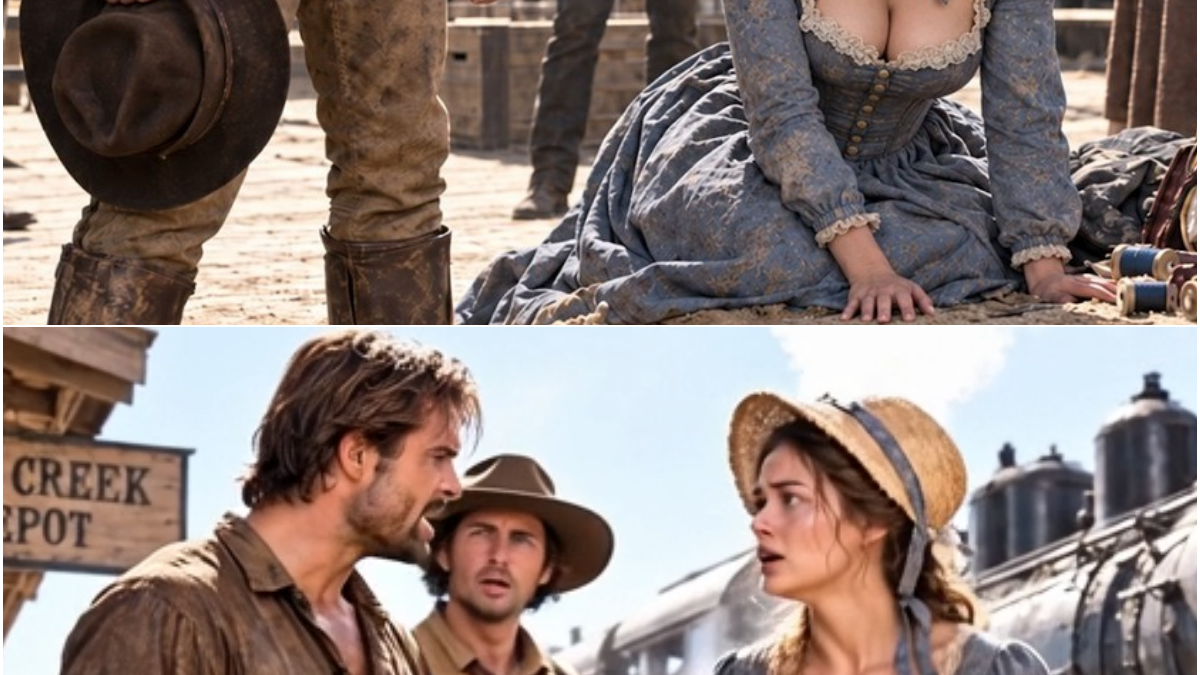
The laughter stopped before Emily Harper understood why. One moment, she was kneeling in the Wyoming dust, gathering the scattered pieces of her life while strangers watched her struggle.
The next, a tall cowboy had stepped out from beneath the depot roof and spoken four words that would change everything.
“I’ll take her.” The station fell silent. Emily looked up, unable to understand why a man she had never met would challenge the humiliation she had just endured.
She had arrived in Red Creek believing she was finally going to have a home, a husband, and a chance to begin again.
Instead, the man who had promised to marry her had thrown her belongings into the dirt and invited the entire town to laugh.
Now a stranger was offering her shelter, and the expression in his eyes suggested he was not afraid of anyone standing there.
His name was Caleb Walker. He was thirty five, a rancher who lived alone eight miles north of town, and a man surrounded by rumors nobody seemed willing to explain.
Emily knew nothing about him, except that he had just shown her more kindness than anyone else in Red Creek.
She also knew she had nowhere else to go. The train that had brought her across nearly fifteen hundred miles was already preparing to leave, and the future she had imagined had disappeared in the duSt. But what Emily could not possibly have known was that the cowboy offering her a place to stay carried a secret of his own, one that might threaten the quiet life they were about to build together.
The afternoon train had arrived in Red Creek beneath a burning August sun. Heat shimmered above the rails, and clouds of steam drifted across the wooden platform before dissolving into the dry Wyoming air.
Horses stamped beside the hitching posts, ranch hands gathered near the station doors, and farmers waited for supplies that had traveled west in crowded freight cars.
Women in Sunday dresses stood beneath parasols, exchanging news and watching the passengers descend from the train.
Emily Harper came off last. She was twenty six years old, exhausted from three days of travel, and carrying one faded carpet bag.
Her pale blue dress had been washed so many times that its original color had nearly disappeared.
Dust marked the hem, her boots were worn, and a loose ribbon hung from the edge of her straw bonnet.
Yet there was still hope in her expression. She had traveled nearly fifteen hundred miles for one reason.
Walter Crane. For six months, Walter had written letters promising that they would marry. He owned a feed store in Red Creek and had described Wyoming as a place where a hardworking woman could build a good life.
Emily had believed him. After her father’s property was lost and the bank took their Missouri farm, she had nowhere left to go.
Her family’s savings were gone, and the future she had once expected had become impossible to imagine.
Walter’s letters had offered a way forward. He had told her that he needed a wife who understood work, someone who could cook, sew, keep a house, and help him establish a respectable home.
Emily had been raised on a farm. She knew how to mend clothing, prepare meals, care for animals, and stretch a little flour into enough bread for a family.
She believed she could offer everything he had asked for. She had imagined him waiting beside the train with a welcoming smile.
He was there. But the moment Walter saw her, the warmth disappeared from his face.
He pushed through the crowd and stopped directly in front of her. His eyes traveled from her faded dress to her old boots, then to the carpet bag in her hand.
“You, Emily Harper?” “Yes.” “Where’s the money?” The question struck her so unexpectedly that she almost forgot to answer.
“My father’s property was supposed to sell before I left.” Walter’s expression hardened. “You wrote that you’d bring four hundred dollars.”
“I believed I would.” “And the sewing machine?” Emily tightened her fingers around the handle of her bag.
“The bank took almost everything.” Several people nearby leaned closer. Emily could feel their attention settling over her, but she tried to keep her voice steady.
“I can work. I can cook, sew, keep house. I’ve worked a farm since I was a child.”
Walter gave a short laugh without humor. “That doesn’t pay debts.” “Walter, please. I came here to be your wife.”
He glanced toward the watching crowd, apparently embarrassed that she had said it aloud. “That wasn’t the agreement.”
“You said you wanted someone honeSt. Someone who could work.” “I wanted a wife who could bring something into the marriage.”
Emily stared at him, struggling to understand how the man who had written such warm letters could now speak to her as though she were an unwanted parcel.
Then Walter stepped back. “Turn around.” She blinked. “What?” “I want to see what I paid train fare for.”
A few men laughed. Emily felt her face burn, but she slowly turned once, completing a circle beneath the curious eyes of the station crowd.
When she faced Walter again, he looked almost bored. Behind the people gathered near the platform stood Caleb Walker.
He had come into Red Creek for fence wire and lamp oil, intending to finish his errands and return to his ranch before evening.
He was thirty five, broad across the shoulders, with sun darkened skin and a quiet face that rarely revealed what he was thinking.
His brown hat sat low over his eyes, and his work clothes were plain and practical.
Most people in Red Creek knew who Caleb was. Almost none of them knew him well.
He owned a small ranch eight miles north of town. He lived alone, kept to himself, and rarely joined the conversations that occupied the local store or church.
People had been whispering about him for years. Some said he was unfriendly. Others claimed he was dangerous.
Few could explain precisely why they believed those things. Caleb had learned to let them talk.
But now, watching Emily Harper standing beneath Walter Crane’s contempt, something in his expression changed.
Walter spat into the dirt. “You should have told me you were broke.” “I didn’t know until after my father’s funeral.”
“Not my trouble.” He reached for her carpet bag. For one brief second, Emily thought he might have changed his mind.
Perhaps he would take the bag and lead her somewhere private, away from the watching crowd.
Perhaps he would remember the promises in his letters. Instead, Walter dropped the bag from the edge of the platform.
It struck the dirt and burst open. A Bible fell out. A brown dress, two shirts, and a framed photograph scattered across the ground.
Her small wooden sewing box hit a wheel and cracked apart. Spools of thread rolled through the duSt.
Someone laughed loudly. Emily stared at her belongings. Her mother’s photograph lay face down near a horse trough.
She climbed down from the platform and knelt in the dirt. One knee pressed into the ground as she began gathering everything quietly.
Walter looked down at her. “You can catch the evening train eaSt.” Emily stopped moving.
“I don’t have money for another ticket.” “Then you’ll have to find work.” A man near the station doors called out that the Silver Bell was always looking for women.
The laughter grew harder. Emily knew what the Silver Bell was. Her hands went still, and for one painful moment she could not bring herself to look up.
She had crossed the country hoping for a home. Now strangers were treating her desperation as entertainment.
She did not cry. Instead, she picked up another spool of thread, then another. Her fingers trembled so badly that she dropped one twice.
Nobody helped. The station master looked away. Two ranch hands suddenly became fascinated by the ground.
A woman pulled her daughter closer, as though Emily’s misfortune might somehow spread to those standing near her.
Caleb set down the box of fence nails he was carrying. The sound made several people turn.
He walked forward, and the laughter gradually faded. Walter saw him coming. “This ain’t your concern, Walker.”
Caleb climbed down from the platform. He did not answer. Instead, he picked up Emily’s mother’s photograph.
The glass was cracked, and dust covered the frame. He wiped it gently with his sleeve before handing it to her.
Emily looked up. Her eyes were wet, but she had not cried. Caleb picked up the broken sewing box, then the Bible, then the remaining spools of thread.
One by one, he helped put her scattered belongings back into the carpet bag. Walter folded his arms.
“You planning to rescue every foolish woman who gets off a train?” Caleb stood. “No.”
He looked at Emily, then at Walter. “Just this one.” The crowd went still. Walter gave a nervous laugh.
“What are you saying?” Caleb lifted his hat from his head. “I’ll take her.” A woman gasped.
Someone whispered his name. Even the station master stepped out of his office. Emily stared at Caleb, unable to understand what he meant.
Walter’s laugh returned, but anger had replaced the amusement in his voice. “You don’t even know her.”
Caleb’s eyes remained on Emily. “I know what I saw.” “What did you see?” “A woman keeping her dignity while half this town tried to take it from her.”
Nobody laughed now. Walter’s face darkened. “You fixing to marry her?” Caleb paused. “No.” Emily felt a small spark of hope vanish almost as quickly as it had appeared.
Then Caleb continued. “I’ve got a spare bed, food, and work if she wants it.
She can stay until she decides what comes next.” Emily searched his face. “What do you want from me?”
“Nothing you don’t choose to give.” The answer confused her more than anything else. In her experience, people rarely offered anything without expecting something in return.
She had learned how quickly promises could become demands. Caleb lifted her carpet bag. “You need somewhere to go?”
Emily glanced toward the train. The conductor was already calling passengers aboard. Going east meant returning to a town where the bank owned her home and everyone knew her family had lost everything.
Staying meant trusting a stranger. Behind her, Walter stood with a cruel little smile. He seemed certain that Emily would fail, that Caleb would soon discover she was more trouble than she was worth.
Emily looked back at Caleb. “Yes.” The word was barely louder than the wind, but Caleb nodded as though she had spoken clearly.
He offered his hand. Emily hesitated before placing hers in it. His palm was rough and scarred, but his grip was gentle.
They walked through the crowd together. People moved aside. Caleb did not look at them, and Emily tried not to either.
His wagon waited near the hitching rail. He helped her onto the wooden seat, placed her carpet bag behind them, and climbed up beside her.
When the wagon began moving, Walter called after them. “You’ll regret this, Walker.” Caleb did not turn.
Emily did. She watched Walter grow smaller behind them until Red Creek disappeared beneath a cloud of road duSt.
For nearly four miles, neither she nor Caleb spoke. The prairie stretched around them in waves of golden grass.
Hawks circled against the blue sky, and cattle moved like dark dots across the distant land.
Finally, Emily asked the question that had been burning inside her. “Why did you help me?”
Caleb kept his eyes on the road. “Because nobody else did.” “That isn’t an answer.”
“It is to me.” She studied his profile. There was sadness in his face, an old sadness that seemed too deep to have come from one difficult afternoon.
“People in town seem afraid of you.” “They ain’t afraid.” “They moved when you walked toward them.”
Caleb’s jaw tightened. “They remember things.” “What things?” He did not answer. An hour later, they reached his ranch.
The house was small, a weathered wooden cabin standing beside a barn and fenced pasture.
A vegetable patch struggled near the porch, and six cattle grazed beyond the fence. It was not grand, but it was quiet.
The prairie around it seemed to stretch without interruption toward the distant hills. Caleb carried her bag inside.
The cabin had one main room, a stone fireplace, a table, two chairs, and a narrow bed against the wall.
A few shelves held tin cups, cooking pots, and books. The room was clean enough, but it lacked the warmth of a place where someone had recently been living with care.
Caleb pointed toward the bed. “You sleep there.” “Where will you sleep?” He pulled a bedroll from beneath the bed and dropped it beside the fireplace.
Emily stared at him. “You don’t have to do that.” “I know.” That answer stayed with her.
As evening approached, Caleb went outside to tend the cattle. Emily began putting away her few belongings.
Her mother’s photograph went on the mantle. Her Bible went beside it. The broken sewing box rested on the table.
Then she noticed something strange. A loose board beneath one of the shelves. She pressed it gently.
The board shifted. Emily glanced toward the open door. Caleb was still outside, moving near the barn.
She crouched and lifted the board. Something wrapped in dark oilcloth lay inside the hidden space.
It was heavy, long, and unmistakably metal beneath the cloth. Emily carefully pulled one corner back.
Her breath stopped. A revolver lay inside. It was clean, oiled, and ready. Beside it rested an old newspaper clipping folded into a small square.
Emily opened the paper. The yellowed headline carried a name she now knew well. Caleb Walker.
Below it were words that made her hands go cold. Wanted for questioning. She heard boots approaching the cabin.
Quickly, Emily folded the paper, covered the revolver, and pushed the board back into place.
The door opened. Caleb stepped inside. For the first time since she had met him, his quiet expression seemed to change.
His eyes moved briefly toward the shelf, then toward Emily. She wondered whether he knew what she had found.
But he only looked toward the cold fireplace. “Winds changing,” he said. “Might rain tonight.”
Emily slowly released the breath trapped in her cheSt. Caleb crossed the room and picked up the coffee pot.
“You hungry a little?” He nodded toward the shelf. “Beans, salt pork, flour, if you know what to do with it.”
Emily almost smiled. “I know what to do with flour.” Something softened in his face.
It disappeared before she could be certain she had seen it. Caleb went outside again.
Emily waited until his footsteps faded toward the barn before looking at the loose board.
The words on the clipping remained in her mind. Wanted for questioning. She did not touch the hiding place again.
Instead, she rolled up her sleeves and went to work. By sundown, Caleb barely recognized his own cabin.
Emily scrubbed years of dirt from the table, cleaned the skillet with hot water and sand, and arranged his tins in neat rows.
She marked scraps of paper so he could tell coffee from sugar without opening every container.
Then she mixed flour, lard, salt, and water into dough. When Caleb entered carrying an armful of firewood, the smell of fresh biscuits stopped him in the doorway.
Emily looked over her shoulder. “You can come in.” Caleb glanced down at his muddy boots.
He removed them. Emily stared. “You don’t have to do that.” “Floor’s clean.” “So I’d like to keep it that way.”
For the first time since reaching Wyoming, Emily laughed. It was small and almost surprised, as though the sound had escaped before she could remember why she had been trying so hard to remain serious.
Caleb looked at her as if he had forgotten what laughter sounded like. They ate at the table.
Emily watched him break open his first biscuit. Steam rose between his fingers. He took one bite, then another.
For several seconds, he said nothing. Emily became nervous. “Is it bad?” Caleb shook his head.
“My mother used to make biscuits like these.” Emily’s expression softened. “When did she pass?”
“Eleven years ago.” “I’m sorry.” He stared at the biscuit. “House stopped smelling like home after that.”
Emily did not know what to say, so she pushed the plate closer. Caleb took another biscuit.
That night, Emily found a worn novel on the shelf. Caleb sat beside the fireplace, shaping a piece of cedar with his knife.
“Is this yours?” “My mother’s.” “Do you read?” “When I have to.” Emily smiled. “That sounds like no.”
He almost smiled back. “Maybe you could read some.” Emily settled into the old rocking chair and began.
Her voice filled the cabin, carrying the story into the quiet corners of the room.
Caleb continued carving, but after several minutes, his knife stopped moving. He simply listened. Later, when Emily climbed into bed, she noticed a small object Caleb had left on the table.
A wooden spoon. Its handle was smooth, its bowl carefully shaped, and its surface freshly polished.
She ran a finger along the edge. No one had given her anything in months without asking for something back.
The next morning, Caleb showed her where the hens nested. Emily collected five eggs while he scattered grain.
She cooked breakfast, and he repaired the fence. She washed clothing at the pump, and he brought water without being asked.
She mended the tear in his work shirt, and he fixed the broken hinge on her sewing box.
Little by little, the cabin changed. So did the silence between them. It no longer felt uncomfortable.
Sometimes Caleb worked while Emily hummed. Sometimes she read while he carved. Sometimes they sat outside after supper, watching the sun disappear across the Wyoming grass.
Neither spoke much. Neither needed to. Three days passed before the outside world found them again.
Emily was sewing near the window when she heard a horse approaching. She looked outside and saw a thin teenage boy riding toward the cabin with a sack across his saddle.
He stopped beside the porch. “Delivery for mr. Walker.” Emily stepped outside. “I’m Emily Harper.”
The boy’s face turned red. “I know.” He unloaded a sack of flour from Miller’s Mercantile.
“Thank you.” He climbed back onto the saddle but did not leave. Emily waited. The boy rubbed the back of his neck.
“Ma’am?” “Yes?” “People are talking.” Emily’s stomach tightened. “About what?” He stared at the reins.
“You living here with Caleb?” “Yes.” “What are they saying?” The boy looked miserable. “That it ain’t decent.
You two under one roof and not married.” Emily gripped the porch rail. The boy hurried to explain.
“I don’t believe it. My pa don’t either, but Walter Crane’s been talking. mrs. Mercer, too.
Says respectable women shouldn’t be living alone with men.” Emily felt the old shame return, hot and immediate.
The boy kicked his horse forward. “Thought you ought to know.” He rode away. Emily remained on the porch long after the sound of his hoofbeats disappeared.
That evening, Caleb returned carrying two prairie hens. Emily barely noticed. “People are talking.” Caleb stopped.
“Figured they would.” “You knew?” “I know Red Creek.” “Walter’s telling people we’re living improperly.”
Caleb set the birds on the table. “Are we?” “No.” “Then let them talk.” Emily stared at him.
“It could hurt you.” Caleb shrugged. “Town’s opinion of me hasn’t been worth much for years.”
The hidden newspaper flashed through her thoughts. “Why?” His expression closed. “Long story.” Emily wanted to ask about the gun.
She wanted to ask what had happened in Kansas, and why a man who seemed so careful with others had hidden a revolver beneath the floor.
Instead, she said something she had not planned to say. “We could marry.” Caleb looked at her.
Her heart jumped. “I mean, to stop the gossip.” “No.” The answer came so quickly it hurt.
Emily looked away. Caleb stepped closer. “I didn’t mean it that way.” “Then what way did you mean it?”
“If I ever ask a woman to marry me, it’ll be because I want her for my wife.
Not because Walter Crane can’t keep his mouth shut.” Emily looked back at him. Something passed between them, something neither was ready to name.
On Sunday morning, they walked into Red Creek together. The church bell was ringing when they reached town.
Conversation died as they approached. Women stared, and men whispered. Emily slowed, but Caleb’s hand touched lightly against her back.
“Keep walking.” Inside, people filled every pew except one. The last bench, far in the back, remained empty.
Emily and Caleb sat there alone. Reverend Samuel Reed climbed to the pulpit. The old minister looked over his congregation, then settled his eyes on the empty space surrounding Caleb and Emily.
He opened his Bible. “Judge not, that ye be not judged.” Several people shifted uncomfortably.
Reverend Reed continued. “A town shows its character not by how it treats the respected, but by how it treats the unwanted.”
Walter Crane sat three rows ahead. His shoulders stiffened. Emily looked down at her hands.
When the service ended, she and Caleb waited until most of the congregation had gone.
They stopped at Miller’s Mercantile to buy thread. mrs. Mercer entered while Emily was choosing buttons.
The older woman looked directly at her. “Some women know how to behave properly.” Emily’s hand froze.
Caleb quietly stepped between them. mrs. Mercer glared at him. “You think frightening people makes you respectable, Walker?”
The store went silent. Caleb’s face changed, only slightly, but Emily saw it. Something cold appeared in his eyes.
For a moment, the man who had needed that hidden revolver seemed very close to the surface.
Then Caleb breathed out, stepped back, and said nothing. mrs. Mercer left. On the long walk home, Emily finally stopped in the road.
“You shouldn’t have taken me from that station.” Caleb turned. “Why?” “Because now they’re judging you, too.”
“They already did.” “You could lose friends.” “Didn’t have many.” “Your reputation.” He gave a humorless smile.
“That disappeared before you ever came weSt.” Emily’s eyes filled. “I’ve brought trouble into your life.”
Caleb stepped toward her. “You brought coffee into my cabin.” She blinked. “What?” “And clean curtains and biscuits and somebody singing while I’m fixing fence.”
His voice grew quieter. “I hadn’t heard another person laugh inside that house in years.”
Emily could not stop the tears now. Caleb pulled a clean handkerchief from his pocket and gave it to her.
She wiped her eyes. “Why were you alone so long?” He looked toward the distant hills.
Emily waited, but Caleb only said, “Because sometimes a man starts believing what people say about him.”
They continued home. The sun was setting when they reached the cabin. Emily opened the door, then stopped.
A folded paper rested on the table. Neither of them had left it there. Caleb picked it up.
His jaw tightened as he read. The notice carried the seal of the Red Creek Town Council.
Caleb Walker and Miss Emily Harper were required to appear Tuesday evening regarding a matter of community decency.
Emily went cold. “They can do that?” Caleb read the notice again. “Seems they think they can.”
Outside, thunder rolled far across the prairie. Emily looked at the loose floorboard beneath the shelf, at the place where Caleb kept the revolver, then back at the man beside her.
“Caleb.” He looked at her. “Before we go into that town Tuesday, I need to know something.”
His face became still. Emily swallowed. “I found the gun.” Silence filled the cabin. Caleb’s eyes changed.
Emily stepped closer despite the fear moving through her. “What happened?” For a long moment, he said nothing.
Then thunder rolled again, closer this time. Caleb slowly sat at the table. “Lock the door, Emily.”
Her heart began pounding. “Why?” He looked toward the darkening window. “Because if I’m going to tell you who I was, you need to hear all of it.”
Emily locked the cabin door. Rain struck the roof harder with every passing second. Caleb sat at the table with both hands flat against the wood.
For the first time since she had met him, he looked afraid. Not afraid of Walter Crane.
Not afraid of the town council. Afraid of what Emily would think once she knew the truth.
She sat across from him. “You don’t have to protect me from your paSt.” Caleb stared at his hands.
“Five years ago, I worked cattle outside Abilene, Kansas.” Lightning flashed through the shutters. “One night, I went into town with some ranch hands.
There was a card game in a saloon. A gambler accused me of watching his hand.”
“Were you?” “No.” Caleb’s jaw tightened. “He didn’t believe me.” The storm rolled over the cabin.
“He stood up and reached for his gun. I was faster.” The answer came quietly.
“One shot.” Caleb looked toward the fireplace. “He never got back up.” Emily said nothing.
“The sheriff questioned everyone. Six men saw him draw firSt. Nobody blamed me.” He paused.
“But that wasn’t the end.” Caleb looked at her. “The gambler had a brother. Two weeks later, that brother found me.
Another challenge, another gunfight. Then came a cousin, then a friend, then another man who wanted the reputation of beating Caleb Walker.”
His voice grew colder. “Everywhere I went, someone wanted to test me.” “How many?” His eyes lowered.
“Five men.” Emily’s stomach tightened. “All self-defense?” “The law said so.” “But you don’t believe it.”
Caleb was silent. Finally, he whispered, “At first, I hated it.” Emily waited. “Then people started moving out of my way.
Men stopped insulting me. Nobody cheated me. Nobody pushed me around.” His fingers curled against the table.
“And I started liking that.” Emily saw the shame in his face. “That frightened me more than anything else.”
He looked at her. “So I left Kansas, bought this ranch, put the gun under that floorboard, and promised myself I’d never become that man again.”
Emily thought of the station. Walter humiliating her, the laughter, the way Caleb had walked forward without reaching for a weapon.
“You could have hurt Walter.” “Yes.” “But you didn’t.” Caleb’s expression tightened. “I wanted to.”
“But you didn’t.” Emily reached across the table. Caleb stared at her hand, then slowly placed his beneath it.
“You aren’t the worst thing you’ve ever done,” she said. His eyes lifted. “You don’t know that.”
“I know the man who sleeps on the floor so a frightened woman can feel safe.
I know the man who fixes sewing boxes and carves spoons when nobody asks him to.”
Caleb almost looked away. “You aren’t nothing but your paSt.” He stared at her for a long moment.
Then he said, “Neither are you.” Emily felt tears burn her eyes. “You lied because you were trying to survive.”
His thumb moved once across her hand. “And I ran because I was trying to become somebody better.”
Thunder rolled away toward the eaSt. For several minutes, they simply sat together, holding hands.
Then Caleb suddenly turned toward the window. His entire body went still. “What?” He stood.
“Riders.” Emily heard them now. Hooves striking wet earth. Several horses moving along the road.
Caleb looked through the shutter. “How many?” “Six.” Emily joined him. Dark figures moved through the rain.
Torches burned against the night. One rider came ahead of the others. Sheriff Daniel Ross.
Behind him rode three town councilmen and Walter Crane. Emily’s stomach dropped. Caleb walked toward the loose board.
His hand hovered near it. Emily caught his arm. “No.” He looked at her. “They came looking for a fight.”
“Then don’t give them one.” A knock struck the door. “Walker. Sheriff Ross.” Caleb opened it.
The sheriff stood on the porch, dripping rainwater. “Council meeting is tonight.” “The notice said evening.”
“It is evening.” “You brought six men to collect us.” Walter spoke from the yard.
“Maybe we didn’t know if you’d come peaceful.” Caleb’s shoulders tightened. Emily felt the change in him, that old instinct and anger rising beneath his calm expression.
She stepped beside him. “We’ll come.” Caleb looked down at her. Emily met his eyes.
“Together.” A few minutes later, they started toward Red Creek. The mounted men rode beside them, while Caleb and Emily walked through the mud.
The journey was seven miles, and by the time they reached town, Emily’s dress was soaked nearly to her knees.
Every lamp in the schoolhouse burned. Dozens of townspeople waited outside. The whispers started the moment they arrived.
Caleb offered Emily his hand. She took it. They entered together. Inside, five councilmen sat behind a long table.
Walter Crane sat among them. mrs. Mercer occupied the front row. Two empty chairs waited in the center of the room.
Emily and Caleb sat. The council chairman stood. “This hearing concerns improper living arrangements and conduct damaging to the moral standards of Red Creek.”
Sheriff Ross spoke from the back. “This isn’t a trial.” The chairman cleared his throat.
“Of course not.” Walter stood and faced the crowd. “I brought Miss Harper here expecting marriage.
She misrepresented what she owned. When I refused her, Caleb Walker took her home.” He pointed toward them.
“Now they’re living together unmarried. What example does that set?” Caleb rose. “She needed somewhere safe.”
“You sleep under the same roof?” “Yes.” Walter smiled. “There you have it.” “I sleep on the floor.”
Several people laughed quietly. Walter turned toward Emily. “And what does she say?” The chairman looked at her.
“Miss Harper?” Emily stood. Her legs shook, and every face in Red Creek seemed fixed on her.
She could sit down and say nothing. She could let Caleb defend her again. Instead, she remembered the station.
Her belongings in the dirt. Their laughter. “I lied.” The room went quiet. “I told Walter Crane I had money.
My father had lost our farm. My mother was gone, and I had nowhere to live and almost nothing to eat.
I believed that if I could reach Wyoming, I could work hard enough to make up for what I didn’t have.”
Her voice strengthened. “I was wrong.” She looked directly at Walter. “He didn’t want a wife.
He wanted money.” Walter’s smile faded. “When I couldn’t give him that, he threw my belongings into the dirt.”
Emily looked around the room. “And most of you watched.” Silence settled over the schoolhouse.
“Some laughed. Several men lowered their eyes. One man didn’t.” She looked at Caleb. “He gave me shelter.”
Her voice cracked, but she continued. “He never touched me without permission. Never demanded payment.
Never treated me like something he’d bought.” Emily faced the council. “If kindness has become indecent in Red Creek, then maybe the problem isn’t Caleb Walker.”
Nobody moved. Emily sat. Caleb remained standing. He looked at Walter, then at the council, then at Emily.
Something in his face had changed. He seemed calm and certain. “I’ve got something to say.”
Emily looked up. Caleb turned fully toward her. “This town thinks I ought to marry you so folks can stop talking.”
Her heart began pounding. “I won’t.” A murmur swept through the room. Emily’s face fell.
Then Caleb stepped closer. “I won’t marry you because they demand it.” The room became silent again.
“I’d marry you because my house doesn’t feel empty anymore.” Emily stopped breathing. “Because there’s coffee waiting when I come in from the pasture.”
His voice grew rough. “Because you sing when you think nobody’s listening.” Tears filled her eyes.
“Because you looked at the worst thing I’ve ever done and somehow still saw the man I’m trying to become.”
Caleb swallowed. “I don’t have much to offer.” He held out his hand. “But what I have is yours if you want it.”
Walter slowly stood. mrs. Mercer covered her mouth. Caleb looked only at Emily. “Emily Harper, will you marry me?”
In a room that had gathered to drive them apart, every person in Red Creek waited for her answer.
Emily looked at Caleb’s open hand. For several seconds, she could not speak. The same hand had picked her mother’s photograph out of the dirt.
The same hand had repaired her sewing box, carried water, carved a wooden spoon, and stayed carefully away from her when she had been too frightened to trust anyone.
Now it trembled, just slightly. Caleb Walker, the man half the town believed could face any gun without fear, was frightened of her answer.
Emily stood. “Yes.” A breath seemed to leave the whole room at once. Caleb stared at her.
Emily smiled through her tears. “Yes, Caleb. I’ll marry you.” Someone near the back whispered, “Well, I’ll be.”
A few people laughed softly. Walter Crane did not. His face had gone dark. “This is ridiculous.”
Sheriff Ross stepped away from the wall. “Seems pretty clear to me.” Walter pointed toward Caleb.
“You people forgetting who he is?” The room went quiet again. Emily felt Caleb stiffen beside her.
Walter looked around, desperate now. “He killed men in Kansas. Everybody knows the stories.” Several faces turned toward Caleb.
The old fear returned to the room. Caleb lowered his hand. Emily saw shame enter his face.
Then she stepped beside him. “He told me.” Walter blinked. “What?” “He told me everything.”
“You still agreed to marry him?” Emily looked at Caleb. “Yes.” Walter laughed bitterly. “Then you’re more foolish than I thought.”
This time, someone else stood. Reverend Samuel Reed had entered quietly through the rear door.
Rainwater dripped from his black coat. “I’ve known foolish men,” the old minister said. “Usually, they’re the ones who mistake cruelty for good judgment.”
Walter’s face burned. Reverend Reed walked toward the front. “I’ve visited Caleb’s ranch twice this week.”
He looked at the council. “I saw two people working, eating together, praying before supper, and treating each other with respect.”
mrs. Mercer shifted in her chair. The reverend looked toward her. “I’ve seen marriages in this town with less decency.”
Nobody answered. The council chairman cleared his throat. “We still have a matter of community standards.”
Sheriff Ross frowned. “What exactly are you voting on now?” The chairman looked uncomfortable. “Well, their living arrangement.”
“They just agreed to marry,” Miller said. “That doesn’t change what happened before.” Emily felt Caleb’s hand close around hers.
Then Henry Miller, the owner of the mercantile, stood from the council table. He removed his spectacles and looked directly at Walter.
“I’ve heard enough.” The chairman stared at him. “Henry?” “We dragged two people seven miles through mud because Walter Crane didn’t like being embarrassed.”
Walter slammed a hand against the table. “This is about decency.” “No,” Miller said. “It’s about pride.”
The words struck harder than shouting. Walter looked around the room. This time, few people looked back at him.
Miller turned toward Reverend Reed. “When can you marry them?” The old minister smiled. “Sunday afternoon.”
Caleb looked at Emily. Her eyes widened. “That soon?” “You want longer?” He asked. Emily thought about the train station, about having nowhere to sleep, about believing her life was already over.
Then she looked at the man who had changed everything with four words. “No.” Sunday came bright and clear.
Emily woke before sunrise. The cabin was quiet, and Caleb still slept beside the fireplace.
For the last time before their wedding, she slipped outside and washed at the pump.
Then she heated water, cleaned her face, and brushed her hair. Her wedding dress was the same faded blue dress she had worn when she stepped off the train.
She had washed it, mended the torn sleeve, and replaced the missing buttons. The dress was still old, but Emily no longer felt ashamed of it.
It belonged to the woman who had crossed half a country with nothing but hope.
She wanted to wear it. When Caleb woke, he shaved carefully outside using a small mirror hung from the porch poSt. He nicked his jaw.
Emily laughed when he came inside. “You’re bleeding.” “I noticed.” She dipped a cloth in water and stepped toward him.
Caleb went still as she touched it gently to his jaw. Their eyes met. Neither moved for a moment.
Then Emily smiled. “Can’t have the groom bleeding before the wedding.” Caleb’s ears turned red.
They walked toward town together. But when Red Creek came into view, Emily stopped. People were waiting along the road.
Dozens of them. Sheriff Ross stood beside a wagon. “You two planning to walk seven miles to your own wedding?”
Caleb looked at Emily. She smiled. They climbed aboard. For the first time since Emily had arrived, the people of Red Creek did not watch her like something unwanted.
Some waved. A little girl handed her wildflowers. Miller’s wife hugged her outside the church.
Even mrs. Mercer stood near the doors. She did not apologize. But when Emily passed, the older woman quietly said, “Blue suits you.”
It was enough. Inside, Caleb waited beside Reverend Reed. The church was nearly full. Emily walked down the aisle carrying black-eyed Susans tied with string.
Caleb watched every step. When she reached him, he whispered, “You sure?” Emily almost laughed.
“Are you?” “No.” Her smile disappeared. Then Caleb added, “I’m terrified.” Emily squeezed his hand.
“So am I.” “Good.” “Why good?” “Means we’re both paying attention.” She laughed quietly. Reverend Reed opened his Bible.
The vows were simple. There were no grand promises about riches, because neither of them had much.
There were no promises that life would always be easy, because both knew better. Caleb promised honesty, protection, and respect.
Emily promised the same. When Reverend Reed asked for the ring, Caleb pulled a simple gold band from his pocket.
Emily stared at it. “When did you buy that?” “Yesterday.” “With what money?” Caleb leaned closer.
“Don’t ask questions during your wedding.” She smiled through her tears. He slipped the ring onto her finger.
It was slightly too large, so Emily curled her hand to keep it from falling.
Reverend Reed smiled. “You may kiss your wife.” Caleb looked at Emily as though he still needed permission.
She moved closer. Their first kiss was gentle and brief, nothing like the wild romance people told stories about.
But when Caleb pulled back, Emily knew she had never been kissed with greater care.
Applause filled the church. Outside, tables had been set beneath cottonwood trees. People brought biscuits, beans, fried chicken, pies, preserves, and lemonade.
Miller gave them flour and coffee. Sheriff Ross gave Caleb a new lantern. The little girl who had handed Emily flowers brought six eggs wrapped in cloth.
mrs. Mercer’s daughter gave Emily a quilt. Near sunset, Sheriff Ross drove them home. The gifts filled the back of his wagon.
When the cabin appeared across the prairie, Emily leaned against Caleb. Smoke curled from the chimney.
The garden glowed green in the evening light. Home. That word no longer frightened her.
After unloading everything, Caleb disappeared into the barn. He returned carrying something large beneath a blanket.
Emily raised an eyebrow. “Another secret?” “Last one.” He removed the blanket. A rocking chair stood beneath it, made from fresh pine and carefully carved.
Emily ran her fingers across the smooth arm. “You made this?” “Been working on it after you went to sleep.”
She looked toward the old rocking chair already on the porch. “Now there are two.”
Caleb nodded. “Didn’t seem right having only one anymore.” Emily’s eyes filled. They carried both chairs outside.
Before sitting, Caleb handed her a small rose cutting that Reverend Reed’s wife had sent.
They planted it beside the cabin. Emily held the plant straight while Caleb covered its roots with soil.
“Think it’ll survive winter?” She asked. Caleb pressed the earth down with his hands. “Give it a chance.”
Emily looked at him. “That’s all anything needs, isn’t it?” He understood. That evening, they sat side by side in the two rocking chairs.
The prairie turned gold, then purple. Stars appeared over the Wyoming sky. Inside the cabin, Emily’s parents’ photograph stood beside Caleb’s mother’s picture.
The broken sewing box had been repaired, and her Bible rested safely on the shelf.
The hidden revolver was no longer beneath the floorboard. Caleb had unloaded it, wrapped it in cloth, and locked it inside an old trunk in the barn.
Not because the past had disappeared. It never would. But because it no longer controlled every decision he made.
Emily rested her head against his shoulder. “Do you regret saying it?” Caleb looked down at her.
“Saying what?” She smiled. “I’ll take her.” Caleb thought for a moment. Then his arm moved around her shoulders.
“Wrong words.” Emily lifted her head. “What should you have said?” His eyes softened. “I’ll stand beside her.”
Emily took his hand. The two chairs rocked together beneath the endless western sky. Weeks earlier, she had stepped from a train believing she had nothing left except herself.
It turned out that had been enough. She had brought her hands, her skills, her memories, and the stubborn hope that had carried her across nearly fifteen hundred miles.
Caleb had believed his own past had made him unworthy of a peaceful home. He had spent years keeping people at a distance, convinced that silence was safer than allowing anyone close enough to discover what he carried inside.
Neither had expected the other. Neither had planned to find love in a dusty station, a small cabin, or a town that seemed determined to misunderstand them.
But kindness had begun with one simple act. Caleb had picked up a photograph from the dirt.
Emily had accepted a hand without knowing where it would lead. After that, each had made another choice, and another, until the cabin no longer felt empty and the future no longer seemed impossible.
The town would continue talking. Some people would remember the rumors longer than the truth.
Walter Crane would remain part of Emily’s story, but he would no longer decide what happened next.
Caleb’s years in Kansas would remain part of his past, but they would not be allowed to define every day of his future.
The prairie offered no guarantee that life would be easy. Winters would come, work would be hard, and there would be days when the ranch seemed too quiet or the world beyond it too demanding.
Yet the two chairs on the porch gave them something neither had possessed before. Someone to sit beside.
Someone to listen. Someone who would stay when the world became difficult. As the evening deepened, Emily watched the first leaves stir on the small rose bush.
It was only a cutting, fragile and newly planted, with a long season ahead before anyone could know whether it would flourish.
Caleb followed her gaze. “Looks like it’s settling in.” Emily smiled. “So are we.” He kissed her forehead, and she leaned closer.
The first green leaf opened on the rose bush beside their cabin, small enough to miss if a person were not looking carefully.
But Emily saw it. Caleb saw it too. And beneath the vast Wyoming sky, they watched it together.
Disclaimer: This content may be created by Al for entertainment purposes. Any resemblance to real persons, events, or places is coincidental.








