“I’ll Show You How Cowboys Make Babies,” Growled the Rancher to the Virgin Mail-Order Bride
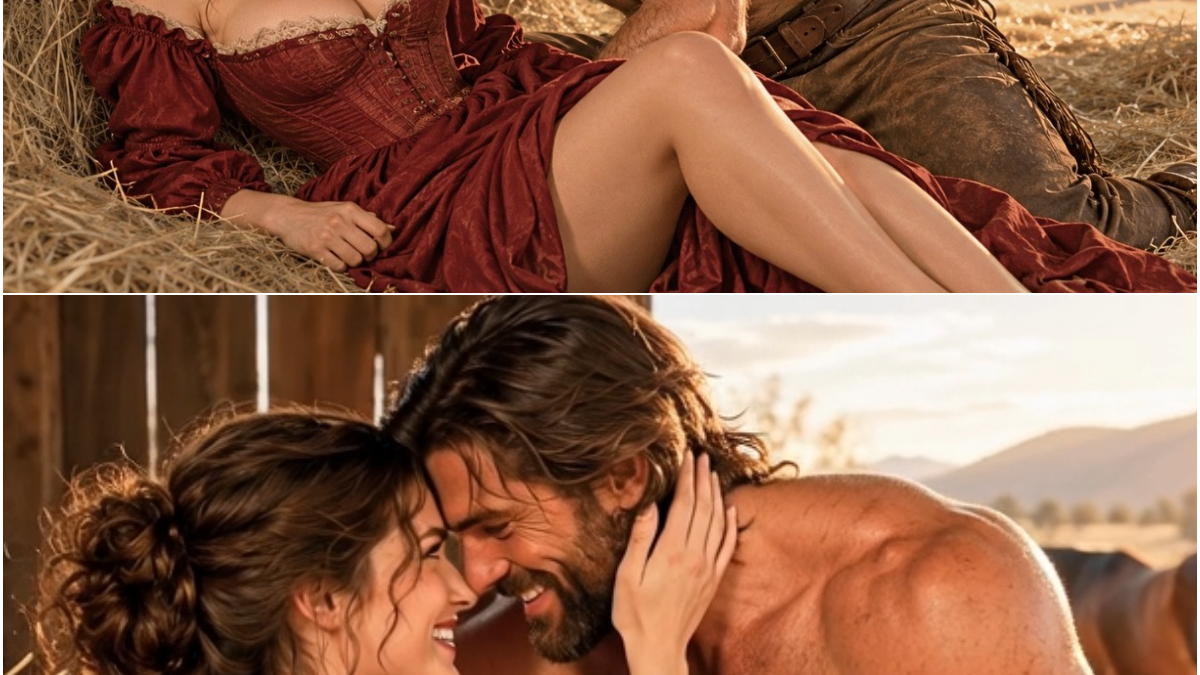
The lightning split the sky, and the horse beneath Josephine Hartwell erupted in terror. Its front legs rose, its hooves struck the air, and before Caleb Ashford could reach her, the animal twisted violently beneath the storm.
Josie flew from the saddle. She struck the frozen ground, rolled through the snow, and felt the breath driven from her lungs.
For a moment, the world became nothing but white darkness, pounding wind, and the sharp taste of ice in her mouth.
“Josephine!” Caleb was beside her almost instantly. His boots skidded across the frozen earth as he dropped to his knees and caught her shoulders.
“Talk to me. Are you hurt?” “I’m all right.” She tried to sit up, but a sudden pain made her gasp.
Both hands flew to her stomach. “Caleb.” His expression changed. “The baby?” She looked at him, frightened beyond anything she had ever known.
“The baby, Caleb.” He pulled off his coat, wrapped it around her, and lifted her carefully into his arms.
The wind struck them so hard that he nearly lost his footing. He caught himself, gathered the reins of both horses, and stumbled toward the dark outline of a rocky overhang.
There was barely room beneath it for two people and their frightened animals, but it was shelter, and shelter was all he could find.
He laid Josie down and reached for his saddlebag. His hands shook as he struck a match.
The first flame vanished in the wind. The second failed before it could catch. When the third finally burned, Josie seized his wrist.
“Caleb.” He looked down and saw the red spreading across the snow beneath her. And in that terrible moment, with the storm closing around them and the future they had fought so hard to protect suddenly uncertain, Caleb understood that the greatest battle of his life had only just begun.
Four months earlier, Josephine Hartwell had stepped off a train in Wyoming Territory with one small trunk, a travelworn dress, and a decision she had spent four days trying to convince herself was sensible.
The train had shuddered to a halt in Brier Hollow, a settlement of dusty streets and weather-beaten buildings surrounded by grassland stretching toward distant mountains.
It was a place so wide and unfamiliar that she could scarcely imagine what her life might become there.
She was twenty-three years old, and she had crossed much of the country to marry a man she had never met.
The decision had not been made from romance. It had been made because the alternative was Thomas Ferris.
Thomas had appeared in her aunt’s parlor with a gold pocket watch, an expensive coat, and eyes that seemed to measure everything in terms of what it might coSt. Her father had lost money gambling at Thomas’s establishment.
Rather than face the consequences himself, he had signed an agreement promising Josephine’s hand in marriage as settlement for the debt.
Thomas spoke of the arrangement as though it were perfectly ordinary. He discussed dates, expectations, and the future with the confidence of a man who believed that everything he wanted was already his.
Josie had listened until she could no longer bear the sound of his voice. Then she had climbed through a window and run.
Her escape had led her to a newspaper advertisement and a series of letters from Caleb Ashford, a thirty-five-year-old rancher with four hundred acres, a house he had built himself, and a practical manner that seemed almost severe on paper.
He wrote about cattle prices, winter feed, fence repairs, and the difficulties of keeping a ranch through changing seasons.
His handwriting was careful and blocky, as though every sentence required a degree of effort he would rather have spent elsewhere.
Only once had he mentioned his previous marriage. His wife, Eleanor, had passed away three years earlier after a fever.
He had included the information between two ordinary observations about ranch business, without explanation or sentiment.
Josie had read that line repeatedly, wondering what kind of man could mention such a personal matter so briefly.
Perhaps he was guarded. Perhaps he had learned that speaking too openly about sorrow only made it harder to carry.
She understood the impulse. In Ohio, she had learned to keep her fears quiet, her opinions carefully measured, and her hopes hidden from people who might use them against her.
Now she stood on the train platform, searching the crowd for the man whose letters had become her only guide to a life she could not yet picture.
She recognized Caleb immediately. He stood beside a hitching post, tall and broad-shouldered, with dark hair pushed back from his forehead and sleeves rolled to his elbows despite the autumn chill.
Years of hard work had shaped his hands and forearms. His face was serious, almost stern, but there was something unexpectedly gentle about his mouth.
When his eyes found hers, he became very still. “Miss Hartwell?” “mr. Ashford.” “Caleb,” he corrected.
She offered her hand. His was warm, large, and rough from years of handling rope, tools, and horses.
The simple contact made her suddenly aware of how close they stood. “I confess,” he said, “I expected someone older.”
“I confess I expected someone less handsome than your letters suggested.” A hint of amusement touched his expression.
“The preacher is waiting,” he said. They were married within the hour in a small clapboard church that smelled of dust and old candle wax.
Josie repeated the vows she had practiced in her mind during the journey. Caleb held her hand steadily throughout the ceremony, and when he lifted her veil, he kissed her with the restrained courtesy of a man honoring an agreement rather than claiming a bride.
The kiss was brief, but its warmth stayed with her long after they left the church.
They rode to the ranch in near silence, the wagon rolling over uneven ground as the sky darkened toward evening.
Josie tried not to notice how close Caleb sat beside her. She tried not to notice the warmth of his shoulder or the occasional brush of his leg against hers.
His house surprised her. She had expected a rough shelter thrown together for a solitary rancher.
Instead, the porch was swept clean, the front curtains carefully hemmed, and the rooms furnished with a quiet attention to comfort.
Caleb followed her gaze toward the curtains. “I built the second room after Eleanor passed,” he explained.
“The house needed more space.” “I’m sorry for your loss,” Josie said softly. “It was a long time ago.”
He looked toward the window, his expression difficult to read. “Sometimes it feels longer than it is,” he added.
She did not know how to answer, so she carried her trunk into the room he had prepared for her.
Supper was awkward. They sat across from each other at a table built for a larger household, passing biscuits and asking practical questions about the journey.
Josie found herself watching Caleb when she thought he would not notice. He ate with the efficient movements of a man accustomed to working outdoors and wasting very little time.
He noticed her attention, of course. His eyes occasionally met hers, and the faintest curve appeared at the corner of his mouth.
“You have questions,” he said at laSt. “I’m not sure what you mean.” “I know the particular quiet a woman falls into when she is nervous and too proud to say so.”
“I’m not frightened.” “Then nervous?” She hesitated. “Perhaps a little.” “That’s allowed, Josephine.” The sound of her name in his voice unsettled her more than she cared to admit.
“I’ve been married before,” he continued. “I understand that this is an unusual beginning. We needn’t rush anything.”
His words should have relieved her. Instead, they awakened a strange anticipation she did not know what to do with.
“Thank you,” she managed. “Don’t thank me yet, mrs. Ashford. Patience and restraint are not always the same thing.”
He showed her to her room that night and lingered briefly in the doorway. “Sleep well, Josephine.”
“Good night, Caleb.” They looked at each other for a moment before he finally left.
Josie lay awake listening to the wind move through the grass and the unfamiliar house settle around her.
She remembered his hand around hers at the station and wondered whether she had made a mistake by promising herself not to expect anything more from their marriage.
The days developed a steady rhythm. Caleb rose before dawn, worked through the morning, and returned with dust on his boots and the smell of sun-warmed leather on his clothes.
Josie learned the kitchen, the pantry, the household routines, and the small responsibilities that made the ranch feel less like a stranger’s property.
She also learned that Caleb noticed everything. He noticed when she paused at the window to watch him cross the yard.
He noticed when she grew quiet during supper. He noticed when she was struggling with a task and offered help without making her feel foolish.
Martha Witcom, a neighbor with a warm manner and a sharp eye, visited during Josie’s first week with a jar of preserves.
“You’ve got the look of a woman still deciding whether she’s landed on solid ground,” Martha observed.
“Have I landed wrong?” “That’s a question time will answer. But I’ll tell you something.
Caleb hasn’t smiled this much in three years.” Josie felt an unexpected warmth spread through her chest and quickly changed the subject.
On the ninth day, a rider brought a letter from Ohio. Josie recognized Thomas Ferris’s handwriting immediately.
The sharp, impatient strokes seemed to carry his personality across the page. She waited until the rider had gone before breaking the seal.
Thomas informed her that she had made a serious mistake by believing herself beyond his reach.
Her father’s agreement, he insisted, was binding. She was to return to Ohio by December, or Thomas would make certain Caleb learned what kind of woman he had married.
Josie read the letter twice. Her hands trembled as she folded it into a small square.
She was not a debt, she told herself. She was not property. Yet the words had been repeated so often in Ohio that some part of her still feared they might be true.
That evening, Caleb noticed her silence. “You’re quiet tonight.” “I’m tired.” He studied her, but did not press her.
“All right,” he said. “But if something is troubling you, you can tell me.” She promised herself she would explain the letter the next day.
Then another day passed, and she still could not find the courage. Three days later, she discovered the papers in Caleb’s desk.
He had asked her to bring him a ledger while he prepared to ride into town.
When she opened the bottom drawer, she found a stack of official documents tied with twine.
The name Elias Dracott appeared on the top page, above a notice of deficiency and a series of figures she struggled to understand.
The meaning beneath the legal language was unmistakable. Caleb’s ranch was in serious financial trouble.
One more missed payment could put the house and land beyond his control. She stared at the papers, unable to understand why he had never mentioned the danger.
Then she saw Dracott’s signature at the bottom of a letter and felt an unfamiliar uneasiness.
Something about the name seemed threatening, although she could not yet explain why. When Caleb returned, she handed him the ledger and pretended nothing was wrong.
He studied her face for a moment, but she held her expression steady. That night, she lay awake thinking about the two dangers now surrounding her.
Thomas wanted to force her back to Ohio. Someone named Elias Dracott appeared to be threatening Caleb’s livelihood.
She did not yet know whether the two men were connected. She only knew that she did not want to leave.
The realization frightened her. She had come west to escape one arrangement, not to become emotionally dependent on another man.
But Caleb’s quiet patience, his careful kindness, and the growing warmth between them had begun to matter more than she had intended.
The following morning, frost silvered the grass. Caleb crossed the yard toward the barn, his breath visible in the cold air.
Josie watched him from the kitchen window, carrying both secrets inside her as though they were stones.
Martha arrived with more preserves and caught her staring. “You’re going to wear a hole through that window if you keep looking at it like that.”
Josie laughed despite herself. Later, while they worked together, Josie cautiously asked whether Martha knew anyone named Dracott.
Martha’s hands stopped over the jars. “Where did you hear that name?” “Somewhere in town.”
Martha did not believe her, but she let the answer stand. “Some things are better left buried,” she said.
It was not an answer, and Josie understood that the truth was more complicated than she had imagined.
That afternoon, Caleb asked for help repairing a fence near the creek. Josie welcomed the chance to leave the kitchen.
He showed her how to hold the wire taut while he drove a staple into the poSt.
His arms came around hers as he guided her hands. His voice was low near her ear, and she became increasingly aware of the warmth of his body behind her.
“You’re a fast learner,” he said. “I have a patient teacher.” “Patient,” he repeated, almost thoughtfully.
She turned toward him and discovered that his face was much closer than she expected.
His gaze dropped briefly to her mouth. For one suspended moment, she thought he might kiss her.
Then a steer called from the far end of the fence, and Caleb stepped away to finish the repair.
They walked home with their hands brushing occasionally, neither quite daring to reach for the other.
Three nights later, Caleb came into the kitchen humming. He had enjoyed a good day at the far pasture, and there was an unfamiliar lightness in his expression.
“Dance with me,” he said. “There’s no music.” “There’s my humming.” “That is a generous description.”
“And there’s you.” He took her hand and drew her into a slow dance across the kitchen floor.
Josie laughed as he turned her, surprised by how graceful he was for such a large man.
The laughter faded when he drew her closer and stopped humming. “Josephine,” he said quietly.
“I’ve been very patient.” “I’ve noticed.” “I’m about to become considerably less patient.” He gave her time to step away.
She did not. When he kissed her, it was nothing like the careful kiss in the church.
It was warm and certain, filled with everything they had been too cautious to say.
Josie gripped his shirt and felt the last of her uncertainty begin to loosen. He eventually drew back, resting his forehead against hers.
“I know this marriage began as an arrangement,” he said. “But I want you to understand that I’m not simply waiting for you to fulfill some obligation.
I want all of you, Josephine. Whatever time it takes.” “I want that too,” she whispered.
She should have told him about Thomas then. She should have confessed that she had read the papers in his desk.
But the moment seemed too fragile, and she wanted one more evening in which she could simply be loved without fear interrupting it.
Tomorrow, she promised herself. Tomorrow came, and she remained silent. Martha finally learned about the documents when she found Josie watching Caleb work with the horses.
“I saw papers in Caleb’s desk,” Josie admitted. “The ranch is in debt. There was a name on them.
Elias Dracott.” Martha became very still. “Dracott was Caleb’s commanding officer during the war.” Josie’s stomach tightened.
Caleb had never told her he had served. “There was a battle,” Martha continued. “Dracott gave an order that would have sent men into terrible danger.
Caleb refused it and pulled his company back. He saved most of them.” “Then Caleb did the right thing.”
“He did. But Dracott never forgave him. He said Caleb had disobeyed him and made him look foolish before his superiors.
Now Dracott owns land notes across this territory. Including, I suspect, the one attached to Caleb’s ranch.”
Josie understood at once that the debt might not be an ordinary business matter. Dracott had a personal reason to want Caleb to fail.
She still did not tell Caleb everything she knew. Four days later, Thomas Ferris arrived in Brier Hollow.
Josie was at the mercantile when she heard his voice behind her. “Josephine.” She turned, her basket held tightly in both hands.
Thomas looked exactly as she remembered, from the cold eyes to the gold watch chain catching the light.
“What are you doing here?” “Collecting what is owed me.” “I am not a debt, Thomas.”
“No,” he replied smoothly. “But your father’s signature is on a contract.” He spoke casually about Caleb’s financial troubles, then revealed that he and Dracott had become acquainted.
They shared an interest in seeing Caleb lose the ranch, and Thomas believed their combined position would force Josie to return to Ohio.
She rode home as fast as she could. Caleb was in the barn when she arrived.
One look at her face made him stop what he was doing. “I need to tell you something,” she said.
“And I should have told you weeks ago.” She told him everything. The arrangement in Ohio, the escape, Thomas’s letter, the documents in the desk, Martha’s account of the war, and Thomas’s latest threat.
Caleb listened without interruption. His expression remained controlled, but when she finished, the silence between them felt heavier than any argument.
“You should have told me,” he said at laSt. “I know. I was afraid you would think less of me.”
He crossed the barn and gently took her face between his hands. “I am not angry that you ran from a man who thought he owned you,” he said.
“I am angry that you thought I would judge you for surviving him.” Her eyes filled.
“And Dracott?” She asked. “Why didn’t you tell me about the war?” “Some things a man buries so deeply that he convinces himself they’re gone,” Caleb said.
“But they wait.” He looked toward the darkening land. “Well, it seems the waiting is over.”
The bank’s letter arrived the following Tuesday. The full balance was due within thirty days.
Caleb read it in the kitchen, standing in the doorway with his hat still on.
Josie watched his face become completely still. “Banks don’t usually call notes early without cause,” she said.
“Unless the note has been sold to someone who wants it called.” “Dracott.” Caleb nodded.
“We’ll fight it,” she said. “With what?” “We’ll find a way.” She did not yet know what that way would be, but she refused to accept that the matter was settled.
The very next night, smoke woke them. The barn was burning. Caleb ran outside and shouted for Josie to get the horses.
She rushed toward the stalls, coughing as smoke filled the air. One horse bolted past her into the darkness.
Then another. She kept going, fumbling with latches and fighting the panic rising in her cheSt.
“Josephine, get out!” “One more!” She freed the last horse and turned just as a beam gave way.
Caleb threw himself toward her and shoved her clear. The timber struck his shoulder as it fell, dropping him to one knee.
She rushed to his side. “I’m all right,” he said through clenched teeth. “You are not all right.”
Martha arrived soon afterward and helped clean and bind the injury. When she saw the scattered lantern oil, her expression hardened.
“This was no accident.” Josie looked at Caleb. “Dracott,” she said. “Or Thomas,” Caleb answered.
“It doesn’t much matter which one held the match.” The next morning, Josie understood that her body had been trying to tell her something for days.
The sickness came at the same hour, and the tiredness did not disappear with sleep.
She sat on the edge of the bed with one hand against her stomach. Caleb found her there and immediately noticed her pale face.
“What’s wrong?” She took his hand and placed it gently against her abdomen. “I think we’re going to have a child.”
For a long moment, he could only stare at her. Then his expression opened into a wonder she had never seen before.
“In the middle of all this,” he whispered. “Is that not welcome news?” He drew her carefully against his good shoulder.
“It is the best news I could possibly have received.” She cried against him, feeling joy and fear intertwined so tightly that she could scarcely tell them apart.
The following day, Thomas rode to the ranch. He watched Josie hanging laundry and spoke as though he had every right to stand there.
“Congratulations are in order, I hear.” “Get off this land, Thomas.” “I came to remind you that your happiness is built on unstable ground.
Twenty-seven days remain.” Caleb appeared in the doorway, his shoulder still bandaged. “You have one minute to leave.”
Thomas glanced at him with a thin smile and repeated that Dracott intended to foreclose.
Then he rode away, confident that the deadline would accomplish what threats alone had not.
Josie stood in the yard, one hand resting against her stomach. “He is not taking this from us,” she said.
Caleb held her close. “No,” he answered. “He is not.” “We need proof of what happened during the war.”
Caleb thought for a moment. “There was a man named Owens. He served under me.
Last I heard, he was running a livery stable near Cheyenne. He was there that day.”
“Then we find him.” They left the next morning, with Martha staying behind to watch the ranch.
She took Caleb’s rifle and promised to discourage anyone who came looking for trouble. The road to Cheyenne was cold and rough.
Caleb wrapped Josie in blankets despite her protests, reminding her that she was carrying their child.
“I am perfectly capable of tolerating cold,” she insisted. “I’m perfectly capable of ignoring that argument.”
They found Owens at the livery stable on their second evening. He looked relieved to see Caleb and admitted that he had thought often about the battle.
“I need you to tell the truth,” Caleb said. “Dracott is using it against me.”
Owens’s expression tightened. “You disobeyed him and saved forty men, myself included. He’s spent every year since telling people you were a coward.
I’ll put it in writing. I owe you that much.” Josie felt tears gather in her eyes.
She had married a man who had chosen forty lives over a commander’s pride, then carried the consequences without asking anyone to understand.
Owens signed a statement describing what happened. He also remembered another sergeant, Amos Puit, who had been present but had gone north after the war.
They had no time to search for him. Owens’s statement would have to be enough.
They began the journey home at first light. The storm found them before they could reach the ranch.
Lightning cracked, the horses panicked, and Josie was thrown hard onto frozen ground. Caleb reached her almost immediately, but the pain in her side and the fear in her eyes made him understand how serious the moment was.
He found the rock overhang, built a fire, and held her through the night. She was frightened by the slight bleeding, and he was terrified of what it might mean.
“Please,” he murmured, holding her close. “Not this. Not now.” “I’m still here,” she whispered.
“The baby is fighting too.” By morning, the bleeding had stopped. Caleb insisted they travel slowly, and their return took two careful days instead of one hard ride.
On the trail, he finally told her how frightened he had been. “I’ve feared many things,” he said.
“The war. Losing the ranch. Failing when someone depended on me. But I never understood what it meant to be afraid of losing you.”
“You didn’t lose me.” “No. But lying beside you last night, listening to you breathe, I realized I would trade every acre and every animal for the chance to hear that sound again.”
Josie reached for his hand. “I love you, Caleb.” He looked at her, his expression softening.
“I love you too.” They returned to the ranch with twenty-one days remaining before the deadline.
Martha met them in the yard, relief giving way to concern when she saw Josie’s pale face and Caleb’s exhaustion.
They needed a lawyer, a judge, and every hour they had left. Caleb rode into town the next morning and met with a young lawyer named Wexford, whom Martha had recommended.
Wexford agreed to present Owens’s statement and seek a hearing before Judge Whitmore. The court would sit in nine days.
Wexford also sent word north, asking whether anyone knew where Amos Puit had settled. There was no guarantee the message would reach him in time.
The waiting was difficult. Caleb rode into town repeatedly to prepare the case, while Josie stayed closer to the house as her pregnancy began demanding more reSt.
Martha caught her pacing the kitchen one afternoon. “You’ll wear a groove in those floorboards.”
“I can’t just sit here.” “Sometimes sitting still is the work that needs doing.” Josie reluctantly accepted that she could not ride through every difficulty.
But she could prepare, listen, and stand beside Caleb when the time came. On the sixth day, a letter arrived from Elias Dracott.
He requested a meeting before the hearing, suggesting that they settle the matter privately. Josie laughed bitterly when Caleb read it aloud.
“He burned our barn and now wants to speak like a gentleman?” “He wants to see whether we’re frightened enough to surrender.”
Caleb agreed to meet him, and Josie insisted on going too. At the hotel dining room, Dracott stood waiting in an expensive coat.
Silver showed at his temples, and his smile was as carefully arranged as Thomas’s. He spoke about Owens’s statement and suggested that the judge would give little weight to a man who had spent years running a livery stable.
“He’ll give it the weight the truth deserves,” Caleb replied. Dracott’s smile thinned. “You disobeyed a direct order.”
“An order that would have gotten forty men killed.” “You made me look foolish.” “I saved forty lives.”
Dracott’s eyes shifted toward Josie. “And now you have a wife and a child to consider.
Perhaps you should think carefully about what a courtroom might cost you.” Josie stepped forward.
“You have spent three years punishing a man for saving lives you would have risked for your own pride.
You burned our barn, threatened our family, and now you want us to trade the truth for an extension.
That isn’t generosity. It is fear dressed up as mercy.” Dracott’s expression hardened. “You will regret that.”
“We’ll see,” Caleb said. “Bring your version of the truth to court. We’ll bring ours.”
They left him sitting alone. Outside, Caleb looked at Josie with a mixture of admiration and concern.
“That was possibly the most terrifying thing I’ve ever watched.” “I couldn’t stop myself.” “Don’t apologize.
I have never wanted to marry you more than I did in that moment.” “You already married me.”
“Then I’ll keep choosing you.” The evening before the hearing, Josie stood by the henhouse fence and watched the last light fade over the frozen land.
Caleb found her there and waited until she turned toward him. “I’m frightened,” she admitted.
“If we lose the ranch, will you look at me and see the woman who cost you your home?”
He gently turned her toward him. “If we lose the land, we’ll still have each other.
We’ll still have our child. We’ll build again, smaller if we have to, and harder if we have to.
I’ll do it every time, so long as you’re beside me.” “I love you,” she said.
“I love you too.” The courthouse in Brier Hollow was packed the next morning. Neighbors filled the benches and stood along the walls.
Judge Whitmore sat at the front, watching the room with tired patience. Dracott sat across from them, composed and immaculate.
Thomas Ferris sat beside him. Wexford presented Owens’s statement firSt. It described the battle, Dracott’s order, Caleb’s refusal, and the forty men who had survived because Caleb had chosen to pull them back.
Dracott’s lawyer objected, but the judge allowed the statement to be considered. Then Caleb testified.
He spoke calmly, without embellishment. He described the order, the danger, and his decision. When Wexford asked whether he regretted refusing his commander, Caleb answered without hesitation.
“I would make the same decision tomorrow.” Dracott’s witnesses gave a different account. They described Caleb as reckless and insubordinate, repeating a version of the battle that supported their former commander.
Josie listened with her hands knotted in her lap. Hours passed, and she began to fear that Owens’s statement would not be enough.
Then Wexford called his final witness. A weathered man stepped forward, stiff and unfamiliar with the courtroom.
“Sergeant Amos Puit,” Wexford announced. “He served in the same company and was present at the battle.”
Caleb turned sharply toward Josie. “I didn’t know he was coming.” Puit took the stand and confirmed Owens’s account.
Then he revealed something neither Owens nor Caleb had known. “Dracott was paid to give that order,” he said.
“A contractor wanted the ground cleared quickly, regardless of the coSt. He paid Dracott to make it happen.
Ashford’s refusal cost the contractor his profit. That’s why Dracott carried the grudge all these years.”
The room filled with murmurs. Judge Whitmore struck his gavel and ordered silence. “Do you have evidence of this, Sergeant?”
Puit produced a folded yellow document from his coat. It was a contractor’s ledger showing a payment to Dracott three days before the battle.
The judge examined it for a long moment. Then he looked directly at Dracott. “This court will review the document alongside the appropriate military authorities.
In the meantime, I am dismissing the acceleration of the note against mr. Ashford’s property and ordering an investigation into the circumstances surrounding its purchase and enforcement.”
Dracott’s composure finally broke. “This is outrageous!” “What is outrageous,” the judge replied, “is a man’s reputation being damaged for years to conceal a bribe.”
Josie felt tears slide down her cheeks. Beside her, Caleb sat motionless, as though he could not yet believe that the truth had finally been heard.
Then Thomas tried to slip toward the door. “mr. Ferris,” the judge called. “Before you leave, there is another matter.”
He explained that the court had reviewed the agreement Thomas had been attempting to enforce against Josie.
It purported to transfer ownership of her hand in marriage as settlement for her father’s gambling losses.
“The court does not recognize human beings as collateral,” Judge Whitmore said. “I suggest you be careful about what agreements you attempt to enforce in this territory.”
Thomas did not answer. He walked out of the courtroom and, as far as Josie ever learned, never returned to Wyoming.
The room erupted into conversation. Neighbors crowded forward, and Martha reached Josie first, embracing her so tightly that she could barely breathe.
“You did it,” Martha said. “Both of you.” Josie could not speak. She turned instead to Caleb, who gathered her into his arms.
“I’m sorry,” she whispered. “For keeping so much from you.” “We’re still here,” he said.
“All three of us.” His hand rested gently against her stomach. “Whatever came before this moment, we have this now.”
They rode home as the afternoon sun turned the valley gold. The barn had already begun to rise again, thanks to neighbors who had come to help without being asked.
The house stood as it had on the evening Josie first arrived, with its swept porch and carefully hemmed curtains.
But it no longer felt like a stranger’s home. It was theirs. Winter passed, and the first signs of spring appeared across the valley.
Josie grew round with their child, learning the ranch more completely and finding happiness in ordinary days.
She rode with Caleb when she felt strong enough, and Martha visited often with preserves, advice, and a knitted blanket she claimed to have made from leftover yarn.
Owens wrote twice from Cheyenne with news of the inquiry. Dracott’s conduct was formally investigated, and by the time the snow melted, he had lost his commission.
His land holdings were seized and sold as the charges against him moved forward. Josie felt no triumph in the news, only relief that the burden Caleb had carried for three years was finally lifting.
Their daughter arrived in early June, on a warm night when the windows stood open to catch the breeze.
The labor was long and difficult. Caleb stayed beside Josie through every hour, holding her hand and speaking softly whenever the pain made it hard for her to think.
At last, just before dawn, their daughter arrived, loud, healthy, and furious at the interruption.
Caleb held her with hands that trembled more than they had during the barn fire.
Tears ran freely down his face as he looked at the tiny child resting against his cheSt.
“She’s got your stubbornness already,” he said. “She’s got your patience,” Josie replied, exhausted and smiling.
“Heaven help her.” They named her Eleanor, after the woman whose curtains still hung in the front window and whose memory Caleb had carried quietly for years.
The name felt like a gentle bridge between the life he had known and the family he had begun again.
That evening, after Martha had gone home and the baby had finally settled, Caleb and Josie sat together on the porch.
The sky faded through orange and violet above the wide grassland. His hand rested warmly on her shoulder, and hers lay over his heart.
“I think about that first evening sometimes,” Josie said. “Stepping off the train, frightened of everything waiting for me here.”
“What do you think now?” She looked at his familiar face, softened by the peace they had struggled to find.
“I think I found something I never knew I was allowed to ask for. Not simply a husband or a home.
A whole life.” Caleb kissed her hair. “Then I suppose that makes two of us.”
The wind moved gently through the grass. Inside the house, their daughter slept beneath the knitted blanket Martha had brought, surrounded by the quiet comfort of a home rebuilt through patience, courage, and truth.
Josie leaned into Caleb’s arms and understood that the future would not always be easy.
There would be hard seasons, unexpected troubles, and days when the work seemed endless. But she no longer faced those possibilities alone.
She had come west believing she needed a place beyond Thomas Ferris’s reach. She had found a man who never treated her as something to own, a family she had never dared imagine, and a home that belonged to them because they had chosen to build it together.
And at last, she understood the only debt worth honoring was the one they owed each other: to keep choosing love, honesty, and the life they had fought so hard to make.
Disclaimer: This content may be created by Al for entertainment purposes. Any resemblance to real persons, events, or places is coincidental.








