Ignored for Years, She Got Her Grandfather’s Old House — Then She Opened the Basement Door
Family loyalty had always been spoken about in the Hayes family as though it were something valuable, something inherited alongside property, money, and a respected name.
But when the family gathered at the law office of Miller and Vance, Sadi Hayes discovered that loyalty had a very different value depending on who was measuring it.
Her aunt and uncle were waiting for estates, accounts, buildings, and everything that could be entered neatly into a ledger.
Sadi expected nothing. She had come wearing her best black dress, sitting quietly at the far end of the polished conference table, prepared to leave with nothing more than memories of her grandfather.
Then Richard, the estate lawyer, reached the final page of the will and read the one sentence that would change everything.
“I leave the property located at 42 Sycamore Drive, including the house and all its remaining contents, to Sadi.”
For several seconds nobody moved. Then David laughed. Carol smiled with obvious relief. To them, Sadi had just been handed the worst property in the Hayes family, an aging house on a forgotten street that had been neglected for decades.
They saw peeling paint, damaged floors, unpaid future taxes, and a structure that might cost more to repair than the land was worth.
Sadi saw the brass key Richard placed in her palm and wondered why Thomas Hayes, a man who had spent his entire life noticing details other people overlooked, would leave her something everyone else considered worthless.
She had no idea that beneath the ruined house was a secret her grandfather had protected for decades.
So why had Thomas chosen the one person in the family who had almost nothing to give her the one property everyone else wanted nothing to do with?
The law office of Miller and Vance smelled strongly of lemon polish and expensive coffee.
It was a carefully maintained scent, the sort of fragrance intended to make people feel that everything in the building was orderly and under control.
That afternoon, however, nothing about the Hayes family felt orderly. Sadi sat quietly in the corner of the conference room with her hands folded over her lap.
Her black dress was slightly too thin for the aggressive air conditioning, and her sensible flats had already begun to pinch at her heels.
Across the mahogany table sat Aunt Carol and Uncle David, both dressed as though they had stepped out of a luxury clothing advertisement.
Carol wore cashmere and expensive jewelry. Her manicured finger tapped lightly against a porcelain coffee cup.
David kept checking his phone. Thomas Hayes had been gone for exactly three weeks, and the family had already turned the final arrangements into a business transaction.
Sadi remembered the gathering afterward, the catered food, the polite conversations, and the people who had spent years avoiding Thomas suddenly discussing his accomplishments as though they had been close to him all along.
She had stayed near the back. She had cried because she missed Grandpa Tommy. He had never been easy.
Thomas was stubborn, blunt, impatient, and sometimes so abrasive that people walked away from conversations with him shaking their heads.
But Sadi had never known him as the wealthy businessman the rest of the family talked about.
She knew the man who taught her how to change a tire when she was 16.
She knew the man who could identify an engine problem from the sound coming through a half-open garage door.
She knew the man who once sat beside her on the porch when she left college, said almost nothing, and handed her a lukewarm beer instead of giving her the speech she expected.
That was Grandpa Tommy. Richard, the estate lawyer, cleared his throat. He adjusted his wire-rimmed glasses and opened the thick leather binder.
“If we are all ready,” he said, “we will proceed with the division of assets.”
The room became still. David placed his phone face down. Carol stopped tapping her fingernail.
The first portions of the estate moved quickly. Thomas had built a substantial fortune in the commercial supply business before selling it during the late 90s.
His investments had continued to grow. His commercial properties alone represented significant value. David received the remaining commercial properties downtown and a substantial cash payout.
He nodded slowly. Carol received the lakehouse, investment portfolios, and remaining liquid assets. She sighed dramatically, as though accepting an enormous responsibility.
Sadi kept her eyes on her hands. She expected nothing. She was the daughter of Thomas’s youngest son, who had passed away when Sadi was a toddler.
Her mother had struggled to provide for her, and Sadi had grown up on the outer edge of the Hayes family.
She had been invited to holiday dinners because family photographs looked better when everyone was present.
She had learned early where she belonged. Then Richard reached the final page. He stopped.
His eyes lifted toward Sadi. “To my granddaughter, Sadi Hayes.” Carol shifted in her chair.
David looked over. Richard continued. “I leave the property located at 42 Sycamore Drive, including the house and all its remaining contents, to Sadi.
May she find more peace there than I did.” Silence filled the room. David gave a short laugh and quickly disguised it as a cough.
Carol took a sip of coffee. “Oh, sweetheart,” she said. “That old place? I didn’t even know Dad still owned it.”
Sadi felt heat rise into her face. She knew 42 Sycamore Drive. Everyone in the family did.
It had been Thomas’s original house, purchased back in the 60s. He had lived there for years before eventually moving into an upscale apartment closer to his doctors.
The Sycamore property had slowly deteriorated until it became a family joke. The neighborhood had changed.
The house had changed. And Thomas had stopped talking about it. “Is that it?” David asked.
Richard closed the binder. “That concludes the reading of the will.” Chairs scraped against the floor.
Carol immediately began discussing the lakehouse with someone on her phone. David was already calling his accountant.
Within minutes, both were gone. Sadi remained. Richard opened a drawer and removed a heavy manila envelope.
“The deed is inside,” he said. “So are the keys. The property taxes are paid through the end of the year.
After that, they’re your responsibility.” Sadi looked down at the dull brass key in her palm.
“How much?” Richard hesitated. “Approximately 4,000 dollars a year.” Her stomach tightened. She had about 600 dollars in her checking account.
She worked as an administrative assistant at a dental clinic. She had no savings large enough to absorb a 4,000 dollar annual bill.
Richard leaned back. “Frankly, Sadi, the land is probably worth more than the structure. You may want to consider demolishing the house and selling the lot.”
Sadi nodded. She thanked him. Then she walked outside. She sat in her 10-year-old sedan for several minutes without starting the engine.
The brass key rested in the cup holder. She stared at it. Why would Thomas leave her this?
Why had he given the wealth to the relatives who barely visited him and the neglected property to the person who had actually spent time with him?
For the first time since the reading of the will, Sadi wondered if her grandfather had been trying to make one final joke.
She started the engine. She would inspect the house. She would find a realtor. She would sell the property.
Then she would finally walk away from the Hayes family. Sycamore Drive had been swallowed by time.
Large oak trees had pushed their roots through the old sidewalks, lifting sections of pavement into uneven ridges.
The houses were mostly modest post-war bungalows, some carefully maintained and others boarded behind overgrown yards.
Number 42 stood at the end of the cul-de-sac. Sadi parked. She remained inside the car for nearly a minute.
The house was worse than she remembered. White paint peeled from the siding in long curled strips.
The front porch sagged. The gutters were packed with dead leaves and pine needles. Weeds reached nearly to her knees.
She picked up the envelope and walked toward the front door. The brass key resisted.
She twisted it again. Nothing. Sadi placed her shoulder against the oak door and pushed.
The lock finally gave with a sharp crack. A heavy smell rolled out. DuSt. Dry rot.
Old wood. Something faintly metallic. She switched on the nearest lamp. Nothing happened. Using her phone as a flashlight, she stepped inside.
The living room was packed. Boxes filled corners. Furniture stood beneath yellowing sheets. Old newspapers had been stacked into unstable columns.
A rusted stationary bicycle leaned against one wall. Sadi slowly turned in place. “Grandpa, what did you do?”
Her voice disappeared into the stale air. The kitchen was no better. The linoleum curled upward at the corners.
Mason jars filled with rusted screws and nails covered the counters. The stove was coated in grime.
Sadi suddenly understood why Richard had suggested tearing the place down. Cleaning it would take days.
Maybe weeks. Hiring someone would cost thousands. Money she didn’t have. So she took three days off from the dental clinic and began working.
She bought heavy trash bags, leather gloves, and masks. The first day was miserable. She hauled broken lamps and ruined newspapers outside.
She dragged old rugs across the floor. She carried boxes until her shoulders ached. By evening, she could barely lift her arms.
But then she began finding things. Under a stack of magazines, she discovered a small wooden cigar box.
Inside were smooth river stones. Sadi immediately recognized them. She had painted those stones when she was seven.
One had a crooked blue flower. Another had a badly drawn yellow sun. Thomas had kept them.
She sat on the floor for a long moment. Then she found old diner receipts.
On the backs were drawings. Gears. Bearings. Mechanical assemblies. Thomas had always loved machines. At the bottom of another box was a photograph wrapped in an old shirt.
It showed Sadi and Thomas at a county fair. She was holding an enormous cone of cotton candy.
Thomas was looking down at her. He was smiling. Not his usual half-smile. A real smile.
Sadi sat on the floor with the photograph in her hands. The anger she had carried from the lawyer’s office began to weaken.
Thomas had kept these things. He had remembered her. So why leave her this house?
By the afternoon of the third day, the main floor was mostly clear. The rooms looked larger.
They also looked sadder. Water damage appeared across the ceiling. Deep scratches covered the hardwood.
The walls revealed years of neglect. Only the basement remained. Sadi stood at the top of the narrow staircase.
A single bulb hung halfway down. She flipped the switch. The bulb flickered. Then it remained lit.
She pulled her mask over her nose and began descending. The basement was colder than the rooms above.
Concrete walls were marked by old water stains. Spiderwebs covered the ceiling. More boxes waited in the corners.
But this clutter was different. There were industrial workbenches. Rusted vices. Metal parts. Wooden crates filled with objects that felt heavy enough to be engine components.
The smell of motor oil was stronger down there. It reminded her of Thomas. She began clearing the room.
Hours passed. She carried old paint cans upstairs. She moved crates. She dragged broken tools toward the stairs.
Eventually, she stopped. Something didn’t look right. Sadi had never been an architect, but she understood the basic shape of the house.
The house above was a simple rectangle. The basement should have followed the same footprint.
But the basement ended too early. She measured the distance mentally. There should have been another 20 feet toward the backyard.
Instead, there was a cinder block wall. She approached it. The wall looked ordinary. Then she noticed the shelving unit.
It stood directly against the center of the wall. It was enormous. Heavy tools filled every shelf.
Jars of dried glue sat beside coils of copper wire. Sadi looked down. There were marks in the concrete.
Deep semicircular grooves. Something had been moving. She touched the shelf. It did not move.
She tried again. Nothing. Sadi began unloading it. Wrenches fell onto the floor. Jars broke.
Screws scattered everywhere. She barely noticed. Twenty minutes later, the shelf was almost empty. She planted both feet against the floor.
She pulled. The wood groaned. Then it moved. The entire shelving unit swung outward. Sadi stumbled backward.
She raised her flashlight. Her mouth fell open. The wall was not a wall. It was steel.
A massive industrial vault door had been concealed behind the shelving. A thick steel wheel sat in the center.
Above it was a digital keypad. One small red light remained illuminated. Sadi stepped closer.
“What did you hide down here, Grandpa?” She tried his birthday. 04 12 32. The keypad beeped.
Red. She tried his anniversary. Red. The year her father was born. Red. The year Thomas sold his company.
Red. Sadi stepped back. She sat on an overturned crate. Then she remembered something. The county fair.
She had been 10. Thomas had played a guessing game. The man running the booth had asked Thomas for a number.
Thomas wrote one down. Sadi had asked what it meant. “My lucky number, kiddo.” It wasn’t his birthday.
It was the serial number from the first engine he had rebuilt himself. He had used it everywhere.
Sadi remembered him making her memorize it once because his hands were covered in grease and he needed her to enter it at an ATM.
She stood. Her hands trembled. She approached the keypad. 824911. She pressed the final number.
The red light disappeared. A green light appeared. Deep inside the door, machinery moved. A heavy metallic clack echoed through the basement.
Sadi grabbed the wheel. It turned smoothly. The door opened. Cold air rushed toward her.
Not basement air. Clean air. Dry air. The smell was leather, polished metal, and fresh motor oil.
Lights flickered on inside. Sadi stepped forward. The hidden room was enormous. It extended far beyond the footprint of the house.
Steel beams reinforced the ceiling. The floor was polished concrete. Along one wall stretched a perfect 30-foot pegboard.
Hundreds of tools hung in exact positions. Each had a painted outline. Every wrench had its place.
Every gauge. Every torque tool. Every specialized instrument. On the opposite wall stood a heavy steel tanker desk.
A green glass banker’s lamp rested on top. And in the center of the room sat something enormous beneath a gray canvas cover.
Sadi walked toward it. She stopped. Her hand reached for the fabric. She pulled. The canvas slid away.
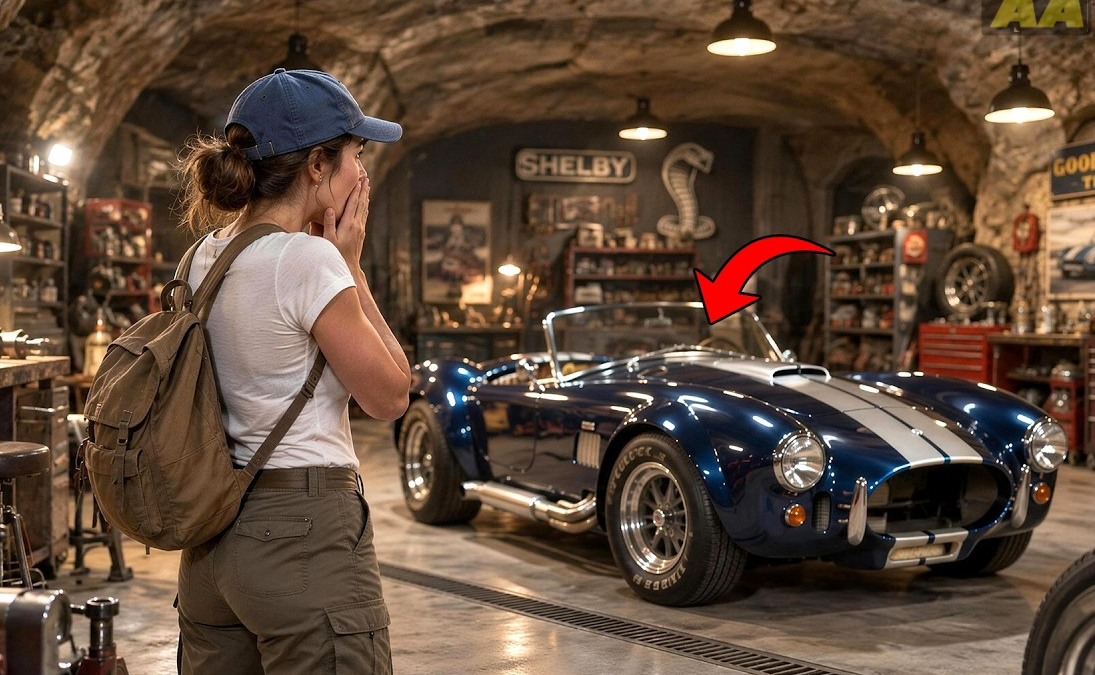
Sadi forgot to breathe. Beneath it was a car. A 1962 Shelby Cobra. The midnight blue paint looked flawless.
The chrome reflected the overhead lights. The long hood stretched forward beneath a polished silver air scoop.
The white wall tires were immaculate. The tan leather interior looked untouched. The wooden steering wheel had been polished until it appeared almost warm.
Sadi walked slowly around it. She didn’t know enough about classic cars to explain every detail.
But she understood beauty. She understood craftsmanship. And she understood that this was something extraordinarily valuable.
She turned toward the desk. Her hands were shaking. A thick brown leather ledger sat on the green blotter.
Beside it was a sealed white envelope. Her name was written across the front. Sadi.
She picked it up. Inside was a single letter and a small silver thumb drive.
She unfolded the paper. The handwriting was unmistakable. “Kiddo, if you’re reading this, it means you actually bothered to clean up my mess.”
Sadi smiled despite herself. “I knew you would.” She continued reading. Thomas explained that he could have cleared the upstairs himself.
But he had wanted to leave her a final teSt. Then came the reason for the secrecy.
David and Carol had received the obvious assets. The buildings. The investments. The lakehouse. The cash.
Thomas knew exactly what would happen if the Shelby Cobra had been listed openly in the will.
David would challenge it. Carol would demand an auction. Lawyers would become involved. The family would spend years arguing over something Sadi had never even known existed.
Thomas had chosen differently. He had purchased the Cobra chassis in 1978 from a scrapyard in Nevada.
It had been damaged and neglected. He spent four decades rebuilding it. Parts came from different countries.
Some components had to be machined. Some had to be restored. Some had to be fabricated.
He documented everything. The car had never been treated as a casual investment. It had been Thomas’s private project.
His life’s work. Then Sadi reached the final part of the letter. “Look in the bottom left drawer of the desk.”
She lowered the paper. She opened the drawer. Stacks of 100-dollar bills filled it. Sadi stared.
Thomas had accumulated 75,000 dollars over five years, withdrawing a few hundred at a time.
The money was intended for her. He told her to use it for the property taxes, the contractors, and whatever work was necessary to retrieve the car.
The ledger contained four decades of records. Every part number. Every receipt. Every hour of labor.
The thumb drive contained photographs documenting the restoration. Then came the number that made Sadi sit down.
Thomas estimated the market value of the finished Cobra at more than 3 million dollars, perhaps 4 million.
He told her not to waste the money trying to impress people who did not care about her.
He told her not to invest with David. He told her to leave the dental clinic if she wanted to.
He told her to return to school, start a business, travel, or simply live quietly.
Then came the final words. “Nobody hands you freedom, Sadi. You have to dig it out of the dirt yourself.”
She lowered the letter. For several minutes, she sat beneath the bright lights of the hidden room.
The fear she had carried for three weeks disappeared. The taxes. The ruined house. The judgment from David and Carol.
All of it suddenly seemed manageable. Thomas had not left her an abandoned property. He had left her a secret.
And he had trusted her to find it. Getting the Cobra out took three weeks.
Sadi never returned to the dental clinic. She left a polite voicemail for her boss and began hiring contractors.
She found a structural engineering firm two towns away. The work remained quiet. The contractors received payment in cash from the money Thomas had left.
They excavated the backyard. They removed sections of the old patio. Eventually, they found a reinforced steel plate buried beneath approximately 2 feet of soil.
Under it was a concrete ramp. The ramp led directly toward the hidden room. The workers opened the concealed wall.
When the foreman, a broad man named Griggs, saw the Cobra, he simply removed his hard hat.
He stared for several seconds. “I won’t say a word,” Griggs finally said. “But you need specialized transport for that thing, not a regular tow truck.”
Sadi agreed. Exactly one month after the reading of the will, the neighborhood woke to the sound of a large transport truck moving slowly down the cul-de-sac.
Sadi stood on the torn-up lawn with a paper cup of black coffee. She wore jeans and a heavy flannel shirt.
The morning air was cold. The Cobra emerged from the underground room and began moving up the transport ramp.
Sunlight touched the midnight blue paint. The car seemed almost unreal in the open air.
Then Sadi heard tires crunching behind her. She turned. A silver BMW 7 Series stopped awkwardly at the curb.
David stepped out. His navy suit was expensive. His tie was crooked. His face was flushed.
He crossed the muddy yard. “What the hell is this?” Sadi continued watching the transport crew.
David pointed at the Cobra. “What is that?” “A 1962 Shelby Cobra,” Sadi said. David stared.
“Did Dad own that?” “In the basement.” David’s expression changed. “Stop them.” Sadi didn’t move.
“Stop that truck right now.” She finally looked at him. “No.” David’s face hardened. “That is a multimillion-dollar asset.
It belongs to the estate.” “I didn’t steal it.” “You can’t remove something worth that much without an appraisal.”
Sadi reached into her flannel pocket. She removed a folded copy of the final page of the will.
She handed it to him. “Read it.” David looked down. His eyes moved across the page.
“I leave the property located at 42 Sycamore Drive, including the house and all its remaining contents, to Sadi.”
He crumpled the paper. “This doesn’t cover something like that.” “It was in the house.”
“Hidden assets are different.” Sadi took another sip of coffee. “You and Carol signed the estate closure documents.”
David’s expression tightened. “You waived future claims to the Sycamore property.” “That doesn’t mean this is yours.”
“It doesn’t mean it’s yours either.” Sadi looked toward the transport truck. “You can challenge it if you want.”
David stepped closer. “I’ll tie this property up in court for years.” “You can try.”
Her voice remained calm. David was waiting for fear. He didn’t get it. Then Sadi said something that made him stop.
“You should think carefully before you start asking questions about Grandpa Tommy’s financial records.” David’s expression changed.
Sadi had seen the ledgers. She had seen records of how Thomas handled his business interests.
She had no desire to use them against anyone. But she knew exactly how much trouble a prolonged legal dispute could create for everyone involved.
David stared at her. “You’re bluffing.” “No.” The rear doors of the transport trailer began closing.
David looked at the Cobra one last time. The hydraulic locks engaged. The car disappeared behind the steel doors.
David stood in the muddy yard. For once, he had no immediate response. Then he said something quieter.
“He always liked you beSt.” Sadi looked at him. “No.” David waited. “He just hated me the leaSt.”
She turned away. The transport driver approached with the final paperwork. Sadi signed. The truck slowly moved down Sycamore Drive.
She watched it disappear. David returned to his BMW. The engine started. A moment later, the car pulled away.
Sadi stood alone beside the ruined house. The wind moved through the oak branches. She looked back at 42 Sycamore Drive.
For three weeks, she had thought this place represented everything her family had decided she was worth.
Now she understood that the house had never been the inheritance. The inheritance had been hidden beneath it.
Three months later, the Shelby Cobra was sold at a private auction in Monterey for 3.8 million dollars.
Sadi paid the auction house fees. She paid the required taxes. She did not buy a mansion.
She did not purchase a fleet of expensive vehicles. She bought land in the county, far from the Hayes family and far from the neighborhood where everyone had known her grandfather.
Then she built a modest single-story house. It had a wraparound porch. Behind it stood a six-bay garage.
The garage did not contain million-dollar cars. Inside were her 10-year-old sedan, a used truck, and a rusted 1970s motorcycle frame she had bought because it reminded her of the machines Thomas had loved.
She installed a massive set of Snap-on tools. She found a heavy steel tanker desk.
And she placed a green glass banker’s lamp on top. One quiet Tuesday evening, with cold rain tapping against the garage doors, Sadi sat at the desk.
She opened Thomas’s leather ledger. For a long moment, she ran her fingers across its worn cover.
Then she opened a blank page. She picked up a pen. She wrote down her first part number.
The garage smelled of motor oil. Rain tapped against the roof. The lamp cast a warm circle of light across the desk.
Sadi looked around the room. There was no mahogany conference table. No expensive coffee. No relatives waiting to see what she had received.
No one telling her what her place was. There was only the work. She understood then what Thomas had really left her.
It wasn’t the Cobra. It wasn’t the 75,000 dollars. It wasn’t even the hidden room.
It was the lesson behind all of it. Thomas had spent decades restoring something other people would have thrown away.
He had looked at a damaged chassis in 1978 and imagined what it could become.
He had looked at an abandoned house and imagined a workshop beneath it. And he had looked at Sadi, the granddaughter nobody expected to inherit anything important, and trusted that she would understand what everyone else missed.
She had spent three weeks cleaning the house because she thought she was trying to escape a burden.
Instead, every box she moved had brought her closer to the truth. Every dusty room had led her toward the basement.
Every forgotten tool had pointed toward the hidden door. And every number Thomas had left behind had been another piece of a puzzle designed specifically for her.
Sadi closed the ledger. Outside, rain continued falling across the land. She switched off the banker’s lamp.
Then she stood and walked toward the garage doors. Tomorrow there would be more work.
There would always be more work. But for the first time in her life, the work belonged entirely to her.
The Hayes family had measured inheritance in buildings, accounts, property, and numbers. Thomas had measured it differently.
He had left Sadi something that could not be divided among relatives or calculated by an accountant.
He had left her the ability to look at something everyone else had dismissed and ask a different question.
Not what is this worth today? What could it become if someone cared enough to uncover what was still there?
Disclaimer: This content may be created by Al for entertainment purposes. Any resemblance to real persons, events, or places is coincidental.








