“If You Want The Land, Marry My Ugly Daughter” — The Cowboy Fell Silent And Did The Unthinkable
That night, the Texas sky turned red above a ranch that had taken six years to build.
Every board, every fence post, every beam had passed through Cole McBride’s hands, shaped slowly into a home that finally felt permanent.
Then, in a single evening, the house and barn became a field of glowing embers.
Cole stood barefoot in the cold grass and watched without moving, counting the beams as they fell and the cracks that opened across the dark sky.
Beyond the hill, riders disappeared into the distance. Cole knew why they had come. For two years, men with polished boots and polished promises had tried to convince him to sell.
He had refused every offer. Now his land was gone, and knowing who was responsible was useless without proof.
Seven years later, a lone rider crossed the Arizona desert with a hand drawn map folded soft inside his coat.
He had spent years moving from ranch to ranch, working other men’s land and sleeping beneath other men’s roofs.
He wanted only one thing now, a place that belonged to him. The map showed a riverbend beyond the territory of a chief named Duskorn, a place where water and grass could support the ranch Cole had always wanted.
But the town warned him that men who entered Duskorn’s territory with intentions rarely came back with those intentions unchanged.
Then Cole saw the white veiled woman standing between two silent tepees, watching him from forty yards away.
She had hidden her face for five years. Nobody in the camp had seen it.
And now, somehow, she was looking directly at him, so what exactly had Cole McBride just ridden into?
Cole McBride had not slept in a real bed in eleven days. He knew because he counted.
Counting had become a habit during the years after Texas. Days, miles, creek crossings, canteen refills, hours worked, horses ridden, fences repaired.
Numbers gave his mind somewhere to go when memories tried pulling it backward. His gray mare, Duchess, carried him toward Red Rock Flats on a Thursday afternoon.
The town appeared slowly through the desert heat. Three saloons. One church. A general store with a sign leaning so far to the left that Cole wondered how long it had before gravity finally won.
Two streets crossed in the middle of town, then seemed to lose interest in going anywhere.
A water trough stood beneath a wooden awning, and a dog slept directly in the road as if horses had been invented specifically to walk around him.
Cole guided Duchess toward the trough. “Water first,” he murmured. The mare lowered her head.
Cole watched the town while she drank. He was thirty two, tall and lean, with a weathered brown coat and a hat that had seen better years.
His face looked older than thirty two, not because of age, but because seven years of wandering had taught him how to carry silence.
He tied Duchess outside the general store and stepped inside. The man behind the counter looked about sixty.
He had a long beard, a ledger, and the expression of someone who had seen enough strangers to know that most of them brought trouble or questions.
He studied Cole. “You lost?” “No.” “You look loSt.” “I look tired. There’s a difference.”
The storekeeper grunted. “What do you need?” “Information.” “That’s free.” “Then supplies.” “Those coSt.” “Fair enough.”
Cole unfolded his map. He placed one finger along the riverbend. “This land here, east of the Hayyampa wash.”
The storekeeper did not look at the map immediately. Instead, he looked at Cole. “You’re pointing at Duskorn’s territory.”
“That’s what I heard.” “You know who Duskorn is?” “Chief.” “You know what happens to men who ride in there wanting something?”
“They usually get told no.” The storekeeper’s eyes narrowed. “Sometimes.” Cole folded the map. “I want to buy land.”
“That land isn’t for sale.” “Everything has a price.” “Not everything.” Cole studied him. “How good is the water?”
The storekeeper sighed. “Best in forty miles.” “Then I want it.” “You really don’t listen.”
“I listen.” “No, son. You calculate.” Cole almost smiled. “That too.” The storekeeper finally took the map.
His finger followed the river. “That bend runs against Duskorn’s territory. Nobody has a deed there.”
“Why?” “Because nobody has managed to make a deed matter there.” Cole said nothing. The storekeeper returned the map.
“You’re serious.” “I am.” “Then take my advice.” “I’m listening.” “Turn around.” Cole folded the map and placed it inside his coat.
“I appreciate the advice.” “You’re not taking it.” “No.” The storekeeper shook his head. “What supplies?”
“Flour. Salt pork. Rope. Coffee.” “You want good coffee?” “If you have it.” “I do.”
“Then give me a pound.” The storekeeper gathered the supplies. Cole paid. Outside, he ate hardtack and dried meat while watching Red Rock Flats move through another ordinary afternoon.
A woman crossed the street carrying laundry. Two men argued outside a saloon. The same dog remained in the road.
Cole watched them all. Normal. He had spent seven years watching normal life from the outside.
He remembered Texas carefully, never all at once. The ranch had been forty acres beside a creek.
The house had two rooms and a covered porch. The door had always needed to be lifted slightly before it would close.
The barn had taken two summers to build. Cole had done most of it himself.
For six years, he had worked until his hands hurt and then worked some more.
Then came the night when everything changed. By morning, there was nothing left that could be called a home.
Cole had known the fire was not an accident. The men who wanted his land had made that clear enough over the previous two years.
But knowing something and proving it were different things. He had no money for lawyers.
No influence. No powerful friends. So he left. Seven years passed. He worked wherever someone needed a reliable pair of hands.
He repaired fences. Broke horses. Moved cattle. Built barns. Fixed wells. He became very good at building things that belonged to other people.
But he never stopped wanting something of his own. That was why he was riding toward Duskorn’s territory.
Not because he wanted trouble. Because he wanted land. Cole finished his meal, mounted Duchess, and headed eaSt.
The desert grew wider as the sun dropped. By sunset, the sky had turned gold.
Cole made camp beside a dry wash. He built a small fire and prepared coffee.
Duchess grazed nearby. Cole sat with his cup and studied the stars. “Land,” he said quietly.
Duchess flicked an ear. “Water. Grass. Twenty head to start.” The mare continued grazing. “I know.”
Another ear moved. “I know it’s a risk.” Both ears pointed toward him. Cole nodded.
“Exactly.” He slept quickly. The following afternoon, he reached the edge of Duskorn’s territory. He knew before he saw anyone.
The desert had changed. The silence felt different. Cole kept riding. Then he saw three riders on a ridge.
They were almost invisible against the rocks. The three riders descended and approached him. The man in the center spoke in Apache.
Cole understood none of it. “I’m looking for Duskorn,” Cole said. “I want to speak with him about land.”
The riders exchanged looks. Cole kept his hands visible. “I’m willing to pay a fair price.”
They moved around him. Cole did not resiSt. He simply rode with them. Duskorn’s camp was larger than Cole expected.
It stood beside the river, organized around water, shelter, animals, families, and work. Cole noticed everything.
The horses were well cared for. The people moved with purpose. Children ran between the tepees.
Women worked around cooking fires. Men repaired leather and equipment. It was not a temporary camp.
It was a home. Duskorn waited in the center. He was fifty five, broad shouldered, with dark hair streaked with gray and two long braids resting against his shoulders.
His eyes were steady. His face carried years of experience without needing to announce them.
Cole stopped several feet away. “Duskorn.” The chief watched him. One of the younger men translated Cole’s purpose.
“I want the land along the riverbend,” Cole said. Duskorn answered. The translator turned back.
“He says the land is not for sale.” Cole nodded. “I expected that.” Duskorn said something else.
The translator hesitated. “There is one way.” Cole waited. “If you marry his daughter, the land becomes yours.
You become part of the family.” Cole stared at him. “Can I meet her first?”
The translator asked. Duskorn answered. “She does not speak to strangers. She wears a veil.
She does not show her face.” “Why?” Duskorn answered again. The translator looked uncomfortable. “He says she is ugly.
The ugliest woman in the tribe. No man wants her.” The camp seemed to become quieter.
Cole looked around. People had heard the words. And many of them suddenly found something else to look at.
Cole understood that there was more to the story. He turned back toward Duskorn. “I’ll need to think.”
Duskorn nodded. Cole considered the river. He thought about Texas. He thought about seven years of borrowed roofs.
He thought about the feeling of driving a fence post into ground that belonged to him.
Then he remembered the reaction of the camp when Duskorn had described his daughter. Everyone had flinched.
That meant something. Cole put his hat back on. “I accept.” The camp reacted with a quiet ripple of surprise.
Duskorn studied him. “You will stay three days before the ceremony.” “Fine.” “You will not seek her out.”
Cole nodded. “One question.” Duskorn waited. “Does she have a say in this?” The translator looked surprised.
He asked Duskorn. The chief was silent for several seconds. Then he answered. “She knows.”
Cole did not like the answer. But it was the answer he had. As Cole turned away, Duskorn spoke in English.
“I will know if you are the right kind of man.” Cole glanced back. The chief’s expression had not changed.
Cole simply nodded. Then he saw her. She stood between two tepees about forty yards away.
Entirely covered in white. The veil fell from her head to her feet. She did not move.
Cole stopped. She was watching him. He could feel it. The young warrior guiding him touched his arm.
“Your shelter is this way.” Cole followed. Before the tepees blocked his view, he looked back.
She was still standing there. The shelter prepared for him was small but comfortable. There was water.
Food. A bedroll. Cole sat down. He had agreed to marry a woman he had never seen.
A woman whose father had called her ugly in front of everyone. A woman who had watched him arrive without saying a word.
He ate. He slept. The next morning, Cole woke early. The camp was already busy.
He washed, then looked around for something useful to do. He saw a pile of wood.
So he split it. Then he found another pile. He split that too. Afterward, he noticed a fence post leaning badly near the horse corral.
He fixed it. Nobody had asked. That did not matter. Work was work. A man named Flint watched him.
Flint was around Cole’s age, broad shouldered, with a pale scar across his jaw. “You split the wood,” Flint said.
“It needed splitting.” “Nobody asked you.” “No.” “You fixed the fence.” “It needed fixing.” Flint studied him.
“You think doing things nobody asks you to do makes you belong here?” “No.” Cole tightened a rope.
“I think wood needs splitting and fences need fixing.” Flint stared at him. “You won’t last here.”
“Maybe.” Cole stood. “But I’ll be here long enough.” Flint walked away. Cole watched him go.
There was something behind Flint’s dislike. Something older. Something Cole did not yet understand. That evening, Cole sat outside his shelter.
Footsteps approached. He looked up. The woman in the white veil stood ten feet away.
She said nothing. Neither did Cole. Then she spoke. “You did not ask if I wanted this.”
Cole looked at the veil. “No.” “My father said I was asked.” “He told me you knew.”
“I do.” Cole waited. “I agreed,” she said. “But he did not tell you that I was asked firSt.”
Cole nodded. “I assumed.” “You were wrong.” “Yes.” The veil moved slightly. “Most men would not say that.”
“Most men would rather be right.” Silence. Then she asked, “May I ask you something?”
“Yes.” “Why did you agree?” Cole looked toward the river. “Because I want the land.”
She was silent. “That is honeSt.” “I promised myself I would not lie about why I came here.”
“And after you receive the land?” Cole looked at her. “I gave my word.” “That is not the same answer.”
“No.” He considered it. “I don’t know what comes after.” The veil moved. “My name is Sable.”
Cole repeated it. “Sable.” “Running Water.” “Sable Running Water.” “Yes.” “It suits you.” “How would you know?”
“I don’t.” For the first time, she laughed quietly. It surprised him. “You are strange, Cole McBride.”
“So I’ve been told.” She stood there a moment longer. Then she said, “Good night.”
“Good night.” She walked away. Cole watched until the white veil disappeared between the tepees.
The next morning, he returned to Red Rock Flats. He needed rope and a new clasp for his canteen.
The storekeeper looked at him. “You’re still here.” “I am.” “I heard about the marriage.”
“News travels faSt.” “Duskorn’s business always does.” Cole paid for his supplies. Then the storekeeper lowered his voice.
“Harden Veil knows.” Cole stopped. “Who?” “Harden Veil.” Cole remembered the name. “What does he want?”
“The river.” “Why?” “Water rights. He has wanted that land for five years.” Cole’s expression hardened.
“What does he know about Sable?” The storekeeper was quiet. “Three years ago, he came here.
He saw her. Then he made Duskorn an offer.” “What kind?” “Thirty horses and gold.”
“For her?” The storekeeper nodded. “Duskorn refused.” Cole left the store. Harden Veil was waiting outside.
He was around forty five, dressed in clean clothes, with a pleasant face and carefully controlled eyes.
“Cole McBride.” “You know me.” “I know who you are.” Cole mounted Duchess. “I hear you want Duskorn’s land.”
“I want a business arrangement.” “I’m not interested.” Veil smiled. “You should hear the offer.”
“I already heard enough.” Veil stepped closer. “You are planning to marry a woman you have never seen.”
“That’s correct.” “You could do considerably better.” “Perhaps.” “I could give you work.” “I have work.”
“Real work.” Cole looked at him. “I have something better.” “What?” “A promise.” Veil’s smile disappeared.
“I have been patient for three years.” “So I heard.” “I intend to see this resolved.”
“One way or another?” Veil smiled again. “Exactly.” Cole rode away. The second day at the camp passed quietly.
Cole worked. He helped move a heavy cooking structure. He repaired leather. He sat near the men and listened.
People stopped watching him every time he walked somewhere. Flint still watched. That afternoon, Flint approached him.
“You know Veil is coming.” “I figured.” “He comes every afternoon.” “Why?” “To count horses.”
Cole looked toward the ridge. “How many men?” “Usually twelve.” Cole nodded. That night, he noticed movement near the corral.
Three men were cutting ropes. Cole moved silently. One man noticed him too late. Cole threw a stone.
The man staggered. Cole rushed the second. The third pulled a knife. Then voices came from the darkness.
Flint and several warriors surrounded them. The three men were taken away. Duskorn examined one of them.
“Veil’s men.” Cole nodded. “He wants the horses disturbed before the ceremony.” Flint looked at Cole differently.
“Tomorrow, I will stand at the east position.” Cole understood. It was Flint’s way of saying he trusted him.
“Thank you.” Flint nodded. The next morning, Duskorn came to Cole carrying two cups of something hot.
“You have questions,” Duskorn said. “One.” “The veil.” Duskorn looked toward the river. “Five years.”
“Why?” “My wife asked me to protect Sable.” Cole waited. “She told me to protect her until I found someone who would choose her without needing to see her face.”
Cole looked at him. “The story about her being ugly?” “I created it.” “Why?” “To keep away men who wanted her for the wrong reasons.”
Duskorn’s voice became quieter. “But she heard those words for five years.” Cole understood. “She began believing them.”
Duskorn nodded. “She was fifteen.” Cole looked toward the tepees. “She is twenty now.” “She chose you.”
Cole said nothing. “She came to you herself.” That mattered. Duskorn stood. “Her yes was hers.”
Cole nodded. “I understand.” The ceremony began that afternoon. The camp changed. Fires were prepared.
Drums began as the sun lowered. Cole stood near the center, wearing his clean shirt.
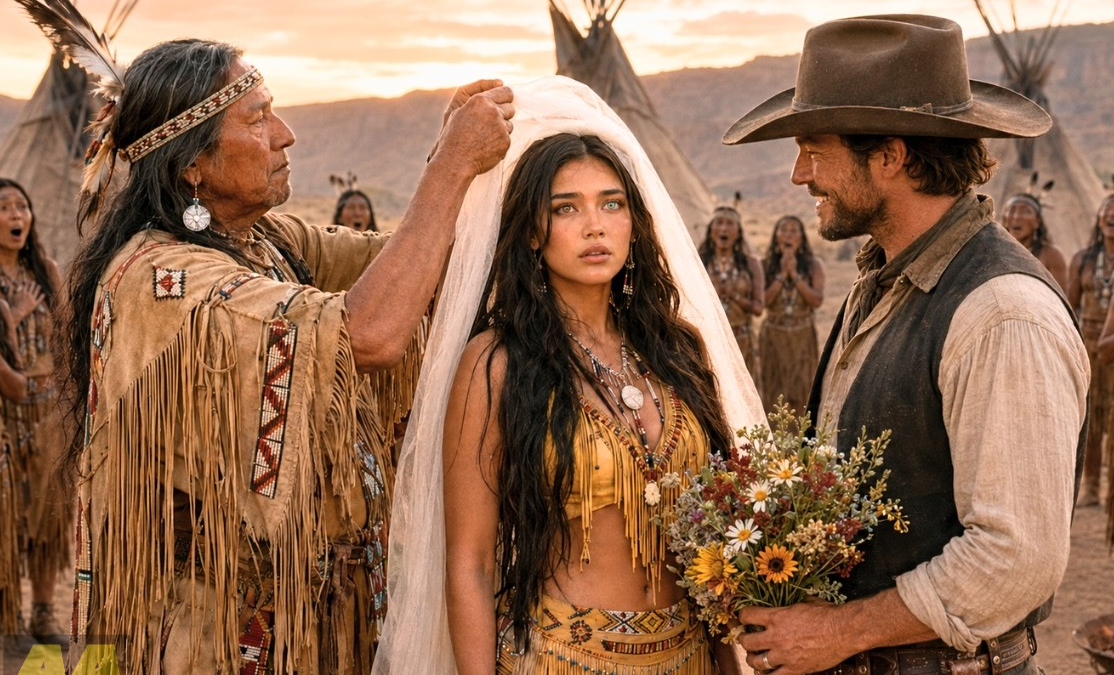
Then Sable appeared. She walked between two elder women. The veil was still white, but now it carried delicate stitched patterns.
Stars. Clouds. She stopped before Cole. A red cord was tied around their wrists. Duskorn stepped forward.
He spoke quietly to his daughter. Then he lifted the veil. Cole saw her face.
For a moment, he forgot the land. He forgot the map. He forgot Texas. Sable was beautiful.
Not because of some impossible perfection. Because she looked real. Strong features. Dark hair. One brown eye.
One gray blue eye. Two different colors looking directly into his. There was uncertainty in them.
Fear of being judged. Fear of hearing the words she had heard for five years.
Cole did not look away. “I have spoken with you twice in the dark,” he whispered.
She looked at him. “And I already knew.” “Knew what?” “That you were worth showing up for.”
Her eyes brightened. A single tear slipped down her cheek. She did not hide it.
Duskorn looked at Cole. “My daughter is everything her mother wanted her to become.” Cole nodded.
“I understand.” “Do not waste that.” “I won’t.” The ceremony continued. Later, Cole and Sable sat together beside the fire.
The red cord still joined their wrists. “It feels strange,” Sable said. “What does?” “Being seen.”
Cole looked at her. “You have always been seen.” “Not like this.” She smiled. It was the first time Cole had seen her smile without a veil.
It changed her face. “I used to look in the water,” she said. “Your father told me.”
“I stopped.” “Maybe you can start again.” She looked toward the river. “Maybe.” The next morning, Cole woke married.
The thought surprised him. He had land now. A family. A wife. A place where people knew his name.
He stepped outside. Flint stood at the east ridge. “He’s coming,” Flint said. “Veil?” “Yes.”
“How many?” “Twelve.” Cole nodded. “Keep the camp ordinary.” Flint looked at him. “Why?” “Because Veil wants to see fear.”
“And if he sees none?” “Then he has to wonder what he cannot see.” Flint understood.
Duskorn agreed. The camp continued its morning. Women worked. Children played. Horses moved. Fires burned.
Cole stood at the entrance. Eventually, twelve riders appeared. Harden Veil led them. He dismounted.
“I came to make an offer.” “No.” “You have not heard it.” “I know enough.”
“The railroad will change this territory.” “Maybe.” “The government will eventually examine these claims.” “Maybe.”
“I am offering you three times the current value for the riverbend.” “It isn’t mine to sell.”
Veil looked toward the camp. “You are married now.” “Yes.” “You could leave.” “No.” “You could take the money.”
“No.” Veil’s expression changed. “You do not understand what is coming.” Cole looked at him.
“I understand what you want.” Veil became still. “I had three men here last night.”
“They made a mistake.” “They did not return.” “They were not welcome.” Veil studied him.
Then Cole said quietly, “There are forty warriors in this camp.” Veil’s eyes moved. Cole continued.
“Some are visible.” He paused. “Others are not.” Veil looked around. Only then did he notice the shapes.
A figure near the ridge. Another behind a supply stack. Someone standing beside the corral.
Men he had not seen before. Veil understood. “This is not finished.” “No,” Cole said.
“But it is finished for today.” Veil mounted. He looked at Cole one final time.
Then he turned his horse and rode away. Flint approached. “You were right.” “About what?”
“He wanted us afraid.” Cole watched Veil disappear over the ridge. “He wanted us divided.”
Flint nodded. Cole looked toward the river. “And he still wants the land.” “Yes.” Cole placed a hand on the red cord still around his wriSt.
Sable stepped beside him. She no longer wore the veil. The morning light touched her mismatched eyes.
“What happens now?” She asked. Cole looked toward the riverbend. “Now we build.” Sable smiled.
“Like your ranch in Texas?” “Better.” “Why better?” “Because this time, I’m not building alone.”
She looked at him for a long moment. Then she took his hand. Together they walked toward the river.
Cole had spent seven years counting what he had loSt. For the first time, he began counting something else.
Fence posts. Trees. Horses. Acres. Days. Morning fires. Evenings beside the river. And the moments when Sable laughed without thinking about who might be watching.
He still remembered Texas. He always would. But Texas no longer owned every thought he had.
There was Arizona now. There was the river. There was the camp that had become home.
There was Sable Running Water walking beside him beneath an open sky. And there was work waiting.
A fence needed building. A house needed planning. Twenty head of cattle would eventually need room.
Duchess needed better grass. The river needed watching when the spring water rose. Cole looked at the land stretching before them.
Seven years earlier, he had watched everything he built disappear. Now he had another chance.
This time, the ground beneath his feet was not borrowed. This time, someone was standing beside him.
And when Sable looked toward the river and removed the last small piece of cloth she had carried with her from the years behind the veil, Cole understood that they were not simply beginning a ranch.
They were beginning a life neither of them had expected. A life built slowly. Honestly.
Together. And for the first time in seven years, Cole McBride stopped counting what had been taken from him and started counting what he could build.
Disclaimer: This content may be created by Al for entertainment purposes. Any resemblance to real persons, events, or places is coincidental.








