If You Let Me Stay, I’ll Guard Your Ranch, Said the Stranger — The Widow Almost Said No… Until
There are moments when trouble is still far enough away to look like nothing more than dust on the horizon.
You can see it moving, but you cannot yet hear it. You can count the shapes beneath it, but you cannot know what they intend.
And sometimes, the difference between an ordinary afternoon and a day that changes everything is no more than twelve minutes and one person willing to turn around when everyone else would keep riding.
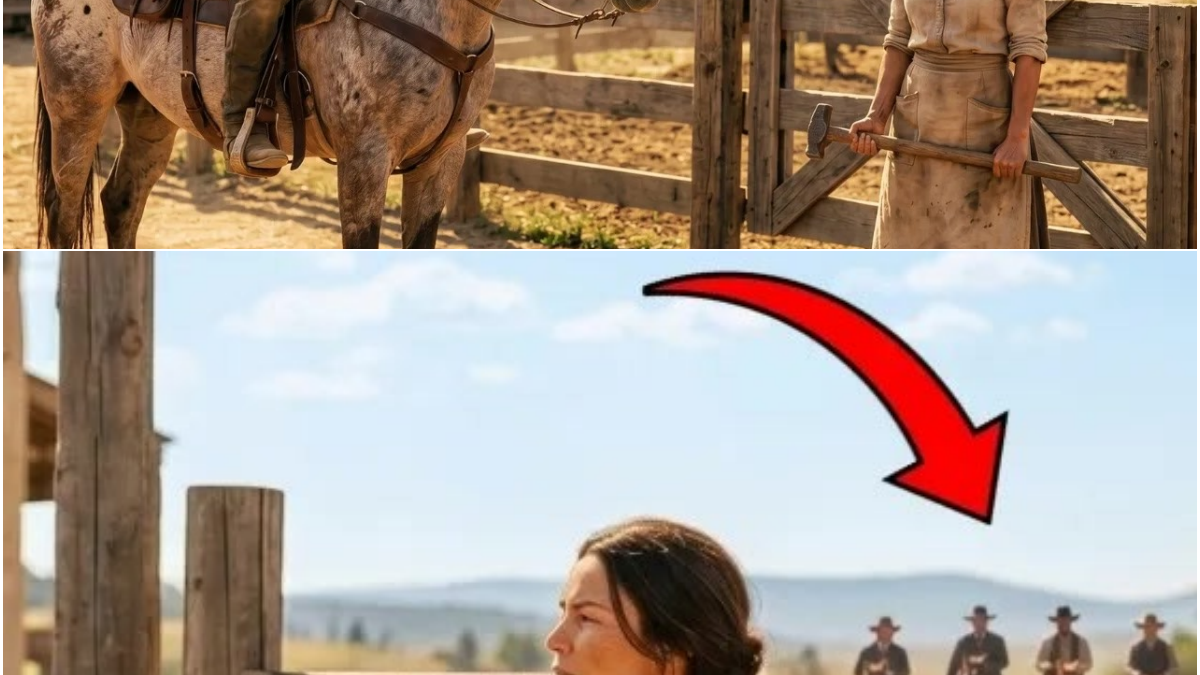
In the summer of 1885, in the wide country of Idaho territory, a woman stood at the entrance to her ranch, working on a fence post that had refused to stand straight.
She had spent three years learning how to manage the land, the cattle, the buildings, and every unexpected problem that came with them.
She had not asked anyone to make the work easier, and she had grown accustomed to people assuming she could not do it alone.
Then a stranger arrived on a horse, wearing a burgundy poncho and carrying the quiet manner of a man who had traveled a long way without needing company.
He had no business at her gate, no reason to know her name, and no promise that helping her would bring him anything in return.
Yet he had seen something on the road that she had not. Fifteen riders were coming toward her ranch, and they were not traveling for pleasure.
The stranger had twelve minutes to explain what he knew, and she had even less time to decide whether to trust him.
What would she do when the dust finally reached her gate? The stranger had been riding south through Idaho territory for a week.
He had no particular destination in mind. His immediate plans were simple enough: find water when Scout needed it, keep moving while the weather remained favorable, and avoid places where other people might expect him to explain himself.
Scout was a steady horse, accustomed to long distances and the changing ground of the territory.
He moved at an easy trot, saving his strength without wasting the afternoon. The country opened around them in dry hills, broad valleys, scattered brush, and stretches of grass that had already begun to lose their summer color.
There was little shade, and the sun seemed to reach every part of the land without obstruction.
The stranger had been following a ridge when he noticed movement below. At first, he counted fifteen riders.
They were traveling south along the valley road, keeping a measured pace. They did not appear to be racing toward anything, but their formation suggested that they were accustomed to moving together.
Their horses carried equipment, and several men had visible weapons secured to their saddles. He watched them for a moment, then turned Scout weSt.
Whatever those men were doing, it did not concern him. He had spent enough time on the road to understand that trouble could be found almost anywhere, especially when a person went looking for it.
He preferred to keep his distance. Then he saw the ranch. It stood about three miles south of the riders, close enough to the valley road that anyone traveling through would notice it.
There was a main house, a barn, corrals, and several outbuildings arranged around the working areas.
Smoke rose from the chimney. Horses stood in the corral, and the place had the unmistakable appearance of a ranch that was occupied and operating as usual.
The stranger looked from the ranch to the riders. The men were heading straight toward it.
He turned Scout south. He did not have a reason he could put into words.
He simply understood that the ranch was occupied, the riders were armed, and the people living there had no apparent warning.
He could reach the gate before the group arrived. That was enough. Scout quickened his pace.
The stranger reached the ranch twelve minutes before the riders. A woman was repairing a fence post near the gate.
She worked with a hammer and a length of timber, concentrating on the job with the practiced efficiency of someone who had learned not to waste movement.
When she heard Scout approaching, she looked up. She was thirty-seven years old. Her dark hair was pulled back beneath a hat that had belonged to her husband.
It was too large for her, so she had folded the brim until it sat properly.
Her hands were strong from daily work, and her expression showed the habit of assessing people before deciding what to say to them.
Her name was Martha Callaway. She looked at the stranger’s burgundy poncho, his horse, and the dust trailing behind him.
“Whatever you’re selling, I’m not buying,” she said. “I’m not selling anything.” “Then keep riding.”
He did not answer immediately. Instead, he looked beyond her toward the valley road. “If you let me stay,” he said, “I’ll guard your ranch.”
Martha almost laughed. She had heard plenty of offers from men who believed they knew what she needed.
Most of them had arrived with advice, questions, or an opinion about what a woman should do with a property like hers.
“I’ve been guarding my own ranch for three years,” she replied. “I don’t need a stranger with a poncho to tell me how to do it.”
She stopped when she noticed where he was looking. Dust was rising over the road.
It was not the thin trail left by one rider or a small group passing through.
It was a wide cloud, growing larger as it moved along the valley. Beneath it, individual shapes were beginning to appear.
Martha looked at the road, then at the stranger. “How many?” “Fifteen, maybe more. They’re armed, and they’re not coming for a visit.”
Her expression changed. It was not panic. It was the quick adjustment of someone who had been managing every part of a difficult situation alone and had suddenly discovered that the situation was larger than expected.
She glanced toward the ranch. Three years of work stood behind her. The house, the barn, the corrals, the cattle, and the fences had all required attention.
She had learned how to handle repairs, keep accounts, manage supplies, and make decisions without waiting for someone else to approve them.
When her husband had been gone from the ranch, people in town had assumed she would sell.
Some had suggested she could not possibly manage the operation by herself. Others had offered to buy the property at prices that did not reflect the years of work she had put into it.
Martha had refused them all. Now she looked at the approaching dust and understood that the men on the road might not be interested in making another offer.
She turned toward the stranger. “Get off your horse,” she said. “We have twelve minutes.”
He dismounted. Martha led him toward the house, speaking as she walked. The rifles were inside.
She had two Winchesters and a Sharps, all kept ready for the ordinary dangers of ranch life.
She had spent three years shooting coyotes away from her cattle, sometimes at night, sometimes from a distance, and often without the luxury of a second attempt.
“How well do you shoot?” She asked. “Well enough.” “That’s not an answer.” “It’s the one I’ve got.”
She gave him a brief look, then continued. “I’ve been shooting coyotes off my cattle for three years.
Two hundred yards, in the dark, when I have to. That answer your question?” “It does.”
The house had two windows facing north, one in the bedroom and one in the kitchen.
The barn loft offered a view across the valley road and the approaches to the property.
A narrow path behind the smokehouse provided another way to move between the buildings without crossing the open yard.
Martha knew every useful angle on her land. The stranger studied the layout while she gathered the weapons.
She handed him one Winchester, kept the other for herself, and carried the Sharps toward the barn.
“You’ve thought about this,” he said. “Every night for three years.” She placed the Sharps in the loft and checked the view from the opening.
From there, she could see the gate, the road, and the open ground on either side of the ranch.
The stranger walked the perimeter. The gate was the main approach from the north. East and west were open for about three hundred yards before the ground broke into ravines and brush.
To the south, a shallow creek crossed the property. It could be ridden through, but anyone approaching that way would be visible from the barn loft.
Martha had not designed the ranch’s defenses as a separate project. She had simply learned where the land offered advantages and where it left her exposed.
The stranger returned to the gate. “When they arrive, they’ll probably talk first,” he said.
“Why?” “Men like that want to know what they’re facing. Talking gives them a chance to count the people, judge the confidence, and see whether anyone is likely to step aside.”
“And what will they find?” “One man at the gate and one woman in the barn with a Sharps rifle.”
“That’s not a lot.” “It’s enough if they don’t know about the Sharps.” Martha looked down from the loft.
“And if it isn’t enough?” He glanced toward the road. “Then we’ll know soon enough.”
The riders were getting closer. Their shapes were clear now, and the afternoon light caught the metal on their saddles.
The stranger could see more than fifteen men. There were eighteen. Three had been following behind the main group, far enough back that they had not been visible from the ridge when he first counted.
They arrived at three o’clock in the afternoon. The man in front was not the largest of the group, nor did he carry the most visible equipment.
What distinguished him was his stillness. He sat in the saddle with the composure of someone accustomed to having other men wait for his decisions.
His name was Warren Decker. He operated the largest cattle business in the Boise Basin and had been expanding south for two years.
He had acquired eleven ranches through a combination of purchases, pressure, and negotiations with families who had eventually decided to leave.
Martha’s property was intended to be the twelfth. She had refused three offers. Decker stopped at the gate and looked at the stranger standing in front of it.
His eyes moved over the burgundy poncho, the single holster, and the rifle. “This isn’t your ranch,” Decker said.
“No.” “Then step aside.” “No.” Decker studied him. “Who are you?” “Nobody in particular.” “Then you have no reason to stand here.”
“I’m standing here anyway.” Decker glanced at the men behind him, then returned his attention to the stranger.
“One man against eighteen,” he said. “I can count.” “Then you can count the odds.”
“I can count those, too. But there’s something you should include before you finish.” “And what’s that?”
“The woman in the barn with the Sharps rifle.” Decker’s eyes shifted toward the building.
The barn loft was dark, but the barrel of the rifle was visible against the opening.
It was pointed toward the gate, and Martha was holding it steadily. Decker understood that she had a clear view of him.
He was a calculating man. He did not make decisions simply because he was angry or impatient.
He assessed the circumstances and acted according to what he believed the results would be.
His first calculation was that one man and one rifle could not change the basic advantage of eighteen against two.
He was about to discover that the arrangement of the ground mattered as much as the number of people.
“Take the gate,” he told six men on his left. The six riders moved forward.
They did not charge as one mass. They spread across the approach, each man keeping enough distance from the others to avoid crowding.
Their horses advanced at a controlled pace, and their movement suggested that they expected the stranger to retreat once the group came close enough.
He stayed where he was. The first rider reached fifty yards. Martha fired. The shot struck the ground three feet in front of the lead horse.
It was deliberate, close enough to be understood and far enough to leave the animal unharmed.
The six men stopped. “That was the ground,” the stranger called. “The next one won’t be.”
The riders looked at one another. Decker studied the barn loft. The shot had been placed with precision, and Martha had not needed to fire twice to make her point.
He raised one hand. The six men withdrew. For the rest of the afternoon, the ranch remained quiet.
Decker and his men stayed within sight of the property, but they did not make another approach.
The stranger and Martha used the time to check their weapons, watch the road, and consider what the morning might bring.
When evening came, Martha made coffee. They sat on the porch, where the stranger could see the gate and the valley road.
The ranch had settled into its usual nighttime sounds. The cattle shifted in the corrals, horses moved in their stalls, and the wind passed through the dry grass beyond the buildings.
Martha studied him over her cup. “Why are you here?” “I was riding south.” “That’s not what I mean.”
He waited. “Why are you at my gate?” He looked at his coffee. “I saw fifteen men riding toward a ranch with smoke coming from the chimney.
I was faster than they were.” “That’s still not what I mean.” “I know.” She watched him for a long moment.
He did not offer a story about his past, a promise about his future, or an explanation designed to make his decision sound noble.
He had seen the riders and turned toward the ranch. That was all he was willing to say.
Martha finally looked away. “My husband died three years ago,” she said. “He was thrown from a horse.
He knew that animal better than most people know their own homes, and he still couldn’t make every day go the way he expected.”
The stranger listened. “Decker came the first time six months later. He was polite. He offered a fair price, or what he called a fair price.
I said no.” She took a drink. “He came again four months after that. The offer was higher, and the conversation was shorter.
I said no again. Two months ago, he came without an offer. He suggested that a woman alone was in a vulnerable position and that vulnerable people sometimes had to accept what was practical.”
“And you said no.” “I said no.” “Why?” Martha looked toward the house. The walls had been built by her husband.
She had learned to cook at the stove, repaired the porch rail, and replaced sections of the roof when the weather had damaged them.
Beyond the house were the cattle she had raised, the fences she had mended, and the land she had worked through three difficult years.
“Because it’s mine,” she said. There was no anger in her voice, no performance, and no need to make the words sound larger than they were.
“It’s mine.” The stranger nodded. They spent the rest of the evening preparing for the next day.
Martha checked the Sharps and set the ammunition where she could reach it quickly. The stranger inspected the Winchester and made sure his Colts were ready.
They agreed on the positions they would take if Decker approached from more than one direction.
At first light, Decker returned. This time, all eighteen riders came forward. They approached from three directions.
Six moved toward the gate from the north. Six crossed the open ground to the east, preparing to flank the ranch.
The remaining six rode south toward the creek, intending to come up behind the buildings.
Martha was already in the barn loft. The stranger stood at the gate with the Winchester and both Colts.
“Three directions,” he called. “I see them,” Martha answered. “The south group will cross the creek in two minutes.”
“I know. I’ve been watching that creek for three years.” “How many rounds in the Sharps?”
“Enough.” The plan required no long discussion. They had studied the ground the previous afternoon and understood what each approach would mean.
The stranger would hold the gate and watch the eastern side. Martha would cover the southern route from the loft, where the creek and its open bank were visible.
The north group reached the gate firSt. The stranger waited until the riders came within range, then raised his weapon.
The confrontation lasted less than ninety seconds. When it was over, four of the six men had been stopped before reaching the fence line, and the remaining two had turned back toward the road.
The eastern group arrived about thirty seconds later. They had come across the open ground at speed, hoping to reach the side of the ranch before the stranger could shift his attention.
He tracked their approach and fired from the gate. Two riders were forced to retreat, and the others pulled away before they could reach the buildings.
From the south, Martha fired three times. The riders crossing the creek reconsidered their approach and turned back.
Afterward, the valley grew quiet. Ten of Decker’s eighteen men remained mounted and in position.
The others had been stopped or had withdrawn from the immediate approach. Decker watched the ranch from a distance, studying the gate and the barn loft.
The calculation had changed. Ten men against two still appeared favorable if the numbers were considered alone.
But the ranch offered the defenders cover and clear sight lines, while Decker’s men had been forced to approach across open ground.
His group had already failed to take the gate, failed to flank the property, and failed to cross the creek unnoticed.
He rode forward alone. The stranger watched him approach. “That’s close enough,” he said when Decker reached fifty yards.
Decker stopped. “Who is she?” “She is the woman whose ranch you’re trying to take.”
“I’ve taken eleven ranches in this basin,” Decker said. “This is number twelve.” “And twelve is where you stop.”
“One man and one woman?” “One man and one woman who just stopped eight of your eighteen riders in four minutes.
You should run the calculation again.” Decker looked toward the barn. Martha was still in the loft, the Sharps ready.
She had not lowered the rifle, and she had not moved away from the opening.
Decker’s men were watching him. Some appeared unsettled. Others looked toward the ranch as if they were considering whether the next order would be worth following.
The stranger did not raise his voice. “Take your men and go back to Boise.”
“You think this is finished?” “I think you have a choice.” Decker’s expression remained controlled.
The stranger continued. “The territorial land office in Boise has a record of every claim in this basin.
Martha Callaway’s claim is there. So are the records for the eleven ranches you acquired before hers.
I wonder how many of those records would stand up to a careful inspection.” Something changed in Decker’s face.
He had been expecting a confrontation over weapons and numbers. Now he was being reminded that the land had a history beyond his own business arrangements.
The stranger knew about the land office and the importance of documentation. He understood that a claim could become difficult to challenge when its owner had kept clear records of improvements, payments, and the work required to establish the property.
Decker looked back toward the men behind him. “You don’t know anything about my claims,” he said.
“I know you brought eighteen men to a ranch owned by one woman.” The two men watched each other for several seconds.
“South,” the stranger said. “Take your men and go.” Decker finally turned his horse. The ten riders followed him away from the ranch.
A few looked back as they reached the road, but none returned toward the gate.
Martha remained in the loft until the group had moved far enough away that she could no longer see them clearly.
Then she lowered the Sharps, descended the ladder, and walked toward the stranger. She looked at the road where the dust was slowly settling.
“You could have told me about the land office before the shooting started,” she said.
“You could have missed at two hundred yards.” “I didn’t.” “No.” She adjusted the rifle on her shoulder.
“The land office was your backup?” “In case the Sharps wasn’t enough.” Martha looked at him for a moment.
She seemed to be considering not only what he had said but the way he had approached the entire situation.
He had not arrived expecting to take charge. He had not questioned her knowledge of her own property.
When he needed to know something, he had asked. When she gave him an answer, he had accepted it.
“Coffee,” she said. They went to the porch. Martha made another pot, and they sat together while the ranch returned to its ordinary rhythm.
The cattle were restless, and one horse had pushed against the corral rail during the commotion.
Martha made a note to check the damaged section later. The stranger looked over the property.
“You should go to Boise and make sure the claim documentation is complete,” he said.
“I know.” “Decker may try to make things difficult.” “I know that, too.” “Boise is four days by horse.
Three if you push it.” “I can’t leave the cattle.” “I’ll stay until you get back.”
Martha turned toward him. “A week?” “A week.” “You’ll guard my ranch for a week?”
“I’ll guard your ranch for a week.” She studied him, then glanced toward the barn, the house, and the cattle beyond the yard.
“Why?” “Because it’s yours,” he said. “You told me so, and I believed you.” Martha did not answer immediately.
For three years, she had heard people tell her what her ranch was worth, what she should do with it, and what sort of help she ought to accept.
Some had treated her determination as stubbornness. Others had treated her independence as a temporary condition that would disappear when the right offer arrived.
The stranger had asked for nothing. He had not suggested that the property would be safer under his name or that she should hand over the decisions to someone with more experience.
He had simply accepted her statement that the ranch belonged to her and acted as though that fact mattered.
The next morning, Martha prepared for the journey to Boise. She placed her claim documents in a leather folder and checked the contents carefully.
The folder held the records of her work: receipts, tax payments, improvement notes, and the papers that established the history of the property.
She had kept them organized because she understood that the difference between owning land and proving ownership could become important when someone challenged a claim.
She saddled her horse and left on the second morning. The stranger watched her ride away, then turned toward the ranch.
He was not a rancher. He knew how to ride, how to handle weapons, how to read a trail, and how to recognize trouble before it arrived.
He knew less about managing cattle than Martha had expected, and the animals quickly made their opinions clear.
The cattle did not respond to him with the cooperation he wanted. They moved when they felt like moving, stopped when he needed them to continue, and showed little interest in following his instructions.
A few wandered toward the wrong pasture. Others refused to leave the shade near the barn.
Scout proved more useful. The horse seemed to understand the basic movement of the herd.
He held position naturally, turned when the cattle shifted, and stayed calm when the animals crowded together.
The stranger began relying on him to help move the herd, although he suspected Martha would have managed the same work in half the time.
On the fourth day, he stood near the corral and watched Scout guide a small group toward the water.
“You’re better at this than I am,” he said. Scout flicked his ears. The stranger took that as agreement.
The week passed without another visit from Decker. The ranch remained quiet, although the stranger kept watch over the road and checked the fences each morning.
He repaired a loose section near the creek, inspected the gate, and made sure the cattle had enough water.
He was still a poor substitute for Martha. But the work continued. On the seventh day, she returned at sunset.
The claim had been filed, and the documentation was in order. The records showed the years of work she had put into the ranch, the payments she had made, and the improvements she had completed.
Whatever Decker might attempt to do next, he would have to contend with a carefully maintained record.
Martha rode into the yard and dismounted. The stranger was sitting on the porch. Scout stood at the rail, and the ranch looked much as it had when she left.
The buildings were intact, the gate was closed, and the cattle were where they belonged.
“Any trouble?” She asked. “The cattle don’t like me.” “They don’t like anyone.” “They seem to have made an exception for Scout.”
“That’s cattle.” She walked up the porch steps and stood beside him. The sun was sinking behind the hills, turning the basin gold.
The long shadows of the buildings stretched across the yard, and the evening air had begun to cool.
Martha looked at the ranch. “Thank you,” she said. The stranger nodded. “I heard about you,” she continued.
He waited. “They say there’s a man in a burgundy poncho who rides through the territories, appears when someone needs help, and leaves before anyone can thank him.”
“That’s more romantic than the reality.” “What is the reality?” “I stayed a week on your ranch.
I guarded your cattle. I’m terrible at it, and I’m leaving in the morning.” Martha gave him a brief smile.
“That’s the reality,” she said. “Then thank you for the reality.” For a while, neither spoke.
The stranger had already decided to leave at first light. He had no reason to remain, and Martha had her ranch back under her own management.
The claim was secure for the moment, the cattle were settled, and the road south was open.
Martha looked toward the gate. “You always leave in the morning?” “Usually.” “I thought so.”
She did not ask him to stay. She had learned that some people were best understood by the things they did rather than the promises they made.
The stranger had arrived without an explanation, stayed when he was needed, and offered no expectation that she would owe him anything afterward.
There was no reason to turn his help into an obligation. At first light, he saddled Scout.
Martha was already outside when he led the horse toward the gate. She had returned to the fence post she had been repairing when he first arrived.
It stood straight now, firmly set into the ground. She had finished the job and moved on to the next piece of work.
The stranger looked at it. “That was broken when I got here,” he said. “A lot of things were.”
He mounted Scout. Martha rested one hand on the top rail of the gate. “If Decker sends someone, I’ll be in the barn loft,” she said.
“With the Sharps at two hundred yards, if necessary.” He almost smiled. “I believe you.”
“Good.” She stepped aside. “Now get off my ranch. You’re scaring the cattle.” The stranger looked toward the corral.
The animals were watching him with the same reserved suspicion they had shown all week.
He turned Scout south and rode away. His horse settled into the easy trot that had carried them across the territory for days.
The morning light spread over the basin, touching the hills and the dry grass. Behind him, the ranch grew smaller, but the sound of Martha’s work remained clear for a while.
A hammer struck a fence poSt. Steady, certain, and entirely ordinary. Martha had returned to the job she had been doing before the stranger arrived.
She did not stand at the gate watching the road, waiting for another person to decide what happened next.
She had cattle to tend, fences to repair, accounts to keep, and a property she intended to maintain.
The stranger had mattered. The twelve minutes mattered. The week mattered. His decision to turn south when he could have continued west had changed what happened at the ranch.
His presence had given Martha time to prepare, and his willingness to stand at the gate had helped her hold the ground she had worked so hard to keep.
But the ranch had not begun with him, and it would not depend on him after he left.
Martha had been managing it for three years. She had learned the land, the cattle, and the work.
She had developed her own judgment and built a life around the responsibilities she had chosen to carry.
The stranger had not given her those abilities. He had recognized them. That distinction was the part of the day she would remember when the dust had settled and the story had become something people told in town.
There had been no grand promise, no claim that one person could solve every problem, and no suggestion that Martha needed to surrender her independence to accept help.
There had been a stranger who saw trouble coming and arrived twelve minutes early. There had been a woman who looked at the dust, assessed the danger, and made a decision.
And there had been a ranch that remained hers when the riders left. Scout continued south beneath the wide Idaho sky.
The stranger did not look back for long. He had learned that a road could take a person toward places he did not yet know, and that some encounters were meant to be brief.
Behind him, Martha picked up her hammer. The fence needed finishing, and the cattle would need attention before the day grew hot.
There would be supplies to order, water to check, and more ordinary decisions waiting for her.
The land would not pause simply because eighteen riders had come to the gate. She drove the next stake into the ground.
The ranch stood around her, familiar and demanding. The house, the barn, the corrals, and the long stretches of fence were all part of the same responsibility.
She knew where each task began and what would happen if she neglected it. The stranger had ridden away, but the work had never belonged to him.
It belonged to Martha Callaway. And that was why she had been able to meet him at the gate, hear what he had to say, and accept his help without giving up the right to decide what happened next.
By the time the morning sun had climbed above the hills, the hammer was still sounding across the yard.
The road was empty. The ranch was hers. And Martha had work to do.
Disclaimer: This content may be created by Al for entertainment purposes. Any resemblance to real persons, events, or places is coincidental.








