I Took My Ex’s Older Sister to a Drive In Movie… Then She Climbed The Seat The Movie Can Wait
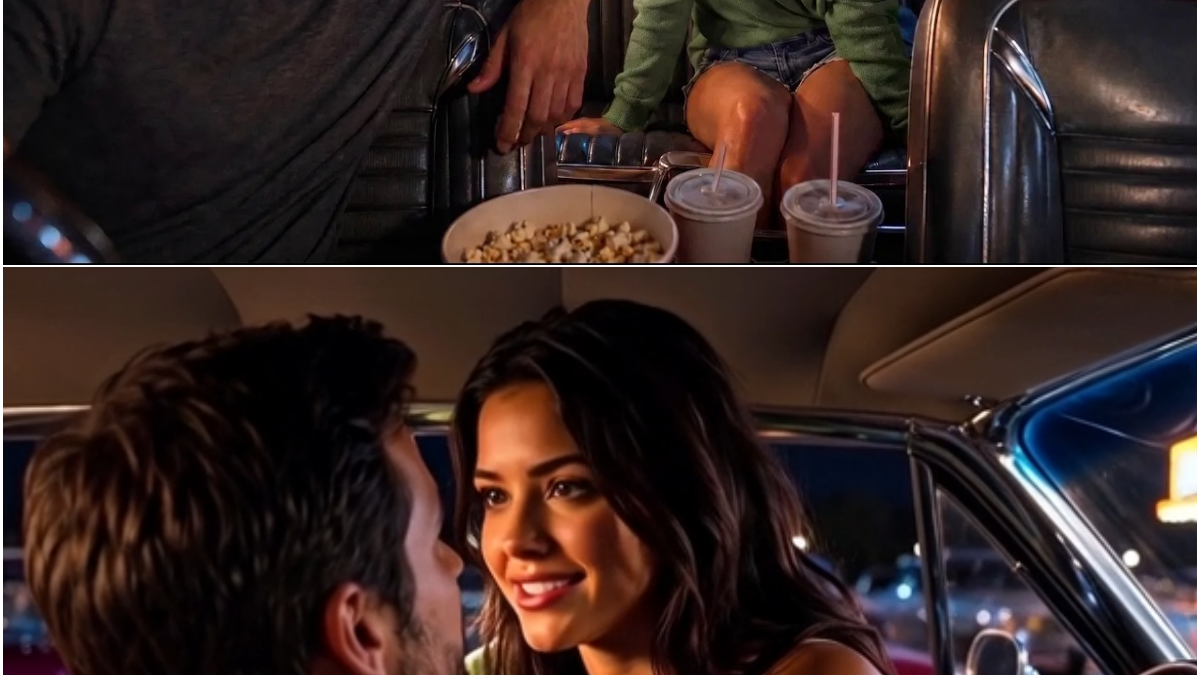
The projector bulb hummed to life behind me before I had even parked the truck, throwing a wide rectangle of white light across a screen that stood taller than a barn.
The gravel lot smelled of popcorn butter, cut grass, and the faint smoke of somebody’s cigarette drifting from a car three rows away.
It was Friday night, and the town was gathering beneath the open sky, looking for a few hours when nobody had to think about anything beyond the movie playing in front of them.
My name is Pete, and I run the drive-in. Not officially full-time, and not because I ever planned to spend my life selling tickets and repairing speakers.
My uncle handed me the keys when he grew tired of the late nights, the broken equipment, and the bills that seemed to arrive faster than the money.
I could have sold the land, but I couldn’t bring myself to do it. The place meant too much to too many people, including me.
Then Nora Whitfield pulled into the fourth row in her father’s old Bronco. I recognized the vehicle before I recognized the woman behind the wheel.
Nora was my ex-girlfriend Dean’s older sister, and I hadn’t expected to see her again.
Dean had moved to Portland eight months earlier, and our relationship had become another thing left behind in this town.
Nora had her own life, her own work, and plenty of reasons to stay away from me.
Yet there she was, lowering her window and smiling as if nothing had changed. “You’re still running this place,” she said.
And somehow, that ordinary question made me wonder whether the past had really finished with us.
“Somebody has to,” I answered. She smiled, and I walked back to the ticket booth with the strange feeling that something familiar had just returned to a place where I hadn’t realized it was missing.
I didn’t understand what that feeling meant until two nights later, when her Bronco came back with steam pouring from beneath the hood.
The radiator had apparently decided it had done enough work for one lifetime. Nora stood beside the front bumper with her hands on her hips, staring at the engine as if she expected it to explain itself.
“Don’t suppose you know anything about engines?” She called when she saw me approaching. “More than I know about running a movie theater, believe it or not.”
I was the only person around with a decent collection of tools and enough mechanical experience to be useful.
The movie hadn’t started, and the evening crowd was still arriving, so I told her to wait while I fetched my toolbox.
She held the flashlight while I examined the radiator. The beam wandered occasionally, slipping from the engine to my hands and back again.
I pretended not to notice. “You didn’t have to do this,” she said. “You’d have been stuck here until midnight otherwise.”
“I’ve been stuck in worse places.” She delivered the line lightly, but something in her voice made me wonder what she meant.
I decided not to ask. There were things about Nora I had never known, and I wasn’t sure whether she wanted to discuss them with me.
I tightened what I could, checked the hose, and told her the Bronco should make it home.
It wasn’t a permanent repair, but it would get her through the evening. She thanked me twice before climbing behind the wheel.
I watched her drive away, then remembered that I had a movie to run. For the rest of that night, I told myself the encounter meant nothing.
She was my ex’s sister. We had known each other for years, and people in a small town didn’t need a special reason to be friendly.
She had needed help, and I had happened to be available. That was all. At least, it was all I could comfortably admit.
Nora was three years older than me. When I had dated Dean, she had been the dependable person at every family gathering, the one who remembered birthdays, checked on her father, and somehow kept conversations from becoming arguments.
I had eaten Sunday dinner at their house every other week for two years. Nora had always made room for me at the table, asking about my work and remembering details I had mentioned weeks earlier.
I had liked her company, but I had never considered what it might mean to like her in any other way.
She was Dean’s sister. That fact had always been enough to keep my thoughts in the right place.
Then her Bronco started appearing at the drive-in most Fridays. Sometimes she came alone. Sometimes she brought a book that remained closed for the entire movie.
Sometimes she carried a thermos and offered me half of whatever she’d made, usually coffee.
She began parking a little closer to the booth each week. At first, she stayed in the fourth row.
Then she moved to the third. Eventually, she started choosing a space near the booth whenever one was available.
I noticed, of course. I noticed everything about her once I had started paying attention.
One evening, while I was counting the register, she leaned against the booth counter and watched me sort the bills.
“You know, you could just say hello like a normal person instead of hiding behind glass.”
“I’m not hiding.” “You’re working?” “Exactly.” “That’s a very convenient excuse.” She grinned, and I shook my head.
“What are you hiding from?” I asked. “Depends on the week.” She took a sip of coffee and looked toward the screen.
She had a way of answering questions without entirely answering them, leaving just enough space for someone to ask again if they genuinely wanted to know.
I didn’t push. Talking with her had become surprisingly easy. We discussed movies, the weather, the condition of the concession stand, and the strange collection of people who seemed to attend the drive-in every week.
She had opinions about nearly everything, but she never seemed interested in proving she was right.
I liked that about her. I also liked the way she listened. Nora had a habit of asking someone a question and then looking away while they answered.
I eventually asked why. “People perform less when they think you’re not paying attention,” she explained.
“I like the unperformed version of things.” “Is that some kind of architect philosophy?” “It’s a Nora philosophy.
I just happen to apply it to buildings, too.” She smiled into her coffee. “You should try it sometime.”
“Try what?” “Looking away. Letting people talk without making them feel like they’re being examined.”
“I don’t examine people.” She gave me a look. “You watch people like you’re waiting for them to disappoint you.”
I started to protest, but she continued before I could find the words. “You did it with me for the first two weeks.
You’ve mostly stopped now.” There wasn’t any accusation in her voice. She said it like she was describing a change in the weather.
I busied myself restocking napkins, although the dispenser was already full. Later that evening, she asked what I had done before taking over the drive-in.
I told her about my two years doing maintenance work at the community college, fixing things that rarely received much attention unless they stopped working.
The job had been steady, but I had never felt especially connected to it. The drive-in was different.
When something broke here, people noticed. When it worked again, they were happy. “You like being needed,” Nora said.
“Maybe. Is that a bad thing?” “No. It’s just something I’ve noticed.” She studied me for a moment.
“I like it, too, if I’m honeSt. Being needed. Most people don’t say that part out loud.”
“Most people don’t say a lot of things out loud.” “I’m working on that.” The way she said it made me suspect she was talking about something more important than our conversation, but I didn’t ask.
The first real hint that our friendship might be becoming something else came on a Tuesday night.
A forgettable drama was playing, the kind of movie that seemed to have been chosen because somebody had found it on a list of available titles.
Nora had parked closer than usual, and I brought her a fresh cup of coffee during the opening scenes.
“You remember I used to hate this place?” She asked. “You came here every summer with Dean.”
“I came because Dean made me.” “You stayed because…” She stopped. Her eyes moved toward the screen, and her expression changed just enough for me to notice.
“Never mind.” “Because what?” “Nothing.” She smiled, but the smile didn’t quite match her eyes.
“Old news.” I wanted to ask what she had been about to say. Instead, I refilled her coffee and went back to the booth.
People got nostalgic at drive-ins. That was practically part of the business. The following Friday, Nora brought a folding chair and set it beside the ticket booth.
She spent most of the first half of the movie talking through the open window, telling me about a difficult client, a leak in her kitchen ceiling, and a neighbor’s dog that had apparently developed an interest in howling at the night sky.
I found reasons to remain at the booth longer than my work required. “You’re supposed to be working,” she said when she caught me lingering.
“I am working.” “This is customer service?” “Is it customer service if you’re the only customer I talk to all night?”
She considered that. “Maybe I’m getting special treatment.” “Maybe.” She smiled as though that answer had satisfied her.
During a lull between showings, I walked over to inspect a speaker post that had been flickering.
Nora followed me and leaned against the hood of her Bronco while I checked the wiring.
The night was warm. The screen cast pale blue light across the lot, and the air carried the smell of grass and warm metal.
We talked about the movie, the weather, and whether the popcorn machine was making a strange sound because it needed cleaning or because it was genuinely possessed.
At some point, her shoulder came to rest against mine. Neither of us moved away.
I became aware of how close she was, of the faint scent of vanilla mixed with the familiar smell of the old vehicle, and of her hand resting on the hood a few inches from mine.
She looked at me. I looked back. For a moment, the entire drive-in seemed to disappear around us.
There was only the light on her face and the quiet understanding that something had changed, even if neither of us was ready to say what.
Then a car door slammed nearby. A kid hurried toward the concession stand, and the moment broke.
I stepped away and pretended to check the speaker post again. Nora mentioned that the popcorn line was getting long, and I agreed too quickly.
The rest of the evening passed normally, at least from the outside. Inside, I kept replaying those few seconds.
The next Friday, I tried to make a joke about her Bronco running hotter than the concession stand’s coffee machine.
It was a stupid joke. I knew that as soon as I said it. Nora didn’t laugh.
She folded her arms and looked toward the screen, her expression suddenly guarded. I couldn’t tell whether I’d offended her or accidentally made light of something she had taken seriously.
I considered apologizing, but I couldn’t decide what I was apologizing for. By the end of the evening, she was already sitting in the driver’s seat.
She gave me a polite wave through the windshield and drove away. It felt like a door closing.
She didn’t come the following Tuesday. I told myself she had other things to do.
She had a career, a home, and a father who probably expected her to visit regularly.
There was no reason she needed to spend every spare evening at the drive-in. Still, I kept looking toward the fourth row.
By Thursday, I had nearly convinced myself that the whole thing had been a misunderstanding.
The flashlight, the coffee, the way she leaned against me beside the Bronco. Maybe I had turned ordinary friendliness into something more because I was lonely and she happened to be there.
It was easier to believe that than to think I might have made her uncomfortable.
Friday arrived, and she wasn’t in the lot when the first feature began. I worked through the opening scenes, checked the speaker posts, and helped a family find an empty space.
During intermission, I restocked the candy rack and tried not to look toward the entrance.
Then I heard the Bronco. That particular engine rattle had become familiar enough that I recognized it immediately.
She pulled into the lot fifteen minutes late, and I felt a knot in my chest loosen before I even saw her face.
Nora walked up to the booth, slightly out of breath. “Busy night?” She asked. “Not especially.”
“Good.” She didn’t mention my joke. Neither did I. We talked about the second feature as if the previous week hadn’t happened.
Slowly, the easy rhythm returned, and I realized that whatever had gone wrong might not have been as permanent as I had feared.
After a while, I said, “You could have called.” She raised an eyebrow. “I don’t have your number, Pete.”
That was true. We had spent weeks talking, but somehow neither of us had done the ordinary thing of exchanging phone numbers.
It was as if we had both wanted to keep our conversations inside the boundaries of the drive-in, where we could pretend they were accidental.
“That’s an oversight,” I said. “Fix it, then.” She held out her phone. I entered my number, trying to make my hands look steadier than they felt.
“There.” “Now you have no excuse.” “I never needed an excuse. I just like coming here.”
She slipped the phone into her pocket and smiled. I thought about that sentence long after she drove away.
Two weeks later, she arrived during a slow evening and leaned against the booth window while I sorted tickets.
“You know what’s funny?” She asked. “What?” “Dean used to complain that you never talked enough.”
“I’ve heard that before.” “I always thought it was the best thing about you.” I wasn’t sure how to respond.
It sounded like a compliment, but there was something more personal underneath it. She explained that her work involved plenty of noise.
Clients wanted entire houses redesigned in a few weeks, often without being able to explain what they disliked about their current homes.
Her father had opinions about her career, her finances, and what she should be doing next.
“Everyone has an idea about what I should be doing,” she said. “It’s nice to spend a few hours somewhere nobody wants anything from me except correct change for a large popcorn.”
“I want things from you,” I said. She looked at me. “Like what?” “Company, I guess.
On slow nights.” I tried to make the answer sound casual, but I could hear the hesitation in my own voice.
“Nothing complicated.” “Nothing’s ever nothing complicated with you, Pete.” She was smiling, though, and she didn’t ask me to explain.
That same night, the projector bulb failed during the last twenty minutes of the feature.
The entire lot went dark. A few people honked their horns, while others turned on their headlights and waited for an explanation.
I grabbed my tools and headed for the equipment shed, knowing the repair could take a while.
Nora stayed. She brought me coffee from the concession stand, black, just the way I liked it.
She held the flashlight while I examined the wiring, keeping the beam steady without needing to be reminded.
“You don’t have to wait around for this,” I told her. “I know.” She didn’t move.
“I want to.” The repair took nearly two hours. By the time I had the projector running again, most of the cars had left.
The lot was quiet, and the equipment shed was filled with the ticking sounds of machinery cooling down.
I sat back on my heels and wiped my hands. “Thanks for staying.” “You don’t have to thank me every time I do something normal.”
“Is waiting two hours in an empty parking lot normal?” “For you, apparently.” She said it lightly, but neither of us laughed.
I stood and brushed the dust from my knees. Nora had moved to the open tailgate of my truck, sitting there with her legs swinging slightly while I locked the shed.
“You could have left,” I said. “I know.” “Nobody would have blamed you.” “I didn’t want to leave you out here fighting a machine older than both of us.”
“It’s not that old.” “It sounds like a tractor trying to start in winter.” “That’s the character of the place.”
She clicked off the flashlight. In the sudden darkness, her voice seemed closer. “Besides, you still owe me a movie.”
“The projector is running now.” “I missed half the feature. You can’t expect me to be satisfied with that.”
“I’ll make it up to you.” “I’ll collect.” I laughed, and she smiled. It was past midnight, and I offered to drive her home.
She said she wasn’t in a hurry and asked whether we could sit for a while firSt.
We climbed into my truck and drove around to the back of the property, where the ridge overlooked the valley.
I parked in the place that gave us the clearest view, switched off the engine, and lowered the windows.
The night air moved gently through the cab. For a while, neither of us spoke.
Then Nora folded her hands in her lap. “Can I tell you something real?” She asked.
“Not drive-in small talk?” “Sure.” “I turned down a job in Chicago two years ago.”
She stared through the windshield. “It was a design firm. Good money, interesting projects, the kind of opportunity people are supposed to take.
I told everyone I stayed because of my dad’s health. That was true, but it wasn’t the whole truth.”
“What was the rest?” “I was scared.” She said it quietly. “Scared of leaving somewhere I understood for somewhere I didn’t.
Dean left and built a whole new life two thousand miles away. He seemed certain about it.
I stayed here and told myself I was being responsible. Sometimes I wonder whether I was just afraid to find out what else I could do.”
I listened without interrupting. There was no answer I could offer that would make the choice simple, and I knew she wasn’t asking me to solve it.
“I understand,” I said eventually. “I had a chance to sell this place. Take the money and do something else.
My uncle told me I was making a mistake by keeping it.” “Why didn’t you sell?”
“Probably the same reason. I was scared of who I’d be without it.” She turned toward me.
“Guess we’re both experts at staying.” “Maybe staying isn’t always the same as being scared.
Sometimes it means knowing what matters to you.” She studied me, her expression softening. “That’s a generous way to look at it.”
“I’m a generous guy.” “You’re really not. You’re careful. There’s a difference.” “Careful isn’t so bad.”
“No,” she said. “It isn’t.” I looked at her for a moment before asking the question that had been following me for weeks.
“Why do you keep coming back here?” She didn’t answer immediately. “After the radiator was fixed, I mean.
You could watch movies anywhere.” She looked out over the valley. “Honestly, I told myself it was the popcorn at firSt. Then I said it was nostalgia.
Then I stopped making excuses and admitted I liked watching you work.” I felt my attention sharpen.
“The way you fix things without making a big deal out of it. The way you talk to people in that booth as if every person matters, even when they’re complaining about ticket prices.
You make this place feel like it belongs to everybody.” I didn’t know what to say.
She continued. “I used to think your family was all noise. Loud opinions, loud affection, everyone talking at once.
You were the quiet one at the table. I liked that there was room to breathe when you were around.”
“That’s a lot to put on a guy who mostly showed up for the mashed potatoes.”
“Don’t do that.” Her voice became gently firm. “Don’t make yourself smaller because it’s easier than accepting what I’m saying.”
I looked down at my hands. She had spent more time paying attention to me than I had realized.
Perhaps she had noticed things I hadn’t even noticed about myself. “I think the only reason Dean and I lasted as long as we did was because your family made it easy,” I said.
“Sunday dinners, all of you being steady. I think I liked being part of that more than I liked being part of him.”
The words sounded different once they were out in the open. I wondered whether I had crossed a line by saying them.
Dean was still her brother, and I was sitting alone with her in a truck after midnight, admitting that the family I had once belonged to had meant more to me than the relationship that brought me there.
Nora didn’t look at me. For a moment, I thought I had ruined everything. Then she reached toward the radio and turned the volume down, leaving the music barely audible.
“I always liked that you fit at that table better than he did,” she said softly.
I turned toward her. “That’s a strange thing to say about your own brother.” “It’s not about him.”
She met my eyes. “It’s about you. It always kind of was, if I’m honeSt. And I’m trying to be honest tonight.”
The quiet settled around us. Outside, the wind moved through the grass at the edge of the property.
A moth circled the dashboard light, then disappeared into the darkness. Nora’s hand rested on the seat between us.
Her fingers were close to mine, but she didn’t reach for them. I could feel the moment waiting.
“The movie can wait,” she said. I looked at her. “Yeah,” I answered. “It can.”
“Are you sure?” “I’m sure.” She smiled, but there was a vulnerable edge beneath it.
“I’ve been sure for weeks, Pete. You’re the slow one.” I leaned toward her, stopping just short of closing the distance.
She met me halfway. The kiss was gentle and careful, a question neither of us had quite known how to ask.
Her hand settled against my jaw, and I felt her smile before we separated. For a moment, we simply looked at each other.
“Permission granted, by the way,” I said. “In case that wasn’t clear.” “It was clear.”
Her thumb moved lightly along my jaw. “I just wanted to hear you say it.”
The second kiss came more easily. There was no need to pretend we were uncertain anymore.
Weeks of glances, conversations, coffee, and small excuses had led us here. My hand rested at her waist, and she drew closer.
After a while, she laughed against my mouth. “This truck was not built for this.”
“Clearly.” “Back seat’s bigger.” I raised an eyebrow. “Nora Whitfield.” “Don’t act scandalized. You’ve been thinking about this since the radiator.”
She opened the door, climbed out, and walked around to the back of the truck.
Then she looked at me through the window, smiling. “Come on, Pete.” I followed her.
We settled into the back seat, where the space was wider and the windows framed the quiet ridge.
The kiss that followed was slower, unhurried, and filled with the certainty that neither of us had been willing to admit until now.
Eventually, Nora rested her forehead against mine. “For the record,” she whispered, “I’ve wanted to do that since the radiator.”
“That was three weeks ago.” “I told you. I’ve been patient.” “You’re calling me slow?”
“Very.” I laughed, and she kissed the corner of my mouth. “Next time,” she said, “don’t wait for the equipment to break down firSt.”
“I’ll try to remember.” We stayed there for a long time, holding hands and talking about ordinary things.
She told me what she wanted to do the following weekend. I told her the popcorn machine might finally need replacing.
She warned me that her father would have something to say when he found out.
“He’s going to be insufferable,” she said. “I can handle insufferable.” “You say that now.”
The sky was beginning to lighten when she finally sat up and stretched. “Is it almost morning?”
“Getting there.” “We should probably move before somebody drives past and gets the wrong idea.”
“The right idea, technically.” “Don’t ruin it with accuracy.” She kissed me again, then leaned against my shoulder while I started the truck.
I took her home slowly. Neither of us seemed particularly interested in ending the night.
The next eleven days changed the shape of my week. Nora stopped bringing a book to the drive-in.
She parked closer to the booth, not because the Bronco required special attention anymore, but because she wanted to be near me.
Instead of waiting for me to come over, she walked straight to the window and leaned against the counter as if she belonged there.
We were careful at firSt. Small towns have their own ways of keeping track of people, and we knew that the relationship would become a subject of conversation eventually.
We wanted to understand what we were doing before everybody else began offering opinions. Nora told her father firSt.
She invited me to dinner at the house where I had once eaten with Dean.
Sitting at that familiar table again felt strange, but not uncomfortable. Her father watched us throughout the meal with an expression that suggested he had already reached a conclusion.
When Nora finally told him we were together, he leaned back in his chair. “Took you long enough,” he said.
Nora laughed so hard she nearly spilled her drink. I wasn’t sure whether to take it as approval or a warning, but she squeezed my hand beneath the table, and I decided that was enough.
Dean sent a message from Portland a few days later. “Heard about you and Nora.
Weird. But good for you both, I guess.” I read it twice before showing her.
She shrugged. “That’s about as warm as he gets. Take the win.” I replied with a simple thank-you and left it there.
The town found out gradually. A knowing smile at the grocery store. A question from someone at the feed store.
A neighbor who suddenly seemed very interested in whether Nora would be coming to the next movie night.
Nobody made a great announcement. People simply adjusted to the new fact. Not everyone was immediately comfortable with it.
At a family barbecue, Nora’s aunt asked whether it wasn’t strange for her to date her brother’s former boyfriend.
Nora told me about the conversation later, laughing, although I could tell the question had bothered her.
“What did you say?” I asked. “I told her it was strange right up until it wasn’t.”
“That was it?” “I also suggested that if she wanted to keep discussing my personal life, she could do it with a plate of ribs in her other hand.
At least then I’d get something out of the conversation.” I laughed. “Did she have anything to say?”
“Not really.” “I’m sorry she put you in that position.” Nora reached across the table and squeezed my hand.
“I didn’t need your help defending myself. But it was nice knowing you’d have shown up if I’d asked.”
I looked at her. “Of course I would.” “That’s sort of the whole thing about you, isn’t it?
You don’t crowd in unless you’re needed, but you’re always close enough to reach.” I thought about that for a long time.
She was right. I had spent years believing that being useful was the same as being present, that if I could fix something or take care of a problem, I had done my part.
Nora seemed to understand that I was learning something different. She started arriving early on Fridays to help me set up the speaker posts.
Her assistance mostly consisted of handing me tools and making comments about how I should have bought better equipment, but I enjoyed having her there.
On quiet evenings, she sat in the booth with her feet resting on the counter and read from whatever book she had brought.
Sometimes she read a passage aloud without warning. I always listened. The town eventually stopped treating us like news.
We became part of the ordinary arrangement of things, as familiar as the lights along Main Street or the sound of the concession stand door opening.
My uncle called one afternoon after hearing about Nora. He had handed me the drive-in with a warning about the debt and the endless repairs, and he had never been entirely convinced that keeping it was a sensible decision.
Now he told me he was glad I had someone to come home to. I repeated the conversation to Nora later that evening.
“Did he really say that?” “Pretty much.” She smiled. “He’s not wrong about you working too much.”
“I’ve gotten better.” “You have.” She was sitting on the tailgate while I restocked the popcorn kernels.
“You used to stay here until two in the morning doing inventory nobody asked you to do,” she said.
“I worried about you sometimes.” “How would you have known that?” “Dean mentioned it once.
He said you never knew how to stop working.” I considered that. “I guess I had a lot of time to fill.”
“And now?” “Now I’ve got somewhere better to be.” I kept my eyes on the boxes while I said it, but I heard her go quiet.
When I finally looked up, she was smiling in that particular way that always made me feel as if she had heard something much larger than the words themselves.
A few weeks later, she brought lunch to the drive-in on a day when it wasn’t even open.
The lot looked different in daylight. Without the cars, the screen seemed enormous and oddly plain.
The speaker posts stood in straight rows, and the concession stand looked more like an old building than the center of an evening’s entertainment.
Nora sat beside me in the grass with a sandwich wrapped in paper. “It’s different without the movie,” she said.
“Less magic?” “More like a field with speakers.” “Don’t let the customers hear you say that.”
“I’m basically part of the staff now.” She handed me half her sandwich without asking whether I wanted it.
We ate together and watched the empty lot. “I used to think this place was sad,” she said after a while.
“Like something hanging on past its time. Now I think it’s one of the most honest places in town.”
“How’s that?” “Everybody is always pretending they should be somewhere better. A bigger house, a better job, a different town.
But you run this drive-in and let people watch a movie beneath the stars. You give them somewhere to go when they want an ordinary evening to feel special.”
I looked at the screen. “I never thought about it that way.” “Maybe that’s why it works.
You don’t spend all your time trying to convince people it’s important. You just keep it running.”
She turned toward me. “I’m glad your uncle didn’t sell the land.” “So am I.”
I meant it for more reasons than I could explain. By October, six weeks after that first night with the radiator, Nora arrived in a different vehicle.
The old Bronco had finally become too unreliable, and she’d replaced it with a newer car.
She parked beside the booth and walked directly to the window. “You’re supposed to buy a ticket,” I told her.
“I was hoping the guy running this place had a soft spot for me.” “Maybe he does.”
“Good. I brought coffee.” She handed me a cup, then glanced toward my truck. “I was thinking we could skip the movie tonight.”
“Why?” “Maybe drive somewhere with a better view.” “We could watch part of it firSt.”
“We could.” She tilted her head, considering me. “Or we could not.” I looked at her and felt that familiar warmth settle in my cheSt.
“The movie can wait,” I said. She smiled. “Took you long enough.” “You keep saying that.”
“I’ll keep saying it until you stop being slow.” She reached through the window and took my hand.
“Come on, Pete. Lock up.” I finished closing the booth and shut down the concession stand.
The projector continued running while we walked to my truck, its light spilling across the empty spaces between the remaining cars.
We drove past the last row and followed the road toward the ridge. The valley opened below us, dotted with scattered lights from houses, the diner on Main Street, and the occasional passing vehicle.
I parked in the place we’d quietly claimed as ours and switched off the engine.
For a while, neither of us spoke. Nora rested her head against my shoulder. “Can I ask you something?”
“Always.” “Do you ever think about how close we came to not doing this?” I considered the question.
“If your radiator hadn’t broken that Tuesday,” she continued. “If I’d stopped coming after you fixed it.
If you hadn’t noticed me parking closer every week.” “I think about it sometimes.” “How much of this was luck?”
“I don’t think it was luck.” She lifted her head. “No?” “I think you’d have found another excuse eventually.
You’re persistent when you want something.” She laughed quietly. “That’s fair.” Then she admitted she had been planning to fake a flat tire if the radiator hadn’t given her a reason to talk to me.
“You were going to do what?” “Let the air out slowly. Just enough to make it believable.”
“Nora.” “I had a backup plan.” “You actually looked that up?” “Of course.” I stared at her, and she grinned without the slightest embarrassment.
“I told you. Patient, not passive.” “Remind me never to underestimate you.” “Wise man.” She kissed me, soft and unhurried, as if the answer to every question we’d asked each other over the previous weeks had finally become simple.
Below us, the town continued with its ordinary Friday night. Porch lights glowed. Kitchen windows brightened.
Somewhere, a car moved along Main Street, and the diner sign shone against the dark.
Nothing about the moment announced itself as important. There were no fireworks or grand declarations.
Just two people sitting in a truck above a town that had quietly made room for them, holding hands and feeling at home.
Behind us, the drive-in screen continued flickering over an almost empty lot. A couple of teenagers had apparently slipped onto the property after closing and were wandering near the concession stand.
I noticed them and made a mental note to run them off before I forgot.
I didn’t move. Nora followed my gaze. “Aren’t you supposed to be responsible?” “I’m delegating.
Future Pete can handle it.” “Future Pete sounds lazy.” “Future Pete’s had a very good night.
Cut him some slack.” She laughed and settled against me again. After a while, she asked another question.
“Are you glad the radiator broke?” I thought about the first night, the steam beneath the hood, the flashlight in her hand, and the way she’d looked at me while I worked.
“I’m glad you kept coming back after it was fixed.” She smiled. “The radiator was just the excuse I needed to stop pretending I didn’t want to.”
She laced her fingers through mine. “I think I’d have found my way here eventually.
Some road always leads back to the place you’re supposed to be. Mine just happened to go through a busted hose and a very patient mechanic.”
“I fix things carefully.” “Sue me.” “I’m not complaining.” “I never was.” We sat together long after the conversation had ended, content with the quiet and the steady warmth of being close to someone who understood us.
Eventually, Nora’s breathing slowed, and her head settled more heavily against my shoulder. She was falling asleep again, just as she had that first night in the back of the truck.
I watched the distant screen flicker across the lot. I thought about the flashlight, the radiator, the coffee passed through the booth window, the half-second glances, and the nights when neither of us had been brave enough to say what we wanted.
I thought about how easily I might have missed it all if I had kept treating every moment as an ordinary coincidence.
The projector hummed behind us, the town rested below us, and Nora slept against my shoulder.
I didn’t need to fix anything. For once, everything that mattered was already right where it belonged.
Disclaimer: This content may be created by Al for entertainment purposes. Any resemblance to real persons, events, or places is coincidental.








