I Thought I Had One Alien Wife — Until Her Identical Twin Claimed She Was Married to Me Too
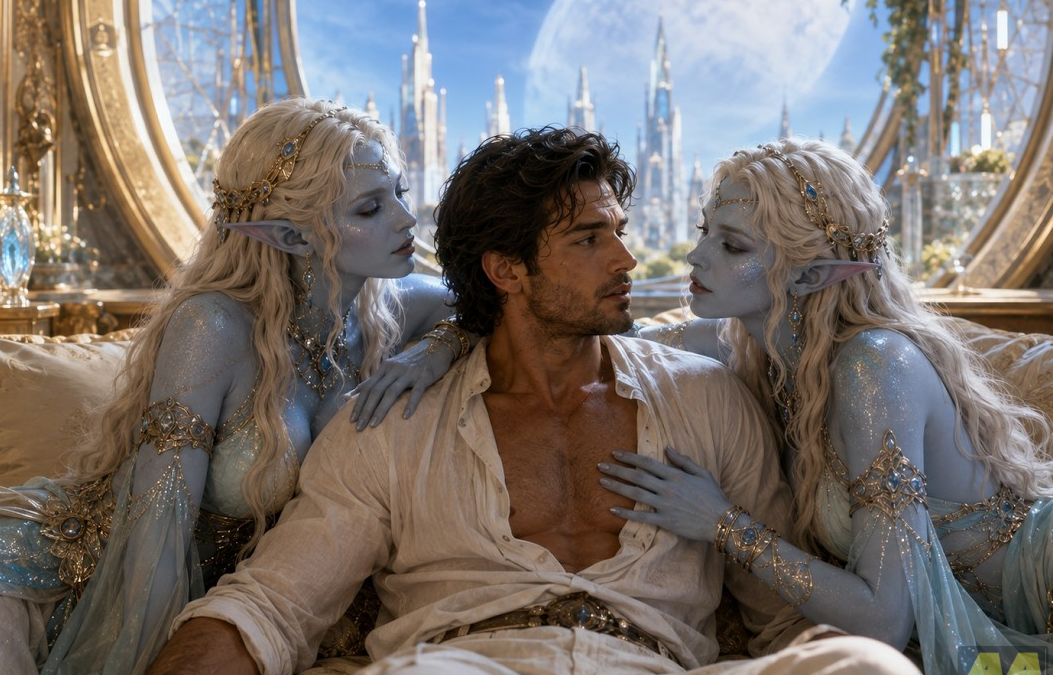
The door opened before I reached it, and for one impossible second I thought Sarah had somehow come home early.
The woman standing on my porch had her silver eyes, her sharp cheekbones, her dark hair falling over one shoulder in exactly the same way, and the same slight tilt of the head Sarah used whenever she was about to tell me something that would rearrange my entire afternoon.
But Sarah had never arrived wearing travel clothes covered in dust from three star systems.
This woman carried a metal case in one hand. She looked at me as though I had personally inconvenienced her by existing.
“You must be Ethan,” she said. I tightened my grip on my coffee. “Yes.” “I am Vessa.”
She stepped inside. “I believe you are my husband.” The coffee nearly slipped from my hand.
I stared at her. She stared back. Then she placed the metal case on my kitchen table with the calm confidence of someone who had already decided the furniture belonged to her.
“I think,” I said carefully, “you have the wrong house.” “I do not.” She opened the case.
Inside were documents stamped with seals I recognized from Sarah’s world, along with a small silver pendant and several identification cards.
“This is the correct house,” Vessa said. “You are the correct man. And under Veil law, I am the correct wife.”
That was when I heard the garden door open. Sarah walked into the kitchen carrying a basket of blue moss fruit.
She saw Vessa. The basket slipped from her hands. Fruit rolled across the floor. Nobody spoke.
For several seconds, all I could hear was the faint hum of the refrigerator and the soft ticking of the wall clock.
Then Sarah whispered one word. “Vessa?” Her sister looked at her. “Hello, Sarah.” I looked from one face to the other.
They were identical. And in that moment, I realized I had spent two years believing I knew the woman I married.
Now another version of her was standing in my kitchen with legal documents and a suitcase.
The worst part was not that Vessa claimed to be my wife. The worst part was that Sarah did not immediately tell her she was wrong.
She simply stared. So what exactly had my wife forgotten to tell me? Sarah finally moved.
She stepped around the scattered fruit and closed the garden door. “You were supposed to be on Caor station.”
“I was.” “You were supposed to stay there.” “I did.” “For almost two years.” “Plans changed.”
“Plans do not simply change across four star systems, Vessa.” “Mine did.” I raised one hand.
Both sisters looked at me. “Can somebody please explain why the woman standing in my kitchen looks exactly like my wife and just told me she is also married to me?”
They both stared at me with the same expression. For one horrifying moment, I could not tell them apart.
That was when I understood how serious this was. Sarah sat down. Vessa remained standing.
I slowly lowered myself into the chair across from them. Sarah rubbed her forehead. “There is something I should have told you.”
“That sentence has never improved anyone’s morning.” “I know.” “You told me you were an only child.”
“I am.” Vessa raised an eyebrow. Sarah pointed at her. “Legally, spiritually, socially, in every way that matters, I am an only child.”
“I am still here,” Vessa said. “That is not helping.” “I did not come here to make things worse.”
“You walked into my kitchen and announced that you were Ethan’s wife.” “Because that is what the law says.”
I looked at Sarah. “Please tell me she is joking.” “She is not.” Vessa opened the metal case.
She removed a document and placed it in front of me. The seal at the bottom shimmered when I touched it.
I recognized the symbol. It belonged to the Veil Consulate. Sarah and I had been married for almost two years.
I had learned her language. I had attended family ceremonies. I had eaten food that occasionally seemed to have ambitions of its own.
I had stood beneath the twin moons of her home continent while an elder painted symbols across my forehead and explained what they meant.
At the time, Sarah had translated them as something close to welcome. Later, Owen told me the more literal translation was closer to a warning that I now belonged to an unusually large family and should behave accordingly.
I had accepted all of that. What I had not accepted was the existence of Vessa.
Sarah finally began explaining. Among the Veil, twins were not considered entirely separate in the legal sense.
Their culture treated a twin bond as a single family thread divided between two bodies.
If one twin entered a marriage, certain legal obligations extended to the other. There was a procedure called the severance.
It formally separated the second twin from the marriage bond. But there was a condition.
Both twins had to appear before an elder within thirty days of the original bonding.
Our marriage had happened almost two years ago. No severance had been performed. Vessa had been living on Caor station.
Sarah had believed that distance would make the matter irrelevant. She had been wrong. “Why did nobody tell us this before?”
I asked. Vessa answered. “Because most families complete the severance immediately when a twin does not intend to join the household.”
Sarah looked down. “I thought it would never matter.” Vessa placed another document on the table.
“It matters now.” “What happened?” “Our family estate on Ka is under review.” Sarah looked up.
“What?” “The inheritance authority issued a notice three weeks ago. They found an unresolved marriage status attached to both of us.”
“And?” “And unless our status is clarified, the estate can be frozen.” Sarah went pale.
Vessa continued. “My citizenship privileges are connected to the estate.” I looked at Sarah. “What does that mean?”
“It means she could lose her family status.” Vessa nodded. “And if I renounce my claim, I become legally separate from my family.”
I frowned. “Separate how?” “Completely.” She said it without emotion. “No inheritance. No family rights.
No claim to our ancestral property. No standing in family decisions. The law would treat me as unrelated.”
Sarah looked at her sister. “No.” Vessa met her eyes. “I am not asking you to choose.”
“But that is exactly what the law is asking.” The room became quiet. I looked at the papers.
“So our choices are what?” Vessa answered. “Either the marriage remains recognized for both twins.”
She looked directly at me. “Or I renounce my family connection.” Sarah shook her head.
“Or we find another solution.” Vessa gave a small, tired smile. “That is what I came here for.”
I leaned back. “Let me understand this. If we do nothing, the marriage continues as it is?”
“Yes.” “With both of you legally connected to me?” “Yes.” I rubbed my face. “I am human.”
Vessa waited. “On my world, one wife is already a complicated responsibility.” Sarah covered her mouth.
I pointed at her. “Do not laugh.” “I am not.” “You are.” “I am trying not to.”
Vessa’s mouth twitched. “You are handling this unusually well.” “I am absolutely not handling this well.”
“You are sitting upright.” “That is shock.” “I see.” Sarah finally laughed. It was brief.
Then she became serious again. “I should have told you.” I looked at her. “Yes.”
“I was afraid.” “Of what?” “That you would see me differently.” I did not answer immediately.
She continued. “When we met, I had spent years trying to make my life simple.
My family history was complicated. Vessa lived far away. We barely spoke. I thought the distance meant the problem would disappear.”
“It did not.” “No.” She looked at her sister. “I thought if I waited long enough, there would never be a reason for you to know.”
Vessa spoke quietly. “There was another reason.” Sarah looked at her. “You were afraid he would think of me whenever he looked at you.”
Sarah’s expression changed. “That too.” I looked between them. For the first time, I stopped thinking about the legal problem.
I started thinking about the people. Vessa was not simply a second copy of Sarah.
She was a person who had spent her entire life being compared to her sister.
Sarah was not simply my wife who had hidden a family secret. She was a woman who had been afraid that the person she loved would leave if he saw all the complicated pieces she had tried to hide.
I reached across the table. I did not know which hand to take. So I placed my hand flat on the table.
Sarah looked at it. Vessa looked at it. Neither moved. “Then we start with the truth,” I said.
Vessa nodded. “The truth is that I do not want to renounce my family.” Sarah nodded.
“The truth is that I do not want you to.” “And the truth,” I said, “is that I do not want some ancient document deciding what our household has to look like.”
Vessa studied me. “What would you prefer?” “I have no idea.” “That is honeSt.” “I am trying something new.”
Sarah smiled. The next morning, I went to see Owen. Owen had lived on our world longer than I had.
He was human, married into a Veil family, and possessed an alarming ability to discuss interspecies law while eating breakfaSt.
I found him at his usual table. He listened to the entire story. Then he nearly choked on his drink.
“Two wives?” “Do not say it like that.” “How else am I supposed to say it?”
“Quietly.” “You are the most unlucky fortunate man I have ever met.” “It is not funny.”
“It is a little funny.” I stared at him. He stopped smiling. “Fine.” He leaned forward.
“The Veil take family bonds seriously. But they also respect negotiation.” “Negotiation?” “Their entire civilization is built around negotiated obligations.”
“So there is a way out?” “There might be a way forward.” I frowned. “What is the difference?”
“A way out leaves somebody behind.” He tapped the table. “A way forward creates something nobody had before.”
I sat back. “What are you suggesting?” “You said there is no legal procedure for your situation.”
“Yes.” “Then create one.” “I cannot invent Veil law.” “Why not?” “Because I am human.”
Owen smiled. “That is exactly why you should try.” I said nothing. He continued. “Humans entered the wider galaxy because we were stubborn enough to keep asking questions after everyone else accepted the answer.”
“That sounds like something you made up.” “I probably did.” He shrugged. “But it is still useful.”
I thought about Vessa. I thought about Sarah. I thought about the word renunciation. I thought about a law that offered only two possibilities.
Wife or stranger. There had to be something between those extremes. When I returned home, both sisters were sitting at the kitchen table.
The documents were spread between them. Nobody had touched the blue moss fruit still sitting in a bowl.
I sat down. “I have an idea.” Sarah looked at me. “That is dangerous.” “Probably.”
Vessa folded her hands. “Tell us.” I looked at her. “If the legal problem disappeared tomorrow, would you want to stay?”
She blinked. “What?” “Forget the estate. Forget the inheritance. Forget the old law. If none of that existed, would you choose to live here?”
Vessa did not answer. Sarah looked at her sister. I waited. Finally Vessa spoke. “I do not know.”
“That is okay.” “No.” She looked down at the table. “I do know.” Her voice became quieter.
“I spent my entire life being the second twin.” Sarah’s expression tightened. “I was always the other one.”
She continued. “Sarah was the one who stayed. Sarah was the one everyone understood. Sarah was the one who belonged.”
“You belonged too,” Sarah said. “I know that now.” Vessa looked at her. “But I did not always feel it.”
Sarah lowered her eyes. Vessa took a slow breath. “When the estate notice arrived, part of me was relieved.”
Sarah looked surprised. “Why?” “Because suddenly I mattered.” The words sat heavily between them. “If the law was willing to fight over my connection to the family, then maybe I was not as unnecessary as I had believed.”
Sarah reached across the table. She stopped halfway. Vessa looked at her hand. Then she took it.
“You were never unnecessary,” Sarah whispered. Vessa’s eyes became wet. “I know.” Sarah shook her head.
“No. You do not.” She squeezed her sister’s hand. “I spent so much time being afraid of losing you that I forgot you were already gone.”
Vessa closed her eyes. I looked away. Some conversations did not need an audience. After a moment, Sarah laughed softly through her tears.
“This is a terrible time for us to become emotionally healthy.” Vessa smiled. “It is very inconvenient.”
I waited until they were ready. Then I explained my idea. It would not be a second marriage.
It would not be renunciation. It would be a household partnership. Vessa would retain her family rights.
Her citizenship would remain intact. Her inheritance would be protected. She would have a legal place within our household without becoming my wife simply because an old rule connected twins.
Sarah’s marriage would remain exactly what it had always been. If, in the future, any of us wanted to change the arrangement, that decision would have to be made voluntarily.
No inherited obligation. No automatic bond. No forced choice. Vessa listened carefully. “That agreement does not exiSt.”
“Then we write one.” Sarah looked at me. “You would really do this?” “I married you.”
She smiled. “You know what I mean.” “I would do it because this is your family.”
I looked at Vessa. “And because she deserves a choice too.” Vessa sat quietly. Then she nodded.
“I want to try.” Three days later, we stood in the stone hall of the Veil elders.
The building had existed for three hundred years. Its walls were covered with carved symbols representing family agreements, partnerships, reconciliations, and changes to ancient customs.
An elder sat at the front. She had storm colored eyes and a silver staff.
Representatives from Sarah’s family sat along one side. Vessa’s legal representative sat along the other.
Owen sat near the back and looked far too pleased with himself. The elder looked at us.
“Who speaks first?” Vessa stepped forward. “I do.” She presented the documents. She explained the problem without exaggeration.
She explained the absence of a severance. She explained the estate. She explained why renunciation was unacceptable to her.
Then Sarah stepped forward. “My sister is not an extension of me.” The hall became quiet.
“She is not my legal shadow. She is not a spare member of our family.
She is Vessa.” She looked toward her sister. “I failed to understand that for a long time.”
Vessa lowered her eyes. Sarah continued. “I do not want a law to decide whether she belongs to us.”
Then the elder looked at me. “And you, Ethan?” I stood. I had never spoken in front of so many Veil elders before.
I was nervous. But I had learned something during the past few days. Fear did not always mean you were making the wrong choice.
Sometimes it meant the choice mattered. “I do not understand every tradition of your people.”
A few members of the audience exchanged glances. “But I understand families.” I looked at Sarah.
Then Vessa. “A law that gives only two choices, marriage or stranger, cannot account for every family that comes after it.”
Nobody moved. “Your law was created to protect families. I believe that.” The elder watched me closely.
“But if protecting a family requires one member to surrender everything, then the law is no longer solving the problem.”
I took a breath. “We are not asking you to erase your traditions.” I raised the proposed contract.
“We are asking you to let the tradition grow.” The elder leaned back. “For three hundred years, no one has requested such a bond.”
“I know.” “You understand that allowing it creates precedent?” “Yes.” “You understand others may follow?”
“Yes.” “You understand that future families may build upon what you propose?” I looked at Vessa.
She nodded. Then I looked at Sarah. She nodded too. “Yes.” The elder considered us for a long time.
Finally she stood. “The purpose of law is not to preserve the shape of the paSt.”
She placed both hands on her staff. “It is to protect the people who inherit that paSt.”
The room became completely still. “I will allow the contract to be tested.” Owen smiled from the back.
I could practically hear him saying that humans were excellent at climbing walls. The ceremony that followed was unlike anything I had experienced.
Vessa signed firSt. She became a recognized protected partner of our household. Not my wife by accident.
Not a stranger by renunciation. A chosen member of our family with her own rights and her own boundaries.
Sarah and I renewed our vows afterward. This time, there were no hidden histories between us.
No missing names. No carefully edited family stories. Nothing left in the shadows. When the ceremony ended, the elder placed her staff between the three of us.
“Today, this household is recognized by deliberate choice rather than inherited obligation.” She looked at Vessa.
“You remain part of your family.” Then she looked at Sarah. “You remain within your marriage.”
Finally she looked at me. “And you have learned that a household can contain more than one kind of love without requiring every bond to carry the same name.”
I nodded. That was enough. When we returned home, the kitchen looked exactly as it had before.
The same table. The same chairs. The same refrigerator. The same window overlooking the violet grass.
The difference was that the papers on the table no longer felt like a threat.
They were simply papers. Vessa sat across from me. Sarah sat beside her. For a while, none of us spoke.
Then Vessa smiled. “When I arrived here, I expected you to panic.” “I did panic.”
“You hid it well.” “I am very good at looking calm while internally falling apart.”
Sarah laughed. Vessa looked at me. “I also expected you to send me away.” “I considered it.”
“You did?” “For approximately twelve seconds.” “That is longer than I expected.” Sarah shook her head.
“You two are impossible.” Vessa looked at her. “So are you.” Sarah smiled. Then she reached across the table and took Vessa’s hand.
I watched them. For two years, I had thought Sarah’s family was something I had married into.
Now I understood that family was not always something you entered. Sometimes it was something you helped rebuild.
Sometimes it was something that arrived at your front door carrying documents and dust from three star systems.
Sometimes it was a sister who had spent years believing she was second. Sometimes it was a husband who had absolutely no idea what he was doing.
And sometimes it was three people sitting around the same table, trying to decide what their lives should look like when the old rules no longer fit.
Vessa eventually looked at me. “You know, there is still one problem.” I became suspicious immediately.
“What?” She pointed toward the kitchen. “You have one guest room.” Sarah started laughing. I stared at the hallway.
Then at Vessa. Then at Sarah. “That is not a legal problem.” “No.” “It is not an inheritance problem.”
“No.” “It is not a Veil law problem.” “No.” “Then what is it?” Vessa smiled.
“It is a furniture problem.” Sarah laughed harder. I leaned back in my chair. After everything we had survived during that strange week, somehow the greatest challenge was apparently going to be deciding where to put a second bed.
I looked at the two women across from me. Sarah was still laughing. Vessa was smiling.
And for the first time since that impossible door had opened, I realized something. I had spent days believing the question was how to choose between two people.
It had never been that. The real question was whether we were willing to stop letting old rules define the shape of our lives.
The answer had been sitting at the kitchen table all along. Not as a perfect solution.
Not as an old tradition. Not as something written centuries ago. But as three people choosing, one decision at a time, to make room for one another.
Outside, the twin moons rose above the violet grass. Inside, Sarah reached for my hand.
Vessa reached for hers. Nobody had to let go of anyone else. And somewhere beyond our little house, perhaps another family was staring at an old law and wondering whether the future really had to look exactly like the paSt.
Maybe it did not. Maybe a closed door was sometimes only waiting for someone brave enough to ask why it had been locked in the first place.
And maybe the most important part was not who had the key. Maybe it was whether everyone inside was finally free to choose when to open it.
Disclaimer: This content may be created by Al for entertainment purposes. Any resemblance to real persons, events, or places is coincidental.








