I Saved the Alien Warrior They Called a Monster—Her First Words Changed Everything
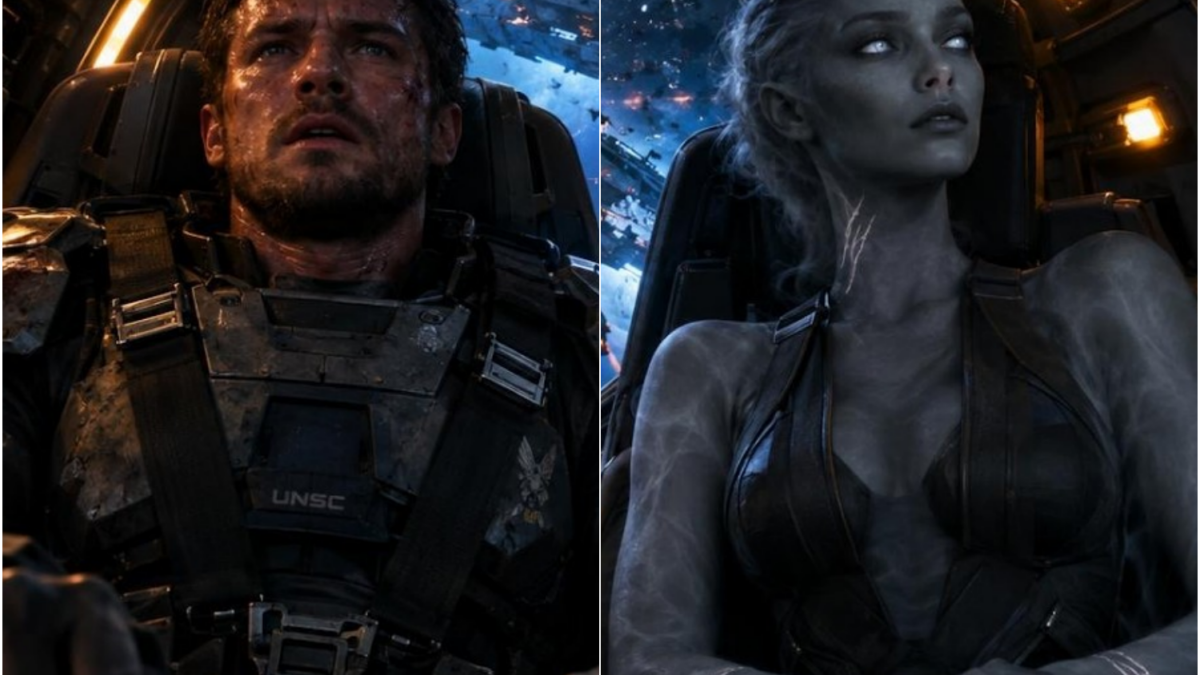
The alarm inside my helmet had been screaming for almost two minutes when I heard the breathing.
Six minutes. That was all the ship had left before its failing core would tear through the decks and turn the Van Tyrus into a cloud of burning fragments.
My unit had already withdrawn. The surrender had been confirmed. The corridors were supposed to be empty.
I was supposed to be running. Instead, I was standing in front of a door that had no business being locked.
The metal around it was warped from the battle, the lights above me flickering between red and black.
Somewhere beneath my boots, the entire warship groaned as if the structure itself were struggling to remain together.
My helmet display kept flashing the same warning. Six minutes. Then I heard it again.
Breathing. Slow. Steady. Alive. I placed my scanner against the unfamiliar lock. It responded with a sharp hiss, and the door opened barely wide enough for me to squeeze through.
The room beyond was cold and almost completely dark. At first, I saw only chains.
Then silver eyes opened in the darkness. A woman sat against a metal frame bolted into the floor, her gray skin catching the weak emergency light.
Bands surrounded her wrists and throat, their surfaces strangely smooth, as though they had grown there rather than been fastened.
She looked directly at me. There was no panic in her expression. Only certainty. “You are not one of them.”
“No,” I answered. The ship shook hard enough to throw dust from the ceiling. I looked at the countdown.
Five minutes and forty seconds. “Then we need to move.” What I did not know was that opening that door would change far more than one life.
It would uncover an agreement older than my fleet, a tradition built around chains and inheritance, and a choice that would eventually force two civilizations to reconsider what freedom actually meant.
But before any of that happened, I had to get the woman in front of me off a collapsing warship.
And I had less than six minutes to do it. My name is Elliot Hale, and until that moment, I had believed the hardest decision of my military career had already been made for me.
I was wrong. The woman watched me draw my cutting tool. “My name is Vessa,” she said.
I pressed the tool against the first band around her wriSt. “What are you doing here?”
“Surviving.” The cutter sparked. “That makes two of us.” The band resisted for several seconds before splitting apart with a sharp metallic snap.
Vessa looked down at her newly freed wrist, turning it slowly as if she had forgotten what an unrestrained hand felt like.
Then she looked back at me. “I have been here longer than you have been alive.”
I moved to the second band. “We can talk about that later.” “You should understand what you are doing.”
“I understand that this ship is coming apart.” “That is not what I mean.” The cutter bit into the second restraint.
“Then tell me quickly.” Vessa watched the tool work. “If you free me, you will become part of something that began long before either of us was born.”
The second band broke. I moved to the restraint around her neck. “Sounds complicated.” “It is.”
“Then explain it after we get outside.” The final band released. For several seconds, Vessa did not move.
Then she tried to stand. Her legs gave way almost immediately. I caught her before she hit the floor.
She was lighter than I expected, but her body trembled with the strain of muscles that had spent far too long without freedom of movement.
I pulled her arm over my shoulder and looked toward the doorway. The countdown had dropped again.
Five minutes. “We run now.” Vessa nodded. I guided her into the corridor. The Van Tyrus no longer looked like the warship I had boarded earlier.
Emergency lights painted everything in shifting red. Smoke drifted through the passageways. Loose panels hung from the ceiling, and somewhere far below us, machinery screamed under the strain of the failing core.
I had entered the ship with a simple assignment. Confirm the surrender. Check the surviving systems.
Withdraw with my unit. Instead, I was carrying a stranger through a collapsing enemy vessel.
And somehow, that did not feel like the reckless part. The reckless part was the way Vessa looked at every corridor as though she remembered it.
“You know where we are?” “Yes.” “Escape pods?” “Three decks ahead.” “Good.” She took another step.
Her face tightened. I slowed. “I can carry you.” “No.” “You can barely stand.” “I have spent too long being carried by other people’s decisions.”
I looked at her. She met my eyes. “I will walk.” The ship shook again.
I released my grip slightly, allowing her to place more weight on herself. “Fine.” We moved.
Our boots struck the metal floor in uneven rhythm. Mine were steady from years of training.
Hers were uncertain, but each step became stronger. The first junction was blocked by fallen debris.
I checked the alternate route. “Left.” Vessa immediately shook her head. “Right.” “Why?” “Left leads toward the command section.”
“That is where we came from.” “And the command section is already losing pressure.” I looked at her.
“How do you know?” “I lived here.” There was something in the way she said it that made me stop asking questions.
We turned right. A narrow bridge connected two sections of the vessel. The bridge had begun to separate from its supports.
Sparks dropped from damaged wiring overhead. The floor tilted enough that loose equipment slid toward the far wall.
Vessa grabbed the railing. I held her arm. “Stay close.” “I am.” We moved one step at a time.
Halfway across, a deep metallic groan rolled through the structure. I looked ahead. The far section shifted.
“Move.” We hurried. Behind us, a support beam tore loose and crashed onto the bridge.
The impact sent a vibration through the floor. Vessa stumbled. I grabbed her. “You all right?”
“Yes.” “Keep moving.” We reached the opposite side. The corridor ahead was filled with smoke.
My helmet scanner struggled to read through it. “Pod bay should be another hundred meters.”
Vessa looked toward the smoke. “There is another route.” “Where?” “Maintenance passage.” “Show me.” She pointed toward a narrow service door.
I forced it open. The passage beyond was barely wide enough for two people. Pipes ran along the walls, and the emergency lighting had completely failed.
We moved through darkness. Vessa’s hand found my shoulder. For the first time, I realized she was no longer leaning on me because she lacked the strength to walk.
She was using me to navigate. That small difference mattered. She was beginning to move under her own power.
Then the ship lurched. We slammed against the wall. My helmet struck metal. For a second, my vision blurred.
Vessa caught my arm. “Elliot.” “I am fine.” “You are bleeding.” I touched the side of my helmet.
The display showed a minor damage warning. “Nothing serious.” “You say that very calmly.” “I have practice.”
She almost smiled. AlmoSt. Then the emergency lights came back on. The passage ended. Beyond the door was the escape pod bay.
I checked the timer. One minute. “Go.” We rushed inside. I opened the nearest pod and helped Vessa through the hatch.
She turned toward me. “You firSt.” “No.” “Elliot.” “Get inside.” She hesitated. Then she obeyed.
I climbed in behind her. The hatch sealed. The pod detached. A violent force pushed us into our seats as the launch system fired.
For several seconds, there was nothing except vibration and the sound of our breathing. Then the pod cleared the Van Tyrus.
I looked through the small window. The warship drifted against the darkness. Sections of its outer hull separated and disappeared into space.
Light flashed across the broken vessel before fading into the distance. I lowered my head.
My hands were shaking. Vessa noticed. “You are afraid.” “Not exactly.” “Then what is it?”
I looked at her. “I do not know yet.” She folded her hands in her lap.
The faint marks left by the restraints were visible around her wrists and neck. “You saved me.”
“I opened a door.” “You knew I was there.” “I heard you breathing.” “That is enough.”
I leaned back against the seat. “My unit is going to have questions.” “They should.”
“Your people will have questions too.” “Yes.” I studied her. “What exactly have I stepped into?”
Vessa looked toward the window. “The answer is not simple.” “We have time.” She gave me a quiet look.
“No. We have very little time.” I glanced at the navigation display. The pod was approaching the recovery point.
“What happens when we land?” “That depends on what you decide.” “I have already decided to get you somewhere safe.”
“That is not the decision I mean.” I waited. Vessa took a slow breath. “My people have an old institution called the war bride agreement.”
I frowned. “I have heard of diplomatic marriage arrangements.” “This is different.” “How?” “It was created after a conflict between powerful families many generations ago.
The agreement was supposed to prevent another conflict by binding one family to another.” “And you were part of it?”
“I was given the title.” The words were quiet. “But I never chose it.” I looked at the marks around her wrists.
“The bands.” “Yes.” “What did they mean?” “Ownership.” The word sat between us. “They passed the right of command from one generation to the next.
Whoever held the chain held authority over the person wearing it.” “That cannot be legal.”
“Not under your laws.” “And under yours?” “Under the old agreement, tradition matters more than individual choice.”
I stared at her. “So someone could simply claim you?” “Yes.” “What about now?” “The bands are gone.”
“That means you are free.” Vessa shook her head. “Does it?” I said nothing. She continued.
“The records still exiSt. The agreement still exists. The families who enforce it still exiSt. You removed the physical proof, Elliot, but you did not erase the rule.”
I felt something tighten in my cheSt. “What happens if they find you?” “They will attempt to restore the agreement.”
“Then we keep you hidden.” “That will not be enough.” “Why?” “Because the agreement contains a provision your people never discovered.”
I waited. “If the person who frees a war bride formally binds her under their own tradition, with witnesses from both sides, the original agreement is permanently broken.”
I understood the meaning before she finished. “You mean marriage.” “Yes.” The pod seemed suddenly much smaller.
I stared at the floor. “You are asking me to marry you.” “I am explaining what the law requires.”
“That is not the same thing.” “No.” She looked directly at me. “I would never ask you to make such a choice because I was afraid.”
“Then why tell me?” “Because you deserve the truth before anyone else tells you what your decision should be.”
I looked through the window. Stars moved silently beyond the glass. Only twenty minutes had passed since I entered the Van Tyrus.
Twenty minutes. Yet the person who had boarded that ship felt distant. I had expected a military report.
A routine recovery. A return to base. Instead, I had found Vessa. And now she was telling me that the freedom I had given her might disappear unless I made a choice that would change both of our lives.
“Why me?” I asked. Vessa’s expression softened. “Because you did not ask what I could offer.”
I looked back at her. “You did not ask who my family was. You did not ask what position I held.
You did not ask whether freeing me would benefit you.” She paused. “You heard someone breathing behind a locked door and opened it.”
“That does not make me special.” “It makes you different from the people I knew.”
I looked down at my hands. “I do not know anything about your culture.” “Neither did I know yours.”
“You could regret this.” “Yes.” “You could regret trusting me.” “Yes.” “And I could make the wrong choice.”
“Yes.” She smiled faintly. “That is why it has to be a choice.” The pod chimed.
Recovery approach. My unit was waiting. I could already imagine the questions. Why had I gone back?
Why had I ignored the extraction window? Who was the woman? Why was she wearing no identification?
Why did her biological readings match no known human profile? I looked at Vessa. She seemed strangely calm.
“You are not nervous.” “I am.” “You hide it well.” “I have had practice.” The pod descended toward the recovery platform.
Bright lights filled the window. I watched soldiers gather below. Then I looked at Vessa.
“If I agree, there will be conditions.” She nodded. “Name them.” “You will never be treated as property.”
“I agree.” “You make your own decisions.” “Yes.” “You can leave whenever you want.” She looked at me for several seconds.
“Yes.” “And this cannot be a performance that ends once the old agreement is broken.”
Her eyes became brighter. “I would not want that.” The pod touched down. The hatch opened.
Cold air rushed inside. For a moment, neither of us moved. Then I stood. I offered Vessa my hand.
She looked at it. Not because she did not understand. Because she understood exactly what it meant.
She placed her hand in mine. We stepped outside together. The soldiers around the landing platform fell silent.
My commander approached. “Elliot.” “Sir.” His eyes moved to Vessa. “Who is she?” I looked at her.
Vessa stood beside me without chains, without restraints, without anyone holding a claim over her.
“My responsibility.” The commander frowned. “What does that mean?” “It means she is under my protection.”
Vessa spoke before he could continue. “And it means I speak for myself.” The commander looked surprised.
So did several of the soldiers nearby. I almost smiled. She had spent years with people speaking over her.
She was not going to let that happen again. The next hours were filled with reports.
Questions. Medical examinations. Identity checks. Security reviews. None of them mattered as much as the conversation that followed.
Representatives from Vessa’s people arrived. They came expecting to reclaim an old agreement. Instead, they found her standing beside me.
The first representative spoke formally. “She belongs to the House of Serrin under the ancient compact.”
Vessa stepped forward. “No.” The representative stopped. “I am Vessa.” Her voice did not shake.
“I was assigned that title without my consent.” The representative turned toward me. “You removed the binding.”
“I did.” “Then you have violated the compact.” Vessa answered before I could. “No. He has fulfilled the part of the compact you hoped everyone would forget.”
Silence filled the room. The representative’s expression changed. “You know the clause.” “I know all of it.”
She looked at me. “The old agreement says that a war bride freed by an outsider may choose a new bond.
The new bond must be entered freely and witnessed by both civilizations.” I looked at the representatives.
“And if she chooses me?” “The old claim ends.” “Completely?” “Completely.” Vessa turned toward me.
The room disappeared for a moment. There were no officers. No representatives. No old families.
Only two people standing across from each other. I thought about the door on the Van Tyrus.
The breathing behind it. The silver eyes in the darkness. The first chain breaking. Then the second.
Then the third. I had believed I was simply helping someone escape. But perhaps freedom was never about opening one door.
Perhaps it was about making sure nobody could close another one. I reached for Vessa’s hand.
She took mine. “I agree.” The representative looked at her. “And you?” Vessa’s silver eyes remained on me.
“I choose.” Those two words changed everything. The ceremony was not extravagant. There were no grand halls.
No royal procession. No celebration designed to impress the galaxy. There were witnesses from the human fleet.
There were representatives from Vessa’s people. There were records. There were signatures. And there were two people who understood that the meaning of the ceremony was not the words spoken aloud.
It was the fact that either person could have walked away. Vessa could have refused.
So could I. Neither of us did. When the final record was sealed, something strange happened.
Nothing. No explosion. No dramatic announcement. No sudden transformation. The universe simply continued moving. Ships traveled through distant systems.
Stars burned. Signals crossed empty space. Somewhere, the old agreement was removed from active authority.
For Vessa, however, everything had changed. She was no longer a title. She was no longer a claim.
She was Vessa. Months passed. I expected our lives to become easier. They did not.
Freedom was not a straight road. Vessa had to learn how to make choices after spending years being denied them.
Sometimes the smallest decisions were the hardeSt. What food did she want? Where did she want to live?
Which clothes did she prefer? Which people did she trust? At first, she would look at me before answering.
I would wait. “What do you want?” She would think. “I do not know.” “That is all right.”
And slowly, she began to learn. She chose a small apartment near the fleet’s outer station.
She chose silver fabric for the curtains. She chose music that sounded strange to human ears.
She chose to learn how to pilot. That last choice surprised me. “You want to fly?”
“Yes.” “Why?” “Because you told me a ship can take you somewhere you have never been.”
“That was not exactly what I said.” “It is what I heard.” So I taught her.
At first, she struggled. Human controls were different from the systems she knew. She made mistakes.
She became frustrated. Then she started understanding. Within months, she could bring a training craft through a difficult approach better than some experienced pilots.
The first time she landed without assistance, she climbed from the cockpit with a smile.
“I did it.” “You did.” She looked toward me. “You sound surprised.” “I am.” She laughed.
It was the first time I had heard her laugh. I realized then that the woman I had found inside that room had never truly been given the opportunity to become herself.
Now she was. Not because I had saved her. Because she had chosen to save herself after someone finally opened the door.
Years later, people would tell the story differently. Some would say Elliot Hale rescued Vessa from the Van Tyrus.
Some would say the marriage between a human soldier and a woman from an old enemy culture changed diplomatic history.
Some would describe the ancient agreement as a relic that should have disappeared generations earlier.
Others would argue that traditions survive because people allow them to survive. But Vessa always corrected them.
She would say, “He opened the door.” Then she would smile. “But I walked through it.”
Whenever I heard her say that, I remembered the corridor. The flashing lights. The countdown.
The sound of metal breaking apart. And the breathing behind the locked door. Sometimes I wondered what would have happened if I had followed my orders exactly.
I would have reached the extraction point. The Van Tyrus would have been left behind.
The report would have been completed. The mission would have ended. And Vessa would have remained where I found her.
A person reduced to a name in an agreement she had never chosen. That thought stayed with me.
Not because I believed I had changed the galaxy. I had not. I had simply opened one door.
Vessa was the one who walked through it. Years after the Van Tyrus incident, we returned to the recovery platform where the pod had landed.
It was quiet that evening. The same kind of lights still lined the platform. The stars looked almost exactly as they had that night.
Vessa stood beside me. She looked toward the sky. “Do you remember?” “I remember every second.”
“You were afraid.” “So were you.” “I was not.” I looked at her. She smiled.
“All right. I was terrified.” “You hid it well.” “I had practice.” I laughed. She slipped her hand into mine.
The same hand that had once been wrapped in a restraint. Now it was free.
Not because someone had granted permission. Because she had claimed the right to choose what happened next.
“Do you ever regret opening that door?” She asked. I thought about the question. “No.”
She looked at me. “Not even once?” “Not even once.” She turned toward the stars.
“Neither do I.” We stood there for a while without speaking. There were still conflicts in the galaxy.
There were still old agreements that needed to be challenged. There were still people living under rules created by those who came before them.
But somewhere between the moment I heard her breathing and the moment she walked beside me into the light, I had learned something I had never been taught in military training.
Freedom was not something another person could give you. Someone could open a door. Someone could cut a chain.
Someone could stand beside you when the whole world insisted that an old rule mattered more than your voice.
But eventually, you had to decide whether you would step forward. Vessa had stepped forward.
And she never stopped. The woman from the locked room became a pilot. Then an adviser.
Then a representative for people who had spent generations believing old traditions could never change.
She spoke to human officers. She spoke to her own people. She stood before councils that once would never have allowed her into the room.
And every time someone tried to describe her as someone who had been rescued, she corrected them.
“I was not rescued,” she would say. “I was given a chance to choose.” Then she would look at me.
“And I chose.” That was the part people remembered. Not the battle. Not the failing ship.
Not the escape pod. Not even the ancient agreement. They remembered a woman standing before two civilizations and saying that her future belonged to her.
I remembered something simpler. A locked door. A countdown. A voice in the darkness. “You are not one of them.”
“No,” I had said. And for the first time in her life, neither was she.
She was Vessa. Nothing more needed to be added. Nothing needed to be taken away.
Just Vessa. Free to decide where she would go next. And I was Elliot Hale, the soldier who had once been given six minutes to leave a collapsing ship.
I had thought those six minutes were counting down toward an ending. I had been wrong.
They were counting down toward the moment one locked door opened. And sometimes, that is all it takes to change the direction of two lives.
Disclaimer: This content may be created by Al for entertainment purposes. Any resemblance to real persons, events, or places is coincidental.








