I Saved a Wounded Alien Woman — Now She Refuses to Leave My Side
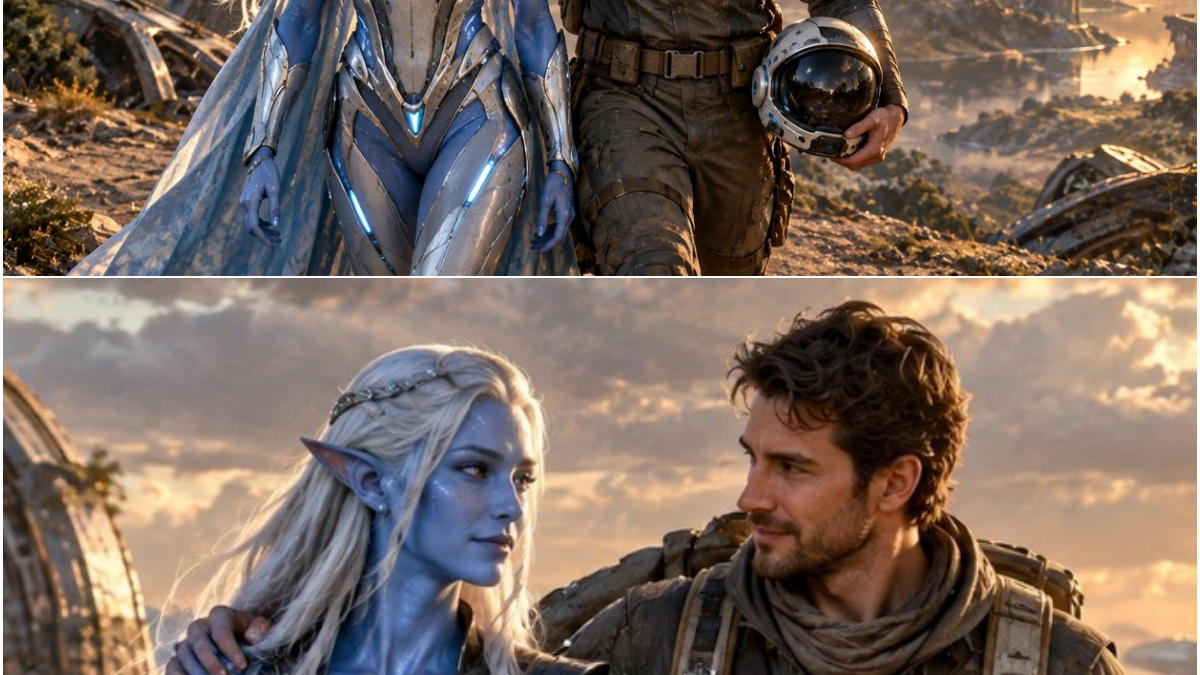
The alarms began screaming before I understood what had appeared on my scanners. Red warning lights flooded my cockpit, and the proximity system flashed so rapidly that the display became a blur.
I pulled the controls hard to the left as a twisted section of metal spun past my viewport.
Its edges glowed from the heat, and I could see individual rivets before it vanished into the darkness.
I was three days into a supply run beyond the Kesh Line, carrying medical crates through a stretch of space most pilots avoided.
Then my scanners detected a distress beacon buried inside a debris field. The signal was weak, uneven, and barely holding together.
The wreckage around it had once belonged to a warship, but now it was little more than broken hull plates and drifting machinery.
Out there, a distress call could be a trap. Pirates used them to attract passing ships, and desperate survivors sometimes had nothing left to offer except another problem.
My hand hovered over the controls as I considered turning away. Then the signal pulsed again.
It did not sound like an ordinary automated transmission. Its rhythm was irregular, almost like a frightened heartbeat.
I knew I should keep moving, but I could not convince myself to leave without checking.
I turned my ship toward the wreck and began threading through the debris. Somewhere inside that ruined vessel, someone was still waiting.
I had no idea who they were, what had happened, or why their beacon had survived when so much else had not.
But when my scanner finally detected a living presence inside a crushed escape pod, I realized that whatever waited beyond that hatch could change the course of my journey.
I had spent most of my adult life flying routes that other pilots considered inconvenient, unprofitable, or simply too dangerous.
My ship was an aging cargo hauler with a patched engine casing, an unreliable identification system, and a medical bay that had been assembled from equipment salvaged across half a dozen stations.
It was not elegant, but it could carry a respectable load and keep moving when newer vessels needed repairs.
I worked alone. That was partly a matter of preference and partly a matter of economics.
A second crew member meant another share of the earnings, another set of supplies, and another person whose safety I would have to consider whenever the route became difficult.
I had learned to trust my own hands and to keep my expectations modest. The Kesh Line marked the edge of a region where commercial traffic became scarce.
Beyond it lay scattered settlements, abandoned mining operations, and the remnants of a conflict that had left entire systems struggling to recover.
The route was not officially closed, but most shipping companies charged extra for deliveries there.
Some refused to send vessels at all. I had accepted the medical cargo because the receiving settlement had been waiting for it longer than anyone should have to wait for basic supplies.
The crates contained stabilizing fluids, diagnostic equipment, sterile instruments, and replacement components for a clinic whose old systems were failing.
The payment was modeSt. The risk was not. Still, I had never been comfortable with the idea that someone’s access to medical care should depend entirely on whether a route looked attractive on a company’s financial report.
That was why I turned toward the distress beacon. The debris field was larger than it had appeared from a distance.
Sections of the destroyed warship drifted in loose clusters, turning slowly against the stars. Some pieces were no larger than cargo containers.
Others were entire sections of reinforced hull, their interior structures exposed like the ribs of some enormous mechanical creature.
My proximity sensors kept complaining. I reduced speed and moved carefully between the largest fragments, watching the scanner for the beacon’s location.
A narrow ribbon of vapor escaped from a ruptured compartment and froze into glittering particles.
Farther ahead, a communications mast rotated slowly, its broken antenna catching the light from a distant star.
I saw no signs of active weapons or functioning engines. The beacon grew stronger as I approached.
Then the scanner identified the escape pod. It was wedged against a broken bulkhead, its outer shell crushed along one side.
The pod’s emergency lights flickered through a narrow observation window. Its power reserves were nearly exhausted, and the beacon was transmitting on a frequency that had probably been designed to survive conditions far worse than the pod itself.
I brought my ship alongside it and extended the docking clamp. The maneuver was awkward.
The pod had been pushed into an unstable position, and the broken bulkhead kept shifting whenever the debris field moved.
I had to make several adjustments before the clamp finally secured itself around the pod’s frame.
I sealed my cockpit, checked my suit, and entered the connecting passage. The pod’s emergency hatch would not open.
Its control panel had been damaged, and the manual release was jammed beneath a bent section of metal.
I retrieved my cutting torch and began working through the obstruction. The metal glowed orange, then white along the narrow line where the torch passed.
I moved slowly, careful not to damage the pod’s interior. When the final section separated, the hatch shifted outward with a harsh metallic sound.
The first thing I noticed was the cold. The second was the woman. She was slumped against the inner wall, her silver hair floating around her face.
Her helmet visor was cracked, and the suit’s emergency display showed that her remaining air supply was dangerously low.
A shard of metal had lodged in the protective layers along her side, and her breathing was shallow.
She was still conscious, though only barely. Her eyes moved toward me as I reached inside.
“Can you hear me?” I asked. She made a small movement that might have been a nod.
“Do not try to stand. I am getting you out.” I supported her neck and shoulders, then carefully freed her from the damaged restraints.
She was lighter than I expected, but the awkward position made it difficult to move her without putting pressure on her injured side.
I worked as quickly as I could. Once I had her inside the passage, I secured the hatch behind us and carried her into my ship.
The airlock cycled, the inner door opened, and the ship’s warmer atmosphere surrounded us. I took her directly to the medical bay.
My equipment was old, but I knew how to use it. I checked her breathing, monitored her oxygen levels, and stabilized the damaged suit before removing it.
The shard had caused a serious injury, but the protective layers had limited the damage.
I treated the wound, administered fluids, and connected her to the monitoring system. The work took longer than I wanted.
When I finally stepped back, the medical display showed that her condition had stabilized. Her breathing remained uneven, but the numbers were moving in the right direction.
I sat beside the bed and watched the monitor. Outside, the wreckage drifted farther behind us as the ship’s navigation system slowly brought us back onto our original route.
I had lost hours, used supplies I could not easily replace, and taken a risk that might have cost me the entire delivery.
I did not regret it. The woman did not wake that day. She remained unconscious through the next cycle, and I checked on her every few hours.
I adjusted the medical equipment, replaced the fluids, and made sure her temperature stayed within a safe range.
Whenever I left the bay, I kept the door open enough to hear the monitor.
I had rescued injured travelers before. Most woke confused, frightened, and full of questions. Some demanded to know where they were.
Others wanted to contact family or report their situation to the nearest authority. This woman did none of those things.
For two full days, she remained still. When her eyes finally opened, I was sitting at the small table beside her bed, repairing a loose connector from the diagnostic console.
I heard the slight shift of the mattress and looked up. She was watching me.
Her expression was calm, but the attention behind it was unmistakable. She seemed to be studying the room, the medical equipment, and me in the same instant.
“You should not have done that,” she said. Her voice was steady and clear, each word carefully chosen.
I set the connector aside. “Most people start with asking where they are.” “I know where I am.”
“Then you are ahead of schedule.” She did not smile. I explained that she was aboard my cargo ship and that I had found her inside an escape pod in the wreckage of a warship.
I told her that her medical condition had been serious and that she had been unconscious for two days.
She listened without interrupting. When I finished, she looked at the ceiling for a moment.
“Why did you stop?” “Your beacon was active.” “That is not an answer.” “It was enough of one for me.”
She turned her head toward me. “Do you understand where you are traveling?” “Beyond the Kesh Line.
I have a supply delivery waiting.” “And you stopped for an unidentified distress signal?” “I did.”
“Why?” I considered the question. “Where I come from, we do not leave people in wreckage if we can help them.”
She studied me with a look that made me feel as though I had been asked to defend an entire civilization.
“If that is a problem for you,” I added, “the airlock works both ways. But I recommend waiting until you can stand without assistance.”
A short laugh escaped her before she could stop it. It sounded unfamiliar, almost surprising to her.
Then she became serious again. “My name is Iara.” “Just Iara?” “For now.” I nodded.
“Then I am glad you are still here, Iara.” She looked away. I did not ask about her home world, her uniform, or the warship.
I had noticed the small black sunburst stitched over her heart, but it was not my place to demand an explanation while she was still recovering.
Instead, I brought her water and a portion of plain nutritional broth. She accepted both.
Over the next two days, her strength returned gradually. She could sit up for short periods and eventually walk a few steps with support.
I kept her in the medical bay until the monitoring system showed that she could move without putting too much strain on her injury.
She was not an easy passenger to ignore. Iara had a sharp mind and a habit of asking questions that revealed how much she noticed.
She wanted to know the age of my ship, the limits of its engines, the condition of its shields, and how I had managed to keep the navigation system functioning despite its damaged processor.
She asked about my species, too. I answered what I could, although some of her questions seemed to be designed to measure my reactions rather than gather information.
In return, I asked about her. She answered perhaps a third of my questions. Whenever she repeated something that sounded rehearsed, her voice dropped slightly and became more formal.
I began to recognize the difference between her prepared explanations and her actual thoughts. She ate the rations I offered without complaint.
She studied my star charts with quiet curiosity and seemed particularly interested in the routes used by independent cargo pilots.
At times, she moved through the ship as if she were accustomed to commanding a much larger crew.
She would pause at a panel, notice a problem, and almost issue an instruction before catching herself.
Once, when I was repairing a ventilation unit, she stood behind me and watched for several minutes.
“You are losing efficiency through that connection,” she said. “I know.” “Then why have you not replaced it?”
“Because I do not have the replacement.” She looked at the unit again. “Could you redirect the flow through the secondary channel?”
I glanced at her. “Possibly.” She described a way to balance the pressure and reduce the strain on the damaged component.
I tested her suggestion, and the ventilation system immediately began running more smoothly. “Where did you learn that?”
I asked. “Experience.” “That is a broad answer.” “It is an accurate one.” I laughed, and she gave me a brief, almost reluctant smile.
By the fourth day, we were approaching the nearest neutral station. I expected to deliver the medical crates, refuel, and arrange passage for Iara if she wanted to leave.
I had already decided that I would not ask her to explain herself before helping her reach somewhere safe.
Then my identification system finished processing the footage I had recovered from the wreckage. The alert appeared while I was checking the cargo manifeSt.
A name filled the screen. Empress Ilara. Sovereign ruler of the Ashfall Reach. The warning beneath it was marked extinction class.
I read the identification twice, then opened the attached file. The system displayed a long record of military campaigns, territorial disputes, and major conflicts.
It included casualty estimates, population comparisons, and a collection of titles used by different governments and rival factions.
The file described Ilara as a ruler whose decisions had reshaped entire systems. It also identified the black sunburst on her uniform as the symbol of the imperial household.
I stared at the screen for a long time. Then I looked toward the rear cabin, where Iara was resting.
The woman I had pulled from the escape pod was an empress. Not a minor official or a ceremonial figure.
She was the sovereign ruler of a territory that had appeared in enough military reports to fill my entire data archive.
I leaned back in my chair. For a moment, I considered turning the ship around.
I imagined the trouble that could follow if someone discovered I was carrying her. I thought about the medical delivery, the neutral station, and the people who might be waiting for supplies that I could no longer guarantee would arrive.
I did not seriously plan to abandon her. But the thought crossed my mind, and I knew I needed to speak with her before it became a problem between us.
I walked to the rear cabin and found her resting with her eyes closed. When I sat down across from her, her eyes opened almost immediately.
She had not been sleeping deeply. “Empress,” I said. “That is a fairly important detail to leave out of an introduction.”
She became completely still. She did not deny it. She did not attempt to assume some grand commanding posture.
Instead, her gaze moved briefly toward the cabin entrance, then returned to me. “I assumed you would either know who I was and leave me in the wreckage,” she said, “or you would not know and would eventually discover it.”
“You could have told me.” “And what would you have done?” “I do not know.”
“That is why I did not tell you.” I considered that. “Were you planning to remain Iara for the entire journey?”
“I was planning to remain alive long enough to decide what to do next.” Her answer was direct enough that I could not argue with it.
I leaned forward. “Your file is impressive.” “Is that what it says?” “It says you have commanded campaigns across several systems.
It says your decisions changed the populations of entire worlds. It says you are considered an extinction class threat.”
She looked toward the floor. “Those are the words people use when they want a person to become a symbol rather than an individual.”
“Are they wrong?” “Some are exaggerated. Some are incomplete. Some are accurate descriptions of things I would rather not have needed to do.”
I studied her face. “Why did you not tell me?” “Because I did not know whether you would see me or the title.”
“And now?” “Now I know you have read the file.” She was watching me carefully, waiting for my decision.
I took a breath. “I do not actually know what you have done. I know what a report says you have done.
Those are two different things.” She did not move. “I was not there for any of those battles,” I continued.
“I did not see the decisions you made or the circumstances you faced. The only part of your story I witnessed myself was pulling an injured woman out of a damaged escape pod.
Everything else comes from someone else’s account of a conflict I was never part of.”
For several seconds, she said nothing. Then her expression changed. It was subtle, but the guarded control seemed to loosen.
Something vulnerable appeared behind her eyes, something she had been careful to keep hidden since the moment she woke.
“I have an entire territory of people who follow me because they fear what might happen if they refuse,” she said quietly.
“Advisers who tell me what they think I want to hear. Enemies who judge me by my position before they consider my actions.
For a very long time, almost everyone around me has had a reason to present a particular version of the truth.”
She looked at me. “It has been a long time since anyone decided to see for themselves.”
“I have a bad habit of doing that,” I said. “Making up my own mind instead of trusting a file somebody else wrote.”
This time, she smiled. It was not the controlled expression I had seen before. It looked genuine, and it changed her face more than I expected.
We had four more days of travel before reaching neutral territory. During those days, Iara began telling me her story.
Not the official version. Not the carefully arranged account in the identification file. She told me about her childhood, the expectations placed on her family, and the political struggles that had shaped the Ashfall Reach long before she took the throne.
She described a conflict that had passed from one generation to another. Agreements had been made and broken.
Borders had shifted. Systems that once traded freely had become divided by suspicion and old grievances.
By the time Ilara inherited the throne, many of those conflicts had already become part of daily life.
She had not been given a peaceful territory and then chosen to transform it through ambition.
She had inherited a complicated situation in which nearly every decision carried consequences for people who had little control over the larger struggle.
That did not make her choices simple. She admitted that some decisions had caused terrible hardship.
She spoke of campaigns she had approved, agreements she had refused, and moments when she had believed there was no option that would protect everyone.
She did not try to make herself sound innocent. “I made decisions,” she told me one evening, as we watched the navigation display.
“Some were necessary. Some were made with incomplete information. Some were mistakes. I cannot undo them by explaining what I intended.”
“Do you think people understand that?” “Some do. Others have built their entire identity around believing I am the source of every problem they have faced.”
“Which is easier?” “Blaming one person is easier than understanding a complicated history.” I thought about the file on my screen.
It had reduced years of political conflict to a series of labels and figures. It gave me no sense of what Ilara had known at the time of each decision, what choices had been available, or what other people had done.
I did not decide that every action she described was justified. I simply understood that a warning label could not explain an entire life.
As the days passed, Iara grew stronger. She could walk through the ship without assistance and began helping me monitor the systems.
Her knowledge of military equipment was extensive, but she also understood logistics, navigation, and the practical problems of maintaining a vessel far from a major repair station.
She helped me identify a fault in the auxiliary power regulator that had been draining energy for months.
She also showed me a more efficient way to arrange the cargo bay’s power distribution.
In return, I taught her the peculiar habits of my ship. The navigation system occasionally delayed a course correction by half a second.
The left cargo hatch required a manual override. The galley heater worked only if someone tapped the panel twice before activating it.
She seemed amused by the ship’s imperfections. “You have built an entire routine around its failures,” she observed.
“I prefer to think of it as knowing my equipment.” “You have made peace with a machine that regularly disobeys you.”
“It has character.” “It has problems.” “Those can be the same thing.” She laughed again.
For the first time since finding her, I began to feel that we were traveling together rather than merely sharing a ship.
The distance between us had not disappeared, but our conversations no longer felt like negotiations.
Then, on the fifth day, the proximity alarms sounded again. I was in the cockpit when three ships dropped out of hidden space behind us.
Their engines flared as they accelerated, and the scanner identified them as hunter-class vessels. Their hull markings carried the same black sunburst that had appeared on Iara’s uniform.
My stomach tightened. Iara appeared in the cockpit entrance. “They found me,” she said. I glanced at the scanner.
“Who are they?” “Soldiers loyal to my brother.” “Your brother?” “He has wanted the throne for years.
He arranged the attack on my ship, and he will not allow me to return if he can prevent it.”
I had no time to ask what had happened between them. The first shot passed close enough to shake the ship.
Alarms blared, and red warning lights filled the cockpit. I pushed the throttle forward, trying to increase the distance between us and the pursuing vessels.
My engines protested, their output climbing beyond the level I normally allowed. A second shot struck the rear shields.
The whole ship shuddered. A panel near my feet sparked, and the navigation display flickered.
Iara moved into the auxiliary seat. “Reroute power to the rear shields,” she ordered. “Their weapons are calibrated for standard hull plating.
If you redistribute the energy, we can absorb the next two hits.” I followed her instructions.
The power allocation changed, and the rear shields brightened on the display. Another shot struck us, but the energy dispersed across the reinforced field instead of reaching the hull.
The ship still shook, but we remained intact. “We cannot outrun three hunter ships in open space,” I said.
“Not in this vessel.” “Do you have another suggestion?” She studied the scanner, then pointed toward a dense asteroid field ahead.
“There.” I looked at the display. The field was a tangled region of drifting stone, with larger asteroids scattered among countless smaller fragments.
It was the kind of place cargo pilots avoided unless they had no other choice.
“Their ships are built for speed and firepower,” she said. “They are not designed to maneuver through a field this dense.
If we enter it, they will have to slow down or risk damaging their own vessels.”
“And if we hit something?” “We will have to avoid it.” “That is your entire plan?”
“It is the plan we have.” I gave her a quick look. “You make it sound very simple.”
“It is not simple. It is possible.” I turned the ship toward the asteroid field and pushed the throttle forward.
The first large rock passed beneath us. I rolled the ship to the right, narrowly avoiding a second that crossed our path.
Smaller fragments flashed past the viewport, striking the shields with sharp bursts of light. The hunter ships followed.
Their formation broke apart as they entered the field. One slowed immediately, adjusting its course around a massive asteroid.
Another tried to maintain speed and had to make a sudden turn to avoid a cluster of smaller rocks.
Iara watched their movements. “Keep to the left,” she said. “There is a narrow passage ahead.”
I followed the route she indicated. A huge asteroid rotated across the viewport, its surface marked by deep ridges and old impact scars.
I pulled the controls hard, guiding the ship through the gap between it and a smaller rock.
The hull trembled as the engines strained. Behind us, one of the hunter ships fired.
The shot missed our ship and struck the larger asteroid ahead. The explosion sent fragments spinning outward, turning the passage into a storm of debris.
“Down!” Iara shouted. I dropped the nose of the ship and rolled beneath the spreading fragments.
A large piece of rock passed above the viewport, close enough to fill the entire upper display.
Smaller fragments struck the shields in rapid succession. The power indicator dropped. “Rear shields are weakening,” I said.
“Shift some energy from the forward array. They are no longer directly behind us.” I made the adjustment.
Iara continued calling out changes in the debris field, identifying safe openings before my sensors could fully map them.
She moved across the auxiliary controls with practiced precision, adjusting our shield distribution and monitoring the pursuing ships.
It was obvious that she had commanded far larger vessels than mine. But she never treated my ship as insignificant.
She worked with what we had, adapting her knowledge to the equipment in front of her rather than demanding that the equipment become something it was not.
We moved deeper into the field. The hunter ships fell behind, forced to slow and separate.
Their signals remained on the scanner, but the distance between us increased with every maneuver.
One attempted to follow our path through a narrow opening. It misjudged the angle and had to pull away sharply, losing speed as it avoided a collision with a tumbling rock.
Another tried a wider route. Iara watched its signal. “They are breaking formation.” “Is that good?”
“It means they cannot coordinate their pursuit as effectively.” “Can they still reach us?” “Yes.”
I tightened my grip on the controls. “Then I would prefer they did not.” She gave me a brief glance.
“Agreed.” We continued through the asteroid field, following a twisting path that kept the largest rocks between us and our pursuers.
My ship groaned whenever I changed direction too quickly. Several warning lights remained active, and the shield indicator was lower than I liked.
But the hunter ships were falling farther behind. Eventually, their signals began disappearing from the scanner.
One vanished behind a large asteroid. Another moved away from our route, apparently searching for a different passage.
The third remained visible for several more minutes before its signal weakened and finally faded.
I did not slow down. I kept flying for another twenty minutes, steering through the last clusters of debris before we emerged into open space.
Only then did I ease back on the throttle. The cockpit fell quiet. I could hear the hum of the engines, the faint vibration of the damaged ventilation system, and the sound of my own breathing as my body gradually stopped expecting another impact.
My hands were trembling. Iara leaned back in her seat and closed her eyes for a moment.
“Thank you,” she said. I looked at her. “For what?” “Not for pulling me from the wreckage this time.
For staying after you learned who I was.” I turned toward the viewport. “I made a choice when I found your beacon.
I do not usually change my mind just because the situation becomes complicated.” She studied me.
“My brother believes fear is the only currency worth having,” she said. “He believes loyalty built on anything else is weakness.”
“And you?” “I used to believe that strength meant making certain nobody could challenge me.
I thought control was the same as security.” “What changed?” She looked down at her hands.
“I began to understand that people can obey without trusting. They can follow orders while waiting for the first chance to escape.
They can tell a ruler whatever will keep them safe, even when the truth would be more useful.”
She paused. “Then a stranger pulled me out of a damaged pod and expected nothing in return.”
“Where I come from, we call that decency.” “Your people seem to have a different understanding of power.”
“Maybe we have simply learned that fear gets expensive.” She looked at me thoughtfully. “What do you mean?”
“Fear makes everyone spend their time watching everyone else. People hide information. They make decisions to protect themselves instead of solving problems.
Eventually, nobody knows who can be trusted, and even simple things become difficult.” Iara considered that.
“My brother would call that weakness.” “Your brother sounds like a man who has never had to repair a failing engine with three mismatched tools and a very limited supply of patience.”
For a moment, she stared at me. Then she laughed, and this time the sound filled the cockpit.
It was the first time I had heard her laugh without restraint. The moment passed, but the warmth remained.
After a while, she asked what I intended to do next. I checked the navigation display.
The neutral station was still ahead, though our detour had cost us time and fuel.
My ship had sustained damage, and I would need to make repairs before taking another long route.
“I know people at the station,” I said. “They owe me a few favors, and they know how to keep quiet when a traveler needs privacy.”
“Can they protect me?” “They can give you time. I cannot promise more than that.”
She nodded. “And after that?” “That depends on what you decide.” She looked toward the stars.
“I may have to return to the Ashfall Reach.” “You may.” “My brother has control of the central command network.
If I remain away, he will use my absence to strengthen his position.” “Then you will need allies.”
“Yes.” “People who trust you?” “People who are willing to question me when they believe I am wrong.”
I smiled faintly. “That sounds more useful than people who agree with everything you say.”
“It is also more difficult to find.” “Most worthwhile things are.” She turned toward me.
“Would you help me?” I considered the question carefully. I was a cargo pilot, not a soldier or a political adviser.
I had no fleet, no influence in the Ashfall Reach, and no desire to become a symbol in someone else’s conflict.
But I had learned enough about Iara to know that she was not asking me to make decisions for her.
She was asking whether I would remain beside her while she made them herself. “I can help you reach the station,” I said.
“I can listen, ask questions, and tell you when I think you are overlooking something.
I cannot promise to solve your problems.” “I would not ask you to.” “And I will not pretend that everything in your file is false just because I have come to know you.”
“I would not want you to.” “Then I can help.” She was quiet for several seconds.
“Whatever comes next,” she said, “I would rather face it having made my own choices with someone who sees me clearly than through the judgment of people who have never looked me in the eye.”
I nodded. “That makes two of us.” She studied me with a thoughtful expression. “You have learned more about me in four days than that file could have taught you.”
“Not everything.” “No.” “But enough to know that I should keep asking questions.” A faint smile touched her face.
“Then I suppose I should keep answering them.” The ship continued toward the neutral station, its engines humming steadily beneath us.
The damaged systems would need attention, the medical cargo still had to be delivered, and three hunter ships might be waiting somewhere beyond our scanners.
Iara had a throne to consider, a brother who wanted her place, and a territory whose future had become uncertain.
I had a battered cargo hauler, a delayed delivery, and a passenger whose name could attract more trouble than I had ever wanted.
Yet the cockpit felt strangely peaceful. I thought about the first distress signal and the moment my hand had hovered over the controls.
I could still remember the weak, irregular pulse that had come through the scanner, so unlike the flat repetition of an ordinary automated beacon.
I had nearly ignored it. If I had continued on my route, I would have delivered my cargo, collected my payment, and returned to the quiet routine of independent flying.
I would never have known who had been trapped in that escape pod. I would never have heard her story, or learned how much of it had been hidden behind the warnings attached to her name.
And she might never have had the chance to decide what came next. I did not know whether helping her would change the Ashfall Reach.
I did not know whether she would reclaim her position or choose a different future.
I could not tell whether the people around her would welcome her return or whether her brother’s influence had already reached too far.
Those answers belonged to the days ahead. What I did know was that the decision to rescue her had been mine.
The decision to keep helping her was mine, too. Neither had been made because a report told me to do it, or because a title demanded my respect.
I had seen a person in need, and I had chosen to respond. That did not make me a hero.
It did not make me an expert in her history or give me the right to decide what was best for her.
It simply meant that I had been willing to listen before judging and willing to help before knowing what I might gain.
Iara sat beside me, watching the stars slide past the viewport. Her expression was thoughtful, but the tension in her shoulders had eased.
She no longer looked like someone waiting for the next person to demand something from her.
After a while, she leaned forward and studied the navigation display. “How long until we reach the station?”
“About six hours, assuming the engines behave.” “And if they do not?” “Then we will have a very interesting conversation with the maintenance crew.”
She smiled. “You speak of your ship as though it were a difficult companion.” “It is.”
“Perhaps it has been listening to us.” “If it has, I hope it understands that I have been very patient.”
The ship gave a faint metallic creak. Iara glanced toward the ceiling. “Was that an answer?”
“Probably a complaint.” She laughed softly. For a few minutes, we talked about ordinary things.
She asked what I planned to do after delivering the medical crates. I told her I would need to replace a damaged coupling, refill the fuel cells, and find a buyer for the spare components I had been carrying.
She listened as if these small concerns mattered as much as the larger problems waiting for her.
Then she asked whether I had ever wanted to stop flying alone. I thought about it.
“Sometimes. But it is difficult to trust someone with your life when you spend most of your time beyond the routes where help is easy to find.”
“Yet you trusted me with your ship during the attack.” “You knew what you were doing.”
“And you did not know whether I would use that knowledge to help you.” “I had to make a choice.”
She looked at me. “That is what you keep saying.” “Because it is true.” “And you believe people should be judged by the choices they make?”
“I believe choices tell us something important. But I also think we need to understand what someone knew, what they intended, and what options they actually had.
One decision does not explain an entire person.” Iara looked back toward the stars. “Perhaps that is the difference between judgment and understanding.”
“Perhaps.” The neutral station appeared on the edge of the display as a small cluster of lights.
It was not impressive, but it was independent, well supplied, and far enough from the Ashfall Reach to offer a measure of privacy.
I adjusted our course and began preparing the docking requeSt. For the first time since the wreckage, I felt that we might reach a place where we could pause long enough to think.
Iara rested her hands on the edge of the console. “Whatever happens at the station,” she said, “I want you to know that I will not forget what you did.”
“I would rather you remember what you decided to do afterward.” “What do you mean?”
“You chose to tell me your story. You chose to help during the pursuit. You chose to keep going when it would have been easier to give up.
Those were your decisions.” She considered that, then nodded. “I will remember them.” The station grew larger in the viewport.
Its docking lights formed a steady line against the darkness, and the traffic controller began transmitting approach instructions.
I answered, checked our speed, and guided the ship toward the assigned bay. Behind us lay the wreckage, the pursuit, and the first days of a journey neither of us had expected.
Ahead lay questions that could not be settled in a single conversation. But I no longer thought of Iara as a warning label or a problem I had accidentally brought aboard.
She was a person with a difficult history, a complicated present, and a future that still belonged to her.
And I was still the pilot who had turned toward a weak distress signal when every sensible instinct had told him to keep flying.
The stars stretched endlessly beyond the viewport as the engines carried us toward the station.
I had no guarantee that our next choices would be easy, or that the people waiting there would understand what had happened.
I only knew that I would rather make those choices with my eyes open, guided by what I had witnessed and what I was still willing to learn, than let someone else’s judgment decide everything for me in the dark.
Disclaimer: This content may be created by Al for entertainment purposes. Any resemblance to real persons, events, or places is coincidental.








