I Fixed a Stranger’s Damaged Armor—Then Discovered She Ruled the Most Feared Empire
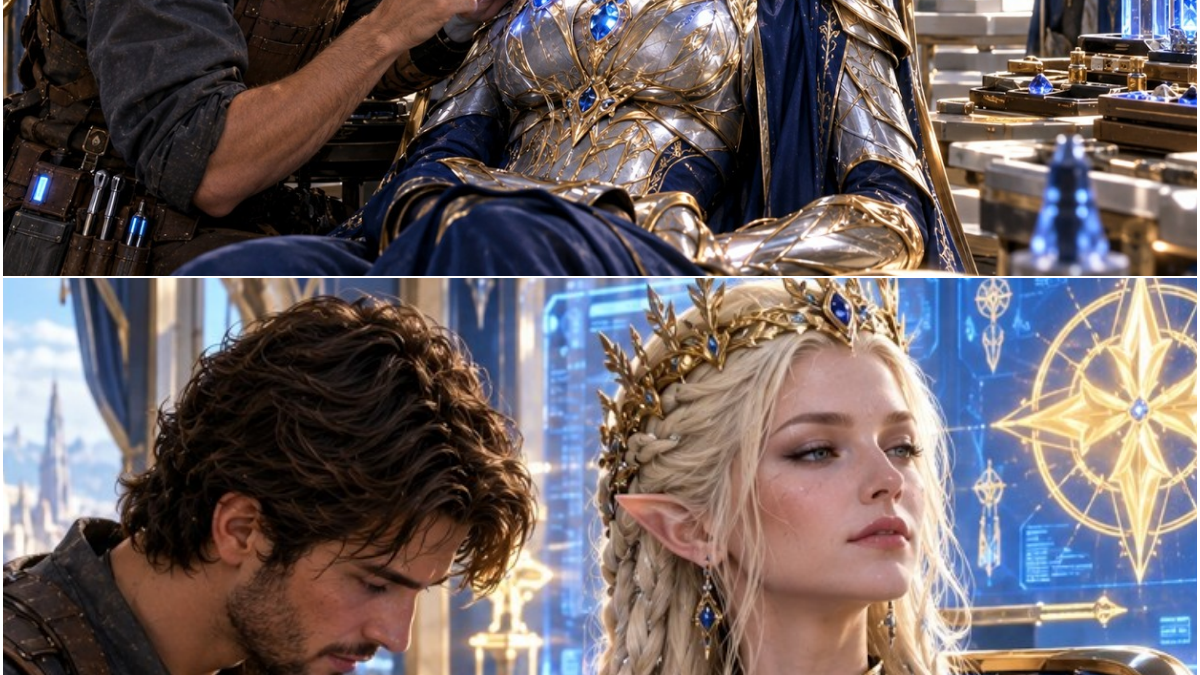
The first spark struck my workbench just as the alien woman stumbled through my door, and the second landed on the floor beside my boot.
I looked up from the water pump I had been repairing and saw her gripping the doorframe with one trembling hand.
Blue light pulsed beneath the cracks in her black armor. Something inside her chest was overheating, and whatever it was, it had already begun to fail.
“Please,” she said. “They told me you fix what others throw away.” It was the middle of the night shift on Harbor Ring, the oldest and roughest trade station on the edge of known space.
Most shops had closed hours earlier. The corridor outside was quiet, the station lights were dim, and my coffee had been cold long enough to become part of the furniture.
My name is Ben Carter. I was human, which on Harbor Ring meant I was usually the last person anyone called when something important needed fixing.
I had a cramped repair shop, a collection of tools that belonged in a museum, and more unpaid bills than I cared to count.
I was not expecting a royal visitor, a political crisis, or anything that would change the station.
I was expecting to finish a water pump and go home. Then the woman stepped inside, and the door slid shut behind her.
“Who turned you away?” I asked. “Everyone.” Her answer was quiet, but the fear beneath it was unmistakable.
I glanced at the blue light flickering across her armor and reached for my scanner.
“Then sit down,” I said. “Let’s see what everyone else was afraid to touch.” I had no idea what I was about to uncover, or how much trouble one repair could bring through my door.
Her name was Ria. At first, I thought she was a soldier. The armor suggested it, though I had never seen a design quite like hers.
It was black and smooth, fitted close to her body, with narrow plates that overlapped like the scales of some deep-space creature.
The blue line running from her shoulder to her hip was not decoration. It was a visible power channel, and the irregular flashes traveling through it told me the system was struggling.
She lowered herself onto my only good stool. The stool complained. “Hold still,” I said.
“I am trying.” “I can see that. I’m asking the armor, too.” She looked at me over one shoulder.
Her visor concealed most of her face, but I could tell she was studying me, measuring whether I knew what I was doing or was simply too stubborn to recognize a bad situation.
I ran the scanner along her chest plate. The screen filled with symbols I could not read, then translated the measurements into a language I understood.
The core temperature was climbing. The safety system was approaching its final threshold. Several power lines were damaged, and the armor was attempting to compensate by drawing energy from systems that were already under strain.
“How long has it been like this?” I asked. “Since the ferry. Perhaps two hours.”
“And you kept walking around in it?” “I had to find someone who could repair it.”
“Six shops turned you away?” “Yes.” “Did any of them explain why?” “They said the armor could not be saved.
They wanted me to accept a replacement.” I glanced at the cracked chest plate. “And you didn’t want a replacement.”
“No.” There was something in the way she said it that made me pause. She did not sound like someone refusing a newer model because she preferred an old one.
She sounded as if the armor meant something that no replacement could provide. “Is it valuable?”
I asked. “It is important.” “That’s not quite the same thing.” “No,” she said. “It isn’t.”
A fresh burst of sparks jumped from the chest plate. Ria’s fingers tightened around the edge of the stool.
I reached for the tool drawer. “Okay,” I said. “Let’s see what we can do.”
The first problem was the screws. They had six sides, but the angles were unusual, and the standard drivers in my drawer slipped against them.
I tried a precision set, a flexible driver, and a small wrench I had modified for machinery from three different species.
Nothing fit. Ria watched in silence until I finally set the tools down. “Your tools are wrong,” she said.
“My tools are always wrong.” “Then how do you repair anything?” “By refusing to let the tools win.”
I looked around the shop. A broken chair leaned against the wall beside a stack of discarded panels.
I pulled it over, removed one of its legs, and carried the metal piece to my bench.
Ria turned her head. “What are you doing?” “Making a tool.” “From furniture?” “Furniture has a long history of being useful in emergencies.”
I clamped the chair leg into a vise and worked the end with a file.
The metal was cheap, but it was sturdy enough. After a few minutes, I had shaped a crude six-sided tip.
I tested it against the first screw. It slipped once. I adjusted the angle and tried again.
Click. The screw turned. Ria made a small sound that might have been a laugh.
“You built a tool from a chair.” “You built armor nobody can open. I think we’re even.”
I removed the first plate, then the second. The inside of the armor was a maze of silver cables, narrow conduits, and tiny components arranged so tightly that I could barely fit my fingers between them.
Some wires had scorched insulation. Others were twisted around one another in ways that made no engineering sense.
At the center sat the power core. It looked like a glowing egg suspended inside a framework of dark metal.
The light within it shifted from pale blue to white, then back again. Heat rolled from the housing in waves.
I held my scanner near it. The warning number climbed. “Your core is overheating,” I said.
“Not just a little. It’s close to the red line.” Ria’s voice became very quiet.
“That is the lock signal.” “What lock signal?” “If the core passes the red line, the armor seals itself.
It will not open again until a full engineering team arrives.” “How long?” “Days.” I stared at her.
“Days inside that suit?” “Yes.” I looked back at the scanner. “Then we’re not going past the red line.”
My shop did not have alien cooling gel. It did not have a royal engineering kit, a specialized containment field, or any of the other things that might have made the repair straightforward.
It did have a bucket of ice, a desk fan, and a generous supply of bicycle grease.
I poured the ice around the outer housing, careful to keep the water away from the exposed wiring.
Then I spread a thin layer of grease over the hottest joints, using it to help carry heat away from the metal.
Finally, I aimed the desk fan at the open chest plate. The fan rattled. The scanner needle slowed.
It wavered. Then it stopped climbing. Ria let out a long breath. “That should not work.”
“It works on my bike.” “This is not a bike.” “Not with that attitude.” For the first time, her shoulders relaxed.
The relief lasted about ten seconds. I traced the main power line from the core to the chest plate and found a section that had burned through.
The insulation had melted, and the inner conductor was dark and brittle. The line carried too much current for any ordinary wire I had in stock.
I could remove it, but without a replacement, the armor would lose power. The safety system would interpret the sudden drop as a critical failure and seal the plates.
I needed a temporary bridge. Something strong enough to keep the system alive while I rebuilt the damaged line.
I searched the shelves, moving aside boxes of old connectors and a cracked radio. Then I found an old music player.
It was a human model from years earlier, small enough to fit in my palm.
The battery had been designed to last through long commutes, and the casing was tough enough to survive being dropped.
It was not meant to power alien armor, but its energy output was clean and predictable.
I opened the casing, stripped the internal connections, and attached two thick leads. Ria watched me with growing disbelief.
“That is a toy.” “It is a very good toy.” “You are connecting a music player to my power system?”
“Only temporarily.” “What happens if it fails?” “Then we will have a very short and very unpleasant conversation about my repair choices.”
She did not laugh this time. I clipped the battery into the gap and checked the scanner.
The blue light along her shoulder steadied. The power reading rose, then settled into a narrow range.
The armor was holding. Ria lowered her hands from the stool and sat back. I wiped my fingers on a rag and stepped away from the bench.
“Try breathing normally,” I said. “I am breathing normally.” “You were holding your breath.” “I was concentrating.”
“Concentrate on breathing for a moment.” She turned her head toward me, and after a pause, she reached up and released the visor.
I had expected some sort of alien display. Maybe a face covered in protective markings or eyes adapted to a different atmosphere.
Instead, I saw a woman with pale gray skin, silver eyes, and dark rings around her irises.
Her features were sharp but not severe, and she looked younger than I had expected.
She also looked exhausted. I handed her my second-best mug. “What is this?” She asked.
“Coffee.” She examined the dark liquid. “Is it safe?” “Usually.” “Usually?” “Drink it before I change my mind.”
She took a cautious sip and made a face. “That is terrible.” “Thank you.” Then she took another sip.
I returned to the bench and began cleaning the scorched cables. For a while, the only sounds were the fan, the scanner, and the faint hum of Harbor Ring’s ventilation system.
Then Ria asked, “Why are you helping me?” I glanced over. “You came into my shop with sparks coming out of your cheSt.”
“You do not know who I am.” “I know your armor is in trouble.” “You have not asked what I can pay.”
“I haven’t finished the repair.” “Everyone asks.” “Then everyone must be tired of hearing themselves talk.”
She studied me. “In my home, nobody does anything without asking what they will receive in return.”
“In mine, sometimes you just fix the thing.” “Why?” I considered the question while I worked.
“My grandfather used to say that broken doesn’t mean finished. It just means unfinished.” Ria looked down at her mug.
“Nobody in my home has ever said that to me.” Before I could answer, the lights flickered.
The desk fan slowed, made a grinding noise, and stopped. My scanner blinked once and went dark.
Somewhere in the corridor, a machine gave a low warning chime. Then the whole station groaned.
Every light went out. The only illumination in the shop came from Ria’s armor, which cast a soft blue glow across the walls and the cluttered workbench.
“Brownout,” I said. “Something big just pulled power from the ring.” Ria’s eyes moved toward the door.
“They are early.” I looked at her. “Who is early?” She did not answer. I went back to the exposed wiring, working by the blue light.
The temporary battery was holding, but the main line still needed a proper connection. I trimmed away the damaged section and checked the insulation.
That was when I saw something that did not belong. A small black clip had been attached to the lock signal wire, tucked behind the power core where it was almost impossible to see.
It was no larger than my thumbnail. A thin layer of adhesive held it in place, and a tiny metal contact connected it to the line.
I took a pair of tweezers and pulled it free. “This isn’t part of your armor.”
Ria turned sharply. “What?” I held the clip beneath the blue light. She reached for it, then stopped herself before touching the exposed contact.
I placed it in her palm. She turned it over. A tiny silver crown had been stamped into one side.
Her expression changed so quickly that I felt the temperature in the room shift. “That mark belongs to the royal workshop,” she said.
“Royal workshop?” “Only the people I trust most are allowed inside it.” I looked at the clip again.
“I think this has been telling your armor that the core is hotter than it really is.”
Ria’s fingers closed around it. “Explain.” “It’s interfering with the lock signal. It makes the system behave as if the temperature is climbing faster than it should.
The safety system tries to compensate, which draws more power and creates more heat. If it keeps happening, the armor reaches the red line before the core actually needs to.”
“How long?” “From the adhesive and the wear, I’d guess months.” She stared at the little device.
For a moment, she looked less like a soldier and more like someone who had just discovered that a familiar room had been rearranged while she was away.
“Someone has been pushing me toward that lock for a very long time,” she said.
“And tonight, they almost succeeded.” A device on her belt began to buzz. She glanced at its screen.
A golden scroll appeared, with a curved line beneath it. The symbol repeated several times, accompanied by a series of messages.
“Who is that?” I asked. “The Chancellor’s office.” “Do they always message you this much?”
“No.” “How much is unusual?” “In four years, that office has never asked where I am.
It has always known.” I glanced toward the door. “So now they’re asking?” “Eleven messages in the last hour.”
“Maybe they’re worried.” “No,” she said. “They want to be certain I am still inside the armor.”
I looked at the open chest plate, then at the black clip. “Who knows you’re here?”
“My guards believe I am resting on the ferry deck. I left them with instructions not to disturb me unless there was a serious emergency.”
“And you came here alone?” “Yes.” “Why?” She looked at the damaged wiring. “I needed to find someone who would work without being afraid of me.”
I did not know what to say to that. I had spent most of my life being ignored by people who thought my shop was too small to matter.
I had never imagined that someone could be so powerful that everyone around her would be too frightened to tell her the truth.
I picked up the soldering iron. “Well,” I said, “you found someone who’s mostly afraid of burning his fingers.”
The station lights remained dark. Far down the corridor, I heard the heavy rhythm of boots moving together.
Ria’s head lifted. “They have arrived.” I set the soldering iron down and looked toward the door.
“Your guards?” “No.” The footsteps grew louder. I looked at the open armor, the exposed power core, and the half-repaired cable.
“Then we finish this line right now.” Ria nodded once. “Do it.” The power snapped back on.
The lights blazed overhead, the desk fan roared to life, and the scanner began displaying numbers again.
At the same moment, a deep siren sounded throughout Harbor Ring. The floor trembled under my boots.
I ran to the window. Outside, black ships were filling the docking zone. They were enormous, sleek, and sharply shaped, with glowing silver rings along their hulls.
They moved into position one after another, blocking the stars beyond the station. The corridor outside my shop went silent.
Then the people began kneeling. Traders, mechanics, travelers, station workers, and security officers lowered themselves to the floor.
Even the guards who usually acted as if they owned the place pressed their foreheads down.
I turned from the window. Ria was sitting on my stool, holding her mug with both hands.
The door slid open so quickly it struck the stop. Lucy, who ran the noodle stall next door, stumbled into the shop.
She was still wearing her apron, and her face had gone pale. “Ben,” she whispered.
“Ben, do you have any idea who is sitting in your shop?” I looked at Ria.
“Her name is Ria.” Lucy stared at me as if I had just announced that the station was made of cheese.
“She is the Empress of the Sable Dominion.” I slowly turned back toward the woman on my stool.
Ria looked at me with those silver eyes. She did not look like someone who commanded a thousand worlds.
She looked like someone waiting to find out whether I would still speak to her the same way.
“I hoped to tell you myself,” she said. “I am sorry, Ben.” I was still holding my coffee mug.
I had told the ruler of a thousand worlds to drink my terrible coffee anyway.
Before I could come up with a response, heavy footsteps rang through the corridor. A tall figure in silver-trimmed armor filled the doorway.
Behind him, a line of guards spread into my shop until there was barely room to stand.
The commander looked at Ria, then at the open chest plate, then at me. “Your Majesty,” he said, his voice tight with anger.
“This human has opened the sacred armor with his bare hands. Commander Hale of the Royal Guard will remove him at once.”
I stared at him. “My arms are inside the armor.” “You do not give orders here, human.”
“I’m not giving orders. I’m telling you facts. There are two loose cables in here, and if they are not joined in the next minute, the core climbs past the red line.”
Hale’s gaze hardened. “You have tampered with the royal system.” “I’m repairing it.” “You will step away.”
“I can’t.” His hand moved toward his weapon. Ria’s voice cut through the room. “Commander Hale.”
He turned immediately. “Your Majesty.” “Let him finish.” Hale looked at the armor again. I could see the conflict in his expression, but he did not argue.
I turned back to the wiring. The two loose cables were smaller than the ones I had already repaired, but they carried a signal that connected the core’s temperature readings to the safety system.
The black clip had interfered with that connection. I had removed it, but the old signal path was still compromised.
I needed to route the readings around the damaged section and keep the safety system from interpreting the repair as another failure.
I worked quickly. The scanner buzzed in my pocket. The temperature was rising again. I stripped the wire, twisted the ends together, and wrapped the connection with copper tape.
The temporary music player battery remained clipped into its cradle, keeping the armor’s lights and basic functions alive while I rebuilt the line.
The warning number climbed. Fifty seconds. I pressed the connection into place. Forty seconds. The core pulsed once, bright enough to cast sharp shadows across the room.
Thirty seconds. I checked the second cable and found the insulation had split near the joint.
I cut away the damaged portion and soldered a short bridge between the clean ends.
The warning tone became faster. Twenty seconds. My hands were shaking. I had repaired engines in cramped cargo holds, patched power systems during station outages, and once rebuilt a navigation console while a freighter drifted without steering.
None of those jobs had involved an entire room full of guards waiting to arrest me while an empress sat on my stool.
I pressed the last connection into place. The core gave one deep pulse. The blue light along Ria’s armor brightened from a flicker into a steady glow.
The cracked chest plate slid shut with a smooth whisper. The warning tone stopped. For the first time since she had entered my shop, the armor was quiet.
Ria stood. She rolled her shoulders, lifted her arms, and turned slowly. The armor moved with her as if it had become part of her body.
Every guard in the room stepped back. “It has never felt like this,” she said.
Hale stared at the armor. “That is impossible.” Ria looked at him. “Why?” “Our engineers declared it beyond repair.”
“Did they try?” No one answered. I wiped my hands on a rag and stepped away from the workbench.
Ria turned toward the guards, and her voice filled the shop. “I did not come to Harbor Ring by accident.
Someone in my court has been sabotaging my armor for months. I could not identify the source.
So I left the palace in plain clothes, boarded a public ferry, and searched for a repairer who would work without being afraid of me.”
Her eyes found mine. “Ben was the only one who did.” I held up the black clip.
“This was attached to the lock signal wire. It was pushing the core toward the red line.”
Hale took the clip from me. He examined the silver crown stamped into its surface.
His expression changed. “Commander,” Ria said, “who has authority over the royal workshop?” Hale’s mouth opened, but no answer came.
“Only the Chancellor, Your Majesty,” he said at laSt. The room went still. Ria looked at the guards, then at the clip, then toward the corridor beyond my door.
“Secure the workshop records,” she ordered. “No one is to alter or remove a single file.
Every person with access to the armor’s maintenance system is to be accounted for.” Hale bowed.
“Yes, Your Majesty.” The guards began moving, speaking quietly into their communication devices. The tension in my shop shifted.
The threat had not disappeared, but it had changed direction. Ria turned back to me.
“Ben Carter,” she said, “you have done something no one in my empire would dare to do.
Name what you want. Gold? A fleet? A palace of your own? It is yours.”
I laughed. I did not mean to. It simply came out, short and disbelieving. “Your Majesty, I fix water pumps and old radios.
I don’t want a palace. I don’t even have a place to put one.” “What do you want?”
I looked past her at my shop. The shelves were crowded with broken devices waiting for parts.
The workbench had scratches from years of repairs. The chair I had dismantled was still leaning against the wall, missing a leg.
Through the open door, I could see Lucy standing in the corridor, watching the guards with wide eyes.
“I want to keep my shop,” I said. “I want the people on this corridor to keep their doors open.
That’s about it.” Ria studied me. “That is all?” “That’s plenty.” A small smile appeared on her face.
“That,” she said quietly, “is exactly why I trust you.” A smooth voice spoke from the doorway.
“Your Majesty, thank the stars you are safe.” A slim man in gold-trimmed robes walked through the guards.
His clothing was immaculate, and his expression was arranged into a look of concern so polished that it seemed to have been practiced in front of a mirror.
I recognized him from the public broadcasts. Chancellor Grant. He bowed low. “I came as soon as I heard about the disturbance.
I must warn you, however, that this human has interfered with the sacred armor. We cannot know what he has done to it.
For your safety, he should be taken into custody immediately.” Ria did not move. “He repaired it.”
“He may have damaged it further.” “It is functioning better than it has in years.”
Grant’s gaze shifted toward me. “Your Majesty, the armor is a royal artifact. Its systems are beyond the understanding of an ordinary human mechanic.”
I glanced at the chair leg on my bench. “Apparently not all of them.” Grant’s expression tightened.
He kept his voice gentle, but his right hand had drifted behind his back. Something silver caught the light.
I saw the small rod in his palm. His thumb rested on a button. “Ria,” I said.
“His hand.” Grant pressed the button. Every light on Ria’s armor flashed once. The lock signal surged through the system, the same signal that had been waiting in the black clip for months.
For one long moment, nobody moved. Then nothing happened. The blue glow remained steady. Ria’s arms stayed loose at her sides.
The armor did not seal. Grant pressed the button again. And again. His smile vanished.
“It does not work,” he whispered. “No,” I said. “It doesn’t.” I stepped forward, my knees still shaking.
“You sent the signal down the old lock wire. I cut that wire tonight and rebuilt the line around my music player battery.
Your signal goes into the dark now. It has nowhere to land.” Ria moved toward Grant.
The guards parted without being ordered. She stopped directly in front of him, tall and calm in the repaired armor.
The blue light reflected from the polished edges of her chest plate. “You have been sending that signal for months,” she said.
Grant’s eyes moved from her face to the armor. “Your Majesty, I can explain.” “Then explain.”
“The system was unstable. I was attempting to protect you.” “By making it fail?” “By ensuring you would accept the replacement.”
Ria’s expression remained still. “Why?” Grant hesitated. For the first time, the smooth confidence in his posture faltered.
“The old armor represents a political tradition that has become difficult to manage,” he said.
“A replacement would have allowed the court to present a new image of the throne.
It would have simplified several matters of succession and authority.” “You sabotaged a royal artifact to influence the court.”
“I acted in the interest of stability.” “You acted without my knowledge.” Grant looked toward Hale, perhaps expecting the commander to intervene.
Hale stepped forward and took the silver rod from his hand. “Chancellor Grant,” he said, “you will come with us.
Your hearing will be held before the full court.” Grant’s face hardened. “You cannot do this.”
Ria’s voice was quiet. “I can.” Two guards escorted him from the shop. He did not look back.
The people in the corridor watched him pass, their expressions uncertain, but no one lowered their head for him.
When the doorway cleared, Ria turned toward the station. Hundreds of faces were gathered outside.
Humans, Kel ran traders, four-armed dock workers, travelers, mechanics, and children who had been pulled close by their parents.
Some were still kneeling. Others had begun to rise. Ria lifted her voice. “Hear me.”
The corridor fell silent. “My engineers told me to discard this armor. They said it could not be saved.
Tonight, a human with a chair leg, a bucket of ice, and a battery from an old music player looked at it and said, ‘Let us see.’”
A few people laughed softly. Ria placed her hand against the repaired chest plate. “My empire has spent a thousand years replacing what it could have mended.
That ends today. From this night forward, the Sable Dominion will not overlook those who know how to repair what others abandon.
Nor will it overlook the people who make their homes and livelihoods on stations like Harbor Ring.”
She looked toward the crowd. “The humans of this station are now honored friends of my throne.”
For a moment, there was no sound. Then Lucy shouted. It was a loud, joyful noise that startled even the guards.
A dock worker began clapping. Someone else joined in, then another, until the entire corridor filled with applause and cheers.
I stood in my doorway with grease on my hands and my mouth hanging open.
Lucy rushed forward and threw her arms around my neck. “You fixed the empress!” “I fixed her armor.”
“You fixed the empress!” “I’m going to need you to stop saying it like that.”
She laughed and hugged me harder. Ria watched us with an expression I could not quite read.
Then she smiled again, and this time it looked less like the expression of a ruler addressing a crowd and more like the smile of someone who had found a place where she could breathe.
The guards eventually cleared the corridor, though people lingered long after the ships had settled into their docking positions.
Some wanted to see the armor. Others wanted to hear what had happened. A few simply wanted to shake my hand.
I was not used to that kind of attention. For years, most people on Harbor Ring had walked past my shop without looking inside.
I had been useful when something broke, but never important enough to invite into a conversation.
Now strangers were treating me as if I had suddenly become an expert on the entire galaxy.
I was not. I was still Ben Carter, with a cold cup of coffee, a broken water pump, and a chair missing one leg.
The next morning, I opened my shop at the usual hour. I expected the corridor to be quiet again.
I expected the people who had cheered the night before to return to their work, and I expected the station to settle into its familiar rhythm.
Instead, I found a line outside my door. The first customer carried a cracked helmet.
The second had a damaged navigation panel. The third was a freight captain holding a translator that had stopped working halfway through a conversation.
By midday, there were so many people waiting that Lucy had to move her noodle stall’s tables to make room.
Two guards in silver trim stood politely near my doorway. They did not interfere with my work.
They simply helped keep people from crowding the bench. I asked one of them whether this was necessary.
He said the empress had ordered that my shop remain accessible to the public, but that I should not be overwhelmed by visitors.
I looked at the line stretching down the corridor. “Tell her I appreciate the thought.”
The guard bowed. “Her Majesty said you would probably say that.” Three weeks later, my shop looked almost exactly the same.
The workbench still had scratches. The shelves still held a collection of old radios, broken pumps, and spare parts from machines that no longer existed.
The chair still leaned against the wall, waiting for me to replace its missing leg.
But above the door, Lucy had painted a new sign. Bring your broken things. She insisted the words were better than anything I could have written.
I did not argue. She had also added a small drawing of a chair with one leg missing, which I thought was a little too personal.
The station had changed in smaller ways, too. Merchants who once stepped around me now stopped to ask how I was doing.
Other repair shops began trading parts and advice instead of treating every customer as a competition.
A few people had asked me to teach a class on practical repairs, though I was still deciding whether I had the patience to explain why a bent piece of furniture could become a perfectly good tool.
The most surprising change was that people started bringing in things they had been told were beyond repair.
A cargo pilot brought an old navigation unit that had been sitting in storage for years.
A Kel ran trader brought a family instrument with a cracked sound plate. A station cleaner carried a small heating device that had belonged to her grandmother.
They did not all need repairs. Some simply wanted to know whether their belongings could be saved.
I began to understand that the line outside my door was not only about machines.
People had spent years hearing that certain things were too old, too damaged, too strange, or too inconvenient to bother with.
They wanted someone to look at them and say, “Let’s see.” One evening, after the last customer had left, I was sweeping the floor when the door slid open.
A woman stood in the doorway wearing a plain gray coat. She had a scarf pulled up around her chin and no visible armor.
Her posture was relaxed, her hands empty, and her expression almost ordinary. But I recognized those silver eyes immediately.
“Do you still have coffee?” Ria asked. “Bad coffee,” I said. “Same as always.” “Good.”
I filled the chipped mug I kept behind the counter and handed it to her.
She sat on my good stool and wrapped both hands around the cup. I noticed she did not make a face when she tasted it.
“Armor okay?” I asked. “Perfect. It has not flickered once.” “I could have told you that.”
“You could have sent a message.” “I could have.” She looked around the shop. Her gaze moved over the crowded shelves, the old tools, the repaired devices, and the chair with one leg missing.
“Why haven’t you fixed that chair?” “I keep meaning to.” “You built a tool from it.”
“Exactly. It has already served a purpose.” She laughed, and the sound was warm and unguarded.
For a while, we talked about ordinary things. The station’s new repair exchange. The strange requests I had received.
The fact that Lucy had started telling everyone she was responsible for introducing me to the empress, which was technically true only if one counted her shouting through my doorway after the ships arrived.
Ria listened without interrupting. Then she looked down at her mug. “Do you know what I find most unusual about this place?”
“The coffee?” “That is unusual, but not what I mean.” “What, then?” “You speak to me as if I am a person.”
I leaned back against the workbench. “You are a person.” “I am also the ruler of the Sable Dominion.”
“Those things can both be true.” She considered that. “In the palace, every conversation begins with what I represent.
My title, my authority, my obligations. Even the people who care about me sometimes forget that I am allowed to be tired, uncertain, or simply curious.”
I nodded toward the stool. “Here, you’re a customer who needs coffee.” “And your customer service is terrible.”
“I’m working on it.” She smiled. Outside, the corridor hummed with its usual activity. A cart rolled paSt. Someone called to a friend.
Lucy’s stall sent the familiar scent of warm broth into the air. Ria looked toward the door.
“Do you ever wonder what would have happened if you had refused to help me?”
“Sometimes.” “What do you think would have happened?” “I think I’d have finished that water pump, gone home, and complained about the station power system the next morning.”
“And the armor?” “I don’t know.” She studied me. “You could have asked for a great deal.”
“I know.” “You could have asked for wealth, authority, or a place in my court.”
“I know.” “Why didn’t you?” I looked at the chair leg still leaning against the wall.
Then I looked at the little battery casing on the workbench, the one I had removed from the music player after the armor was stable.
“I didn’t help you because I expected a reward,” I said. “I helped because you needed someone to try.”
Ria was quiet. Then she lifted the mug and took another sip. “Do you think people can change the way they treat one another?”
I glanced at the line of tools hanging above my bench. “I think they can start.”
“That sounds small.” “It is small. Most things are, at firSt.” She looked toward the sign above my door.
Bring your broken things. “Perhaps,” she said, “that is where a better empire begins.” I did not have an answer for that.
I was a repairman, not a philosopher. I understood broken connections, worn bearings, and the stubborn logic of machines.
People were harder to understand, especially when they had spent generations learning to keep their distance.
But I knew what it meant to offer someone a place to sit while they gathered themselves.
I knew what it meant to keep a door open. And I knew that sometimes the most important thing a person could do was not to promise that everything would be fixed, but to pick up a tool and begin.
Ria finished her coffee and set the mug on the bench. “Will you come to the palace someday?”
She asked. I looked at her. “Is there a repair shop there?” “There are several.”
“Do they need help?” “Some of them.” “Then maybe.” She stood, straightening her coat. “I would like you to see the royal workshop.
The people there have questions about what you did.” “Tell them I used a chair leg and an old music player.”
“I already did.” “And?” “They have not stopped arguing about it.” I laughed. Ria moved toward the door, then paused and looked back at me.
“Ben Carter, if I ask you to help repair something that is not made of metal, will you?”
I rested my hands on the workbench. “What kind of thing?” She glanced toward the station corridor, where people were still bringing broken objects to my door.
“Something much harder to repair than armor.” I watched her for a moment, then looked at the tools spread across my bench.
“I suppose,” I said, “we can start by seeing what’s broken.” Ria smiled. And for the first time, I wondered whether the most difficult repair in the galaxy might be the one neither of us could complete alone.
Disclaimer: This content may be created by Al for entertainment purposes. Any resemblance to real persons, events, or places is coincidental.








