I Drove My Ex’s Sister To Her Divorce Hearing She Grabbed My Hand And Said, “Don’t Let Go Yet!”
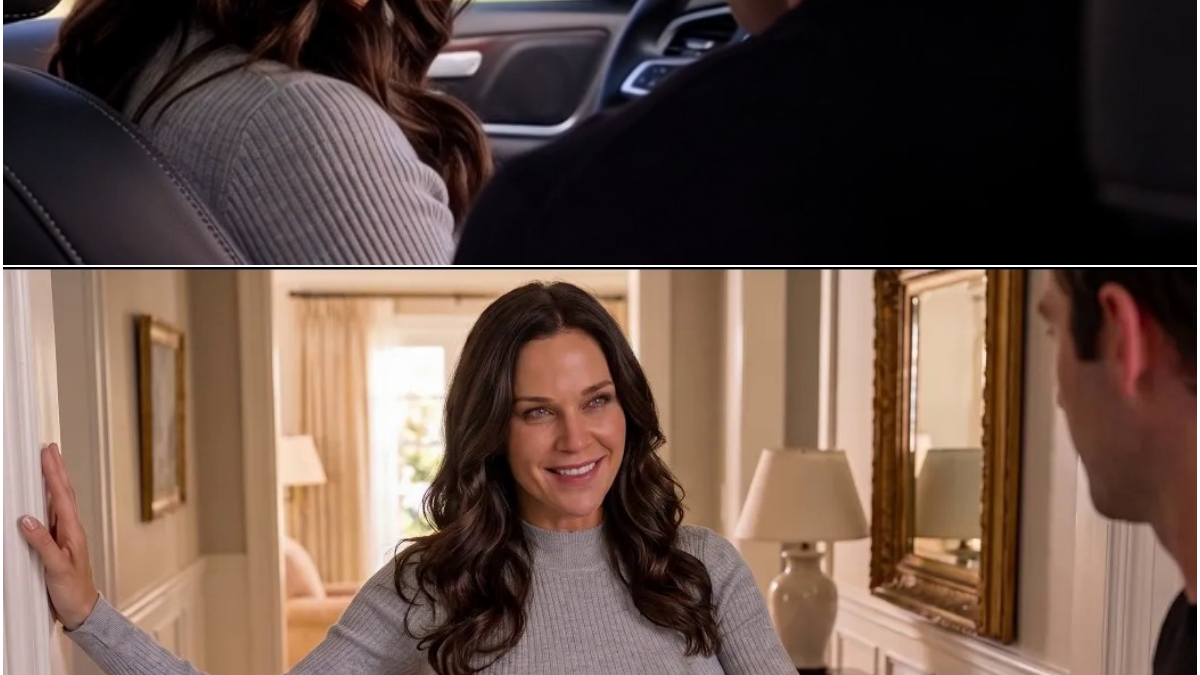
The first thing I noticed was the way Jenna held those folders against her chest, as if the papers inside them were the only things keeping her life from coming apart.
The second was the look in her eyes when she saw me working on her parents’ deck.
It was a look I had never quite understood, even after years of sitting across from her at Sunday dinners, listening to her sister talk over everyone else and watching Jenna quietly observe the room.
I had come to repair a few rotten boards, collect my tools, and leave before the family returned.
I had no intention of becoming part of their lives again. Not after the way my relationship with her younger sister had ended, and certainly not while Jenna was preparing to face the final complications of her own marriage.
But the morning had other plans. Her car wouldn’t start, her lawyer was delayed, and the rain that had threatened all morning eventually swallowed the town in a gray curtain.
One small favor became a long drive, then a cup of terrible coffee, then an unexpected refuge inside my workshop.
And somewhere between the courthouse and the warmth of my old iron stove, the quiet woman I thought I knew began telling me things she had kept hidden for years.
I had spent most of my life believing that broken things were worth saving if someone was willing to do the work.
That morning, I began to wonder whether I had been applying that belief to the wrong things, and whether the person standing beside me had been waiting for me to understand something I had never dared to ask.
I wiped the sweat from my forehead with the back of my hand and let out a long breath into the cool morning air.
My name was Reed, and I made my living working with wood. I repaired old furniture, rebuilt damaged porches, and took on the jobs that other people had decided were no longer worth the trouble.
I liked the work because it was honeSt. Wood showed you where it had weakened, where it had split, and where it needed support.
If you took your time and used the right materials, you could often give it another chance.
That morning, however, the job in front of me felt different. I was repairing the back deck of the house where I had once spent nearly every Sunday evening.
It belonged to my former girlfriend’s family, and I had agreed to do the work months earlier, back when I still believed I would always be welcome there.
Things had changed since then. My relationship with her younger sister had ended badly, and the family had gradually become a place I avoided.
I had no desire to revisit any of it. The deck had several rotten cedar boards, a loose railing, and a set of stairs that had started to sag.
I had brought enough lumber and tools to finish most of the repairs before lunch.
My plan was simple. I would enter through the side gate, work quietly, load everything into my truck, and leave before anyone came home.
I kept my head down, concentrating on the rough grain of the cedar and the sharp edge of my chisel.
The smell of wet grass and old sawdust usually calmed me, but that morning even familiar things seemed weighed down by memories.
Then the screen door opened. Its long, familiar squeak traveled across the yard, and I looked up before I could stop myself.
Jenna stepped onto the porch with a ceramic mug of black coffee in one hand and a thick stack of manila folders in the other.
She was my former girlfriend’s older sister, the quiet one in a crowded family. While her younger sister had always filled every room with conversation, Jenna had preferred to listen.
She noticed things other people missed and rarely spoke unless she had something worth saying.
She wore a gray wool sweater, and the morning breeze pulled gently at its sleeves.
Her dark hair was slightly untidy, and the tiredness in her face was impossible to miss.
I knew what she was dealing with. Everyone in town knew Jenna was going through a difficult divorce, although most people were careful not to discuss it directly.
She had spent months untangling her life from a marriage that had become increasingly difficult to maintain.
Now she was supposed to appear at the courthouse and take another step toward putting it behind her.
She glanced at the damaged deck. “You actually came to fix it,” she said. “I said I would.”
I set down my mallet and brushed sawdust from my palms. “My car is completely dead,” she said, looking at the folders.
“And I have to be at the courthouse in exactly one hour.” I studied her for a moment.
She was standing on the edge of a broken porch with a stack of legal documents in her hands, looking as though she had spent the entire night trying to prepare herself for the day ahead.
I could have suggested she call a cab. I could have sent her to a neighbor.
Instead, I found myself offering the one thing I could give her without making the situation more complicated.
“I can take you.” She looked down at my muddy boots and work clothes. “You’re covered in dirt, Reed.”
“My truck runs fine.” I began putting my tools away before she could argue. The hammer and nails clattered into my metal toolbox, and I kept my eyes on my work because looking directly at her made the offer feel more personal than I intended.
We walked around the side of the house toward my old truck. Tall wet grass brushed against our trousers, and the sky above the trees had turned a deep, threatening gray.
Rain had been hanging over the town all morning, and it finally looked ready to arrive.
Jenna climbed into the passenger seat, carefully arranging her sweater around her knees. I closed the tailgate, walked around the front, and settled behind the steering wheel.
The engine coughed twice before roaring to life. I pulled away from the driveway, leaving the unfinished deck behind us.
The inside of my truck smelled like old coffee, dried mud, and fresh lumber. It was not a quiet vehicle.
The engine rattled, the dashboard vibrated, and the passenger window had a small crack near the bottom corner.
But it had carried me through years of work, and I trusted it more than I trusted most things.
The rain began as we reached the county road. A few drops struck the windshield, then a steady shower blurred the trees and darkened the asphalt.
I turned on the wipers and listened to their rubber blades squeak across the glass.
Neither of us spoke for several minutes. It was not an uncomfortable silence. Jenna seemed content to watch the countryside pass, and I was happy to concentrate on the road.
The truck’s heater had only two settings, broken or unbearably hot. That morning it was working at full blast, sending warm air toward her legs.
“I can turn the heat down if it’s too much,” I said. “No, it’s fine.
It feels nice.” She moved the vent slightly and held her fingers near the warm air.
When she pulled her hand back, her knuckles brushed mine where my hand rested on the gear shift.
It was a small touch, almost accidental. Still, she did not immediately pull away. Her hand remained close to mine for a moment before she turned toward the window.
I tightened my grip on the steering wheel and told myself the cab was simply cramped.
She was cold, and the heater was the only comfortable place in the truck. There was no reason to make anything of it.
I had dated her sister. I had shared meals with their parents and spent countless evenings in that house.
There were boundaries built from years of history, and I had no intention of crossing them.
Jenna had enough to deal with without becoming involved in whatever complicated thoughts I might have been foolish enough to entertain.
We passed the old gas station near the edge of town. Its neon sign buzzed in the rain, and the wet pavement reflected the pale light.
Jenna rested her head against the passenger window, watching the blurred trees move paSt. For a moment, I wished I could keep driving.
Not because I wanted to avoid the courthouse, but because there was something peaceful about having her beside me.
She was not demanding anything. She was not trying to fill the silence or make the morning easier by pretending everything was fine.
She was simply there. I reminded myself that I was taking her to an appointment.
That was all. The town square appeared through the rain, its old brick buildings surrounding a small green lawn and a clock tower.
Traffic was light, and the courthouse stood at the far end of the square behind a broad set of concrete steps.
I stopped at the red light before the entrance. Jenna adjusted the folders on her lap.
The edges of the papers rustled, and I noticed a slight tremble in her hands.
She was trying to hide it. I wanted to tell her she did not have to be brave every minute of the day.
I wanted to tell her that whatever happened in that building, she would still be herself when she walked back outside.
But I knew better than to offer a speech when she had not asked for one.
The light turned green, and I drove around the corner. I pulled up beside the courthouse steps and put the truck in park.
“This is it,” I said. She nodded and began gathering her things. Then her phone buzzed.
The sound cut through the steady drumming of the rain. Jenna stopped with one hand on the passenger door and reached into her purse.
She looked at the screen, and the little strength she had been holding onto seemed to disappear from her shoulders.
She leaned back against the headrest and closed her eyes. “My lawyer is stuck behind a three-car pileup on the interstate,” she said.
“The highway patrol is diverting traffic. He says he won’t be here for at least another two hours.”
I glanced at the courthouse. “Can they reschedule?” “They might. I don’t know. I spent the entire morning getting ready for this, and now I’m supposed to sit here and wait.”
Her voice was flat, but I could hear the disappointment underneath it. “I can wait with you,” I said.
She turned toward me. “You don’t have to do that. You have a job to finish, and I’ve already dragged you all the way across town.”
“The porch is wood,” I said. “It doesn’t care whether I fix it at eight in the morning or noon.”
“Reed…” “There’s a diner three blocks from here. The coffee is terrible, but the heating works.
You don’t need to sit on a wet bench for two hours.” She studied my face for a few seconds before giving a small nod.
The diner sat between an old hardware store and a closed antique shop near the edge of the square.
It was a narrow building with red vinyl booths, scratched laminate tables, and a wooden rack by the entrance for wet coats.
The moment we stepped inside, the smell of fried bacon, burnt coffee, and damp clothing surrounded us.
We slid into a booth near the back. The waitress, a tired-looking woman wearing a green apron, brought two ceramic mugs and filled them with steaming coffee before either of us had ordered.
Jenna wrapped both hands around her mug. “I always hated this coffee,” she said. “It tastes like they brew it through an old work boot.”
She smiled. “But it’s hot,” I added. “And right now, that’s the only thing that matters.”
Her smile grew a little more genuine. We began talking about ordinary things. A stray dog had been digging up her mother’s flower beds.
The hardware store had changed owners. Someone had painted the old mailbox near the church bright blue, and nobody seemed to know why.
The conversation was easy, almost surprisingly so. I realized that this was probably the longest uninterrupted conversation I had ever had with Jenna.
When I was dating her sister, the family house had always been noisy. Her sister talked constantly, their parents argued about small things, and everyone seemed to compete for attention.
Jenna had usually sat quietly in the corner. I had noticed her, of course. I had always noticed her.
But I had never really taken the time to speak with her alone. “It’s strange,” she said after a while.
“You being the one who drove me here.” “Why?” “After everything with my sister. After the way she yelled at you on the front lawn, I never thought you’d come back to the house.”
“I told your dad I would fix the deck.” “You could have changed your mind.”
“I don’t like leaving a job unfinished just because the circumstances changed.” She looked at my hands, then raised her eyes to meet mine.
“You always were the only steady thing in that house, Reed.” The words landed more heavily than I expected.
I picked up my coffee and took a long sip, burning the roof of my mouth.
I was suddenly unsure what to say. Her gaze was steady, almost searching, as though she had finally decided to look at me without the noise of the rest of her family getting in the way.
Before I could answer, the diner door opened with a loud bang. A gust of cold air swept through the room, followed by the booming voice of mr. Henderson from the feed store.
He spotted us and called out a greeting from across the diner. Jenna blinked and lowered her eyes.
The quiet moment disappeared. I felt foolish for having attached so much meaning to a simple conversation.
She was going through a difficult morning, and I was an old friend who happened to be available.
There was no reason to turn kindness into something more. We finished our coffee in a more guarded silence.
I paid the bill, left a few dollars on the counter, and followed her back into the rain.
By then, the weather had become much worse. Water poured from the diner’s awning, and the town square had turned into a gray blur.
We hurried to the truck, soaked by the time we climbed inside. I turned the heater all the way up.
Jenna pulled her wet hair over one shoulder and tried to squeeze water from its ends.
“I’m sorry for dragging you into this mess,” she said. “It’s just water.” I reached into the glove compartment for a small stack of paper napkins.
When I pulled my arm back, my wrist brushed her shoulder. She turned toward me.
We were suddenly close enough that I could see the raindrops clinging to her eyelashes.
Her eyes moved from my hand to my face, and she held my gaze for several seconds.
I did not move. Neither did she. Then I shifted back and looked at the dashboard clock.
The silence returned, but it felt different now. It was no longer simply the absence of conversation.
It was a space filled with questions neither of us seemed ready to ask. “Do you ever regret it?”
She said softly. “Regret what?” “Staying.” I kept my eyes on the windshield. “Staying in this town.
Fixing things for people who don’t always appreciate how much work it takes to keep them from falling apart.”
Her question carried more than one meaning. She could have been talking about my former relationship, about the years I had spent trying to keep things together with her sister.
She could have been talking about her own marriage, about the effort she had made to preserve a life that had never really belonged to her.
Or perhaps she was asking something else entirely. “I like fixing things,” I said. “I like knowing something is solid because I put the right nails in the right places.”
She nodded slowly. I could tell she understood the answer I had chosen not to give.
Before either of us could say anything else, the streetlights outside flickered wildly. The lights went out, plunging the square into darkness.
Across the street, the diner’s neon sign buzzed and vanished. The digital clock on the bank building went completely black.
Jenna’s phone buzzed again. She read the message, then leaned back with a long sigh.
“The courthouse just lost power,” she said. “A transformer blew down the street. The clerk texted my lawyer.
Everything is shut down. The judge is postponing all hearings until next Tuesday.” For a moment, neither of us spoke.
The entire morning had been arranged around that courthouse appointment. Jenna had prepared herself for it, gathered the documents, and worked up the courage to face another difficult step in her life.
Now the day had simply stopped. I looked at the dark building and then at her.
“My workshop is about two miles from here,” I said. “I’ve got a cast iron stove that heats the whole place in ten minutes.
There are clean towels, too.” “That sounds better than sitting here waiting for the power to come back.”
I put the truck into drive. The roads were dark and slick, and the rain made visibility difficult.
I drove slowly, following the pale shapes of the roadside trees and the faint glow of my headlights.
Jenna sat quietly beside me, holding her purse close. The tension from earlier had softened.
We were no longer waiting for something to happen. We were simply going somewhere warm.
My workshop was an old converted barn at the end of a gravel driveway, surrounded by tall pine trees and open fields.
I pulled up beside the large sliding doors and switched off the engine. “Wait here for a second,” I said.
“I’ll unlock the side door and turn off the alarm.” I grabbed my canvas jacket and stepped into the rain.
The cold water soaked through my shirt as I hurried to the entrance. I punched the code into the keypad, opened the door, and waved Jenna over.
She ran through the rain with her purse held against her cheSt. Inside, the workshop smelled of cedar, machine oil, and sawduSt. The familiar scent settled around me like an old coat.
I knew every tool, every shelf, and every uneven place in the concrete floor. I went straight to the iron stove.
A few crumpled sheets of newspaper, some dry cedar kindling, and a long wooden match were enough to bring the fire to life.
Orange light spread across the room, revealing racks of lumber and the heavy tools hanging along the walls.
I found two clean towels in the cabinet above the utility sink and handed one to Jenna.
“Here. You can use this to dry your hair.” “Thank you.” I took an oversized red flannel shirt from a hook and laid it over the back of a stool.
“You can put this on over your sweater if you’re still cold.” She smiled faintly and began drying her hair.
I switched on a battery-powered camping lantern on the workbench. The storm had taken the electricity, but I kept enough equipment around to work through a power outage.
The small lantern gave us a soft circle of light while the stove gradually warmed the room.
Jenna pulled the stool closer to the fire and wrapped the flannel around her shoulders.
I sat on a wooden crate opposite her. For several minutes, we listened to the rain beating against the roof.
The stove crackled, and the room slowly filled with dry warmth. Outside, the storm continued to move across the fields, but inside the barn everything felt sheltered.
Then Jenna began talking. “I used to love drawing,” she said. I looked up. “When I was in high school, I wanted to go to an art institute in Chicago.
I wanted to study architectural drafting.” “What happened?” “My parents said it wasn’t practical. They thought I should choose something dependable.”
She looked into the fire. “So I went to state college and studied accounting. Then I married a man who was dependable, and I built a life that was supposed to be safe.”
She paused. “And then I woke up one morning and realized I was thirty-two years old and completely hollow inside.
I hadn’t made a single choice that actually belonged to me.” She did not cry or ask me to comfort her.
She spoke plainly, as if she had finally found a place where she could say the truth without worrying about how anyone would react.
I understood more than I wanted to admit. “I think a lot of people end up building things they never meant to build,” I said.
“They follow somebody else’s plans because it feels easier than starting from scratch.” Jenna nodded.
“You sound like you know something about that.” I looked down at my hands. My fingers were rough and scarred from years of work.
They were strong enough to carry heavy lumber and steady enough to cut a clean joint, but they had not always been gentle.
“My dad used to break things when he got angry,” I said. “Plates, chairs, doors.
I learned early that if I could fix them before morning, I could pretend the bad things had never happened.”
The admission felt strange in my mouth. I rarely talked about my childhood. I had spent years building a life around being dependable, useful, and calm.
It was easier to repair other people’s broken things than explain why I had become so determined to keep everything from falling apart.
Jenna did not interrupt. She did not offer a hollow apology or look at me with pity.
She simply listened, her eyes steady and warm in the firelight. “You were always the strongest person in that house,” she said.
“Even when my sister was screaming, you just stood there.” I swallowed. “You don’t have to be the solid rock for them anymore.”
The words struck somewhere deep inside me. “Jenna,” I said, “you don’t have to carry your sister’s chaos, and you don’t have to carry a marriage that only exists because your parents think it’s the proper thing to do.”
As soon as I said it, I worried I had gone too far. Her expression changed.
She looked down at the concrete floor, and the flannel shirt slipped slightly off one shoulder.
Her arms folded around her stomach. I felt regret rising in my cheSt. I had been trying to give her a safe place to rest, and now I had pushed into parts of her life she had not invited me to discuss.
I began to stand. “I’m sorry,” I said. “I shouldn’t have—” Her hand reached out and caught the fabric of my jacket.
The movement was small, but it stopped me completely. She did not look up. Her fingers simply remained curled around the canvas, holding me in place.
I sat back down. We stayed like that for a long time, listening to the fire and the rain.
Her hand gradually loosened, but she did not move away. The tension in the room softened until it became something quiet and strangely comforting.
After a while, she spoke again. “I’ve spent the last six months dreading today.” I watched the firelight move across her face.
“I thought this morning would be the worst day of my life. I thought I’d have to stand in front of a judge and admit I had failed at the one thing I was supposed to be good at.”
“You didn’t fail,” I said. “You stopped trying to hold together something that was already falling apart.”
She turned toward me. A small smile appeared on her face, and the exhaustion that had weighed her down all morning seemed to ease.
“You really do see everything, don’t you, Reed?” I did not know how to answer.
I had seen her for years, even when she was sitting quietly in the corner of a crowded room.
I had noticed her patience, her careful attention, and the way she seemed to understand people without needing them to explain themselves.
But I had never imagined that she might have been noticing me just as closely.
The fire continued to burn, and the storm pressed against the workshop walls. We sat across from each other in the warm glow, neither of us in a hurry to return to the complicated world outside.
Eventually, Jenna shifted closer. Her hand moved across the narrow space between us and settled on the back of my rough, calloused hand resting on my knee.
Her fingers curled around my knuckles. I looked down at our hands. Then I looked at her.
She was no longer staring into the fire. Her dark eyes were fixed on mine, and the uncertainty that had followed her through the morning had given way to a calm, deliberate expression.
“Don’t let go yet,” she said. Her voice was quiet, but there was nothing uncertain about it.
I turned my hand beneath hers and held on. “I’m not going anywhere.” She stood from the stool, and I rose from the crate without releasing her hand.
The space between us narrowed until we were standing close enough to feel each other’s warmth.
I lifted my free hand slowly toward her face, giving her time to change her mind.
She did not step away. Instead, she tilted her chin upward. I rested my palm against her cheek.
Her skin was warm, and she leaned gently into my touch. For a moment, neither of us moved.
“Is this okay?” I whispered. “Yes,” she said. Then, more softly, “Please.” I bent down and kissed her.
It was a careful kiss, gentle enough to leave her room to pull away. But she stayed close, her hand tightening around mine before her other arm rose to rest around my neck.
The kiss deepened slowly. The months of distance, the years of unspoken familiarity, and the complicated history of our families all seemed to gather in that moment.
I had spent so long telling myself that the safest thing was to stay away that I had almost forgotten what it felt like to let someone come close.
Jenna’s fingers slipped into the short hair at the back of my neck. I held her around the waist, drawing her closer as she leaned against me.
When we finally separated, we stayed with our foreheads resting together. Neither of us spoke.
The storm was still moving over the fields, but the rain had softened into a steady rhythm against the roof.
The stove radiated warmth across the concrete floor, and the little lantern continued to glow on the workbench.
Jenna’s expression was different now. The strain had not vanished entirely, but there was a new kind of relief in her face, as though she had finally allowed herself to stop bracing for the next difficult thing.
“We should probably see whether the power is back,” she said. “The courthouse will be closed for the rest of the day.”
“And your deck?” “Soaked through. It can wait.” She laughed quietly and rested her head against my cheSt.
We walked to the small window near the front doors, our fingers naturally finding each other again.
Outside, the gravel driveway was covered in shallow puddles, and the pine trees swayed in the remaining wind.
The storm clouds were beginning to break apart. Jenna watched the rain slipping from the eaves.
“I always hated the way you disappeared after you and my sister broke up,” she said.
“I thought staying away was the right thing to do.” “Nobody talked about you anymore.
It was as if you had never been there.” “I didn’t want to make things harder for anyone.”
She leaned her shoulder against my arm. “I felt like I had lost the only person in the world who actually made sense.”
I looked down at her. “I never stopped thinking about you.” She turned toward me.
“The quiet girl who used to sit in the corner?” “That’s the one.” Her smile was soft and unmistakably happy.
The light coming through the high window grew brighter, casting a pale golden beam across the dusty floor.
I looked around my workshop, the place where I had spent so many years working alone, and realized that it no longer felt like a refuge from the rest of my life.
It felt like somewhere I could share. We stayed by the window for another hour, watching the afternoon rebuild itself after the storm.
The fire gradually burned down, and the workshop cooled, but neither of us hurried to leave.
The legal papers were still in Jenna’s purse. Her divorce had not suddenly become simple, and the difficult conversations waiting for her had not disappeared.
The relationship between us would have to be handled with care, especially because of my history with her sister.
But for the first time, those complications did not seem like reasons to run away.
They were things we could face honestly, one step at a time. Fourteen days passed.
The morning air was different now, clear and bright beneath a wide blue sky. The heavy rain and dark clouds that had dominated that earlier Tuesday were gone.
Sunlight spread across the backyard, passing through the branches of the old oak tree and falling over the cedar deck I had spent the previous two weeks rebuilding.
I knelt on the smooth boards, running my hand along the final floorboard. The new wood was firm beneath my palm, its grain clean and golden.
The support beams had been reinforced, the stairs rebuilt, and the loose railing secured. The deck was nearly finished.
I could smell fresh pine and wood sealant, mixed with the faint sweetness of honeysuckle growing near the garage.
It was the kind of morning that made even ordinary work feel worthwhile. Behind me, the screen door opened.
There was no long squeak this time. I had oiled the hinges two days earlier, when nobody was watching.
Jenna stepped onto the deck carrying two mismatched ceramic mugs of coffee. She wore a faded blue cotton shirt and worn denim jeans, and her bare feet made almost no sound against the cedar boards.
She looked different from the woman who had stood on the porch with a stack of legal papers and a tired expression.
The exhaustion around her eyes had eased. Her shoulders were relaxed, and she carried herself with the quiet confidence of someone who had finally begun making decisions for herself.
She was not carrying folders. She was carrying coffee. She walked toward me without stopping at the polite distance that had once defined our interactions.
Then she sat beside me, close enough that her knee brushed against my work trousers.
“You always leave the red-handled screwdriver exactly three feet away from where you actually need it,” she said.
“It’s a sophisticated organizational system.” “Is that what you call it?” “If I keep everything within reach, I might finish early.
Then I’d have to figure out what to do with the rest of the afternoon.”
She laughed and handed me one of the mugs. I took a sip and returned to the final bracket on the stair stringer.
The metal was lined up properly, and I tightened the last screw with a steady turn of my wriSt.
Jenna watched me work. We sat together in the sunshine, talking occasionally and allowing long stretches of silence to pass without feeling any need to fill them.
The quiet between us was no longer uncertain. It had become something familiar, something we could share without worrying about what it meant.
She traced the smooth edge of the railing with one finger. “My mother complained yesterday that the new wood is too bright,” she said.
“Cedar starts out bright. It eventually grays and settles into the environment.” “How long does that take?”
“Depends on the weather and how much sunlight it gets.” She looked toward the yard.
“So you can’t force it to look like it belongs right away?” “No. You build it properly and give it time.”
She turned toward me with a knowing smile. I realized what I had said only after seeing her expression.
The words applied to more than the deck. We had not tried to force our new relationship into an easy shape.
We had talked carefully about the past, about her divorce, and about my history with her sister.
There were still details to work through, and we both understood that trust was not something we could demand simply because we had finally admitted our feelings.
But we had begun with honesty. That was enough for now. Jenna reached for my hand and held it briefly while I set down the screwdriver.
Her fingers rested against my rough skin, and I felt the familiar warmth of her touch.
I brushed a loose strand of dark hair behind her ear. She leaned into my palm and closed her eyes for a moment, breathing out slowly.
There was something deeply reassuring about that small gesture. She was no longer trying to carry every problem by herself, and I was no longer trying to prove my worth by repairing everything around me.
We could simply be together. I returned to the final piece of railing, the stubborn section that needed to be secured to the main support poSt. I positioned the nail, lifted the wooden mallet, and struck it firmly.
The sound rang across the sunny yard. The nail settled flush into the cedar, and the railing held steady.
I set down the mallet and wiped the sawdust from my hands. Jenna looked over the finished deck, then back at me.
“You really did build something solid, Reed.” I met her eyes. “I had a good reason to get it right.”
She smiled, remembering that rainy morning, the courthouse, the diner, and the workshop where everything had changed.
“I thought about that moment every day since.” I reached for her hand again. The deck was finished, but neither of us felt that the work was over.
We had a new beginning to take care of, and for once, I understood that building something lasting did not mean keeping it untouched by weather or time.
It meant giving it a strong foundation, making room for the changes that would come, and choosing to return to it every day.
Jenna rested her shoulder against mine as the morning sun warmed the cedar beneath us.
And for the first time in a long while, I was not thinking about what I needed to fix next.
I was thinking about how fortunate I was that she had stayed.
Disclaimer: This content may be created by Al for entertainment purposes. Any resemblance to real persons, events, or places is coincidental.








