I Don’t See 3 Gunslingers, I See 3 Dead Men, Said the Nameless Gunman to the 3 Deadliest Hunters
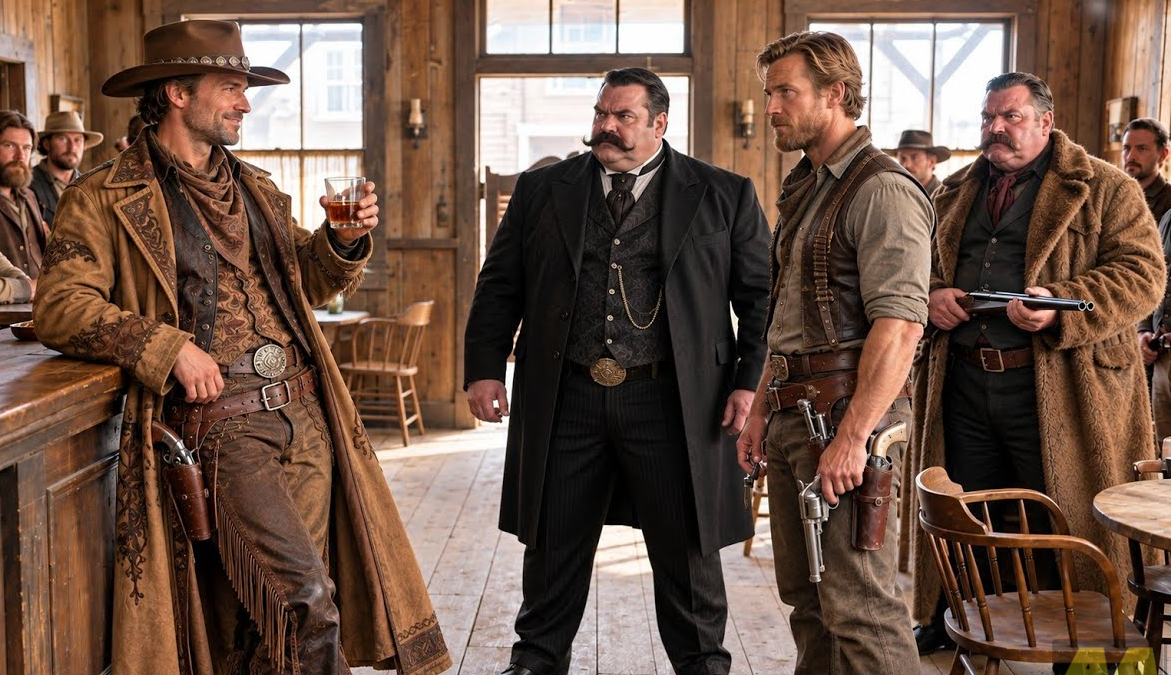
The doors of the Silver Spur Saloon went quiet before the stranger had even finished his drink.
Three hunters had ridden into Red Hollow with reputations so dark that grown men stepped aside when they passed, and now all three stood between the nameless gunman and the only exit.
One carried two revolvers, another was said to have never missed a man at 50 paces, and the third was a tracker whose name made fugitives look over their shoulders.
The biggest of them smiled and said, “You’re looking at the three most dangerous guns in the territory.”
The stranger slowly set down his glass. He looked at each man once. “I don’t see three gunslingers,” he said.
“I see three men walking toward the wrong end of a bad bargain.” Nobody in the room understood what he meant.
Not yet. Because the stranger was not trying to frighten them. He was warning them about something far worse moving toward Red Hollow from the open desert.
Before the night ended, the three hunters would discover that their reputation had been built on information that was never meant to be true.
Sheriff Ilas Boon would finally reveal a name he had kept hidden for seven years.
And the quiet man at the bar would be forced to decide whether the truth he had spent so long protecting was worth revealing at last?
Red Hollow had been built where sensible people would never have chosen to live. The town sat between red cliffs and miles of dry Arizona country, where the summer heat could bend the horizon until distant mountains appeared to float above the earth.
Silver had brought nearly 800 people into the valley during the boom years. Men came with picks, shovels, wagons, rifles, dreams, and enough confidence to believe the hills would provide for them forever.
By 1887, the richest veins were fading. The mine still operated, but fewer wagons came out loaded with ore.
Storekeepers had begun counting coins twice before making purchases. Boarding houses had empty rooms. Men who had once arrived wearing new boots were now walking the same streets in patched clothes.
Yet Red Hollow remained busy. It was a stopping place for cattlemen, prospectors, gamblers, fugitives, travelers, and men who preferred places where questions were considered bad manners.
Shortly before noon, a dusty gray horse entered the town. The rider looked somewhere around 40.
He was lean but broad through the shoulders, with weathered features, dark hair touching his collar, and eyes that seemed to notice everything without appearing to move.
His long brown duster had once been beautifully made, though years of sun had faded the shoulders.
A revolver hung low on his right hip. The weapon was not polished. The holster was not decorated.
Everything about the man suggested use rather than display. He tied his horse outside the Silver Spur, pushed through the swinging doors, ordered whiskey, and took the quietest corner of the bar.
Nobody paid much attention. That changed 20 minutes later. Sheriff Ilas Boon entered the saloon.
Boon was 63, silverhaired, heavy around the middle, and carried the exhausted expression of a man who had spent 30 years watching foolish people turn temporary anger into permanent trouble.
He took two steps inside. Then he stopped. His eyes fixed on the stranger. “Can’t be,” Boon whispered.
The stranger raised his glass. Their eyes met. The stranger gave the smallest shake of his head.
Boon understood. He turned away and walked toward the rear of the saloon without another word.
Unfortunately, someone else had noticed. Caleb Voss owned the Silver Spur and had built his fortune by collecting information almost as carefully as he collected money.
He was enormous, extravagantly dressed, and wore a sweeping black mustache that seemed almost too carefully maintained for a town as dusty as Red Hollow.
Voss also possessed enough political influence to make sheriffs cautious. He had seen Boon’s reaction.
By sundown, he intended to know exactly who had walked into his saloon. That was when the three hunters arrived.
Silus Crow entered firSt. He was narrow faced and dressed entirely in charcoal gray. Two revolvers rested at his hips, both with ivory colored grips.
Crow had spent years hunting fugitives across three territories, and people spoke about him as though he were a force of nature rather than a man.
Boon Mercer came next. He was blonde, muscular, and carried himself like someone who had spent years around cavalry horses and military camps.
His speed with a pistol had become famous. Men claimed he could draw before another man finished reaching for his weapon.
The third was Amos Red. He was massive, heavily bearded, and wrapped in a buffalo coat despite the heat.
A shortened shotgun rested in his hands. Together they were known as the Black Mesa 3.
Nobody used that name in front of them. They hunted fugitives for money. Rumor claimed they sometimes found work even when there were no warrants worth pursuing.
Voss greeted them as though he had been expecting them. The stranger watched their arrival through the reflection in the mirror behind the bottles.
Silus Crow eventually walked toward him. “You’re sitting in my place.” The stranger looked along the empty stools stretching down the bar.
“Seems you have choices.” Crow leaned closer. “I hear you rode in without a name.”
“I rode in with one.” “Then what is it?” “Just didn’t give it away.” A few men near the tables quietly moved farther back.
Crow smiled without warmth. “Maybe introductions would help.” He tapped his cheSt. “Silus Crow.” He pointed toward Mercer.
“Boon Mercer.” Then toward the large tracker. “Amos Red.” Crow rested both hands on the bar.
“Three hunters you’re unlikely to forget.” The stranger took another sip. “That what Voss told you?”
Crow’s smile disappeared. The stranger turned slowly on his stool. His gaze moved from Crow to Mercer and then to Red.
“I don’t see three gunslingers,” he said. “I see three men who have been given very bad information.”
Mercer’s hand drifted toward his revolver. Red shifted the shotgun. The stranger remained against the bar.
Then he said something that nobody expected. “You have maybe 6 hours.” Crow frowned. “If you’re still working for Voss when midnight comes, none of you sees sunrise.”
Voss laughed loudly from across the room. “Listen to him. A nameless drifter trying to frighten professional hunters.”
The stranger finally looked directly at Voss. “They’re not the ones I came for.” For the first time that evening, Voss stopped smiling.
The saloon doors opened again. Sheriff Boon stepped inside. “Everyone leave their iron where it is.”
His voice carried across the room. He approached the stranger. “You shouldn’t have come back.”
The stranger’s jaw tightened. Boon sighed. “His name is Daniel Creed.” The room changed. Older men recognized the name.
Younger ones did not. Silus Crow did. His expression changed firSt. Seven years earlier, Daniel Creed had served as a deputy United States marshal.
He had been responsible for transporting evidence connected to one of the largest criminal networks in the southweSt.
The wagon carrying that evidence had disappeared in Black Canyon. Five marshals were officially listed as having vanished during the incident.
Creed was listed among them. The newspapers had accepted the story. The territorial authorities had accepted it.
Most people had forgotten it. But Sheriff Boon had never forgotten. Neither had Daniel Creed.
Creed had survived the ambush and spent 7 years quietly following money, forged documents, false warrants, stolen cattle, bribed officials, and unexplained payments.
Every road eventually led toward Caleb Voss. Voss had not simply purchased stolen cattle. He had financed robberies, arranged false bounty warrants, influenced officials, and used professional hunters to remove people who learned too much.
Crow stared at Voss. “You told us Creed was responsible for the federal courier.” “He was,” Voss snapped.
“That warrant is legitimate.” Daniel slowly reached inside his coat. Every hand in the room seemed to tighten.
But he did not touch his revolver. He placed a folded document on the bar.
Sheriff Boon picked it up. A federal seal appeared at the bottom. He read the paper once.
Then again. “That warrant was cancelled four years ago.” Silence filled the saloon. “Freed has been working with federal investigators,” Boon added.
Mercer turned toward Voss. “You hired us on a cancelled warrant?” “I hired you to bring me a criminal.”
Voss shouted the words as though volume could restore his authority. “No!” Daniel’s voice cut through the room.
“You hired them because you knew I was coming.” Mercer stared at Voss. Crow did the same.
Amos Red remained strangely quiet. Then came the first surprise. Red slowly raised his shotgun.
He did not point it at Daniel. He pointed it toward Voss. Crow turned. “What are you doing?”
Red reached beneath his buffalo coat and removed a small leather ledger. He placed it on the bar.
“Found this two nights ago in Voss’s freight office.” Voss went pale. Red opened the ledger.
“Payments. Judges. Deputies. Bounty contracts. Freight accounts. Names of people who received money and names of people who were supposed to disappear from the record.”
Voss took one step backward. Red closed the ledger. “I figured I could use it to negotiate.”
Daniel looked at the book. For the first time, the corner of his mouth moved.
“That ledger is why you are finished.” Nobody answered. Then horses thundered outside. One. Then another.
Then many more. Every face in the saloon turned toward the windows. Riders were entering Red Hollow from both ends of town.
Not three horses. Dozens. Voss backed toward the staircase. “Those aren’t mine.” Daniel watched the street.
“No.” “Then whose are they?” “Jeremiah Pike.” Even Voss looked frightened. Pike controlled an outlaw network stretching from Arizona into New Mexico.
His organization had been responsible for robberies, cattle theft, and attacks on freight routes for years.
Voss had secretly been taking money from Pike. For years, he had skimmed portions of payments and falsified accounts.
Now Pike had learned that a ledger existed. Daniel had known Pike would come. That was the reason he had returned to Red Hollow.
Crow finally understood. “You used us as bait.” “I used Voss’s problem as bait.” Daniel looked toward him.
“You three chose where to stand.” Crow stared at him. Outside, a rifle cracked. The front window shattered.
Everyone dropped. The next moments had none of the clean simplicity that stories later gave them.
Wood splintered. Smoke rolled through the saloon. Horses screamed in the street. People crawled beneath tables.
Someone knocked over a chair. Sheriff Boon immediately began directing civilians toward the kitchen. “Back door.
Keep moving.” Daniel overturned a heavy table and pointed toward the side entrance. “Get them through the stable alley.”
Boon nodded. Crow moved toward the front. Mercer took position beside a support poSt. Red crouched near the rear window with his shotgun.
Daniel remained in the center of the room, watching the movement outside. He did not fire blindly.
Every time he raised his revolver, he waited until he knew exactly where the shot needed to go.
Mercer glanced at him. “You said we were finished.” Daniel reloaded. “You were if you stayed Voss’s men.”
Mercer stared at him. The meaning finally reached him. The sentence had never been a prophecy.
It had been a warning. And now it was a choice. Crow fired through the broken window.
Red moved toward the side entrance. Mercer covered the kitchen while Boon pushed the last civilians outside.
The battle continued through the afternoon. The attackers expected Voss to control the saloon. Instead, they found the town sheriff, three professional hunters, and one man who had spent seven years preparing for this exact confrontation.
Voss disappeared upstairs. Daniel noticed. He always noticed. He looked toward the staircase. Then he was moving.
He reached Voss’s office and found the window open. Outside, a roofline connected the saloon to the neighboring hotel.
Voss was already crossing it. He carried a leather satchel. Daniel climbed through the window.
The afternoon wind swept across the rooftops. Voss reached the far side and turned. A pistol appeared in his hand.
“Seven years,” he shouted. “You wasted seven years chasing me.” Daniel stopped 20 ft away.
“No.” Voss raised the pistol slightly. “You threw away your life.” Daniel looked at him.
“I spent seven years finding everyone you bought.” Voss laughed bitterly. “And what did it cost you?”
For a moment, Daniel said nothing. The question reached deeper than Voss could have known.
During those seven years, Daniel had lived under another identity. His family had believed he was gone.
His wife had been lost to fever while he remained hidden. His son had grown up believing his father would never return.
Daniel had stayed away because contacting them could have exposed them to the same network he was trying to dismantle.
He had sacrificed years that could never be recovered. But he had made one decision that separated him from the men he was pursuing.
He would bring the evidence to a courtroom. He would not become another man with a gun deciding who deserved punishment.
Voss raised his pistol. Daniel did not move. Then the roof beneath Voss gave way.
The rotten boards cracked. Voss dropped through the roofline and landed on the wagon awning below.
The pistol fell from his hand. Daniel climbed down. Sheriff Boon arrived moments later. Voss was taken into custody.
Daniel had never fired at him. Across town, Jeremiah Pike’s riders discovered that their escape routes were already blocked.
Federal marshals and territorial officers had been waiting beyond the southern ridge. The trap had been prepared before the first rider entered Red Hollow.
Pike’s organization suddenly found itself surrounded. Some riders surrendered. Others attempted to flee through the eastern wash.
The lawmen closed the route. By dawn, the shooting had stopped. Pike himself escaped temporarily, but most of his organization was captured.
And Amos Red’s ledger gave investigators something far more valuable than rumor. It gave them names.
Payments. Dates. Transactions. Connections. For the first time, the people who had operated behind false names and purchased protection with money had records that could be followed.
Red Hollow would remember the night for years. But the greatest surprise came after sunrise.
Silus Crow found Daniel outside the Silver Spur. The saloon had lost a window and part of its front railing.
Crow stood with his hands resting at his sides. “Why did you warn us?” Daniel tightened the strap on his saddle.
“I knew what people said you were.” Crow frowned. “That is not an answer.” “It is.”
Crow waited. Daniel looked toward Mercer. The blonde hunter was helping repair a damaged storefront.
Amos Red was carrying water toward an injured stableman. “They could have walked away,” Daniel said.
Crow glanced toward them. “So could I.” “You still can.” Crow looked back at Daniel.
For a long moment neither man spoke. Then Crow nodded. There was no handshake. No grand speech.
Only an understanding that reputations were often built by people who had never bothered to learn the truth.
Sheriff Boon approached carrying a telegram. He held it out to Daniel. Daniel opened it.
He read it once. Then again. His expression changed. Boon watched him carefully. “What does it say?”
Daniel folded the paper. “My son knows I’m alive.” Boon smiled. “Where is he?” “Prescott.”
“How old?” “17.” Boon studied Daniel’s face. For the first time since the previous afternoon, the man seemed uncertain.
The sheriff smiled wider. “Funny thing.” Daniel looked at him. “You can walk into a room with three armed hunters without blinking.”
Boon nodded toward the telegram. “But you are frightened of a boy.” Daniel folded the paper more carefully.
“Men with guns are simpler.” Boon laughed quietly. By afternoon, federal wagons carried Voss and the surviving members of his organization away from Red Hollow.
Crow, Mercer, and Red surrendered the questionable bounty documents they had been carrying and agreed to testify about what they knew.
Their partnership ended that day. Mercer eventually became a ranch foreman. Red became a legitimate tracker working with federal marshals.
Crow disappeared north. Years later, Daniel received an unsigned Christmas card. There were only four words written inside.
“Still not dead yet.” Daniel understood who had sent it. He kept the card. But before any of that happened, he still had one final ride to make.
Daniel Creed saddled his gray horse. Sheriff Boon stood in the street. The Silver Spur had reopened before noon.
Men were replacing the broken window. Someone had already swept the glass from the floor.
Daniel mounted. Boon raised one hand. Daniel returned the gesture. Then he turned his horse toward Prescott.
He rode until Red Hollow was behind him. At the top of a low ridge, he stopped.
The town sat beneath the red cliffs. Smoke rose from chimneys. The mine stood farther beyond the buildings.
The Silver Spur looked small from that distance. Daniel remained there for a moment. Seven years of searching had brought him back to the place where everything had begun to unravel.
He had arrived with no name. He was leaving with one. The newspapers later transformed the night into something far more dramatic than it had been.
They claimed Daniel Creed had faced three of the territory’s most feared hunters and frightened them into surrender with a single sentence.
They invented a duel that never happened. They exaggerated the number of riders. They called Creed the fastest gun alive.
Daniel hated every version. The truth was quieter. Three dangerous men had entered a saloon believing reputation had already decided who they were.
A stranger had told them that they were standing beside the wrong man. Then he had given them enough truth to change direction.
Daniel had learned during seven years that courage was not always about pulling a trigger before another man could.
Sometimes courage was refusing to pull one when anger gave you every reason. Sometimes it was carrying evidence instead of vengeance.
Sometimes it was returning to a son who might not know what to say when you finally stood in front of him.
And sometimes courage meant admitting that the life you had imagined seven years earlier no longer existed, while still having the strength to build something different.
Years later, people still asked Sheriff Boon about that afternoon in Red Hollow. They asked whether Daniel Creed truly looked at three of the most feared hunters in the territory and told them they were already walking toward the wrong end of a bad bargain.
Boon always smiled. Then he would lean closer and tell them the part the newspapers had missed.
“Creed wasn’t telling them how they were going to lose everything.” The old sheriff would pause.
“He was telling them they still had time to choose what came next.” And somewhere far beyond Red Hollow, Daniel Creed continued toward Prescott, carrying seven years of silence behind him and a telegram from his 17 year old son in his coat pocket.
For the first time in a very long while, he was not riding toward a man he had been searching for.
He was riding toward someone who had been waiting for him.
Disclaimer: This content may be created by Al for entertainment purposes. Any resemblance to real persons, events, or places is coincidental.








