I Discovered My Alien Roommate’s Secret — Now I’m Her Chosen Mate
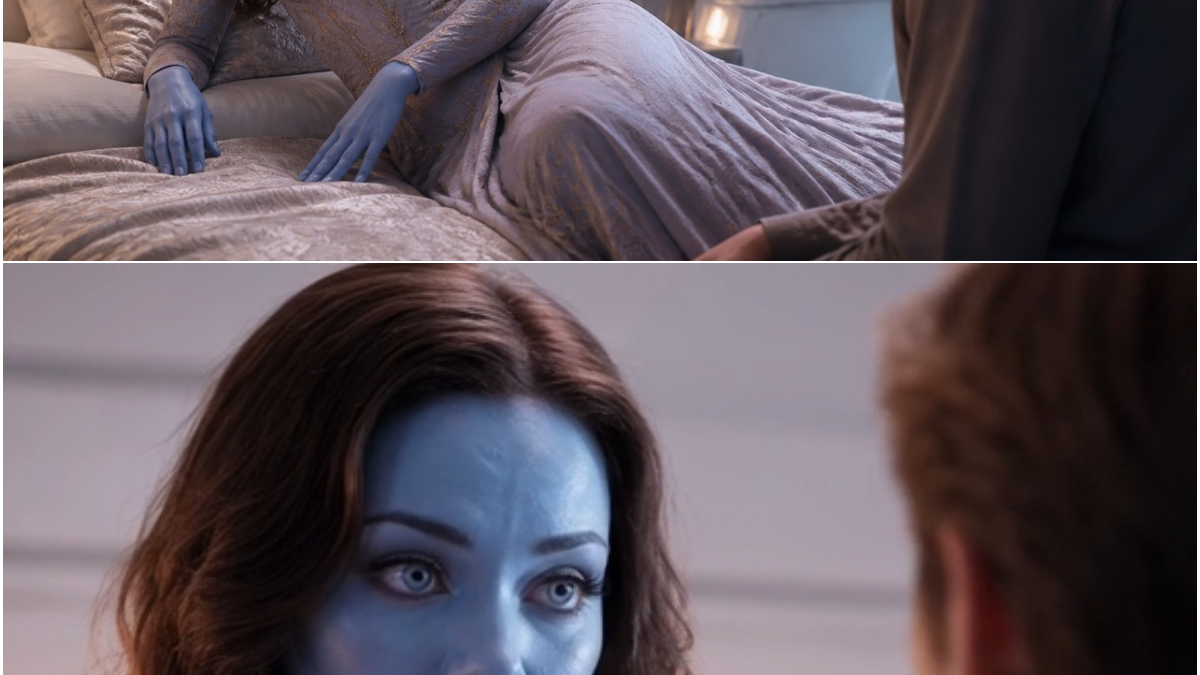
The magnetic seal engaged with a sharp click, and Marcus Chenafer suddenly understood how loud silence could become.
The sound echoed through the small research quarters aboard Helotrope, swallowing the familiar hum of the ventilation system and the distant vibrations of laboratory equipment.
Across the room, dr. Seth Nithalara stood with her back against the locked door, her pearl white skin glowing with a strange, intensifying rose gold light.
“Saveth, why did you lock the door?” She did not answer immediately. Her silvery blonde hair shimmered with pink filaments, each strand producing a warmth light that painted the walls in the colors of a distant sunset.
Her dark wine red eyes were fixed on him, their golden flecks spinning in patterns he had never witnessed during their four months of working together.
Marcus had studied alien biochemistry long enough to recognize when a body was communicating something its owner could not easily explain.
He had inherited that instinct from his mother, dr. Adiz Akaferchen, a biochemist who believed every biological mystery began with careful observation.
His father, Dr. James Chen, had taught him a complementary lesson through decades of studying bioluminescent creatures in the deepest Pacific waters.
But nothing in their combined experience had prepared him for the sight of his closest research partner glowing as though her entire body had become a living signal.
“The resonance cycle,” Saveth finally whispered. Marcus studied the rising warmth in her skin, the trembling light in her hair, and the unusual intensity of her gaze.
Something had changed, and whatever it was, it had already begun. “Then tell me what it means,” he said.
“And why does it seem to be happening because of me?” Saveth drew a careful breath, as though the answer itself might change everything between them.
For four months, Marcus had believed their partnership was built entirely on scientific curiosity, professional respect, and the occasional argument over experimental results.
Now, standing in a locked room with a brilliant alien scientist whose biology was behaving in ways neither of them had planned, he was beginning to suspect that their greatest discovery had never been written in a laboratory report.
And what would happen when he finally understood what her body had been trying to tell him?
“The resonance cycle occurs annually in mature Nithalari,” Saveth explained. Her voice had lost its usual precise, melodic rhythm.
Each word seemed to require concentration, and Marcus noticed that the rose gold beneath her skin was spreading farther across her neck and shoulders.
The pink filaments in her hair brightened again, casting a warm glow over the narrow bunks, the workstation, and the neatly arranged research equipment that occupied nearly every available surface.
“In ordinary circumstances, the cycle is managed through isolation. A Nithalari retreats to a sealed environment for eight to ten hours while the pheromone cascade completes.
The system produces its compounds, reaches saturation, and resets.” Marcus remained still, listening. “Then why is it happening now?
You said your cycle was scheduled for thirty seven standard days from now.” “It was.”
Saveth pressed her palms against the door. Her expression tightened as another wave of warmth passed through her body.
“My cycle is predictable. Since maturation, the timing has varied by less than forty eight hours.
This is not supposed to be happening.” “But it is.” “Yes.” She looked directly at him.
“And it is happening because of you.” The words seemed to change the atmosphere more profoundly than the increasing temperature.
Marcus had spent his career studying unfamiliar biological processes, and he had learned that an unexpected result was not necessarily an impossible one.
Still, this was different. The scientist standing before him was not simply reporting an unusual phenomenon.
She was telling him that his presence had altered a fundamental process in her body.
He moved a little closer, careful not to overwhelm her. “Start at the beginning. What does your pheromone system normally do?”
Saveth closed her eyes briefly, gathering her thoughts. “The resonance cycle is a maintenance process.
During periods without a compatible individual, the pheromone glands follow a self contained annual pattern.
They produce the necessary compounds, reach saturation, and reset. The cycle prevents the glands from becoming inactive.”
“And the acceleration?” “When my receptors detect a compatible biochemical signature over a sustained period, the system may interpret that signature as a possible complement.
If the interaction continues and reaches a certain threshold, the cycle can accelerate.” Marcus felt his scientific curiosity sharpen.
“So your receptors have been detecting my biochemical signature.” “For four months.” He looked at her, remembering the small changes he had observed throughout their assignment.
The adjustments to the ventilation. The different herbal mixtures she had begun preparing. The evenings when she disappeared into the atmospheric processing chamber and returned with an explanation about needing to reset her sensory systems.
He had suspected that something unusual was happening, but he had respected her privacy and her explanations.
“Why didn’t you tell me?” “Because I did not expect the response to become this strong.”
Saveth opened her eyes. The golden flecks inside them were moving rapidly, forming concentric patterns that Marcus recognized from the station’s xenobiology briefing materials.
“My body has been assessing your chemistry since the first week. Your volatile organic compounds interact with my receptor array in a way I have never experienced.
I adjusted my diet to suppress the response. I increased the ventilation in our quarters.
I spent several hours each evening breathing filtered air in the atmospheric processing chamber.” “And none of that worked.”
“No.” Her hair brightened again. “The system has reached its confirmation threshold. It has decided that your biochemical signature is complementary.
The resonance will not wait for its scheduled date.” Marcus considered the information carefully. His mother’s research had taught him that chemical communication was rarely simple.
A molecule could have different effects depending on concentration, receptor sensitivity, environmental conditions, and the broader metabolic state of the organism receiving it.
He wanted to ask about the compounds, the receptor binding kinetics, and the exact signaling pathways responsible for the luminescence.
He wanted to understand every detail. But there was another question that mattered more immediately.
“What happens if I leave the room?” Saveth’s expression changed. “If you leave during the active cascade, the system may undergo an uncoupled reset.
The complimentary signature that triggered the acceleration would disappear before the exchange completed.” “And what would that do to you?”
“The pheromone glands would continue producing compounds at cascade levels without the regulatory feedback they require.
The system would redirect its activity inward.” She hesitated. “The medical literature calls the resulting condition resonance shock.
It can cause severe physiological distress and require intensive metabolic support. In documented cases, the receptor array has sustained permanent damage.”
Marcus looked at the sealed door again. “So your body needs my biochemical signature to complete the process.”
“Yes.” “And separating us now could make you seriously ill.” “Yes.” He did not need another explanation.
“Then I’m staying.” He said it calmly, without hesitation. The decision seemed so obvious that he barely considered it a decision at all.
Saveth stared at him. “You do not understand what staying means.” “Then explain that too.”
“The exchange is continuous. For eight to ten hours, our biochemical systems will interact. My glands will produce the primary bonding compounds.
Your skin will absorb them and respond with your own volatile organic profile. The two systems will gradually integrate.”
“And afterward?” “The nithrine will be complete.” Marcus recognized the term from the foundational Nithalari biological literature he had been studying.
It referred to the warmth seal, a rare recognition event in which a Nithalari’s pheromone system encountered a signature that completed its molecular pattern.
He remembered reading that the response was believed to occur only once in a lifetime.
Most Nithalari never experienced it. “What happens to the people involved?” Saveth’s voice became quieter.
“Their biochemical signatures become permanently connected. The bond does not dissolve or weaken. It becomes part of the individual’s normal physiology.”
Marcus absorbed the information. “You mean I would be permanently bonded to you.” “Yes.” The room was quiet for several seconds.
Saveth’s glow had become almost overwhelming. Her pearl white skin was now deeply suffused with rose gold, while the pink filaments in her hair illuminated the space around them.
The warmth radiating from her body was measurable, and her eyes remained fixed on him with an intensity that made it difficult to look away.
Marcus thought about his parents. dr. Adiz Akaferchen had spent twenty six years studying the molecular architecture of stress responses and the complex signaling systems that regulated human physiology.
dr. James Chen had spent twenty eight years studying deep ocean organisms whose bioluminescence allowed them to communicate in places where sunlight never reached.
Their home in San Diego had been filled with conversations about molecules, organisms, signaling pathways, and the strange ways living things recognized one another.
His mother had taught him that the body’s signals belonged to the person producing them.
His father had taught him that biological connections sometimes required patience and sustained proximity. Marcus had inherited both lessons.
He had also inherited their habit of preparing for difficult questions long before anyone else realized those questions were coming.
Three weeks earlier, he had called his father late in the evening, when James was reviewing footage from a deep ocean observation project.
“Dad, in your anglerfish research, what happens when an organism tries to suppress a complimentary bioluminescent response?”
His father had paused. “The signaling compound builds. The luminescent organs increase their output to compensate.
Eventually, the organism becomes increasingly distressed until the suppression fails.” “And when it fails?” “The bonding cascade activates, often with greater intensity than it would have had if the organism had allowed the initial response.”
Marcus remembered the quiet that followed. “Is this hypothetical?” “It’s a comparative biochemistry question.” “It’s also about someone you care about.”
Marcus had not answered immediately. His father had smiled. “When it happens, whatever form it takes, stay.
The chemistry needs you present.” Now, sitting in the quarters with Saveth, Marcus understood how much that advice mattered.
“You’ve been fighting this for four months,” he said. “Yes.” “Because you were afraid of what would happen if you acknowledged it.”
Saveth lowered her gaze. “I was afraid of losing the life we had already built together.
I did not want to request a room reassignment and abandon our work. I did not want to tell you that my biology was responding to you in a way I could not control.”
“You thought you could complete the cycle without involving me.” “I thought I could manage it.”
Marcus sat on the edge of his bunk. His mother would have wanted to know the molecular structure of every compound involved.
She would have asked about the receptors, the signaling pathways, the metabolic heat, and the conditions that had caused the cycle to accelerate.
But Marcus was not his mother, and Saveth was not a laboratory specimen. He could be curious without treating her experience as an experiment.
“Saveth, I’ve known something was happening for a while.” Her head lifted. “You knew?” “I noticed the changes in your luminescence.
I noticed the ventilation adjustments. I noticed that you changed your diet several times and that you spent your evenings in atmospheric processing.”
“You noticed all of that?” “My mother taught me to read molecular behavior the way other parents teach their children to read facial expressions.”
Saveth looked genuinely astonished. “Then why did you say nothing?” “Because it was your body.
Your signals belonged to you. I could observe them, but I couldn’t decide what they meant for you before you were ready to explain them.”
He paused. “And because I wanted you to choose this, if it was what you wanted.
Not because your biology forced the question.” For the first time since she had locked the door, Saveth’s controlled expression began to soften.
She slid down against the door until she was sitting on the floor. Her knees drew toward her chest, and her arms folded around them.
Marcus recognized the posture immediately. It was the same position she adopted in the xenobotany laboratory when she was trying to solve a difficult problem.
Only now, the problem was not a question of cross biome pollination or germination rates.
It was the uncertainty of allowing another person to see her without the protection of scientific precision.
“My body has been telling me what I was unwilling to acknowledge,” she said. Marcus moved from the bunk and sat beside her, leaving enough space for her to decide whether she wanted him closer.
“What were you unwilling to acknowledge?” “That I liked being with you.” He waited. “I liked our conversations.
I liked our arguments. I liked that you asked questions carefully and never treated my unfamiliar biology as a curiosity to be displayed.
I liked that you changed your data presentations to match Nithalari visual processing.” “That seemed like a reasonable courtesy.”
“It was more than reasonable. No other human researcher has done that for me.” She looked down at their hands.
“I liked sharing meals with you. I liked hearing your thoughts about our research. I liked the way you made room for my habits without making me feel unusual.”
Her hair glowed softly. “I did not want to lose any of that.” Marcus felt something shift inside him.
It was not a biochemical response he needed to catalog or a signal he needed to compare against a reference chart.
It was a simpler kind of recognition. He had come to know Saveth over four months of shared work, late night discussions, meals, and the ordinary choreography of two people living in a space designed for efficiency rather than comfort.
He knew how she organized her research notes, how she paused before disagreeing, and how she leaned toward the workstation when a result surprised her.
He knew that her herbal infusion smelled like warm honey and tasted, to him, like liquid starlight.
He knew that she was brilliant, stubborn, careful, and quietly considerate. And he knew that he wanted to be beside her.
“I’m staying,” he repeated. Then he moved closer. Their shoulders touched. The response was immediate.
Rose gold light flared across Saveth’s skin at the point of contact, spreading outward in a delicate wave.
The pink filaments in her hair brightened, and the warmth around them intensified. Marcus felt the contact as both heat and information.
His cardiovascular system began adjusting, and his skin warmed where it pressed against hers. Saveth took a slow breath.
“The exchange begins at contact,” she explained. “My dermal glands will produce the primary bonding compound.
Your skin will absorb it, and your body will respond with its own volatile organic profile.”
“How long until equilibrium?” “Approximately eight hours.” “And we need to remain close?” “Continuous proximity.
Separation beyond two meters interrupts the exchange.” Marcus looked at their joined shoulders. “Then we’ll remain close.”
He reached for her hand. It was a deliberate gesture, not an automatic reaction. He wanted her to understand that his decision was not merely an attempt to prevent a medical emergency.
He was choosing to be there. Saveth’s fingers closed around his. The first wave of warmth passed through their joined hands, and Marcus felt his own body responding to the biochemical signal.
His mother’s scientific vocabulary could describe some of the process, but the experience itself was more complicated than any list of compounds.
His body was recognizing hers. The resonance cycle had begun. They eventually moved from the floor to Marcus’s bunk, where the stronger concentration of his ambient biochemical signature appeared to provide Saveth with some comfort.
He helped her settle against the wall and sat beside her, allowing her to rest her shoulder against his cheSt.
The quarters became a small world of pink and amber light. For the first hour, Saveth explained the process with the precision of a scientist describing a newly observed phenomenon.
She identified the compounds, discussed the receptor interactions, and described the sequence of metabolic changes expected during the cascade.
Marcus listened carefully, asking questions when he needed clarification. He was fascinated by the biology, but he was equally aware of the person experiencing it.
Whenever her voice faltered, he waited. Whenever she needed a moment to collect herself, he gave her one.
As the first hour passed, the warmth between them became steadier. The second hour brought a change in the quality of the exchange.
Saveth explained that the pheromone system was moving from assessment toward integration. Their individual signatures were beginning to form a combined biochemical profile.
Marcus felt the difference as a gradual settling. The early warmth had been directional, as though something inside Saveth was reaching toward him.
Now it was more diffuse, spreading evenly through the contact between them. Saveth leaned against him, resting her head between his shoulder and jaw.
It was the same position she often occupied during their evening research reviews, when she leaned close enough to see the workstation display while he explained an experimental result.
For months, he had assumed it was simply the most convenient angle for viewing two screens.
Now he wondered how much of their ordinary routine had been shaped by a connection neither of them had been ready to discuss.
“I’m sorry I didn’t tell you,” she said. Marcus looked down at her. “You don’t have to apologize for needing time.”
“I should have requested a room reassignment when I first noticed the response.” “Would you have wanted to?”
She was quiet. “No.” “Then I understand why you didn’t.” Saveth examined their interlaced fingers.
“I thought I could complete the resonance cycle in isolation. I thought I could reset the system before it reached the point where it required a complimentary signature.”
“But your body had already identified one.” “Yes. It was not interested in pretending otherwise.”
Marcus smiled faintly. “My mother says the body doesn’t care what’s supposed to be possible.”
“Your mother sounds like a formidable scientiSt.” “She is. She once spent forty seven consecutive hours characterizing a signaling peptide she had found in a sample.
My father brought her meals throughout the entire process.” “And what did he do during those visits?”
“Updated her on his latest bioluminescence observations. She incorporated two of his findings into her paper.”
Saveth’s hair pulsed with a gentle pink light. “They collaborated even while working in different fields.”
“They’ve been doing that for thirty two years.” She smiled. “Your parents must have a remarkable partnership.”
“They do. Their marriage is a biochemical collaboration that occasionally produces meals and offspring.” Saveth laughed.
The sound was warmer than Marcus remembered, carrying a subtle harmonic richness that he suspected was related to the active resonance.
The laughter made the small room feel less like a medical environment and more like the quarters they had shared for months.
“Tell me about them,” she said. Marcus told her about his father, James Chen, and his work studying bioluminescent pair bonding in deep ocean organisms.
He described the observation tanks, the submersible footage, and the strange beauty of creatures that found one another through light in places where sunlight never reached.
His father had spent decades studying organisms that lived under immense pressure, in water so dark that their own luminescence became their primary means of communication.
He had taught Marcus that the most interesting biological relationships were not always between similar organisms.
Sometimes, the strongest connections formed between complementary systems, each producing something the other required. Saveth listened closely.
“Your father studies bonding in darkness,” she said. “And his son found his own bond in a shared room barely larger than a submersible.”
“He’ll appreciate that comparison.” “He will also want to know about the nithrine.” “He’ll want to know everything.”
Marcus told her about his mother, Adiz Akaferchen, who had studied biochemistry at UCSF and spent her career investigating the molecular conversations that occurred beneath conscious awareness.
She had taught him to observe before interpreting, to respect the limits of available evidence, and to remember that understanding a biological process did not mean owning the experience of the organism involved.
Saveth seemed particularly interested in that last lesson. “She sounds like someone who understands the importance of boundaries.”
“She does. She also believes every important scientific discovery should eventually be discussed over dinner.”
“What does she cook?” “Jalaf rice. She makes it competitively.” “Competitively?” “She and my father have a long running argument about the correct preparation.
Neither will admit the other has ever made it properly.” Saveth laughed again. “I would like to meet them.”
Marcus felt the warmth in his chest deepen. “I think they’d like to meet you.”
During the third hour, Saveth began describing her home world. Nithfeller was a tidally locked planet, one hemisphere held in permanent daylight and the other in permanent darkness.
Between them lay a narrow habitable band of perpetual twilight. The Nithalari had evolved within that region, where natural illumination remained low and unchanging.
Their bioluminescence had become central to communication, social interaction, and emotional expression. Their pearl white skin produced a soft ambient glow, while the pink filaments in their hair generated warmth light in response to strong emotion.
The light was especially important in Nithalari culture because it could not easily be controlled.
“Speech can be shaped,” Saveth explained. “Expressions can be concealed. Even our ordinary skin luminescence can be adjusted through deliberate effort.
But the warmth light is connected directly to the emotional processing center.” “So it reveals what you feel.”
“Yes. It is the one signal that cannot be convincingly faked.” Marcus remembered the faint pink glow he had noticed during their early research arguments.
He had attributed it to intellectual excitement. Now he understood that it might have been something more personal.
“My hair has been responding to you since the second week,” Saveth said. “I thought I could interpret the light as professional excitement.
I was wrong.” “Your hair was trying to tell you something.” “It was trying to tell me something I did not want to hear.”
“And now?” She looked at him. “Now I am listening.” The fourth hour passed with a long conversation about their work.
Saveth described the pollination mechanisms they had been studying, the differences between the station’s biome samples, and the surprising ways certain plant species transported pollen across environments with radically different atmospheric conditions.
Marcus challenged one of her interpretations. She challenged his in return. For several minutes, they argued about the relationship between pollen transport efficiency and cross species germination rates.
Then Saveth began laughing. “What?” “We are discussing experimental methodology during a permanent biochemical bonding event.”
“We have a paper to finish.” “You are impossible.” “My confidence interval is still ninety two percent.”
“I have data from the third quadrant biome that may reduce it.” “Then I will revise the model.”
“You will revise it downward.” “I will revise it accurately.” Her warm light brightened. “There you are,” she said.
“Who?” “The man I wanted to spend my evenings arguing with.” Marcus looked at her, understanding that the argument had never been separate from their growing attachment.
Their scientific disagreements had become one of the ways they learned to trust one another.
He remembered the evenings when she had stayed late to examine his results, the careful notes she left beside his workstation, and the quiet satisfaction she showed whenever one of their experiments produced a result neither had anticipated.
He had valued those moments long before he understood the biological process accompanying them. Now, as the resonance continued, the distinction between their professional collaboration and their personal connection seemed less important than the trust beneath both.
The fifth and sixth hours brought the integration plateau. The pheromone exchange had progressed beyond its early stages.
Their individual biochemical signatures were becoming increasingly difficult to distinguish, and both systems were beginning to produce synchronized compounds.
Marcus noticed that his body had settled into a rhythm that seemed connected to Saveth’s presence.
The warmth no longer felt like a signal demanding a response. It felt like a shared condition, something stable and quietly reassuring.
Saveth rested against him, her breathing slow and even. The rose gold beneath her skin had deepened into amber, and the pink filaments in her hair glowed with a gentle, steady light.
“This is different,” Marcus said. “The integration phase.” “Does it feel different to you?” “Yes.”
“How?” She considered the question. “Earlier, my body was reaching toward your biochemical signature. Now it is incorporating it.
The difference is subtle, but complete.” Marcus looked at their joined hands. “And when the process finishes?”
“The combined profile becomes permanent.” He thought about his father’s research again, about the deep ocean organisms that produced complementary light patterns.
James had once described the moment when two anglerfish recognized each other’s signals as one of the most beautiful events in biology.
Not because the organisms were identical, but because their differences created the conditions for a connection neither could produce alone.
Marcus had grown up hearing that explanation. Now he was experiencing a version of it himself.
During the seventh hour, Saveth’s glow began to stabilize. The intense rose gold of the early cascade had softened into a rich amber.
Her hair no longer blazed with the brightness of an incandescent filament. Instead, the pink threads produced a constant, gentle light.
“The nithrine is complete,” she said. Marcus looked at her. “The warmth seal?” “It is set.”
She lifted their joined hands. At the points where their skin touched, the amber glow pulsed softly.
“My pheromone system has integrated your biochemical signature as permanent, complementary, and essential.” Marcus studied her expression.
“How permanent?” “For the rest of my life.” “And mine?” “The integration is reciprocal. Your physiology has already incorporated the bonding compounds into its normal signaling pattern.”
He took a slow breath. “So this is it.” “This is it.” Saveth watched him carefully, perhaps searching for a sign of uncertainty or regret.
Instead, Marcus thought of the first day they had met, when the UEDC had assigned him to work with the station’s leading xenobotaniSt.
He remembered her formal introduction, the precision of her research presentation, and the way she had challenged one of his assumptions before they had even finished their first meeting.
He remembered the shared meals, the late night arguments, and the small gestures of consideration that had gradually become part of their routine.
He remembered the faint pink light in her hair, which he had never understood until now.
He had spent four months learning her scientific habits. He had spent four months learning her personality.
And now he had discovered that the person he wanted beside him was also the person his biology had learned to recognize.
“What do your people call this state?” He asked. “The warmth seal. The nithrine. There are several terms, depending on whether we are describing the biological process or the cultural relationship.”
Marcus considered the question. “My mother calls it molecular recognition.” “And your father?” “Finding your frequency.”
Saveth’s eyes softened. “And what do you call it?” Marcus smiled. “I think I call it being lucky enough to get assigned the right roommate.”
She kissed him. It was warm, deliberate, and unhurried. The final stages of the exchange settled into place, and the amber light at their contact points pulsed gently.
The taste reminded Marcus of her herbal infusion, the warm honey and strange sweetness he had accidentally discovered during their first week together.
It also reminded him of the small details that had brought them to this moment.
The shared meals. The arguments. The truSt. The patience. The countless ordinary moments that had become extraordinary without either of them recognizing when the change had begun.
By the end of the eighth hour, Saveth’s breathing had settled into a calm, steady rhythm.
The resonance cycle had completed its work. The quarters were quiet again, but the silence no longer felt like the tense stillness that had followed the magnetic seal.
It felt peaceful. Saveth remained close to him, her head resting against his shoulder, her hair casting a soft pink glow over the bunk.
“I should have told you sooner,” she said. Marcus gently brushed a strand of silvery blonde hair away from her face.
“You told me when you were ready.” “I was afraid.” “I know.” “I was afraid that if I acknowledged the response, everything would change.”
“Everything did change.” “Yes.” “But not everything we had before was loSt.” She looked at him.
“Our research partnership?” “Still here.” “Our arguments?” “Already started again.” “Our shared meals?” “I expect them to continue.”
“And the person you thought I was before tonight?” Marcus smiled. “She is still here too.”
Saveth’s warmth light pulsed gently. For a moment, she seemed unable to find a response.
Then she leaned against him again. In the morning, Marcus called his parents. It was three hundred a.m. Pacific time, and both answered with the alertness of scientists accustomed to receiving important calls at unusual hours.
His mother appeared first on the screen, sitting at her home workstation. Behind her were shelves of research materials and the familiar equipment she used for her biochemical studies.
His father appeared beside her a moment later, wearing the expression Marcus remembered from childhood whenever a new discovery had become too interesting to ignore.
“Mom, Dad, I need to tell you something.” Adiz studied his face. “You bonded.” Marcus stared.
“What?” “Your ambient volatile organic compound signature shifted during the last several weeks. I noticed the changes during our recent video calls.”
His father nodded. “The bioluminescence reflected on your face also changed. The spectral pattern suggested a developing pair bonding response.”
“You noticed all that through a video call?” “I am a biochemist,” his mother said.
“I’ve spent twenty six years analyzing human volatile organic compound profiles. Your upper cheek flush changed between your third and fourth weekly check ins.
The spectral distribution was consistent with a pheromone mediated vasodilation response.” Marcus looked from one parent to the other.
“You discussed my biochemistry?” “Extensively,” Adiz replied. “Your father compared your observations with his anglerfish data,” she continued.
“I reviewed the Nithalari warmth seal literature you sent us last month.” “That paper was background reading for our collaboration.”
His father smiled. “We recognized that you were researching your roommate’s bonding biology and trying not to admit why.”
Marcus laughed. His mother continued. “We compared the cascade timelines, the proximity requirements, and the bioluminescent frequency patterns.
Your father developed a projection based on the concentration of your ambient compounds in a sealed environment.”
“And what did he predict?” “Four to five months of cohabitation.” Marcus glanced at Saveth.
“It happened at four months and nine days.” His father looked pleased. “Very close.” “Do not encourage him,” Adiz said.
“He will bring that projection up at every family dinner for the next decade.” Saveth stepped closer to Marcus and placed a hand on his shoulder.
Her pearl white skin glowed with steady amber warmth, and the pink threads in her hair cast a soft light around her face.
“dr. Akaferchen,” she said, “I look forward to meeting you. I would also like to see your gas chromatograph.”
Adiz’s expression changed immediately. The delighted smile that appeared on her face was so genuine that Marcus almost laughed again.
“You want to see my chromatograph?” “Yes. I would like to understand the bonding compounds and compare the receptor response with the available Nithalari data.”
“James,” Adiz said, turning toward her husband. “She wants to see the chromatograph.” “Of course she does,” James replied.
“She’s a scientist who has just completed a remarkable biochemical event.” “And I’m making jalaf rice,” Adiz added.
“You both should come home for Christmas.” Saveth looked at Marcus. He smiled. “I think we can arrange that.”
His father leaned toward the screen. “I want to compare the warmth seal with my deep ocean pair bonding observations.
The similarities could be significant.” “They will be,” Marcus said. The conversation continued for some time.
Adiz wanted to discuss the biochemical panel she planned to prepare. James wanted to review the resonance timeline.
Saveth asked questions about the equipment and the observation methods used in the deep ocean studies.
By the time the call ended, Marcus had a list of research questions, a possible visit to San Diego, and two parents who were already treating Saveth as part of their scientific and family lives.
When the screen went dark, Saveth remained beside him. “Your parents are very enthusiastic.” “They’ve spent thirty two years discussing molecules over dinner.
They were never going to react to this casually.” “They seem happy.” “They are.” Saveth looked toward the door.
The magnetic seal had remained engaged throughout the night. Now, with the resonance completed, there was no longer a biological reason to keep the quarters closed.
She reached for the control panel and disengaged the lock. The seal released with a quiet click.
This time, the sound seemed almost insignificant. The corridor beyond was beginning to fill with the ordinary activity of the station’s morning shift.
Researchers were heading toward their workstations. Laboratory systems were returning from standby. Conversations drifted through the ventilation network, accompanied by the distant hum of the facility.
Their quarters had been sealed overnight, and the station’s small community would certainly notice. Saveth did not appear worried.
“The nithrine is a recognized biological event,” she said. “It will be documented in the medical log, and the cultural liaison can confirm its legitimacy.”
“And the part where we’ve been research partners for four months?” “That requires a conversation with the station commander.”
“About whether we can keep working together?” “Yes.” “What’s your recommendation?” “Our partnership should continue.”
Marcus raised an eyebrow. “You’re recommending that we remain research partners after becoming permanently bonded?”
“Our professional work has been excellent. We have produced three joint publications in four months.
The nithrine does not diminish our scientific abilities.” “It could introduce questions about objectivity.” “Then we will document our methods carefully, maintain independent review procedures, and disclose any potential conflict of intereSt.”
Marcus smiled. “You’ve already thought about this.” “I have been thinking about it for four months.”
“Of course you have.” Saveth’s eyes brightened. “The enhanced cognitive synchronization associated with the warmth seal may also improve our collaborative output.”
“You’re saying the bond could make us better scientists.” “I am saying that it may improve certain aspects of our collaboration.
The results will need to be measured.” Marcus laughed. “My mother is going to love you.”
“I know.” He looked at her again. The pearl white skin, the settled amber warmth, the wine red eyes with their golden flecks, and the silvery blonde hair glowing softly in the morning light were all familiar now, yet somehow different.
The bond had not replaced the person he knew. It had made the connection between them impossible to ignore.
He stepped toward her. Saveth’s warmth light responded with a gentle pulse, spreading across her skin and following his movement.
“The station commander will want an explanation for the sealed door,” she said. “Tell her the truth.”
“And what is the truth?” “The biochemistry required it.” She considered that answer. “It is accurate.”
“Then we’ll start there.” “And afterward?” “We go back to work.” Saveth’s expression brightened. “We have a pollination transport paper to finish.”
“And you have data from the third quadrant biome that you believe will challenge my germination hypothesis.”
“It will challenge your confidence interval.” “My model currently stands at ninety two percent.” “My new results may reduce it to eighty seven.”
“Then I’ll revise the model.” “You will revise it downward.” “I will revise it accurately.”
Saveth laughed, and her hair produced a soft, warm glow. “Then you will help me, because you are my research partner and my warmth sealed complement.”
“And because collaborative disagreement is the most productive form of partnership in known science.” She looked pleased.
“Your parents have taught you well.” “They’ve had thirty two years of practice.” Marcus reached for her hand again.
Together, they stepped toward the open doorway, leaving behind the small room where their ordinary working relationship had become something neither of them had expected, but both had chosen to accept.
Beyond the door waited the station, the research, the unanswered questions, and the familiar challenges of two scientists determined to understand a universe full of complicated biological systems.
They would still argue about methodology. They would still challenge each other’s conclusions. They would still share meals, compare results, and spend long evenings discussing the smallest details of their experiments.
Only now, beneath every conversation and every disagreement, their biochemical signatures would remain connected. Saveth glanced at him as they entered the corridor.
“And jalaf rice,” she said. “And jalaf rice,” Marcus agreed. Her hair pulsed once, soft and pink, like a heartbeat made of light.
Disclaimer: This content may be created by Al for entertainment purposes. Any resemblance to real persons, events, or places is coincidental.








