“I Am Not Fit for Any Man, The Curvy Orc Woman Said—But I Can Love Your Children.” The Cowboy Went Quiet…
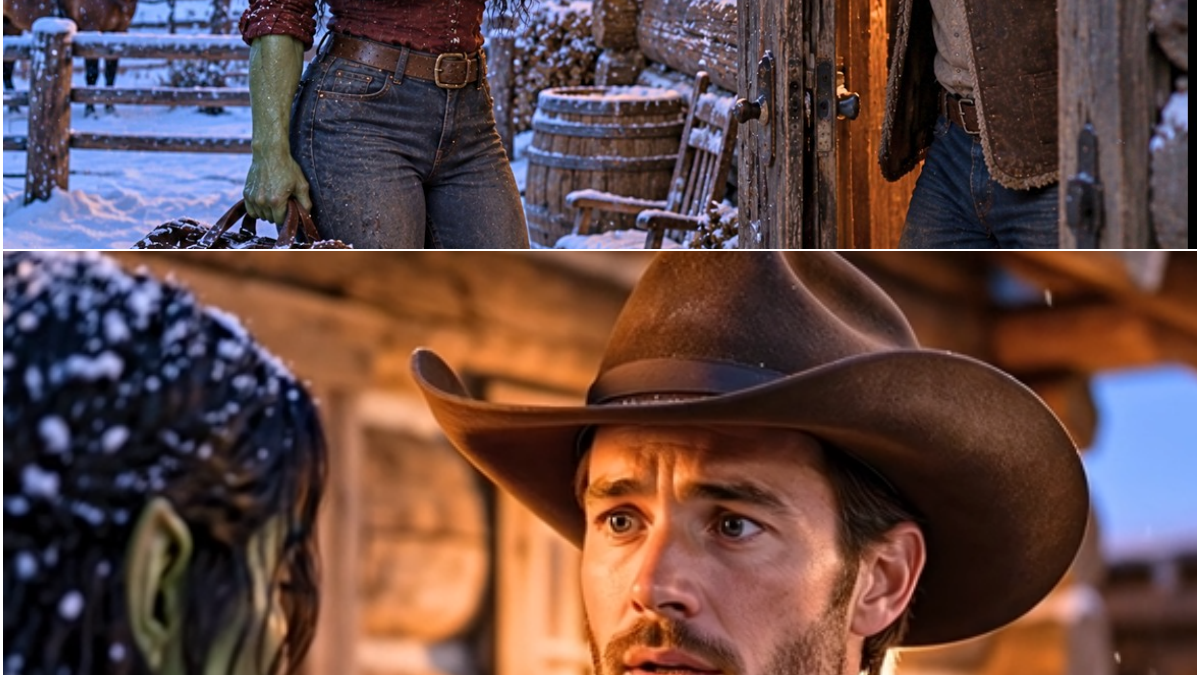
Dust had a way of settling over Oak Haven, finding its way into every crack in the farmhouse walls, every fold of a work shirt, and every quiet corner where a person kept the things they could not bring themselves to say aloud.
For Wade, it had settled over everything. His ranch was struggling, his children were restless, and the empty space left in his home had become harder to ignore with every passing morning.
He had spent months telling himself that if he worked long enough, slept little enough, and kept his hands busy, he could hold the pieces of his life together.
But a man could mend fences, feed cattle, and repair machinery. He could not be in two places at once, and he could not make a home feel whole through stubbornness alone.
So when he went looking for help, he expected to find someone willing to do the work nobody else wanted.
He did not expect to find Ursa, a broad-shouldered orc woman with scarred hands, quiet eyes, and a lifetime of reasons to keep her distance.
He certainly did not expect her to become the steady center of his household, or to make his children feel safe in ways he had struggled to manage himself.
And Ursa had no reason to believe a place like that could ever belong to her.
What could happen when two people who had learned to live without tenderness found themselves sharing the same home?
The beans were burning. Wade Graves stood over the cast iron stove, coughing as smoke curled toward the low kitchen ceiling.
He grabbed the handle of the pan with a rag, lifted it from the heat, and nearly dropped it when the cloth slipped against the hot iron.
“Damn it.” He set the pan down and waved a hand through the smoke, trying to clear enough air to breathe.
Outside, Toby was crying on the porch because a splinter had lodged in his finger.
Clara, who had turned four not long ago, was sitting on the living room floor with a cushion in her lap, pulling out handfuls of stuffing as if she had discovered a remarkable new game.
Wade looked from the stove to the doorway and then toward the ceiling. Four months.
That was how long he had been trying to manage the ranch, the house, and the children without Sarah.
Four months of waking before sunrise, falling asleep whenever exhaustion finally caught him, and discovering that every ordinary task seemed to multiply when there was nobody beside him to share it.
His hands were rough from repairing fences. His back hurt from lifting feed sacks and wrestling stubborn equipment.
He had slept perhaps three hours the night before, and the day was already slipping away from him.
He needed a ranch hand. He needed someone who could cook, clean, and keep an eye on two young children.
He needed help that he could afford. The trouble was that he could barely afford any help at all.
That morning, Wade had visited the employment board in Oak Haven. The human workers available there wanted wages and working conditions that made sense for them, but not for a rancher whose accounts were already stretched thin.
He had thanked them, walked away, and continued toward the edge of town, where laborers from other communities gathered.
That was where he found Ursa. She stood outside a supply shed, waiting with a battered leather duffel at her feet.
She was six feet three inches tall, with a sturdy frame, broad shoulders, and thick arms that suggested years of demanding work.
Her skin was the muted green of dried sagebrush. Two small ivory tusks curved upward from her lower jaw, and her dark eyes watched the street without seeming to expect anything from it.
Wade had seen orcs working timber yards, hauling stone, and repairing roads. He had never hired one to manage a household.
He had also never met anyone who looked quite so determined not to be noticed.
He asked whether she was looking for work. She said she would take domestic labor if the pay was fair and the arrangements were clear.
Now she stood on his porch, filling the doorway with her presence. “You the man who needs help?”
She asked. Her voice was low and rough, like gravel rolling in a metal bucket.
“I am,” Wade replied. “Come on in. Mind the mess.” Ursa stepped across the threshold.
The floorboards creaked beneath her boots. She ducked her head slightly to clear the frame and glanced around the kitchen.
She saw the ruined beans, the muddy floor, the peeling wallpaper, and Clara sitting in the middle of the destroyed cushion.
She did not comment. Wade felt his face grow warm. “It’s a wreck. I’ve been trying to keep up with the herd.
South fence is busted, the tractor’s acting up, and the children have been running wild lately.”
Ursa set her bag down. “Where’s the flour?” Wade pointed toward the pantry. She moved to the stove, lifted the pan with her bare hand, and scraped the blackened beans into a bucket.
Then she washed the pan, found the flour, and began working without waiting for further instructions.
Wade went outside to repair the tractor carburetor. He tried to concentrate, but his attention kept drifting toward the kitchen window.
He expected to hear shouting. He expected Clara to cry, Toby to complain, and the whole afternoon to become more difficult than it already was.
Instead, the house grew quiet. Three hours later, when Wade finally came inside, the first thing he noticed was the smell.
Beef stew simmered on the stove. Biscuits were cooling on a plate. The kitchen floor had been swept and scrubbed, and the smoke had disappeared.
The second thing he noticed was the living room. Clara sat in Ursa’s lap, studying the orc woman’s hands with complete fascination.
Ursa was repairing the torn cushion with thick thread and a small silver needle. Her large fingers moved slowly and carefully, making each stitch neat and secure.
Toby sat across from her, watching every movement. “Did you fight a bear?” He asked, pointing toward a long white scar on her forearm.
“No,” Ursa replied. “What happened?” “Barbed wire. Sheep got stuck in a ditch.” “Did the sheep get out?”
“Yes.” “Was it scared?” “Very.” Toby considered that answer. “Were you scared?” Ursa tied off the thread and examined the repaired seam.
“Not enough to leave it there.” Wade leaned against the doorway. The room looked different.
It was still the same old farmhouse, with the same worn furniture and the same uneven floorboards.
But the children were calm, and Ursa had somehow made the place feel lived in rather than merely occupied.
She glanced up and noticed him watching. “Stew’s ready,” she said, standing. “I’ll sleep in the barn.”
“No,” Wade answered quickly. “There’s a spare room off the back hall. It has a real bed.”
Ursa looked toward the hallway. “Beds are soft. I’m heavy. Might break it.” “It’s solid oak.
It’ll hold.” She studied his face for a moment, then nodded. At dinner, Ursa ate standing at the counter.
Wade asked her twice to sit with them, but she declined both times. She said her legs needed stretching.
He suspected she simply did not believe she belonged at the family table. He did not press her.
The next morning, Wade woke to the sound of an axe striking wood. The sky outside was still dark, with a faint line of dawn showing beyond the ridge.
He pulled on his jeans and boots and walked onto the porch. Ursa stood beside the woodpile, swinging a heavy maul.
Each strike split another thick log cleanly in two. Her movements were powerful and practiced, with none of the wasted effort Wade often saw in inexperienced workers.
She stopped when she noticed him. Immediately, her shoulders drew inward. She set the maul down and crossed her arms over her cheSt.
“Wood was low,” she muttered. “You didn’t have to do that before breakfaSt.” “I like the work.
Keeps my head quiet.” Wade stepped off the porch and looked at the neatly split pile.
“I appreciate it, Ursa. Really.” She nodded and returned to the task. Days settled into a rhythm.
Ursa handled the house and helped with the ranch whenever she finished her domestic work.
She carried feed bags that would have required two ordinary workers. She repaired gates, stacked wood, and cleaned equipment with a patience Wade had never possessed.
But it was her gentleness that surprised him moSt. She lifted Clara as if the child were made of glass.
She let Toby follow her around the property, asking endless questions about tools, animals, and the world beyond the valley.
When the children became noisy, Ursa rarely raised her voice. She simply waited until they noticed her looking at them, then asked what they intended to do next.
They listened to her. They trusted her. Wade began to realize that the children were not merely behaving better.
They were becoming happier. One Thursday evening, a storm rolled over the ridge. Thunder shook the windows, and rain swept across the pasture in heavy sheets.
Wade was near the creek when he heard the frantic bawling of a yearling calf.
The animal had caught its hind legs in loose barbed wire and was struggling so violently that the wire had tightened around it.
Wade dropped to his knees in the mud and tried to hold the calf still.
It kicked and twisted, nearly striking him in the face. He reached for his cutters, but every time he shifted his weight, the animal struggled harder.
Then he heard heavy footsteps splashing through the rain. Ursa appeared beside him. She did not ask what had happened.
She simply planted her boots deep in the mud, placed one hand against the calf’s shoulder, and braced the other against its flank.
The animal thrashed. Ursa held firm. “Cut it!” She shouted over the thunder. Wade leaned forward and worked the cutters around the taut wire.
With Ursa holding the calf steady, he managed to sever the strands one by one.
The yearling stumbled free and ran toward the herd. Wade fell backward into the mud, breathing hard.
Rain ran down his face and into his collar. He looked up at Ursa. She stood over him, soaked through, her dark hair flattened against her head.
Her clothes clung to her powerful frame, and water dripped from the ends of her tusks.
For a moment, Wade saw her differently. Not as the hired worker who had appeared on his porch, not as the strong stranger who could repair a fence or lift a feed sack, but as a woman whose courage and presence had become essential to his life.
Ursa caught his gaze. She looked down at herself and turned away, folding her arms over her cheSt.
“Get inside,” she muttered. “You’ll freeze.” Later, after the storm passed, Wade sat on the covered porch with a bottle of inexpensive whiskey.
The fields were dark, and the roof dripped steadily into the yard. Ursa came outside wearing dry clothes and an oversized flannel shirt.
“Grab a chair,” Wade offered. “I prefer standing.” He poured a little whiskey into a mug and pushed it toward her.
She took it, swallowed the drink, and set the mug down. “You saved that calf,” Wade said.
“It was stuck.” “You saved me from spending half the night in town getting stitched up, too.”
“Was only mud.” “It was more than that.” Ursa looked toward the fields. Wade leaned forward in his chair.
“Since you got here, the kids have been smiling again. The house smells like food.
I can actually breathe. You’ve done more for this place than I know how to explain.”
She tightened her grip on the railing. “You’re a good woman, Ursa,” he continued. “Some man is going to be lucky to have you someday.
You could have a family of your own.” The change in her was immediate. Her shoulders stiffened.
Her gaze dropped to her hands, which were broad and scarred, with dirt embedded in the creases of her skin.
A short, hollow laugh escaped her. “I’m not fit for any man,” she said quietly.
“But I can love your children.” Wade went still. He had meant to offer comfort.
Instead, he had touched a place inside her that had been sore for years. Ursa kept her eyes on her hands.
“People see these,” she said. “They see the tusks. They see a body built for lifting and breaking.
They don’t see a woman they want to hold close. They see a worker. A beaSt. Something useful when the job is hard.”
Wade listened without interrupting. He wanted to tell her that she was wrong, that she was beautiful, that the world had treated her unfairly.
But he knew that words spoken too quickly could sound like another empty promise. So he stayed beside her.
For a long time, neither of them spoke. The rainwater continued dripping from the roof, and the crickets gradually returned to the grass.
At last, Ursa turned toward him. “I meant what I said,” she whispered. “I can love the children.”
“I know,” Wade replied. She looked away again. “And I’m grateful for that,” he added.
“More than you know.” The following week, Wade had to take the truck into town for supplies.
He needed forty bags of winter oats and a few parts for the tractor. He also had to pick up medicine for Clara.
Ursa usually preferred staying at the ranch on town days. Oak Haven was not a welcoming place for an orc woman, and she had learned to avoid situations where people stared or whispered.
But Wade needed help loading the feed. “You’re coming with us,” he told her. “I can finish the fence line.”
“The fence can wait.” She looked at him for a moment, then climbed into the passenger seat.
The truck’s air conditioning had stopped working years earlier. Hot wind swept through the open windows as Wade drove along the county road.
Toby and Clara sat between them, arguing over a piece of taffy that had melted in the heat.
When they reached Main Street, Wade parked outside the diner. “We’re eating first,” he announced.
Ursa kept her hand on the door handle. “I’ll wait here.” “No, you won’t.” “They don’t like my kind in there.”
“I don’t give a damn what they like. You work for me. You eat with us.”
Wade climbed out, lifted Clara onto his hip, and started toward the diner. Toby scrambled after him.
“Come on, Ursa!” The boy called. “They have pie!” Ursa sighed and stepped down from the truck.
She followed them inside, her wide-brimmed canvas hat pulled low. The bell above the door jingled.
Conversation faded almost immediately. Silverware stopped clattering, and people turned in their booths to look at the towering green woman entering behind the cowboy and his children.
Ursa’s shoulders drew inward. Her eyes fixed on the checkered floor. Wade noticed. He did not make a speech or challenge the entire room.
He simply walked to the largest booth in the back, sat down with Clara, and patted the bench across from him.
Ursa squeezed into the seat. Her knees crowded the underside of the table, and the vinyl creaked beneath her weight.
A waitress named Betty approached, keeping her eyes mostly on Wade. “What can I get you?”
“The usual for me and the kids,” he said. “And a double order of chicken fried steak for Ursa.
Mashed potatoes, extra gravy.” Betty hesitated, then nodded. “Coming right up.” A harsh laugh came from the counter.
Carter, a local rancher with a comfortable inheritance and a habit of speaking as if the whole town belonged to him, leaned back on his stool.
“Didn’t know you started running a charity for stray beasts, Wade.” Ursa flinched. Carter continued, louder this time.
“Careful she doesn’t eat your kids when the grain runs out.” Wade set down his water glass.
He looked directly at Carter. “She pulled a yearling out of creek mud in a thunderstorm,” he said evenly.
“She split two cords of wood before you were awake enough to complain about your back.
She keeps my children laughing, and she eats at my table.” Carter gave a dismissive snort.
Wade leaned forward. “You got a problem with the company I keep? You can step outside and we can discuss it.
Otherwise, drink your coffee and leave her alone.” The diner went quiet. Carter’s face reddened.
He looked around, perhaps expecting someone to join him, but nobody did. After a moment, he tossed a dollar on the counter and walked out.
The door slammed behind him. Wade picked up a crayon and began drawing a tractor on Clara’s placemat.
He did not look at Ursa, giving her time to settle herself. When the food arrived, Ursa stared at the plate.
The steak was covered in gravy. The potatoes were piled high, and a warm biscuit rested beside them.
She looked across the table at Wade, who was cutting a pancake into small pieces for Clara.
“You didn’t have to do that,” she said softly. Wade kept his attention on the child’s plate.
“Eat your food before it gets cold.” Ursa picked up her fork. For once, she did not feel that every bite came with a debt of shame.
By late October, the first frost had settled over the pasture. Wade and Ursa spent their days repairing the roof of the loafing shed before the snow arrived.
Ursa climbed onto the rafters to pull sheets of corrugated tin into place. Wade worked below, securing the beams and passing up tools.
The wind grew sharper as the afternoon advanced. Then came a sudden crack. A jagged piece of old roofing slipped loose and sliced across Ursa’s palm.
She grunted but kept hold of the rope. “I’m good,” she called down. “Get down here,” Wade ordered.
“It’s a scratch.” “Down. Now.” She scowled, but climbed down the ladder. When her boots reached the dirt, she tried to hide her injured hand inside her jacket.
Wade stepped closer. “Show me.” “It’s nothing.” “Ursa.” She pulled her hand out. The cut was deep, and blood was running over her palm.
“I can wrap it,” she said, reaching for a dirty rag. Wade caught her wrist before she could use it.
“Not with that. Come inside.” “The roof—” “Will still be there in an hour.” He led her to the farmhouse and brought her into the small bathroom.
The room was barely large enough for both of them, and Ursa had to sit sideways on the edge of the tub to make space.
Wade gathered warm water, a clean cloth, iodine, gauze, and medical tape. Then he pulled a small stool in front of her.
“Give me your hand.” Ursa hesitated. “Just clean it,” she whispered. “Don’t fuss.” He took her hand in both of his.
She went rigid. Wade noticed the reaction, but he did not let go. He dipped the cloth into the water and began cleaning the wound carefully, removing the dirt from the creases of her palm.
Her hand trembled. “My hands are ugly,” she said. “They’re hands.” “They’re dirty. Scarred. Too big.”
Wade looked up at her. “They’re not ugly.” She turned her face toward the wallpaper.
“They’re monster’s hands.” Wade stopped cleaning. “These hands sewed Clara’s favorite cushion back together,” he said.
“They picked Toby up when he scraped his knee. They kept this ranch from falling apart.
They’ve helped me keep my children safe.” Ursa stared at the floor. “They’re built for breaking things,” she murmured.
“They’re built for doing what needs doing.” He cleaned the wound, applied the iodine, and wrapped the palm securely with gauze.
When he finished, he continued holding her hand. “You told me once you weren’t fit for any man.”
“I spoke the truth.” “No,” Wade said. “You spoke a lie somebody put in your head.”
Her eyes lifted toward his. “You think a man wants a porcelain doll who breaks when the wind blows?”
He asked. “Out here, a man needs a partner. Someone who can stand beside him when the roof starts coming down.”
He looked at her, his voice growing quieter. “You’re fit for a man, Ursa. The trouble is, most men around here aren’t man enough to understand you.”
She did not answer. But the guarded expression she had worn for so long began to soften.
She looked at his scarred hands holding hers and allowed herself, for the first time, to remain still beneath another person’s touch.
Three weeks later, snow buried Oak Haven Valley beneath two feet of heavy white. The ranch grew quiet.
The cattle stayed close to the sheltered fields, the roads became difficult to travel, and every morning began with the sound of shovels and boots crunching through frozen drifts.
Inside the farmhouse, wood smoke filled the rooms. Ursa cooked cinnamon oatmeal each morning, and the children began their days at the kitchen table, where Toby often tried to persuade her to tell stories while Clara watched the steam rise from her bowl.
Wade was less cheerful. One night, long after the children had gone to bed, he sat alone at the dining table with the ranch ledger open before him.
The numbers were poor. Grain prices had climbed. Winter feed was expensive. Veterinary bills had taken another portion of what little money remained.
The bank would not wait forever, and the cattle could not be asked to survive on good intentions.
Wade rubbed his eyes. He had kept the children fed. He had kept the herd alive.
But he could not see how he would carry the ranch through another season without a change in his finances.
A floorboard creaked in the hallway. Ursa appeared in the doorway wearing an oversized flannel shirt and loose sweatpants.
Her feet were bare against the cold boards. She walked to the stove and fed two logs into the embers.
Then she came to the table and looked at the ledger. “We’re in trouble,” Wade said.
Ursa pulled out a chair. The wood groaned under her weight. “How much?” “Enough that I don’t know what comes next.”
She studied the pages, though the figures meant little to her. She understood the expression on his face.
“I can eat less,” she said. Wade gave a tired laugh. “You already leave half your bacon for Toby.”
“I can stop taking wages.” “No.” “I have a roof. I have a fire. The children don’t run from me.
I can stay without pay.” Wade closed the ledger. “I won’t turn you into a slave.”
“I’m not a slave.” Her voice was firm now. She leaned forward, resting her scarred forearms on the table.
“I have a place here. You gave me a room. You washed my hand. You let me sit at your table.
Before I came here, every human in this county looked at me and saw a tool that could speak.
A tractor that breathed.” Wade remained silent. “I do not run when winter gets hard,” Ursa continued.
“I stay because I choose to stay.” He looked at her hands, then at her face.
“You don’t owe me your life.” “I owe myself the dignity of choosing where I belong.”
The words settled between them. Wade reached across the table and took her hand. She did not flinch.
“Sarah was a good woman,” he said after a long silence. “I loved her. But this life was harder on her than she wanted to admit.
She hated the dirt and the cold. I spent so much time trying to protect her from the ranch that I forgot we were supposed to face it together.”
Ursa listened carefully. Wade rubbed his thumb over her knuckles. “I don’t have to shield you from this place.
You understand it. You can carry the weight of it with me.” Her breath caught.
He looked exhausted, but there was no uncertainty in his eyes. “When I look at you, I see the person who can stand beside me.
Not behind me. Not in the barn waiting for instructions. Beside me.” Ursa turned her hand over and slowly laced her thick fingers through his.
Her grip was careful, but it was no longer distant. They sat together while the stove crackled and the wind moved over the frozen fields.
The ledger remained open, and the bills had not disappeared. Yet Wade felt something change in the room.
For the first time in months, he was no longer carrying the whole burden alone.
Spring arrived in Oak Haven with mud, melting snow, and the smell of wet earth.
The thaw turned the ranch roads into deep brown ruts. Wade spent his mornings pulling the truck out of soft ground and his afternoons scraping mud from the tractor.
The work was unpleasant, but he found himself moving through it with a lighter heart.
That peace vanished one morning when he stepped onto the back porch and saw Ursa’s battered duffel bag beside the railing.
She stood facing the ridge, her shoulders rigid. Her boots were planted firmly on the boards, and her hands gripped the railing.
Wade stopped. “What are you doing?” Ursa did not turn. “Winter is over.” “I can see that.”
“The fence lines are clear. The roof is holding. The herd is moving well. You can hire someone from town for the summer.”
Wade stared at the bag. “You’re leaving?” “It makes financial sense.” “Ursa.” “You need money for spring planting.
You cannot afford to keep paying winter wages when the hard labor is finished.” He stepped closer.
“Look at me.” She shook her head. “Ursa, look at me.” She finally turned. Her dark eyes were guarded, and sadness sat behind them.
“I’m an orc,” she said. “I break rocks. I haul timber. I fix things human hands cannot manage.
I am not built for a home.” “Stop telling me what you aren’t.” “People talk.
They look at you and wonder why a decent human man keeps a monster in his house.”
“Let them look.” “They look at me, too.” “Let them.” Wade crossed the porch in three long steps.
He stopped directly in front of her. “You think you’re a piece of rented machinery?”
He asked. “Something I put away when the snow melts?” Ursa’s jaw tightened. “I know what I am.”
“No. You know what people have told you.” “I’m not made for the spring, Wade.
People like me move on.” “My children don’t want you to move on.” She looked away.
“Clara asked me this morning if you were going to teach her how to chop wood,” Wade continued.
“Toby wants you to help him build a little fence around his toy animals. They don’t want some stranger in the house.
They want you.” Ursa swallowed. “And what do you want?” She asked. Wade went quiet for a moment.
Then he reached for the lapels of her denim jacket, holding them gently. “I want you here.”
She looked down at his hands. “You’re kind to me because I work hard.” “I’m grateful because you work hard.
That’s not the same thing.” “Wade…” “I want you here when the work is easy, too.
I want you here when the weather’s good and the children are laughing and there’s nothing urgent to fix.
I want you here when the house is quiet.” Her expression trembled. He lifted his hands and gently framed her broad face.
“You told me once you weren’t fit for any man,” he said. “You were wrong, Ursa.
You’re the woman I want.” She stared at him, hardly breathing. Wade rose onto his toes and kissed her.
Ursa went still. Her hands hovered in the air, uncertain where to reSt. She seemed afraid that one careless movement might break the moment, or that the tenderness would disappear if she accepted it too quickly.
Wade kept his hands against her cheeks. He kissed her again, slower this time, giving her room to decide.
Then Ursa’s arms moved. She wrapped them around his waist and drew him close. Her strength was immense, but her embrace was careful.
She held him as if he were something precious, and when she kissed him back, the guarded distance between them finally gave way.
Wade rested his forehead against her shoulder. “You’re home,” he murmured. Ursa looked past him toward the kitchen window.
Toby and Clara were pressed against the glass, grinning and leaving handprints on the pane.
A soft laugh rumbled in her cheSt. She bent down, picked up her duffel with one hand, and tossed it through the open screen door.
It landed in the hallway with a heavy thud. “No,” she said quietly. “I’m not going anywhere.”
Wade held her close while the children burst out of the house and ran toward them.
Toby reached them firSt. “Are you staying?” Ursa lowered one arm and gathered him against her side.
“Yes.” “Forever?” She glanced at Wade. “If your father keeps making breakfast this badly, I may have to stay just to protect you.”
Wade laughed, and Toby looked delighted. Clara wrapped both arms around Ursa’s leg. “Stay,” she whispered.
Ursa bent and lifted her into her other arm. “I’m staying.” The summer brought long days and heavy work.
Wade and Ursa repaired the barn, improved the fencing, and worked through the chores that had been delayed by winter.
They began to make plans for the ranch rather than merely reacting to whatever trouble appeared next.
Wade also began building something in the barn. Ursa noticed the lumber firSt. Then the steel brackets.
Then the careful measurements he marked across several thick pine posts. “What are you making?”
She asked one afternoon. “Something that’ll laSt.” “That tells me nothing.” “You’ll see.” He worked on it for days, refusing to let her help.
She pretended not to be curious, but whenever she passed the barn, her eyes drifted toward the growing structure.
By August, the summer heat had turned the pasture grass the color of old copper.
The barn smelled of sawdust, pine, and warm leather. Wade stood beside the finished frame, wiping sweat from his forehead.
The bed was enormous, built from six by six pine posts and reinforced with steel brackets.
Its frame stood solidly on the packed dirt floor, with broad supports and thick crossbeams.
Ursa entered carrying two buckets of water for the horses. She stopped when she saw it.
“What is that?” “A bed.” She approached slowly, setting down the buckets. Her fingertips moved over the smooth, freshly sanded wood.
“It’s huge.” “King-size. Extra firm. Mattress gets delivered from the city on Tuesday.” Ursa pressed both hands against one of the corner posts and leaned her weight into it.
The frame did not move. She tried again, more firmly. Still nothing. For a woman who had spent her life in a world built for people half her size, the bed seemed almost unbelievable.
“You built this for us?” Wade walked toward her. “I got tired of sleeping on the edge of that old oak frame in the house.
Figured one day it would give way and send me straight through the floor.” Ursa looked down at him.
“You could have told me.” “I wanted it to be a surprise.” She ran her hand over the nearest post again.
“It will hold.” “That’s the idea.” She turned toward him, and a genuine smile spread across her face.
Her tusks showed, but she no longer tried to hide them. Wade stepped closer and wrapped an arm around her waiSt. She rested a hand on his shoulder, her thumb brushing the back of his neck.
The gesture came naturally now. Their affection had grown from the small things: a shared mug of coffee, a hand held during a difficult morning, a quiet conversation after the children had gone to bed.
They had learned each other’s habits and silences. They had discovered that love could be built from ordinary days as surely as a house could be built from timber.
The following afternoon, they drove into town for grain and Clara’s medicine. Ursa took the wheel of the flatbed truck.
Wade sat beside her, watching her work the heavy clutch with an expression of amused approval.
“You just like the noise,” he said. “I like the noise.” “You like making the whole street hear you coming.”
“That too.” When they reached Main Street, they walked together down the cracked sidewalk. Wade’s hand was laced through Ursa’s massive fingers.
People stared. Betty watched them through the diner window. Carter stood outside the hardware store, his expression difficult to read.
A few others turned their heads as the couple passed. Ursa felt the familiar weight of their attention.
A year earlier, she would have lowered her chin, hunched her shoulders, and tried to make herself smaller.
This time, she straightened. She pulled her shoulders back and walked beside Wade with her full six-foot-three frame visible to everyone on the street.
Wade squeezed her hand once. She squeezed back. Neither of them stopped to explain themselves.
That evening, the farmhouse was quiet. Toby had fallen asleep on the living room rug with a toy tractor in his fiSt. Clara was curled against Ursa on the repaired sofa, her small blonde head resting on the orc woman’s broad green shoulder.
Ursa was reading a worn fairy tale. Her huge fingers turned the pages with careful precision, and her low, gravelly voice filled the room with a steady rhythm.
Clara’s eyes had grown heavy long before the story reached its final page. Wade leaned against the doorway with a mug of black coffee.
He remembered the burned beans, the ruined cushion, and the first afternoon when Ursa had stepped into his home with a duffel bag and no expectation of being welcomed.
He remembered how she had repaired the cushion, cooked supper, and made the children feel safe.
He remembered the storm, the diner, the cut across her palm, and the winter night when she had refused to leave simply because the ranch was struggling.
Most of all, he remembered the woman who had once looked at her own hands and believed they made her unworthy of tenderness.
Now those hands held his daughter with extraordinary care. Ursa finished the chapter and closed the book.
“She’s asleep,” she whispered. “I’ll take Toby.” Wade crossed the room and lifted his son from the rug.
Ursa stood and gathered Clara into her arms. Together, they walked down the narrow hallway.
The floorboards creaked beneath their steps, and the children stirred only slightly as they were carried to bed.
Wade tucked Toby beneath his quilt. Ursa settled Clara against her pillow and brushed a stray curl away from the child’s forehead.
They stood in the doorway for a moment, looking at the two sleeping children. Then they turned off the lamps and went to their own room.
The new bed filled much of the space. Its heavy timber frame stood firm beneath the mattress, exactly as Wade had promised.
He lay in the center, waiting until Ursa settled beside him. She turned onto her side, and he moved closer, resting his head against her shoulder.
His arm settled across her middle. Ursa wrapped one strong arm around him and drew him into her warmth.
For a while, they listened to the quiet house. Then Wade murmured, “Did it hold?”
Ursa looked down at him. “What?” “The bed.” A low chuckle rolled through her cheSt.
“Yes, cowboy. The bed holds.” Wade smiled and closed his eyes. The ledger was still tight.
The ranch would need careful work, and winter would return. Oak Haven would not suddenly become a town without gossip or prejudice.
There would still be difficult days, broken tools, muddy roads, and bills waiting on the table.
But Wade no longer believed he had to face every hardship alone. And Ursa no longer believed that strength made her unworthy of softness.
She had a place at the table. She had a home where her hands were valued for more than their power.
She had children who ran toward her without fear, and a man who held her close without asking her to become smaller.
Wade had found someone who could carry the heavy things beside him. Ursa had found someone who could see beyond the work she was able to do and recognize the woman she had always been.
Outside, the summer wind moved through the dry grass. The farmhouse settled around them, warm and familiar, its old boards creaking softly beneath the weight of the people who belonged there.
For once, neither of them was waiting for the other to leave. They were home.
Disclaimer: This content may be created by Al for entertainment purposes. Any resemblance to real persons, events, or places is coincidental.








