How One Bankrupt English Baron Closed the Gate on 3,500 Acres and a Stork Came Back After 604 Years
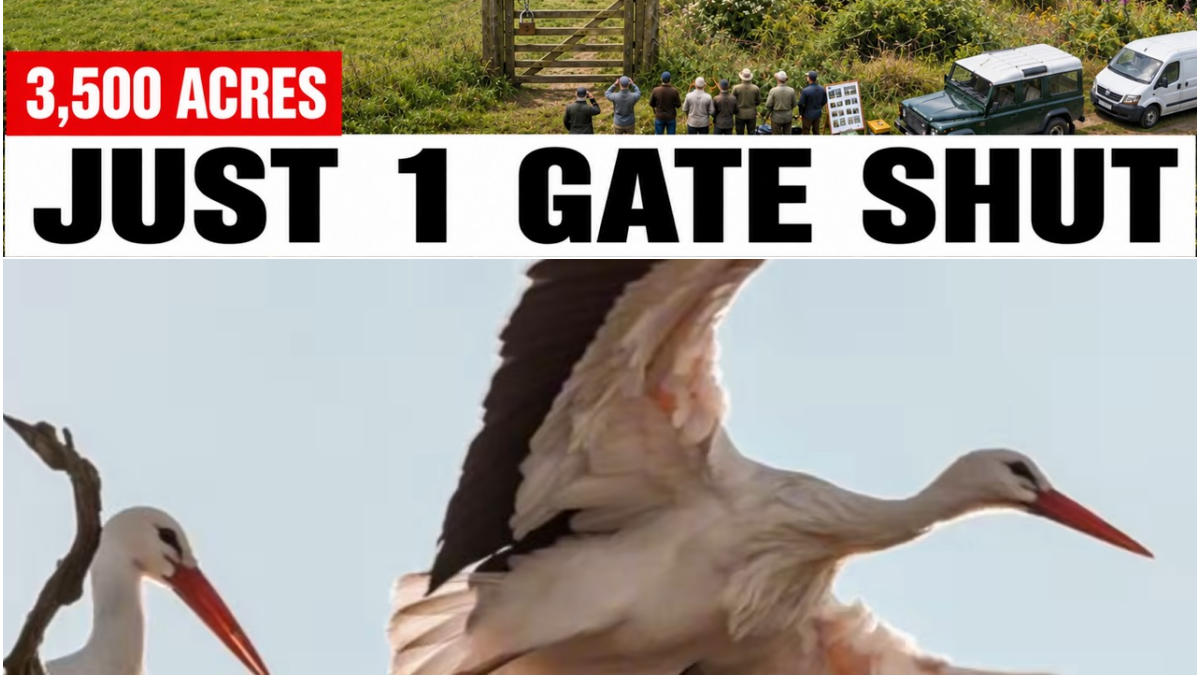
In 2001, on a stretch of heavy clay in southern England, Sir Charles Burell did something that made almost no sense to the people watching.
He opened the gates across 3,500 acres of farmland and simply stopped. No new crop went into the ground.
No seed was ordered. No field was prepared for the next harveSt. The machinery became quieter, the furrows stopped appearing, and the land that had been forced into production for generations was suddenly left to decide what came next.
The county did not know what to make of it. The farming press treated the decision as an expensive curiosity.
Officials at Natural England spent years trying to determine whether such a radical experiment could fit within the rules designed to protect Britain’s countryside.
The estate itself became a place where almost nothing seemed to happen, at least not by the standards of conventional agriculture.
Then the land began moving. Plants that had been hidden beneath the soil appeared. Scrub spread across former fields.
Insects returned. Birds arrived from places nobody expected. Soil changed beneath the surface. Water began behaving differently.
And animals that had vanished from the British landscape as breeding species for centuries began appearing again.
By the time scientists understood the scale of the transformation, the farm was no longer behaving like a farm at all.
It had become something else. But what happens when a landscape that has been controlled for generations is finally allowed to make its own decisions?
The story begins with the ground itself. Across parts of Kent and Sussex, a heavy clay soil lies beneath the countryside.
It is difficult material to cultivate because it changes dramatically with the seasons. Under summer heat, the clay can harden until it becomes almost impenetrable.
During wet winters, it can hold so much water that machinery struggles to cross it without sinking.
For generations, farmers learned to work around those limitations. The Burell family was no exception.
Their land had been part of the family story since 1787, when a Burell ancestor married the daughter of the man who owned the estate.
By the time Sir Charles Burell inherited it in 1985 at 22 years old, farming was not simply an occupation connected to the property.
It was part of the identity of the estate. The fields were expected to produce.
That expectation became increasingly difficult to meet. Postwar agriculture had brought heavier machinery, more precise chemical treatments, improved crop varieties, and increasingly intensive management.
The goal was straightforward. Produce more food from every available acre. The fields responded, but the costs continued rising.
The soil itself was becoming a problem. Organic carbon in the upper layers had fallen dramatically.
Soil without enough organic matter becomes much harder to manage. It holds less water, supports a weaker biological community, and becomes increasingly dependent on external inputs.
The farm could still produce crops. But producing them required more effort. More machinery. More inputs.
More money. Eventually, the question was no longer simply how much the land could produce.
It was whether the land could continue being managed in the same way at all.
By the late 1990s, agricultural advisers had made the situation increasingly clear. The farm was carrying the accumulated cost of decades of forcing difficult ground into intensive production.
Selling would have been the obvious answer for some landowners. But this was not simply a spreadsheet.
The estate had been in the family for generations. The land was part of a history that reached back more than two centuries.
Then, in the year 2000, an idea arrived from outside Britain that would change the direction of the entire estate.
The idea came through an English translation of a book by the Dutch ecologist Fran Vera.
Vera’s argument challenged a deeply established picture of prehistoric Europe. For generations, conservation thinking had often imagined ancient Europe as a landscape dominated by extensive woodland.
Remove modern agriculture, the traditional assumption suggested, and forests would naturally spread across much of the continent.
Vera proposed something more complicated. He argued that prehistoric Europe may have been a shifting mosaic of grassland, scrub, open woodland, and denser foreSt.
Large herbivores were central to his theory. Oroxs. Wild horses. Elk. European bison. Wild boar.
These animals did not merely live inside the landscape. Their grazing, browsing, rooting, movement, and waste constantly changed it.
A herd would feed in one place and move elsewhere. An animal would browse young trees.
Another would break through vegetation. Wild boar would disturb soil. Grazing would prevent some areas from becoming dense woodland while leaving other patches untouched.
The result would not be a single uniform habitat. It would be a constantly changing patchwork.
Vera’s hypothesis remained debated. Pollen records suggested that some parts of prehistoric Europe contained more closed woodland than his model predicted.
But the argument created a new question. What if the landscape people considered natural was actually the result of thousands of years of human influence?
What if Britain had been managing a landscape that was already profoundly altered before modern agriculture arrived?
Sir Charles Burell and Isabella Tree traveled to the Netherlands to see Vera’s ideas being tested at Of Placen.
There, large herbivores had been introduced into a landscape and allowed to shape it with relatively little human interference.
The result was not neat. It was not uniform. It was not arranged into carefully separated conservation zones.
It was rough, changing, and difficult to predict. But it was also full of life.
Burell returned to West Sussex with a different idea of what his own estate could become.
He contacted Natural England. The response was cautious. The problem was not simply whether the idea could work.
The problem was that the existing conservation system had been designed to protect particular habitats and particular species.
Traditional meadows had established management systems. Ancient woodland had established protections. Specific species had specific plans.
But what category did a landscape belong to when the goal was to stop controlling it?
Natural England had no simple answer. Burell submitted a formal letter of intent in December of 2002.
Government financial backing did not arrive until 2009. For seven years, the experiment existed largely ahead of the official system.
During those years, something extraordinary was happening on the ground. The animals arrived in stages.
Each was chosen for a reason. Old English Longhorn cattle were selected as a living comparison for the grazing behavior associated with the long vanished orox.
Tamworth pigs brought a powerful rooting instinct associated with wild boar. Exmoor ponies were small, hardy, and suited to rough conditions.
Red deer and roe deer added another layer of grazing and browsing. None of these animals was a perfect replacement for an ancient species.
They were living approximations. The intention was not to recreate the prehistoric world exactly. It was to restore some of the ecological processes that had disappeared.
The animals began changing the estate simply by behaving like animals. Cattle grazed some plants and ignored others.
Ponies opened patches through vegetation. Pigs disturbed the ground with their snouts. Deer browsed young growth.
Some areas became short grass. Other areas became dense scrub. Some patches remained open. Others began filling with young trees.
The landscape became uneven. And that unevenness was exactly what the experiment needed. Without large herbivores, vegetation tends to develop along one path.
With them, the landscape is constantly interrupted. A young tree can grow in one location while being browsed away in another.
Grass can become dense in one patch while pigs disturb the soil nearby. Scrub can advance.
Then grazing can open a gap. The estate began producing its own pattern. There was, however, one animal that could not simply be returned.
The wolf had once influenced large herbivore behavior across much of Europe. Modern southern England could not simply receive an apex predator and be expected to absorb the consequences.
So humans remained part of the process. Selective culling was used to manage animal numbers.
The goal was to prevent overgrazing and maintain a workable balance between the animals and the available vegetation.
The resulting meat became part of the estate’s food production. Organic beef, pork, and venison were sold to buyers interested in knowing how the animals had been raised and what they had eaten.
The estate had stopped farming in the conventional sense. But it had not stopped producing food.
Then something appeared that nobody had planted. Salow began spreading. Seeds already present in the soil found conditions in which they could grow.
Under intensive farming, young scrub was repeatedly removed. At the estate, that pressure disappeared. Salow expanded.
Dense patches formed across land that had previously been cultivated. And then an insect arrived.
The purple emperor butterfly had long been associated with mature oak woodland in Britain. For generations, conservation efforts had focused on protecting the woodland habitat where the species was known to occur.
But the butterfly has a particular relationship with salow. Female purple emperors lay their eggs on salow leaves.
The discovery raised a difficult possibility. Perhaps the butterfly had not truly required ancient woodland.
Perhaps it required a plant that happened to survive most successfully inside the remaining fragments of woodland.
If so, conservationists had been protecting the place where the butterfly was easiest to find rather than understanding the deeper reason it was there.
The distinction was enormous. At the estate, salow had spread without being planted. The butterfly followed.
By 2012, the transformation was becoming difficult to ignore. The estate had created habitat simply by allowing vegetation to develop under different pressures.
Then came more species. The nightingale had been declining across Britain for decades. Traditional conservation practice had often focused on coppiced woodland, where trees were cut on a rotation to maintain dense vegetation beneath them.
But the estate was not following a traditional coppicing program. Instead, cattle and ponies were creating a dense mixture of thorny scrub.
Blackthorn thickets formed. Sheltered areas developed. Vegetation became thick enough to provide nesting habitat. In the late 1990s, the estate had nine nightingale territories.
By 2025, it had 62 singing males. The change was extraordinary, but the reason was not a single planting project.
The birds had responded to the landscape created by grazing animals. The estate was producing habitat indirectly.
The animals changed the vegetation. The vegetation changed the opportunities available to birds. The birds responded.
Another species revealed an even more dramatic contraSt. The turtle dove had undergone one of the steepest declines among Britain’s monitored breeding birds, with a 98 percent reduction since 1994.
The national population was down to roughly 2,000 territories across England. Yet in 2020, the estate supported 23 territories.
The surrounding countryside had changed dramatically. Hedgerows had disappeared in many places. Intensive cultivation had reduced the patches of disturbed ground and seed rich vegetation that turtle doves use for feeding.
But the estate was creating exactly the sort of disorder that conventional farming had removed.
Blackthorn provided nesting cover. Grazing disturbed the soil. Plants such as fat hen, fumatory, and common vetch emerged from the seed bank.
The seeds had been there all along. The plants had simply been prevented from expressing themselves.
That became one of the central surprises of the experiment. The estate was not necessarily creating everything from scratch.
It was uncovering what was already present. The soil had been holding possibilities that nobody could see.
Then came the event that transformed the estate from an unusual rewilding project into something with national significance.
On the 6th of May 2020, a white stork hatched in an oak tree in the south block.
The last confirmed breeding record for wild white storks in Britain had been in 1416 at the Cathedral of St. Giles in Edinburgh.
More than six centuries had passed. The return was not accidental. The White Stork Project had been developing for years through a partnership involving the Durrell Wildlife Conservation Trust, the Cotswold Wildlife Park, and the estate.
The project used an unusual strategy. A group of Polish storks that could not fly was kept inside a 6 and 1 half acre enclosure.
The birds were visible from the air. The theory was simple. Wild storks migrating north might see the settled birds and interpret their presence as evidence that suitable habitat existed nearby.
It was a form of ecological advertising. The project did not simply release birds and hope for the beSt.
It tried to recreate the social signal that might encourage wild birds to investigate. The result came faster than many expected.
By 2024, 53 chicks had fledged. By 2025, another 45 had fledged. The project target was 50 breeding pairs in southern England by 2030.
A goal that once seemed distant had become part of practical planning. One young bird became especially memorable.
The team called him Snappy. His parents could not fly. That meant Snappy had no flying parents to demonstrate the behavior that young storks normally observe.
Around him, 26 other chicks were born to wild parents. They launched. They landed. They practiced.
They repeated the movements. Snappy watched. Eventually, he fledged as well. He left later than the others, but he left.
A young bird without the expected teachers had found other teachers. The lesson extended beyond one stork.
It suggested that some behaviors do not disappear simply because a landscape loses the species that once shaped it.
Sometimes the environment has to become suitable firSt. Then animals can return. The soil told a similar story.
Researchers from Cranfield University measured the estate’s soil carbon in 2018. The amount had doubled since cultivation stopped.
Agricarbon later found that the rewilded soil could draw in up to 4 and 8 tenths tons more carbon dioxide per hectare per year than conventional farmland on comparable geology nearby.
The rate was comparable to or greater than some 25 year old broadleaf woodland. The explanation lay partly underground.
Conventional models often emphasize what can be measured above the soil. Trees. Leaves. Branches. Visible vegetation.
But rewilded grasslands and scrub can invest heavily below the surface. Roots accumulate. Plants die back.
Organic material enters the soil. Microbial communities process it. The cycle continues. The estate’s root to shoot ratio was measured at just over 1 to 1.
Some standard models predicted something closer to 1 to 4. That difference mattered. If models underestimate the amount of carbon stored below ground in scrub and mixed vegetation, then land management decisions based on those models may also underestimate the climate value of such landscapes.
In July of 2026, Nancy Burell and colleagues discussed these findings in Environmental Research Letters.
The science was becoming more complicated. The visible transformation was only part of the story.
Underneath the grass and scrub, the soil itself was changing. Water was changing too. More vegetation meant more roots.
More roots meant more channels through the soil. More organic material meant greater capacity to hold moisture.
The estate began functioning less like a collection of cultivated fields and more like a sponge.
Rain that once moved quickly across compacted ground could be held within the soil for longer.
That had implications beyond the estate boundary. The Queen Mary University of London mapped close to 4 million square meters of new vegetation in the South Block between 2011 and 2019.
By 2025, breeding bird abundance was roughly nine times the 2007 baseline. Dragonflies and damselflies followed.
The transformation seemed to be accelerating. But the story was not as simple as saying that rewilding solved everything.
There were serious criticisms. Tom Bradshaw of the National Farmers Union argued that agricultural land is finite and food security remains a legitimate public responsibility.
The tenant farmers association raised another concern. Large rewilding projects can displace tenants and rural employment.
They can be easier for wealthy landowners to undertake than for ordinary farmers who depend on annual agricultural income.
That criticism matters because the estate had advantages that most landowners did not. Burell inherited the land.
He owned it outright. The estate received higher level stewardship payments, around 300,000 pounds in a typical year.
It also generated income through other activities. Safari operations produced around 800,000 pounds annually at a 22 percent margin.
Premium meat sales provided another source of revenue. Without those streams, the financial model would look very different.
That does not erase the ecological findings. It places them in context. One estate can demonstrate what a landscape is capable of doing.
It cannot automatically demonstrate that every farm should be managed in the same way. The debate therefore became larger than one property.
What should agricultural land be expected to produce? Only food? Or also flood protection, soil recovery, habitat, pollination, carbon storage, and water retention?
If those services have public value, should public money help support them? And if public money is used, how should the benefits be measured?
These questions have no simple answer. The estate’s success did not remove the need for food production.
It did, however, challenge the assumption that a landscape has only one useful purpose. The estate still produced around 75 tons of living weight annually in organic beef, pork, and venison.
The difference was that food production was now one part of a larger system. The cattle grazed.
The pigs rooted. The deer browsed. The ponies moved through the vegetation. The soil changed.
Birds arrived. Insects followed. Water was held differently. The landscape produced food while also producing other ecological functions.
That was the part conventional farm accounting had difficulty capturing. Walk toward the western edge of the estate on a May morning and the first thing that becomes obvious is sound.
Turtle doves call from the blackthorn. Their low rolling notes rise from vegetation that did not exist in this form when the century began.
Above the South Block, white storks stand on nest platforms. In July, purple emperor butterflies emerge among the oak tops.
Nightingales sing from dense scrub. The animals are not following a plan written for them.
They are responding to habitat. That may be the most important result of the entire experiment.
The estate did not manufacture every species. It created conditions. Then the species made their own decisions.
That difference matters. A conservation project can plant a tree, dig a pond, build a nest platform, or establish a meadow.
But there is another kind of restoration. Stop preventing natural processes. Allow grazing. Allow rooting.
Allow scrub. Allow fallen vegetation to remain. Allow the seed bank to respond. Allow animals to move.
Allow time to pass. The result may be less predictable than conventional landscaping. It may also be more resilient.
The estate’s story did not begin with a grand vision. It began with a farm that was becoming increasingly difficult to farm.
The solution was not to find a more powerful machine or a more efficient chemical.
It was to stop. For years, that decision looked like abandonment. Then the land began revealing what had been waiting beneath the surface.
The seeds were already there. The insects were nearby. The birds were searching. The soil was capable of recovering.
The animals supplied movement. And time did the reSt. By 2025, the estate had become part of a much larger ambition.
The Weald to Waves project was launched to connect more than 20,000 hectares across Sussex, stretching from Ashdown Forest toward the English Channel.
Seven landowners were involved at the beginning. By 2026, the network was approaching 50. The idea was no longer one isolated estate.
It was connectivity. If wildlife could move between restored landscapes, individual projects could become part of a larger ecological network.
A single patch can help. A connected landscape can do much more. Still, the numbers at the estate also reveal the limits.
The turtle dove count that reached 23 in 2020 had fallen to 14 by 2025.
The national population continued to decline. One property cannot reverse decades of agricultural transformation across an entire country.
The return of a species to one estate does not mean the national problem has been solved.
The white storks still depend on a carefully managed project. The purple emperor still depends on specific plants and conditions.
The nightingales depend on the structure of the scrub. The soil recovery depends on the continued management of the animals and vegetation.
Rewilding is not the same as doing nothing. It is a different kind of management.
Instead of controlling every outcome, it controls fewer things and allows ecological relationships to do more of the work.
That requires patience. It also requires accepting uncertainty. The first years can look unproductive. A field covered in weeds may look like failure.
A patch of scrub may look untidy. A pig disturbing the ground may appear destructive.
A grazing animal may seem to be damaging vegetation. But ecosystems do not organize themselves according to human preferences for neatness.
A landscape can look chaotic while becoming more functional. That was the discovery at the heart of the estate.
For decades, the fields had been managed to suppress variation. Every acre was expected to behave similarly.
The rewilding experiment allowed variation to return. Some areas became grass. Some became scrub. Some became woodland.
Some stayed open. Some became wet. Some became dry. And different animals occupied each layer.
That variety created opportunities. The purple emperor found salow. The nightingale found thorny cover. The turtle dove found disturbed ground and seed rich plants.
The white stork found wetlands and open feeding areas. Dragonflies found water. The soil found roots.
The landscape began functioning as a collection of connected habitats rather than one uniform agricultural surface.
The transformation also changed the meaning of failure. When a crop fails, the farmer sees a direct loss.
When a conservation experiment produces an unexpected habitat, the question becomes more complicated. Was the unexpected result actually a failure?
Or was the original expectation too narrow? The estate repeatedly produced outcomes that were difficult to predict from conventional assumptions.
The butterfly found scrub. The birds found disorder. The soil stored more carbon than models anticipated.
The storks returned. The result was not a perfect recreation of an ancient landscape. It was something new, shaped by old ecological processes operating inside a modern countryside.
That may be the most honest way to understand what happened. The estate did not travel backward in time.
It did not become prehistoric England. It became a place where some of the forces that once shaped British landscapes were allowed to operate again.
Grazing. Browsing. Rooting. Disturbance. Natural regeneration. Animal movement. Predation managed indirectly through human decisions. Seasonal change.
Competition. Recovery. And time. The remarkable part was how little had to be invented. The land already contained much of what was needed.
The seed bank had survived. The soil still held biological potential. Nearby populations still existed.
Migrating birds were still moving across Europe. The missing ingredient was opportunity. Someone had to stop preventing the landscape from responding.
That is why the first moment of the story remains the most important. In 2001, the gates opened.
Nothing dramatic happened immediately. No bird returned on command. No forest appeared overnight. No soil scientist could look across the fields and announce that the experiment had succeeded.
There were weeds. There were complaints. There were years of uncertainty. There were questions from officials.
There were financial pressures. There were arguments about land use. But beneath all of that, the soil was changing.
Plants were growing. Animals were moving. The ecosystem was reorganizing itself. Four years after the change began, the transformation was becoming visible.
Fifteen years later, birds were breeding in places where agriculture had once dominated. Twenty years later, soil measurements were challenging assumptions about carbon storage.
And by 2026, the experiment had expanded beyond the estate through a network intended to connect thousands of hectares.
The land had not been waiting for a human blueprint. It had been waiting for pressure to be removed.
That does not mean every field should be abandoned. It does not mean farming has no place in the countryside.
It does not mean every rewilding project will produce the same results. It means the landscape contains more possibilities than the way people currently use it might suggeSt.
A field can be food. It can also be habitat. A wetland can support wildlife.
It can also store water. Scrub can look untidy. It can also shelter birds. Soil can appear like dirt.
It can also function as a living system beneath every step. The question is not simply whether nature can recover.
The estate demonstrated that it can. The harder question is what humans are willing to let nature do.
When Sir Charles Burell opened those gates, he did not know exactly what would return.
He did not know which birds would arrive. He did not know how quickly the soil would change.
He did not know that a white stork would hatch in an oak tree on the 6th of May 2020.
He did not know that 62 singing male nightingales would occupy the estate by 2025.
He did not know that purple emperor butterflies would establish one of Britain’s largest known breeding colonies there.
He did not know that a young stork called Snappy would learn to fly without having flying parents to demonstrate the behavior.
He could not know any of that. Nobody could. That was the point. The experiment was not designed to control the outcome.
It was designed to discover what happened when control was reduced. And after more than two decades, the answer is visible across 3,500 acres.
The land did not become empty. It became complicated. It became louder. It became greener.
It became less predictable. It became a place where animals could make choices again. The most surprising discovery may be that the land did not need to be rebuilt from nothing.
It needed room. Room for roots. Room for scrub. Room for grazing. Room for water.
Room for insects. Room for birds. Room for animals to move. And, perhaps most importantly, room for time.
Because the story of this estate is not really about a man abandoning a farm.
It is about what happened after he stopped telling every acre what it had to become.
The first change was almost invisible. A seed germinated. Then another. A root pushed through clay.
A pig turned over a patch of soil. A butterfly arrived. A bird followed. A stork built a neSt.
And eventually, after decades of intensive management had tried to make the land predictable, the landscape became something that nobody had planned in advance.
It became alive in ways that were difficult to measure until the evidence was everywhere.
The gates had opened in 2001. The experiment was still unfolding in 2026. And the strangest part was that the land had never needed anyone to tell it exactly what to do.
It had been waiting for someone to stop.
Disclaimer: This content may be created by Al for entertainment purposes. Any resemblance to real persons, events, or places is coincidental.








