Her Father Sent Her West to Break Her—Instead, She Built a Life He Never Expected
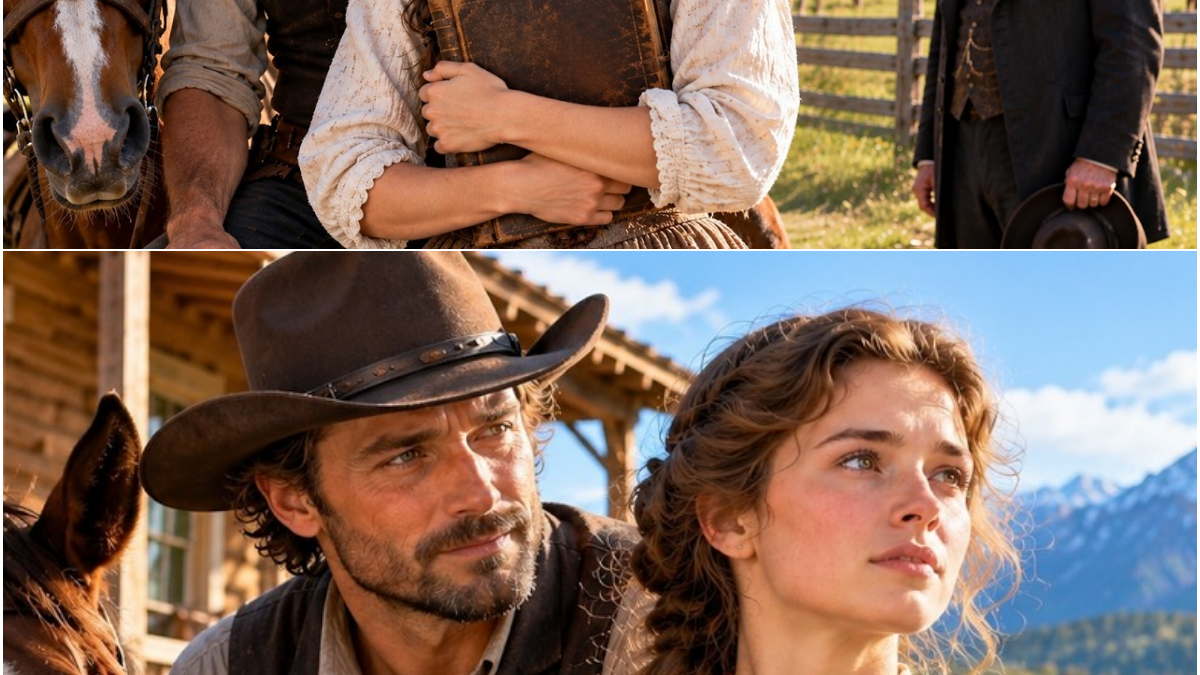
Eleanor Whitlock had spent twenty-two years learning that her father’s approval was something a daughter could never earn without surrendering a piece of herself.
But on the evening he ordered her to abandon everything she believed in, she discovered that there was one thing Silas Whitlock could not take from her.
Her willingness to stand her ground. Across the long mahogany dining table, beneath the flickering light of the chandeliers, she watched his expression harden as he realized that his daughter would not marry Garrett Carrington simply to protect his business interests.
She knew the consequences of refusing him. She had seen what happened to people who challenged his authority, and she understood that her comfortable life in Philadelphia could disappear with a single decision.
Still, she refused to lower her eyes. Her father had mistaken her education, manners, and fine clothes for evidence that she would always obey.
He had never understood that the same stubbornness he despised was the one thing keeping her from becoming someone she could not respect.
When he finally announced that she would be sent west to her uncle’s ranch in the Wyoming territory, Eleanor felt the future she had imagined collapse around her.
She had never milked a cow, repaired a fence, or spent a night beneath an open sky.
Her father believed the frontier would teach her obedience. But what if the wilderness taught her something entirely different?
What if the girl he sent away returned with no intention of asking his permission ever again?
The dining room remained silent after Silas Whitlock delivered his decision. Eleanor sat perfectly still, her hands resting beside her plate, while the grandfather clock in the hallway marked the passing seconds.
The servants had already withdrawn, leaving father and daughter alone with the remains of their dinner.
Silas was a wealthy businessman whose influence extended through Philadelphia’s commercial circles. His reputation rested on his ability to make decisions without hesitation and expect others to follow them.
He considered his daughter’s future another matter requiring careful management, much like his investments, properties, and business agreements.
Garrett Carrington had been an important part of those calculations. His family controlled several valuable commercial interests, and a marriage between the two households promised financial advantages that Silas had no intention of abandoning.
Unfortunately for him, Eleanor had discovered the character of the man she was expected to marry.
Carrington had treated servants with contempt, spoken cruelly about women who disagreed with him, and made it clear that he expected his future wife to obey him without question.
Eleanor had witnessed enough to understand that the marriage would become another arrangement in which her opinions were considered irrelevant.
She had told her father the truth, expecting him to reconsider. Instead, he had decided that the problem was her refusal to cooperate.
“You have mistaken independence for wisdom,” Silas told her. “And you have mistaken obedience for respect,” Eleanor replied.
His eyes narrowed. “You will regret speaking to me that way.” “Perhaps. But I would regret marrying him far more.”
Silas rose from his chair and walked toward the fireplace. He stood with his back to her, studying the flames as though the answer to their disagreement might be found among the burning logs.
When he finally turned around, his decision was already made. “You leave for Wyoming in three days.
Your uncle Thomas has agreed to receive you at his ranch. You will remain there until you understand the responsibilities of a daughter and the importance of doing what is expected.”
Eleanor felt the words settle heavily inside her. She had met Thomas Whitlock only twice.
He lived hundreds of miles from Philadelphia, on land where the nearest town was little more than a collection of wooden buildings and dusty streets.
Her father spoke of the territory as though it were an institution designed to correct troublesome people.
“You cannot seriously believe sending me away will change my mind.” “I believe three months of honest hardship will accomplish what twenty-two years of indulgence have failed to accomplish.”
“And if I refuse to return?” Silas’s expression hardened. “You will return.” Eleanor understood then that he had already arranged everything.
Her destination, her transportation, and the expectations awaiting her had been decided without her participation.
She had no intention of begging. “Very well,” she said. Her father appeared satisfied by her quiet response, failing to recognize that her agreement to travel west was not an agreement to surrender.
Three days later, Eleanor stood on a Philadelphia train platform with a single trunk, a small purse of money, and a letter of introduction addressed to Thomas Whitlock.
Her dark green traveling dress had been carefully chosen for the journey. Its pearl buttons, fitted waist, and fine wool fabric were appropriate for the fashionable gatherings she had attended throughout her life.
They were considerably less appropriate for the long journey ahead. She carried no books except a small volume of poetry and a collection of letters from her late grandmother.
Her father had insisted that she leave most of her belongings behind, claiming that unnecessary possessions would only make her journey more difficult.
Eleanor watched the train pull into the station and felt a brief, unexpected sadness. For all its restrictions, Philadelphia had been her home.
She knew its streets, its churches, its shops, and the familiar routines of its respectable society.
She understood how to conduct herself at dinner parties, how to write formal correspondence, and how to recognize the subtle insults hidden beneath polite conversation.
She knew almost nothing about the country waiting beyond the railroad. But she boarded the train without looking back.
The journey lasted nine days. At first, Eleanor occupied herself by reading, writing in her notebook, and observing the other passengers.
As the train moved farther west, the landscape changed gradually. Familiar towns gave way to smaller settlements, and the buildings became simpler and more widely separated.
The farther she traveled, the more frequently dust entered the carriage. The windows rattled, the seats became uncomfortable, and the meals offered along the route grew less familiar.
Her traveling dress accumulated grime despite her attempts to keep it clean. Her carefully arranged hair gradually became difficult to maintain, and the small comforts she had expected to find during the journey disappeared.
By the time the train reached Larksburg Crossing, Eleanor had begun to understand that the journey itself was only the beginning.
The town consisted of a general store, a modest hotel, a blacksmith’s workshop, a few boardinghouses, and several businesses that appeared to serve the surrounding ranches.
Thomas Whitlock was waiting near a wagon. He was a broad, weathered man with gray hair, a thick mustache, and a face shaped by years of working outdoors.
His clothes were practical, his boots dusty, and his hands rough from handling livestock and tools.
When he saw Eleanor, he looked first at her trunk and then at her dress.
“Your father wrote me,” he said. “Told me you needed toughening up.” Eleanor adjusted her gloves.
“That’s one way to describe it.” Thomas studied her for several seconds. “It’s hard country out here.
Winters that freeze the water in the troughs. Summers that can leave the grass brown before the cattle have finished grazing.
There are people who will take advantage of anyone they believe cannot defend themselves.” “I understand.”
“No, girl. You don’t understand yet.” Eleanor raised her chin. “And what do you think I should do?”
Thomas’s expression softened slightly. “I think you’ve got more of your grandmother in you than your father ever gave you credit for.
She could make a stubborn mule look cooperative. She built a life out here when most people thought the land wasn’t worth the trouble.”
He lifted Eleanor’s trunk into the wagon. “We’ll see whether you’ve inherited any of that determination.”
The journey to the ranch took two hours. The wagon followed a narrow dirt track across open country, passing stretches of golden grass, scattered rocks, and occasional stands of cottonwood trees.
The sky seemed impossibly large, and the horizon appeared so distant that Eleanor struggled to understand how anyone could feel secure in a place with so few natural boundaries.
She had spent her life surrounded by buildings, walls, and familiar streets. Here, the land seemed to continue forever.
When they finally reached the homestead, Eleanor saw a low timber house with a sagging porch and a barn that leaned slightly toward the weSt. A corral stood beside the house, and several horses grazed near a weathered fence.
The ranch was larger than she had expected, but its buildings required attention. The house needed repairs, the barn roof was uneven, and the surrounding fences showed signs of neglect.
Thomas’s wife, Margaret, had passed the previous winter, leaving him responsible for the household as well as the ranch.
Two ranch hands worked the property. One was a weathered cowboy named Pruitt, while the other was a younger man who rarely spoke and seemed suspicious of Eleanor’s arrival.
She heard him mutter to Pruitt as they unloaded the wagon. “She won’t last a month.”
Eleanor pretended not to hear. That evening, Thomas showed her the small bedroom that would become hers.
It contained a narrow bed, a washbasin, a wooden chest, and a window overlooking the pasture.
There was no elaborate furniture, no decorative curtains, and no polished floor. Eleanor placed her trunk beside the bed and opened it.
Inside were several fine dresses, carefully folded and protected with tissue paper. Looking at them, she suddenly realized that almost none of her belongings would be useful on the ranch.
The following morning, Thomas woke her before sunrise. She had barely finished dressing when he announced that breakfast would have to wait until the animals had been fed.
Eleanor followed him outside, her boots sinking into damp earth. The morning air was colder than she had expected.
The barn smelled of hay, leather, and livestock, and the noise of the animals made conversation difficult.
Thomas handed her a bucket. “Start with the chickens. Then we’ll see about the cows.”
Eleanor looked at the bucket. “What am I supposed to do?” “Feed them.” He walked away before she could ask another question.
The first weeks were an education in everything she had never needed to know. She learned to carry water without spilling half of it along the path.
She learned that cows did not automatically cooperate simply because a person approached them politely.
She learned that chopping wood required a combination of balance, strength, and patience that no amount of determination could immediately replace.
Her first attempts at milking were disastrous. She had no idea how much pressure to apply, where to position her hands, or how to keep the animal calm.
The cow shifted repeatedly, spilling milk and eventually knocking over the bucket. Thomas watched the scene from the barn doorway.
“You’ll get it eventually.” Eleanor wiped her hands. “I would appreciate knowing how.” “Watch Pruitt tomorrow.”
She disliked how much she needed their help, but she understood that refusing instruction would only make the work harder.
Her hands blistered from the axe handle. Her back ached from carrying feed. She burned several meals before learning to control the stove, and she struggled to keep her clothing clean despite washing it repeatedly.
Yet she refused to complain. At night, she lay awake listening to unfamiliar sounds outside the cabin.
Wind moved through the grass, animals shifted in their stalls, and the occasional howl from the distant hills reminded her how far she was from the world she knew.
One night, after an especially difficult day, she slipped into the barn and sat on an overturned bucket.
She cried quietly, overwhelmed by exhaustion, loneliness, and the realization that she had no immediate way to change her circumstances.
She cried only once. When the tears stopped, she wiped her face, returned to the house, and began planning the next day’s work.
She would not write to her father asking to come home. That decision became the foundation of her new life.
By the second month, Eleanor had begun to recognize patterns in the ranch’s daily routine.
She knew when the animals needed attention, which tools were kept in the barn, and how long particular chores would take.
She still made mistakes, but they no longer seemed insurmountable. More importantly, she began to discover that the ranch possessed problems that could be solved through skills she already had.
Thomas kept his business records in a collection of ledgers stored inside a wooden cabinet.
He had written down purchases, sales, debts, and payments for years, but his bookkeeping was inconsistent.
Numbers had always come naturally to Eleanor. Her tutors had taught her arithmetic, accounting, and formal correspondence.
In Philadelphia, those lessons had seemed like accomplishments meant to distinguish a respectable young woman from someone less educated.
On the ranch, they became practical tools. One evening, after dinner, Eleanor asked Thomas whether she could examine his ledgers.
He looked surprised. “Why?” “Because I believe you’re losing money.” Thomas frowned. “On what?” “I don’t know yet.
That’s why I need to look.” He handed her the books with obvious skepticism. Eleanor spent several nights comparing entries, checking receipts, and calculating the difference between what Thomas received and what he should have earned.
The problem became clear. For years, Thomas had sold his cattle to Garrett Boon, a powerful stockyard operator who controlled much of the local trade.
Boon paid below the market rate, knowing that independent ranchers had few practical alternatives. Thomas had accepted the arrangement because transporting cattle to Cheyenne was expensive, difficult, and risky.
Eleanor realized that the railroad might offer another possibility. “You’re being cheated,” she told Thomas one morning, placing the ledger beside his breakfaSt.
He studied the figures. “Boon pays what the market allows.” “No. He pays what you can afford to accept.”
Thomas looked uncomfortable. “It’s easy to say that when you’re sitting at a table. Getting cattle to Cheyenne is another matter.”
“Then we should ask the railroad what it would cost to transport them.” “That’s a long way to go for a letter.”
“We can write one.” Thomas stared at her. “You think they’ll listen to a rancher they don’t know?”
“I think they’ll listen to a business proposal that offers them regular freight.” Eleanor began writing immediately.
She prepared a detailed account of the ranch’s expected production, the number of cattle available for shipment, and the potential for future contracts.
She requested information about freight charges, scheduling, and the conditions under which the railroad would accept independent livestock shipments.
She sent the correspondence to Cheyenne. Three weeks later, a reply arrived. The railroad was interested.
Negotiations followed, requiring several more letters and careful adjustments to the proposed arrangement. Eleanor calculated the expected costs and compared them against the prices available through Boon.
The difference was substantial. By autumn, the Whitlock ranch had secured its first shipping contract.
When the cattle were sold, Thomas received nearly twice what Boon had previously offered. For the first time in years, the ranch had money available for repairs, supplies, and improvements.
Thomas examined the final account and shook his head. “Your father has no idea what he’s sent out here.”
Eleanor smiled faintly. “I don’t think he wants to know.” The news traveled quickly through Larksburg Crossing.
Some ranchers admired Eleanor’s accomplishment. Others questioned whether a young woman should be involved in commercial negotiations.
Garrett Boon was not amused. He had built his business around the assumption that local ranchers would continue accepting whatever prices he offered.
Eleanor’s agreement threatened that arrangement by demonstrating that an alternative was possible. One afternoon, she discovered him waiting beside her wagon outside the general store.
He wore an expensive coat, polished boots, and a wide-brimmed hat that appeared almost too fine for the dusty settlement.
“Miss Whitlock,” he said, smiling without warmth. “mr. Boon.” “I hear you’ve been meddling in business that isn’t yours.”
“I helped my uncle obtain a fair price for his cattle.” “You’ve disrupted an arrangement that’s served this region for years.”
“An arrangement that has served you very well.” Boon’s expression tightened. “This is a hard country for a woman who doesn’t know when to keep quiet.”
Eleanor placed one foot on the wagon step. “So I’ve been told.” She climbed onto the seat and gathered the reins.
“Usually by men who have something to lose when I speak.” Boon watched her drive away.
For the remainder of the journey home, Eleanor’s heart beat rapidly. She understood that the man’s influence extended beyond the stockyard, and she had no illusions about his willingness to protect his interests.
Yet she also experienced a feeling that had been almost entirely absent from her life in Philadelphia.
She felt useful. Her work had produced something tangible. It had improved the ranch’s position and demonstrated that she could make decisions with real consequences.
She was no longer simply resisting her father’s authority. She was building a life of her own.
Winter arrived with little warning. The first major snowfall covered the plains, and the temperature dropped so quickly that the water troughs froze overnight.
Thomas and the ranch hands spent long hours keeping the cattle supplied with feed and clearing paths through the snow.
Eleanor’s body had changed considerably since her arrival. Her hands were callused, her shoulders stronger, and her movements more confident.
She no longer hesitated before lifting heavy buckets or approaching unfamiliar animals. The frontier had not made the work easy.
It had made her capable of doing it. It was during that winter that she met Caleb Reyes.
He arrived at the ranch with several other hired hands after a severe storm trapped nearly forty head of cattle against the eastern fence line.
Caleb was a quiet man from Texas who had traveled north in search of work after drought damaged his family’s small farm.
He was lean, broad-shouldered, and careful in his movements. His dark hair was usually covered by a worn hat, and his expression rarely revealed more than he intended.
Eleanor first noticed him because he did not spend the morning boasting about what he could accomplish.
He simply worked. The snow was deep, the cattle restless, and the fence line partially buried beneath enormous drifts.
Caleb moved steadily through the difficult conditions, helping the others free the animals and guide them toward safer ground.
When the work was finished, Thomas paid the hired hands. Caleb accepted his money and began preparing to leave.
Eleanor watched him saddle his horse. “You’re leaving already?” He looked up. “Didn’t figure there was reason to stay.”
“There’s supper. And it’s a two-hour ride back to town in this weather.” Caleb glanced toward the sky.
“That’s a fair point.” “Only a fool would leave now.” A faint smile appeared on his face.
“Well, I suppose I’d rather be called late than foolish.” He stayed for supper. The meal was simple, but the conversation continued long after the plates had been cleared.
Thomas asked Caleb about his experience with livestock, and Pruitt wanted to know whether he had worked with cattle in difficult terrain.
Caleb answered every question without exaggeration. Eleanor found his manner refreshing. Unlike many of the men in Larksburg Crossing, he did not treat her accomplishments as a challenge to his authority.
When she discussed the railroad contract, he listened carefully and asked practical questions about the arrangement.
He never asked why she had come weSt. He never asked about her father. And he never suggested that she should abandon her responsibilities simply because the work was difficult.
Caleb returned several days later to help repair the eastern fence. Then he came again to assist with a difficult delivery of supplies.
Gradually, his visits became a regular part of ranch life. He taught Eleanor to ride properly.
She had learned the basics of riding as a child, but her lessons had involved gentle horses, controlled environments, and the expectation that a lady should sit gracefully rather than travel quickly.
Caleb showed her how to ride across uneven ground, how to balance in the saddle, and how to trust the animal beneath her.
He also taught her to read the sky. He explained how clouds gathered before a storm, how wind shifted through the valleys, and how the behavior of birds could sometimes reveal changing conditions.
When Eleanor struggled to repair a fence, he showed her how to stretch the wire evenly and secure it without weakening the posts.
She learned quickly, and Caleb never seemed surprised by her determination. Their friendship grew through shared work and quiet conversations.
They rode together to inspect distant pastures, discussed the difficulties facing independent ranchers, and occasionally spent long evenings beside the fireplace.
Eleanor began to look forward to his presence in a way she had never anticipated.
Caleb, in turn, appeared increasingly comfortable around her. He told her about Texas, about the farm his family had struggled to maintain, and about the difficult decisions that had eventually brought him north.
He understood what it meant to work hard without knowing whether the effort would be enough.
Eleanor understood that feeling now. She had once believed hardship was something that happened to people who lacked proper education, wealth, or influence.
The ranch had taught her otherwise. Sometimes a person could do everything correctly and still face circumstances beyond their control.
What mattered was what they chose to do afterward. By spring, the Whitlock ranch was thriving.
The shipping contract had improved its finances, and Thomas had begun investing in better equipment, stronger fencing, and additional grazing land.
He now consulted Eleanor before making important business decisions. Pruitt had also changed his opinion of her.
He began teaching her about cattle breeding, pasture management, and the practical details of maintaining a profitable herd.
The younger ranch hand who had predicted she would not last a month now greeted her respectfully each morning.
Eleanor wrote her father one letter that spring. It was brief, formal, and entirely free of any request for permission or assistance.
She informed him that she was well, that Thomas’s ranch was profitable, and that she had become involved in its business operations.
She did not mention Garrett Boon. She did not mention Caleb. And she did not ask when she could return to Philadelphia.
No reply arrived. Eleanor was surprised to discover that she did not particularly mind. Somewhere during the long months of work, cold mornings, and quiet evenings, she had stopped waiting for her father’s approval.
She no longer measured her worth by whether Silas Whitlock considered her obedient. She had found a different standard.
Her own judgment. But Garrett Boon had not forgotten the woman who had taken his most reliable supplier out of his control.
He began looking for ways to weaken the Whitlock ranch. The first warning arrived in the form of a bank notice.
A rider delivered the document to Thomas one afternoon, informing him that an old debt had been transferred to a new creditor and was now due in full within thirty days.
Thomas examined the paper repeatedly. He remembered the original agreement and believed the debt had already been settled.
Yet the document contained legal language and references to financial transactions that made the situation difficult to challenge without assistance.
Eleanor studied it carefully. She recognized the name of the new creditor. Garrett Boon. “He’s trying to force us into selling,” she said.
Thomas lowered the paper. “We don’t have enough money to pay this before the next cattle shipment.”
“Then we need to challenge the claim.” “With what?” Eleanor returned to the desk and began examining the ranch’s old records.
She searched through receipts, contracts, and correspondence, looking for evidence of the original debt and its repayment.
Caleb helped her organize the documents, while Thomas contacted the bank to request a detailed account history.
The situation became more complicated when rumors began circulating that the railroad might reconsider its shipping contracts.
According to the rumors, the company was considering an agreement with a single large supplier capable of guaranteeing regular shipments.
Eleanor immediately recognized the threat. If Boon secured exclusive access to the railroad’s livestock facilities, the smaller ranchers could once again become dependent on his prices.
That evening, Thomas sat at the kitchen table with the bank notice in front of him.
“He means to ruin us,” he said. Eleanor studied the documents. “Then we stop letting him deal with us one ranch at a time.”
Thomas looked up. “What do you mean?” “We organize.” She explained that Boon’s influence depended on the ranchers’ isolation.
Each individual operation was too small to negotiate effectively, but together they could offer the railroad a dependable supply of livestock.
If enough ranches agreed to cooperate, they could negotiate their own shipping arrangement and establish a shared commercial organization.
Thomas considered the proposal. “Getting everyone to agree won’t be easy.” “No. But it’s the only way to make sure he can’t threaten every rancher separately.”
Over the following days, Eleanor rode across the territory, visiting ranches and speaking with families who had sold cattle to Boon for years.
She carried copies of contracts, records of prices, and calculations demonstrating the difference between what ranchers received and what their cattle were worth.
Some welcomed her immediately. Others were suspicious. A few believed that challenging Boon would only make their circumstances worse.
Eleanor understood their concerns. She did not promise that the cooperative would eliminate every problem.
Instead, she explained exactly how the arrangement would work, what each ranch would contribute, and what responsibilities every member would accept.
She made it clear that the agreement would require cooperation and discipline. No rancher could expect everyone else to carry the burden.
Gradually, support grew. Within a week, twelve ranches had agreed to join the cooperative. They gathered in the back room of the general store to discuss the final arrangement.
Eleanor stood before the group with her notes spread across a wooden table. Several ranchers questioned whether the railroad would negotiate with them directly.
Others worried about transportation costs and the possibility of disagreements over shipment schedules. She answered each concern with specific figures and practical explanations.
When one man suggested that the entire plan was too ambitious for a group of small ranchers, Caleb spoke.
“She’s already proved the arrangement can work. Whitlock’s ranch is earning more because she took the time to understand the numbers.
I’d rather try her plan than keep waiting for Boon to decide what our cattle are worth.”
His support encouraged several others. The vote was not unanimous, but it was sufficient. The cooperative agreement was approved.
Eleanor, Caleb, and Pruitt traveled to Cheyenne to negotiate directly with the railroad. The journey took three days.
They arrived tired, dusty, and prepared for difficult discussions. At the railroad offices, Eleanor encountered a different kind of resistance.
Several men appeared uncomfortable negotiating with a young woman. More than once, they directed their questions toward Caleb, assuming he was responsible for the business proposal.
Caleb never accepted that assumption. He introduced Eleanor as the cooperative’s representative and allowed her to lead every discussion.
She presented the proposed shipment volumes, the financial guarantees, and the expected schedule. She explained how the ranchers would coordinate their deliveries and maintain sufficient livestock supplies to make the arrangement worthwhile for the railroad.
The negotiations were difficult. The company wanted guarantees that the cooperative could not initially provide, while the ranchers needed assurance that their shipments would receive fair treatment.
Eleanor spent hours revising figures and adjusting the agreement. She refused to accept a clause that would have allowed the railroad to change freight rates without notice.
She also insisted that the cooperative receive a clear schedule for livestock transportation. After several rounds of negotiation, the railroad agreed to the terms.
The cooperative secured a guaranteed shipping arrangement and established a system for coordinating livestock sales.
When Eleanor returned to Larksburg Crossing, the news spread quickly. For the first time, the ranchers had a way to negotiate collectively rather than depending on Garrett Boon.
His control over the local cattle trade weakened dramatically. He responded with threats and angry correspondence, but the cooperative members refused to abandon their agreement.
Then, late one night, a fire broke out in Thomas’s barn. Eleanor woke to the sound of Caleb shouting outside.
Smoke had begun filling the yard, and flames were climbing the barn’s wooden walls. She rushed from the house and immediately began helping move the cattle away from the burning structure.
Thomas and Pruitt were already working to open the gates. Caleb organized the ranch hands and directed the animals toward the open pasture.
The work was chaotic. The cattle were frightened, the wind was shifting, and sparks threatened to spread toward the nearby buildings.
Eleanor moved between the corrals, helping guide the animals away from the flames. By the time the fire was under control, the barn had been destroyed.
But the cattle had been moved to safety, and the house and surrounding buildings remained intact.
The sheriff was summoned from forty miles away. He examined the remains, spoke with the ranch hands, and questioned several residents who had been nearby.
There was no conclusive evidence identifying who had started the fire. Nevertheless, the ranchers of Larksburg Crossing understood the circumstances.
Garrett Boon had spent months trying to regain control of the cattle trade. The cooperative had removed much of his influence, and the Whitlock ranch had become the symbol of that change.
Boon left the territory two weeks later. His financial arrangements had become increasingly difficult to maintain, and the bank began calling in debts connected to his business.
The same commercial relationships that had once protected him now offered little assistance. Without the ranchers’ cooperation, his stockyard had lost much of its importance.
Eleanor stood in the ashes of the barn the following morning. Her hands were blistered from carrying water, her clothes smelled of smoke, and exhaustion weighed heavily on her shoulders.
Yet she felt something stronger than relief. She felt that she belonged. The ranch was no longer simply the place where her father had sent her to learn obedience.
It had become the place where she had developed her abilities, earned the respect of others, and helped protect the livelihoods of people who had once been afraid to challenge a powerful businessman.
She had arrived carrying a trunk full of fine dresses and an expectation that her life would continue according to someone else’s decisions.
Now she stood in the remains of a building she intended to rebuild, surrounded by people who trusted her judgment.
She had earned her place there. What she did not know was that a letter was already traveling toward Larksburg Crossing.
It would bring Silas Whitlock himself to the territory. Nearly a year had passed since he had sent Eleanor weSt.
He had continued managing his business affairs in Philadelphia, occasionally receiving brief reports about his daughter through commercial acquaintances and correspondence with Thomas.
At first, he had assumed she would soon request permission to return. When no such request arrived, he interpreted her silence as stubbornness rather than evidence that she was building a different life.
Then reports began reaching him about the Whitlock ranch. He learned that Eleanor had secured a shipping contract, improved the ranch’s finances, and organized a cooperative involving twelve independent operations.
He also heard that the cooperative had disrupted Garrett Boon’s control over the local cattle trade.
Silas initially dismissed the stories as exaggerations. He found it difficult to imagine his daughter negotiating freight agreements with railroad officials or organizing ranchers who had spent years working independently.
Yet the reports continued. Eventually, a business associate in Cheyenne mentioned that the cooperative’s representative was a Whitlock.
Silas decided to travel weSt. He told himself that the journey was motivated by business curiosity.
He wanted to understand the commercial arrangement and determine whether it presented opportunities for his own interests.
But beneath those explanations lay another concern. He had not seen Eleanor for nearly a year.
He had no idea what kind of person she had become. Silas arrived in Larksburg Crossing on a warm afternoon in early summer.
His private coach looked entirely out of place among the wooden buildings and dusty streets.
He wore a dark suit, polished boots, and a carefully arranged tie. His appearance suggested a man who expected the world to accommodate him.
The residents watched him arrive with curiosity. He asked for directions to the Whitlock ranch and was informed that Eleanor could usually be found near the eastern pasture during the afternoon.
The journey took him across the same open country his daughter had traveled nearly a year earlier.
When he reached the ranch, he found a property that looked considerably different from the one he had imagined.
The house had been repaired, the fences were stronger, and the barn had been rebuilt after the fire.
Healthy cattle grazed across the pasture, and several ranch hands worked near the eastern boundary.
Silas noticed the improvements immediately. But it was Eleanor who held his attention. She was mounted on a horse near the fence line, directing two ranch hands as they moved the herd toward a new grazing field.
Her skin had darkened under the western sun, and her hands were visibly rough from labor.
She wore a plain work dress, practical boots, and a wide-brimmed hat. There was nothing about her appearance that resembled the fashionable young woman who had left Philadelphia.
Yet her posture was unmistakable. She sat upright in the saddle, gave instructions with confidence, and watched the work with the attention of someone who understood every detail of the operation.
When she noticed the coach, she rode toward the house. Her father stepped down from the vehicle.
“Father,” she said. “I did not expect you.” “Neither did I,” Silas replied. He looked around at the ranch.
“You’ve made considerable improvements.” “Thomas and the ranch hands have worked hard.” “I heard about the cooperative.”
Eleanor nodded. “It’s been successful.” “And the railroad contract?” “Still operating.” Silas glanced toward the rebuilt barn.
“I also heard about the fire.” “It was difficult.” “Do you know who started it?”
“No proof was found.” He studied her expression, perhaps expecting anger or a desire to explain the circumstances.
Eleanor offered neither. She had learned that some questions could not be answered by repeating suspicions.
They stood together near the fence, surrounded by the sounds of cattle and the movement of the wind through the grass.
For a while, neither spoke. Finally, Silas addressed the matter that had brought him weSt.
“I sent you here to teach you a lesson.” “I remember.” “I believed the hardship would make you reconsider your behavior.
I thought you would understand that a family cannot function if every member insists on doing whatever they please.”
Eleanor looked toward the pasture. “The land did teach me something.” Silas waited. “But not what you intended.”
“What did it teach you?” “That I was capable of more than I believed. That I could make decisions, solve problems, and take responsibility without needing someone else to tell me what I was allowed to do.”
She turned toward him. “You thought my stubbornness was a weakness. You believed that refusing to marry Garrett Carrington proved I was selfish and unreasonable.”
Silas remained silent. “But refusing him was the first decision I made because I understood what I wanted for my own life.
Everything that followed began with that decision.” He looked at her carefully. Eleanor continued. “I learned to work here.
I learned to manage the ranch, understand the cattle trade, and negotiate with people who had no reason to respect me until I proved myself.
I learned that I could contribute something meaningful.” She gestured toward the property. “This place is not comfortable every day.
It is not easy. But the work belongs to me as much as it belongs to anyone else who helped build it.”
Silas glanced toward the ranch hands. They greeted Eleanor respectfully as they passed, and one of them stopped briefly to ask about the next shipment.
She answered without hesitation. The man nodded and returned to his work. Silas had spent much of his life measuring authority through wealth, family position, and the ability to secure favorable agreements.
Here, he saw another kind of influence. Eleanor’s authority came from experience, practical knowledge, and the confidence of people who had worked beside her.
It was not something he could simply purchase or command. “Your uncle tells me you’ve done more for this ranch in one year than most people accomplish in ten,” Silas said.
“Thomas is generous.” “He is not a man given to flattery.” Eleanor smiled faintly. Silas looked down at his polished boots, now marked by the dust of the ranch.
For the first time, he appeared uncertain about what to say. “I came here believing I would find you defeated.
I expected you to ask to return home.” Eleanor waited. “Instead, I find that you’ve built something I never imagined you could build.”
She did not respond immediately. Silas looked toward the rebuilt barn and the cattle grazing beyond it.
“I have no life left to offer you that could possibly compare to the one you’ve made for yourself.”
The words were not an apology. They did not undo the humiliation of the dinner table, the unwanted journey, or the months Eleanor had spent learning to survive without the comforts she had known.
But they represented a change in the way her father understood her. He had finally recognized that she was no longer a child waiting for his permission.
Eleanor accepted the acknowledgment without pretending that everything between them had been repaired. “You wanted me to become someone who would obey you,” she said quietly.
“But I needed the chance to become someone who could make her own decisions.” Silas nodded.
“I understand that now.” She wondered whether he truly did. Perhaps understanding would take more than one conversation.
Perhaps it would require him to return to Philadelphia and reconsider the assumptions that had governed their relationship for so long.
Eleanor no longer felt responsible for guiding him through that process. She had spent enough of her life trying to convince her father that her judgment deserved respect.
She would not spend the rest of it waiting for him to agree. That evening, Silas prepared to leave.
Thomas invited him to stay for supper, but he declined, explaining that he intended to return toward the railhead before the road became difficult.
Eleanor accompanied him to the edge of the ranch. The coach waited beside the track, its driver already holding the reins.
Silas turned toward his daughter. “You look well.” “I am well.” “I hope you know that you can always return to Philadelphia if you decide you want to.”
Eleanor considered the offer. She imagined the familiar streets, the grand dining room, the polished furniture, and the social gatherings she had once believed defined the boundaries of her life.
Then she looked toward the ranch. She thought about the cattle, the open plains, the work she understood, and the people who had become part of her daily life.
She thought about the independence she had earned and the future she could shape without asking someone else to approve every decision.
“Thank you,” she said. “But I have a home here.” Silas nodded. He appeared ready to say something more, but the words never came.
Instead, he climbed into the coach. Eleanor stood beside the track as the driver guided the horses forward.
The coach rolled slowly toward Larksburg Crossing, leaving a cloud of dust behind it. She watched until it disappeared beyond the distant rise.
Caleb arrived from the western pasture shortly afterward. He dismounted and stood beside her, close enough that their shoulders touched.
He did not ask what Silas had said. He simply waited. After a long silence, Eleanor spoke.
“He didn’t apologize. Not really.” Caleb looked toward the road. “Did you need him to?”
Eleanor considered the question. For a long time, she had imagined that her father’s eventual recognition would bring a sense of completion.
She had thought that hearing him acknowledge her abilities might finally settle the anger and uncertainty that had followed her weSt.
But standing there, watching his coach disappear, she realized that his approval no longer held the same importance.
She had already built the life she wanted. She had already proved to herself that she could endure difficult circumstances, learn unfamiliar skills, and make decisions that mattered.
She had already found people who respected her because of what she did rather than because of her family name.
“No,” she said at laSt. “I don’t think I do anymore.” Caleb nodded. They remained beside the fence as the evening light spread across the plains.
The ranch was quiet except for the distant movement of cattle and the occasional call of a ranch hand.
Eleanor looked toward the house. The porch still needed a little work. Several fence posts would have to be replaced before the next winter, and the cooperative had another shipment to organize before the end of the month.
There would always be something requiring attention. But those responsibilities no longer felt like burdens imposed upon her by someone else’s decisions.
They were part of a life she had chosen. Caleb reached for her hand. Eleanor accepted it.
Together, they began walking back toward the ranch. She had arrived in Wyoming carrying a trunk of fine dresses, a small purse of money, and a letter of introduction from a father who believed the frontier would break her stubbornness.
She had expected to spend three months proving that she could survive until she was permitted to return home.
Instead, she had learned to milk cows, repair fences, manage accounts, negotiate shipping contracts, and organize ranchers who had once believed they were powerless.
She had learned that courage did not always announce itself through grand gestures. Sometimes it appeared in the quiet decision to get out of bed before sunrise, try again after making a mistake, or refuse to accept an arrangement that would make a person’s future smaller.
She had also learned that independence did not mean refusing every form of help. Thomas had taught her the practical demands of ranch life.
Pruitt had shared the knowledge he had accumulated over decades. Caleb had offered companionship, patience, and truSt.
She had accepted their assistance without surrendering her judgment. That distinction had changed everything. As the sun settled toward the horizon, Eleanor paused near the porch and looked across the land.
The open country had once seemed empty and intimidating. Now she recognized its familiar features, from the grazing fields to the distant hills and the tracks leading toward town.
She knew where the cattle would find water, which fences needed attention, and how the weather changed across the plains.
She understood the work waiting for her tomorrow. And she knew that whatever difficulties the future brought, she would meet them as the woman she had become.
Her father had sent her west expecting to receive a more obedient daughter in return.
Instead, he had given her the opportunity to discover a life in which obedience was no longer the measure of her worth.
Eleanor Whitlock had not returned to Philadelphia defeated. She had found something more valuable than the approval she once wanted.
She had found her own ground, her own purpose, and the freedom to decide what came next.
Disclaimer: This content may be created by Al for entertainment purposes. Any resemblance to real persons, events, or places is coincidental.








