He Found the Queen’s Ancient Sword and Gave It Back — Then She Came Looking for Him
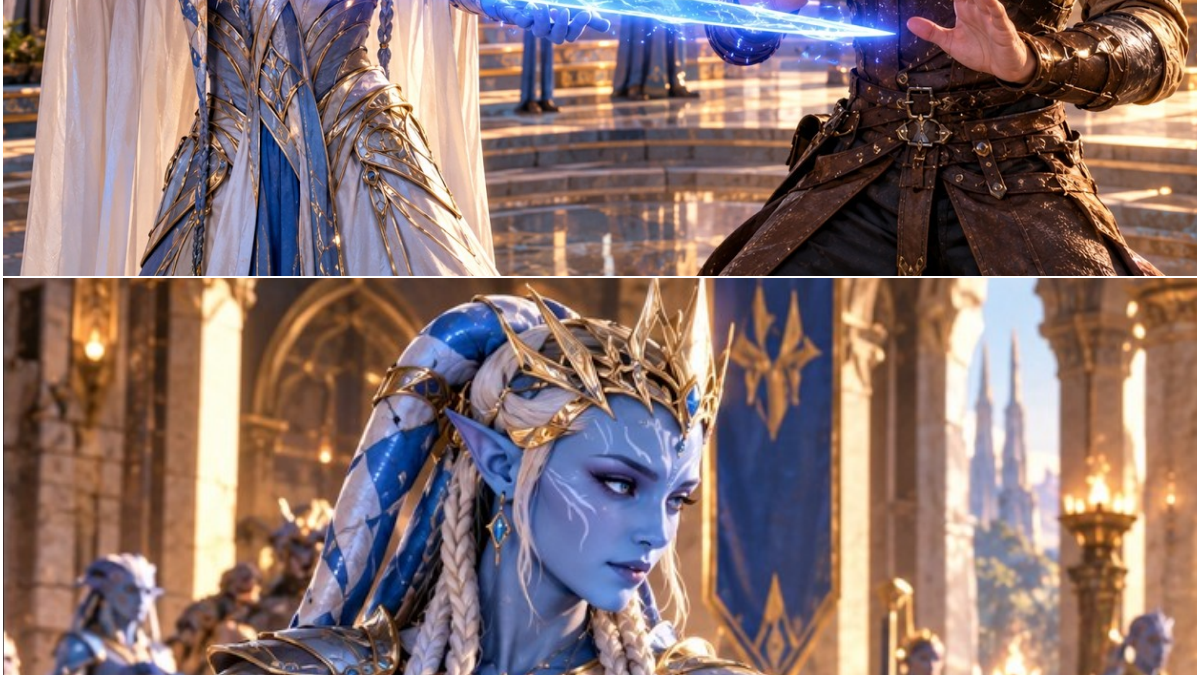
The first thing I noticed was the silence. Not the ordinary quiet of an empty planet, where the wind moves through abandoned structures and the distant machinery of a dying station becomes nothing more than a memory, but a silence so complete that even my own breathing seemed to have disappeared.
One moment, my scanner was screaming in my ear, its warning lights flashing across the dust beneath my boots.
The next, the entire world seemed to be waiting for me to make a mistake.
I was kneeling in a shallow excavation, covered in red sand, with a strange blue light shining between my hands.
I had spent six hours searching a forgotten colony for anything worth selling, and I had expected another day of broken pottery, corroded tools, and worthless pieces of somebody else’s paSt. Instead, I had uncovered a sword that should not have existed, wrapped in cloth that had survived centuries beneath an unforgiving sky.
The blade was beautiful in a way that made me uncomfortable. Its surface shimmered between silver and violet, and unfamiliar writing glowed along its length like something alive beneath the metal.
My scanner translated one word, repeated three times. Queen. I should have left it where it was.
I should have contacted a trading authority, reported the discovery, and returned to my ship before curiosity ruined whatever remained of my ordinary life.
But I reached for the hilt, and the moment my fingers touched it, I felt a strange certainty that the sword had not simply been waiting to be discovered.
It had been waiting for someone to decide what to do with it. And how was I supposed to know that the choice I made in that moment would reach an ancient queen across the stars?
My name is Callum Draper, and before that day, I had never been important to anyone outside a very small circle of people who knew me as a salvage worker with an unreliable ship and a talent for finding things other people had stopped looking for.
I grew up on a mining station where the corridors always smelled faintly of hot metal, recycled air, and the industrial cleaner the maintenance crews used every morning.
My parents worked cargo lifts for most of their adult lives. They were good at their jobs, dependable, and permanently tired.
Their hands were rough from years of moving equipment and securing loads, and their conversations at dinner usually involved shift schedules, repair costs, or the latest problem with the station’s power system.
I learned early that the galaxy was enormous, but opportunities were not evenly distributed across it.
People born on wealthy worlds could study navigation, engineering, diplomacy, and the history of civilizations they might never meet.
People born where I lived learned which maintenance doors stuck in cold weather, which vendors accepted delayed payments, and how to recognize the sound of a machine that was about to fail.
I was never particularly good at formal education. I was not unintelligent, but classrooms seemed designed for people who already understood how the world worked.
I learned better by watching, touching, testing, and making mistakes that cost me something. Old star charts were different.
They were puzzles, and puzzles made sense to me. I liked comparing routes, checking outdated coordinates, and discovering that a supposedly empty region had once contained a settlement or a mining operation.
Eventually, I became the person people asked when they needed someone to identify an abandoned site or determine whether an old navigation record was worth trusting.
That knowledge led me into salvage. At first, I worked with other crews, searching neglected colonies and abandoned industrial zones for equipment that could be repaired or sold.
Later, I acquired a small digging rig and began working independently. I discovered that museums, private collectors, and historical societies sometimes paid reasonable credits for objects that seemed worthless to everyone else.
Sometimes I found something useful. More often, I found duSt. My ship was old enough to have developed its own personality, although most of that personality consisted of warning lights, unpleasant noises, and an engine that seemed to require attention whenever I had almost enough money to fix it.
I owed credits on several repairs. My fuel account was nearly empty, and the navigation system had begun making a clicking sound that I did not want to investigate.
That was why I had traveled to the forgotten colony where I found the sword.
The planet had no permanent settlement, no recognized government, and no active commercial operations. Its original colony had disappeared from modern trade records so completely that most navigators considered the place an unremarkable mark on an old map.
There were stories about its former inhabitants, but nothing reliable. I had found a reference to an excavation site in an outdated survey and decided to investigate.
If I could recover a few objects in decent condition, I might earn enough credits to repair my engine and leave the salvage business behind for a while.
That was the entire ambition. I wanted to fix my ship, return to a place where I could sleep without listening for strange noises from the engine compartment, and spend a few weeks doing absolutely nothing productive.
Then my scanner screamed. The alarm was so sudden that I dropped my brush and fell backward into the sand.
I sat there blinking, staring at the warning display while red dust settled over my gloves.
The scanner had detected an unusual energy signature beneath the excavation. At first, I assumed it was a damaged power cell or a buried piece of equipment that had somehow retained a charge.
The colony had been active long before its final records disappeared, and old machinery sometimes produced readings that made no sense to modern instruments.
I adjusted the scanner and began clearing the sand. The glow appeared gradually. A thin blue line beneath the surface became a narrow curve, then a longer stretch of light that followed the shape of something buried at an angle.
I worked carefully, using a small excavation tool to remove the packed sand without striking whatever lay beneath it.
The object was wrapped in a strange cloth. It was dark, almost black, and covered with a fine pattern that seemed to shift whenever I moved my head.
I expected it to crumble when I touched it. Instead, the material held together as though it had been placed there only recently.
I uncovered the hilt firSt. The moment my glove brushed against it, the blue light spread along the buried object.
I froze. There are moments in salvage work when instinct tells you that the object in front of you is more complicated than the equipment you brought to examine it.
Usually, that feeling means you have discovered a hazardous power source, an unstable mechanism, or something that should have remained buried.
This felt different. The sword seemed to recognize the contact. I could not explain why I thought that.
I had no evidence that the object possessed awareness, and I had no intention of inventing a scientific explanation simply because I was frightened.
Still, I sat in the dust for several minutes before moving again. When I finally lifted the sword free, the air changed.
The wind stopped. The dust that had been drifting across the excavation settled around me, and the small flags I had planted near my equipment hung motionless.
Even the faint vibration of my digging rig seemed to fade. I looked toward the horizon.
Nothing moved. The sky remained the same rusty color it had been all morning, and the distant remains of the colony stood exactly where they had stood before.
But I could not shake the feeling that something had just happened on a scale I did not understand.
The sword was long and slender, its blade curved in a shape unlike any human weapon I had encountered.
The metal seemed to contain several colors at once. Silver shifted into violet near the edges, while the center reflected the blue glow running through the unfamiliar writing.
I turned it carefully in my hands. The scanner attempted to interpret the symbols. Most of the display filled with uncertainty markers, but a few characters repeated often enough for the translation system to make a guess.
Queen. The word appeared three times. I stared at it. Then I did something that would later seem both incredibly foolish and strangely inevitable.
I sat down and began calculating what the sword might be worth. An ancient alien weapon, preserved in extraordinary condition, with an active energy signature and an unknown script, could be worth more than anything I had ever recovered.
If the right collector became interested, I might earn enough credits to repair my ship several times over.
I imagined a working engine. I imagined a comfortable room on a settled world. I imagined a life in which I did not have to spend six hours digging through dust just to afford a replacement component.
The temptation was enormous. But the longer I stared at the writing, the more uncomfortable the calculations became.
The word Queen was not a manufacturer’s mark or a decorative inscription. It seemed to identify the person or office to which the sword belonged.
Someone had carried it. Someone had valued it enough to preserve it beneath the sand.
Someone might have searched for it. I knew what it felt like to lose things that mattered.
My parents had lost years of their lives to work that never became easier, and I had spent much of my own life watching opportunities disappear because I could not afford to pursue them.
I could not explain why that made the sword feel different from every other object I had recovered.
Perhaps I was tired. Perhaps the strange light had unsettled me. Or perhaps I simply understood that possessing something did not automatically make it mine.
I wrapped the blade in its original cloth, packed it carefully, and returned to my ship.
I had no idea what to do next. The nearest trading post was Hollow Reach, three days away by shuttle.
It was a crowded station built around a collection of docking platforms and commercial modules, a place where human traders worked beside dozens of alien species and nobody asked unnecessary questions if the docking fees were paid.
I had visited before. The station was not particularly beautiful. Its central corridors were narrow, its ventilation systems were noisy, and its commercial district smelled of cooking oil, machine lubricant, and imported spices.
But it had repair shops, translators, brokers, and enough independent businesses that a person could usually find someone willing to examine almost anything.
I thought someone there might recognize the script. When I arrived, I carried the wrapped sword through the station’s commercial quarter and approached the first alien trader I saw.
Her name was Yevena. She was tall and slender, with pale blue skin and eyes the color of liquid gold.
Her species had a reputation for careful negotiation, and she ran a small business dealing in historical objects, translated documents, and unusual artifacts.
I placed the wrapped bundle on her counter. “Could you tell me whether you recognize this writing?”
She glanced at the cloth. “Where did you find it?” “On an abandoned colony. Buried beneath the surface.”
She looked at me again, perhaps expecting me to explain why I had brought an unidentified object into her shop.
I unwrapped the blade. The light appeared immediately. Yevena went still. Her expression changed so completely that I felt my stomach tighten.
She took two steps backward, her golden eyes fixed on the sword. “Where did you get that?”
“I told you. I found it.” “Do not touch the blade again.” I raised my hands.
“I’m not touching it.” She leaned forward, careful to keep her fingers away from the hilt.
Her gaze moved along the glowing script, and her breathing became shallow. “This belongs to the Velari.”
I had heard the name, but only in passing. The Velari were an ancient civilization whose territory lay beyond several heavily monitored trade regions.
Their empire had existed longer than most human star charts could reliably measure. They were known for their elaborate traditions, their guarded political institutions, and their reluctance to establish close relationships with younger civilizations.
“What does it mean?” I asked. Yevena did not answer immediately. “This is not a sword you sell,” she said at laSt. “It is not something you should even show to strangers.”
“I was hoping to find out what it was.” “You have found out enough to understand that you should return it.”
“Return it to whom?” “The Velari royal house.” I looked down at the blade. “The queen?”
“Yes.” I felt the room grow smaller. Yevena explained that the sword was known in Velari history as the First Word.
It had been carried by an ancestor of the royal family during the founding of their empire.
Its disappearance during an ancient conflict had become part of the empire’s political and cultural history.
The sword was not merely a ceremonial object. It represented a promise made by the queen’s bloodline, a promise connected to the beginning of Velari rule and the relationship between the royal house and its people.
Its loss had troubled the empire for generations. Some believed it had been destroyed. Others believed it had been deliberately taken and hidden.
Yevena told me that the object had become so deeply associated with the royal family’s history that its return could affect the standing of the current queen.
I looked at the sword again. A few hours earlier, I had been imagining how many repairs I could afford if I sold it.
Now I was holding an object that an entire civilization had spent generations believing was gone.
“What happens if I keep it?” Yevena’s expression hardened. “You would be making yourself part of a political matter that you do not understand.
If the wrong people learn that you have it, they may try to take it.
If the royal court learns that you are withholding it, they may interpret your silence as a deliberate act.”
“I don’t want trouble.” “Then return it properly.” That sounded simple. It was not. The human diplomatic office on Hollow Reach was my first stop.
I thought an official would be pleased to hear that a human had recovered a significant piece of alien history and wanted to return it.
Instead, the officer behind the counter stared at me as though I had requested permission to dismantle the station.
“You want to hand over an unidentified alien weapon to a foreign government?” “I believe it belongs to the Velari royal family.”
“Based on what?” “A translator and a trader who recognized the script.” He leaned back.
“Do you have documentation?” “I have the object.” “That is not documentation.” I explained where I had found it and how the sword reacted when I touched it.
I showed him the scanner’s partial translation. He listened with the patient expression of someone waiting for an inconvenient visitor to finish speaking.
Then he laughed. “Sell it to a museum. If it’s genuine, they’ll know what to do with it.”
“I don’t want to sell it.” “Then find someone who wants to buy it and let them deal with the ownership question.”
I left without raising my voice. I tried three more offices. One was a private arbitration service that specialized in commercial disputes.
Another was a historical property registry. The third was a small diplomatic intermediary that claimed to maintain contact with several nonhuman governments.
Each office found a different reason not to help. Some wanted official confirmation of the sword’s origin.
Others wanted a recognized legal claim from the Velari government before they would accept responsibility for transporting it.
One representative suggested that I contact a museum and allow its legal department to handle the matter.
Another advised me to leave the sword in secure storage until an authorized party came forward.
Nobody wanted to be the person who contacted the Velari court and announced that a human salvage worker had found its most important lost relic.
I began to understand why Yevena had looked frightened. The sword was not dangerous because of its physical properties.
It was dangerous because of what it meant. For several days, I carried it from one office to another, collecting polite refusals and increasingly complicated instructions.
The more I tried to do the right thing, the more the process seemed designed to discourage anyone from attempting it.
I could have stopped. I could have returned to my ship, taken the sword to a private broker, and disappeared into the ordinary business of salvage.
I could have told myself that the Velari had lost the object centuries earlier and that the responsibility for finding it again belonged to them.
But every time I considered that possibility, I remembered the glowing word. Queen. Somewhere beyond the trade routes, someone might have spent a lifetime hearing stories about the sword.
Someone might have wondered whether it had been destroyed, stolen, or lost beyond recovery. I could not know how much it mattered to them.
But I knew it mattered. Eventually, I returned to Yevena. She was sorting a collection of small metallic objects when I entered her shop.
She looked up, saw the wrapped bundle beneath my arm, and sighed. “You have not returned it.”
“I’ve tried.” “I know.” “How?” “Because everyone on this station has already heard that a human is attempting to deliver a royal relic without an appointment.”
I sat down. “Do you know anyone who can actually contact the Velari?” Yevena studied me for a long moment.
“There is someone.” “Who?” “Dorian. He was a trade envoy for many years. He worked along the border routes near Velari space before retiring here.”
“Would he help?” “That depends on whether he believes you.” “Can you tell him I’m coming?”
She considered the request, then gave me an address. Dorian’s garage was located in an older section of Hollow Reach, far from the polished commercial district and the newer docking facilities.
The corridors leading there were narrow, with exposed cables running along the walls and ventilation fans that rattled whenever the station adjusted its internal pressure.
The garage smelled of oil, burnt metal, and old machinery. Dorian was working beneath the open panel of an engine when I entered.
He was an elderly human with silver hair, broad shoulders, and hands covered in grease.
A small lamp illuminated the machine, and several tools lay arranged across a workbench beside him.
He looked at me without standing. “What do you need?” “My name is Callum Draper.
Yevena sent me.” “Yevena sends people here when they have problems she doesn’t want.” “She said you used to work with the Velari.”
That got his attention. He slowly straightened. “What about them?” I told him everything. The excavation, the sword, the glowing script, the translation, and the offices that had refused to help.
I explained that I did not want money or recognition. I only wanted to return the object to its rightful owners.
Dorian listened without interrupting. At first, his expression was skeptical. Then, as I described the writing and the reaction of the blade, his eyes narrowed.
When I finished, he set down his tools. “Show me.” I unwrapped the sword. The blue light spread across the garage, reflecting from the metal surfaces and illuminating the old man’s face.
Dorian stopped breathing for a moment. Then he straightened. It was not simply surprise. His entire posture changed, as though some old habit had returned to him without warning.
He stepped closer. “The First Word,” he whispered. “You recognize it?” “I recognize the name.”
He studied the blade without touching it. “I heard stories about this when I was working the border routes.
Most of them were considered ceremonial accounts, not reliable history. But the Velari have always treated the royal sword differently.”
“What does it mean to them?” Dorian looked at me. “It means the beginning. It means the promise their first ruler made to the people who followed her.
The sword was carried during the founding of their empire, and the royal house used its return as a symbol of continuity.”
“Yevena said its loss caused problems.” “More than problems. Some parts of the court believed the disappearance proved that the royal line had lost the protection of its ancestors.
Others believed the sword had been deliberately taken by someone inside the empire.” He paused.
“If this is genuine, you are holding something that could change how the current queen is regarded by her own people.”
I swallowed. “Can you help me return it?” Dorian did not answer immediately. He walked to the workbench, wiped his hands with a cloth, and stared at the floor.
“I can send a message,” he said eventually. “I still have an old contact route.
It may reach someone who knows how to bring this to the right people.” “That sounds good.”
“It is not necessarily good.” I waited. “If the message reaches the wrong person, this becomes a political weapon.
Someone may try to use the sword to challenge the royal house or influence the queen’s decisions.
If it reaches the right person, the consequences may be much larger than either of us expects.”
I looked at the sword. I was frightened. I was also tired of being told that the safest thing to do was nothing.
“Send it,” I said. Dorian studied me. “You understand that once I do, you cannot take the message back?”
“Yes.” “And you understand that the Velari may not be grateful?” “I don’t need them to be grateful.”
He held my gaze for another moment. Then he nodded. “All right.” He opened a secure communications terminal and began preparing the message.
I watched him work, entering codes and checking the connection several times before sending a short report through an old diplomatic channel.
He did not include every detail. He gave the location of the discovery, the nature of the object, the evidence supporting its identity, and my willingness to return it.
Then he added his own name. When the message went out, the terminal displayed a confirmation that the transmission had reached its first relay.
Dorian leaned back. “Now we wait.” I rented a small room above the garage. The sword remained wrapped on a table beside my bed, its blue light faintly visible through the cloth whenever the station lights dimmed.
I barely slept. Every time I closed my eyes, I imagined a response arriving. Sometimes I pictured a diplomatic official demanding that I surrender the sword immediately.
Other times I imagined a group of Velari arriving to accuse me of interfering in their affairs.
I also imagined the queen herself. I had no idea what she looked like, what she believed about humans, or whether she would consider my actions helpful or insulting.
I had never spoken to anyone from her royal house. I had never even seen a Velari official outside a distant trade delegation.
The possibility that I might soon be standing in front of one made my ordinary life feel very far away.
Three days passed. Then five. A full week went by without a response. I began to wonder whether the message had disappeared into the communication network.
Perhaps the contact route was outdated. Perhaps the royal court had decided the report was too uncertain to investigate.
Dorian refused to speculate. “Messages travel at their own speed,” he said. “And important people have a talent for making simple things complicated.”
I tried to return to ordinary work. I helped him repair engines, cleaned old equipment, and checked the scanner from the excavation.
But my attention kept drifting toward the communications terminal. On the eighth day, everything changed.
I was helping Dorian replace a damaged coupling when the station alert system began pulsing.
The sound rolled through the garage and into the corridor beyond it. It was not the sharp warning of a local machinery fault or the brief signal used to announce a routine docking.
It was a deep, repeating alarm that meant a large vessel had entered the station’s docking zone.
Dorian dropped his tools. “That isn’t a trade ship.” I looked toward the garage entrance.
“What is it?” He was already moving. “An honor vessel.” We hurried outside. The docking platforms were filling with people.
Workers had stopped carrying equipment, traders had stepped out of their shops, and station security officers were gathering near the main access corridor.
Above the platform, a sleek dark vessel descended through the atmosphere. Its shape reminded me of the sword.
Long, narrow, and elegant, with smooth lines that seemed to flow from one end to the other.
There were no visible weapons, no bulky cargo sections, and no obvious signs of commercial purpose.
The vessel moved with an extraordinary calmness. It did not rush toward the landing platform or make unnecessary adjustments.
It simply descended, steady and controlled, as though the entire station had been designed to receive it.
The docking bay became quiet. The ship settled onto the platform without a sound. A ramp extended from its lower section.
For several seconds, nobody appeared. Then she walked out. I had expected a group of officials, perhaps accompanied by security personnel or diplomatic representatives.
Instead, a single woman emerged from the vessel. She was tall, taller than any human woman I had met, with skin that reflected the platform lights like polished stone.
Her eyes seemed almost luminous, though I could not tell whether that was a natural feature of her species or something connected to the ceremonial clothing she wore.
She had no crown. She carried no visible weapon. Her clothing was simple in design but unmistakably formal, made from dark material with subtle lines of silver running along the sleeves and collar.
The moment she stepped onto the platform, the Velari traders in the crowd lowered themselves to one knee.
The movement spread through the group with astonishing speed. Dorian bowed beside me. Then he caught my sleeve and pulled me down as well.
“That is her,” he whispered. I stared. “The queen?” “The queen.” My mouth went dry.
I was kneeling on a dusty trading platform in a worn work jacket, with an ancient royal sword wrapped in cloth against my cheSt.
The ruler of an empire that had existed longer than most human histories was walking toward me.
She did not hurry. Her attention moved across the crowd before settling on me. I felt every muscle in my body tighten.
She stopped a few feet away. For a long moment, she said nothing. Then her eyes moved to the bundle in my arms.
“You are the one who found what my people believed was lost forever.” Her voice was calm, clear, and measured.
It carried easily across the silent platform without requiring her to raise it. I tried to answer.
Nothing came out. I managed a nod. “Show me.” My hands shook as I unwrapped the sword.
The blue light appeared. A quiet sound passed through the gathered Velari. Some lowered their heads.
Others seemed unable to look away. The queen’s expression remained composed, but something changed in her eyes.
She stepped forward and extended her hands. I gave her the hilt. She accepted the sword with a care that made me think of someone receiving a treasured family object rather than a weapon.
The glowing script brightened beneath her fingers. She studied the blade from end to end.
I watched her face as she read the inscription. Whatever she saw there seemed to reach far beyond the words themselves.
For a moment, she looked less like a ruler and more like someone remembering a story that had shaped her entire life.
Then she looked at me. “Do you understand what you have done?” I swallowed. “I found it buried on an abandoned colony.
I didn’t know what it was at firSt. I thought it might be worth something, and I almost sold it.”
Several people in the crowd shifted. The queen remained still. “But then I learned it belonged to your people,” I continued.
“I tried to return it through official channels. Nobody wanted to accept it without proof, and I didn’t know how to reach you.
Dorian helped me send the message.” She glanced toward him. Dorian bowed his head. Then she looked back at me.
“Most who find something of this importance attempt to keep it. Some sell it. Others use it to demand favors from my people.”
“I understand.” “You did none of those things.” I looked down at my hands. “It wasn’t mine.”
The queen’s gaze sharpened slightly. “Why?” The question was simple. I had been asked it in my imagination a hundred times during the days I waited for a response.
I had prepared explanations, considered diplomatic language, and wondered whether I should describe the discovery as an act of respect or a personal decision.
Standing in front of her, all those answers seemed unnecessary. “Because I know what it feels like to lose things,” I said.
“And I didn’t want to be the reason someone else had to keep wondering whether they would ever get them back.”
The platform remained silent. The queen studied me for a long moment. Then she lowered her gaze to the sword.
Among the Velari, she explained, there was an old belief that precious things did not always return through the hands of the powerful.
Sometimes they returned through someone who had no reason to understand their importance until the moment of discovery.
The return of the First Word was considered a sign. Not proof that the royal house could never make mistakes, she said, but a reminder that its history was connected to the choices of ordinary people as much as to the decisions of rulers.
I did not know what to say. She turned toward Dorian. “Rise.” He stood slowly.
“You served my people honorably during your years along the border routes,” she said. “You have served them again by bringing this message to me.”
Dorian’s face changed. For years, he had apparently carried some private uncertainty about the work he had done during his time as an envoy.
He had never explained it to me, and I had never asked. Now, standing before the queen, he looked as though a burden he had been carrying had finally become lighter.
The queen turned back to me. “You could have kept the sword. You could have sold it for enough wealth to change your life.
Instead, you spent your time seeking strangers who might help you return it.” She paused.
“You expected nothing in return?” I shook my head. “I expected to be able to stop worrying about it.”
Something close to a smile appeared on her face. “That is an unusual expectation.” “It’s a useful one.”
For the first time, I saw a hint of amusement in her expression. Then she raised the sword.
The glowing script brightened, and a soft pulse of blue light traveled along the blade.
“This object carries the memory of every hand that has held it,” she said. “It remembers the one who carried it during the founding of my house.
It remembers those who guarded it. It remembers the generations who believed it had been lost beyond recovery.”
She looked directly at me. “From this day forward, it will carry your memory as well.”
I stared at her. “Not as an owner,” she continued. “As the one who brought it home.”
She turned toward the gathered Velari and spoke in her own language. I could not understand the words, but their effect was immediate.
The people around us lowered their heads. Then, one by one, they bowed. Dorian had told me that this gesture was reserved for honored guests rather than subjects.
I had never expected to see it directed at me. I felt suddenly uncomfortable. I was not a diplomat.
I was not a historian. I was a salvage worker who had spent six hours digging through sand because he needed money to repair his ship.
The queen seemed to understand my uncertainty. “You have given my people something that cannot be measured by its material value,” she said.
“I owe you a debt that cannot be repaid with wealth.” I opened my mouth, but she continued.
“So I will offer you something greater. My word, and the word of my house, that your people will find a friend in mine for as long as I live and beyond.”
The promise seemed to change the air around us. I had heard stories about the Velari’s caution toward younger civilizations.
Their trade agreements were limited, their diplomatic relationships carefully controlled, and their court known for remembering every promise made in its presence.
A promise from the queen was not an ordinary courtesy. It was a commitment that could influence the relationship between entire civilizations.
I struggled to find a response. “Your Majesty, I don’t know what to say.” “Then say nothing.”
She held the sword against her side. “You have already spoken through your actions.” I bowed my head.
She turned toward her ship. The gathered Velari moved aside, allowing her to pass. Before she reached the ramp, she paused and looked back at me.
“What is your name?” “Callum Draper.” She repeated it carefully. “Callum Draper.” Hearing my name spoken in her voice made it feel strangely unfamiliar.
“Remember this day,” she said. “It may seem small to you now. It will not stay small.”
Then she boarded the vessel. The ramp closed. The honor ship rose from the platform with the same quiet control with which it had arrived.
It passed above the station and disappeared into the atmosphere, leaving a crowd of people who seemed unable to decide whether they should return to their work or remain where they stood.
For several minutes, nobody moved. Then the station began to wake up again. People started talking.
The security officers returned to their posts, the traders gathered in small groups, and the workers resumed their duties.
But the station was not quite the same. Neither was I. I looked at Dorian.
He was still staring at the sky. “Did that really happen?” I asked. He let out a slow breath.
“Yes.” “Did I just receive a promise from the Velari queen?” “Yes.” “Does that mean I can finally get my engine repaired?”
Dorian laughed. “Now that is a question worth asking.” I laughed with him, partly from relief and partly because I had no idea what else to do.
The next few weeks were unlike anything I had experienced. At first, the news traveled slowly.
A human salvage worker had recovered an ancient royal object and returned it directly to the Velari queen.
Then the story spread through the trade routes. People began asking questions about the discovery, the sword, and the message Dorian had sent.
A few historical organizations contacted me, hoping to learn more about the excavation site. The human diplomatic office that had dismissed me requested a meeting.
So did several officials who had refused to accept the sword. I declined some invitations.
I accepted others when I believed the conversations might help preserve the record of what had happened.
I did not want to become a public figure. I had no experience speaking to crowds, and I was not particularly interested in explaining my personal decisions to people who had once laughed at me for making them.
But the situation had grown beyond my control. The queen’s promise became a subject of discussion among traders, diplomats, and historians.
Some people interpreted it as a sign that the Velari were preparing to expand their diplomatic relationships with humanity.
Others cautioned that a promise of friendship did not automatically mean that every political or commercial disagreement between the civilizations had been resolved.
I understood that distinction. The queen had promised a relationship. She had not promised that every future negotiation would be easy.
Still, something had changed. Meetings that had once been difficult to arrange became possible. Trade representatives who had previously maintained their distance began exchanging messages with human officials.
Small academic delegations were invited to discuss historical records and cultural preservation. The sword’s return had become an event that both civilizations could acknowledge without pretending their histories were identical.
And somehow, my name had become attached to it. I received messages from people I had never met.
Some thanked me. Some asked whether I would consider giving interviews. A few wanted to know whether I had discovered anything else on the abandoned colony.
One collector offered to buy my scanner. I refused. The scanner had been with me through too many bad excavations to sell simply because it had helped me uncover something important.
Dorian became something of a local celebrity as well, although he disliked every minute of it.
People visited his garage asking about the queen, the sword, and his years as an envoy.
He answered the questions he felt comfortable answering and sent everyone else away with instructions to stop interrupting his repairs.
Eventually, he announced that he was retiring. This time, he meant it. He had talked about retiring for years, but there had always been another engine to fix, another shipment to inspect, or another reason to delay the decision.
Now he seemed content to close the garage for good. I asked whether he would miss the work.
“Some of it,” he said. “What about the rest?” “The rest can find someone else.”
He smiled faintly. “I spent a long time believing that unfinished business was the same thing as a personal failure.
It isn’t.” I understood that more than I expected. We continued to meet after he retired.
Sometimes we talked about the queen’s visit, but more often we discussed ordinary things: ship maintenance, the quality of station food, and the difficulty of finding reliable parts for older equipment.
We did not need to repeat the story every time we saw each other. The important part had already happened.
As for me, I returned to salvage work. I could have used the attention to find a more comfortable occupation.
I could have accepted an offer from a museum or joined a historical expedition with a proper research team.
For a while, I considered it. But I liked the quiet of the excavation sites.
I liked the patience required to uncover something without damaging it. I liked the feeling of looking at an object and knowing that its story had continued long after the people who made it were gone.
I also liked the independence. My ship still needed repairs, though the attention surrounding the discovery made it easier to arrange them.
I eventually replaced the unreliable engine components and upgraded the navigation system. For the first time in years, I could travel without listening for every unusual vibration.
I returned to the abandoned colony where I had found the First Word once, accompanied by a small survey team.
We documented the excavation site, recorded the remaining energy traces, and examined the surrounding structures.
The place looked different when I returned. Not because the planet had changed, but because I had.
I could still see the shallow trench where I had uncovered the sword. I remembered the red sand, the scanner alarm, and the moment the wind stopped.
The team asked whether I wanted to search the area for additional artifacts. I agreed.
We found fragments of old construction material, several pieces of damaged equipment, and a small collection of objects that appeared to have been used in everyday life.
Nothing else carried the strange blue light. Nothing else seemed to recognize my touch. I was relieved.
The sword had been enough. During the excavation, one of the younger researchers asked whether I regretted not selling it.
I thought about the question for a long time. There was no point pretending that the money would not have helped me.
I had been struggling financially, and the sword could have changed my circumstances almost immediately.
I could have repaired my ship, paid off my debts, and lived more comfortably. But I could not imagine what it would have felt like to keep it after learning what it meant.
“I don’t regret returning it,” I said. “Not even a little?” “Not even a little.”
The researcher nodded, though I could tell he was still considering the practical value of the decision.
I understood. For someone looking at the situation from the outside, the choice might seem irrational.
I had given away something priceless without demanding compensation. But the sword had never been mine.
That mattered more to me than the amount someone might have paid. Months passed. The relationship between humanity and the Velari developed gradually.
There were formal meetings, carefully worded statements, and negotiations that required patience from everyone involved.
I did not participate in those discussions. I was not qualified to decide how two civilizations should structure their future.
But I followed the reports. Whenever a new agreement was announced, I wondered whether the queen remembered the dusty platform at Hollow Reach and the human who had brought her sword home.
I never asked anyone to confirm it. I did not want to turn the promise into a personal reward.
Still, sometimes I imagined the sword resting in a place of honor within the royal court.
I pictured its blue light shining against dark stone, the unfamiliar writing visible to people who understood every line.
Perhaps the queen visited it when she needed to remember the history of her house.
Perhaps she simply regarded it as one restored object among countless treasures. I could not know.
What I did know was that the return had given the Velari something they had believed was beyond recovery.
And it had given humanity an opportunity to be seen differently. Not as a civilization that had solved every problem or earned universal trust, but as a people capable of making choices that reached beyond immediate advantage.
That was enough. One evening, while I was preparing my ship for another salvage trip, a message arrived through a secure diplomatic channel.
It was short. The sender was listed as an office of the Velari royal household.
The message thanked me for the continued care I had shown during the discovery and return of the First Word.
It also informed me that the queen had authorized a formal invitation. I was being invited to visit the royal homeworld.
I read the message twice. Then a third time. I had never traveled to the center of Velari territory.
I had no idea what the journey would involve, what protocol would be expected, or how I was supposed to behave in a royal court.
I was a salvage worker. I knew how to read old charts, repair a damaged scanner, and identify the difference between a valuable artifact and a piece of worthless scrap.
I did not know how to attend a royal reception. I called Dorian. He answered after several rings.
“What broke?” “Nothing.” “Then why are you calling?” “I received an invitation from the Velari royal household.”
There was a pause. “An invitation to what?” “To visit the queen.” Another pause. Then Dorian laughed.
“Well, I suppose you should start learning which fork to use.” I looked at the message again.
“I think they probably have different utensils.” “Then you have more studying to do.” I laughed, but my excitement was mixed with a nervousness I could not ignore.
The invitation felt like the beginning of another journey, one I had not planned and could not predict.
I had spent most of my life traveling to places other people had forgotten. I was accustomed to working alone, dealing with unfamiliar environments, and leaving before anyone had a reason to remember my name.
Now an ancient queen had remembered it. And she wanted to see me again. I accepted the invitation.
The days before the journey passed in a blur of preparation. I checked my ship, reviewed the travel instructions, and studied every piece of information I could find about Velari customs.
I learned that the royal homeworld had several ceremonial districts, each associated with a different period of the empire’s history.
I learned that the royal house maintained strict traditions concerning guests and that visitors were expected to respect certain forms of address.
I also learned that the First Word was not displayed publicly. It was kept in a protected chamber accessible only to members of the royal household and a small group of appointed historians.
I wondered whether I would see it again. When the day came, I left Hollow Reach with a repaired engine, a full fuel reserve, and more nervous energy than I had experienced during the original discovery.
The journey was long. I spent much of it looking through the navigation display, watching the distance between myself and the Velari homeworld shrink one measured interval at a time.
I thought about my parents. I wondered what they would have said if they had known that their son, who had struggled to complete ordinary schooling, was traveling to visit the ruler of an ancient empire.
My mother would probably have asked whether I had packed enough food. My father would have wanted to know whether the ship’s engine was reliable.
They would both have told me to be respectful. And neither would have understood how I had managed to get myself into this situation.
When I finally arrived, the Velari homeworld looked nothing like the places I usually visited.
The atmosphere was clear, the cities carefully integrated with the surrounding landscape, and the architecture seemed designed to preserve open space rather than fill every available area with structures.
The royal residence stood beyond a broad expanse of pale stone and gardens. It was not a single enormous building.
It was a collection of structures connected by long walkways, quiet courtyards, and sheltered passages.
Each section seemed to belong to a different architectural tradition, yet everything fit together with a balance that made the entire complex feel deliberate.
I was met by a royal attendant who guided me through the entrance. My boots sounded unusually loud against the polished floor.
I had spent years walking through industrial corridors and dusty excavation sites. The quiet elegance of the residence made me suddenly aware of every movement.
The attendant led me into a chamber with tall windows overlooking the gardens. The queen was waiting.
She wore a dark formal garment with silver detailing along the sleeves. Her posture was composed, and the First Word rested in a display stand beside her.
The sword’s blue light was steady. For a moment, I could not speak. The queen regarded me with an expression that seemed warmer than the one she had worn on Hollow Reach.
“Callum Draper,” she said. “Your Majesty.” “You have traveled far.” “I was honored by the invitation.”
She gestured toward a seat. “Please.” I sat carefully. For a few moments, we discussed the journey, the repairs to my ship, and the progress of the diplomatic relationship between our civilizations.
Then her attention shifted to the sword. “Do you remember what you said when I asked why you returned it?”
“Yes.” “You said you understood what it meant to lose something.” I nodded. “I did.”
She looked at the blade. “My people have spent a long time arguing about what its disappearance meant.
Some believed it was a warning. Others believed it was a failure. A few believed that its return would never happen.”
She paused. “But you found it without knowing any of those arguments. You made your decision before you understood the history.”
“I didn’t know what else to do.” “That is what interests me.” I looked at her.
“Why?” “Because many people wait until they understand the importance of a choice before deciding whether to make it.
You acted while the meaning was still uncertain.” I considered that. “I was uncertain about almost everything except that the sword belonged to someone else.”
The queen nodded slowly. “That distinction may be more important than you realize.” She rose and approached the display.
The sword brightened as she came near. I watched the light move along the inscription.
“Would you like to see it?” She asked. “Yes, Your Majesty.” She lifted the blade from its stand and held it out.
I hesitated before accepting it. The metal felt familiar in my hands, though the chamber was nothing like the dusty excavation where I had first uncovered it.
The blue light remained steady. I remembered the silence on the abandoned planet and the feeling that the object had been waiting for someone to find it.
Now I understood that the sword had not needed me to keep it. It had needed someone to bring it home.
I returned it to the queen. She accepted it and placed it carefully back in the display.
Then she turned toward the windows. “Your people are still learning how to live among the older civilizations,” she said.
“Some of my advisers remain cautious. Some believe that our relationship should develop slowly, through trade and limited cooperation.
Others believe that your actions have demonstrated a quality worth recognizing.” “I hope they are right to be cautious when they need to be.”
She looked at me. “You do not seem offended.” “Why would I be?” “Many would prefer to be trusted immediately.”
“Trust takes time.” The queen considered my answer. “Then perhaps you understand more about diplomacy than you believe.”
I smiled slightly. “I mostly understand that my ship still needs occasional repairs.” She gave a quiet laugh.
It was the first time I had heard her laugh, and it changed something about the room.
For a brief moment, she seemed less like a distant ruler and more like a person who had found something genuinely amusing.
We continued talking. She asked about my childhood on the mining station, my work as a salvage operator, and the kind of objects I usually recovered.
I told her about the old charts, the abandoned settlements, and the strange satisfaction of discovering something that had been overlooked for generations.
She asked whether I intended to continue. “Yes.” “Even after what has happened?” “Especially after what has happened.”
“Why?” I thought about the question. “Because the discovery didn’t change what I enjoy doing.
It just reminded me that the things we find can matter to people we have never met.”
The queen looked toward the sword. “Then I hope you continue to find things worth returning.”
I did not know whether she meant it as a blessing, a warning, or simply a kind wish.
Perhaps it was all three. When the meeting ended, I was escorted through the gardens and back toward my ship.
The queen did not accompany me to the entrance, but she sent a message with the attendant.
She wished me a safe journey and reminded me that the promise she had made on Hollow Reach remained in effect.
I carried those words with me long after I left the royal world. I still return to forgotten colonies.
I still search old excavation sites, examine damaged machinery, and spend far too much time trying to identify objects that might be worth only a few credits.
My ship is in better condition now, and I have more work than I once imagined possible.
Sometimes a museum requests my help identifying a recovered object. Sometimes a research team asks me to examine a location recorded on an outdated chart.
But I remain a salvage worker. I do not want to become a symbol that has nothing to do with the person I actually am.
I am still the man who grew up among mining equipment, learned to read old star charts because nobody else wanted the job, and spent years searching dead worlds for things that might pay for the next repair.
The difference is that I now understand how a small decision can travel farther than the person who makes it.
The sword was not mine. That was the simplest part of the entire story. The difficult part was deciding what to do when keeping it would have made my life easier.
I have been asked whether I believe the queen’s visit was fate, whether the sword somehow chose me, and whether I think the return was destined to change the relationship between humanity and the Velari.
I don’t know. I have no way to prove that the sword was waiting for me, or that the discovery was anything more than an extraordinary coincidence.
Maybe the story would have unfolded differently if another salvage worker had found it. Maybe someone else would have made the same choice.
Or maybe the sword would have remained beneath the sand for another century. What I know is that I found it, I recognized that it belonged to someone else, and I decided to return it.
Everything that followed came from that decision. Sometimes, when I am working alone on a quiet planet, I think about the queen standing before me on Hollow Reach.
I remember the way the crowd fell silent, the way the sword glowed in her hands, and the expression in her eyes when she finally understood that it had truly returned.
I remember her question. Why? I still do not have a perfect answer. I only know that the thought of keeping the sword never felt as valuable as the thought of giving it back.
And somewhere beyond the routes I have traveled, an ancient queen still remembers my name.
Perhaps one day, she will ask me to help find something else. Perhaps the next discovery will be even stranger than the firSt.
Or perhaps I will spend the rest of my life digging through forgotten places, never again finding anything that changes the course of two civilizations.
I can live with that. Because the most important thing I carried away from the abandoned colony was not the sword, the promise, or the attention that followed.
It was the understanding that a person does not need to be powerful to make a meaningful choice.
Sometimes all it takes is recognizing that something precious belongs somewhere else, and having the courage to let it go.
And whenever I uncover something beneath the dust, whenever my scanner begins to hum and an unfamiliar shape emerges from the ground, I find myself wondering the same thing.
What would I do if the next thing I found belonged to someone who had been waiting just as long to get it back?
Disclaimer: This content may be created by Al for entertainment purposes. Any resemblance to real persons, events, or places is coincidental.








