He Found a Wounded Horse Surrounded by Wolves… Together They Became the Deadliest Duo in the West
Some stories stay quiet for years because the person carrying them knows exactly what they mean.
They are not difficult stories. They are simply too close to the heart to be handed to strangers.
Thomas had carried one for 17 years, keeping it behind ordinary conversations, long rides, ranch work, and the thousand small duties that fill a man’s life until he almost forgets what he has chosen not to say.
Then came a spring night in Texas in 1890. The fire had burned for an hour.
Catherine sat in the good chair with their baby against her cheSt. The child’s tiny hands rested against her mother’s dress while his eyes followed the firelight with the unfocused wonder of someone seeing the world for the first time.
Thomas sat on the porch steps with a warm cup between his hands. Scout stood at the fence rail.
Seventeen years had passed since Thomas first saw him in a dry creek bed in New Mexico.
Seventeen years since a gray horse had stood among three wolves and made a choice that would change both their lives.
Thomas looked toward the fence. “17 years,” he said quietly. The stranger beside the fire looked up.
“17 years,” he repeated. Catherine watched Scout for a moment. “How did you find him?”
The question hung in the warm April air. Thomas looked at the horse. Then at the baby.
Then at the fire. For a long moment, he said nothing. What happened on that lonely road in New Mexico that made a young man stop, look at a wounded gray horse, and begin a friendship that would last 17 years?
Thomas finally leaned back, rested his hands on his knees, and began to tell them.
“I was 23, maybe 24. I stopped counting for a while in those years.” The roads had a way of making time feel like something that belonged to someone else.
Thomas had been riding since dawn through the New Mexico high desert. It was late October of 1876, the kind of October when winter had not yet arrived but had already sent a warning ahead of itself.
The mornings were short. The afternoons were flat and golden. The nights carried a cold that seemed to come from the entire sky.
The territory was not a state yet. It would not become one for another 36 years.
There were roads, but many of them had no proper names. There were settlements, but between those settlements stretched enormous spaces where a rider could travel for hours without seeing another person.
That afternoon, Thomas had been crossing a ridge when something made him stop. It was not a sight.
It was a sound. More accurately, it was the absence of sound. The high desert had its own rhythm.
Wind moved over dry grass. Birds called from distant places. Hooves struck stone. Small creatures moved through brush.
But sometimes all of that disappeared. Sometimes the animals became quiet because something had entered the country that they did not understand.
Thomas heard that kind of silence. He stopped his horse. He listened. Nothing. Then he heard something else.
A faint movement below the ridge. Thomas guided his horse toward it. The land dropped into a dry creek bed.
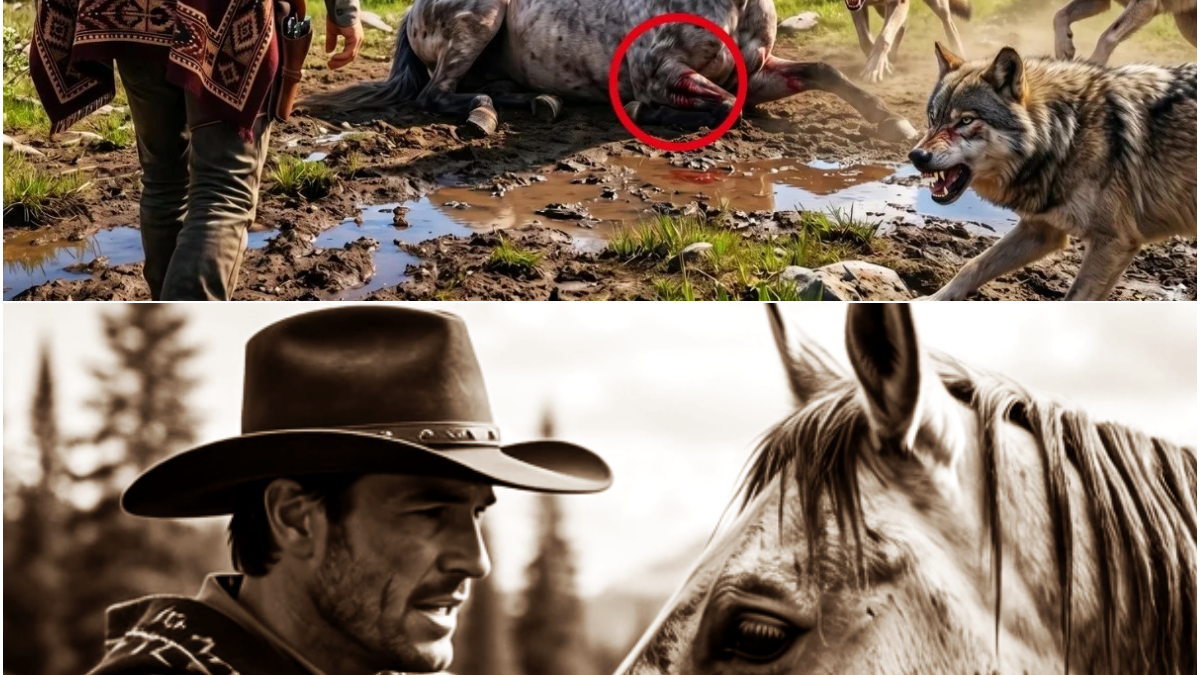
He looked down. Three wolves stood in the sand. And between them stood a gray horse.
Thomas would later remember the exact picture. The horse was not the clean gray of an animal that lived beside a stable.
He was the dusty gray of a traveler who had been on the road for too long.
His left foreleg was injured. He was holding it carefully. The wolves had formed a loose circle about 15 yd away.
But they were not rushing him. They were waiting. Thomas understood that immediately. The wolves were patient.
The horse was patient. Nobody was wasting movement. Thomas watched for about 3 seconds. Then he stopped thinking.
He rode down the ridge. He did not shout. He did not fire into the air.
He had learned that noise was useful only when it had a purpose. He moved quickly and deliberately.
At about 10 yd, two wolves broke away. The third hesitated. Then Thomas closed the remaining distance.
The wolf finally turned. Within moments, the creek bed was empty except for Thomas and the horse.
The gray horse stood exactly where he had been. Thomas dismounted. The animal looked at him.
That was the first thing Thomas remembered clearly. The horse did not panic. He did not pull wildly against an imaginary rope.
He did not turn and attempt to flee on an injured leg. He simply looked at Thomas.
There was something unusually deliberate in that look. Thomas had known horses all his life.
He knew fear. He knew stubbornness. He knew exhaustion. He knew the look of an animal waiting for someone to make the next move.
This was different. The horse seemed to be evaluating him. Thomas walked closer. The injury was on the left foreleg.
It was not caused by the wolves. It looked older. A bad step on loose rock, perhaps.
The kind of injury a traveling horse might suffer when no rider was watching the ground ahead.
Thomas looked around the creek bed. There were tracks. Two horses had entered the creek.
Only one had remained. Thomas followed the other trail. It led about 50 yards around a bend.
He stopped there. That was where he found the traveler. The man had been there for approximately 2 days.
He looked to be 30, perhaps 35. He had the build of someone who had worked hard for years.
His clothes showed the road. His boots showed the road. Everything about him suggested a man who had spent a long time moving through difficult country.
Thomas studied the ground. Three horses had approached from the north. The tracks told him enough.
Whatever had happened had been quick. The stranger had been alone. The three riders had not given him much opportunity to react.
Thomas looked north. The riders had gone that way. He stood there for a long moment.
He did not know the man’s name. He did not know where the man had come from.
He did not know where the man had intended to go. He only knew that somewhere ahead were three men who had left him beside a road without anyone to speak for him.
Thomas looked back toward the creek. The gray horse was still standing there. He walked toward him.
The horse watched him approach. Thomas placed one hand against the animal’s neck. The horse did not pull away.
Thomas looked at the injured leg. “I’m going to fix your leg,” he said. “Then I’m going to find the men who did this.
After that, you can go wherever you want.” The horse stood still. Thomas took that as agreement.
He made camp in the creek bed that night. It was not a good campsite.
He knew that. But the horse needed to remain still, and Thomas had no intention of leaving him alone.
He had medical supplies in his saddlebag. Not much. Just enough. Travelers who spent long periods on the road learned quickly that a small supply of useful things could become more valuable than almost anything else in a saddlebag.
Thomas built a small fire. The horse stood beside him. Then Thomas began working on the leg.
The horse never struggled. He did not make a sound. He simply watched Thomas. That was what Thomas remembered moSt.
Not the wolves. Not the tracks. Not the distant riders. The eyes of the horse.
Thomas worked carefully by firelight. He wrapped the injured leg as well as he could.
It was not healed. He knew that. The wrapping was meant to buy time. To reduce strain.
To give the injury a chance. When he finished, Thomas sat back. The horse lowered his head slightly.
Not toward the ground. Toward Thomas. Thomas raised his hand. The horse allowed him to touch his neck.
Neither moved for a while. The fire burned lower. The October sky spread above the creek bed.
The desert seemed enormous. Cold. Quiet. Indifferent. Thomas had spent enough time alone to understand that the land did not care what a man wanted.
You either learned how to live within it, or you did not. That night, Thomas slept beside the fire.
Before dawn, he woke. The horse was standing over him. Thomas opened his eyes. The animal was facing north.
His ears were forward. Not casually. Not in the way a horse might listen to distant movement.
They were fixed. Focused. Thomas sat up. He looked north. He saw nothing. The horse kept listening.
Thomas watched him. There was something about the animal’s attention that he could not explain.
It was almost as if the horse had already understood something that Thomas had not.
Thomas packed his belongings. He checked the leg. It looked better than it should have after one night.
Not healed. Better. He looked at the horse. “You should rest that leg.” The horse stared back.
Thomas knew what that look meant before he had words for it. The horse was not staying behind.
“All right,” Thomas said. He mounted. The horse fell in beside him. Not behind. Beside.
Thomas would later realize that this was the first important decision the animal made. He did not follow because he was forced.
There was no rope around his neck. No saddle forcing his direction. He simply moved beside Thomas.
And he stayed there. They rode north. Thomas knew the New Mexico Territory well enough to understand what they were entering.
The autumn of 1876 was not an easy time for a traveler. The territory was changing.
Cattle operations were expanding. Land disputes were growing. Men arrived with plans for ranches, businesses, and claims.
Others already lived there and did not welcome those changes. The Lincoln County War was still 2 years away, but the conditions that would eventually produce it were already taking shape.
The roads between settlements were lightly watched. A man could disappear into the territory and travel for days without anyone asking where he came from.
Thomas knew the three riders had gone north. He intended to find them. On the second day, he found their camp.
It was about 12 miles north. The men had stopped at a water hole that the territory maps marked as reliable in October.
Thomas saw them from a ridge. Three men. One fire. Three horses. They had traveled quickly.
Now they had stopped because they believed the road behind them was empty. Thomas looked at the gray horse.
The horse was staring down at the camp. His ears moved forward. Thomas watched him.
“You know them?” The horse did not move. Thomas had no idea how an animal could recognize people from that distance.
Perhaps it was the smell. Perhaps the horses. Perhaps some instinct Thomas would never understand.
But the horse knew something. Thomas touched the reins. “You don’t have to come.” The gray horse looked at him.
The same look. The decision had already been made. Thomas smiled faintly. “All right.” They rode down the ridge.
Thomas did not rush. Speed could be useful. So could patience. He had learned that much from the horse.
The first man noticed them at about 40 yards. He reached for his weapon. Thomas was ready.
The confrontation was brief. The first man made the wrong choice. The second saw what was happening and immediately raised his hands.
The third tried to move around Thomas. The gray horse crossed his path. The movement was so quick and precise that Thomas barely understood it while it happened.
The horse stepped diagonally across the man’s path. The man’s momentum carried him into the wrong position.
He stopped. Thomas stared at the horse. The animal stood calmly. It was not frightened.
It was not excited. He had simply seen a problem and solved it. Thomas looked at the man with his hands raised.
The man looked at the horse. Then he looked at Thomas. “What is that horse?”
“Mine.” The man looked confused. “Since when?” “Since yesterday.” The man stared at the gray horse.
The horse stood in the middle of the camp as if he had been there all his life.
The man shook his head. Thomas understood the expression. It was the same expression Thomas had worn in the creek bed.
The expression of someone encountering something that did not fit easily into any category. “Where did you come from?”
Thomas looked toward the southern horizon. “South.” That was all he said. The encounter was finished.
Thomas stood in the afternoon light with the three men no longer controlling the situation.
The gray horse stood beside him. The wind moved through the grass. Thomas thought about the traveler in the creek bed.
About the 30 seconds that had changed everything. About the horse that had run until his leg gave out.
About the wolves that had circled at 15 yd. About the way the horse had remained still because panic would not help him.
Thomas looked at the gray horse. He walked over and placed his hand against the animal’s neck.
The horse stood quietly. Thomas looked north. Then south. Then back at the horse. “You can go now.”
The horse did not move. Thomas waited. Nothing. “You’re free.” Still nothing. “The road is open.”
The gray horse looked at him. Thomas waited longer. The horse remained beside him. Thomas finally understood.
The horse was not waiting for permission. He had already decided. Thomas looked down at the animal.
The horse looked back. There was that same expression again. The same one from the creek bed.
The same one from the morning. The same one from the road. Thomas had spent 2 days thinking the horse was following him.
Now he understood. The horse had chosen him. Thomas took a slow breath. “All right.”
That was the beginning. The horse did not need another name that day. He did not need a rope.
He did not need to be convinced. He simply walked beside Thomas. They traveled together.
Days became weeks. Weeks became months. The road changed. The territory changed. Thomas changed. The horse changed too, though in ways Thomas noticed only gradually.
The injured leg strengthened. The gray coat became cleaner. The animal learned Thomas’s habits. Thomas learned the horse’s.
He learned that one particular ear position meant something distant had caught the horse’s attention.
Another meant a nearby person had changed direction. A relaxed posture meant the animal felt safe.
A slight lift of the head meant something had changed. Thomas began noticing things before they happened because Scout noticed them firSt.
Eventually Thomas gave him a name. Scout. Not because the horse was trained to scout.
Because that was what he did. He read every road before Thomas did. Every camp.
Every doorway. Every unfamiliar place. Every stranger. Scout would look firSt. Thomas would follow. Years passed.
The horse remained beside him. Sometimes behind him. Sometimes ahead. But whenever there was uncertainty, Scout seemed to find the answer before Thomas did.
The first time Thomas realized how deep their understanding had become, he was crossing a road near a settlement.
A wagon approached. Scout stopped. Thomas stopped too. The driver waved. Thomas had seen nothing unusual.
Then a loose board fell from the wagon. Scout moved. Thomas followed. The board landed where they had been standing.
Thomas looked at Scout. Scout looked back. Neither needed an explanation. That became the pattern.
Scout would notice. Thomas would listen. The years continued. By 1890, Thomas had a ranch in Texas.
Catherine was there. They had a baby. There were cattle. There were fences. There were warm April evenings.
There was a porch. And there was Scout at the fence rail. Seventeen years had passed.
Thomas had never told the whole story. Not because he had forgotten. Because he had never found the right moment.
Until that spring night. The fire burned low. Catherine held the baby. The stranger sat nearby.
Thomas looked at Scout. The horse stood facing south with his ears relaxed. Home. That was the word Thomas had eventually learned to associate with that posture.
Scout had traveled thousands of miles. He had crossed roads, rivers, settlements, open country, and changing territory.
But when he stood at that fence, he looked as if he had finally reached the only place he had ever wanted.
Catherine looked at him. “Does he have a name?” Thomas smiled. “Scout.” “A real name?”
Thomas looked at the horse. “I thought about that.” He leaned back. “The man in the creek bed would have called him something.
I never found out what.” Catherine looked toward Scout. “How did you choose Scout?” Thomas watched the horse for a moment.
“He read everything before I did.” Catherine smiled. “That seems fitting.” Thomas nodded. “It was enough.”
The baby moved in Catherine’s arms. Scout turned his head slightly toward the sound. Then his ears relaxed again.
Thomas stood. He walked toward the fence. Scout watched him approach. Thomas placed a hand on the horse’s neck.
Scout lowered his head. The gesture was quiet. Simple. There was no ceremony. No command.
No expectation. Just recognition. Thomas stood beside him. Seventeen years. A creek bed. A wounded leg.
Three wolves. A road north. A decision made almost before Thomas understood there was a decision to make.
Thomas looked at Scout. “You remember that place?” Scout remained still. Thomas smiled. “I remember.”
Catherine watched them from the chair. The stranger watched too. The fire had burned down to glowing wood.
The April night was warm. The baby was still awake, watching the last light. Thomas returned to the porch.
For a while, nobody spoke. Then Catherine looked at Scout again. “I think he chose you.”
Thomas looked at the horse. “I think so too.” The stranger smiled. “And you never tried to send him away again?”
Thomas shook his head. “No.” Scout stood at the fence. The horse that had once stood in a dry creek bed in New Mexico now stood in a Texas pasture beneath a spring sky.
Seventeen years had changed everything except that one decision. Thomas had spent much of his life believing people chose where they belonged.
He had learned from Scout that sometimes the choice went the other way. Sometimes an animal looked at you.
Sometimes an animal saw something you did not yet see. Sometimes it simply decided. Thomas remembered that first night.
The October cold. The small fire. The injured leg. The horse lowering his head. He remembered saying, “All right.”
He had not known then that those two words would begin 17 years. He had not known the horse would become Scout.
He had not known there would be a Texas ranch. A wife. A baby. A porch.
A fence rail. He had only known that a gray horse had been alone in a dry creek bed.
And that the horse had looked at him. That was enough. The fire sank lower.
Catherine adjusted the baby against her cheSt. The child stared toward the glowing coals. Thomas looked at Scout one more time.
The horse stood quietly at the fence. His ears faced south. Relaxed. Completely settled. Thomas knew that posture.
It meant Scout was home. The stranger looked at Thomas. “You really believe he chose you that first day?”
Thomas thought about it. Then he nodded. “Yes.” “Why?” Thomas looked toward the horse. “Because I gave him a chance to leave.”
The stranger said nothing. Thomas continued. “He could have gone south. He could have gone north.
He could have waited for another rider. He could have stayed at that water hole.”
Thomas paused. “He stayed.” Catherine looked down at the baby. Then back at Scout. There was something peaceful about the scene.
The horse. The fence. The ranch. The warm night. The child. The fire. Seventeen years of road had led to that porch.
Thomas looked at the fire. “I think some animals decide once.” He looked toward Scout.
“And after that, they spend the rest of their lives showing you they meant it.”
Scout lifted his head. For a moment, his ears pointed toward the distant southern pasture.
Then they relaxed. Thomas smiled. He knew what that meant. Nothing was wrong. The night was quiet.
The ranch was safe. The horse was home. And the story that had remained with Thomas for 17 years had finally become part of the air.
Thomas had once found a gray horse because the desert had suddenly become too quiet.
He had followed that silence into a dry creek bed. He had seen three wolves.
He had seen a wounded horse. He had seen the tracks of strangers disappearing north.
But what he had really found was a companion who had already made a decision.
Scout had chosen beside. He had chosen the road. He had chosen Thomas. And for 17 years, he never changed his mind.
The fire gave one last quiet crack. Catherine held the baby closer. Thomas leaned back on the porch step.
The stranger watched Scout. The horse stood beneath the Texas stars. And somewhere far behind them, in a place none of them could see anymore, there remained a dry creek bed in New Mexico where a young man had stopped for three seconds and changed the course of two lives.
Thomas looked toward Scout. “Good horse.” Scout lowered his head. Thomas smiled. “Yes.” That was all he needed to say.
The road had begun with uncertainty. It had continued through years of dust and distance.
It had ended on a Texas porch in 1890. And Scout, who had once been alone beneath the October sky, now stood at a fence rail listening to the quiet sounds of home.
Seventeen years had passed. He was still beside Thomas. And he was still choosing.
Disclaimer: This content may be created by Al for entertainment purposes. Any resemblance to real persons, events, or places is coincidental.








