Goats Climb a 50 Metre Dam Wall in Italy — The Reason Is Stranger Than the Climb
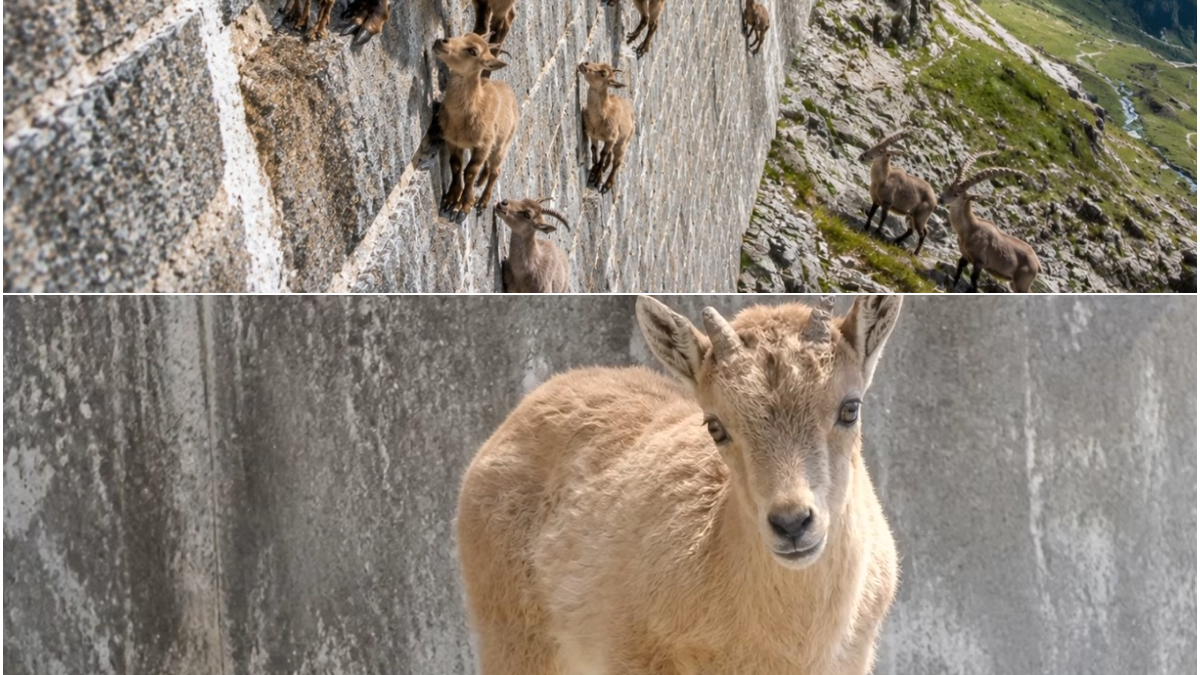
There is a place in the Italian Alps where a wall rises straight out of a mountain valley, and every summer, a mother leads her baby onto its face.
The stone drops nearly fifty meters toward the ground. There are no stairs, no safety rails, and no broad shelves where a young animal can stop and reSt. Yet the mother climbs as calmly as if she were crossing a meadow.
Her little one follows, placing each hoof with care, searching for the narrow seams between the blocks.
Far below, people watch and wonder how such a small creature can keep its balance.
The mother does not seem to notice them. She has no interest in the cameras or the astonishment of visitors.
Her attention is fixed on the wall itself. She presses her muzzle against the pale stone and begins licking the surface, returning again and again to the same patches.
Her baby watches, then tries to imitate her. To a person looking up from the valley, the scene seems impossible.
Why would an animal take such a risk when green pasture lies below? Why would a mother bring her young to a place where one mistake could end their journey?
The answer begins with a mineral that most people barely think about, and with a species that once came so close to disappearing that its entire population could have occupied a small backyard.
It continues through royal hunting grounds, secret journeys across borders, scientific discoveries, and a disease that changed the fate of a French mountain herd.
And it ends where it began, on a wall that was never built for goats.
What could possibly make a mother climb it? The wall belongs to the Chingino Dam, a masonry structure in the Italian Alps.
The reservoir above it rests at approximately 2,250 meters, high enough to sit among the rugged landscapes where snow can linger well into the warmer months.
The dam was built between 1925 and 1930 as part of a network of hydroelectric reservoirs.
Its purpose was to hold water and help turn the movement of that water into electricity.
Nobody designed it as a climbing route. Depending on how its height is measured, the wall rises somewhere between 46 and 51 meters.
It is roughly as tall as a fifteen-story building. From a distance, its face looks like one enormous slab of stone.
But the closer you look, the more its construction becomes visible. The surface is made of individual blocks, arranged in rows, with seams and joints running between them.
Decades of weather have changed those joints. Water has seeped into the masonry, freezing and thawing through countless seasons.
Rain and sunlight have worn the edges. The result is a surface full of tiny irregularities, narrow ridges, and shallow gaps.
To a human being, those details offer little comfort. To an Alpine ibex, they can be enough.
The ibex is built for steep terrain. Its legs are powerful, its balance exceptional, and its feet are adapted to finding purchase where other animals would struggle.
Each hoof is split into two parts. The outer edges are hard and narrow, made of dense keratin that can catch on small protrusions.
Beneath them are softer pads that compress against the surface, helping the animal maintain friction.
The two halves can spread apart, allowing the ibex to grip uneven ground and balance across narrow ridges.
Its feet are not simply miniature versions of human climbing shoes, but the principle is familiar.
A firm edge provides precision. A softer surface helps hold the animal in place. On a natural cliff, those features allow an ibex to move across ledges and broken rock with extraordinary confidence.
On the dam, the same abilities turn the seams between masonry blocks into a route upward.
The animal does not need a staircase in the human sense. It needs a sequence of small places where its hooves can hold.
The wall provides them. Still, being able to climb does not explain why the mother chooses to do it.
The journey is not without danger. The surface is steep, the footholds are narrow, and the consequences of a slip are serious.
A wild animal does not usually spend energy on a difficult route without some benefit.
The benefit, in this case, is salt. Every mammal needs sodium. It helps regulate the movement of water through the body, supports nerve signals, and allows muscles to function.
It is essential for the ordinary work of living, from maintaining fluid balance to moving a leg.
For animals that eat other animals, sodium is available in the tissues of their prey.
For animals that feed mainly on plants, getting enough can be more difficult. Plants generally require far less sodium than mammals do.
Many can grow with very little of it in their tissues. A grazing animal, meanwhile, must build and maintain its entire body using food that may provide only a small amount of this essential mineral.
In the mountains, the problem can become more pronounced. Much of the sodium that reaches inland soils begins near the sea, carried by wind and rain.
The farther inland a landscape lies, the less of that marine influence may reach it.
At high elevations, spring snowmelt can wash minerals downhill, leaving some alpine soils particularly poor in sodium.
The meadows may look rich. They can be covered in fresh green growth, filled with the promise of food after a long winter.
But a plant can be nutritious in one sense and deficient in another. Spring grass often contains high levels of potassium.
When grazers consume large amounts of it, that potassium can make it harder for their bodies to retain sodium and can interfere with magnesium balance.
The result is a peculiar problem: the season when food becomes abundant can also be a season when an animal’s mineral needs become harder to meet.
Wildlife researchers have observed similar patterns in different grazing species. Animals visit mineral licks when fresh growth is available, even though the meadows around them appear full of food.
The Chingino Dam offers a different kind of mineral source. Water moves through the masonry and dissolves small quantities of material from the stone and mortar.
As the water evaporates, pale deposits can remain along the surface. Local descriptions have referred to the crust as saltpeter, though that old term does not establish the exact chemical composition of every patch.
The deposits may contain a mixture of salts and other minerals. The precise makeup can vary from place to place.
But the behavior of the ibexes makes one thing clear. They find something on the wall worth seeking.
They climb, press their mouths against the masonry, and lick. The mothers and young are especially noticeable.
Large males, with their heavy bodies and sweeping horns, are rarely the animals visitors see making the ascent.
They tend to remain in the meadows below, while females and kids appear on the dam’s face.
To understand that difference, it helps to look beyond the wall and into the history of the species itself.
The Alpine ibex did not simply survive in the mountains because it was well adapted to them.
Its survival depended on a series of human decisions, some deliberate, some secret, and some made for reasons that had little to do with protecting wildlife.
Several centuries ago, Alpine ibex ranged across much of the high Alps. They were valuable to people living in those mountains, not only as a source of meat but also because nearly every part of the animal was believed to have a special use.
Horns were associated with remedies for stomach complaints. Hardened material found in the animal’s digestive system was prized as a supposed antidote to poison.
A small structure near the heart, known in some accounts as the heart cross, could be carried as a protective charm.
Even the animal’s droppings were once sold for medicinal purposes. These beliefs made the ibex more than a quarry.
They made it a collection of valuable objects, all contained in one animal. That was a dangerous combination for a species that did not always flee far when threatened.
The ibex’s instinct to escape into steep terrain worked well against predators that could not follow it.
A wolf might be forced to abandon the chase when the rock became too difficult.
A human hunter could simply wait, find a position with a clear view, and aim.
As hunting pressure spread through the Alps, local populations declined. Laws were introduced in some regions, but protection was often too late or too difficult to enforce.
In the canton of Graubünden, ibex hunting was prohibited in 1612, with severe penalties threatened for those who ignored the ban.
Yet the population still disappeared from the region within a relatively short period. One mountain district after another lost its ibexes.
By around 1820, there were no wild Alpine ibex left anywhere in Switzerland. The species had been reduced to a tiny refuge around the Gran Paradiso massif in the Italian Alps.
Estimates of the remaining population differ, but accounts commonly describe fewer than one hundred animals, perhaps around sixty at the lowest point.
The entire species, spread across a continent’s worth of mountains, had been reduced to a small remnant in one rugged region.
Its future depended on what happened there. The man who helped secure that refuge was not a modern conservationiSt. He was Victor Emmanuel II, a passionate hunter who would later become the first king of a unified Italy.
During the 1850s, Victor Emmanuel established a royal hunting reserve around Gran Paradiso. The land was protected from ordinary hunters because the king wanted exclusive access to its wildlife.
He employed game wardens to keep poachers away and preserve the animals for his own hunting.
The arrangement was deeply ironic. The ibex was protected not because the king had decided that it deserved a future independent of human use, but because he wanted to reserve the privilege of hunting it for himself.
Yet the protection worked in an important respect. The remaining animals gained a refuge where hunting was restricted and wardens could intervene against poaching.
The royal reserve later became Gran Paradiso National Park, established in 1922 as Italy’s first national park.
The ibex became its emblem. But while the animals survived in Italy, another country wanted them back.
Swiss authorities had been asking for breeding animals from Italy since 1875. They wanted to restore ibex to the mountains where the species had once been common.
The requests were repeatedly refused. The animals belonged to the king’s reserve, and permission to remove them was not forthcoming.
So a small group in the Swiss city of St. Gallen decided to find another way.
Among them were Albert Guana, a physician and naturalist, Emil Beckler, a forester, and Robert Mard, a hotelier with the money and connections to support the effort.
Their plan depended on a poacher from the Aosta Valley, a man identified in historical accounts as Bar.
He could obtain young ibex from the protected Italian population and move them across the mountains.
On June 6, 1896, according to Swiss historical accounts, Mard met Bar in a secret rendezvous in Martigny, Switzerland.
The poacher brought young ibex that had been taken from the king’s reserve. The animals were sold for 800 Swiss francs each, an enormous sum for the time.
The young animals were transported to the Peter and Paul wildlife park in St. Gallen.
There, caretakers raised them by hand, feeding them from bottles and tending to them as they adjusted to captivity.
The smuggling was not simply an isolated act by private individuals. Swiss accounts describe the federal government as aware of the operation and involved in supporting the purchases.
Customs officers were reportedly instructed to look the other way as the animals crossed the border.
A government was quietly helping move protected wildlife out of a foreign royal reserve, not through formal agreement but through a clandestine arrangement.
It was a crime in the service of restoration. Over the following decades, more young ibex were brought into Switzerland.
By 1933, historical accounts recorded 59 smuggled animals reaching the country. The breeding program gradually produced animals that could be released into the wild.
In 1911, ibex descended from the stolen young were released on the Schweizerischer Nationalpark region’s neighboring mountains, including the range known as the Grauer Herr in the historical account.
The first attempts were not all successful. Some colonies grew, others remained small, and some failed to establish themselves.
The lesson was clear. An animal that thrives in one mountain environment cannot automatically be expected to flourish in another.
Food, terrain, weather, disease, and the conditions of the release all mattered. But where colonies did take hold, they became sources for further restoration.
Animals were moved from established populations to new sites, then later from those sites to others.
The ibex spread through the Alps again, one release after another. Switzerland’s restored populations helped support reintroductions in Austria, Germany, and France.
The species gradually returned to many of the landscapes where it had disappeared. Today, estimates place the Alpine ibex population at roughly 53,000 animals across approximately 180 colonies in six countries.
The exact number changes with surveys and the fortunes of individual populations, but the scale of the recovery is remarkable.
From fewer than one hundred animals to tens of thousands in about a century. And yet the story of that recovery carries a hidden coSt.
When a species passes through such a narrow genetic bottleneck, the animals that remain represent only a fraction of the variation that existed before the population collapsed.
Every new colony founded from a handful of animals can narrow that variation further. The ibexes returned to the mountains, but their genetic history did not reset.
For much of the twentieth century, researchers could observe the population’s recovery without being able to read the full consequences written into its DNA.
Then genetic sequencing made it possible to examine the history at a much finer scale.
In 2020, a research team led by Christine Grossen, working with Daniel Croll, Lucas Keller, and colleagues, published a study in Nature Communications.
The researchers sequenced complete genomes from Alpine ibex and other related species, including domestic goats.
The Alpine ibex was especially valuable for the study because its recent history was unusually well documented.
Researchers knew about the original refuge, the founding of colonies, and the repeated transfers of animals between mountain ranges.
That history gave geneticists an opportunity to connect the structure of a modern population with the sequence of events that had created it.
They were interested in what happens to harmful mutations when a species is reduced to a small number of survivors and then rebuilt.
There are two possible processes that can shape the outcome. In a large population, natural selection can remove many harmful mutations over time.
Individuals carrying damaging changes may be less likely to survive or reproduce, reducing the frequency of those changes in later generations.
In a small population, however, chance becomes more powerful. A mutation may spread or disappear for reasons unrelated to whether it is beneficial.
This random process, known as genetic drift, can allow harmful variants to become more common than they would in a larger population.
But a small population can also experience a different effect. When there are very few animals, relatives are more likely to mate with one another.
A harmful mutation that is carried in only one copy may be hidden, because the other copy of the gene can still function.
If two related animals carry the same mutation, their offspring may inherit two copies. For severe mutations, having two copies can have major consequences.
Individuals carrying them may fail to survive or reproduce. When that happens, the mutation can be removed from the population.
This process is called genetic purging. The researchers found evidence of both effects in the ibex.
Some of the most damaging mutations appeared to have been purged during the species’ bottlenecks.
The small population had, in a sense, exposed certain severe genetic problems and removed them through the consequences of carrying two copies.
At the same time, milder harmful mutations had accumulated. These variants did not produce such dramatic effects that they were consistently removed.
They could remain in the population and become more common over generations. The result was complicated.
The ibex had lost some of its most damaging genetic baggage, but it had also accumulated less severe harmful changes and retained limited genetic diversity.
The study showed that even populations numbering around a thousand animals can accumulate mild harmful mutations.
A population may look numerically secure while still carrying a genetic history that could influence its ability to respond to future challenges.
The question was no longer simply whether the ibex had recovered in number. It was whether its genetic inheritance would help or hinder it when conditions changed.
On one French mountain, that question became urgent. The Bargy massif in the French Alps is a landscape of pastures, dairy farms, and mountain slopes.
The region is known for its traditional cheese production, including Reblochon, and its agricultural economy depends on healthy livestock.
Alpine ibex had disappeared from France long before the modern restoration effort. In the mid-1970s, fourteen animals, six males and eight females, were brought from a Swiss colony at Mont Pleure and released in the Bargy massif.
The population grew. By 2013, estimates placed it at around six hundred animals. Then a bacterial disease appeared in nearby dairy cattle.
The disease was brucellosis, an infection that can affect several kinds of mammals and can pass from animals to people, including through contaminated unpasteurized dairy products.
France had been officially free of the disease in cattle, sheep, and goats since 2005.
Investigators traced human infections in the area to the same outbreak and began looking for its source.
They tested more than twelve thousand farm animals across the region. The tests did not identify the source among those herds.
Attention turned toward the mountains. When researchers tested ibex in the Bargy massif, they found an infection rate that stood out sharply.
Around 38 percent of the ibex tested in 2013 showed signs of the disease. Wild mountain ungulates had often been considered dead-end hosts for this bacterium.
Earlier outbreaks in chamois and ibex populations had appeared and then faded. The Bargy outbreak was different.
The disease persisted, raising concerns about the possibility of transmission between wildlife and domestic animals.
The response became one of the most contested wildlife management decisions in modern France. In October 2013 and May 2014, authorities culled 251 ibex.
The animals targeted were judged to be older than five years. The removal represented more than two in every five ibex on the mountain.
Farmers worried about the health of their herds and the future of their livelihoods. Conservationists and animal welfare advocates objected to the scale of the cull and argued that the disease could be managed through more selective measures.
The dispute moved through public debate and legal challenges. The disease remained a concern, and the arguments over how to respond continued.
Later genetic research added another dimension. When scientists examined the Bargy ibex population, they found low genetic diversity, particularly in genes associated with immune function.
Those genes help an animal’s immune system recognize and respond to pathogens. The population had been founded from just fourteen animals.
Those animals came from a Swiss colony, which itself had been established from smuggled young descended from the tiny remnant in Italy.
The genetic bottlenecks had accumulated across generations. The researchers recommended introducing unrelated animals, including animals from the original Gran Paradiso population, to restore some of the lost variation.
France’s National Agency for Food, Environmental and Occupational Health and Safety later argued against mass culling as a general approach, favoring a more targeted strategy.
That approach involved capturing ibex, testing them, removing infected animals, and releasing healthy ones with identification tags.
There was no simple solution. Protecting livestock, managing a persistent disease, and preserving a genetically limited wild population were goals that could come into conflict.
The Bargy story showed how a rescue carried out generations earlier could influence a crisis long after the animals had returned to the mountains.
But the pressures on the ibex were not limited to disease or genetics. The mountains themselves were changing.
Gran Paradiso, the refuge that had sheltered the last wild population, experienced a major increase in ibex numbers during the 1980s.
A series of unusually mild winters helped the population grow, and it reached close to five thousand animals around 1993.
After that peak, numbers declined. By around 2010, the population had fallen to less than half its earlier size.
Researchers examining the change noticed that the losses were especially severe among young animals. In some accounts, roughly three quarters of kids failed to survive their first year.
The timing of food availability appeared to be part of the explanation. Alpine ibex give birth in early summer, a period when mothers and young can take advantage of the growing season.
The timing of birth has evolved alongside the seasonal rhythm of the mountains. As the snow retreats and the grass begins to grow, females have access to the fresh vegetation needed to support lactation and the development of their kids.
But warming temperatures have been changing that rhythm. Snow melts earlier in many alpine areas.
Plants begin growing sooner and can mature more quickly. The period when grass is tender and especially nutritious may arrive before the young ibex are ready to make full use of it.
A mother’s demands do not disappear simply because spring has shifted forward. She still needs to produce milk, maintain her own condition, and support a growing kid.
If the best food arrives too early and passes more quickly, the seasonal match between birth and vegetation becomes less reliable.
The challenge is not merely that the mountains are getting warmer. It is that the biological calendar of the animal and the seasonal calendar of its environment may no longer align as closely as they once did.
Heat also affects when ibex are active. In 2024, Francesca Bivio, Stefano Grignolio, and colleagues published research using fourteen years of motion-sensor data from 47 collared ibex in Gran Paradiso and Switzerland’s National Park.
The collars allowed researchers to examine how the animals’ activity changed with environmental conditions. One pattern was especially clear.
After hot days, ibex shifted more of their activity into the night. That change creates a new set of difficulties.
Ibex are primarily daytime animals. Their eyesight and ordinary behavior are suited to moving and feeding in daylight.
Steep rock is challenging enough when the animal can see its footholds clearly. At night, the same routes can become more difficult to navigate.
And in Gran Paradiso, another part of the mountain environment has changed. Wolves have returned.
Wolves often hunt at night and include ibex in their diet. Researchers had expected ibex living where wolves were present to be especially cautious about becoming active after dark.
Instead, the study found higher night activity in the park where wolves were present. The likely explanation was that avoiding heat had become more important than avoiding predators under the conditions measured.
The animals were adjusting their behavior to cope with one pressure, even if the adjustment could expose them to another.
The overall effects of warming are not uniform, however. Another recent study from Gran Paradiso found that shorter winters had been associated with increasing body mass among adult ibex over time.
Climate change is not acting as a single force with one predictable result. It is rearranging the pressures that animals experience.
Some changes may benefit certain individuals or age groups, while others create serious difficulties. The young appear especially vulnerable.
And the mothers remain at the center of the story. To understand why females and kids are the ones most often seen climbing the Chingino Dam, the story must leave the Alps for a while and travel to Australia.
In the 1950s and 1960s, a physiologist named Derek Denton was studying one of biology’s basic questions.
How does an animal know when it needs salt? Denton’s work helped establish that salt appetite is innate.
An animal that becomes deficient in sodium does not necessarily need to learn that salt is valuable.
The body can produce a powerful appetite for it, guiding the animal toward sources that help restore its balance.
To study how this worked in natural environments, Denton and his colleagues investigated animals living in the Australian Alps.
The Snowy Mountains are far from the direct influence of sea spray. Their high-country soils can be poor in sodium, and spring snowmelt can carry minerals away as water runs downhill.
Plants growing in those conditions may contain very little sodium. Animals that rely on them can therefore experience substantial deficiencies.
In 1968, Denton’s team published findings in Nature describing sodium deficiency among native Australian animals and introduced species such as rabbits.
The animals showed both physiological and behavioral adaptations to the shortage. Rabbits and kangaroos would leave their usual ranges and travel toward salt sources.
The researchers documented how strongly sodium deficiency could influence where animals went and how they behaved.
One observation was particularly important for understanding mothers. The effects of sodium deficiency were made worse by pregnancy and lactation.
A mother feeding her young is transferring nutrients from her own body into milk. Milk contains minerals as well as fat, protein, and water.
Sodium that leaves the mother in milk must be replaced somehow. If her diet is already low in sodium, producing milk increases the demand on a system that may already be under strain.
A lactating female is not simply trying to meet her own mineral needs. She must also provide for her offspring.
Decades after Denton’s original work, researchers in Kosciuszko National Park revisited the question using wooden stakes soaked in different salt solutions.
The stakes were placed at elevations reaching approximately 1,860 meters. Rabbits chewed the stakes treated with ordinary sodium chloride much more than those treated with other solutions.
The behavior offered a simple demonstration of the animals’ attraction to sodium. The hunger for salt was not a curiosity invented by captivity.
It was a response shaped by the environment and the demands of the body. Now return to the mother ibex on the dam.
Her kid is born at the beginning of summer. She enters the growing season while producing milk, and her body must support both herself and the young animal following her.
The grass may be abundant, but abundance does not guarantee that it contains the minerals she needs.
Fresh vegetation can be rich in potassium while providing little sodium. The combination can make it harder for her body to maintain its sodium balance at precisely the time her demand is increasing.
The mother needs another source. On the Chingino Dam, weathered masonry provides one. The climb is not an expression of fearlessness.
It is not a performance for visitors or a display of athletic skill for its own sake.
It is a response to a need that the pasture cannot fully meet. The mother climbs because the mineral deposits are above her.
She brings her kid because the young animal is not simply an independent traveler that can be left behind while she goes searching.
The kid follows its mother through the landscape, learning where to move and how to move there.
For an ibex, steep ground can also provide a sense of security. Females with kids often use rugged areas where a large predator may find it difficult to approach.
A cliff can offer a refuge that a meadow cannot. The dam presents a strange combination of those two advantages.
It offers a route toward minerals, and its steep face resembles the kind of terrain where ibex are naturally comfortable.
The kid learns by following. Its feet are small, but they already possess the same basic equipment as its mother’s.
It places one hoof after another, finding the narrow seams and copying the movements ahead.
The mother does not need to explain the route. She simply takes it. The males have different demands and different bodies.
Adult males do not produce milk. They spend much of the year apart from females, living in their own groups and following their own seasonal routines.
They also carry much greater weight and may have horns approaching a meter in length.
Their size and equipment are useful in other parts of ibex life, but they are not necessarily advantages on a steep wall made of narrow footholds.
A heavy body requires more secure purchase, and long horns can complicate movement in tight spaces.
That does not mean a male could never climb a dam or a steep artificial surface.
It means that the pattern observed at Chingino is consistent with the particular needs and behavior of mothers and young.
The females have a strong reason to seek minerals during lactation. The kids remain close to them.
The males are not facing the same immediate demand. The wall becomes a place where the needs of the mother and the abilities of the species meet.
But the story does not end with salt, because the dam is only one part of a much larger landscape of change.
The ibex’s modern population was rebuilt through a remarkable sequence of events. Its ancestors survived in a protected refuge because a king wanted exclusive hunting rights.
Later generations were transported across borders by people willing to break the law. Governments and private individuals helped restore animals to mountains where they had vanished.
That rescue made the species visible again across the Alps. It also left a genetic inheritance shaped by a series of small founding populations.
The 2020 genome study revealed that the bottlenecks had not simply reduced diversity. They had changed the balance of harmful mutations in ways that could be both helpful and harmful.
Severe variants had sometimes been removed, while milder ones had accumulated. The Bargy outbreak showed how limited immune-related diversity could become relevant when a pathogen entered a population.
The changing seasons of Gran Paradiso showed that even a population with a long history in its native landscape could face difficulties when the timing of food and temperature shifted.
The ibex has survived through adaptation, but adaptation is not unlimited. A species can be well suited to a mountain environment and still struggle when several pressures arrive together.
The dam makes that tension visible. The animal appears to be doing something extraordinary, but from the mother’s perspective, she is responding to ordinary biological demands.
She needs sodium. Her kid needs milk. The landscape has placed a source of minerals high above the ground, and her body is equipped to climb.
What looks like a spectacle to visitors is a routine decision in the life of an animal.
That is why the sight of a tiny kid on the wall can be so revealing.
It shows how behavior is passed from one generation to another, not through a lecture or a plan, but through following.
The young animal learns the routes that its mother uses. It learns where the footholds are, where the minerals can be found, and how to move through a place that looks impossible from below.
The wall is not part of the mountain’s ancient geology, but the behavior that makes it climbable is.
The ibex has carried its climbing ability through centuries of changing conditions. It has also carried a genetic history that includes near extinction, recovery, and repeated transfers between isolated colonies.
Its present is connected to a king’s hunting reserve, a poacher’s route over the mountains, a Swiss breeding park, and the scientific work of researchers who can now examine its genome.
Even the salt on the dam links the animal to another mountain range on another continent, where Denton and his colleagues studied the same basic appetite in rabbits and kangaroos.
A mother in Australia and a mother in the Alps do not need to share the same species or the same landscape to face a related biological problem.
Lactation increases the demand for sodium. When food does not supply enough, the body’s appetite can direct an animal toward a mineral source.
For the ibex, that source happens to be a wall. The climb also reminds us that conservation is not completed when a population count rises.
A species can return in numbers while retaining the consequences of its history. It can occupy its former range and still face new challenges from disease, climate, and changes in its food supply.
The ibex’s recovery is real. Its continued presence across the Alps is a major achievement.
But its future depends on more than the number of animals alive today. Genetic diversity, habitat conditions, disease management, and the timing of seasonal resources all matter.
So do the decisions people make about how to share mountain landscapes with wildlife and domestic animals.
The Bargy controversy demonstrated how difficult those decisions can become. Farmers have legitimate concerns about disease reaching their herds.
Wildlife managers must consider risks to livestock and human health. Conservationists must consider the value of preserving a population that has already passed through severe bottlenecks.
There is no single choice that removes every risk or satisfies every intereSt. The same is true of climate change.
Warmer conditions may benefit adult body mass in one context while increasing heat stress and disrupting the food available to young animals in another.
A shift toward nighttime activity may help ibex avoid hot days, but it can also alter their exposure to predators and make movement across steep terrain more difficult.
The mountain does not offer one simple problem with one simple solution. It offers a changing set of conditions that the animals must navigate.
And the mother on the wall is navigating them one hoof at a time. She does not know the details of the genetic study published in 2020.
She does not know that her ancestors survived in a refuge protected by a king who wanted to hunt them.
She does not know that young animals were once smuggled across the border for hundreds of Swiss francs, or that their descendants helped repopulate the Alps.
She knows the wall, the mineral taste in its cracks, and the young animal following behind her.
She climbs because her body demands something that the meadow cannot provide in sufficient quantity.
Her kid climbs because its place is beside her. The masonry gives them a route, and their hooves give them the means to use it.
Below, the valley makes the height seem impossible. Above, the reservoir rests quietly behind the dam.
Between them, the mother continues upward, pausing when she finds a patch of pale crust and pressing her muzzle against it.
Her kid reaches the same place and begins to lick. For a moment, the scene looks almost ordinary.
Two animals feeding together, as they might on a hillside or among stones in a high meadow.
But the setting changes everything. The surface is a human structure, the height is immense, and the young animal is still learning how to use its feet.
The mother continues, and the kid follows. Their journey carries the history of a species that nearly vanished and returned through a mixture of protection, ambition, secrecy, and chance.
It carries the consequences of a genetic bottleneck and the demands of a changing climate.
It carries a biological appetite that researchers first studied in the Australian mountains and that now helps explain a sight that seems to belong to another world.
The ibex did not evolve to climb a hydroelectric dam. It evolved to live among steep rocks, sparse alpine vegetation, and the changing seasons of the high mountains.
The dam happens to provide a new surface with familiar features and a mineral resource worth reaching.
To us, the wall is an obstacle. To the mother, it is a route. And when she reaches the top, she does not celebrate or look down at the people watching.
She simply continues with the quiet business of being an ibex, carrying her young through a landscape that has never stopped changing.
The wall was built to hold water and generate power. It was not built for her.
Yet every summer, she finds her way across it, reminding anyone who watches that survival often looks strange when seen from the outside.
A species can be rescued and still carry the marks of its rescue. A mother can face a difficult climb because the ordinary food around her is not enough.
A young animal can learn an extraordinary route by following a parent who has no reason to explain it.
And sometimes, the most revealing thing about a wild animal is not how far it can climb, but what it needs when it gets there.
Disclaimer: This content may be created by Al for entertainment purposes. Any resemblance to real persons, events, or places is coincidental.








