Giant Joro Spiders Keep Spreading In Smoky Mountains — And They’re More Dangerous Than You Think
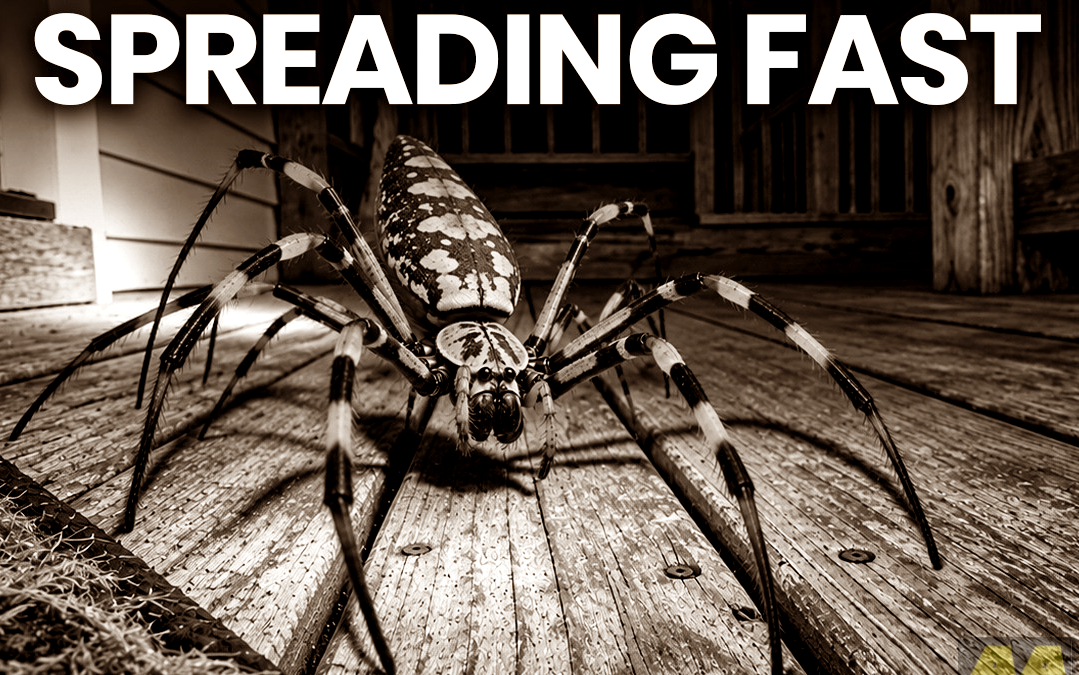
On October 17th, at first light in the Great Smoky Mountains, Jiren Rendon was kneeling in wet grass at Cad’s Cove, pulling invasive plants from the soil one root at a time.
The morning was quiet enough that he could hear the small sounds beneath the trees.
Then he looked up. A sheet of gold stretched between the branches. It was not yellow in the ordinary sense.
It had the warm metallic color of old jewelry, catching the first sunlight and turning almost luminous against the dark foreSt.
The web was enormous. And hanging motionless at its center was a spider nearly the size of Jiren’s open hand.
For a moment, neither moved. The spider had apparently been there long enough to build the entire structure across the gap between the trees, yet Jiren had never noticed it arriving.
That was the unsettling part. The animal had not announced itself. It had simply appeared.
This was the first recorded Joro spider inside the park. Soon there would be others.
The creature had already spread across the American Southeast, and by then millions of them were believed to be moving through the region.
People called them giant. They called them venomous. They called them flying. But those were not the details that mattered moSt.
The spider hanging in the center of that golden web was not looking for Jiren.
It was not waiting to attack him. It was not interested in people at all.
The real mystery was somewhere beyond the web, beyond the spider, and beyond the fear it created.
If an animal can barely hurt you, why can nobody seem to stop it? And if the spider is not the danger, what happens when something this adaptable becomes part of an ecosystem that never asked for it?
The answer begins with the name. Its scientific name is Trionapila Cleavata. Its common name is the Joro spider.
It came from East Asia, including Japan, Korea, Taiwan, and parts of China. There, the spider had existed alongside people for generations.
Its name was connected to Jorogumo, a creature from Japanese folklore that could take the form of a woman.
The old stories gave the spider an identity before anyone in North America had ever seen one.
The mythology was dramatic. The real animal was much less interested in humans. That distinction would become important.
Nobody intentionally brought the Joro spider into the American SoutheaSt. Researchers studying its arrival believe it most likely entered through international commerce, possibly inside a shipping container or other transported cargo.
The first confirmed American records appeared around 2013 and 2014 in northeast Georgia, in the region between Athens and Atlanta.
At first, it was one small population. Then another. Then another county. The spider spread into South Carolina.
It reached western North Carolina, where records appeared as early as 2021. Then it moved toward East Tennessee.
By late 2023, it had reached areas immediately outside the Great Smoky Mountains. The direction of movement was clear.
The spider was heading north. Then came that October morning at Cad’s Cove. The Joro had crossed into the park.
The Great Smoky Mountains had become part of its expanding range. For anyone who saw the spider for the first time, the appearance alone was enough to understand why people noticed it.
The female Joro is large compared with most spiders people encounter around homes. Her body can reach roughly an inch.
Her legs can spread close to four inches. She is not hidden beneath dull colors.
Her body carries bright yellow markings mixed with blue black patterns, along with a red marking underneath.
The males are much smaller and brown. The females are the ones people notice. The females are also the ones responsible for creating those enormous golden webs.
The silk catches the sunlight. In the right conditions, the web appears almost metallic. It can stretch eight feet across and, in some cases, approach ten feet.
That is large enough to make an ordinary garden web look tiny by comparison. The strength of the silk is another reason the spider attracted attention.
In 2022, researchers documented a remarkable observation involving a wild bird. A cardinal came to rest on a Joro web without immediately tearing through it.
The bird was small, but it was still an animal with enough mass and movement to test the strength of the structure.
The web held. That discovery added another layer to the spider’s growing reputation. Then there was the word that frightened people moSt.
Flying. The adult female does not fly through the sky like a bird. The young spiders do something very different.
They balloon. A newly hatched spider climbs to a high point. It raises its abdomen.
It releases silk into the air. Wind catches the thread. The spider is lifted away from the surface.
Under the right conditions, a tiny spider can drift for miles before settling somewhere else.
The spider itself is so small at this stage that a person could easily overlook it.
That is the strange part. The giant spider people photograph is not the form doing most of the long distance traveling.
The tiny spider is. The female builds the visible web. The young spiders become the invisible transportation system.
They climb. They release silk. They catch the wind. And they move. That difference would become one of the most important facts in understanding the spread.
The images that made the Joro famous showed enormous spiders hanging from golden webs. But the expansion happened long before people saw those webs.
By the time someone noticed a large female in a tree, the spider had already established itself there.
The next generation was already waiting for the right season. That is where the public story about the Joro began to separate from the scientific story.
For more than a decade, researchers repeatedly emphasized one basic fact. The spider was not considered dangerous to people.
Its fangs were adapted for catching insects. They were not designed to penetrate human skin easily.
In ordinary encounters, the spider had little reason to bite. For a bite to occur, a person would generally have to trap or handle the animal in a way that left it with few alternatives.
Even in that situation, the venom was described as relatively mild compared with the fear generated by the spider’s appearance.
A person might experience a small mark or swelling. For most people, it would be a temporary inconvenience.
The spider also displayed an unusual temperament. Researchers at the University of Georgia studied the response of Joro spiders to harmless disturbances.
They tested hundreds of spiders across dozens of species. A small puff of air was used as a harmless stimulus.
Many spiders froze briefly. The Joro response was different. Some remained still for more than an hour.
Instead of rushing toward the disturbance, the spider simply waited. The researchers described the Joro as exceptionally shy.
Its appearance suggested confidence. Its behavior suggested the opposite. The result was a strange combination.
A spider that looked intimidating could be remarkably reluctant to interact with anything around it.
For years, that became the reassuring explanation. Yes, the spider was large. Yes, its web was enormous.
Yes, it could appear across a porch, mailbox, garden gate, or path. But it was not interested in people.
The recommended response was simple. Leave it alone. If a web was genuinely in the way, move the web.
The spider itself did not need to become the target. That advice was scientifically reasonable.
But it answered only one question. Could the spider hurt you? It did not answer the question that eventually became much more important.
Could the spider spread? Researchers began looking at that question more closely as the Joro moved north.
The results were concerning. The Joro was not simply a tropical spider that had wandered into a warm corner of Georgia.
It had an unexpected ability to tolerate cold. Researchers at the University of Georgia compared the Joro with a related spider that had lived in the Southeast for much longer without expanding in the same way.
The Joro had roughly twice the metabolism. Its heart rate in cold conditions was about 77 percent faster.
It could also survive a brief hard freeze that the related spider could not tolerate as well.
That changed the map. The spider was not restricted to the deep South. Its native Asian range extended from roughly 35 to 45 degrees latitude.
Mapped onto North America, that band covered an enormous portion of the continent. The implication was straightforward.
The Joro might be able to survive across much of the eastern United States. It might even reach Canada.
The creature that people had imagined as a southern curiosity could become a northern one.
Then researchers noticed something else. The spider tolerated human infrastructure remarkably well. Joro webs appeared around gas station pumps.
They appeared between power lines. They appeared near stoplights. They appeared along busy roads. These were not quiet forest environments.
They were places filled with vibration, noise, vehicles, lights, and constant human movement. Yet the Joro remained.
The spider experienced stress, but it did not necessarily abandon the location. It could continue feeding.
It could continue growing. It could continue reproducing. That made it unusually compatible with landscapes already shaped by people.
The same roads that carried humans across the Southeast could potentially help the spider move as well.
Then reproduction added another layer. A female could leave behind an egg sac containing roughly 400 to 500 eggs.
When those spiders emerged, the smallest among them had an extraordinary transportation option. The wind.
Each spider could climb. Each spider could release silk. Each spider could potentially drift away.
The process was so subtle that almost nobody would ever notice it happening. Imagine a spring morning in a town that has never recorded a Joro.
The trees look normal. The roads are normal. The houses are normal. Then a tiny spider climbs toward the highest point it can reach.
It releases silk. The thread catches the air. The spider disappears. Nobody sees it. Nobody reports it.
Nobody takes a photograph. Weeks later, another web appears. That is the mechanism that makes the spread so difficult to track.
The giant female in the golden web is visible. The transportation system is not. And wind is only part of the story.
The spider can also move with human activity. It can potentially be transported inside vehicles.
It can move with cargo. It can travel with nursery plants. It can enter places people are already moving across the country.
A spider that can travel through both wind and human transportation does not need a single route.
It has many. By the time researchers began seeing large numbers of Joros, the expansion was already well underway.
Volunteers began reporting thousands of sightings. One recent season produced more than 3,600 verified reports across 112 counties.
That number represented documented observations, not every spider actually present. A map made from photographs can only show what people notice.
There are always spiders that nobody reports. That creates a built in delay. The spider expands firSt.
The map catches up later. In one recent year, the number of recorded sightings increased by more than 800 percent.
That did not necessarily mean the spider population itself had grown by 800 percent. Part of the increase reflected the fact that more people were encountering the species and learning how to recognize it.
Still, the direction was unmistakable. The Joro was spreading. Climate models added another possibility. Researchers at Penn State projected that the spider could eventually establish itself across much of eastern North America.
Pennsylvania was among the places considered suitable. The spider might move farther north. The process could take decades.
But the map was no longer limited to Georgia, South Carolina, North Carolina, and Tennessee.
The question had become continental. Could anyone stop it? The answer was becoming harder to find.
Spraying would not eliminate every spider. Removing individual adults would not eliminate the eggs. Removing eggs would not stop ballooning spiderlings.
Stopping one county would not stop wind. And controlling one road would not control every truck or plant shipment.
Once a species becomes widespread, the difference between prevention and management becomes enormous. Prevention can stop an arrival.
Management begins after arrival. The Joro had already arrived. And it was no longer confined to one small area.
That was when the public began asking the question underneath everything. If the spider is harmless to people, what should anyone actually be worried about?
The answer was the ecosystem. The Joro eats insects. That is what spiders do. But introducing another predator into an existing food web can produce effects that are difficult to predict.
One spider in a garden is one thing. Thousands across a forest are another. Millions across a region are something else entirely.
Researchers began studying native spider populations where Joros were becoming established. One study around Atlanta followed forests near the leading edge of the invasion.
The Joro population increased dramatically. At the same time, native orb weaving spiders declined. The decline was substantial.
That raised a disturbing possibility. Maybe the Joro was not simply adding another spider to the ecosystem.
Maybe it was replacing native spiders. The image was easy to understand. Gold webs appearing in places where native webs had once dominated.
A new species occupying the same physical space. A native species becoming less common. But the evidence was not simple.
Another research team examined what the Joros actually ate. They studied the diets of more than 200 spiders.
The results complicated the story. The Joros and native spiders did not necessarily depend on the same prey.
The Joro appeared to consume a broader range of insects. It included more than two dozen types of insects that the native spiders did not appear to rely on in the same way.
Meanwhile, native spiders continued eating many of the prey they had always consumed. There was no obvious evidence that the Joro was simply taking every available food source away from native spiders.
That created two competing possibilities. Perhaps the Joro was displacing native spiders directly. Or perhaps the two groups were occupying different parts of the food web.
Both ideas had supporting evidence. Neither completely explained the entire situation. And that uncertainty was important.
The decline in some native spiders was real. The dietary differences were also real. The problem was understanding the connection between them.
A spider could eat different insects and still compete for space. A native spider could decline for reasons unrelated to the Joro.
Human development could change forests. Weather could change insect populations. Landscape fragmentation could alter habitat.
Multiple factors could be operating at the same time. The Joro had arrived in a living system that was already changing.
That made it difficult to isolate one cause. Then there was another concern. The web itself.
A Joro web can reach eight feet across. Imagine one web. Then imagine ten. Then one hundred.
Then thousands spread across the trees of a valley. Anything moving through those spaces has to interact with the web.
Moths can encounter it. Wasps can encounter it. Bees can encounter it. Other flying insects can encounter it.
Some will escape. Some will not. Researchers still do not have a complete picture of what enormous numbers of these webs might mean for the movement of insects through an entire landscape.
That is the difficult part of studying an invasive species. The most important effects may take years to become visible.
A forest does not change overnight because one spider arrives. But an ecosystem can change gradually.
A native spider becomes less common. An insect becomes slightly more abundant. Another insect becomes slightly less abundant.
A bird changes where it feeds. A plant receives fewer visits from one pollinator. Another species fills the gap.
The changes accumulate. By the time anyone recognizes the pattern, the original event may have happened decades earlier.
That was why the arrival of the Joro inside the Great Smoky Mountains mattered. The park did not know exactly what would happen.
The spider had reached a new environment. Researchers could document its arrival. They could study where it appeared.
They could record how quickly it spread. But they could not simply rewind the clock.
The park’s response reflected that uncertainty. Rather than treating every spider as something that needed to be removed, researchers focused on observation.
Visitors were encouraged to report sightings. Photographs could help researchers determine where the spider had established itself.
Location data could reveal the direction of movement. Ordinary people became part of the survey.
That was especially important because Joros could resemble other orb weaving spiders. A person who removed a spider without identifying it might accidentally remove a native species instead.
The most useful thing a visitor could do was often the least dramatic. Look. Photograph.
Record the location. Leave the spider alone unless it was genuinely interfering with something. That response might seem strange when facing an invasive species.
But it reflected the reality of the situation. Once the Joro had spread across a large region, complete removal was no longer a realistic expectation.
The priority became understanding what was happening. That meant watching. And watching required patience. At Cad’s Cove, Jiren Rendon had been looking down when the spider first caught his attention.
He had been focused on invasive plants. He had been doing the ordinary work of conservation.
Pulling roots. Clearing vegetation. Restoring one small part of a landscape. Then he looked upward and saw something that had not been there in the park’s recorded history.
A gold web. A large female suspended in the center. The first recorded Joro inside the Great Smoky Mountains.
The moment was easy to photograph. The spider was impossible to miss. But the important part of the story was not what hung in the web.
It was everything that had already happened before the spider arrived. The species had crossed oceans.
It had survived transport. It had established itself in Georgia. It had expanded through South Carolina.
It had moved through North Carolina. It had reached Tennessee. Its young had ridden the wind.
Its adults had tolerated human infrastructure. Its population had grown. And eventually, one female appeared inside one of the most famous mountain landscapes in the eastern United States.
The spider did not need to announce its arrival. The wind had already done that.
The web was simply the first visible evidence. That is why the Joro story is different from the stories people first heard.
The frightening image was never the whole story. The spider is large. The web is enormous.
The colors are striking. The silk is strong. The young can balloon. The adults can survive cold conditions.
But the creature itself is not looking for people. It is not hunting pets. It is not chasing hikers.
It is not waiting on a porch to attack someone. Its world is the web.
Its prey is insects. Its reproductive cycle is tied to seasons. Its expansion is driven by biology and opportunity.
That is what makes it interesting. The spider does not need to be dangerous to become important.
It only needs to be adaptable. And the Joro appears remarkably adaptable. It can tolerate cold.
It can tolerate human activity. It can use the wind. It can reproduce in large numbers.
It can exploit environments already altered by people. It can move without anyone noticing. Those traits explain why the spider has advanced so far in such a short period.
They also explain why stopping it has become so difficult. The Joro is not a storm that arrives once and passes.
It is a population. Every generation creates another. Every egg sac creates hundreds of possibilities.
Every ballooning spider becomes another potential starting point. Every vehicle becomes another possible route. Every spring creates another opportunity.
The spread is therefore not a single event. It is a process. And processes are difficult to stop once they become self sustaining.
Researchers now have to watch the leading edge. They need to know where the spider appears next.
They need to understand how far north it can establish itself. They need to determine whether native spider populations continue declining.
They need to understand the insect communities living beneath the webs. They need to study birds and other animals that interact with the spiders.
They need to understand what happens after five years. Then ten. Then twenty. That information cannot be collected instantly.
The ecosystem needs time to reveal the consequences. The Joro is effectively conducting an enormous uncontrolled experiment across eastern North America.
Every new county becomes another observation. Every new forest becomes another data point. Every season adds another piece.
The researchers are watching the experiment as it happens. And the spider does not care about the experiment.
It does not know where state borders are. It does not recognize park boundaries. It does not understand county lines.
It follows the wind. It follows food. It follows the opportunities that exist in the landscape.
That was the deeper meaning of the spider hanging above Cad’s Cove. The animal had crossed an invisible line.
The forest did not look different. The mountains did not change. The streams still ran through the valleys.
Visitors still walked the same trails. But the biological map had changed. One new species had entered it.
And there was no obvious way to make the line move backward. Years from now, the first Joro recorded inside the park may be remembered as a small event.
There may eventually be thousands of webs. There may be years when visitors barely notice them.
There may be years when the spiders become especially abundant. Scientists may discover that their ecological effect is smaller than feared.
They may discover effects that are more complicated. They may find that native spiders adjuSt.
They may find that some decline. They may discover that birds consume the spiders. They may discover that certain insects increase while others decrease.
The future is not yet settled. That uncertainty is not a weakness in the science.
It is the reality of watching a new species move through a continent. The important thing is that researchers are looking.
And ordinary people are helping them look. A photograph can tell a scientist where the species has arrived.
A date can reveal how quickly it moved. A location can reveal whether the population is expanding naturally or arriving through human transportation.
One observation may seem insignificant. Thousands can reveal a pattern. The pattern is already visible.
North. Outward. Further into places where the spider had never existed before. The first recorded Joro at Cad’s Cove was not the end of the story.
It was a marker. A small point on a much larger map. The female hanging in that gold web had already completed the difficult part.
She had arrived. She had found a suitable place. She had built her web. Now she only needed time.
Her egg sac would carry the next generation. When the weather warmed, tiny spiderlings would emerge.
They would climb. They would release silk. The wind would catch them. Some would fall nearby.
Some would travel farther. A few could establish themselves somewhere no researcher was watching. And the process would begin again.
That is why the Joro is not best understood as a monster. It is better understood as a successful biological traveler.
It does not need to be feared to be significant. It does not need to bite people to change a landscape.
Its most important trait may not be its size or its venom or even its golden web.
It may simply be its ability to survive. To wait. To reproduce. To tolerate conditions that other spiders cannot.
To use the wind. To use human infrastructure. To arrive quietly. And then remain. Back at Cad’s Cove, the morning continued.
Jiren Rendon returned to the wet grass. The forest remained calm. The gold web caught the sunlight.
The female stayed motionless at its center. From a distance, it looked almost beautiful. That was perhaps the strangest part.
The creature that had inspired so many frightening headlines did not look dangerous when it was simply sitting in its web.
It looked like another part of the foreSt. But it was not. It was something new.
And the forest was going to have to respond. The question was no longer whether the Joro would arrive.
It already had. The question was how far the next generation would travel. A spiderling would eventually climb into the branches.
It would release one strand of silk. Then another. The wind would catch. And somewhere beyond the ridge, beyond the road, beyond the park boundary, another tiny spider would begin its journey.
No warning. No announcement. No visible invasion. Just silk in the air. That is how the Joro crossed the SoutheaSt.
That is how it reached the Smokies. And that is how it may continue moving north for years to come.
The golden web is only what we see after the journey is over. The real journey happens when the spider is too small to notice.
It happens above the trees. It happens on the wind. And by the time we look up, it may already be too late to ask where it came from.
The better question may be where it goes next? And what will the forests it reaches look like when it gets there?
Disclaimer: This content may be created by Al for entertainment purposes. Any resemblance to real persons, events, or places is coincidental.








