Florida’s Native PREDATORS ARE TARGETING INVASIVE IGUANAS — What Happened Next SHOCKED Scientists
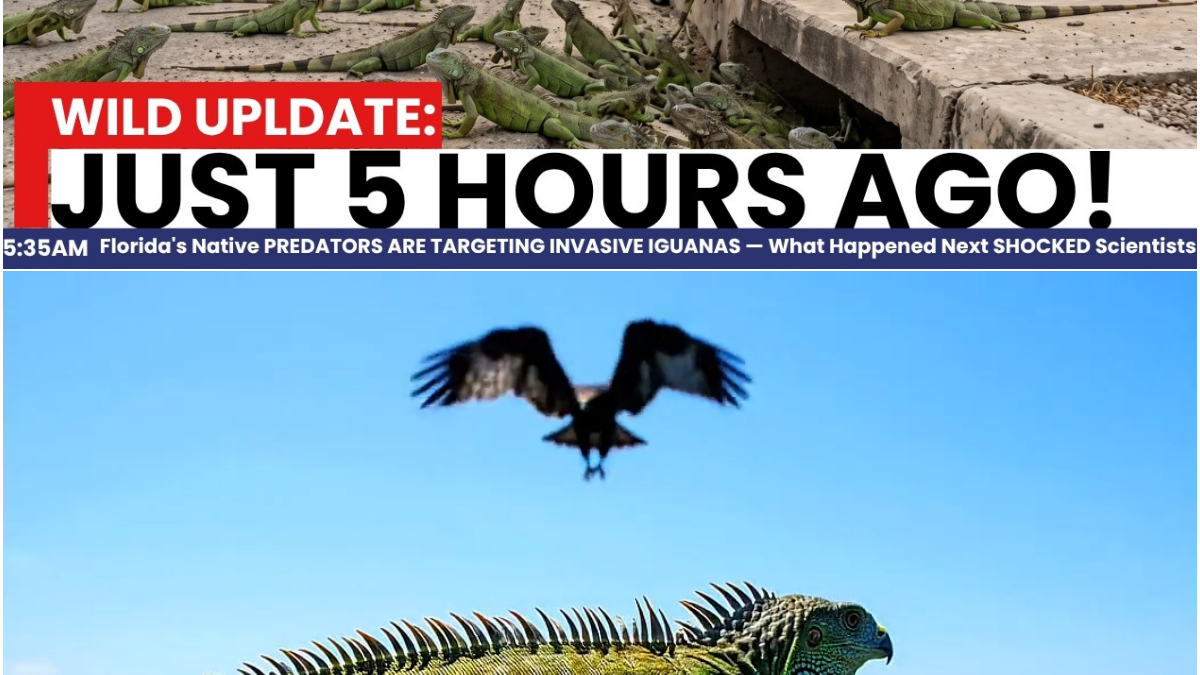
The hawk appeared as a shadow firSt. Two hundred feet above a South Florida canal, a red tailed hawk circled against a white September sky, riding a column of warm air rising from the concrete and dark water below.
On the seawall, a young green iguana lay perfectly still, its body warmed by the sun, its long tail stretched behind it.
The reptile had no reason to recognize the shape moving above. It had never belonged to this landscape in the first place.
The hawk folded its wings. For a moment, it seemed to vanish. Then it dropped.
The dive lasted only seconds. The iguana turned too late. Talons struck, wings opened, and the reptile disappeared upward in a burst of scales and dust from the seawall.
Fifty years ago, nobody would have witnessed such a scene in South Florida because there were no established populations of green iguanas for a native hawk to hunt.
Now it happens along canals, drainage ponds, suburban seawalls, and roadsides throughout the region. Something has changed.
The predators have noticed. Hawks are learning to recognize iguanas as food. Bald eagles are taking them when they find them exposed.
Great horned owls hunt them as evening temperatures fall. Raccoons raid their nests. Alligators take them from the water.
At first glance, it looks like nature correcting a mistake. But there is a problem.
The predators are hunting. The iguanas are still spreading. And when a native ecosystem begins learning how to respond to a species it never evolved alongside, what happens when the predators adapt faster than the system itself can recover?
The answer begins decades ago, long before the hawk ever made that dive. In 1964, more than three hundred iguanas were documented as being released in the Miami area.
That single event did not create the entire population that exists today, but it became an important beginning for the breeding population that followed.
Green iguanas had already become desirable animals in the exotic pet trade. They were colorful.
They were unusual. They were tropical. And South Florida looked almost perfectly designed for them.
The climate was warm year round. Vegetation was abundant. Water was everywhere. And beneath the surface ran a vast network of canals that connected neighborhoods, parks, agricultural land, wetlands, and developed areas.
For an animal adapted to tropical environments, the landscape offered almost everything it needed. What it did not offer was the ecological pressure that had shaped the species in its native range.
Green iguanas come from Central and South America. There, they developed within communities containing predators that had encountered them for generations upon generations.
Harpy eagles could take them. Boa constrictors could find them. Jaguars could pursue them. Caimans could take them near water.
The iguanas existed inside a network of relationships that constantly pressured them to remain alert.
South Florida offered something very different. It offered warmth without the same collection of specialized predators.
And then the pet trade supplied the animals. During the 1980s and 1990s, more than one million green iguanas per year were imported into the United States through commercial channels.
The animals arrived legally. They were sold legally. People bought them because they were fascinating animals.
But a small reptile in a store could eventually become a large animal with a very different set of needs.
Some were released. Others escaped. Some were abandoned when they became too difficult to maintain.
Each animal that entered the wild became part of a biological experiment nobody had planned on conducting.
Florida was the laboratory. The iguanas were the participants. And there was no obvious way to reverse what followed.
By the early 1990s, established breeding populations had been confirmed across Miami Dade, Broward, and Palm Beach counties.
The animals were no longer isolated curiosities. They were reproducing. A female green iguana can reach sexual maturity at roughly two to three years of age.
A single clutch can contain as many as eighty six eggs. The nesting burrow can extend roughly one meter below the surface, with lateral tunnels reaching as far as twenty four meters.
A female can reproduce annually for fifteen to twenty years. The numbers begin quietly. Then they accelerate.
One animal becomes several. Several become dozens. Dozens become hundreds. And eventually the landscape begins carrying an animal that was never part of its original ecological structure.
The canals became highways. The seawalls became basking platforms. The vegetation became food. The neighborhoods became shelter.
The warm climate removed one of the barriers that would have limited the population farther north.
By the time wildlife managers fully understood the scale of the problem, there was no single location where the population could simply be removed.
It was everywhere. And the iguanas were not merely occupying the landscape. They were altering it.
Tavia, a wildlife technician who had worked around South Florida canals for years, learned that lesson one morning beside a seawall in Broward County.
She had been sent to inspect a section of concrete that had begun shifting. At first, the damage looked like ordinary erosion.
Water had worked against the base. Vegetation had pushed through a few cracks. The concrete had settled unevenly.
Then she saw the entrance. An iguana tunnel disappeared beneath the wall. Tavia crouched beside it.
The opening was larger than she expected. She placed her measuring tape along the edge and followed the passage as far as she could reach.
The tunnel continued. She stood again and looked at the wall. A structure that had been engineered to control water was being weakened from underneath by an animal no engineer had ever needed to consider when the wall was designed.
That was the hidden cost of an established invasion. It did not always arrive as something dramatic.
Sometimes it was a crack. Sometimes it was a collapsed bank. Sometimes it was a seawall that suddenly needed a major repair.
Iguanas burrow deeply enough and extensively enough to undermine concrete structures. Their digging can compromise canal banks.
It can affect flood control infrastructure. It can weaken seawalls and foundations. For individual homeowners, repairs associated with iguana damage can reach twenty thousand dollars to one hundred thousand dollars.
The costs do not stop with private property. South Florida depends on an enormous network of canals, levees, flood control structures, and engineered waterways.
The region exists in constant negotiation with water. Every damaged structure becomes another problem that somebody has to pay to address.
The animals also affect native wildlife. In the Florida Keys, iguanas consume eggs and young animals associated with endangered tree snails.
They disturb habitat used by burrowing owls. They feed on native vegetation that may take years to establish after major storms.
Their droppings can contaminate areas around pools, docks, and water sources. And then there is electricity.
Iguanas climb. They climb walls. They climb trees. They climb fences. They climb utility structures.
When one reaches a transformer or electrical component, the result can be an outage affecting homes, businesses, and other facilities.
Utility companies now account for these incidents as part of the unusual collection of problems that comes with operating infrastructure in South Florida.
The invasion had become an infrastructure issue. It had become a wildlife issue. It had become a financial issue.
And then the native predators began paying attention. A bald eagle flew low over a canal one afternoon.
It was a remarkable sight for another reason. The species had once been pushed into severe decline by human activity involving DDT.
From roughly four hundred seventeen nesting pairs, the population recovered dramatically. More than three hundred sixteen thousand individuals are now present in the United States.
The eagle represented one of the most recognizable examples of ecological recovery. Now it was encountering something that had never been part of the landscape when those recovery efforts began.
An iguana. The eagle circled. The reptile moved across the grass. The eagle descended. It was not a specialized hunting response.
The bird had not evolved specifically to target green iguanas. It was simply recognizing an available opportunity.
That distinction mattered. A native predator could learn to eat an unfamiliar species without becoming a specialized predator of that species.
And Florida was beginning to show exactly that pattern. Red tailed hawks regularly targeted juvenile and subadult iguanas.
A 2021 study recorded more than sixty instances of hawks carrying away small green iguanas.
Great horned owls took advantage of the reptiles at dusk, when cooler temperatures slowed them.
Raccoons searched nesting areas. Feral pigs disturbed nests and consumed eggs. Alligators encountered iguanas near the water.
The ecosystem was responding. Not perfectly. Not completely. But visibly. Wildlife biologists began documenting a behavioral adjustment that would have seemed strange only a few decades earlier.
Predators were learning a new prey species. The hawk did not need to understand where the iguana came from.
The alligator did not need to know that the animal had arrived through the pet trade.
The eagle did not need to understand decades of commercial imports. They only needed to recognize opportunity.
That was the encouraging part. The unsettling part was what happened next. The iguana population continued growing.
A hawk can take a juvenile. An eagle can take an exposed adult. An alligator can take one near the water.
But none of those predators is specifically built around green iguanas. They are generalists. They eat many kinds of prey.
An iguana may be useful when convenient, but it is not the foundation of their hunting strategy.
This creates a biological ceiling. Small iguanas are vulnerable. Large iguanas are different. Once an adult reaches roughly two feet in length, the number of native predators capable of reliably taking it drops sharply.
The animal becomes stronger. It becomes harder to handle. It can retreat into vegetation. It can enter water.
It can climb. It can move through the same canals and structures that make human removal difficult.
The population therefore exists in two very different worlds. Young iguanas face growing pressure from native predators.
Adults remain difficult targets. And adults are the animals responsible for producing the next generation.
Tavia learned this while helping monitor a canal system after a cold snap. She found small iguanas lying motionless along the banks.
South Florida had experienced an unusual period of cold. Temperatures had dropped into the mid thirties across parts of the region.
The iguanas had become cold stunned. They were easy to find. They were slow. Some barely moved.
It was an unusual opportunity for wildlife managers. The Florida Fish and Wildlife Conservation Commission issued an emergency executive order.
Possession rules were temporarily adjusted. Five collection sites were established. People came from across the region to help.
In only two days, 5,195 cold stunned iguanas were removed. The number sounded enormous when spoken aloud.
Tavia remembered seeing trucks filled with containers. She remembered volunteers moving carefully along canal banks.
She remembered the public response. People understood that something unusual was happening. But then she looked across the water.
Iguanas were still there. The number collected was significant. The number remaining was much larger.
That was the difficult mathematics of an established invasive population. Removing thousands of animals could still represent only a tiny fraction of the total.
The event also demonstrated something else. Florida could remove iguanas quickly under the right conditions.
The problem was not whether removal was possible. The problem was scale. A 2025 peer reviewed study published in Frontiers examined the broader management challenge.
Its conclusion was uncomfortable. Eradication was no longer considered a realistic management goal. The population was too established.
The animals reproduced too effectively. They occupied too much territory. They had adapted to the environment.
The practical objective had changed. The goal was no longer complete elimination. It was sustained suppression.
And sustained suppression requires sustained money. The South Florida Water Management District spends more than two million dollars annually managing iguanas and pythons.
That money does not represent a single emergency response. It represents a continuing management burden.
Year after year. Season after season. Storm after storm. The problem becomes part of the budget.
That is one of the least visible characteristics of an established biological invasion. The initial event may be brief.
The consequences can last for generations. The animal arrives once. The management bill arrives repeatedly.
In June 2024, commercial breeding of green iguanas was finally prohibited in Florida. That occurred more than sixty years after the first documented wild population began forming in Miami.
The commercial pipeline had existed for decades. By then, however, closing the pipeline could not erase what had already entered the environment.
The animals already living in the canals did not disappear when the rules changed. The eggs did not disappear.
The established adults did not disappear. The nests did not disappear. The infrastructure damage did not disappear.
The predators did not suddenly become specialized iguana hunters. The landscape carried the history forward.
By 2026, Florida wildlife managers were still searching for additional tools. Rule changes expanded the ability to transfer wild caught iguanas to out of state permit holders.
The objective was practical. Every available legal mechanism mattered when the population was too large for one method to handle.
But there was another question beneath all of this. What happens when the ecosystem begins solving part of the problem on its own?
Tavia watched that question unfold every week. One morning she stood beside a canal with binoculars pressed to her eyes.
A young iguana climbed onto a concrete ledge. Above it, a red tailed hawk circled.
The hawk adjusted its wings. The iguana froze. The hawk descended. Tavia watched the bird take the reptile and carry it toward a stand of trees.
She lowered the binoculars. For a moment, the scene looked almost reassuring. The predator had found the prey.
The native ecosystem had responded. But then she looked down the canal. Another iguana was basking on a seawall.
Then another. Then another. Farther away, something moved beneath a bush. The population was still there.
The predator had won one encounter. The ecosystem had not won the larger struggle. That distinction became central to the way Tavia understood invasions.
Nature does not always respond with a single dramatic correction. Sometimes it responds slowly. A hawk changes its hunting habits.
An owl learns where reptiles gather at dusk. A raccoon discovers a neSt. An alligator recognizes movement near the bank.
Each behavior matters. Each one is real. But adaptation does not automatically equal control. Florida’s native predators are learning.
The iguanas are learning too. Juveniles exposed to hawks and other predators can become more cautious.
They scan more often. They flee more quickly. They climb when danger approaches. They alter their behavior.
In their native range, such responses have been shaped over enormous stretches of time. Florida is compressing that process into decades.
The predators are adapting to the invader. The invader is adapting to the predators. Neither side is standing still.
That is what makes the story so difficult. There is no single villain standing beside the canal.
There is no one animal responsible for what happened. There is a chain of decisions.
There was a commercial market. There were imported animals. There were owners. There were releases and escapes.
There were decades when the population expanded faster than management systems could respond. And there is now a public coSt.
The people paying that cost are often nowhere near the original transactions. A homeowner sees a cracked seawall.
A utility worker responds to an outage. A water manager repairs a canal bank. A wildlife technician removes an animal from a road.
A volunteer spends two cold days collecting stunned reptiles. The expenses appear in different places.
The original cause becomes harder to see. That is why the numbers matter. More than one million green iguanas per year were imported into the United States during parts of the 1980s and 1990s.
More than three hundred were documented in the 1964 release near Miami. Five thousand one hundred ninety five were removed during two days in January 2026.
More than two million dollars are spent annually by the South Florida Water Management District on iguana and python management.
Twenty thousand to one hundred thousand dollars can be associated with individual seawall repairs linked to iguana damage.
The numbers tell different parts of the same story. The first numbers describe arrival. The later numbers describe consequence.
And between them sits six decades of ecological change. Tavia returned to the same canal several months later.
The water was calm. Palm fronds moved in the afternoon breeze. A great horned owl called from somewhere beyond the trees.
She stopped beneath a power line and looked toward the seawall. An adult iguana was stretched across the concrete.
It was large. Too large for the hawks that worked the area regularly. The reptile raised its head.
For a few seconds, it watched Tavia. Then it disappeared beneath the wall. She walked closer.
The entrance to the burrow was almost hidden. That was the part people often missed.
The visible animal was only the surface of the problem. Beneath the ground was a tunnel.
Beyond that tunnel could be another. And somewhere deeper could be a neSt. The population did not exist only in the animals people could see.
It existed in the spaces people could not. That was why eradication had become so difficult.
It was not enough to remove what was visible. The reproductive system had to be interrupted.
The adults had to be reduced. The young had to be removed. The habitat had to be monitored.
The infrastructure had to be protected. And the work had to continue. Forever was a difficult word in wildlife management.
But established invasions sometimes demanded exactly that kind of commitment. The hawk above Tavia circled once.
She looked up. It was the same species that had been hunting along the canal all morning.
The bird folded its wings. It dropped. Tavia watched it disappear below the line of trees.
A moment later it rose again. There was a small iguana in its talons. The hawk carried it away.
Tavia followed the flight with her eyes until the bird became a dark speck against the sky.
The scene was remarkable. A native predator had learned. It had recognized a new prey animal.
It had incorporated that animal into its behavior. That mattered. It meant ecosystems were not passive.
They could respond. They could adjuSt. They could learn. But the lesson of South Florida was that adaptation had limits.
The hawk could take one iguana. The eagle could take another. The owl could take another at dusk.
The raccoon could find a neSt. The alligator could catch one crossing the water. Thousands of individual encounters could happen every year.
And still the population could continue. That was the uncomfortable truth hidden beneath the dramatic image of a hawk carrying an iguana over a canal.
The predator was not failing. It was doing exactly what a predator does. The problem was that the invasion had already grown beyond what the native predator community could regulate by itself.
The ecosystem was pushing back. But it was pushing back against something that had been given decades to establish itself.
One evening, as the sun dropped behind the palms, Tavia stood at the canal and watched an adult iguana climb from the water.
The reptile paused. A bald eagle passed overhead. The iguana froze. The eagle continued. Nothing happened.
The predator had another destination. The iguana resumed climbing. That small moment explained the entire problem better than any dramatic chase could.
Predators make choices. They spend energy. They weigh opportunities. They do not hunt every available animal.
An invasive species does not need to defeat every predator. It only needs to reproduce faster than those predators can reduce it.
That was the balance Florida was still trying to change. The future would not be decided by one hawk.
Or one eagle. Or one cold snap. It would depend on management, public behavior, habitat protection, regulation, funding, and the continued ability of native wildlife to adapt.
The story that began with a commercial animal becoming part of a tropical landscape had become much larger.
It was now a story about infrastructure. It was a story about economics. It was a story about wildlife.
It was a story about responsibility. And it was also a story about resilience. The same Florida landscape that had provided the conditions for the iguanas to spread was producing predators capable of learning how to use them.
The bald eagle had returned from a period when its population had been severely reduced.
The red tailed hawk continued hunting the canal edges. The great horned owl waited for evening.
The raccoons searched. The alligators watched the water. None of them had been assigned the task.
None of them understood the history. They simply responded to what was in front of them.
That may have been the most remarkable part. An ecosystem does not read a management plan.
It does not know what year a species arrived. It does not understand a regulation passed in June 2024.
It does not know about the 1964 release. It does not know about millions of imported animals.
It responds to pressure. The iguanas became pressure. The predators responded. And South Florida became a living record of what happens when an introduced species finds nearly perfect conditions in a landscape that was never prepared for it.
The next morning, another hawk would rise over another canal. Another iguana would crawl onto another seawall.
Another predator would learn another hunting opportunity. And somewhere beneath the concrete, another tunnel would extend into the earth.
The story would continue. Not because the ecosystem had failed. Not because the predators were incapable.
But because nature was being asked to solve a problem that had been built over generations.
The hawks could adapt. The eagles could adapt. The owls could adapt. The alligators could adapt.
The question was whether adaptation alone could ever catch up with an invasion that had already become part of the landscape.
Above the canal, the red tailed hawk circled again. Below it, the iguanas remained. And between them was the strange new balance South Florida had spent decades creating.
Disclaimer: This content may be created by Al for entertainment purposes. Any resemblance to real persons, events, or places is coincidental.








