Five Men Followed the Nameless Gunslinger to Deadwood — Wild Bill Ordered Five Coffins
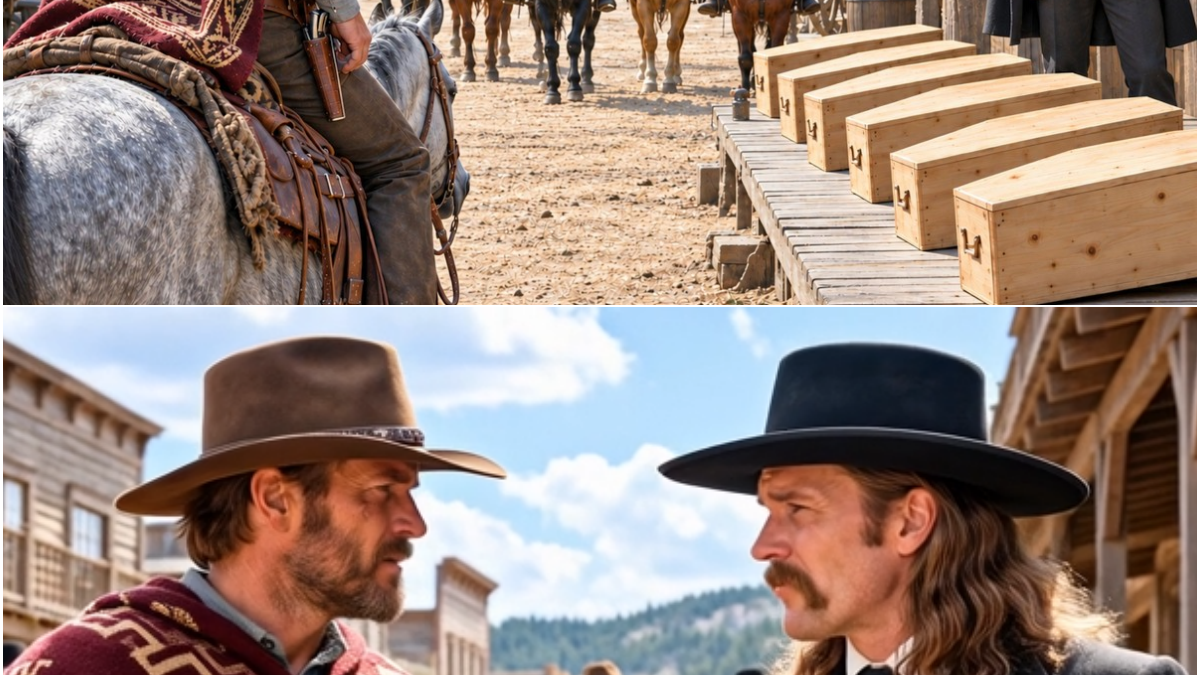
For six days, five riders had followed the stranger through country where a horse could disappear behind a rise before the dust from its hooves settled.
They never hurried. They never fired. They stayed far enough behind to make pursuit impossible to challenge and close enough to make escape feel like a story the stranger had already heard too many times.
By the sixth morning, he understood what they wanted. They were not trying to catch him on an empty trail.
They wanted witnesses. They wanted a town where every window faced the street, where every saloon would go quiet when guns came out, and where a man could no longer ride into the horizon and leave an old grievance behind.
So the stranger rode straight toward Deadwood. The mining camp spread through the Black Hills in the summer of 1876, rough and restless, with fresh cut timber, muddy roads, half finished buildings, smoke rising from cook fires, and men arguing over claims that had barely existed long enough to acquire names.
He entered without slowing. Five riders remained on the ridge behind him. Most people saw only another traveler arriving from the trail.
Wild Bill Hickok saw the riders. Then he saw the way the stranger kept one hand near his coat and the other loose beside the saddle.
Hickok stepped into the road. “Those yours?” The stranger looked toward the ridge. “They think so.”
“How long?” “Six days.” Hickok studied the five distant figures. “And what are they waiting for?”
The stranger looked at Deadwood, then at the narrow undertaker shop ahead. “For a place where I cannot ride away.”
Hickok followed his gaze toward the shop. “Then perhaps we should give them one reason to stay where they are?”
Six years earlier, the trouble had begun in a Kansas cow town the stranger could barely remember without also remembering heat, whiskey, dust, and horses tied too long outside a saloon.
His name had become less important than the reputation attached to it, so most people simply called him the gunslinger.
In that Kansas town, Reuben Coyle had been drinking heavily and playing cards at a table near the back wall.
Nobody disputed that part. Nobody disputed what happened at the card table either. The gunslinger noticed the marked cards firSt.
He had seen enough cheating to recognize it without needing to study the dealer’s hands twice.
Reuben had been slipping cards beneath his palm and changing them whenever the others looked away.
The gunslinger could have walked away. Instead, he gathered the cards, turned them face up, and tossed them across the table.
“You should leave before somebody less patient notices what you are doing.” Twenty men were close enough to hear him.
Reuben stood. The gunslinger remembered the movement clearly. Reuben’s chair scraped the floor. His hand moved toward his revolver.
The gunslinger drew. One shot ended the argument. No formal charge followed. No posse arrived.
No jury sat in a courtroom to decide whether the shooting had been justified. The gunslinger left town before the family finished making arrangements.
That should have been the end of it. It was not. Reuben had five brothers.
Silus was the oldeSt. Amos came next. Then Peter and Nathan. Eli was the youngest, only nineteen when Reuben was lost to the family.
For six years they carried the same account from town to town. The stranger had humiliated Reuben.
The stranger had caused the confrontation. The stranger had walked away. The stranger still lived.
That was enough for them. Over the years, the gunslinger heard pieces of their search.
One Coyle brother had asked about him in Abilene. Another had been seen near a freight station in Nebraska.
A third had carried a description from one settlement to another. The gunslinger never knew which rumors were true.
Then, near Cheyenne, five riders appeared behind him. They did not call out. They did not fire.
They simply followed. The gunslinger changed direction twice. They changed with him. He rode harder.
They stayed behind. He stopped at a creek and watered his horse. They stopped far beyond rifle range.
The next morning, they were still there. By the sixth day, the stranger understood. They had no interest in surprising him on a lonely trail.
They wanted him to know they were coming. They wanted him tired. They wanted him thinking about what waited at the end of the road.
And Deadwood offered exactly what they needed. The town was crowded. The streets were narrow.
Every miner, gambler, merchant, teamster, and traveler would have a view of anything that happened in the center of town.
The stranger rode toward the livery. Wild Bill Hickok walked beside him. “You tell me the whole story,” Hickok said.
“Enough of it.” “That is not what I asked.” The gunslinger glanced over. Hickok’s face looked relaxed, but his eyes missed nothing.
“I caught Reuben cheating at cards.” “And?” “I embarrassed him.” Hickok waited. The gunslinger continued.
“I could have handled it differently.” “Did he draw?” “Yes.” “And you?” “I drew faster.”
Hickok nodded. “You call that fair?” “I call it what happened.” “That is not quite the same thing.”
The gunslinger looked at him. “You were not there.” “No.” “Then why does it matter to you?”
Hickok looked toward the ridge. “Because five men have followed you for six days, and they did not come all this way to discuss cards.”
The stranger tied his gray horse, Scout, outside the livery. Hickok looked at the animal.
“Good horse.” “He has carried me through worse.” “Then he is probably tired of your decisions.”
The gunslinger almost smiled. “You always talk this much?” “Only when someone is about to make my evening difficult.”
Hickok crossed the street toward a narrow undertaker shop. The sign above the door read Olsen.
Inside, Olsen was working over rough pine boards. He was a thin man with narrow shoulders and the expression of someone who had spent too many years around sorrow to be impressed by loud men.
Hickok entered. “I need five boxes.” Olsen looked up. “For what?” Hickok pointed through the doorway.
“Those riders.” Olsen followed his gaze. The five men remained on the ridge. Olsen studied them for several seconds.
“You expecting trouble tonight?” “Before dark, if they are in a hurry.” “And if they are not?”
“By morning we will know.” The gunslinger entered behind him. “You planning to frighten five men with lumber?”
Hickok picked up one of Olsen’s carpenter pencils. “Some men listen to warnings.” He looked toward the ridge.
“Others need measurements.” Olsen sighed and returned to his work. By noon, the first pine box had been assembled.
By one, there were two. By three, most of Deadwood had heard some version of the story.
Some said the five riders were bounty hunters. Some claimed they were lawmen. One drunk insisted the stranger had stolen a gold mine from them.
Another said the five brothers had followed him from Texas. Nobody knew the truth. That did not prevent anyone from discussing it.
The gunslinger stood beneath a saloon awning while Olsen worked. Three pine boxes rested along the boardwalk.
Fresh sawdust gathered around the shop entrance. Hickok stood beside him. “You are enjoying this,” the gunslinger said.
“No.” “You look pleased.” “I look patient.” “With five boxes outside?” “Those are not for enjoyment.”
The gunslinger glanced toward them. “Then why build them?” “Because men behave differently when consequences have shape.”
The gunslinger looked at Hickok. “You think they will turn around?” “I think two might.”
“And the others?” “That depends on whether they came here for Reuben or for the story they have told themselves for six years.”
The afternoon dragged. That was worse than an immediate confrontation. The gunslinger ate because Hickok told him to eat.
He drank water because Scout needed water. He checked his revolver. Five minutes later, he checked it again.
Hickok noticed. “Gun changed?” “No.” “Then leave it alone.” The stranger returned it to the holster.
“You always this irritating?” “Only when someone is nervous.” “I am not nervous.” “Then you are foolish.”
The stranger looked at him. For the first time that day, he smiled. Near sunset, five rough pine boxes stood outside Olsen’s shop.
Each lid rested beside its box. Olsen had marked the ends with charcoal. One. Two.
Three. Four. Five. The gunslinger stared at them. “Whose idea?” “Mine,” Olsen said. Hickok looked satisfied.
Then the riders came down from the ridge. The sound of conversation faded across Deadwood.
A piano continued inside one saloon for several seconds before the player finally stopped. The five riders entered at a walking pace.
Silus Coyle led them. He was broad through the chest, gray at the beard, and carried himself like a man who had spent six years imagining exactly how this moment would feel.
Amos rode beside him. Peter and Nathan followed. Eli came laSt. He was twenty five.
Young enough to have spent more of his life hearing stories about Reuben than remembering the brother himself.
They stopped in front of Olsen’s shop. Five brothers. Five pine boxes. Silus looked at the numbered ends.
“Which one is mine?” Hickok stepped down from the boardwalk. “That depends on who draws firSt.”
Silus looked at him. “Wild Bill Hickok.” “That is what they call me.” “This is not your fight.”
“No.” The answer surprised Silus. Hickok continued. “It is not my town to govern either.”
He looked around at the rough buildings, muddy street, and unfinished boardwalk. “No badge on me.
No proper court waiting behind that door.” He pointed toward the street. “But you are planning to settle an old grievance in front of everyone here.”
Silus dismounted. His brothers followed. The gunslinger stepped into the street. For the first time in six days, there was no distance between them.
Silus stared at him. “You remember Reuben?” “Yes.” “Say his name.” “Reuben Coyle.” Eli’s jaw tightened.
Silus stepped closer. “You humiliated him.” “I caught him cheating.” “You called him a thief in front of twenty men.”
“He was cheating.” “You wanted him angry.” The gunslinger did not answer immediately. Silus noticed.
“So there it is.” The gunslinger looked at him. “I was younger.” “That changes nothing.”
“It changes something.” “How?” “I was meaner than I needed to be.” Eli moved forward.
Silus raised one hand. The youngest brother stopped. The gunslinger continued. “Your brother reached for his revolver.”
“You wanted him to.” “No.” “You pushed him.” “I embarrassed him.” “That is the same thing.”
“No.” The gunslinger’s voice remained calm. “When he drew, I chose to live.” Silus stared at him.
“For six years, we carried that.” “No,” the gunslinger said. “You carried it.” Silus looked toward the pine boxes.
“You think those frighten us?” Hickok answered. “They already changed the situation.” Silus turned toward him.
“How?” “You rode into town expecting one ending.” Hickok pointed toward the boxes. “Now you have to look at five possible endings.”
The five brothers became still. Amos looked at the fourth box. Peter looked toward the open road.
Nathan studied the crowd. Only Eli kept staring at the gunslinger. Silus noticed. So did Hickok.
“We came too far to turn around,” Eli said. Hickok shook his head. “Distance is a poor reason to make a permanent choice.”
Eli’s hand moved closer to his holster. The gunslinger noticed. “Do not.” Eli looked at him.
“You said that to Reuben?” “No.” “Maybe you should have.” “Eli,” Silus warned. But the youngest brother had spent six years living inside a story that required an ending.
“You ever lose a brother?” He asked. “No.” “Then do not tell me what six years feels like.”
The gunslinger nodded. “Fair.” The answer made Eli angrier. Silus raised a hand again. For several seconds, the entire street seemed suspended.
Then Peter spoke. “Tell Hickok what happened after Reuben fell.” The gunslinger looked at him.
Hickok turned toward Peter. Peter continued. “You left before the family finished.” “I was afraid staying would make things worse.”
“You ran.” “I rode away.” “That is the same thing.” The gunslinger lowered his eyes.
“What was I supposed to say?” Peter’s voice softened. “Anything.” The gunslinger had no answer.
That silence changed something. Not the facts. Not the shooting six years earlier. But the shape of the grievance.
Hickok looked at him. “You ever think about going back?” “At twenty eight?” “Yes.” “No.”
“And now?” The gunslinger looked toward the five brothers. “Now I know leaving gave them six years to tell the story without hearing my side.”
Silus looked at him. “It was not an apology.” “No.” “Then what is it?” “The truth.”
Silus studied him. Eli moved. His revolver cleared leather. Everything happened at once. The gunslinger drew.
Hickok moved sideways. Two shots sounded almost together. The gunslinger’s bullet struck Eli’s revolver and knocked it from his hand.
Hickok fired toward Amos. The shot struck Amos high in the shoulder. He spun against the boardwalk railing and dropped hard.
Peter and Nathan drew halfway. Then stopped. Silus had his revolver out. He had not fired.
Hickok’s voice cut across the street. “Enough.” Peter lowered his weapon. Nathan followed. Amos clutched his shoulder.
Eli stared at his empty hand. Silus remained armed. Hickok looked directly at him. “You have brothers standing beside you.”
Silus looked at Amos. Then Peter. Then Nathan. The gunslinger kept his revolver lowered. “Silus,” he said.
Silus raised his eyes. “Do not.” For several seconds, Silus did not move. Then his revolver lowered.
It was the first sign that the six year pursuit might finally end without another shot.
Then Eli lunged toward Amos’s fallen weapon. The gunslinger saw him. “Eli.” Eli grabbed the revolver.
He turned. The shot struck the gunslinger’s forearm. His own revolver answered by instinct. Eli staggered.
The weapon slipped from his hand. He collapsed beside the fifth pine box. Silus made a broken sound.
He raised his revolver again. Hickok stepped between them. “Do not make your mother lose another son over the same grievance.”
Silus froze. The gunslinger pressed his hand against his injured arm. He did not raise his weapon.
Silus stared at Eli. Then at Amos. Then at Peter and Nathan. Finally he looked at the five numbered boxes.
The revolver fell from his hand. Nobody cheered. That mattered. Hickok kicked the weapon away.
“Peter, Nathan, stand beside your brother.” They obeyed. Silus remained in the street. The gunslinger looked toward Eli.
“I told him not to.” Silus looked up. “You told Reuben too?” “No.” The answer was quiet.
The gunslinger looked toward the young man on the ground. “I wish I had.” Silus sat on the edge of the boardwalk.
The strength seemed to leave him. Deadwood returned slowly to itself. Men moved. Someone brought water.
Someone called for the doctor. Olsen came from his shop with rope. There was no polished court waiting to organize the scene.
Deadwood in 1876 was still a rough mining camp in the Black Hills, growing faster than formal authority could keep pace with it.
The place had attracted prospectors, merchants, gamblers, laborers, adventurers, and men who had nowhere else to go.
The streets were crowded. The buildings were unfinished. Law was often improvised. Reputation could carry as much weight as a badge.
And Wild Bill Hickok was there in the final weeks of his life, known throughout the camp for a past that included law work, scouting, gambling, and gunfighting.
But this confrontation between the Coyle brothers and the unnamed gunslinger belonged to fiction. The setting around it did not.
Inside that rough camp, witnesses now stood everywhere. That made the difference. Amos’s shoulder was bound.
The gunslinger’s forearm was examined by a doctor. The bullet had passed through flesh without breaking the bone.
“Lucky,” the doctor said. The gunslinger looked at the bandage. “It does not feel lucky.”
The doctor gave him a dry look. “You are still complaining.” “That means I am still here.”
Hickok stood near the door. Outside, Olsen carried the fifth pine box into his shop.
Four remained beneath the awning. The gunslinger watched them. “Four wasted.” “Hope so,” Hickok said.
The gunslinger looked toward him. “You think they will try again?” “No.” “You sound certain.”
“I think grief makes men foolish.” He paused. “Shame can make them worse.” The gunslinger looked toward the building where the brothers were being held.
“Silus will not.” “You know him that well?” “No.” “Then do not make the mistake of thinking you understand him.”
Near midnight, Silus asked to speak with the gunslinger. Hickok disliked the idea. The gunslinger went anyway.
Silus sat against the wall with his hands bound in front. Amos rested nearby, his shoulder tightly wrapped.
Peter and Nathan remained silent. Silus looked at the bandage on the gunslinger’s arm. “Eli always was the quickest to anger.”
“He was twenty five.” “He was still my little brother.” The gunslinger nodded. Silus looked down.
“You apologize for Reuben now?” The gunslinger took several seconds before answering. “No.” Silus looked sharply at him.
“I regret humiliating him.” He paused. “I regret leaving before your family finished burying him.”
Silus’s eyes hardened. “I regret giving five brothers six years to tell the story without ever hearing my part.”
He looked directly at Silus. “But I will not apologize for surviving when your brother reached for a gun.”
Silus lowered his eyes. “Then what are we doing here?” “Ending it.” “Easy word.” “No.”
The gunslinger glanced toward Amos. “One brother injured.” His eyes moved toward the room where Eli was being prepared.
“One brother loSt.” Silus closed his eyes. “You can spend another six years deciding that means you need me gone too.”
Silus looked up. “Or?” “Or you take your brothers home.” Silus stared at him. “You would let us leave?”
“Not my town.” The gunslinger glanced toward the door. “Not Hickok’s either.” Silus waited. “But by morning, enough people will know what happened that coming after me again will not turn it into justice.”
Silus leaned his head against the wall. “Reuben would have hated those boxes.” The gunslinger almost smiled.
“Probably.” “He hated pine.” “You never told me that.” “Because you never asked.” For the first time, the gunslinger laughed softly.
It lasted only a moment. Then the room became quiet again. By morning, Deadwood had already changed the story three times.
One version claimed Hickok had handled all five brothers himself. Another said the stranger had defeated them without firing.
A drunk insisted the five pine boxes had been sitting outside Olsen’s shop for a week because Hickok had dreamed the whole affair.
The gunslinger ignored every version. He stood outside Olsen’s shop while the fifth box was carried inside.
The lid remained open. Silus came under guard. He stopped in front of the shop.
He looked at the four empty boxes. “Why number five?” Olsen shrugged. “It was closeSt.”
Silus stared at the charcoal mark. Then he looked toward Hickok. “You knew?” “Knew what?”
“Which one would be used.” Hickok shook his head. “No.” He looked at the empty boxes.
“That was the point.” Silus’s gaze shifted toward the gunslinger. The hatred had not vanished.
Nothing that deep disappeared in one night. But certainty had. For six years, the brothers had believed they knew exactly how the story had to end.
Now they did not. That was enough. The brothers surrendered their weapons. Witnesses gave statements.
The camp kept them under guard. There was no neat procession toward a formal courthouse.
There was only the rough justice of a settlement trying to keep another violent argument from spreading through its streets.
By the following day, Silus accepted the simplest arrangement available. They would take Eli home.
They would not pursue the gunslinger again. If they returned armed, Deadwood would remember exactly what had happened.
It was not elegant. It was not the kind of justice a lawyer would have designed.
But it prevented the grievance from claiming another family member. The gunslinger remained in Deadwood for three days while his arm healed.
Scout seemed to enjoy the rest more than his rider did. The gray horse spent most of the time eating as if six days of pursuit had been a personal insult.
On the second evening, Hickok found the gunslinger outside the livery. “You leaving when the doctor clears you?”
“Before that if he talks too long.” “Road south?” “Maybe.” Neither man asked much about the other’s paSt.
That was part of why they understood one another. Eventually, the gunslinger looked toward Olsen’s shop.
“You knew the boxes might make things worse.” “Yep.” “They could have taken it as a challenge.”
“Yep.” “You built them anyway.” Hickok looked at the four empty boxes. “I wanted them thinking about another ending.”
The gunslinger considered that. “Worked on four.” Hickok’s expression changed. “That is the part people forget.”
“What?” “You can do almost everything right.” He looked toward the shop. “And still need one box.”
The gunslinger said nothing. The next morning, the Coyle brothers prepared to leave. Amos rode one handed, his injured shoulder secured beneath his coat.
Peter and Nathan followed. Silus led a horse beside the wagon carrying Eli’s pine box.
The gunslinger watched from beside Scout. Silus stopped. For several seconds, neither man spoke. The gunslinger did not know whether to expect another threat, an apology, or silence.
Silus simply nodded. The gunslinger returned the gesture. Then the brothers continued south. Hickok came from the saloon carrying coffee.
“You think it is finished?” “No.” Hickok raised an eyebrow. “I think they decided to stop.”
“Difference?” “A big one.” Hickok handed him the coffee. “You are learning.” “Do not get sentimental.”
“No danger of that.” Olsen stepped onto the boardwalk. Behind him stood four rough pine boxes.
“Either of you want these?” The gunslinger stared at him. “What would I do with four boxes?”
Olsen frowned. “You are the reason I built them.” Hickok took a drink. “Put them somewhere dry.”
“For what?” Hickok looked at the empty boxes. “Good lumber should not go to waste.”
The gunslinger climbed into Scout’s saddle. He looked once down Deadwood’s raw main street. Hammering had already begun again.
Wagons rolled through the mud. Miners shouted across the road. Men argued over claims. A piano attempted the same tune it had been attempting for three days.
The town had absorbed another violent night and gone back to business. The gunslinger turned Scout south.
After a few yards, Hickok called after him. “Next time five men follow you into town, give me more warning.”
The gunslinger looked back. “Next time build six.” Hickok laughed. Then Scout carried the gunslinger beyond the noise of Deadwood.
For a long time, the rider said nothing. The road stretched ahead beneath the bright Wyoming sky.
Behind him remained the unfinished buildings, the muddy streets, the five brothers, and the pine boxes Olsen had built before anyone knew how the evening would unfold.
The gunslinger thought about Reuben. He thought about Eli. He thought about six years spent carrying one version of an old argument.
Then he thought about his own part in it. He had been right about one important fact.
Reuben had drawn firSt. But being right about that did not mean every choice before or after the shooting had been wise.
He had embarrassed a man because he could. He had left town because staying seemed unnecessary.
He had never considered what his absence might become inside the minds of five brothers.
For six years, they had filled that absence with their own explanation. Now he understood something he had not understood at twenty eight.
A gunfight can last only a second. The choices surrounding that second can last for years.
Silus had spent six years believing revenge would settle an account. Eli had believed courage meant finishing what the family began.
Peter and Nathan had followed because loyalty was easier than questioning an old story. Amos had nearly paid a permanent price for something that had happened before he was ready to let it go.
And the gunslinger himself had finally understood that surviving an encounter did not automatically mean he had handled everything wisely.
Behind him, five pine boxes had been built. Only one had been needed. Perhaps that was the real measure of what happened in Deadwood that evening.
Not who drew faster. Not whose reputation became larger by morning. Not which version of the story the miners repeated in the saloons.
The important thing was that four boxes remained empty. Four endings had been avoided. Four brothers had ridden away from Deadwood carrying grief instead of vengeance.
And somewhere behind the gunslinger, Wild Bill Hickok stood in a rough mining camp that barely had enough law to keep its streets orderly, watching another old frontier argument finally leave town.
The gunslinger never knew whether Hickok had saved him. Maybe he had. Maybe the five pine boxes had.
Maybe it had been the witnesses. Maybe it had simply been one quiet moment when Silus Coyle looked at four brothers still standing beside him and understood that six years of anger could not bring Reuben back or make the past different.
Whatever the reason, the road ahead was finally his alone. Scout carried him south. The dust rose behind them.
Deadwood grew smaller. And for the first time in six days, nobody followed.
Disclaimer: This content may be created by Al for entertainment purposes. Any resemblance to real persons, events, or places is coincidental.








