FDR Planted a 220-Million-Tree Wall Across the US — Why Farmers Are Ripping It Out 80 Years Later
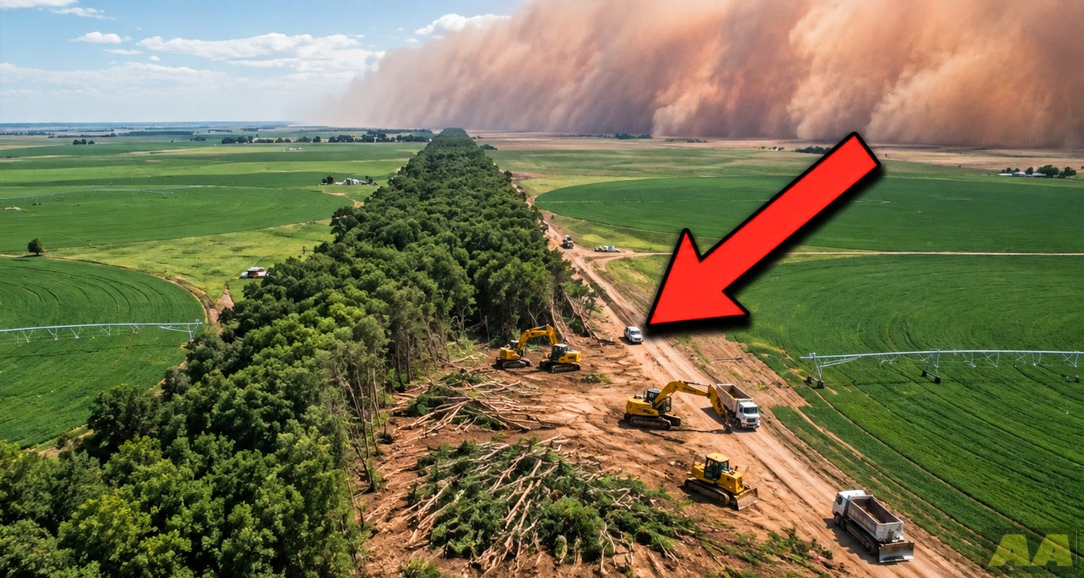
There was a morning in 1935 when the sky over the Great Plains stopped looking like a sky at all.
The horizon disappeared behind a moving wall of brown. Farmhouses vanished first, then fences, then the distant grain elevators that had always marked the edge of town.
The wind pressed against wooden doors until the hinges groaned. Inside the houses, families pushed wet cloth beneath windows and covered their faces as the dust slipped through every crack the buildings possessed.
Outside, fields that had taken generations to cultivate were being lifted into the air one handful at a time.
The storm did not care who owned the land. It did not care how much wheat had been planted, how many tractors stood in barns, or how many prayers had been spoken for rain.
It moved across the plains with the force of something older than farms, railroads, or state lines.
And somewhere in Washington, a few days later, a man was about to look at that same dust and decide that the answer was not another law, another speech, or another appeal for rain.
The answer, he believed, could be trees. Not a foreSt. Not a national park. A wall.
A living wall more than a thousand kilometers long, built by hand across the most damaged agricultural land in America.
Scientists doubted it. Congress tried to stop it. Farmers had little reason to believe it could work.
Yet thousands of young men and unemployed workers were soon carrying seedlings into fields where even grass was struggling to survive.
So how did a line of trees become one of the largest experiments in American environmental engineering, and why would the same idea that once protected the Great Plains later become something many farmers wanted removed?
To understand why Roosevelt believed trees could save the plains, it is necessary to go back to a time when there were almost no fences, roads, tractors, or wheat fields stretching across the horizon.
The Great Plains had once been covered by grass so dense that the land seemed almost solid from a distance.
Beneath that grass was an enormous underground network of roots. Some reached roughly 15 feet into the soil, creating a living structure that held the ground together through seasons of heat, wind, and limited rainfall.
The prairie did something that modern machinery could not easily imitate. It protected the soil while constantly building more of it.
The roots opened channels through the ground. Dead vegetation became organic material. Rain moved slowly through the soil instead of immediately running away.
The grass absorbed the energy of the wind near the surface. For thousands of years, the plains had developed their own system of protection.
Then people began replacing that system with wheat. For roughly half a century, farmers plowed enormous sections of virgin prairie.
More than 100 million acres were eventually converted to cropland. The decision made sense in the economic world of the time.
Wheat prices rose dramatically during World War I, and farmers responded by planting more. Then tractors made cultivation faster.
Land that had once required enormous amounts of human and animal labor could be turned over at a speed previous generations could hardly have imagined.
The prairie was transformed. But beneath the machinery, one problem remained. The climate had not changed to accommodate the new farming system.
The Great Plains still sat between two enormous influences. The Rocky Mountains stripped much of the moisture from Pacific air before it reached the interior.
Moisture from the Gulf of Mexico could move northward, but its arrival was never guaranteed.
When the rain failed, the difference between grassland and cultivated soil became enormous. Grass had roots.
Bare fields did not. Then came the economic collapse. After 1929, wheat prices fell sharply.
Farmers who were losing money on every bushel did not necessarily respond by planting less.
Many tried to compensate by producing more. More acres went under the plow. More soil was exposed.
Then, in 1931, the rain stopped. The combination was devastating for the landscape. Fields that had once been covered with living plants were left exposed beneath an increasingly powerful wind.
Soil that had taken centuries to accumulate could now move across a field in a matter of hours.
In 1932, the National Weather Service counted 14 major dust storms. In 1933, the number reached 28.
Soon the storms were appearing again and again across the southern plains. People gave them a name that captured their appearance perfectly.
Black blizzards. These were not ordinary clouds of duSt. Some storms formed enormous walls that could rise more than half a mile into the atmosphere and move at more than 60 miles per hour.
In Kansas, the sky could become so dark in the middle of the day that street lights were needed.
Dust entered homes, barns, schools, and machinery. It covered furniture. It settled over dishes. It found its way into clothing and food.
Fine particles entered the airways of people and animals, creating severe respiratory problems during prolonged exposure.
The smallest particles were particularly dangerous because some were only a few microns across. Much of the material consisted of quartz and other minerals that had been ground down by erosion.
Farmers learned to improvise. They placed wet sheets over windows. They sealed cracks around doors.
They tried to protect children and livestock from the worst of the airborne soil. The storms were not simply destroying crops.
They were changing the entire meaning of the word farm. By the middle of the decade, millions of people had left their land or were preparing to leave.
The scale of the migration was difficult for the country to comprehend. Between 2.5 and 3.5 million people eventually moved away from the hardest hit regions.
And still the storms continued. Then came April 14th, 1935. The day would later be remembered as Black Sunday.
A massive storm crossed the southern plains, carrying hundreds of thousands of tons of soil into the atmosphere.
The darkness was so complete that people struggled to see what was directly in front of them.
The storm moved eaSt. Five days later, its remaining dust reached Washington DC. On April 19th, 1935, a soil scientist named Hugh Bennett was appearing before the Senate to argue for legislation aimed at protecting the nation’s soil.
Bennett had spent years warning that erosion was becoming a national problem. His testimony had been moving slowly through the political system.
Then the dust arrived in the capital. Bennett knew where it had come from. He had been following the storm by telegram.
When the sky outside began turning copper, he walked toward the window. He opened it.
Then he pointed toward the dust and said, “This gentleman is what I’ve been talking about.
There goes Oklahoma.” The moment changed the political atmosphere. Eight days later, Congress passed the Soil Conservation Act.
But another idea had already been developing inside the White House. Franklin Roosevelt had spent years interested in forestry and land management.
As governor of New York, he had supported reforestation efforts. As president, he had already placed unemployed young men into conservation work.
Now he was looking at the Great Plains and seeing something different from a simple drought.
He saw an engineering problem. Rain could not be commanded. The weather could not be negotiated with.
But wind could be slowed. That distinction mattered. On August 19th, 1933, Roosevelt met with the head of the Forest Service and asked what it would cost to establish shelter belts across the Great Plains.
The concept was straightforward. Wind was energy. A solid wall would not necessarily stop it.
A permeable barrier could work better. Trees would break the wind into turbulent currents, reducing its strength as it moved through and beyond the shelter belt.
A mature tree roughly 30 feet tall could influence wind conditions hundreds of feet behind it.
The larger the trees and the wider the belt, the greater the protected area. Roosevelt liked the idea immediately.
He reportedly referred to the project as “my baby.” But enthusiasm from the White House did not mean the scientific community agreed.
One important skeptic was Raphael Zh, a Russian silviculturist who had observed attempts to establish protective tree systems in the Russian steppes.
The lessons from those experiments were complicated. Planting trees where the climate did not naturally favor forests could produce unexpected problems.
Roosevelt did something unusual. Instead of dismissing the skeptic, he made Raphael Zh the technical director.
The species list was revised. Planting methods were reconsidered. The entire project became an experiment in matching trees to the harsh conditions of the plains.
The final shelter belts were not supposed to be simple lines of identical trees. Some stretched for miles.
Some contained as many as 17 parallel rows. Up to 40 species could be used.
Each layer had a purpose. Tall trees formed the central structure. Cottonwoods could grow rapidly where moisture was available.
Honey locusts provided another layer of protection. Siberian elms offered drought tolerance and rapid growth.
Shrubs along the outside edges helped weaken the first impact of the wind. And in some areas, Osage orange provided an almost impenetrable outer barrier.
Osage orange was not actually related to oranges. It was a thorny tree with strange green fruit roughly the size of a baseball.
Long before barbed wire became common, farmers used it as living fencing. Its branches could form dense barriers.
Its wood was famously hard. Meriwether Lewis had sent cuttings from St. Louis to Thomas Jefferson, noting the use of its wood by the Osage people for bows.
Now the tree was returning to the plains for another purpose. It was difficult for animals to destroy.
Its thorns discouraged grazing. Its dense structure made it useful around the edges of shelter belts.
But one species would eventually become the symbol of both the project’s ambition and some of its later problems.
The Siberian elm seemed almost perfect. It tolerated dry conditions. It grew quickly. It could survive where many other trees struggled.
It was also resistant to Dutch elm disease. But the advantages came with costs that would become obvious only decades later.
Its wood was relatively weak. Branches could break during strong winds. Its useful lifespan was shorter than that of some native elm species.
And its seeds could spread aggressively. A tree chosen to protect the prairie could eventually become difficult to control beyond the places where it had been planted.
At the time, however, the priority was survival. The government needed millions of trees. It also needed millions of hours of labor.
The first major workforce came from the Civilian Conservation Corps. Young men, many from families hit hard by the Depression, were given work planting trees, digging furrows, carrying water, and maintaining conservation projects.
The pay was $30 a month. Twenty five dollars was commonly sent home to families.
The work was physical. There were no easy shortcuts. Seedlings had to be placed into the soil individually.
Water had to be carried. Rows had to be maintained. Young trees had to survive grasshoppers, drought, heat, cold, and grazing animals.
The second major workforce came through the Works Progress Administration. Thousands of unemployed people, including farmers who had been devastated by the same environmental conditions the project was designed to address, became part of the effort.
They were rebuilding the landscape one seedling at a time. The first tree was planted on March 18th, 1935.
It was an Austrian pine. George Phillips drove the seedling into the soil on the farm of H.
Curtis in Grier County, Oklahoma. That single tree was an ordinary object in one sense.
A small plant. A hole in the ground. A person kneeling beside it. But it represented an enormous change in how the country understood conservation.
Within weeks, planting expanded into Nebraska, South Dakota, and Kansas. The project faced enormous skepticism.
Critics expected the trees to fail. The climate was too harsh, they argued. The rainfall was too uncertain.
The temperatures were too extreme. The soil conditions were too difficult. But the seedlings survived at surprisingly high rates.
First year survival was about 71.5 percent. Second year survival reached roughly 73.5 percent. By 1942, survival had climbed to approximately 82 percent.
The trees were not merely surviving. They were changing the fields around them. The effect on rainfall was limited.
The shelter belts could not manufacture clouds. They could not end drought. But they could change the conditions close to the ground.
Wind speeds were reduced. Evaporation declined. Summer soil temperatures became lower in protected areas. Winter conditions became less severe.
Snow that might have blown across open fields could accumulate against the trees instead. When the snow melted, that moisture remained available to the soil.
The most important effect was erosion. Wind erosion increases dramatically as wind speed rises. Reducing the wind near the surface could therefore reduce soil movement by a far greater percentage than the simple reduction in wind speed might suggeSt.
A mature shelter belt could reduce ground level wind speeds by as much as half.
The result was an enormous reduction in soil loss. The trees were not producing soil.
They were preventing farmers from losing soil they already possessed. That distinction would become increasingly important.
The fields around the shelter belts began showing another set of changes. Wildlife used the trees.
Birds found shelter. Small animals gained protection from extreme weather. Ring necked pheasants became particularly associated with the landscape.
South Dakota had an estimated pheasant population of roughly 12 million by 1935. Then the winter of 1937 arrived with more than 70 inches of snow.
The severe conditions reduced the population dramatically. But the birds that survived often found refuge in dense shelter belts, where the trees and shrubs reduced exposure to the wind.
In 1943, South Dakota named the pheasant its state bird. Below ground, another transformation was happening.
Tree roots and soil organisms formed complex relationships beneath the surface. Fungal networks could connect with plant roots and help move nutrients through the soil.
Insects found habitat in the vegetation. Researchers noticed increased populations of parasitoid wasps near fields protected by shelter belts.
Modern ecology provides a way to understand what was happening. The trees were not simply standing between the wind and the crops.
They were creating habitat. That habitat supported organisms that could influence agricultural systems. The shelter belts were becoming small ecosystems.
And all of it had started with a question that seemed almost absurd during the worst years of the Dust Bowl.
What if trees could be used as infrastructure? By the early 1940s, the answer was becoming difficult to ignore.
The trees had not ended the drought. They had not ended the storms. They had not solved every agricultural problem.
But they had made the landscape more resistant to extreme weather. That mattered. The rains eventually returned.
Farmers adopted better cultivation practices. Contour plowing reduced runoff and erosion. Soil conservation programs expanded.
The Great Plains began recovering. Within a decade, a landscape that had become a symbol of environmental failure was once again producing enormous agricultural harvests.
Roosevelt’s baby had worked. For a while, the story seemed finished. But the shelter belts had been created through agreements with farmers rather than through permanent federal ownership of the land.
Farmers provided the acreage. The government provided seedlings, technical assistance, and labor. That arrangement helped the program expand quickly.
It also created a weakness that would not become obvious until later. The trees belonged to a particular generation of farmers.
Their descendants would have different problems. By the 1960s, agriculture was becoming more mechanized. Center pivot irrigation was spreading across the Great Plains.
Circular irrigation systems could efficiently water large fields, but straight lines of trees created obstacles.
Corners became inconvenient. Machinery had to maneuver around them. Every strip of land occupied by trees was also land that could not be planted.
For a farmer trying to increase production, the calculation could look simple. Remove the trees.
Expand the field. Make the machinery easier to operate. Harvest more acres. For decades, that logic gradually changed the appearance of the plains.
Then commodity prices rose. In the 2010s, corn prices climbed dramatically, at one point reaching more than $8 a bushel.
The economic value of every acre increased. The shelter belts that had once been considered national infrastructure could now look like obstacles.
Federal programs that had originally supported the trees were long gone. The people who had planted the first shelter belts were aging.
Their children and grandchildren were managing farms under completely different economic conditions. One by one, trees began disappearing.
In Nebraska, estimates suggest that about 57 percent of the original shelter belts have been trimmed back or removed entirely.
A field that once had a protective border could become completely open. Fence to fence.
Nothing interrupting the wind. Nothing slowing the snow. Nothing catching drifting soil. One of the most famous examples involved the Schlloza farm, about a mile and a half north of Orchard, Nebraska.
The farm contained a 14 row shelter belt planted in April 1935. Lyall Schlloza was three years old when the trees were planted.
He lived long enough to watch them grow. The belt eventually became roughly 100 feet wide and formed an enormous wall of vegetation.
For decades, it stood as a living reminder of the original New Deal conservation effort.
Then ownership changed. The new owner removed the trees with chainsaws and a bulldozer. The land became available for more corn.
The decision was legal. The property belonged to the farmer. The economic reasoning was understandable within the context of modern agriculture.
But the environmental tradeoff remained. Remove the barrier, and the wind returns to the field.
Steve Schozer, a family descendant, later expressed the concern that removing shelter belts could expose farmland to the same wind patterns that had contributed to the Great Dust Bowl.
The problem was not that history was repeating itself exactly. The climate was different. Farming practices were different.
Technology was different. But the physical relationship between bare soil and strong wind had not changed.
Then came another warning. On May 1st, 2023, along Interstate 55 south of Springfield, Illinois, strong winds lifted dust from freshly cultivated fields and pushed it across the highway.
The resulting visibility problems contributed to a major chain of crashes. Seventy two vehicles were involved.
Eight people lost their lives. The highway was closed for nearly 30 miles. The event occurred far from the original Dust Bowl landscape.
But the mechanism was familiar. Loose soil. Strong wind. Low visibility. Human infrastructure suddenly overwhelmed by moving earth.
In the summer of 2021, major dust storms also moved across Colorado, Kansas, and the Texas panhandle.
The storms were not simply historical curiosities anymore. They were reminders that the underlying forces remained.
Today, the United States loses an estimated three tons of topsoil per acre each year through erosion.
That number is not a prediction of exactly how long agriculture can continue. It is a measure of a process.
Soil is being removed. Some of it can be rebuilt. Some cannot be replaced quickly.
The Great Plains also contain another warning hidden in their geological record. Tree rings and lake sediments show that the region has experienced droughts far more severe than the Dust Bowl several times during the past 1,500 years.
Those periods ended. Eventually the climate changed again. The lesson is not that another Dust Bowl must happen.
The lesson is that the climate of the plains has never been permanently stable. A wet period can last for generations and still eventually change.
That makes the shelter belt story relevant again. Stand beside a Nebraska cornfield today and look closely.
One side of a road may still have an old line of trees. Cottonwoods. Honey locusts.
Red cedars. Siberian elms. Perhaps they are 60 or 70 years old. Birds move between the branches.
Snow collects beneath them in winter. The field behind them may be green with corn or soybeans.
Across the road, there may be almost nothing. The field stretches from one fence to the next.
A center pivot irrigation system moves slowly across the landscape. Underneath it, water comes from the Ogallala aquifer, one of the most important underground water systems in the American Great Plains.
The contrast can look almost like two different agricultural philosophies occupying the same horizon. One treats trees as productive infrastructure.
The other treats them as lost acreage. Neither view appeared from nowhere. The farmer looking at a shelter belt and calculating the value of every acre is responding to real economic pressures.
The conservationist looking at the same trees and calculating the value of retained soil is responding to real environmental pressures.
The difficult question is how to make both calculations work at the same time. That is where the story has begun turning again.
In 2010, federal cost share programs were reopened to support shelter belt restoration in four of the six original states.
The Natural Resources Conservation Service, the agency connected to the soil conservation movement that Hugh Bennett helped establish, continues supporting conservation planting.
Researchers are using satellite imagery to identify surviving shelter belts. They can map where the old tree lines remain.
They can identify gaps. They can measure changes in land use. They can compare fields with protective vegetation to fields without it.
A new generation of farmers is also looking at the landscape differently. Some have watched water levels decline.
Some have seen dust move across fields. Some have inherited shelter belts and discovered that the trees their grandparents planted still provide benefits.
The lesson is not simply to plant more trees. Raphael Zh had warned about that kind of thinking decades earlier.
Trees must match the climate. Species must match the soil. Water availability matters. Maintenance matters.
Spacing matters. A poorly designed forest belt can create new problems. China’s Three North Shelterbelt Program, launched in 1978, eventually became one of the largest tree planting efforts in the world.
It also demonstrated the limitations of treating tree planting as a simple numbers game. Large areas dominated by a small number of species could become vulnerable to pests and disease.
In some regions, trees consumed significant amounts of water. The African Union’s Great Green Wall, announced in 2007, attempted an enormous restoration effort across the Sahel, from Senegal to Djibouti.
The ambition was immense. The results were more complicated. By some estimates, only about 4 percent of the promised area had been restored 13 years after the announcement.
The difficulties were not proof that trees cannot restore landscapes. They showed that restoration is more complicated than putting seedlings into the ground.
Climate. Soil. Water. Species selection. Local communities. Agricultural economics. Maintenance. All of them matter. The American shelter belt project succeeded because it eventually became more than a tree planting campaign.
It became a system. The trees protected the soil. The soil supported crops. The vegetation provided habitat.
The habitat supported insects and birds. The shelter reduced wind. The reduced wind protected moisture.
The snow collected by the trees returned water to the fields. The system did not defeat nature.
It worked with physical processes that were already there. And perhaps that is why the story remains so powerful.
The original planners could not control the weather. They could not stop drought. They could not force rain from a cloudless sky.
They could not command the wind to disappear. So they changed the landscape. They inserted a living structure between the wind and the soil.
It was slow engineering. There was no dramatic machine. No concrete wall appeared overnight. No giant construction crew arrived with steel cranes.
There were young people with shovels. There were seedlings. There were buckets of water. There were farmers willing to surrender narrow strips of productive land for something whose greatest value might not be visible for another generation.
The first tree on March 18th, 1935 was not impressive. An Austrian pine planted by George Phillips on H.
Curtis’s farm in Grier County, Oklahoma did not look like national infrastructure. It looked like a small tree.
But thousands became millions. The original project eventually involved roughly 220 million trees, about 1,300 miles of shelter belts, and approximately 30,000 farms.
The scale was extraordinary. More extraordinary was the time required for the idea to reveal its full value.
A farmer could plant wheat and see a crop within months. A farmer could plant a tree and see almost nothing happen for years.
The shelter belt required patience. That patience became part of its engineering. A tree does not need to be spectacular to be useful.
It only needs to remain in the right place long enough to grow. By the time the trees matured, many of the people who had planted them were no longer making the decisions.
Their children were. Their grandchildren were. And eventually some of those grandchildren removed them. That is the strange circle at the center of the story.
The same landscape that once needed trees to survive later became valuable enough that farmers could be tempted to remove the trees.
The trees solved part of the original problem so successfully that future generations could forget why they had been planted.
That may be the greatest danger of environmental infrastructure. When it works, people stop noticing it.
A shelter belt does not announce its success. There is no siren when the wind slows.
There is no receipt showing the tons of soil that remained in place. There is no obvious monument to the snow that accumulated behind the trees instead of blowing into a ditch.
The benefit is measured in what does not happen. A field does not lose as much soil.
A crop experiences less wind stress. Moisture remains available a little longer. Birds have shelter.
Insects have habitat. Snow stays where farmers need it. The landscape becomes slightly more resilient.
And because nothing dramatic happens, the trees can look unnecessary. Until they are gone. Then the wind reminds everyone.
The Dust Bowl was not created by one mistake. It was the result of drought, exposed soil, economic pressure, agricultural expansion, and weather patterns interacting at enormous scale.
The shelter belts did not erase those forces. They created resistance. That distinction matters. The trees did not win a war against the wind.
They held the line. They bought time. They reduced the speed of the air moving across the soil.
They kept snow in place. They gave crops and wildlife protection. They allowed other conservation practices to work more effectively.
That is what good infrastructure often does. It does not make difficult conditions disappear. It makes the landscape better able to withstand them.
Today, the surviving shelter belts stand as pieces of a living historical record. Some are aging.
Some are being replaced. Some are being cut back. Some are being expanded again. New trees are going into the ground in places where old trees disappeared.
The reasons are different from 1935, but the physical problem is familiar. Wind still moves.
Soil still erodes. Water is still limited. Agriculture still depends on the thin layer of productive ground between the atmosphere and the deeper earth.
And the climate can still change. The Great Plains will never become a place where trees alone determine the future.
No single intervention can do that. But the old shelter belts demonstrate something that remains difficult to replace with technology.
A living structure can perform several jobs at once. It can protect crops. It can conserve soil.
It can influence moisture. It can create habitat. It can alter the movement of snow.
It can reduce wind. And if it is designed correctly, it can continue performing those functions for decades.
That is why the story of Roosevelt’s trees is not really a story about trees.
It is a story about time. The people who planted them in 1935 knew they would not receive the full benefit immediately.
They planted anyway. They were working for fields they might never farm. For children who had not yet grown up.
For grandchildren who might never know their names. They planted a barrier against a problem that could not be solved in a single season.
Nearly a century later, the question is not whether those trees mattered. The question is whether the next generation will recognize their value before removing them.
Because the wind has not changed its mind. The plains are still the plains. And somewhere beyond the next road, there is still a field waiting for someone to decide what should stand between its soil and the sky.
Disclaimer: This content may be created by Al for entertainment purposes. Any resemblance to real persons, events, or places is coincidental.








