Farmers Put Armor on Their Sheep — The Wolves Never Saw It Coming
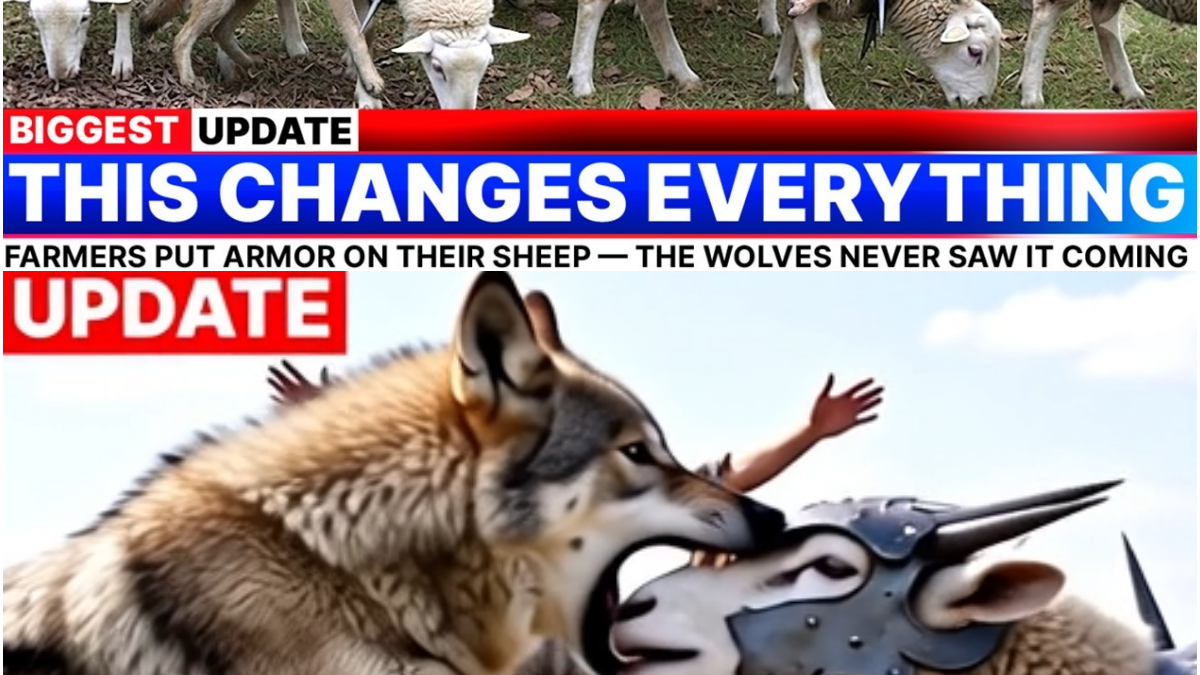
The morning count in an Alpine pasture is supposed to be the easiest job of the day.
You look across the wet grass, count the white backs moving through the mist, count again, and then walk toward the gate knowing the flock is where you left it.
But there are mornings when the second count is different from the firSt. A space appears between two sheep.
Then another. The grass bends toward the trees, and suddenly the quiet pasture feels like evidence of something you cannot see.
For generations, shepherds have learned to live with that uncertainty. Wolves do not announce themselves.
They test fences, watch from cover, study a flock, and wait for the moment when one animal becomes easier to reach than the others.
A shepherd can add dogs, lights, ropes, cameras, alarms, and patrols, yet the question remains the same.
What if the sheep itself could make a wolf stop and reconsider? In the Austrian Alps, a man in his 70s believed he had found a strange answer.
His name was Rudolf Schaalbach, and for three years he had spent his own money, his own time, and eventually his patience on an invention that looked so unusual that people struggled to decide whether it was brilliant or absurd.
He had built armor for a sheep. Not metal armor. Not a cage. Not something designed to trap or injure a predator.
It was a net of rigid plastic spikes, fitted across the back, shoulders, and neck of a ewe named Ananas.
And Schaalbach believed those spikes could change the calculation of a wolf in the single half second before it committed to a bite.
The idea sounded simple. Make the sheep look like the wrong meal. But before anyone could discover whether it worked, the experiment would be stopped for a reason that had nothing to do with wolves.
Rudolf Schaalbach had spent three years trying to solve a problem that had become increasingly familiar across European and North American grazing country.
Wolf numbers had climbed across large areas, and shepherds who had spent decades working without seeing one were suddenly learning what earlier generations had already understood.
A flock could be protected by fences, watched by dogs, checked by people, and still be vulnerable during the few quiet hours when nobody was looking.
The difficult part was that wolf predation was rarely dramatic from the shepherd’s point of view.
There was no warning bell. There might be no barking. There might be nothing unusual on a camera.
A shepherd could inspect the flock at night, return at dawn, and discover that several animals were missing from the group.
The grass could still be wet. The gate could still be closed. The flock could still be moving normally.
Only the count had changed. That was why Schaalbach approached the problem differently. He did not begin by asking how to keep wolves farther away.
He began by asking what happened when a wolf was already close enough to attack.
A wolf is an efficient hunter because every decision has a coSt. Running costs energy.
Chasing costs more. A failed attack wastes even more. A bite can injure the animal attempting it, and even a relatively small injury can become a serious problem for a predator that depends on speed, strength, and a working jaw to survive.
So the hunter watches. It tests. It pushes. It searches for the animal that is easiest to reach.
A guardian dog can change that calculation. So can a shepherd standing in the pasture.
A strange light can change it. A fence can change it. A noise can change it.
Schaalbach wondered whether the sheep itself could become part of that calculation. His answer was Ananas.
The device he designed covered approximately a meter and a half across the sheep’s upper body and weighed about 2 kilos.
It was made from rigid plastic spikes arranged in a net like structure. The shape was deliberate.
It protected the areas where a wolf might attempt its first bite while leaving openings for the head, legs, hindquarters, and udder.
That last detail mattered. A sheep could not simply be covered from head to tail and expected to function normally.
It had to walk. It had to graze. It had to reSt. It had to feed a lamb.
Schaalbach’s design had to remain practical enough for an animal that would spend an entire grazing season wearing it.
The concept was inspired by animals that survive not because they can outrun predators, but because attacking them is an unpleasant calculation.
A porcupine does not need to chase a predator. A hedgehog does not need to overpower one.
Their protection works because the predator reaches a point where continuing is no longer worth the effort.
Schaalbach wanted to create that same hesitation around a sheep. He was not trying to injure wolves.
He was trying to create one second of uncertainty. One second might be enough. His plan was to take Ananas into an Alpine pasture and have her wear the device through the grazing summer.
If a wolf approached and then changed direction, the idea would have its first real evidence.
For Schaalbach, that would be the moment three years of work finally meant something. For everyone else, the photographs came firSt.
They spread quickly. Ananas stood in the pasture with her ordinary white coat beneath a strange covering of rigid plastic spikes.
The image was difficult to ignore. The sheep looked less like livestock and more like an animal from a machine shop.
People immediately wanted to know whether it worked. The problem was that the photograph could not answer.
No wolf approached Ananas. There was no encounter. There was no footage showing a predator seeing the spikes, changing course, and leaving.
The most important part of the experiment never happened. Instead, another question arrived. It came through an anonymous email to an animal protection organization in Vienna, an organization with roots reaching back to the 1860s.
The concern was not about wolves. It was about Ananas. The complaint focused on the rigid device itself and whether a sheep could rest normally while wearing it.
For a ruminant, resting is not a minor detail. The animal spends substantial time lying down, chewing, and processing its food.
Anything attached to its body can therefore become a welfare question. There was also a legal question about what could be fastened to a sheep under Austrian rules.
Two days later, a criminal complaint had been filed. By late May, a letter arrived from the district authority in Villach.
Then an official veterinarian went to the pasture. Schaalbach was there. So was Ananas. The veterinarian approached the sheep, examined the situation, unfastened the device, and carried it away.
That was the end of the field trial. Three years of work had produced a device that had not been tested against the one animal it was designed to influence.
There was no night encounter to analyze. No camera recording. No evidence of a wolf circling the sheep and deciding against an approach.
No result showing success. No result showing failure. The experiment simply stopped before the decisive moment.
Schaalbach maintained that he had veterinary advice and legal representation and that he intended to continue pursuing the matter.
Others involved in livestock protection described the device as expensive, impractical, and unproven. That final description was difficult to dispute.
It was unproven because nobody had been allowed to find out. And that left a much larger question hanging over the pasture.
Could something placed around livestock really persuade a wolf to choose another target? There was already evidence that predators could be influenced by objects that looked almost ridiculously simple.
The example was not armor. It was rope. A line of rope stretched around a pasture with strips of fabric hanging from it.
The technique was known as fladry. The idea was centuries old. Pieces of red fabric were attached to a rope at intervals, allowing them to move in the wind.
The rope itself was not an impenetrable barrier. A wolf could physically pass underneath it.
Yet wolves often refused to cross. The reason was unfamiliarity. A predator that spends its life examining its surroundings does not automatically treat every strange object as harmless.
Something moving in an unexpected way can create hesitation. Researchers studied the effect more formally in the early 2000s, beginning with controlled settings and then moving into field conditions.
The results showed that fladry could discourage wolves from entering an area for a period of time.
But there was an obvious weakness. Wolves learn. If something remains in the same place long enough without creating any consequence, the animal can eventually stop treating it as a serious obstacle.
The strange rope becomes scenery. The fluttering fabric becomes part of the landscape. The protection can fade.
Researchers therefore developed a variation known as turbo fladry. The basic rope and fabric remained.
An electrical current was added. Now the unfamiliar object could also produce an unpleasant consequence if crossed.
That changed the calculation. In controlled studies, the electrified version performed considerably better than ordinary fladry.
In Montana, one trial used roughly 14 kilometers of the system, and wolves were detected in comparison areas while none were detected inside the protected areas during the trial.
There was an important limitation. The comparison livestock did not experience the same losses either.
So the experiment demonstrated avoidance more clearly than it demonstrated exactly how many animals had been protected.
The system also required money and labor. The first kilometer cost roughly $2,300, while later sections cost somewhat less.
Installation and maintenance required roughly 32 person hours per kilometer. Over one year, the system experienced 18 failures.
Yet more than four fifths of the participating ranchers said they would use it again.
The lesson was not that one fence solved everything. The lesson was that behavior could sometimes be changed without trying to remove the predator.
A broader review of 30 documented cases involving 11 protection measures found that deterrents, with fladry among them, could substantially reduce risk.
The results varied, and habituation remained a major problem. In many cases, the protective effect weakened after roughly five months.
But the concept had been demonstrated. Change the calculation. Make the pasture less predictable. Make the approach more complicated.
Give the predator another reason to turn around. Then came Idaho. In Blaine County, a new wolf pack began affecting sheep operations in 2007.
More than a dozen sheep were loSt. The response that followed was different from what many people expected.
Suzanne Asha Stone, Mike Stevens, and Rick Williamson worked with ranchers in the area on a nonlethal approach.
They put rope and fabric around pastures. They used lights. They used noise. They placed people near flocks at the hours when encounters were most likely.
The goal was not to remove wolves from the landscape. The goal was to convince them that livestock pastures were difficult places to hunt.
A peer reviewed study published in 2017 examined seven years of the project. The comparison area experienced losses at roughly three and a half times the rate found inside the protected project area.
Within the project, the depredation rate was approximately two hundredths of 1 percent of the flock, described as the lowest rate reported anywhere in Idaho wolf range.
There was another striking difference. No wolves were lethally removed inside the project area. In the comparison area, wolves were removed.
The sheep inside the project had fewer problems, while the wolves remained on the landscape.
More recent figures associated with the project are self published rather than peer reviewed, so they require more caution.
Those figures report roughly 20,000 sheep across more than 280,000 acres, with fewer than five sheep lost per year and losses roughly 90 percent below the rest of the state.
The larger lesson was the same one Schaalbach had built into his strange plastic armor.
You did not necessarily have to defeat the predator. You could make the predator reconsider.
And farmers had been experimenting with that principle in many other ways. Guardian dogs were one of the oldeSt.
Great Pyrenees, Anatolians, and Kangals were raised with livestock from a young age. Instead of treating sheep as animals to be moved, they learned to treat the flock as their territory.
Their first defense was often not physical contact. It was presence. A dog standing between the flock and an approaching predator could create enough uncertainty to make the predator continue looking elsewhere.
Donkeys worked differently. People sometimes laughed when donkeys were mentioned as livestock guardians until they watched one react to a canine predator.
Donkeys have strong hearing, naturally react to unfamiliar canines, and can kick with remarkable force.
Llamas offered another variation. They remained alert when sheep were not, watched the edges of the flock, and could sound an alarm across a valley.
Then came technology. Lightweight collars could track location, motion, and other measurements. An unusual movement pattern could trigger an alert on a phone while the event was happening instead of being discovered during the morning count.
Thermal drones could search pasture edges at night. Cameras could distinguish among different animals. Virtual fencing could create boundaries through software rather than physical posts.
Every one of these systems followed the same principle. Do not necessarily fight the wolf.
Make the wolf uncertain. That was the principle Schaalbach had pushed into an entirely different form.
His sheep was not surrounded by rope. It was wearing the rope. It was not standing behind an electric barrier.
It was carrying a barrier across its back. It was an attempt to move the moment of uncertainty from the edge of the pasture to the exact instant when a predator decided whether to bite.
And that was why the story of Ananas remained unresolved. Perhaps the armor would have worked.
Perhaps a wolf would have looked at those rigid spikes and turned away. Perhaps the animal would have learned to approach from another direction.
Perhaps the device would have had no meaningful effect at all. Nobody knew. The field trial ended before any of those possibilities could be tested.
Schaalbach continued to argue that the idea deserved a fair trial. He had spent years developing it, had obtained a patent, and had sought veterinary input.
But the authorities had a different responsibility. They were looking at the animal wearing the device, not the predator the device was supposed to deter.
That difference made the argument much harder. A farmer sees an urgent problem in the pasture.
An animal protection official sees an animal that must be protected from the solution itself.
A researcher wants a controlled teSt. A shepherd wants to get through the season. A predator sees none of those distinctions.
It sees opportunity. That is what makes wolf management so difficult. The debate is rarely about one technology.
It is about how much uncertainty people are willing to accept, how much labor a farmer can afford, how much risk an animal can reasonably carry, and whether a method can remain effective after the predator has learned what it means.
The sheep in the pasture never gets to participate in that debate. It simply grazes.
That was why the case of Ananas became so compelling. The invention was unusual, but the idea behind it was not.
Farmers everywhere have spent generations turning ordinary objects into barriers. A rope. A light. A noise.
A dog. A donkey. A llama. A camera. A collar. A drone. And now, potentially, a plastic suit covered in spikes.
Each one asks the same basic question. Can a predator be convinced that this particular opportunity is not worth taking?
That is also why the early morning count remains so important. A shepherd does not begin the day by studying predator behavior.
The shepherd counts sheep. One. Two. Three. Four. The numbers continue across the pasture. Most mornings, the first count and the second count match.
Then one morning they do not. The missing space becomes the center of the entire day.
That is the part people far from livestock country can have trouble understanding. Wolf predation is not always a dramatic confrontation visible from a distance.
It can happen quietly between one check and another. The farmer is left with the consequences.
The wolf moves on. The flock remains. And the question becomes what can be changed before the next morning.
That is where Schaalbach’s invention belongs. Not as a proven breakthrough. Not as a failed experiment.
Not as proof that wolves can be fooled by plastic spikes. It belongs in the unfinished category.
An idea that was stopped before the test could answer the question. The photographs made it look as though the hard part had already been solved.
A sheep stood in the grass wearing something no shepherd had ever seen before. But the real story was what happened after the photograph.
The device came off. The wolf never arrived. And three years of work were left hanging between possibility and proof.
Schaalbach still had his lawyer. He still had veterinary assessments. He still believed the idea deserved another chance.
What he did not have was the one piece of evidence everyone wanted. A wolf looking at Ananas and deciding not to bite.
That moment never came. Yet the larger field of livestock protection had already shown that changing a predator’s decision was possible.
The rope and fabric experiments had demonstrated avoidance. The electrified version had extended the effect.
The Idaho project had shown that layered nonlethal methods could be associated with substantially lower livestock losses.
Guardian animals continued to work through presence and warning. Technology continued to improve the speed at which shepherds could know what was happening.
None of those methods was perfect. Every one had limitations. Wolves could habituate. Equipment could fail.
Dogs could become injured. Drones required operators. Fences needed maintenance. Virtual systems depended on batteries and signals.
And every new solution had to be judged not only by whether it affected the predator, but also by whether it was safe and practical for the livestock carrying the burden.
That was the unresolved lesson of the sheep in the Alps. Sometimes the strangest idea is not necessarily the foolish one.
But a strange idea still needs a real teSt. And a real test has to account for every animal involved.
Ananas never became the sheep that proved the armor worked. She became something more complicated.
She became the sheep at the center of a question nobody managed to answer. Could a wolf be stopped by a sheep that suddenly looked like the wrong animal to attack?
Maybe. Maybe not. The evidence was never created. The pasture remained quiet. The spikes came off.
The wolf never saw them. And somewhere in Austria, the man who built that strange armor continued to believe that the answer was still waiting out there in the grass.
Perhaps the most important part of his experiment was never the plastic itself. It was the question behind it.
If predators make decisions based on risk, effort, and uncertainty, how many different ways can a shepherd change that calculation before the next morning count?
Because every night, somewhere in wolf country, a flock settles into the grass. A shepherd checks the gate.
A dog watches the darkness. A camera records an empty field. And beyond the fence, something moves through the trees, testing the same old world with the same old instincts.
The shepherd cannot control what the wolf wants. But perhaps the shepherd can still control what the wolf believes will happen next.
And if one strange sheep wearing a net of plastic spikes was never allowed to answer that question, how many other ideas are still waiting for their chance to prove what they can do?
Disclaimer: This content may be created by Al for entertainment purposes. Any resemblance to real persons, events, or places is coincidental.








