Everyone Thought She Bought a Worthless Cow—Until the Registry Records Appeared
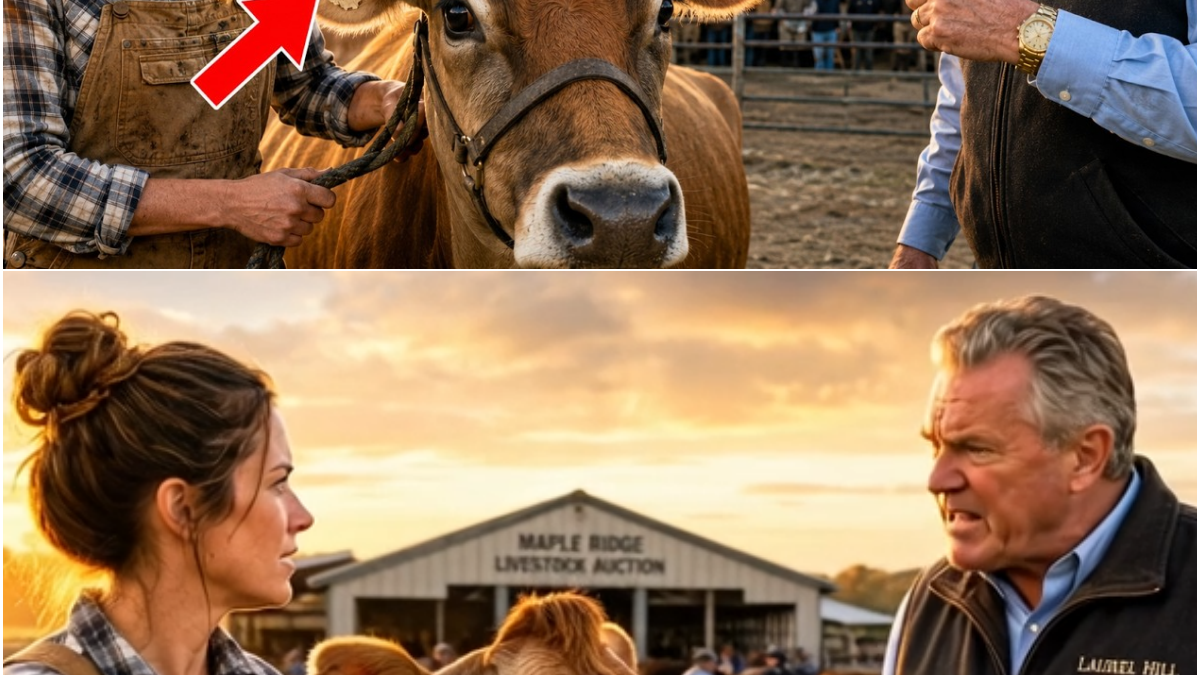
Nobody at the November livestock sale wanted the little Jersey cow in pen 46. By the time she entered the ring, most of the serious buyers had already gone.
She was too thin through the ribs, her right hind foot barely touched the ground, and one side of her udder hung lower than the other.
The auctioneer started at $800. Nothing. Then $600. Still nothing. At $400, the ring stayed silent.
A woman named Hannah Cole sat in the third row with $600 in an envelope, and only $200 of it was supposed to come home with her.
She had driven 32 mi to buy a used stainless steel feed trough, not another cow.
Then she noticed something nobody else seemed interested in seeing. Beneath the rough coat and sharp hips was the structure of an animal that had once been carefully bred.
The auctioneer dropped the price to $300. Hannah raised two fingers. The hammer came down.
Behind the rail, Victor Hail, owner of Hail Genetics, laughed and told the people beside him that Hannah had not bought a cow.
She had bought a veterinary bill with four legs. Hannah loaded the Jersey herself and took her home.
Five days later, a scanner passed over the cow’s neck and suddenly beeped. The veterinarian froze.
He stared at the 15 digit number on the screen, then looked at Hannah and said, “This cow cannot be where you found her.”
How could a $300 auction cow from pen 46 have a record worth more than most farms in the county?
Five days earlier, Hannah Cole had not gone to the livestock sale intending to buy a cow.
She had gone because somebody had listed a used stainless steel feed trough near the end of the auction, and Hannah needed one badly enough to drive 32 mi in a truck that made a grinding sound every time she turned left.
Coal farm sat on 19 acres outside Milbrook. It had once been 43 acres when Hannah’s grandfather bought it, but 24 acres had disappeared over the years through property taxes, medical bills, repairs, and two difficult seasons that had left very little room for mistakes.
Hannah milked 10 jerseys. On a good month, all 10 were producing. On a bad month, nine were.
There was always one cow with a problem. One was fresh. One was dry. One was recovering.
One seemed determined to make Hannah question every financial decision she had ever made. The milk check usually paid the bills.
Just not always at the same time. That month, feed was due Friday. The compressor repair was already sitting on a credit card.
The barn roof leaked into two buckets whenever rain came from the weSt. Hannah had $600 in an envelope.
Four hundred was for the trough. Two hundred was supposed to stay there. That was the plan.
Then pen 46 entered the ring. The little Jersey moved slowly. Her ribs showed. Her hips were sharp.
Her coat was rough. Her head hung low. Her right hind foot barely touched the concrete.
The udder was uneven, and even from 50 ft away Hannah could see that one side was much lower than the other.
The auctioneer read what little information was available. “Fresh earlier this year. Selling as is.
No production sheet. No registration paper. No health history beyond the basic sale requirements.” The ear tag carried only the sale lot number.
Hannah leaned forward. She was no longer looking at the udder. She was looking underneath everything that was wrong.
The cow was thin, but the structure was good. The top line was strong. The shoulders were clean.
The ribs were deep. The rear attachment of the udder was higher than Hannah expected.
There was something about the animal that did not match the story being told about her.
That did not make the cow valuable. It did not make her healthy. It did not even mean she would recover.
But it made Hannah curious. Victor Hail noticed. That was one of the things about living in a small agricultural county.
People with money always seemed to notice when someone without much of it was considering doing something they thought was foolish.
Victor stood near the sale office wearing a quilted vest with Hail Genetics embroidered across the cheSt.
His operation milked more than 900 cows. He sold embryos. He sold registered heifers. He hosted breeder tours.
His family name appeared on plaques around the fairgrounds and on donor lists at the county extension office.
Hannah had met him perhaps six times. Victor behaved every time as though they had met once, and he had been generous enough to remember it.
He looked toward pen 46. Then he looked at Hannah. “Don’t do it, Cole.” Hannah kept watching the cow.
Victor smiled. “I’m serious. That thing is done.” One of the men beside him asked, “Yours?
Came through one of our commercial groups?” Victor shook his head. “Didn’t earn her feed.”
Then he looked directly at Hannah. “You people running 12 cows can’t afford to get sentimental.”
Hannah finally turned. “I milk 10.” The men around Victor laughed. Victor laughed louder. “That is worse.”
The auctioneer asked for $400. Nobody moved. “$350?” Silence. Hannah looked at the Jersey again.
The cow shifted her weight. The right hind foot came down carefully. Hannah heard herself speak.
“$300.” The auctioneer looked around. “Three hundred. Anybody give me $350?” Nobody did. The hammer came down.
The sale was finished. Nine minutes later, Hannah stood beside the loading chute wondering how $600 had turned into one cow and a problem because she had not even bought the trough.
The Jersey took a long time to load. Hannah let her. She did not slap her.
She did not twist her tail. She simply walked beside her. Three steps. Stop. Wait.
Three more. Stop. Halfway up the trailer ramp, the Jersey turned her head. Hannah reached up to steady her.
That was when she noticed the cow’s left ear. There was a pale oval inside it where the hair did not grow correctly.
Hannah rubbed the area with her thumb. At first, she thought it was old scar tissue.
Then she saw three tiny dark marks in a line. Tattoo ink. Or what remained of it.
Above the faded marks was a clean round hole where an identification button had once passed through the ear.
The hole had healed. The tag was gone. Hannah stared at it. Commercial jerseys lost tags all the time.
Tags caught on gates. Tags pulled loose in feeders. Tags were replaced. There was nothing extraordinary about a missing tag.
But most grade cows did not have a tattoo like that. And most cows that did have one had a reason.
Hannah loaded the cow. She drove home. She named her Maple before they reached Coal farm.
Mostly because calling her the auction cow had started to sound rude. At home, Hannah made up a small maternity pen beside the old milking parlor.
She gave Maple water firSt. Then hay. Then she called dr. Samuel Reed. Sam had been Hannah’s veterinarian since before Hannah technically owned cattle.
He had treated her first 4H calf after it caught a shoulder on sheet metal when Hannah was 13.
He was 62 now. He spoke slowly. He was difficult to impress. And he had an irritating habit of knowing when Hannah had already made up her mind.
He arrived just after 7 that evening. He watched Maple walk three passes down the alley.
“Foot first,” he said. He lifted the right hind hoof. A pocket of inflammation sat between the claws.
Painful. Messy. Treatable. Then he examined the udder. He spent longer there. “No major infection,” he said.
“One quarter has old damage. The larger problem is the edema and the uneven involution.
Could have been made worse by an abrupt change in milking.” “How bad?” “She is uncomfortable.”
“That isn’t what I asked.” “I know.” Sam stood. “She is underconditioned. She has a foot problem.
Whoever dried her off did it faSt. I don’t love that quarter.” “Can she recover comfortably?”
“I think so.” “Milk?” “Maybe.” “Good milk?” Sam looked at her. “Hannah.” She smiled. “Had to ask.”
Sam looked back at Maple. “Do not turn this into a rescue story in your head.”
“I am not.” “Treat her because you bought her and because she deserves proper care.
But don’t spend $8,000 trying to prove Victor Hail wrong.” “I wasn’t planning to.” “You were born planning to prove men like Victor Hail wrong.”
“That is not medically relevant.” “No, but it has been financially relevant several times.” For the first 3 days, nothing happened that would have impressed anybody.
Hannah soaked the foot twice a day. She kept the bedding dry. She increased energy in the ration slowly.
She checked Maple’s temperature morning and night. She cleaned the udder. She followed Sam’s treatment schedule exactly.
At 5:10 every morning, Hannah milked her own herd. At 6:40, she took care of Maple.
At noon, she walked her. At night, she repeated the whole routine. By the third morning, Maple was putting more weight on the injured foot.
By the fourth, she finished her hay before Hannah returned with the afternoon bucket. By the fifth, she lifted her head when Hannah opened the barn door.
None of that proved Hannah had made a smart purchase. It proved the cow felt better.
There was a difference. That afternoon, Sam came back. He wanted to recheck the foot.
Hannah had spent the morning brushing dried manure and old dirt from Maple’s coat. She had cleaned the brown hair along the upper neck.
Sam noticed something. He moved closer. “What?” He did not answer. He wet the hair and parted it.
Then he moved Maple closer to the light. There were pale characters beneath the hair.
Not a traditional brand. Not random scarring. A deliberately placed identification mark that had faded into the skin.
Sam checked the ear again. Then he took out his phone. “What are you doing?”
“Looking at a photograph from 2019.” “Of what?” “A donor cow I worked on once.”
Hannah stared at him. “You think this is a donor?” “I think this cow has been through a level of identification most $300 cows have not.”
That was the first moment Hannah felt the story move beneath her feet. Not because Maple might be worth money.
Because something did not fit. The next morning, Sam returned with an electronic livestock scanner.
It was old. One side was scratched. The battery door was held together with black tape.
Hannah looked at it. “Very professional.” “It works.” He passed the scanner over Maple’s ear.
Nothing. Over the shoulder. Nothing. Then slowly down the left side of her neck. Beep.
Sam stopped. He moved the scanner away. Then passed it over the same spot. Beep.
A number appeared. 15 digits. Sam read it twice. Then he became quiet. Hannah waited.
“What?” “I know the prefix.” “What does that mean?” “It means I want to verify before I tell you what I think it means.”
“Sam.” He looked at her. “This animal has an implanted identifier associated with registered breeding stock.”
Hannah looked at Maple. Maple was trying to reach a loose piece of hay through the gate.
“Registered where?” “That is what I’m going to find out.” Sam wrote the number down.
Then he left. Forty seven minutes later, Hannah’s phone rang. Sam did not say hello.
“Are you near a chair?” “You’re 62. Stop being dramatic.” “I am not being dramatic.”
That made her sit down. Sam read the name carefully. “Hail Legacy Maragold 742.” Hannah said nothing.
He repeated it. “Hail Legacy Maragold 742.” Hannah looked toward the barn. “The cow in my pen?”
“Yes.” “Maple?” “Maple.” Hannah stood. Sam began explaining what he had found. Maragold had been genomically tested.
Her dam had been a major embryo donor. Two maternal sisters had ranked exceptionally well for component production.
Another sister had produced embryos sold into three states. Maragold herself had entered the Hail Genetics donor program as a young cow.
She had been flushed multiple times. She had photographs. Classification records. Breeding records. Transfer notes.
Production history. The cow standing in Hannah’s little side pen had a better documented professional life than most people.
And less than 3 weeks before the auction, the digital record still showed her inside Hail Genetics.
Hannah stared through the kitchen window. “How does a cow like that become a no paper cull?”
“That,” Sam said, “is an excellent question.” “Could the chip be wrong?” “Possible.” “Could it be in the wrong cow?”
“Also possible.” “How likely?” “Less likely.” “What proves it?” “DNA.” Hannah looked at the number written on the back of an electric bill.
“So we test her.” “We test her.” Before they did, Hannah made one mistake. At least Sam called it a mistake.
Hannah called Hail Genetics. She did not accuse anyone. She asked for the records department.
She gave the electronic identification number and said she had bought a Jersey at public auction and wanted to know whether the number had been retired or reassigned.
The receptionist asked for her name. Hannah gave it. Less than 20 minutes later, Victor Hail called her personally.
“Hannah.” His voice was warm. Too warm. “I hear you’re still playing veterinarian with my old cull.”
“She is doing better.” “Well, good. I’m glad she landed somewhere decent.” Hannah looked toward the barn.
“Victor, do you know a cow called Hail Legacy Maragold 742?” There was a pause.
Not long. Maybe 3 seconds. But 3 seconds was a long time when somebody already knew the answer.
Victor laughed. “Where did you get that?” “From an electronic identifier.” “Those old records cross map all the time.”
“Sam Reed says the prefix is registered.” “Sam Reed is a country veterinarian, Hannah, not a database engineer.”
“He is also the one who scanned her.” Victor’s tone changed. “Listen, we’ve migrated management systems twice.
There are legacy IDs floating around. Don’t build a conspiracy out of bad data.” “I didn’t say conspiracy.”
Another pause. Then Victor asked how much she had paid. “$300.” “I’ll give you $4,000.”
Hannah actually pulled the phone away from her ear. “For the cow you said couldn’t earn her feed?”
“I’m offering you a favor.” “A very specific favor.” “Hannah, take the four. You made a nice trade.
Everybody wins.” “Why?” “Because I don’t like loose ends in our records.” Hannah looked at Maple through the barn window.
“No.” Victor waited. Then he said, “Think about it.” The next day, somebody from Hail Genetics called and offered $12,000.
Two days after that, Victor offered $30,000. By then, Hannah was no longer thinking about what Maple might be worth.
She was thinking about why the number kept changing. Three hundred to $4,000 could be generosity.
$4,000 to $12,000 could be embarrassment. $12,000 to $30,000 in less than 48 hours was something else.
Sam drew blood. He pulled hair follicles. He sealed both samples. He sent them to the lab with the registry paperwork.
While they waited, Maple kept improving. Her appetite returned hard. Her foot healed. Her coat changed first around the shoulders.
Then along the ribs. The sharpness disappeared. Her back became smooth again. She started standing at the gate whenever Hannah entered the barn.
One morning, Hannah scratched her beneath the jaw. Maple leaned forward until nearly half her weight rested against Hannah’s hip.
“You are going to knock me over.” Maple did not care. On the following Tuesday, Sam came to the farm without calling.
That alone made Hannah nervous. He walked into the barn carrying an ultrasound machine. “What’s that for?”
“I want to check something.” “What’s something?” “I’ll tell you if I’m right.” Hannah hated when he did that.
Twenty minutes later, Sam sat back on his heels. “Well?” He pointed toward the screen.
“I believe your $300 mistake is pregnant.” Hannah stared. “How pregnant?” “Four and a half months.
Maybe closer to five.” She looked at Maple. “Victor sold a pregnant donor cow as a cull.”
“Let’s not get ahead of the paperwork.” The paperwork got ahead of them. The DNA result arrived the next morning.
Full parentage match. No ambiguity. Maple was Maragold 742. The breeding record arrived later that afternoon.
Maragold had been bred using frozen semen from a Jersey sire called Kingswell Meridian. Hannah had never heard of him.
Sam had. “Meridian had been heavily used for a short period before an unexpected injury ended his collection career.”
“What does that mean?” “Most of his remaining semen was already allocated. The rest was divided among a handful of breeding programs.”
“And Maragold?” “One of the final planned crosses under a specific genetic agreement.” Hannah sat at the kitchen table reading the report.
“So the calf could be valuable?” “Potentially.” “How valuable?” Sam took off his glasses. “Do not start putting fantasy numbers on an unborn animal.”
“That wasn’t my question.” “I know.” He set the report down. “But Hannah, the calf is not the biggest problem.”
The ownership history had arrived with the breeding records. Maragold was not fully owned by Hail Genetics.
Four years earlier, a regional Jersey breeding consortium had purchased an interest in her donor program.
Hail housed her. Hail managed her. Hail handled routine breeding decisions under the agreement. But Hail did not have unilateral authority to dispose of her.
They could not simply remove her from the program, sell her, or send her through a public auction without written notice and consent from the other owner.
Hannah read that section three times. “Did they consent?” “There is no document here saying they did.”
“What does the disposal record say?” Sam turned the laptop toward her. One entry. Removed from active donor inventory.
That was all. No authorized sale. No transfer. No notice. No explanation for how Maragold 742 became an anonymous Jersey in pen 46.
That evening, Victor came to Hannah’s farm. Not an employee. Not a lawyer. Victor himself.
His truck cost more than Hannah’s milking system. He parked beside the barn and stayed outside.
“I’m done playing around,” he said. Hannah folded her arms. “I didn’t know we were playing.”
“$75,000.” She stared at him. “For Maragold.” That was the first time Victor had used the registered name.
He handed her a folder. “$75,000 wire transfer within one business day. You sign the agreement.
We load her this afternoon. Everybody moves on.” Hannah opened the folder. She did not understand every legal sentence.
She understood enough. Confidentiality. No public discussion of the sale. No contact with registry officials beyond closing the identification inquiry.
No statement that Hail had knowingly sold partnership property without authority. Hannah closed the folder.
“No.” Victor blinked. “You didn’t read it.” “I read the part that matters.” “You have 19 acres and a roof with blue tarps on it.”
“Green tarps.” “This isn’t funny.” “No.” Victor stepped closer. “$75,000 fixes your barn. It clears debt.
It gives you breathing room.” Hannah looked at him. “You are saying no because you want to feel righteous for 5 minutes.”
“I’m saying no because you’re offering $75,000 to make a $300 public sale disappear.” Victor’s jaw tightened.
“You have no idea what you’re involved in.” “Then explain it.” He did not. The feed delivery was late the following Monday.
That had never happened in 6 years. The driver blamed scheduling. The next order was late too.
Then Hannah’s milk buyer called to say they were reviewing small volume routes for efficiency.
Her livestock hauler suddenly had no openings for 3 weeks. Nobody threatened her. Nobody said Victor’s name.
Nobody needed to. The story started circulating. Hannah Cole had bought one of Hail’s sick cows.
Hannah had found an old chip. Hannah was trying to squeeze Victor for a giant payout.
Hannah had turned down good money because she wanted more. That version spread beautifully because it sounded believable if you left out almost everything that mattered.
The county Jersey Breeders held their monthly meeting in a church fellowship hall. Hannah usually sat in the back.
That month, Victor Hail showed up. He had not attended since spring. Near the end of the meeting, during open discussion, he stood.
He talked about responsible breeding. He talked about professionalism. He talked about how electronic records could be misunderstood by people without enough experience.
Then he smiled. “A backyard dairyman can find a chip in a cow and suddenly believe she understands genetics, ownership law, and an entire breeding program.”
Nobody had said Hannah’s name. Nobody needed to. Thirty two people turned toward her. Hannah stayed seated until Victor finished.
Then she stood. She carried a plain grocery bag to the front table. Victor watched her.
Hannah took out the auction receipt firSt. Lot 46. $300 paid in full. Then the electronic identification verification.
Then the DNA parentage report. Then Sam Reed’s treatment records. Then the ultrasound report. Then the breeding certificate.
Then the ownership agreement. Then the internal movement history. The final document ended with the unexplained removal from donor inventory.
She arranged everything in one straight line. “I’m not a geneticist,” she said. The room was silent.
“I milk 10 jerseys. Sometimes nine. My barn roof leaks. I bought a cow at a public auction because she looked like she needed treatment and I thought I could give it to her.”
She touched the first sheet. “This says I bought her.” Then the second. “This says who the chip belongs to.”
Then the third. “This says the cow matches the registered parents.” Then the fourth. “This says what was wrong with her.”
Then the fifth. “This says she is carrying a calf.” Hannah touched the ownership agreement.
“And this one says Hail Genetics wasn’t the only owner.” Victor stood. “You’re simplifying documents you do not understand.”
A man in the last row rose before Hannah could answer. Nobody recognized him. He wore a gray jacket and white shirt with no tie.
He walked to the front. “My name is Michael Grant,” he said. “I’m council and program representative for Northstar Jersey Consortium.”
Victor’s face changed. Only slightly. But everyone saw it. Michael placed a folder beside Hannah’s papers.
“Our organization holds the co ownership interest described in that agreement.” Then he looked directly at Victor.
“We received no notice that Maragold 742 was being removed from the donor program.” Nobody moved.
“We gave no consent for her disposal.” Victor started to speak. Michael continued. “We gave no authorization for her consignment to public auction.”
The room became so quiet that Hannah could hear the refrigerator in the church kitchen cycle on behind the wall.
Michael turned toward the group. “Our records indicated Maragold remained under Hail Genetics management until dr. Samuel Reed contacted the registry for identification verification.”
Victor’s coffee sat untouched in his hand. The problem was no longer a $300 cow.
The partnership agreement connected Maragold to a larger program involving embryos, contracts, and future breeding rights.
Unauthorized disposal did not simply create an argument over one animal. It triggered review provisions across the program Hail had spent years managing.
A week later, five vehicles came up Hannah’s gravel driveway. A registry inspector. An independent veterinarian.
Two representatives from Northstar. Their attorney. Victor arrived 20 minutes later with his own counsel.
For 2 hours, Maple stood in Hannah’s barn while strangers verified everything. Chip. Tattoo. DNA.
Pregnancy. Body condition. Foot recovery. Overall health. The independent veterinarian finally closed the case. “She is doing well.”
One of the Northstar representatives asked, “Safe to transport?” The veterinarian hesitated. “Possible?” “Yes.” “Advisable?”
“Not my first choice.” “Why?” “She is settled here. She’s pregnant. She’s recovered well under this routine.
I see no medical advantage in moving her.” Victor’s lawyer spoke immediately. “Then the logical solution is compensation to Ms.
Cole and return of the animal to professional management.” Hannah almost laughed. Professional management. Maple reached over the gate and started licking Hannah’s sleeve.
The Northstar representative watched her. Then he asked Hannah to step outside. They stood beside the old barn where one green tarp covered the worst section of roof.
“We don’t want to buy her from you,” he said. Hannah frowned. “We don’t want to move her either.”
He explained slowly. “Maragold would remain at Coal farm. Northstar would fund her veterinary care, nutrition program, reproductive work, and the upgrades required for proper calving and donor management.”
Hannah stared at him. “You want me to manage a donor cow?” “You already are.”
“My barn leaks.” “We noticed.” “I milk 10 cows.” “We noticed that too.” He looked through the open barn door.
“We also noticed that a cow who arrived lame, thin, and stressed gained condition, healed, settled, and maintained a viable pregnancy under your care.”
Victor stood perhaps 15 ft away when they went over the final terms. He heard every word.
The woman he had told not to get sentimental over a cull cow was being invited into the breeding program he had assumed she was too small to understand.
Three months later, the County Dairy Association held its winter dinner. Hannah almost did not go.
Northstar asked her to bring Maple for a short presentation about electronic identification and record integrity.
So she did. Maple walked into the fairgrounds calm, shiny, round with pregnancy, and very interested in a bucket somebody had left near the demonstration area.
The host read her registered name. “Hail Legacy Maragold 742.” Then he read the sale information.
Purchased at public auction for $300. Someone near the front whispered louder than intended. “That was Hail’s cow.”
Victor was standing near the sidewall. Nobody laughed at Hannah. Northstar announced the new management agreement with Coal farm.
It did not make Hannah rich. That was not what happened. What happened was more useful.
The barn roof was fixed. The old compressor was replaced. The maternity pen received proper drainage.
Hannah stopped carrying Maragold’s veterinary costs herself. The long term agreement gave Coal farm enough predictable income that one broken machine no longer meant deciding which bill would be late.
Victor kept Hail Genetics. He kept his house. He kept hundreds of cows. There was no dramatic collapse.
But Northstar removed him as the primary representative on the Maragold program while the disposal issue was reviewed, and several breeding decisions that had once passed automatically through his office no longer did.
For a man like Victor, that loss mattered. The following spring, Maple calved at 2:17 in the morning.
Hannah was beside her. Sam was there. The delivery was uncomplicated. A Jersey heifer arrived on the straw, shook her head, and within 40 minutes was trying to stand on legs she clearly had not read the instructions for.
Hannah named her Clover. Nobody claimed Clover was worth a fortune. Nobody could know what she would become.
Genetics gives probabilities. Animals still have to live the life between the pedigree and the result.
But her first genomic testing came back strong enough that Northstar called Hannah twice that afternoon.
Maple stayed at Coal farm. That had been Hannah’s condition from the beginning. She spent most afternoons in the pasture behind the kitchen.
When Hannah opened the back door, Maple often lifted her head before the other cows did.
Months later, Victor caught Hannah alone after a breeder meeting. He waited near the parking lot.
“You know what your problem is?” Hannah kept walking. “You think this proves you knew something everybody else didn’t.”
She stopped. Victor shook his head. “You got lucky.” Hannah looked toward the trailer where Maple stood behind the slats chewing hay.
“Luck is finding something valuable,” Victor said. Hannah looked back at him. “No.” Victor’s smile faded.
“You already had her.” He said nothing. “You had her records. You had her breeding history.
You had the people. You had the money. You had every advantage I didn’t have.”
Victor stared at her. Hannah continued. “And you still decided she was easier to throw away than to take care of.”
Victor did not answer. Hannah opened the truck door. Then she looked once more toward Maple.
The Jersey was standing quietly behind the trailer gate. Healthy. Calm. No longer thin through the ribs.
No longer limping. No longer an anonymous animal in pen 46. Hannah climbed into the truck and drove home.
Coal farm is still 19 acres. There are 12 jerseys there now. Not 900. Not 90.
Twelve. The barn is still old. The driveway is still gravel. Hannah still checks the milk price more often than she admits.
She still buys used equipment when used equipment will do the job. But the roof does not leak anymore.
And on most mornings, just after sunrise, Maple walks to the fence when she hears Hannah cross the yard.
That is the part people like to turn into a story about money. A $300 cow that turned out to have elite genetics.
A rare calf. A breeding contract. A powerful man embarrassed by a farmer he underestimated.
All of that happened. But it is not really why the story matters. Victor Hail looked at Maragold and saw a line item that had become inconvenient.
Hannah Cole looked at the same cow and saw a sore foot, an empty body condition score, and an animal that might feel better if somebody gave her a decent week.
Hannah did not know about the pedigree. She did not know about the electronic identifier.
She did not know about the embryo program. She did not know about the rare mating.
She did not know about the ownership agreement. She did not know that people would eventually drive up her gravel road in expensive vehicles to ask questions about a cow she had bought for $300.
When she raised her hand at that auction, she knew exactly one thing. The cow standing in front of her had not finished being worth caring for.
Everybody else had simply finished caring?
Disclaimer: This content may be created by Al for entertainment purposes. Any resemblance to real persons, events, or places is coincidental.








