Everyone Said This Muddy River Was Dead — Then Piles of Rock Turned 300 Trout Into 2,500
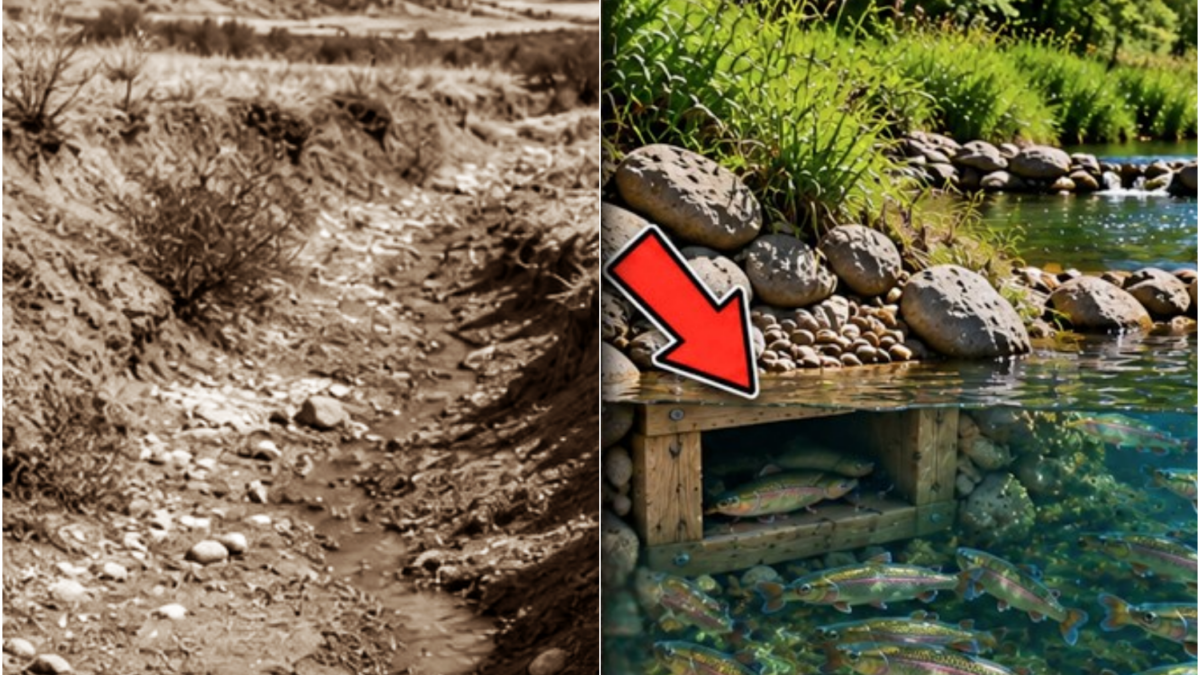
In 1978, a Wisconsin creek carried a strange contradiction. There was water moving through it, but almost nothing living in that water could complete the cycle that made the stream a trout creek.
The channel was so shallow that in places the water barely covered a pair of boots.
The gravel where trout should have laid their eggs had disappeared beneath layers of old sediment.
There were no deep pools for winter. There were few places beneath the banks where fish could shelter from the current or hide from danger.
The only trout appearing in the stream arrived on hatchery trucks. A biologist named Dave Vrono looked at those fish and understood what the trucks could not fix.
The creek itself was broken. More fish would not solve the problem. The water needed somewhere for them to live.
So Vrono began working on an idea that sounded almost absurd. He wanted to bury wooden boxes underneath the banks, cover them with tons of rock, redirect the current, deepen the channel, and give trout something the creek had not provided in generations.
A roof. A hiding place. A winter refuge. To make it happen, excavators would have to enter private farms, rock would have to be hauled into pastures, and landowners would have to trust people who wanted to reshape the very streams running through their property.
One of those landowners had earned a reputation as the man who polluted the creek.
Yet he opened his gate. Decades later, restored streams across the Driftless Area would hold hundreds, and in exceptional places thousands, more trout per mile than before.
But the greatest test of Vrono’s idea would not come from a fishing survey. It would arrive one night in August 2018, when rain transformed the valleys into rushing water and one of the most severe floods the region had seen came down through the restored country.
When the water finally fell, the people who had rebuilt those creeks discovered whether they had actually changed anything.
How much can a stream remember after a century of damage? The answer begins thousands of years before the first farmer ever opened a field in the hills of Wisconsin.
During the last ice age, enormous sheets of ice moved across much of the upper MidweSt.
They flattened landscapes. They carried soil and rock. They changed valleys and left behind enormous deposits of glacial material.
But in roughly 24,000 square miles where Wisconsin, Minnesota, Iowa, and Illinois meet, the ice went around.
It never covered that particular landscape in the same way. It never dropped its layer of glacial drift across the region.
That is how the area acquired its name. The Driftless Area. Instead of broad, flattened plains, the region kept its steep hills and limestone bluffs.
Beneath those hills, rainwater slowly worked its way through the limestone. Over thousands of years, the water dissolved passages through the rock, creating caves and underground channels.
Eventually, the water returned to the surface. It emerged from hillsides as springs. Those springs carried something precious into the valleys.
Cold water. Even in the middle of July, the water flowing from these springs could remain cold enough to support trout.
More than 600 cold water creeks developed through this network of springs and streams. Before large scale settlement transformed the landscape, the valley floors were often wet prairie.
Deep rooted plants held the soil together. The creeks were narrow. They were cold. They flowed across clean gravel.
That gravel mattered because trout need the right kind of streambed to reproduce. Then settlers began changing the hills.
During the 1800s, forests and prairie were cleared. Hilltops were cultivated. Slopes were opened for agriculture.
The deep roots that had once held the soil together were reduced. Rain still arrived.
But now, when hard storms came, the water could carry enormous amounts of soil downhill.
From roughly the 1890s into the 1930s, erosion became severe. Sediment moved from the hills into the valleys.
In some places, valley floors eventually ended up buried under as much as 15 feet of mud.
The consequences reached far beyond the streams. Roads became difficult to maintain. Farmers struggled to move milk from their dairies.
Creeks that had once been narrow and cold became wide and shallow. The gravel disappeared beneath sediment.
The habitat changed. Then the country began responding. In the 1930s, Creek became the country’s first large scale soil conservation demonstration project.
Farmers changed how they worked their land. Erosion slowed. But slowing new erosion was different from removing the old damage.
The mud already deposited across the valleys remained. Four decades later, that was the landscape Dave Vrono inherited.
The stream still carried water. It still had trout. But the trout were arriving from hatchery trucks.
They were not establishing a self sustaining population in the creek. The solution being used was straightforward.
Bring in more fish. Vrono could see the problem immediately. A creek with no deep pools could not provide enough winter refuge.
A creek with little overhead cover offered few places for fish to shelter. A creek whose gravel was covered with sediment could not provide suitable spawning habitat.
The fish were being placed into a system that lacked the structures they needed. More fish could not compensate for missing habitat.
Vrono worked for the Wisconsin Department of Natural Resources out of La Crosse. He would eventually spend 30 years working in the region.
Instead of asking how many fish could be added to the creek, he began asking what the creek itself needed.
He was not starting from nothing. Seven years before Vrono began his work at Creek, another Wisconsin researcher named Robert Hunt had published important results from Lawrence Creek in central Wisconsin, just outside the Driftless Area.
Crews had added habitat structures. Hunt measured what happened afterward. The youngest trout increased by 41 percent by weight.
The one year old trout increased by 57 percent. The two year old trout increased by 141 percent.
The numbers pointed toward a basic problem. Winter. Deep water mattered. Cover mattered. When temperatures changed and conditions became difficult, trout needed places where they could remain protected.
A deep pool could serve as both food source and shelter. Hunt kept measuring. In 1988, he reviewed 45 different habitat projects.
Three out of every four projects that added bank cover and structures designed to guide the current increased local trout numbers by at least 25 percent.
One out of four did not reach that mark. That detail would become important later.
Restoration was not magic. A structure placed in a stream did not guarantee success. Location mattered.
Design mattered. Water movement mattered. The surrounding land mattered. Over time, biologists began turning the research into something closer to a recipe.
Roughly 2 to 12 percent of a creek’s surface should have cover extending over the water.
Another 2 to 3 percent should consist of rock within the channel. Together, the structures could create a significant amount of shelter.
About a quarter of the creek should be deeper than two feet. But Creek had only about three inches in many places.
The problem was not simply that the stream lacked trout. The problem was that it lacked places where trout could live.
That was where Vrono’s wooden boxes entered the story. Wisconsin’s Department of Natural Resources began using them in 1982.
The design was simple enough to describe but complicated enough to require careful construction. A typical unit was about eight feet long, four feet deep into the bank, and about one foot tall.
The material was rough, untreated oak. Fresh oak was particularly useful because it was extremely hard.
The box was positioned at the bottom of the bank. Then rock and soil were placed around it until the structure disappeared from view.
Only a dark opening remained facing the water. From the outside, it looked like another part of the bank.
From inside, it created something entirely different. A ledge. A roof. A protected space beneath the streambank.
The structure was essentially an artificial undercut bank. It became known as a lunker. The name was an acronym for little underwater neighborhood keepers encompassing riotactic salmonids.
Rheotactic describes a fish that positions itself facing into flowing water. That was exactly what the trout could do beneath the wooden roof.
The design had an important requirement. The wood needed to remain beneath the water. If it repeatedly became wet and then dried, it would deteriorate more quickly.
The top planks therefore needed to sit below the lowest water level of the year, usually at least a foot and a half down.
The location was also important. The boxes were installed on the outside of bends, where the current naturally pressed against the bank.
That current helped keep the space beneath the structure clear. The boxes were installed in groups of three or four.
Too many placed together could cause the current to weaken near the final structure, allowing sediment to collect.
Large stones held the boxes in position. Metal rods were driven into the streambed. At least a foot and a half of rock was packed behind the structures.
The entire system depended on moving water. The goal was never simply to place objects inside a creek.
The goal was to change how the creek moved. Boulders were placed in clusters. When current struck the rocks, it accelerated around them.
That faster water could scour the streambed and create a deeper pool downstream. The moving water also picked up oxygen.
Behind individual rocks, pockets of slower water formed. A trout could hold position there while using very little energy.
Food moving through the current came toward it. The fish could remain sheltered while the creek delivered food.
Other structures were arranged in U and J shapes. These formations redirected current away from vulnerable banks and toward the center of the channel.
They helped protect the banks. They helped clean sediment from the streambed. And they helped produce a repeating pattern.
Deep pool. Fast riffle. Deep pool again. The creek began to regain some of the physical rhythm that trout needed.
Then there was riprap. It was not beautiful. It was not designed to attract attention.
It was simply stone placed over vulnerable sections of streambank. Its purpose was straightforward. Keep the bank from collapsing into the water.
Every piece of soil prevented from entering the stream represented less sediment moving downstream. It also meant less phosphorus entering the water from eroding soil.
In a later project on Warner Creek in Vernon County, crews stabilized 17 separate eroding banks with riprap.
The work opened almost a mile of creek to public fishing. The rock and the lunkers were not independent systems.
They worked together. Boulders placed upstream could direct current toward the lunker boxes. That moving water could continue flushing sediment from beneath the wooden structures.
The boxes could rest on stone bases dug into the streambed. Riprap could then cover the bank and hold everything together.
Logs added another layer. Root wads created shelter. Wood placed across the channel altered the current.
The structures created habitat not only for trout but also for insects that trout depended on.
The creek was becoming more than a channel carrying water. It was becoming a system again.
Then restoration crews began making another change that seemed completely backward. They lowered banks. For decades, people had often thought of tall banks as protection.
But a creek carrying a major flood needs somewhere for the water to go. When the banks are too high and the valley is disconnected from the channel, fast water stays concentrated inside the stream.
That increases the pressure on the channel. Lower banks give high water room to spread across the valley floor.
As the water spreads, it slows. Sediment can settle. The main channel experiences less pressure.
The valley becomes part of the flood system again. Vrono built a team of restoration specialists.
They worked one creek at a time. Thousands of lunker boxes eventually went into streams across the region.
But Vrono understood the limitation. One creek at a time would never restore an entire landscape.
The next step required a watershed. In the mid 1990s, Trout Unlimited began a watershed project on the Kickapoo River.
Vrono joined as a partner. He pushed for restoration on the West Fork of the Kickapoo, which would eventually become one of the best known trout streams in the country.
In 2003, during a tour of Wisconsin trout streams and the conversations surrounding it, Vrono played an important role in addressing concerns about restoring entire watersheds.
That same year, Trout Unlimited launched what became known as the Driftless Area Restoration Effort, or TU DARE.
The project brought together state and federal agencies, counties, conservation groups, anglers, and farmers. Jeff Hastings managed the effort.
Its central task was not simply to build structures. It was to fill gaps in technical help, funding, and education.
Someone had to explain the designs. Someone had to find funding. Someone had to work with landowners.
Someone had to convince farmers that restoration could fit alongside agriculture. One of the people who joined that effort was Duke Welter.
Welter had worked as a reporter. Then he became a trial lawyer. He learned to fish in 1981 by falling into the river and losing his watch.
At the end of that day, he said it had been a great day. After retiring, he spent years helping spread the message of TU DARE.
When he toured the creeks in 2004, he saw tall banks of dark soil throughout the region.
To him, they looked like material waiting for the next major flood. But the biggest obstacle was not a lack of engineering knowledge.
It was ownership. Almost all of these creeks crossed private land. Every project required a farmer willing to let an excavator enter a pasture.
That meant restoration depended on truSt. One farmer had a creek that had jumped its banks and threatened one of his buildings.
Runoff from his cattle lot flowed directly toward the water. Around the area, he had earned a reputation as the person polluting the creek.
Then he said yes. The restoration crews came onto his property. They installed riprap. They placed lunkers.
They planted grass strips to catch runoff. They built a concrete lot large enough for 800 head of cattle, giving manure a place to remain instead of allowing it to wash toward the creek.
The transformation was not immediate. That was one of the hardest parts for everyone involved.
Research had already shown that restored habitat could take years to reach its full effect.
On Hunt’s Creek, the number of larger brook trout did not peak the following summer.
It did not peak the year after that. The peak came in the sixth year.
For a farmer who had just allowed an excavator onto his land, six years was a long time.
Vrono understood that restoration did not always produce the same result. He estimated that only about half to 60 percent of local creeks showed the major turnaround people hoped for.
The warning from Hunt’s earlier review remained important. Not every project worked equally well. But when restoration succeeded, the numbers could be extraordinary.
On Elk Creek in Richland and Vernon counties, Wisconsin’s state trout plan reported brown trout increasing 556 percent one year after restoration.
That meant roughly six and a half times as many fish. Seven years later, the increase reached 1,779 percent.
Nearly 19 times as many trout. The farmer who had once carried the reputation of being the person polluting the creek now had a healthy trout fishery running through his property.
Other landowners noticed. Then they wanted to participate. By 2008, five additional landowners had signed on.
Three more miles of creek were added to the restoration effort. One agreement became six.
One restored property encouraged another. Gradually, the network expanded. By that point, close to 400 miles of creek had been restored through more than 100 major projects.
The combined public and private investment was a little over $80 million. A rough average came to around $200,000 per mile.
That was about $40 for every foot of stream. The benefits were not limited to fish.
On Citroen Creek, restoration was estimated to prevent roughly 980 tons of soil from entering the water each year.
With that soil came about 1,000 pounds of phosphorus. That was roughly half a ton of the same nutrient found in agricultural fertilizer.
Crews stabilized banks. They placed boulders and logs. They removed more than 3,000 cubic yards of old valley sediment so the creek could reconnect with its floodplain.
The fish responded. Before restoration, a typical Driftless Area creek might hold only 200 to 300 trout per mile.
Iowa’s strongest wild brown trout streams could hold between 500 and 2,000. Some restored creeks reached 2,500.
That was not the average. It represented the upper end of what restored habitat could produce.
In a small spring creek, however, 2,500 trout per mile was extraordinary. And the trout were not the only species returning.
The food web began rebuilding from the bottom. Mayflies returned. Stoneflies returned. Caddisflies returned. These insects could not tolerate heavily polluted water, which made them useful indicators of stream conditions.
Then came kingfishers and herons. Otters and mink appeared. Turtles returned. Frogs returned. Snakes returned.
Butterflies and water birds followed. The creek was no longer simply being restored for one species.
It was becoming habitat for an entire community. Welter saw that as one of the greatest values of watershed restoration.
The more species the watershed could support, the more valuable the restoration became. There was also an economic dimension.
A 2016 study placed the value of trout fishing in the Driftless Area at about $1.6 billion per year.
That figure covered fishing throughout the region, not just restored streams. It did not prove that restoration itself generated all of that economic activity.
But it placed the cost of restoration in perspective. The region was supporting a fishing economy worth enormous sums.
And much of that economy depended on the small cold water streams flowing through private farms and public landscapes.
Then the same force that had shaped the original problem returned. Water. Rainfall. Floods. The Driftless Area had already experienced major floods in 2007, 2008, and 2016.
A so called 100 year flood has about a one percent chance of occurring in a given year.
Yet the Kickapoo River and surrounding watersheds had experienced at least three major events in roughly a decade.
Then came August 2018. Rain hammered the Driftless Area. Creeks rose. Small streams became torrents.
Water moved through valleys at enormous speed. When the flood finally passed, the estimated damage reached $29 million.
It was the worst flooding many people in the region could remember. Then the restoration work faced its greatest teSt.
The pattern became visible afterward. Landowners who had allowed their streams to be restored had generally experienced less damage than neighboring areas.
The likely reason was the one the restoration crews had designed into the landscape. Lower banks.
More room for floodwater. A connected floodplain. Instead of forcing all the water through a narrow channel, the restored landscape gave it somewhere else to go.
Welter described the difference simply. Floods behaved differently where the floodplain had been restored. But restoration was not invincible.
Some older structures were damaged or destroyed. A dam failed at the Jersey Valley Reservoir.
Even lunker boxes required changes. Across the Driftless Area, some lunkers placed directly in the channel were replaced by skyhooks designed to resist tipping.
Eventually, both approaches began giving way to newer methods. The lesson was becoming clearer. Restoration could not be reduced to a single recipe.
The creek itself had to be studied. The surrounding land mattered. The current mattered. The flood history mattered.
The soil mattered. The habitat needs mattered. Minnesota agencies openly criticized riprap and lunkers when they were placed in unsuitable locations.
One goal of newer restoration work became avoiding the appearance that every stream had been built from the same template.
Minnesota’s Ian Chisum explained that restoration methods had to be continually reassessed. More wood could provide trout with a wider variety of habitat.
In Iowa, on Waterloo Creek, Mike Osterholm followed another approach centered more heavily on prairie and natural processes than on large engineered structures.
Even the question of bank vegetation remained open. A federal study on Minnesota’s Wells Creek found that on narrow streams, tall grasses could provide shading comparable to trees.
The debate was evolving. The question was no longer whether stream restoration could work. The evidence from Hunt’s studies, Elk Creek, and the flood response of restored properties supported the basic concept.
The argument had become more precise. Which method should be used? Where should it be used?
How much structure should be installed? When should nature be allowed to do more of the work?
The answers differed from one creek to another. There was another complication. The brown trout that had become such an important part of the region were not native to Wisconsin.
They came from Europe. The only native trout in the area was the brook trout.
Brown trout could compete with brook trout and push them out of suitable habitat. On Maple Creek in Wisconsin, researchers removed 20,495 brown trout between 2019 and 2023.
Afterward, native brook trout numbers increased nearly tenfold. Restoration, in that case, required more than building habitat.
It also required deciding which species the habitat should favor. That revealed something important about conservation.
There was no single definition of returning a stream to the paSt. Sometimes restoring one species meant reducing another.
Sometimes adding more structure helped. Sometimes less structure was better. Sometimes a creek needed rock.
Sometimes it needed wood. Sometimes it needed grass. Sometimes it needed its floodplain back. And all of those decisions were becoming more urgent because the weather itself was changing.
Researchers at the University of Wisconsin Madison reported that the region was already experiencing about 15 percent more precipitation and 43 percent more heavy storms.
Some projections suggested that as much as 68 percent of trout habitat could be lost by 2050.
The restored streams had demonstrated resilience. But resilience had limits. Scientists wanted to know exactly how much restoration could help when storms became heavier and more frequent.
The National Science Foundation funded a study of about $611,000 led by Professor Caroline Gottschalk Duska with the University of Wisconsin Madison and Indiana University.
The study examined the relationship between restoration and flood resilience. That research mattered because much of the understanding of the 2018 flood response had come from people directly involved in restoration.
More controlled evidence was needed. The story of the Driftless Area was still being written.
And some landowners were already thinking far beyond the next fishing season. One family that worked with TU DARE donated a public fishing easement on its property.
When explaining the decision, they did not focus on trout counts. They wanted their grandchildren to be able to fish there.
That was the measure that mattered to them. Not one season. Not one survey. Not one dramatic increase in fish.
A future. That same patience had defined Vrono’s work from the beginning. In 1978, he had stood beside a creek with only inches of usable depth.
The stream still had water. It still had fish. But the habitat no longer worked the way it once had.
The obvious solution had been to bring in more trout. Vrono looked at the creek and saw a different problem.
The fish were not the missing piece. The habitat was. So he began building places for trout to live.
Wooden boxes disappeared beneath the banks. Boulders altered currents. Logs created cover. Riprap held soil in place.
Banks were lowered. Floodplains were reconnected. Farmers opened their gates. Researchers measured the results. Years passed.
Some projects produced dramatic improvements. Some produced smaller changes. Some failed to reach expectations. The process was never as simple as placing a structure in a stream and waiting for fish to appear.
It required adjustment. It required patience. It required accepting that a creek was not a machine.
A creek was a living system. The most remarkable part was that the restoration did not create something completely new.
It gave the water opportunities to behave more like it had before the landscape was heavily altered.
The current could carve. The pools could deepen. The gravel could become visible again. The banks could hold.
The floodplain could absorb water. Insects could return. Fish could find shelter. And once those pieces began working together, the stream could continue much of the process without constant human intervention.
That was the real goal. Not to build a perfect creek. To give the creek enough structure and space to begin rebuilding itself.
By 2008, Trout Unlimited had named Dave Vrono its conservation professional of the year. Thirty years earlier, he had been looking at a stream with roughly three inches of water in places.
Now the restored brown trout from Creek helped provide breeding fish for Wisconsin. The difference had not been created by a single machine.
It had not come from one dramatic intervention. It came from thousands of smaller decisions.
A farmer agreeing to open a gate. A crew placing a boulder in exactly the right location.
A wooden box buried beneath a bank. A strip of grass planted beside a field.
A concrete lot built for 800 head of cattle. A valley lowered enough to give floodwater room.
A scientist measuring the results. Then measuring again. And again. The Driftless Area had spent more than a century accumulating the consequences of changed land use.
Restoration could not reverse that history overnight. The trout did not immediately reach their highest numbers.
The insects did not return in a single season. The floodplain did not become resilient the day an excavator left.
The system needed time. That may have been the most important lesson of all. A creek does not heal according to the schedule of a grant.
It does not respond according to the schedule of a newspaper article. It responds according to water temperature, sediment, current, vegetation, insects, fish, storms, seasons, and years.
Six years could pass before the biggest trout response appeared. Seven years could pass before the increase on Elk Creek reached its extraordinary level.
And decades could pass before anyone could look back and understand how many individual decisions had contributed to the transformation.
The original problem had taken generations to develop. The solution required patience on the same scale.
The old hatchery trucks had treated the symptom. The lunker boxes treated the habitat. That difference changed everything.
A truck could bring fish. A restored stream could produce them. A truck could add trout to a creek.
A functioning ecosystem could support trout through winter, provide spawning gravel, produce insects, create shelter, and allow new generations to emerge.
That was what Vrono had seen when the creek barely covered his boots. The water was not the whole story.
The shape of the water mattered. The ground beneath it mattered. The banks mattered. The valley mattered.
The land surrounding the creek mattered. And eventually, the floodplain mattered too. When the August 2018 flood arrived, all of those decisions were tested at once.
The water did what water always does. It followed gravity. It moved downhill. It filled every available space.
But on restored ground, there was more space available. The creek could spread. The valley could absorb.
The banks did not have to carry the entire force. That did not mean restoration made flooding harmless.
It did not. Structures still failed. Land still eroded. Dams still presented risks. Some restoration designs had to be replaced.
New methods had to be developed. But the flood revealed something important. The work had changed the relationship between the stream and the land around it.
That was the larger achievement. Today, the Driftless Area remains a landscape of cold springs, limestone hills, farms, forests, and narrow trout streams.
Some restored creeks now support numbers that would have seemed impossible when hatchery trucks were the only reliable source of trout.
Some reach 2,500 trout per mile. Others do not. Some projects thrive. Others require revision.
The debate over rocks, logs, banks, vegetation, floodplains, and species continues. And that is not necessarily a sign that restoration has failed.
It is evidence that the people working on these streams are still learning. The first generation built structures.
The next generation learned where those structures worked. The next generation began asking when fewer structures might work better.
The science kept moving. The creek kept moving too. And beneath the surface, trout kept doing something they could not do in the old three inch channel.
They were living there. They were finding shelter. They were moving through deep pools. They were feeding in the current.
They were reproducing in clean gravel. The hatchery truck was no longer the beginning of the story.
The creek itself was. That is what makes the history of this Wisconsin stream so remarkable.
Nothing about the solution sounded spectacular at firSt. A wooden box. Some rocks. A few logs.
Grass along a field. A lowered bank. An excavator entering a pasture. A farmer saying yes.
But together, those ordinary things changed the physical structure of an entire watershed. The creek did not need to be forced into becoming something artificial.
It needed some of the conditions it had loSt. And once those conditions returned, the water began doing much of the work.
The current shaped the pools. The pools sheltered the trout. The gravel provided habitat. The insects returned.
The fish followed. The birds returned. The mammals returned. The floodplain slowed the water. The valley began functioning as part of the creek again.
The lesson was never really about a wooden box. It was about understanding what the stream was missing.
Dave Vrono looked at a creek that had been reduced to inches of shallow water and refused to believe that adding more fish was enough.
He looked underneath the problem. He saw missing depth. Missing cover. Missing gravel. Missing connection between water and land.
And he began rebuilding those pieces. Forty years later, the results could be measured in trout.
They could be measured in restored miles. They could be measured in tons of soil kept out of the water.
They could be measured in phosphorus prevented from entering the stream. They could be measured in fishing activity.
They could be measured in the return of insects, birds, amphibians, reptiles, and mammals. But perhaps the clearest measure was simpler.
The creek could once again produce the fish that people had previously needed to bring there.
The water had become a place where trout could belong again. And the story is not finished.
Heavier rainfall continues to challenge the region. Native brook trout still face competition from brown trout.
Restoration techniques continue to evolve. Researchers continue testing which designs work best and where. Landowners continue deciding whether to open their properties to restoration.
The Driftless Area remains an enormous experiment in how water, land, wildlife, farming, and people can coexiSt.
The first projects did not provide a final answer. They provided a beginning. In 1978, the creek had almost everything a stream needs to carry water and almost nothing a trout needs to thrive.
Today, restored sections tell a different story. The current moves over gravel. Pools hold cold water.
Wood and rock create shelter. Insects move through the food web. Trout occupy places that once stood empty.
And when the next storm arrives, the restored valleys have more room to receive it.
A creek that once depended on trucks can now produce its own future. That transformation began with a biologist looking at three inches of water and asking what was missing.
The answer turned out to be hidden beneath the surface. Not more fish. More habitat.
More depth. More cover. More connection. More time. And perhaps that is why the story of this creek reaches beyond Wisconsin.
It shows that landscapes do not always need to be replaced. Sometimes they need to be given back the conditions that allowed them to function in the first place.
A wooden box can become a shelter. A boulder can become a pool. A grass strip can become a filter.
A lowered bank can become floodplain. A farmer’s agreement can become a mile of restored stream.
One yes can become six. Six can become hundreds. And a creek that once received its trout from the back of a truck can eventually become the place where the next generation begins on its own.
In the Driftless Area, that process is still happening. The springs are still feeding the valleys.
The water is still moving through limestone. The trout are still facing into the current.
And beneath a bank, hidden from anyone standing above the water, a rough oak box can still be doing exactly what it was designed to do.
Give a fish a roof.
Disclaimer: This content may be created by Al for entertainment purposes. Any resemblance to real persons, events, or places is coincidental.








