Everyone Said Her Old Mare Was Worthless — Until She Found the Hidden Brand
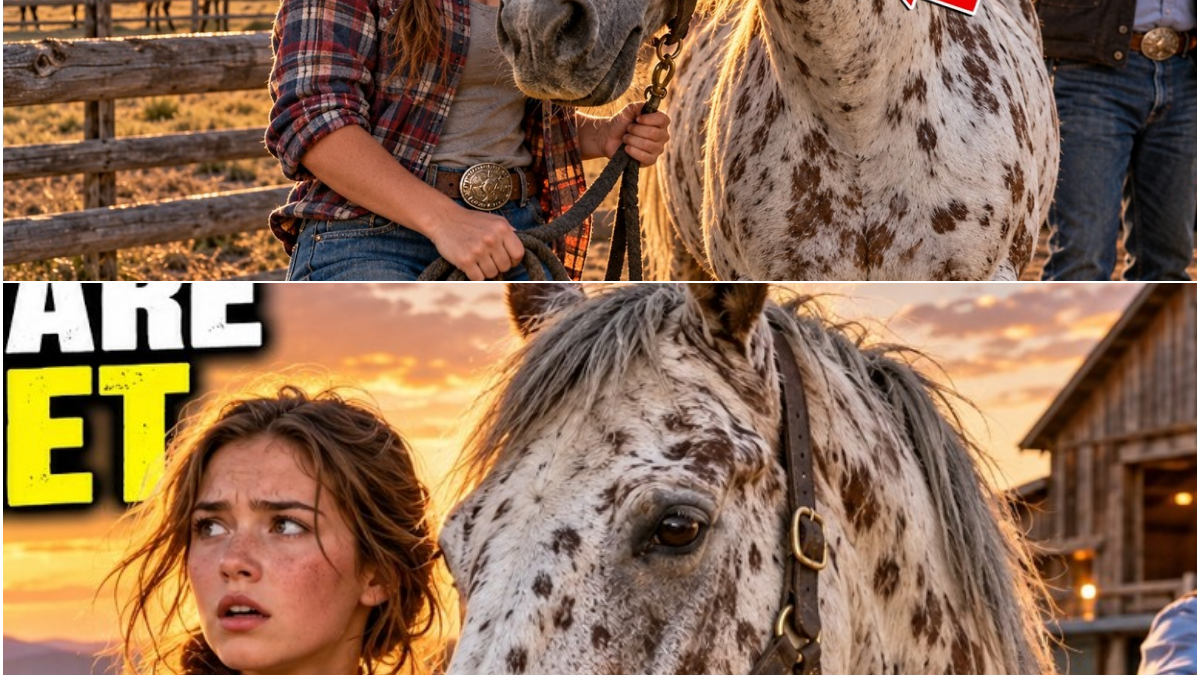
In the fall of 1997, Cal Mercer arrived at the Ward ranch with an envelope containing $240,000 and the confidence of a man who believed the hardest part of a negotiation was making the other person understand that there were no real alternatives.
Across from him sat Lena Ward, nineteen years old, six months out of community college, and responsible for a struggling breeding operation in Eastern Oregon that had belonged to her grandmother.
Outside the kitchen window, thirty-one Appaloosa horses stood behind dry fences, their coats catching the pale afternoon light.
Some were old, several were underweight, and three had not produced a healthy foal in years.
The ranch had less than two months of operating cash remaining. Cal knew the figures.
He knew the debts, the failing business, and the young woman who had inherited more responsibility than experience.
He believed he was offering her a way out. But Lena had been watching one particular mare for four mornings, and what she had discovered beneath that mare’s winter coat had changed the meaning of everything on the property.
The horse was twenty-three years old, stiff in her hindquarters, and apparently worth little more than the cost of keeping her fed.
Yet an unfamiliar brand beneath her mane had led Lena to a forgotten veterinarian, a box of old records, and a bloodline that had nearly disappeared from official history.
Cal was certain the ranch was worth $240,000. Lena was beginning to suspect that the truth was worth considerably more.
What would happen if she could prove it before the bills forced her to sell?
Cal Mercer did not raise his voice when he spoke. He sat comfortably at Ruth Ward’s old kitchen table, wearing a pressed denim shirt, clean boots, and the expression of someone who had already considered every objection the other person might make.
“Nineteen years old, six months out of community college, and you think you’re going to run a breeding ranch?”
Lena looked at the envelope in front of her. Cal pushed it a little closer.
“Two hundred and forty thousand dollars,” he said. “For the ranch, the barns, the equipment, and every horse on the property.
It’s more than the place is worth.” He glanced through the window toward the west pasture.
An old leopard-spotted mare stood alone near the fence. Her muzzle had turned gray, her back was beginning to hollow, and her hind legs moved with the stiffness of an animal that had spent decades walking rough ground.
“Look at that mare,” Cal said. “You’re feeding animals that should have been sold five years ago.”
Lena followed his gaze. The mare was Bluebird, twenty-three years old, and one of the last horses her grandmother had ever intended to breed.
She had produced seven foals between 1979 and 1990, but her last three breeding attempts had failed.
Ruth had stopped trying in 1993. Since then, Bluebird had remained on the ranch without producing income.
“I’m not selling,” Lena said. Cal did not argue. He stood, buttoned his coat, and left the envelope on the table.
“Think about it. Feed prices aren’t coming down. Banks don’t care about family history, and sentiment doesn’t pay a veterinarian.”
At the door, he paused. “When you change your mind, call me before the number gets smaller.”
Then he drove away. Lena watched his truck disappear down the ranch road. She knew the offer was substantial.
She also knew that the ranch was in serious trouble. Her grandmother, Ruth Ward, had managed the operation for years, but the figures had deteriorated before Lena came home.
Ruth had kept the bills organized, but she had rarely discussed the details. After her passing in May of 1997, Lena had discovered the full extent of the financial strain.
The property loan still carried a balance of $86,400. The hay supplier was owed $17,800.
A tractor repair had added another $9,600. The breeding operation, which had once produced twelve to fifteen foals annually, had registered only four live foals in 1996.
Two had sold, while two remained on the property. Gross revenue for the previous year had been just under $94,000.
Expenses had exceeded $131,000. The ranch was losing money, and it did not have enough cash to absorb many more surprises.
The bank manager had suggested liquidation. A neighboring rancher had told Lena she was young enough to start over.
A family friend recommended returning to school and finishing her agriculture degree. At the feed store, people still called the property Ruth’s Ranch, and Lena was usually introduced as Ruth’s granddaughter.
Almost nobody called her a horse breeder. But Ruth had taught Lena to pay attention long before she had ever considered managing a ranch herself.
When Lena was six, Ruth had taken her into a pasture containing twenty horses and asked her which animal was in pain.
Lena pointed toward a gelding with a visible cut on his shoulder. “That one’s bleeding,” Ruth said.
“That’s not the same question.” They watched the herd for another ten minutes. Eventually, Lena noticed a bay mare shifting her weight every twenty or thirty seconds.
The movement was subtle, barely noticeable unless someone watched long enough. Ruth nodded. “Watch what an animal does when nobody is asking it to do anything,” she told her.
“That’s when it tells you the truth.” Lena remembered those words. By twelve, she could often recognize the early signs of a hoof abscess before a horse became visibly lame.
By fifteen, she could identify the behavior of mares approaching their breeding cycles. By seventeen, she could walk among young horses and notice which ones were being pushed away from food, even when there were no obvious marks or injuries.
Ruth had never taught her to search only for dramatic signs. She taught her to observe ordinary behavior, recognize patterns, and notice the animal that did something different.
That was why Lena had begun following Bluebird. After returning to the ranch, she walked the pastures each morning before feeding.
It was partly a work routine and partly a way of keeping close to the place she remembered from childhood.
The quiet of early morning made the ranch feel familiar, even when the bills and responsibilities seemed overwhelming.
Bluebird had developed a peculiar routine. While the other older horses gathered near the feed gate, she walked toward the far side of the west pasture.
There, she stood beside an abandoned working pen that had not been used since Lena was a child.
She did it at almost the same time every morning. She stood in almost the same place.
Then she returned for feed. On the first morning, Lena paid little attention. On the second, she followed her.
On the third, she brought a brush and began grooming her. Bluebird’s winter coat had thickened, and the mare was beginning to shed in patches.
Lena brushed her shoulder, neck, back, and hip, moving slowly and watching for signs of discomfort.
When the brush passed along the left side of Bluebird’s neck, the mare flinched. It was not the sharp reaction of an animal experiencing pain.
It was more like a response to pressure in a particular spot. Lena parted the hair with her fingers.
Beneath the coat was a faint freeze brand. Four characters were visible: WR, followed by the number 48.
Lena stared at it. The Ward ranch had used a simple W brand for decades.
She had never seen WR48, and Bluebird had been born in 1974. The number could not have represented her birth year.
She went inside and searched through every horse file she could find. Bluebird’s registration certificate listed her sire as High Desert Jack and her dam as April Snow.
The pedigree extended through three generations, but it contained no WR48 designation and no special notation explaining the brand.
Lena could have dismissed it as an old identification mark. Instead, she remembered Ruth’s habit of preserving records that other people considered unimportant.
“Old horse records never disappear,” her grandmother used to say. “They just end up where nobody thinks to look.”
The following morning, Lena drove ninety miles to Bend to visit dr. Martin Hail, a retired veterinarian who had worked with Ruth during the 1970s and 1980s.
Hail was seventy-one years old. He still kept paper records in metal filing cabinets because he trusted computers about as much as he trusted horses that pinned their ears without moving their feet.
Lena described the brand. “WR48?” “Yes.” “Where did you see it?” “On Bluebird.” Hail stopped sorting invoices.
He asked her to repeat the name. Then he stood and walked into the back room.
Twenty minutes later, he returned carrying a dusty cardboard box. Inside were breeding records, black-and-white photographs, blood typing reports, and handwritten veterinary notes dating back to 1968.
Hail removed one photograph and placed it on his desk. A stallion stood in profile beside a wooden barn.
He had heavy bone, a strong hip, and leopard spotting across his hindquarters. The writing on the back read: Ward’s Redcloud, foaled 1948.
“Your great-grandfather bred him,” Hail said. Redcloud had been a respected working Appaloosa stallion in that part of Oregon during the 1950s and early 1960s.
He was not nationally famous and had never become a show-ring celebrity. But ranchers valued his offspring for their soundness, balance, endurance, and ability to work cattle over difficult ground.
Then his line had nearly disappeared. Redcloud died in 1966. Several of his sons were gelded.
Two daughters went to ranches that eventually stopped breeding horses. During the 1970s, the Ward branch of his family line effectively vanished from the official pedigree records.
Except it had not vanished completely. Hail opened another file. According to Bluebird’s registration certificate, her dam was April Snow.
But the mare listed under that name was not Bluebird’s biological mother. Her actual dam was a mare named Ruthie’s Promise.
Ruthie’s Promise was a granddaughter of Redcloud. Hail had drawn blood from the mare in 1975 and still possessed the laboratory report.
Lena stared at him. “If that’s true, why isn’t it on her papers?” Hail studied the records.
“I always wondered.” Then he looked directly at Lena. “Your grandmother knew.” That afternoon, they returned to the ranch.
Hail examined Bluebird, photographed the brand, and collected hair samples for DNA parentage testing. Equine DNA testing was becoming increasingly available in 1997, but many older pedigrees had never been checked against modern genetic evidence.
Bluebird had surviving maternal relatives, and there were descendants of High Desert Jack. Hail also had preserved blood type records that could help connect the older family line.
The results took seventeen days. Before eight o’clock on the morning they arrived, Hail called Lena.
“Sit down,” he said. She sat. “The registration record is wrong. Bluebird’s maternal line matches Ruthie’s Promise.
The paper pedigree does not hold up.” Lena was quiet. Bluebird was not simply an old mare with incomplete papers.
She was one of the last living mares carrying a direct female branch of the Ward Redcloud line.
But Hail was careful about what that meant. “Financially, it means nothing yet,” he told her.
“A bloodline is only valuable if you can prove it, reproduce it, and demonstrate that the traits people associate with it are actually there.”
Bluebird was twenty-three. Her reproductive history was poor. Redcloud was a forgotten stallion from 1948, and an old photograph could not make his descendants valuable on its own.
Lena understood the distinction. She also understood that telling people too soon could create problems before she had enough evidence to answer their questions.
She told no one about the discovery. Instead, she began building a complete record of the ranch’s breeding history.
She examined old breeding books, sale receipts, photographs, veterinary notes, and registration papers. She contacted former customers and ranchers whose parents had purchased Ward horses decades earlier.
Some of the people she called remembered the horses clearly. Others remembered only a name or a distinctive marking.
Lena wrote everything down and looked for connections. She traveled to Idaho, Washington, and Nevada.
Gradually, she found mares scattered across the region that carried pieces of the same maternal family.
Some had incomplete pedigrees. Some had been sold as trail horses. One was being used as a children’s lesson horse outside Burns.
Another had spent six years producing ranch colts for a family near Winnemucca. Their owners did not know the horses might be related to Redcloud.
Lena did not tell them that she had discovered a valuable bloodline. She asked whether they would consider selling, leasing, or signing breeding-rights agreements.
Her first acquisition was a sixteen-year-old mare named Cinnamon Sky, purchased for $4,800. The second was a fourteen-year-old mare named Painted June, purchased for $6,200.
A retired rancher agreed to lease Lena two mares for three breeding seasons in exchange for $3,000 upfront and a percentage of future foal sales.
Within seven months, Lena controlled breeding rights to nine mares linked to the Redcloud female family.
Then she had to decide what to do about Bluebird. At twenty-three, another natural pregnancy carried risks.
dr. Hail recommended a reproductive evaluation by a specialiSt. Lena hauled the mare to an equine clinic in Washington State.
The veterinarian explained that Bluebird’s chances of safely carrying another foal were limited, but her ovaries remained active.
Embryo transfer offered another possibility. It was expensive and uncertain, and Lena did not have the money available.
She sold Ruth’s newer stock trailer and a utility tractor that could be replaced later.
She also borrowed $18,000 from an aunt, who insisted that Lena sign a proper promissory note.
Ruth had taught the family never to confuse love with bookkeeping. The first embryo transfer attempt failed.
The second failed, too. On the third cycle, the clinic recovered a viable embryo. A recipient mare carried it through the pregnancy.
In April of 1999, a leopard-spotted colt was born. Lena named him Ward’s Second Chance.
dr. Hail laughed when he heard the name. But when he watched the colt move, his expression changed.
The young horse had a short back, a strong hip, large feet, and unusually balanced movement.
Those features resembled the stallion in the old photograph of Redcloud. At six months, Lena filmed him crossing rough ground.
At ten months, he was already displaying the calm, deliberate response to pressure that Ruth had valued in working ranch horses.
Lena sent the footage, DNA documentation, and historical records to six breeders. Four did not respond.
One replied that old ranch genetics were interesting but commercially meaningless. The sixth breeder drove six hours to see the colt in person.
After watching him move and examining the documentation, he offered $35,000. Lena declined. The offer did, however, change the bank conversation.
It gave her evidence that the work might become financially viable, even if the bank was not yet ready to treat the entire bloodline as a dependable asset.
The following year, three related foals sold for a combined $96,000. In 2000, two young stallions from the program sold breeding interests totaling $210,000.
Lena reinvested almost everything. She improved the broodmare barn, installed safer foaling stalls, and built a small laboratory room for veterinary reproduction work.
She leased another 160 acres and hired a full-time breeding manager. By 2001, Ward Heritage Horses had thirty-eight mares under management.
Seventeen carried documented Redcloud blood at meaningful levels. Gross revenue reached $740,000. The following year, it passed $1.6 million.
Cal Mercer finally began paying attention. For years, he had assumed Lena was surviving by selling equipment and borrowing against the ranch.
Then three Ward-bred horses placed in major regional ranch horse competitions during the same season.
One sold privately for $185,000. Another breeding prospect was syndicated at a valuation of $620,000.
People who had ignored Lena’s earlier calls began asking to join her waiting liSt. Cal attended one of the sales.
He stayed toward the back and did not speak to her. Two months later, Lena’s attorney, Karen Ellis, discovered something that changed the dispute from a question about pedigree accuracy into a question about the history of the records themselves.
Lena had hired Karen to review a breeding-rights contract with a buyer in Texas. While tracing Bluebird’s ownership history, Karen found an old transfer document dated 1976.
At the bottom of a microfilm copy was a notation: Foundation designation removed pending pedigree review.
Karen asked Lena what review had taken place. Lena had no idea. They searched further.
The notation appeared on a microfilm copy made in 1989, but it did not appear on the original 1976 transfer document.
Someone had added it later. Karen recommended that they consult an archive specialiSt. That brought them to Marjorie Pike, who had spent twenty-seven years working with livestock pedigree records in breed association archives across the NorthweSt. Marjorie remembered filing systems that other researchers had forgotten existed.
She found the first important document in three days. It was a private blood typing report from 1988.
The client was Mercer Performance Horses. The subject was the surviving descendants of Ward’s Redcloud.
Cal Mercer’s company had paid to investigate the bloodline nine years before he offered Lena $240,000 for the ranch.
The report identified six likely surviving mares. Bluebird was one of them. Lena read the document twice.
Marjorie then located a 1989 letter from Mercer’s breeding manager to an independent pedigree record contractor.
The letter requested that several Ward horses be held from foundation classification until additional ownership documentation could be established.
No additional documentation was attached. No formal dispute had been filed, but the classification changed anyway.
The next documents were purchase offers. Cal had made four separate offers to Ruth in 1990, 1991, 1993, and 1995.
They concerned Bluebird, the broodmare band, or the entire Ward breeding operation. Ruth had rejected every offer.
The highest had been $310,000. After the final rejection, the historical pedigree notation became increasingly difficult to locate, and several horses that should have appeared in foundation searches no longer did.
The records suggested that the line had not disappeared because it lacked a history. Someone had known what it was, and someone had recognized that controlling the information could make it easier to buy the horses cheaply.
Lena wanted to confront Cal immediately. Karen stopped her. “Paper first,” she said. “Anger later.”
They continued searching. By the spring of 2002, they had assembled enough documentation to reconstruct nearly fifty years of the bloodline.
Then Cal made his move. The complaint arrived on a Monday. Mercer Performance Horses alleged that Ward Heritage Horses had marketed breeding stock using disputed pedigree claims and had failed to disclose uncertainty surrounding the historical registration status of the Redcloud line.
Cal requested an emergency review of Lena’s registration applications. His attorneys also asked a county judge for a temporary injunction that would prevent Lena from completing several high-value breeding transactions while the ownership and pedigree claims were being resolved.
The timing was particularly difficult. Ward Heritage Horses had just signed a letter of intent with a Kentucky breeding group.
The agreement was worth $4.8 million over five years and covered frozen semen rights, embryo transfer services, and limited access to three Ward stallions.
The Kentucky group paused the agreement. The bank delayed financing for Lena’s planned $2.3 million breeding and veterinary facility.
Two buyers withdrew from an upcoming sale. Within ten days, years of progress had been interrupted.
Cal spoke to a livestock publication. He said historical preservation was important, but buyers deserved confidence that pedigree claims were complete and transparent.
He argued that no breeder should be allowed to create artificial scarcity around disputed bloodlines.
He never called Lena dishoneSt. He did not have to. People understood what he was suggesting.
Then his offer arrived. Seven and a half million dollars for everything. The original ranch, the land rights, every horse owned by Ward Heritage Horses, every embryo in storage, all semen inventory, every breeding contract, every trademark, and every historical pedigree claim.
Lena took the offer home. She sat at the same kitchen table where Cal had left the $240,000 envelope five years earlier.
Seven and a half million dollars could settle every debt, reward her employees, and remove the financial uncertainty that had followed the ranch since Ruth’s final years.
She could buy a home wherever she wanted and never again have to worry about whether a court hearing would interrupt a breeding season.
She stayed at the table for almost an hour. Then she heard a horse kick the side of the old barn.
It was an ordinary sound, one sharp bang followed by another. Lena walked outside. Bluebird stood in a small retirement paddock beside the barn.
She was twenty-eight now, thin through the topline and gray around nearly her entire face, but still alert.
Lena entered the paddock. Bluebird walked toward her, passed her, and stopped at the old tack room door.
The door had been locked for years. Ruth had once kept show equipment there before converting most of the main barn.
Lena had opened the room after the funeral, finding old bridles, broken saddle racks, blankets, and two trunks.
Nothing had seemed especially important. Now Bluebird stood with her nose against the door. “You’re not getting fed in there,” Lena said.
The mare did not move. Lena unlocked the door. Inside, an old wooden trunk sat beneath a shelf.
Lena had examined it before, but now she noticed that it weighed more than she expected.
She emptied it. There were leather tools, registration forms, horseshoe nails, and a stack of photographs.
When she lifted the empty trunk, she noticed that its bottom panel did not sit flush with the frame.
She ran a screwdriver along the edge. The panel lifted. Beneath it lay a cloth envelope, a safe deposit box key, a bundle of original registration papers, and a letter bearing Lena’s name.
She did not read the letter firSt. The documents stopped her. There were original blood typing reports, signed breeding certificates, foaling records witnessed by dr. Hail, and photographs carrying dates and identifying marks.
There was also a notarized statement from 1977 confirming Bluebird’s true dam. At the bottom was a copy of a private pedigree investigation Ruth had commissioned in 1990, after becoming suspicious of Cal Mercer’s sudden interest in the old mares.
Ruth had not known everything. But she had known enough. She knew the Redcloud line had survived.
She knew Mercer had identified it. She knew the public paperwork did not match the ranch’s own records, and she had spent years quietly preserving the originals.
The safe deposit box contained more. Lena and Karen opened it the next morning. Inside were three binders.
The most important contained correspondence between Ruth and the pedigree contractor responsible for the 1989 classification hold.
In one letter, the contractor admitted that Mercer Performance Horses had supplied the requeSt. In another, he told Ruth that the hold was temporary.
It had never been removed. There was also a canceled check for $12,500, paid in 1989 by Mercer Performance Horses to the same contractor for pedigree research and consulting.
The check alone proved very little. But together with the letters, the altered microfilm notation, Cal’s private blood typing report, and the repeated purchase offers, it formed a much clearer record of what had happened.
Then Lena read Ruth’s letter. Her grandmother wrote that horse people often confused paperwork with truth.
Papers mattered. Registries mattered. Contracts mattered. But the horse existed before the paperwork. Its bones existed.
Its movement existed. Its temperament existed. Its offspring existed. If the records became confused, Ruth wrote, Lena should begin with the animal and work backward.
She remembered Lena at eight years old, asking why Bluebird moved differently from the other mares when cattle crowded a gate.
She remembered Lena at eleven, noticing that three horses from the same female family had unusually hard feet.
She remembered Lena at fourteen, asking why Bluebird’s registration papers did not seem to match the old photographs in the house.
Ruth had not answered those questions directly. She wanted Lena to learn the difference between being given an answer and proving one.
At the bottom of the final page was one sentence. “If somebody tells you a good horse is ordinary, find out who benefits from you believing them.”
Lena folded the letter and placed it carefully in the envelope. Then she went to court.
The hearing began in November of 2002. Cal’s attorneys focused on uncertainty. They argued that old breeding records could contain mistakes.
They pointed out that early blood typing was less precise than modern DNA testing and questioned whether handwritten ranch notes should outweigh official registry records.
Karen agreed with one part of their argument. Old records could contain mistakes. That was why Lena’s case did not depend on a single document.
Karen began with Bluebird’s DNA evidence, which established her maternal relationship to surviving members of the Ruthie’s Promise family.
Then she introduced dr. Hail’s original 1975 blood typing documents. Next came signed foaling records, photographs, veterinary treatment notes, bills of sale, and archived breeding certificates.
Each document supported another part of the history. Marjorie Pike explained the altered pedigree notation.
The original 1976 transfer had contained no foundation hold. The microfilmed version created in 1989 did.
No formal review file existed to explain the change. Then Karen introduced Mercer Performance Horses’ private 1988 report.
Cal’s own company had identified Bluebird’s connection to Redcloud before the disputed notation appeared. The room became quiet.
Karen followed with the letters, the contractor’s invoice, and the $12,500 payment. Finally, she introduced the four purchase offers Cal had made to Ruth.
His attorneys had prepared to argue that Lena could not prove the bloodline. They had not expected to explain why Cal had privately investigated that same bloodline years before repeatedly attempting to buy it.
The judge did not decide the commercial value of the horses. That was not the issue before the court.
He did decide that Mercer had not demonstrated sufficient grounds to maintain the emergency restriction on Lena’s breeding transactions.
The temporary injunction was dissolved. The historical documents were admitted for the underlying civil case.
Because several records raised questions about whether commercial pedigree files had been intentionally altered, the judge referred the documentation to the appropriate state investigators for further review.
Cal left through a side door. He did not speak to reporters. The next afternoon, the Kentucky breeding group called Lena.
They wanted to restart negotiations. The original five-year agreement had been worth $4.8 million. After reviewing the demand that had developed during the legal dispute, the group expanded the arrangement.
The final value was $6.4 million. The bank approved financing for the breeding facility. Construction began the following spring.
Bluebird never produced another embryo. Lena never asked her to. The mare had already given her more than anyone could reasonably have expected.
Bluebird lived to thirty-one. Lena buried her on a low hill above the west pasture, where she could see the land the mare had walked for so many years.
Five years after the hearing, a group of animal science students from Oregon State visited Ward Heritage Horses.
There were eighteen students, most around the age Lena had been when Cal first sat at her grandmother’s kitchen table.
By then, the ranch had changed almost beyond recognition. Ward Heritage Horses managed 920 acres owned or leased.
There were eighty-four broodmares, and three breeding stallions stood to the public on limited contracts.
The veterinary reproduction center handled embryo transfer, semen freezing, and reproductive services for outside clients.
Annual revenue for the previous fiscal year had reached $1.8 million. An independent appraisal placed the land, horses, breeding contracts, stored genetic material, facilities, and business operations at a little over $32 million.
Cal Mercer had once offered $240,000 for all of it. Lena guided the students through the foaling barn, the reproduction laboratory, and the young horse pastures.
Finally, she took them into the old barn. A photograph of Bluebird hung on the wall.
Beneath it was the small brass plate Lena had removed from the mare’s stall after she was gone.
Bluebird, 1974 to 2005. Beside the photograph was another image: Ward’s Redcloud, 1948. A student near the front asked whether Bluebird was the horse that had made the ranch valuable.
Lena shook her head. “No. She was valuable before I knew what she was.” The students looked at the photographs.
“Bluebird carried that bloodline when my grandmother was alive. She carried it when the paperwork was incomplete.
She carried it when people looked at her and saw an old mare worth perhaps eight hundred dollars at a local sale.
Nothing inside the horse changed when I found the records. What changed was the information around her.”
Another student asked whether the story was really about pedigree. “Partly,” Lena replied. “But pedigree is just how this story happened to show up.”
She explained that the larger mistake had been deciding what an animal was worth before understanding what it actually was.
People had seen Bluebird’s age, her poor fertility, her incomplete papers, and the cost of feeding her.
Every one of those details was real. None of them told the whole story. Lena took the group outside.
Across the property, several young horses were being worked quietly around cattle. Some carried Redcloud blood.
Others did not. The ranch had grown beyond the original family line, but the principles that guided it remained the same.
Ward Heritage Horses had also started a preservation program for small breeders with old working bloodlines.
It helped ranch families document their horses before incomplete records and changing ownership made the history difficult to reconstruct.
During its first three years, the program assisted twenty-seven ranch families with DNA testing, veterinary records, archival pedigree research, and reproductive preservation.
Lena also established an emergency mare fund. When an older breeding mare from a documented working line needed veterinary care her owner could not afford, the fund could cover part of the cost in exchange for preserving records and, when appropriate, reproductive material.
She understood what happened when the people most capable of preserving a valuable line were also the people being told it was financially foolish to keep it.
One student asked whether Lena regretted refusing Cal’s $7.5 million offer. She thought about the kitchen table, the envelope, the bills, and the years of uncertainty.
“The money wasn’t the hard part,” she said. “The hard part was knowing whether I was protecting something real or just protecting something because it belonged to my grandmother.”
She looked toward the west pasture. “That’s why proof mattered. Not pride. Not revenge. Proof.”
After the students left, Lena walked into Bluebird’s old paddock. The fence had been replaced years earlier, but the pasture itself remained much the same.
Horses grazed near the far end, and a young leopard-spotted filly lifted her head when Lena approached.
The filly was six generations removed from Redcloud. Bluebird appeared twice in her extended pedigree.
She was not especially impressive yet. Her legs were long, her chest was narrow, and her winter coat made her look awkward.
She was the sort of young horse that someone unfamiliar with the family might pass without a second glance.
Lena stood at the fence and watched. The filly moved toward the herd, then stopped as another horse shifted behind her.
She turned before the other horse came close. It was a small movement, easy to miss.
Lena smiled. Ruth would have noticed it. Bluebird would have noticed it. And now Lena noticed it, too.
That was the real inheritance. Not the ranch, not the paperwork, and not even the bloodline.
It was the habit of paying attention after everyone else had already decided there was nothing left to see.
The horses moved across the pasture as the evening light settled over the hills. Thirty years earlier, one of them might have been dismissed as an old mare with bad papers.
Five years earlier, a man had been willing to spend millions to control what those papers meant.
Now the records were organized. The bloodline was documented. The ranch was profitable, and the next generation of horses was already growing.
But Lena still trusted the place Ruth had taught her to begin. Watch the animal.
Watch what it does when nobody is asking it to perform. And when something does not fit the story everyone keeps repeating, do not ignore it simply because the explanation would be inconvenient.
Sometimes an old horse really is just an old horse. Sometimes an incomplete pedigree is only an incomplete pedigree.
But every once in a while, an animal standing quietly at the far end of a pasture carries a story that someone has worked very hard to keep hidden.
The difference begins when one person decides to look twice.
Disclaimer: This content may be created by Al for entertainment purposes. Any resemblance to real persons, events, or places is coincidental.








