Everyone Laughed When She Paid $11 for This Sheep — Two Years Later, It Broke a State Record
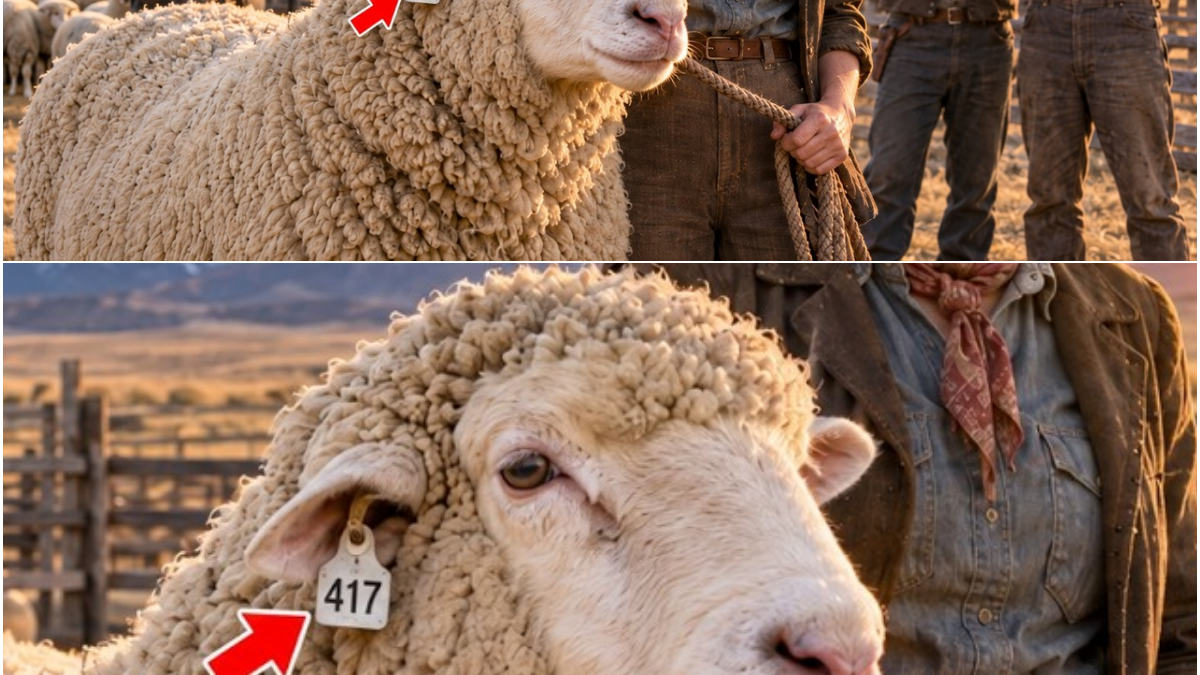
The auctioneer had already decided the sheep was worth almost nothing when Clara Whitmore raised her hand.
The animal stood in the corner of a dusty pen outside Pueblo, Colorado, its fleece dulled by a long summer and one ear torn along the edge.
It had no registration papers, no impressive record, and no obvious reason for anyone to spend another dollar on it.
Yet Clara had driven 40 miles through the September wind to see that particular sheep, and she had spent five weeks studying old breeding catalogs and forgotten reports to understand a number stamped into its ear tag.
Around her, the other buyers watched with the impatience of people waiting for something more valuable to come along.
Eight dollars. Nine. Ten. Then Clara offered eleven. Nobody answered. The auctioneer brought down his hand, and the sheep became hers.
She walked into the pen, tied a rope around its neck, and led it toward her truck while the men nearby shook their heads.
They saw an ordinary unregistered ewe, already two years old and past the age when most buyers wanted to begin a breeding program.
Clara saw a possibility supported by a letter, an old report, and one small metal tag.
But there was still a question she could not answer. Had she recognized a valuable animal, or had she simply convinced herself that an overlooked number meant more than it did?
Clara had learned to be careful with hope. She had been running the Whitmore ranch alone since the spring of 1932, and the property had taught her that enthusiasm could not repair a fence, fill a water trough, or pay a mortgage.
The ranch covered 86 acres of dry pasture, with another 40 acres leased from a neighbor.
It had a weathered barn, two corrals, and a windmill that demanded attention every few months.
The flock, once numbering 73 sheep, had fallen to 38 during the difficult years of the Depression.
Her father, Thomas Whitmore, had raised commercial sheep for 27 years. He understood the land and the seasons, and he could study a ewe from a hundred yards away and make a remarkably accurate judgment about her condition.
He knew which animals handled poor grazing, which ones raised strong lambs, and which ones were likely to struggle when winter feed became scarce.
But Thomas had never been especially interested in pedigrees. He believed a good sheep was one that survived, raised a lamb, and produced enough wool to help pay for the next season.
When wool prices were dependable, that approach had served the family well. By 1932, however, Clara could see that the old arithmetic no longer worked.
The ranch still owed $1,480 on its mortgage. Alfalfa delivered from the Arkansas Valley cost roughly $11 to $13 a ton, depending on the month.
Fence wire, salt, medicine, repairs, and transportation all took money from an income that had become painfully uncertain.
Even a flock that produced a respectable wool clip could leave its owner struggling to cover expenses.
Clara understood that she could not simply make the ranch larger. She did not own enough ground, and buying more land would have added a burden she could not afford.
Instead, she began considering a different possibility. If she could improve the quality of her flock, perhaps each animal could contribute more than an ordinary commercial ewe.
That was why she started reading. At the county extension office in Pueblo, she found livestock bulletins covering several years of sheep breeding and production.
She studied fleece weight, staple length, clean yield, uniformity, crimp, body size, mothering ability, and lamb growth.
She learned that two sheep could look almost identical in a pasture and still have very different value to a breeder.
A commercial ewe was generally worth what her body, fleece, and lamb could bring that season.
A proven breeding ewe from a documented line could be worth considerably more because a buyer was purchasing not just the animal, but also a reasonable expectation about what its offspring might become.
The distinction seemed simple once Clara understood it. Yet the information required to make that distinction was not always easy to find.
She began collecting old catalogs and back issues of the American Rambouillet record. She read about flocks in Colorado, New Mexico, Wyoming, and other western states.
She compared breeding records and tried to understand which characteristics appeared consistently in successful lines.
Then she encountered the number. It was stamped into a faded metal tag in the used left ear of a ewe whose previous owner had left almost no reliable records.
The ranch had passed through an estate after its owner died in 1932, and the paperwork had become scattered between the house, the barn office, and a bank that wanted the property settled quickly.
Someone remembered that a group of replacement ewe lambs had been purchased from New Mexico in the fall of 1931.
Clara wrote down the ranch name, searched the extension office records, and eventually found an old sales circular.
The number on the tag appeared in the information connected to that sale. She wrote to the breeder and waited.
The reply arrived on September 14th, 1933. Clara read it once, then again, and finally folded it carefully and placed it inside her coat pocket.
The ewe had been sold as a lamb from a group sired by a registered Rambouillet ram named Mesa King Hi Modi Tom.
The breeder’s records described the daughters of that ram as productive animals with substantial fleece weights and promising wool characteristics.
Their recorded greasy fleece averages were impressive. Their tested clean yield was strong. Mature daughters regularly produced staples measuring close to 3 and 1/2 inches.
More importantly to Clara, 17 of the 22 daughters recorded in 1932 had raised twins.
The figures did not guarantee that every daughter would perform equally well. Clara understood that a pedigree was not a promise.
It was information, and information could only become valuable when it was tested against the animal standing in front of her.
Still, the letter gave her a reason to investigate the ewe. She had spent five weeks gathering what she could before the ranch liquidation sale.
By the time she arrived outside Pueblo on that windy Saturday in September, she knew how much she was willing to pay and why.
The other buyers had no reason to share her confidence. They saw a two-year-old ewe with dusty wool and no papers.
Clara saw an animal whose ancestry might explain qualities that were not immediately visible. She named her Pearl.
It was not because Pearl looked particularly beautiful. Her fleece was dirty, her ear was torn, and she was not the kind of sheep that attracted attention in a show pen.
Clara chose the name because something useful had been hidden beneath a layer nobody had bothered to clean away.
When she unloaded Pearl at the ranch, she led her into a separate pen and watched her move.
The ewe had a broad forehead, heavy bone, a deep barrel, and dense cream-colored wool.
Her feet appeared sound, and she carried herself with the steady confidence of an animal accustomed to ordinary ranch conditions.
Clara examined her carefully, then checked the ear tag again. The number was still there.
For the next several months, Pearl became part of the flock without receiving any special treatment that might interfere with Clara’s ability to judge her.
She had access to the same pasture, the same water, and the same general care as the other ewes.
Clara did, however, keep a separate record of everything she could observe. She wrote down Pearl’s condition, her movements, her appetite, and the changes in her fleece.
She also made a point of comparing her with the other animals rather than judging her in isolation.
A good ewe needed to do more than look promising. She had to perform. The first important test came in February of 1934.
The night was cold enough for the water bucket beside the barn door to freeze around the edges.
Clara checked Pearl before midnight and found no sign that lambing had begun. She returned later with a lantern and found the ewe still standing quietly in her pen.
When Clara came back in the morning, she discovered Pearl on her feet with two lambs already resting on the straw.
Both were alive. One was a ewe lamb, the other a ram lamb. Clara checked them carefully and recorded their birth weights.
The ram weighed 9.4 pounds. The ewe weighed 8.8. Pearl cleaned both lambs, and both began nursing.
By sunrise, they were following their mother around the pen. Clara wrote the numbers in the notebook she kept hanging from a nail beside the feed room door.
Twins were not unusual enough to prove a ewe exceptional, but they were an encouraging beginning.
Clara knew that the next several months would tell her much more. The county extension office had begun encouraging small sheep operators to keep detailed performance records, particularly those interested in improving their breeding stock rather than selling every animal as commercial livestock.
A fieldman named Samuel Reid was responsible for visiting several ranches in the area. He was 34 years old and had worked with sheep in western Colorado before taking a position with the county extension service in 1929.
He had weighed lambs on more ranches than Clara could count and had graded wool for five seasons.
Samuel trusted numbers more readily than conversation. He had a reputation for being difficult to impress and impossible to hurry.
He arrived at the Whitmore ranch on March 19, 1934, at 8:05 in the morning.
His Ford pickup carried a livestock scale, a canvas sample bag, and three notebooks. Clara met him at the gate.
“Clara Whitmore.” “That’s me.” “Two lambs for 30-day weights?” “That’s right.” “Dam number?” “417.” Samuel looked at Pearl, then back at Clara.
“Do you have registration?” “No.” “Breeding record?” “I have a letter.” That got his attention.
Clara handed him the reply from New Mexico. Samuel read it once, then read it again, studying the information about Mesa King Hi Modi Tom and the group of daughters recorded by the breeder.
“You’re certain this tag hasn’t been changed?” “No,” Clara said. “I’m not certain of anything.
That’s why you’re here.” Samuel looked at her for a moment. Then he folded the letter along its original crease and handed it back.
“Fair enough.” They weighed the lambs and recorded the results. Samuel checked Pearl’s body condition, examined her teeth, and looked carefully at her udder.
He made a small mark beside her number in his notebook. Clara noticed it. “What does that mean?”
“Nothing yet.” “Then why did you write it?” “Because I don’t like trusting my memory.”
The answer pleased her more than she expected. Samuel returned on April 18th for the 60-day weights.
The ram lamb weighed 53.4 pounds, and the ewe lamb weighed 50.8. He checked the figures twice before writing them down.
Clara leaned against the fence. “Is that good?” “It’s good.” “How good?” Samuel opened his notebook and compared the results with the county records he had been collecting.
“The county average for range-raised Rambouillet lambs in the farms I’m recording this year is running around 42 pounds at 60 days.”
Clara looked toward the two lambs. “So they’re 11 pounds ahead?” “The ram is. The ewe is almost 9 pounds ahead.”
She waited for him to say more. Samuel continued watching Pearl. Finally, he said, “If that ewe shears the way the letter suggests she might, you may have something.”
Clara smiled slightly. “I paid $11 for her.” Samuel looked at her. “That may turn out to be annoying information.”
“Why?” “Because if you’re right, I’ll have to hear that $11 story every time I come out here.”
Clara laughed. It was the first time Samuel had heard her laugh, and he seemed quietly pleased that he had managed it.
He returned in May for the 90-day weights. The ram lamb reached 72.6 pounds, while the ewe lamb reached 68.3.
Both were well above the county group Samuel was tracking. But Clara’s attention was already turning toward the next teSt. The lambs had grown well, and Pearl had demonstrated that she could raise twins.
The question that had brought Clara to the liquidation sale remained unanswered. What would the ewe’s fleece reveal?
Shearing day came on June 7, 1934. Clara hired two shearers from Canon City. They moved through the flock with the practiced speed of men who had been doing the same work since they were boys.
One sheep followed another onto the board, and each fleece was removed, gathered, and weighed.
Most of Clara’s commercial ewes produced respectable clips. Some yielded 7 pounds, others 8 or 8 and 1/2, and a few reached 9.
They were useful animals, but none showed anything extraordinary. Then Pearl went onto the board.
The shearer worked carefully around her shoulder, down her side, across her belly, and around her hind leg.
The fleece came away in one dense, heavy piece. He stopped before placing it on the table.
“That’s a lot of wool for that ewe.” Samuel was there to collect samples from several flocks that week.
He had not needed to attend the entire shearing, but Pearl’s records had given him a reason to make time.
They placed her fleece on the hanging scale. The beam settled. Samuel adjusted the weight, checked the balance, and looked again.
“14.7 pounds.” Clara said nothing. Samuel looked from the scale to the fleece, then toward her.
“You heard me?” “I heard you.” “Fourteen point seven.” “What was the best ewe you weighed last year?”
He opened his notebook. “Commercial or registered?” “Either.” “Fourteen point one in this county.” Clara folded her arms.
Samuel understood the question she had not quite asked. “No,” he said. “What?” “No, you don’t have a record yet.”
“I didn’t say I did.” “You were about to.” “What do I need?” “A clean yield teSt. Greasy fleece weight only tells us so much.
If the fleece is full of dirt and grease, that 14.7 won’t mean nearly as much as it looks.”
Clara nodded. She had expected that answer, and she was glad he had not allowed excitement to replace measurement.
They sent a wool sample to the state agricultural laboratory. The result came back 12 days later.
Pearl’s clean yield was 55.8 percent. Her estimated clean wool weighed 8.2 pounds, and her staple length measured 3.6 inches.
Samuel brought the report to Clara on a Thursday afternoon and placed it on her kitchen table.
“Highest clean fleece output I’ve documented from an unregistered Rambouillet ewe in Pueblo County since I started this job.”
Clara read the form carefully. “Since you’ve been keeping records?” “Since I started.” “And the lambs are still ahead of the county group?”
“Yes.” She looked up. Samuel was watching her, but his expression had changed. There was no longer the mild skepticism he had shown during their first meeting.
He was interested in the animal, certainly, but he was also interested in the person who had found her.
Clara poured coffee. Samuel stayed long enough to drink one cup, then another. By the summer of 1934, word about Pearl began spreading beyond the Whitmore ranch.
A short item appeared in the county agricultural circular in July. It mentioned an unregistered Rambouillet ewe with a 14.7-pound greasy fleece, a 55.8-percent clean yield, and twin lambs whose growth was well above the local average.
Three weeks later, a rancher from Fremont County drove out to see Pearl’s ram lamb.
He walked around the young animal twice, checked his feet, ran a hand along his back, and asked Clara to bring Pearl into view.
Then he asked what she wanted for the ram. “Twenty-eight dollars.” The rancher raised his eyebrows.
A good commercial ram lamb might bring less than half that amount. “He doesn’t have papers.”
“He has performance.” “He has half a pedigree.” “He has enough pedigree for me to know what you’re looking at.”
The man studied the ram lamb again. He asked a few more questions about his growth, his dam, and the sire information in the letter.
Clara answered what she could and made it clear where the records stopped. Eventually, he offered $24.
Clara said $28. He paid. That single ram lamb brought in more than twice what Clara had paid for Pearl.
Samuel heard about the sale on his next visit. “I assume you’re going to tell me this proves something.”
“It proves I got my $11 back.” “You got that back in wool.” “Then I got it back twice.”
“Apparently arithmetic is going to make you difficult.” “I was difficult before the arithmetic.” Samuel smiled.
By August, he no longer finished his work and immediately drove away. He stayed for coffee, and sometimes the conversation continued long after the practical business of the visit had ended.
At first, they talked almost entirely about sheep. Samuel brought Clara a bulletin from the Wyoming experiment station on selecting replacement ewes.
She had already read it, so they argued about the recommendations. Samuel believed ranchers placed too much emphasis on fleece weight and not enough on reproductive performance.
Clara agreed that both mattered, but she thought extension men sometimes discussed balanced selection without explaining what balance meant when feed money was short.
Samuel considered her point. “That’s fair.” Clara raised an eyebrow. “I’ve never heard a government man admit that in under 30 seconds.”
“I’m trying something new.” They continued their discussions through the summer. Sometimes they disagreed about selection methods, sometimes about the interpretation of a particular report, and sometimes about how much a small ranch could realistically accomplish with limited money.
Clara appreciated that Samuel did not pretend every recommendation could be followed under every circumstance.
He appreciated that she did not accept advice simply because it came from someone with an official notebook.
In September, he came on a Sunday. There were no lambs to weigh, no wool samples to collect, and no county forms waiting to be completed.
Clara noticed immediately. “So, what are you measuring today?” “Nothing.” “Checking tags?” “No.” “Extension emergency?”
“No.” She waited. Samuel took off his hat. “I was nearby.” “You live 37 miles away.”
“I was nearby in a larger sense.” Clara laughed and invited him inside for coffee.
He stayed until nearly dark. By the fall of 1934, Clara had 44 breeding ewes.
She kept Pearl’s ewe lamb instead of selling her. The young animal had grown into a wide-bodied yearling with dense wool and better feet than her mother.
Clara named her June. Pearl was bred again in October, and Samuel continued visiting. Sometimes he brought work.
Sometimes he brought a bulletin or a question about a flock elsewhere in the county.
Increasingly, he came without any particular reason beyond wanting to spend time with Clara. She understood what was happening.
She simply saw no reason to hurry it. She had learned something from keeping sheep.
Good results did not improve because someone pulled on them. You put the right things together, paid attention, and gave them time.
Pearl lambed again on February 11, 1935. This time she produced two ewe lambs. Their birth weights were 9.1 and 9.0 pounds.
Both were healthy, and both began nursing within the hour. Samuel recorded their 30-day weights in March, then returned for the 60-day and 90-day measurements.
The figures remained encouraging. Both lambs grew strongly, and both stayed ahead of the county group Samuel was tracking.
Clara had stopped asking whether Pearl was a good ewe. That question had been answered.
The new question was how good she might be. Shearing came on June 4. Pearl walked onto the board carrying a full year’s fleece.
The shearer worked carefully around her shoulder and down her side, and the wool came away in a dense, substantial piece.
Samuel carried it to the certified scale himself. The weight settled at 16.3 pounds. He said nothing.
Clara leaned closer. “Sixteen point three?” “That’s what it says.” “What was last year’s state high?”
Samuel did not answer immediately. That silence told Clara he knew the number. “Registered mature Rambouillet ewe,” he said at laSt. “Seventeen point one pounds greasy fleece.
Mesa County, 1932.” “So we’re eight-tenths off on greasy weight.” “Yes.” “Clean yield still matters.”
“Yes.” “Staple still matters.” “Yes.” “Uniformity still matters, Samuel.” He looked at her. “We’re eight-tenths off.”
Then he smiled. “Yes, we are.” The laboratory report arrived at the end of June.
Pearl’s clean yield remained strong, and her estimated clean fleece had increased substantially from the previous year.
The county office forwarded the figures to the Colorado State Fair livestock committee. In July, Clara received a letter inviting her to enter Pearl in the Rambouillet wool and production class at the state fair in Pueblo that September.
She read the invitation twice. Then she walked out to the pasture. Pearl stood beside the water trough, calmly chewing while June grazed about 20 yards away with the younger ewes.
Clara rested both arms on the fence. Eleven dollars. Not even two years earlier, she had paid $11 for a ewe nobody else wanted.
Now the animal had earned recognition from the state fair committee. Samuel arrived that evening.
He was not there for work. By then, neither of them pretended otherwise. Clara handed him the letter.
He read it carefully. “They accepted her.” “They did.” “You’re entering?” “Of course.” Samuel nodded.
Then he became quiet in a way Clara had learned to recognize. “What?” “Nothing.” “That’s not true.”
“No.” “What is it?” He looked toward Pearl, then back at Clara. “I’ve been thinking about September.”
“The fair?” “Partly.” Clara waited. Samuel had never been a man who used three words when two would do.
When he struggled to begin a sentence, she understood that whatever came next probably mattered.
He reached into his shirt pocket and brought out a small ring. It was plain gold, without a stone, and worn smooth around the edges.
Clara looked at it, then at him. “That was my mother’s,” he said. She remained quiet.
“I started coming here in March of last year because the county paid me to weigh your lambs.”
Clara folded her arms on the fence rail. “By September, I was driving 37 miles on Sundays to drink coffee I could have made at home.”
“Mine’s better.” “It is.” “Important distinction.” “It is.” He looked down at the ring once, then back at her.
“I don’t think you need anyone to run this place for you.” “Good.” “I don’t think you need anyone to tell you what to buy.”
“Also good.” “And I’m fairly certain telling you what to do would be a poor long-term plan.”
“Best thing you’ve said so far.” He laughed quietly, then his expression became serious again.
“I would like to build something with you anyway.” The ranch seemed to grow still around them.
Wind moved through the dry grass, and Pearl lifted her head from the trough. Samuel held the ring in his palm.
“I would like to be here when you find the next $11 ewe. And I’d like to be here when you’re wrong, too.”
Clara raised an eyebrow. “You think I’m going to be wrong?” “Eventually.” “That’s a dangerous proposal.”
“I’m willing to take the risk.” She studied him for several seconds. Then she held out her hand.
“Put it on before you improve the speech.” He did. They stood at the fence for another minute without speaking.
Then Clara looked toward Pearl. “You know she still has to win.” Samuel nodded. “I assumed you’d say that.”
The Colorado State Fair opened on September 23, 1935. By sunrise, the sheep barns were already full of activity.
Handlers moved animals between pens, children carried feed pans, and judges in white shirts walked along the aisles examining the entries.
Woolmen spread fleeces across long tables beneath the bright windows. The air carried the familiar mixture of hay, dust, lanolin, and livestock.
Clara had entered Pearl in two categories: mature ewe and fleece production. She had also entered June in the yearling ewe class.
That second entry mattered almost as much to Clara as Pearl’s appearance. One good animal could be a fortunate exception.
A good daughter could make a stronger argument. Pearl performed well in the ewe class, but she did not win.
She placed third. The first-place ewe came from a registered flock that had been breeding Rambouillets for more than 20 years.
Clara accepted the result without disappointment. Pearl had never been purchased to win a beauty contest, and the judging had not contradicted anything Clara knew about her.
The fleece class came that afternoon. The judges examined the wool for weight, clean yield, staple length, strength, density, and uniformity.
They compared the entries with the records and certificates submitted by the breeders. Pearl’s laboratory report was among the documents accompanying her fleece.
The judge studied it, examined the wool, and returned to the official figures. Then he stepped toward the microphone.
He announced the previous state-certified high clean fleece for the mature Rambouillet production class. Clara listened carefully.
Pearl’s estimated clean fleece had reached 9.3 pounds. The difference between the old mark and Pearl’s figure was only two-tenths of a pound.
For several seconds, Clara did not move. Then the judge announced the new figure again and confirmed that Pearl had established a Colorado state production record for the class.
People began clapping. Samuel stood behind the rail. He did not shout or wave his arms.
He simply looked at Clara and nodded once. That was enough. The next morning, June entered the yearling ewe class.
She was younger than several of the other animals and not as fully developed, but she had a broad, level back, clean legs, dense fleece, and a balanced appearance that caught the judges’ attention.
She placed second. Clara was pleased. June had already shown that the qualities she valued were appearing in the next generation.
After the judging, a breeder from another Colorado county approached her and asked whether June was for sale.
“No.” He asked what Clara wanted for one of Pearl’s ewe lambs. “Which one?” “Either.”
“Thirty-five dollars.” The breeder stared at her. “For an unregistered ewe lamb?” “Performance recorded.” “Thirty-five is registered money.”
“Then buy a registered one.” He looked back at Pearl, then at June, then toward the younger twins.
“Would you take thirty?” “No.” He paid the $35. By the end of the fair, Clara had sold Pearl’s second twin to another breeder for $32.
Two ewe lambs had brought $67. Pearl had cost eleven. The sale money mattered, but the larger value was becoming clear.
Clara had begun with a single animal whose ancestry was only partially documented. Through careful records and measured results, she had established a reason for other breeders to take her flock seriously.
The state fair record gave that work public recognition. Clara and Samuel were married on December 7, 1935, at a small church in Pueblo.
There were 18 people present. Clara wore a dark blue dress because she saw no sense in buying something white that she would never wear again.
Samuel wore the only suit he owned. Afterward, they ate lunch at Clara’s sister’s house.
By 4:00 in the afternoon, they were back at the ranch. The sheep still needed feeding, the water still needed checking, and the next season’s work was already waiting.
The following years changed the Whitmore flock gradually. In 1936, Clara registered the ranch’s first qualifying homebred ram after assembling enough documentation on the maternal line and beginning to use registered sires.
The young ram sold the following year for $62. The flock grew to 58 breeding ewes by the next season.
Twenty-one could trace directly to Pearl or to Pearl’s daughters. The average fleece weight across the improved group reached 11.9 pounds, compared with 8.6 pounds across Clara’s original commercial flock in 1933.
Lamb survival improved, too. Clara kept daughters from ewes that consistently raised two strong lambs and gradually removed animals that repeatedly struggled.
She compared the results from one season with the next, never allowing one impressive figure to replace the broader record.
Samuel eventually left the county extension office in 1938 and began working the ranch full-time.
During the spring, he continued doing seasonal wool grading. Their daughter Ruth was born in May of 1937.
Their son Thomas followed in January of 1940. Ruth grew up carrying a small notebook because Clara carried one.
At five years old, she could not yet multiply, but she understood that the numbers beside an animal’s ear tag meant something important.
One afternoon in October of 1941, Clara stood at the pasture gate while the flock moved toward the barn.
There were 71 ewes by then. The late sun made the dust behind them look golden.
Samuel stood beside Clara, and Ruth sat on the lower fence rail with her boots hooked around the board.
Pearl was eight years old, old for a working ewe, but still sound. She walked more slowly than the younger animals, and the wool around her muzzle had begun to lighten.
Her fleece was no longer what it had been in 1935. Clara had stopped breeding her the previous year.
Pearl had done enough. Behind her came daughters, then granddaughters, then ewes that carried only a portion of her blood but still showed the qualities Clara had first read about in that old New Mexico report.
Heavy fleece. Good feet. Strong lambs. Twins. Ruth pointed toward Pearl. “Is that the famous one?”
Clara glanced at Samuel. He smiled. “That’s the famous one,” Clara said. “Why is she famous?”
“Because nobody wanted her.” Ruth thought about that. “Why?” “They didn’t know what she was.”
“How did you know?” Clara looked across the pasture. That question had followed her for eight years.
People had asked it in different ways. How had she spotted Pearl? How had she known the ewe was worth buying?
How had she managed to find an animal with such promising ancestry at a liquidation sale?
Sometimes they called it luck. Clara never felt that luck was quite the right word.
She had not looked at Pearl and seen the future. She had looked at a tag, then a ranch name, then a breeding circular, then a sire, and finally a set of numbers.
She had written a letter. That was all. “I didn’t know,” Clara said. “I checked.”
Ruth looked at her. Clara pointed toward Pearl. “There’s a difference.” Samuel rested one arm on the fence.
The flock continued moving toward the barn, 71 ewes crossing the same ground where 38 had grazed in 1933.
Clara thought about the mortgage they had finally paid off in 1939. She thought about the state fair certificate hanging in the ranch office, the daughters sold into five Colorado counties, and the ram that had brought $62.
She thought about Samuel driving 37 miles on Sundays and pretending he was nearby. She thought about two children who now considered scales, notebooks, ear tags, and wool samples ordinary parts of ranch life.
And she thought about the Saturday in September when she had stood beside a dusty pen and raised her hand.
Eleven dollars. One faded metal tag marked 417. Five weeks of reading. A letter from a breeder who had taken the time to answer.
The men at the sale had not been foolish. They had judged the animal they could see, using the information they had available.
Their decision made sense according to the market they understood. Clara had asked a different question.
She wanted to know what the animal could produce, what her ancestry might explain, and whether the evidence supported the possibility that she was worth more than her appearance suggested.
That small difference had become a flock, then a ranch that survived, then a marriage, then a family.
Pearl had not transformed the Whitmore place by herself. The transformation came from the way Clara used what she had learned.
She kept records. She compared daughters. She weighed lambs. She tested wool. She sold animals that did not fit her breeding program, even when she liked them, and kept animals that proved themselves even when they were not the prettiest in the pen.
There had been no single miracle season. There had been years of careful decisions, ordinary work, and steady attention.
Yet the beginning remained easy to remember. A windy Saturday in September of 1933. A dusty ewe in a used pen.
An auctioneer waiting for another bid that never came. And one woman who had decided that an overlooked number deserved another look.
Sometimes the important thing is not hidden very deeply. Sometimes it is sitting in front of everyone, waiting for someone to ask what it means.
A number, a name, a detail, or a question nobody else has bothered to investigate can change the way an entire situation looks.
Clara had not purchased certainty that afternoon. She had purchased an opportunity to find out whether the information she had gathered was worth anything.
Then she did the work required to answer that question. And years later, when her daughter asked how she had known, Clara gave her the most honest answer she could.
She had not known. She had checked.
Disclaimer: This content may be created by Al for entertainment purposes. Any resemblance to real persons, events, or places is coincidental.








