Everyone Feared the Alien Queen’s Touch — Until One Human Took Her Hand
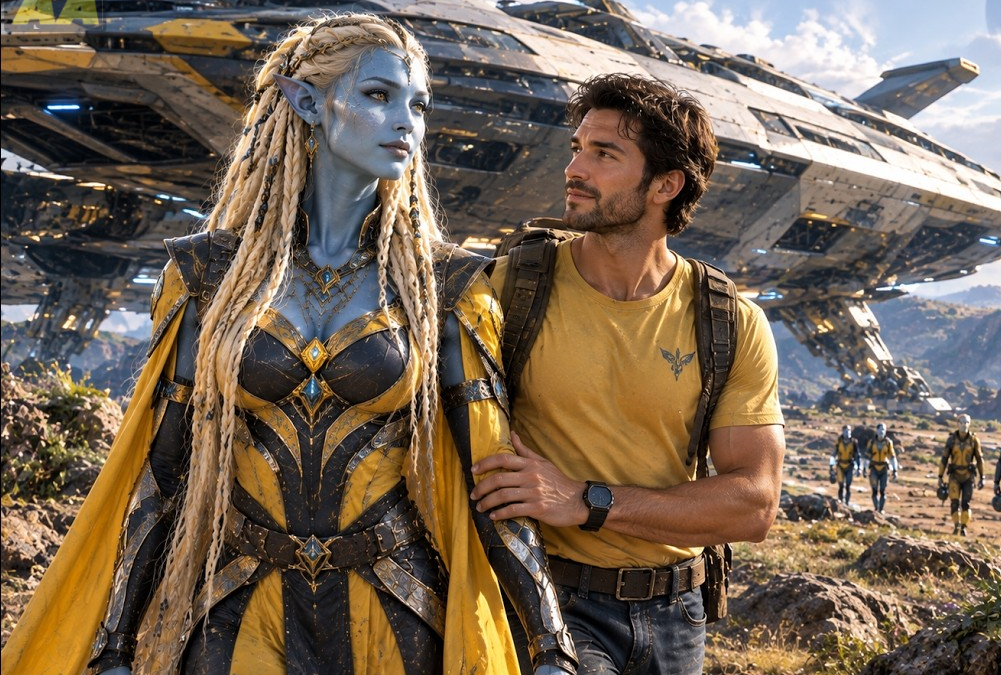
The alarm began the instant my fingers closed around hers. For half a second, there was only the cold of her skin beneath my palm and the strange stillness that always came whenever we touched.
Then the station sirens erupted, red lights flashed across the ceiling, and every guard in the audience hall raised a weapon.
Nobody moved. Nobody spoke. Every weapon pointed toward the doors. My hand remained locked around hers.
Her name was Vessa, ruler of the Vashkar, and across known space, touching her bare hand was considered something no sensible person would ever attempt.
Stories had traveled between worlds for generations. Diplomats had approached her with trembling fingers and never returned to their duties.
Officers had collapsed after ceremonial greetings. Even trained negotiators had been warned that one moment of contact could overwhelm everything inside them.
Yet Vessa was still holding my hand. And I was still standing. Six months earlier, I had been the least important translator on the station.
Now I stood beside the most feared ruler in the region while an emergency siren screamed above us and armed guards waited for an order.
Then a voice came through the wall speaker. Laura Bennett, our station commander, sounded calm.
Too calm. She announced that the cooling system on deck three had failed and that vapor from a damaged reactor line was moving through the lower corridors.
Vessa’s fingers tightened around mine. She looked directly into my eyes. “This was planned,” she whispered.
I believed her. But if she was right, who had arranged an attack that depended on everyone believing the Vashkar Queen could never be touched without disaster?
Six months earlier, I had not known Vessa existed. My name is Daniel Hart, and at the time I was a language processing specialist on a station that was important enough to appear on trade maps but not important enough for anyone to remember its name.
Most days were predictable. I translated shipping records. I processed requests from visiting delegations. I softened insults before they reached diplomats who were already irritated.
Occasionally, I helped resolve arguments between merchants who had discovered that their contracts had been translated differently by three separate computer systems.
It was not exciting work. I liked it. Nobody expected much from me, and that meant nobody watched me closely.
Then the request arrived. It was addressed to me personally. I assumed someone had made a mistake.
The request stated that I had been selected to serve as personal liaison to Queen Vessa of the Vashkar.
I read it twice. Then a third time. I went to my supervisor and asked whether the message was legitimate.
She looked at the screen. Then she looked at me. “I think so.” “You think so?”
“She specifically requested you.” That was the first thing about Vessa that frightened me. Not her reputation.
Not the stories. The fact that she had somehow noticed me. I had never met her.
I had never spoken with her. I had never even been inside the Vashkar diplomatic wing.
Yet she had requested me by name. The shuttle ride to her vessel lasted several hours.
I spent most of that time rehearsing polite ways to decline the assignment. None of them sounded convincing.
By the time I arrived, I had accepted that refusing was impossible. The Vashkar vessel was unlike anything I had seen.
Its interior was dark and elegant, built from curved materials that seemed almost organic. The walls were covered in narrow lines of silver light.
Nothing appeared unnecessary. Every object had a purpose. I was escorted into the audience chamber.
Vessa sat on a raised platform at the far end. She was taller than I expected.
Her clothing was formal but practical, layered with dark metallic plates that followed the shape of her body.
Her face was difficult to read at firSt. The Vashkar had subtle facial movements, and I had to concentrate to understand them.
Her guards stood behind her. They watched me carefully. I tried not to look nervous.
Vessa looked directly at me. “You are Daniel Hart.” “Yes.” “You are not afraid.” I almost laughed.
“I am terrified.” The chamber became silent. Vessa’s expression changed. It was a tiny movement around her mouth.
At the time, I thought she was confused. I later learned that it was the closest thing her face had to a smile.
“You admit it?” “I would rather not lie to a queen.” “You are afraid, yet you continue standing.”
“I have a job.” She studied me for several seconds. Then she said something that changed everything.
“You are the first person to tell me that.” I did not understand. Vessa explained that fear had followed her throughout her entire life.
The Vashkar possessed a biological response unlike that of most known species. Physical contact, especially contact with bare skin, could trigger an overwhelming reaction in another person’s nervous system.
But the Vashkar had misunderstood the mechanism for generations. It was not simply her touch.
It was the emotional state carried into the contact. Fear amplified itself. The more frightened someone became, the stronger the reaction became.
And because everyone approached Vessa already terrified by the stories surrounding her, the result had always been the same.
People touched her hand. Fear surged. The reaction intensified. And afterward, everyone assumed Vessa herself had caused it.
She had spent years watching people approach her with trembling hands. She had watched them become overwhelmed.
She had listened to entire civilizations describe her as dangerous. Yet nobody had asked the most obvious question.
What would happen if someone touched her without fear? I asked her. She stared at me.
“No one has tried.” “Would you like to know?” She did not answer. So I held out my hand.
The guards reacted immediately. Vessa did not move. For several seconds, we simply looked at each other.
Then she reached forward. Our hands touched. Nothing happened. There was no surge of pain.
No collapse. No panic. Only cold skin against warm skin. Vessa stared at our joined hands.
Then she looked at me. “You are still here.” “Yes.” “You are not afraid.” “I am.”
“But not of me.” “No.” That was six months ago. Since then, I had served as her liaison.
I translated meetings. I explained human customs. I helped her understand why humans sometimes smiled when uncomfortable.
She taught me that Vashkar silence did not always mean disagreement. Some days were difficult.
Others were surprisingly ordinary. Over time, we became comfortable around each other. Vessa discovered that I preferred quiet rooms.
I discovered that she disliked crowded ceremonies. She learned that I drank too much station coffee.
I learned that she secretly enjoyed old Earth music. Neither of us discussed the strange importance of the way we could touch without consequence.
We did not need to. Our friendship became its own quiet answer to a question the rest of the galaxy had never thought to ask.
Then the alarm sounded. The station changed instantly. The peaceful audience hall became a place of confusion.
Red emergency lights flashed. Guards moved into defensive positions. People shouted questions. The doors remained closed.
Vessa did not release my hand. Her attention shifted toward the nearest wall speaker. Laura Bennett’s voice came through.
“Cooling failure on deck three. Reactor vapor is spreading through the lower corridors. All nonessential personnel are to proceed to evacuation pods immediately.”
The announcement ended. Vessa looked at me. “Something is wrong.” “You mean the reactor?” “Yes.”
“How can you know?” “Because this station is too well maintained.” She looked toward the guards.
Then toward the doors. “A failure of this kind would produce warnings long before it became an emergency.”
I understood. “You think someone caused it?” “I think someone wants everyone to believe it was an accident.”
Before I could respond, the main doors opened. Victor Lang entered. I knew him. He was part of the human trade delegation.
He had never hidden his opinion of the Vashkar. He believed cooperation with them was dangerous.
He had told me once that humans were making a mistake by trusting a civilization he considered unpredictable.
Now he stood inside the audience hall wearing the deep blue coat of the trade delegation.
Two armed guards followed him. “The western passage is clear,” Lang announced. His voice was calm.
Too calm. “Everyone should proceed immediately.” Vessa looked at him. “How did you know the western passage was clear?”
Lang paused. Only for 1 second. That was enough. Vessa’s fingers tightened around mine. She whispered, “He knows too much.”
I looked toward the western passage. Something felt wrong. Not because I knew anything about security.
Because I had spent six months walking around this station while everyone else was busy.
I knew the corridors. I knew which doors were usually locked. I knew which passages smelled like machinery and which ones carried recycled air.
I knew that the western passage was the most direct route toward the evacuation pods.
That also meant it was predictable. If someone wanted to control where frightened people went, that was exactly where they would send them.
I pulled Vessa sideways. She followed instantly. We moved toward a narrow service door beside the audience chamber.
Lang shouted. His guards started forward. Vessa gave a sharp command. Her escort reacted immediately.
Weapons rose. The hall erupted into movement. I opened the service door. Dust fell from the frame.
Vessa stepped through beside me. We ran. The maintenance corridor was narrow and dark. Emergency lighting illuminated the walls in weak strips.
The sound of the alarm followed us. Vessa moved quickly. I had never seen her move like that.
For six months, I had known her as a ruler. She sat during meetings. She walked slowly during ceremonies.
She spoke carefully. Now she moved with complete confidence. She asked where the corridor led.
“The old cargo bay.” “Is it still in use?” “Not officially.” “Then someone may have prepared it.”
I stopped. She looked at me. “How do you know?” “I don’t.” “That is acceptable.”
“You are not worried?” “I am worried.” She continued walking. “I simply refuse to allow worry to make decisions for me.”
That sounded like something I might have said. I almost smiled. We reached a junction.
The corridor divided. I looked left. Then right. My memory failed me. I knew one path led toward the old cargo bay.
The other led toward the crew quarters. I could not remember which was which. Vessa placed her free hand against the wall.
She closed her eyes. “What are you doing?” “Listening.” “To what?” “The station.” She remained completely still.
After several seconds, she pointed left. “That way.” “How can you know?” “There is machinery running.”
“That could be anything.” “It is large machinery.” She opened her eyes. “And it is behind a sealed bulkhead.”
I followed her. The corridor opened into the old cargo bay. The room was enormous.
Crates were stacked along the walls. Old equipment sat beneath dust covers. Several overhead lights flickered.
And two men stood near the outer door controls. They turned when they saw us.
I immediately understood what they were doing. The outer doors were connected to the station’s emergency systems.
If someone opened them while the bay was unpressurized, everything inside would be pulled into open space.
It would look like an equipment failure. A tragic accident. No obvious connection to Victor Lang.
No witnesses. No proof. Vessa released my hand. The absence startled me. She moved forward.
One of the men reached toward the control panel. Vessa crossed the distance faster than I expected.
She struck the man’s arm away from the controls. The second man moved toward her.
I reacted without thinking. I caught his arm. He tried to pull away. I held on long enough for Vessa’s escort to enter the bay.
The guards surrounded the two men. Within seconds, both were secured. I stood there breathing hard.
Vessa turned toward me. “You are injured?” “No.” She examined me anyway. “I am fine.”
“You moved toward him.” “I noticed.” “You could have moved away.” “So could you.” For a moment, neither of us spoke.
Then Laura Bennett entered the cargo bay. She looked exhausted. Her eyes moved from the two captured men to the disabled controls.
Then to Vessa. Then to me. “What happened?” I explained. She listened without interrupting. When I finished, she looked at the control panel.
“Seal the bay.” The guards secured the area. Engineers arrived soon afterward. They discovered that the reactor problem had been deliberately triggered.
It had not been designed to cause a major station failure. It had been designed to create confusion.
Someone had wanted everyone out of the audience hall. Someone had wanted Vessa and me separated from her security.
Someone had wanted the two of us inside the old cargo bay. Victor Lang was arrested twenty minutes later.
He was attempting to reach a docking bay. Laura questioned him for hours. Eventually, he admitted what he had done.
He believed the alliance between humans and the Vashkar was dangerous. He believed that the old stories about Vessa proved she could never truly be trusted.
He had decided that if the alliance collapsed during a diplomatic incident, people would turn against the Vashkar again.
He had expected the station to become a symbol of betrayal. Instead, it became something completely different.
The investigation revealed that Lang had been studying every previous incident involving Vessa. He had collected reports.
He had studied witness statements. He had examined security recordings. But he had made one mistake.
He had never studied the people who approached her. He had only studied what happened afterward.
He saw fear. He saw panic. He saw the terrible consequences of fear. He assumed Vessa was the cause.
He never considered that fear itself might be the trigger. After the investigation, I returned to the audience hall.
The room looked completely different. The chairs had been moved. The guards stood along the walls.
The emergency lights had been replaced with normal illumination. Vessa stood beside the window. She looked toward the stars.
I approached. “You should reSt.” “So should you.” “I am not the queen.” “That does not make you immune to exhaustion.”
I smiled. She looked at me. “Daniel.” “Yes?” “When you held my hand today, were you afraid?”
I thought about it. “Yes.” She nodded. “But not of me.” “No.” She looked back toward the stars.
“I spent my entire life believing that fear was something other people placed upon me.”
“What do you mean?” “They approached me afraid.” She turned toward me. “I believed their fear was simply a natural response to my presence.”
“And now?” “Now I wonder how many of them would have behaved differently if someone had told them the truth.”
I did not know what to say. Vessa continued. “I have spent years being treated as though I were dangerous simply because everyone expected me to be.”
“You are not dangerous.” She gave me a quiet look. “That is not entirely true.”
I laughed softly. “You know what I mean.” “Yes.” She looked down at her hands.
“I have always wondered what it would feel like to touch another person without wondering what they were feeling.”
“You know now.” She looked at me. “Yes.” Six months ago, I had been a translator nobody remembered.
Now I was the person the Vashkar Queen trusted enough to hold her hand. The story spread quickly.
First across the station. Then through nearby trade routes. Then throughout the worlds connected to our diplomatic network.
People began calling it the Hand of Vessa. The story became larger with every retelling.
Some claimed I had been specially trained. Others claimed Earth had developed a secret resistance to Vashkar biology.
Neither was true. I was simply a man who had not known enough to be frightened by the wrong thing.
Eventually, diplomats began arriving to meet Vessa. Some still approached her cautiously. Others were openly curious.
One representative asked me whether it was really safe to touch her. I told him the truth.
“I do not know what you will feel.” He looked nervous. “What did you feel?”
“Cold fingers.” He stared at me. “That is all?” “That was all.” He looked toward Vessa.
She was waiting patiently. The representative approached. His hand trembled. He stopped. Vessa did not move.
She waited. The representative took a breath. Then he held out his hand. Vessa accepted it.
Nothing happened. The representative blinked. Vessa released him. He smiled. Not because he had discovered something extraordinary.
Because he had discovered that fear could sometimes be inherited without being deserved. After that, more people began trying.
Not everyone succeeded. Some were too frightened. Some withdrew at the last moment. Vessa never mocked them.
She simply waited. That was one of the things I admired most about her. She understood fear because she had spent her entire life surrounded by it.
She never demanded that anyone overcome it instantly. She simply gave them time. Months passed.
The diplomatic relationship between Earth and the Vashkar strengthened. Trade agreements expanded. Joint research projects began.
Human and Vashkar scientists studied their biological differences. Researchers eventually confirmed what Vessa had suspected.
The reaction was strongly influenced by emotional state. The old stories had never been completely false.
They had simply been misunderstood. That distinction changed everything. A biological reaction had become a legend.
The legend had become fear. Fear had become tradition. Tradition had become prejudice. And prejudice had nearly been used to destroy an alliance.
All because nobody had stopped to ask the simplest question. What if the story was wrong?
One morning, months after the incident, I entered Vessa’s audience chamber. She was already there.
The guards stood along the walls. The room was quiet. Vessa looked toward me. “You are late.”
“By two minutes.” “Two minutes is late.” “You sound like my supervisor.” “Your supervisor is wise.”
“She also thinks I drink too much coffee.” “She is correct.” I laughed. Vessa extended her hand.
I took it. The contact was familiar now. No alarm. No panic. No fear. Just the same cold skin I had noticed the first time.
Vessa looked at our hands. “Do you remember the first day?” “Yes.” “You were terrified.”
“I told you that.” “And yet you stayed.” “I had nowhere else to go.” She looked at me.
“That is not the answer I wanted.” I smiled. “Then ask again.” She was quiet for a moment.
“Why did you stay?” I considered the question. Because she was a queen. Because I was assigned to her.
Because refusing had never been an option. None of those answers felt right anymore. Finally, I said, “Because you looked lonely.”
Vessa became completely still. The guards did not move. The station continued operating beyond the chamber.
People walked through corridors. Ships arrived. Ships departed. The universe continued as if nothing had happened.
But Vessa looked at me with an expression I had never seen before. “You noticed?”
“Yes.” “How?” “You looked at everyone like you were waiting for them to leave.” She looked down.
“I was.” I squeezed her hand gently. “I stayed.” “Yes.” She looked up again. “That is why I chose you.”
I had never asked her why she had requested me. Now I finally understood. It had never been because I was the best translator.
I was not. It had never been because I was especially important. I was not.
She had chosen me because when she looked at me, she had seen someone afraid of the situation but not afraid of her.
There was a difference. A small difference. A difference that had changed both our lives.
Years from now, people would probably tell the story differently. They would make it grander.
They would turn me into a hero. They would turn Vessa into a mysterious queen who challenged an entire civilization.
They would describe the alarm, the cargo bay, the sabotage, and the moment two species finally understood one another.
But the truth was much simpler. A frightened man held the hand of a lonely queen.
Neither let go. And because neither did, thousands of people were given a chance to see one another differently.
That was all. Sometimes that was enough. I still serve as Vessa’s liaison. I still translate her meetings.
I still soften the occasional insult before it reaches the wrong diplomat. And every morning, before the formal work begins, Vessa offers me her hand.
I take it. Not because I have forgotten the stories. Not because I believe there is nothing to fear in the universe.
But because I have learned that fear should never be allowed to make every decision for us.
Vessa once believed that everyone who approached her would bring fear. Now she knows that some people bring truSt.
Some bring curiosity. Some bring uncertainty. And sometimes, if given enough time, they bring friendship.
The station still remembers what happened that day. The sealed cargo bay remains closed. Victor Lang’s name still appears in old security reports.
The diplomatic protocols were rewritten. The Vashkar biological research program continues. But the most important change cannot be recorded in any report.
It is visible whenever someone enters Vessa’s audience chamber and hesitates before approaching her. They look at her.
They look at me. Then they remember that the old stories were not the whole truth.
Sometimes they step forward. Sometimes they do not. Vessa never judges them. She simply waits.
And when someone finally reaches out without allowing fear to decide for them, she takes their hand.
The room always becomes quiet. Everyone watches. Everyone waits. And almost every time, nothing happens.
Just two hands meeting. Two people realizing that the thing they feared might never have been what they thought it was.
I used to believe my life would always be small. A translator. A quiet station.
Routine meetings. Routine arguments. Routine days. Then Vessa chose me. And I learned that sometimes the smallest person in a room can notice the one detail everyone else has missed.
Sometimes the least important person is the one who asks the question nobody else considered.
Sometimes peace begins with something as simple as refusing to be frightened by a story you have never tested yourself.
And sometimes, when the entire galaxy expects you to pull your hand away, the strongest thing you can do is simply hold on.
Disclaimer: This content may be created by Al for entertainment purposes. Any resemblance to real persons, events, or places is coincidental.








