Everyone Expected the Human Cadet to Run — Instead, She Opened Her Arms for the Charging Cub
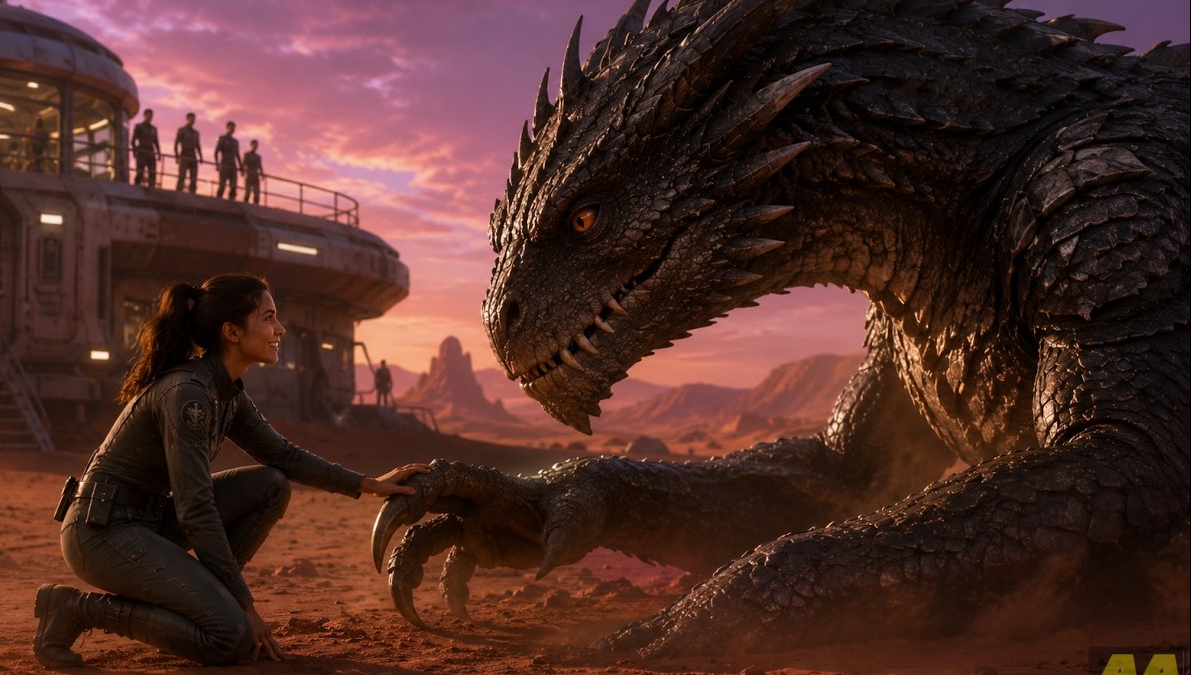
The scream reaches me before the warning siren does. One second, the training field is quiet beneath the pale afternoon sky.
The next, the ground seems to tremble under something moving faster than anything that size should be able to move.
I turn, and my stomach drops. Four hundred kilos of muscle is charging straight toward us.
Around me, eleven cadets from three different species scatter almost instantly. Someone shouts. Someone else draws a training baton.
Tall grass bends as another cadet disappears into it. Every lesson I have ever been taught tells me to do exactly what they are doing.
Run. Get distance. Do not become the closest target. But I cannot move. Not because I am brave.
Not because I am fearless. I am terrified. My name is Naomi Ashford, and I am the only human cadet still standing in the open.
The creature racing toward us is a young Vashtari, a species whose strength and instincts have made them one of the most carefully studied predators in the coalition.
We were supposed to observe them from a safe distance today. We were supposed to record their movements, study their communication, and return to the academy with a clean field report.
Instead, something has gone wrong. The young Vashtari has been separated from its pack, and now it is coming directly toward me.
Then I notice its ears. They are pinned flat against its head. And suddenly, I realize that everything I thought was happening may be completely wrong?
The first thing I notice after the ears is the tail. It is tucked beneath the young Vashtari so tightly that for a moment I almost cannot see it.
That matters. I know it matters because I have spent three weeks learning everything I could about this species.
Nobody assigned the research to me. Nobody told me to stay awake after curfew reading field reports or replaying observation recordings until I could recognize individual sounds without looking at the screen.
It started as curiosity. Then it became something I could not put down. The Vashtari were fascinating in a way that most academy subjects were not.
Their size made people focus on their physical power, but the more I studied them, the more I realized how much of their behavior depended on small movements.
An ear turned slightly backward. A tail held too stiffly. A change in breathing. A shift in weight.
Tiny details that could completely change the meaning of what the body was doing. Most cadets had learned the basic rule.
If a Vashtari approaches quickly, create distance. If it displays its teeth, move away. If it lowers its body, do not make sudden movements.
Simple. Safe. Useful. But simple rules had limits. Real animals did not read academy manuals.
They reacted to what they felt. And the young Vashtari charging across the field was not displaying the posture I had spent weeks studying in hunting footage.
Its ears were wrong for that. Its tail was wrong. Its breathing was wrong. And most importantly, the sound coming from its throat was wrong.
A hunting call would have been lower. Controlled. Focused. This sound was high and uneven, breaking apart between breaths.
I had heard it before. Not in person. On a recording. A Vashtari separated from its pack.
A frightened young one searching for the largest living presence it could find. I remember sitting alone at my desk when I first heard that recording, replaying it several times because I could not believe what I was hearing.
The sound had not been aggressive. It had been desperate. The young Vashtari had not been calling for prey.
It had been calling for its pack. And now that same sound is coming toward me.
“Naomi, move!” Callum’s voice snaps through the air. I look sideways. The Kryon cadet is already several meters away, his training baton held in both hands.
His stance is perfect. Feet positioned correctly. Shoulders lowered. Eyes fixed on the charging creature.
He looks like every instructor would want a cadet to look during an unexpected field encounter.
Then he shouts again. “Naomi, get back!” I should. Every part of me agrees with him.
My legs want to move. My lungs are pulling air too quickly. My hands are cold.
My heart is pounding so hard that the sound seems louder than the Vashtari’s footsteps.
But the creature is getting closer. Twenty meters. Fifteen. Ten. I can see its eyes now.
They are wide. Not focused. Not calculating. Searching. It is looking at me the way a frightened child might look at the first familiar shape appearing through a storm.
I take one step forward. Callum shouts something I cannot understand. I take another. Then I stop trying to convince myself that I am not afraid.
I am afraid. I am extremely afraid. But fear is telling me to run because the creature is large.
My research is telling me something else. The difference matters. I lower my hands. I do not raise them.
I do not stare directly into its eyes. I do not turn my back. I simply open my arms.
The Vashtari reaches me. For one strange instant, I think it is going to strike me.
Instead, the entire creature seems to fold. Four hundred kilos of speed suddenly becomes four hundred kilos of trembling weight.
Its head drops against my cheSt. Its front legs buckle. My knees hit the ground.
The impact knocks the air from my lungs, but my arms close around its neck before I can think about whether I should.
The fur beneath my hands is warm. Its breathing is wild. Its heart is beating so fast that I cannot separate one beat from the next.
The creature makes another sound. This one is quieter. Broken. Almost like a long breath finally escaping after being held too long.
I freeze. So does it. For several seconds, neither of us moves. I can feel its shoulders shaking.
I keep my arms loose. Not restraining it. Not pulling it closer. Just letting them rest around it.
Somewhere behind me, I hear Callum say my name. Nobody approaches. Nobody needs to. The entire field has gone silent.
I close my eyes for half a second. “It’s all right,” I whisper. I do not know whether it understands the words.
Probably not. But my voice seems to matter. Its breathing begins to slow. One breath.
Then another. Then another. The trembling becomes less violent. The creature shifts its head slightly against my shoulder.
I feel its ear move. Not forward. Not backward. Just listening. Then the ground begins to shake again.
This time, I know exactly what it means. The pack is coming. I open my eyes.
Three adult Vashtari break through the tree line. They move with astonishing speed. The first is enormous, easily larger than the young one pressed against me.
The second follows several meters behind. The third stays slightly to the side, watching everything.
I stop breathing. The lead adult reaches us and slides to a halt. Dust rises around her feet.
For a moment, she is so close that I can see every detail of her face.
Every muscle in my body wants to move. I force myself to stay still. The young Vashtari does not.
It lifts its head. The adult looks at it. Then she looks at me. Our eyes meet.
I remember the research. Do not challenge. Do not stare aggressively. Do not make yourself appear larger.
Keep your posture calm. Show that you are not attempting to control the young one.
So I lower my gaze slightly. My hands remain open against the young Vashtari’s shoulders.
The adult makes a low sound. I feel it more than hear it. The young one responds immediately.
It turns toward her. For a second, I wonder whether it will leave. Then it looks back at me.
Its eyes meet mine. I do not move. It steps away. One shaky step. Then another.
The adult lowers her head toward it. The young Vashtari presses against her side. The second adult approaches.
Then the third. Within seconds, the entire group is together again. The lead adult looks at me one last time.
Then the pack disappears into the tree line. I remain on the ground. My arms are still around nothing.
My hands are shaking. My breathing is uneven. I look at the empty space where the young Vashtari stood and realize that nobody has spoken.
Then a drone settles onto the grass beside me. Instructor Halverson steps out from behind it.
He does not say anything. He simply looks at me. Then at the tree line.
Then at the drone. He kneels and begins replaying the footage. The first replay moves quickly.
The young Vashtari crossing the field. The cadets scattering. Callum raising his baton. Priya running toward the trees.
Draca disappearing into the grass. Me standing alone. Then stepping forward. Halverson slows the recording.
We watch again. The young Vashtari approaches. I open my arms. It lowers its head.
I go down. The creature settles against me. Halverson pauses the recording. Nobody speaks. More cadets begin gathering around the drone.
Priya arrives firSt. Her face is still pale. She looks at the paused image on the screen, then at me.
“I thought you had completely lost your mind.” I give a weak laugh. “So did I.”
Callum approaches next. He looks at the screen for several seconds. Then he looks at me.
“Did you know what it was doing?” “I had an idea.” “An idea?” “I wasn’t certain.”
He studies me. “You stepped toward four hundred kilos of frightened muscle without being certain?”
I glance at the screen. “I was more certain about what it wasn’t doing.” Callum’s expression changes.
“What do you mean?” “The ears.” He looks confused. “The ears?” “They were pinned back.
Its tail was tucked. The breathing was uneven. And the call wasn’t a hunting call.”
Callum lowers his baton. “You noticed all that while it was charging?” “I noticed the ears firSt.”
Draca emerges from the grass behind him. There is still dirt along one side of her uniform.
She looks from me to the drone. Then she asks the question everyone else seems to be thinking.
“Why did you move toward it?” I look at her. I want to give her an impressive answer.
Something about courage. Something about instinct. Something that makes the whole thing sound intentional. But none of that would be true.
“I don’t know.” She blinks. “You don’t know?” “I was scared.” “Then why did you move forward?”
I look down at my hands. They are still trembling. “Because it looked scared too.”
Nobody says anything for several seconds. Halverson finally speaks. “That distinction is precisely why this incident matters.”
We all turn toward him. He shuts off the drone. “Every cadet on this field made a reasonable decision.”
He looks at Callum. “Creating distance.” Then Priya. “Seeking cover.” Then Draca. “Reducing visibility.” Finally, he looks at me.
“And you made a different decision.” I expect criticism. Instead, he continues. “You did not ignore the danger.
You interpreted it differently.” I say nothing. He folds his arms. “Those are not the same thing.”
That sentence stays with me. Later that evening, I sit beside the observation window in the shared quarters.
The academy lights stretch across the grounds below. The training field is almost invisible from here.
Priya sits opposite me. She has brought two cups of something warm from the dining hall.
She places one in front of me. “You’re still thinking about it.” “I keep replaying the moment.”
“Me too.” She sits back. “When I saw that thing coming, I didn’t think. I just ran.”
“You weren’t wrong.” “I know.” She looks toward the window. “But when I watched the footage later, I realized I never actually looked at it.”
I turn toward her. “What do you mean?” “I saw a large animal moving toward us and my brain filled in everything else.”
She pauses. “I didn’t see the ears.” I think about that. “Most of us didn’t.”
“You did.” “I had studied them.” Priya smiles faintly. “You really did spend three weeks reading about Vashtari behavior?”
“Four, technically.” “Four?” “I kept finding more material.” She laughs. “That is possibly the most Naomi answer you could have given.”
I smile. Then she becomes serious again. “Were you afraid?” “Yes.” “Really afraid?” “Yes.” She looks surprised.
“I thought maybe you knew it would work.” “I didn’t.” “Not even a little?” “No.”
I wrap my hands around the cup. “I thought I might be making the worst decision of my life.”
Priya studies me. “Then why did you do it?” I think about the young Vashtari’s face.
The pinned ears. The tucked tail. The shaking body. The sound. “I think because I had already spent weeks learning what fear looked like in that species.”
I look out the window. “And once I recognized it, I couldn’t pretend I hadn’t.”
The next morning, the academy feels different. People look at me when I walk through the corridors.
Not everyone. But enough. Some cadets whisper. Others smile. A few ask about the encounter.
I answer the same way every time. “I saw the ears.” By midday, the footage is being reviewed by instructors from several training groups.
Halverson does not let me watch all of those sessions. Instead, he calls me into his office.
There are two senior officers waiting. I recognize neither. One is a Sevein woman with pale gray eyes.
The other is a broad shouldered coalition officer wearing the academy command insignia. They ask me to sit.
The Sevein woman opens a file. “Naomi Ashford, we would like you to describe the encounter from the beginning.”
I do. No footage. No prompts. Just my memory. I tell them about the scream.
The charging movement. The other cadets retreating. The ears. The tail. The breathing. The call.
The moment I stepped forward. The impact. The pack returning. The Sevein woman listens without interrupting.
When I finish, she asks, “How certain were you that the creature was frightened?” “I wasn’t completely certain.”
She writes something down. “How certain were you that approaching it was safe?” “I wasn’t.”
The second officer looks up. “Then why approach?” “Because doing nothing also had risks.” He studies me.
“Explain.” “If it was frightened, continued pursuit would probably make it more desperate. If I ran, I might encourage it to keep following.
If everyone scattered in different directions, it might become more confused.” I stop. “I thought being still might give it something predictable to focus on.”
The Sevein woman nods slowly. “You chose to become predictable.” “I suppose.” She looks at the file.
“Would you make the same choice again?” I hesitate. “I would look again.” She raises an eyebrow.
“That was not the question.” “I know.” I take a breath. “If I saw the same signals, I would consider the same response.”
She nods. This time, she writes nothing. When the officers leave, Halverson remains behind. He waits until the door closes.
“You handled that well.” “I wasn’t sure what they wanted.” “They weren’t looking for certainty.”
I look at him. “Why not?” “Because certainty can be dangerous.” He walks toward the observation window.
“You were paying attention. That is different.” I follow him with my eyes. He continues.
“You didn’t decide that the creature was harmless. You didn’t decide that it was dangerous.
You kept watching long enough to determine what kind of situation you were facing.” I think about that.
“I nearly ran.” “Of course you did.” He looks at me. “Fear is information too.”
That sentence follows me for days. The official report is released three days later. I read it twice.
The language is careful. It describes the incident as an unexpected behavioral deviation during a standard observation exercise.
It notes that the young Vashtari displayed several indicators associated with distress. It records that I responded without physical restraint and that the pack subsequently recovered the separated member without further escalation.
There is no dramatic language. No heroic description. No suggestion that I intended to do something extraordinary.
Just observations. Facts. Yet one sentence catches my attention. The report recommends additional research into human responses during cross species behavioral encounters, particularly the role of empathy, patience, and close observation in rapidly changing situations.
I read that sentence several times. Empathy. The word has never sounded particularly important to me before.
At the academy, we talk about it as a social quality. Useful. Necessary. Sometimes difficult.
But rarely treated as a field skill. Now I begin to wonder whether that was a mistake.
Weeks pass. Training continues. We study navigation. Communication. Environmental survival. Species recognition. Emergency response. Every subject feels slightly different now.
When an instructor shows us a behavioral recording, I watch the smallest details. An ear.
A hand. A tail. A shift in posture. A pause before movement. Sometimes I see things before the instructor points them out.
Sometimes I am wrong. Halverson reminds me that being wrong is part of learning. “You are not trying to become someone who always understands the situation,” he tells me during one afternoon session.
“You are trying to become someone who keeps looking when the first explanation stops making sense.”
I remember that. I write it down. Then I underline it twice. A few weeks after the incident, another training group visits our academy.
One of their instructors asks Halverson about the Vashtari encounter. He tells them I was there.
Suddenly I am standing in front of a room full of cadets explaining ear positions.
I show them how the same body can communicate completely different things depending on the small movements happening around it.
One cadet asks whether I think humans are naturally better at reading emotions than other species.
I shake my head. “No.” The room becomes quiet. “I think every species has things it notices more easily than others.”
I pause. “Humans aren’t automatically better. We just have our own way of paying attention.”
The cadet nods. Another raises a hand. “Then what did you do differently?” I think about the field.
“I was lucky enough to recognize something I had studied.” That answer seems to disappoint them.
So I add something. “And I was willing to admit that my first instinct might not have been enough.”
Nobody speaks for a moment. Then Halverson smiles. It is barely noticeable. But I see it.
Later that day, I return to the field alone. The grass has already recovered. There are no marks left from the encounter.
No evidence that anything unusual happened there. I stand at the same place where I had been when the young Vashtari came toward me.
I remember the sound. The fear. The impact. The warmth of its fur. The rhythm of its breathing changing beneath my hands.
I close my eyes. For a moment, I can almost hear that broken call again.
Then I open them. The field is quiet. I realize something that I had not understood on that first afternoon.
I had always thought courage meant moving toward something frightening. Maybe sometimes it does. But that is not what happened to me.
I did not move forward because I wanted to prove I was brave. I moved because I stopped seeing the creature as a shape rushing toward me.
I saw what was underneath the movement. Fear. Confusion. A search for safety. And once I saw that, the situation changed.
Not because the creature became smaller. Not because the danger disappeared. Because I understood what I was looking at.
A month after the incident, Halverson gives our class another observation exercise. This time, the assignment is simple.
Watch. Do not interfere. Record behavior. We stand behind a reinforced observation barrier while a group of Vashtari moves across a distant field.
The young ones stay close to the adults. I recognize some of the movements now.
An ear turns. A tail shifts. One young Vashtari pauses and looks toward us. I smile without realizing it.
Callum notices. “You’re smiling at them.” “Maybe.” “You still like them after what happened?” I glance at him.
“I never stopped.” He laughs. “I don’t think I will ever understand you.” I look back toward the field.
“You don’t have to.” The Vashtari group moves farther away. The young one disappears behind an adult.
I watch until I can no longer see it. Then I return to my notes.
That afternoon, our class finishes the exercise without incident. But as we walk back toward the academy, Priya falls into step beside me.
“I’ve been thinking.” “That sounds dangerous.” She laughs. “About the field.” “Again?” “Yes.” She looks ahead.
“I think I understand something now.” “What?” “You didn’t choose between fear and courage.” I wait.
“You chose what to pay attention to.” I smile. “That sounds like something Halverson would say.”
“Probably.” We walk in silence for several seconds. Then she looks at me. “Do you think that’s why humans are difficult for the coalition to understand?”
I consider the question. “I think every species is difficult to understand until someone takes the time to look closely.”
Priya nods. “That sounds like another Halverson answer.” “Maybe I’ve been listening.” She smiles. “So what happens if you see another four hundred kilo animal charging toward you?”
I glance at her. “I look at its ears.” She laughs. I laugh too. But underneath the humor is something I know I will carry for a long time.
The lesson was never that large creatures are harmless. It was never that instinct should be ignored.
It was never that fear is something to overcome. Fear can warn us. Fear can protect us.
Fear can tell us to stop. But fear is only one piece of information. The rest comes from paying attention.
From learning. From remembering. From being willing to question the first answer your mind gives you.
The young Vashtari taught me that without saying a single word. It taught me that sometimes a charging body is not asking you to fight.
Sometimes it is asking you to understand. Sometimes what looks like aggression is confusion. Sometimes what looks like strength is simply panic wrapped in muscle.
And sometimes the difference between those things is hidden in something as small as the position of an ear.
I still think about that afternoon whenever I enter a training field. I remember the moment when everyone else ran.
I remember wanting to run with them. I remember stepping forward anyway. Not because I knew everything.
Not because I was fearless. Because I had learned enough to stop and look again.
That is the lesson I carry with me now. Not that humans are better. Not that instinct is wrong.
Not that courage means standing in front of danger. It is much simpler than that.
When something frightening comes toward you, take one more moment to understand what you are seeing.
Listen before you decide. Look before you react. And if the thing in front of you is not asking for a fight, perhaps the strongest response is not to raise your hands at all.
Perhaps sometimes the right answer is simply to remain still, open your arms, and give something frightened a place where it can finally stop running.
Disclaimer: This content may be created by Al for entertainment purposes. Any resemblance to real persons, events, or places is coincidental.








