Everyone Called Him a Worthless Mutt—Years Later, Ranchers Begged for His Puppies
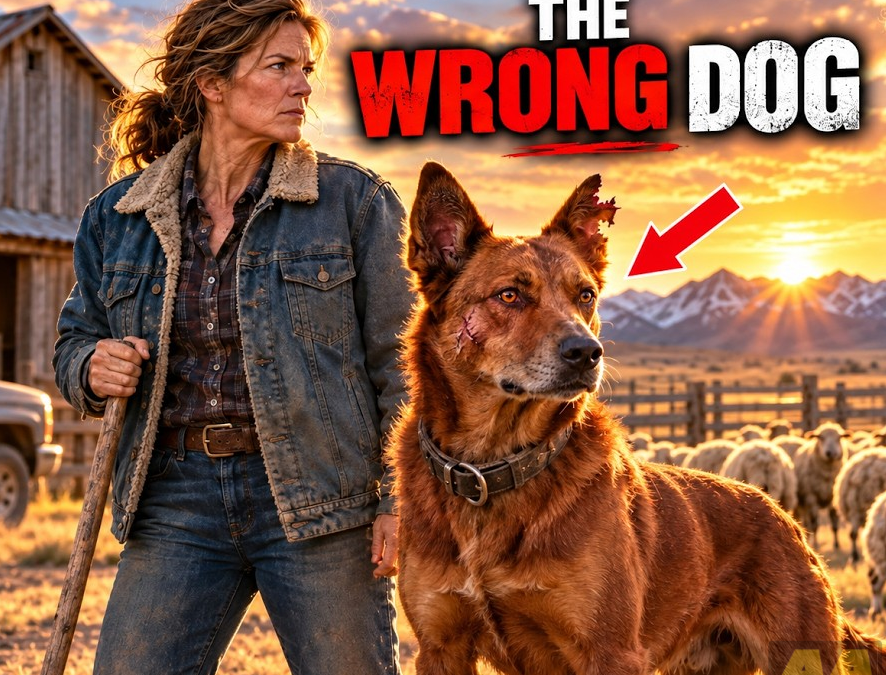
The contract said Maggie Cole was receiving a champion. What stepped out of the wooden shipping crate looked like something the world had already given up on.
It was October of 1987, and Maggie had borrowed the last $3,600 she could put against Cole Sheep Ranch for a 30 day breeding lease on Glenrock Royal Ace, a nationally titled Border Collie stud from Nebraska.
Ace was supposed to be black and white, beautifully marked, registered, photographed in magazines, and famous for moving sheep with almost no visible command from his handler.
The dog in front of her was red. Not handsome copper red, either. His coat was the color of rusted machinery abandoned behind a barn.
One ear stood straight. The other had been torn halfway down and healed crooked. A pale scar crossed from the corner of his left eye toward the top of his muzzle, and when he looked at Maggie, every tooth seemed to say that nobody should come closer.
The freight driver stayed ten feet away from the crate. “You Maggie Cole?” “That depends,” she said.
“Are you about to tell me that is Glenrock Royal Ace?” The driver looked at the dog and laughed under his breath.
“Lady, I do not know what that thing is, but if it is a champion, I am the governor of Wyoming.”
The dog struck the crate door again. The wooden frame jumped. Maggie did not. Behind her stretched 840 acres of dry Wyoming grass, and the November wind rattled the sheet metal on the lamming shed.
The ranch had never looked so large or so empty. Maggie had a choice to make, but what if the wrong dog had just arrived with the right answer?
Maggie kept looking at the dog. The driver crouched beside the crate but did not get close enough to touch it.
A grease stained tag was wired to the handle. There was a kennel number, a faded destination, and three red stamped words.
Unclaimed working stock. “What does that mean?” Maggie asked. The driver rubbed his jaw. “It means he was not supposed to be here.”
“That much I figured out.” “No, ma’am. I mean he was not headed anywhere good.”
Maggie looked through the gaps in the wood. The dog stood perfectly still now. The driver continued.
“Some outfit in western Kansas shut down. Dogs were split up. Good ones sold. Others went through holding kennels.
That red one has been transferred three times in two months.” “What breed?” “Paper says Australian Kelpie.
Maybe pure, maybe not. No registration.” The dog suddenly slammed against the door again. The driver stepped back.
“There is also a bite history.” Maggie looked at the tag. “Two incidents?” “That is what the paperwork says.
One handler needed twelve stitches. Another got bitten through a leather glove.” “Where was he going?”
The driver hesitated. “County shelter outside Casper.” Maggie understood what that meant without asking for the reSt.
She looked at the red dog again. His eyes were dark and sharp. He was not running around wildly.
He was watching her. That difference mattered. Maggie had spent most of her adult life around sheep and working dogs.
She knew what panic looked like. She knew what fear looked like. This was neither.
This dog was calculating. “Help me get the crate into the machine shed.” The driver shook his head.
“I will move the crate. I am not touching the dog.” “Fine.” Twenty minutes later, the wooden crate sat behind six foot livestock panels inside the old machine shed.
Maggie went into the farmhouse and called Nebraska. The first time she reached a secretary.
The second time she got Howard Bell, owner of Glenrock Kennels. Howard sounded irritated before Maggie finished explaining.
“Yes, there was a transfer problem,” he said. “Where is Ace?” “On a southbound freight run out of Cheyenne.”
“Southbound where?” “Colorado.” “You sent my dog to Colorado.” “Maggie, I did not personally load the crates.”
“You personally took my money.” Howard sighed. “I am trying to fix it.” Maggie looked toward the machine shed.
The red dog was pacing behind the panels. Back and forth. Back and forth. He never looked away from the house.
“When can Ace be here?” “Ten days. Maybe twelve.” Maggie went quiet. “June started her heat three days ago.”
“I understand.” “No, Howard. Tess will be right behind her. I have a breeding window.
I do not have twelve days.” “I can refund the unused portion of the lease.”
“That does not give me another year.” There was silence. Howard lowered his voice. “I am sorry about Ry.
I really am. But I cannot change biology.” Maggie looked at the stack of bank notices beside Ry’s old coffee mug.
The red final notice stamp had become part of the kitchen. Her operating loan was ninety days behind.
She needed $11,400 by April 15th, 1988, or Mountain Plains Bank could begin foreclosure proceedings.
Royal Ace was supposed to solve the problem. Maggie owned two excellent working Border Collie females, June and Tess.
Both were registered. Both came from proven ranch lines. Ranchers in Wyoming, Montana, and Colorado had already reserved puppies from Ace at $850 each.
If both females produced average litters, Maggie expected fourteen to sixteen pups. That money could catch up the loan.
It could keep the ranch open. It could buy time. Instead, Ace was somewhere in Colorado and a scarred red Kelpie was pacing in her machine shed.
“What am I supposed to do with the Kelpie?” Maggie asked. “Keep him contained until transport comes.”
“He is dangerous.” “I heard.” “You heard?” “That dog has a reputation.” “What reputation?” Howard hesitated.
“He was worked too hard when he was young. Cattle operation in Texas, I think.
Then he changed owners. Got rougher every time he moved.” “Meaning?” “Do not reach for his collar.”
Maggie looked through the window. The dog had stopped pacing. He was looking directly at her.
Howard continued. “The shelter was going to make the decision on him. Just feed him until transport comes.”
The decision. Maggie had heard people use gentle words when the truth was unpleasant. She hung up.
That afternoon, she carried a stainless steel bowl of food into the machine shed. The red Kelpie charged the panels.
Maggie stopped outside them. He struck the wire with both front feet, snarling. “All right,” she said.
“That is your opinion.” She put the bowl down. Then she sat ten feet away on an overturned bucket.
The dog stared at her. Maggie stared back. Ry used to say a stock dog could read a person faster than a banker could read a balance sheet.
He believed nervous people made nervous dogs, angry people made defensive dogs, and animals noticed when a person’s body told a different story than their voice.
Maggie was not nervous. She was tired. She was not angry at the dog. She was angry at the tractor, angry at the bank, angry at winter, angry at herself for still waking at two in the morning expecting to hear Ry’s boots in the hallway.
The dog gave a low growl. Maggie leaned back against the wall. “You and me both.”
For two days, that was their relationship. Food. Water. Distance. The Kelpie would not eat while she remained in the shed.
He waited until she left. He slept against the far wall with one eye open.
If Maggie moved too quickly, he snapped. If she reached toward the gate latch, he rushed it.
But Maggie noticed something. He never wasted movement. Most frightened dogs ran in circles. This one did not.
He watched. He measured. He anticipated. On the third morning, one of Maggie’s yearlings slipped through a broken section of fence behind the machine shed.
Maggie was carrying a roll of wire when she heard the panels rattle. She looked inside.
The Kelpie had changed. The growling was gone. His body was low. His head was slightly forward.
His eyes were fixed through the open shed door on the yearling trotting across the yard.
The sheep turned left. The dog shifted left. The sheep stopped. The dog froze. He was not chasing it.
He was reading it. Maggie lowered the wire. “You see her, do you?” One crooked ear flicked toward Maggie, but his eyes never left the sheep.
That afternoon, Maggie moved three calm yearlings into the small training lot behind the barn.
The Kelpie watched through two layers of fencing. At first, nothing happened. Then one sheep broke away.
The dog moved. Three steps. That was all. The sheep changed direction. Maggie felt something tighten in her cheSt.
She had spent most of her adult life around working dogs. She knew the difference between excitement and instinct.
Excitement was noise. Instinct was geometry. This dog understood angles, pressure, escape routes. He was calculating where the sheep would be before they arrived there.
That night, Maggie called dr. Walter Price. Walter had been the Cole family veterinarian since 1971.
He was sixty two, drove a Ford pickup with more rust than paint, and had the bedside manner of a fence poSt.
When he stepped into the machine shed and saw the red Kelpie, he stopped. “That the dangerous dog?”
“That is what everybody calls him.” Walter studied the animal. “That usually means there is a reason.”
“I need you to examine him.” “For what?” “Everything.” Walter frowned. “And I want a fertility check.”
He stared at her. “No.” “Walter.” “No, Maggie.” “I am paying you.” “You are also grieving, sleep deprived, and about two bad decisions away from losing this ranch.”
“I know.” “You paid for one of the best Border Collie studs in the country.”
“I know.” “And you are considering breeding your females to this?” Maggie looked at the dog.
“You watched him move?” “No.” “I have.” Walter sighed. “He does not have papers.” “I know.”
“You do not know his pedigree.” “I know.” “You will not get premium puppy prices.”
“I know.” “Then what exactly do you know?” Maggie looked toward the sheep. “I know he can see stock.”
Walter said nothing. “I know he reads pressure faster than June. I know he does not waste movement.
I know his feet are tight. His hips look clean. And after everything somebody did to him, he still wants to work.”
Walter looked at the Kelpie. “That is not a business plan.” “My current business plan is waiting for a dog in Colorado while my breeding window closes.”
Walter rubbed his forehead. “The bank called me yesterday.” Maggie looked up. “They called you?”
“They wanted to know whether your flock was current on health work before updating the livestock valuation.”
“How bad?” “Eleven thousand four hundred by April?” “Yes.” Walter nodded. He understood. “Get me a muzzle.”
“I do not think he will take one.” “Then you had better be right about him.”
The examination took forty five minutes. The Kelpie trembled when Walter touched his neck. He growled when the veterinarian lifted his tail.
But he never bit. Maggie stayed beside him without forcing him down. Whenever the dog stiffened, she backed the pressure off.
Then she tried again. At the end, Walter stood and brushed straw from his knees.
“Well?” Maggie asked. Walter looked annoyed. Maggie knew that expression. It meant the answer had surprised him.
“He looks sound.” She waited. “Lungs clear. Teeth suggest maybe four years old. Hips feel excellent.
No obvious defects I can identify without radiographs.” Walter took off his glasses. “Fertility looks normal.”
Maggie nodded. Walter pointed at her. “That is not me telling you to do this.”
“I know.” “I know those pups will not be registered Border Collies.” “I know.” “People may not buy them.”
“I know.” “And that dog could still decide he hates you tomorrow.” Maggie looked at the Kelpie.
He was watching the sheep through the open barn door. “What would you do?” Walter shook his head.
“I would wait for Ace.” “That was not my question.” The old veterinarian looked at the dog for a long moment.
Finally he said, “If I owned twelve hundred sheep instead of a clinic, I would want to know what that dog could produce.”
Maggie called Howard Bell that afternoon. “I found Ace,” Howard said immediately. “I can have him there Tuesday.”
“Do not.” Silence. “What?” “Send him home.” “Maggie, you paid for thirty days.” “Keep the money.”
“Are you serious?” “Yes.” “You are breeding those females to that Kelpie?” “I am.” Howard laughed once.
It was not amusement. It was disbelief. “You will destroy the value of those females.”
“They work for a living, Howard. They are not paintings.” “You could sell registered Ace pups for eight hundred dollars.”
“If Ace were here, he would be.” “He will be.” “Too late.” Howard’s voice hardened.
“That red dog was headed to a county shelter for a reason.” Maggie looked outside.
The Kelpie stood beside June on opposite sides of a fence. No barking. No lunging.
Only quiet attention. “What is his name?” Maggie asked. “What?” “The Kelpie.” Howard paused. “I do not know.”
“Nothing on the paperwork?” “Just kennel number K19.” Maggie looked at the dog’s scarred face.
“That is not a name.” Howard sighed. “You are risking your ranch.” Maggie gave a tired smile.
“No. The ranch is already at risk.” She hung up. That evening, she walked into the barn carrying a bowl of food.
The Kelpie came to the gate. He did not charge. He simply waited. Maggie opened it.
“You need a name.” The dog stared at her. Ry used to keep a coffee can full of old fencing staples on his workbench.
Bent pieces of steel he refused to throw away because, according to him, anything that survived forty Wyoming winters had earned the right to stay.
Maggie looked at the scar along the dog’s muzzle. RuSt. The crooked ear lifted. “Yeah,” she said.
“That will do.” The breedings were almost boring. Maggie had expected trouble. There was none.
Rust was cautious around June and even more cautious around Tess. There was no frantic behavior.
No aggression. He listened when Maggie called him off. By the second week, he was sleeping inside the mudroom.
He still did not like strangers. He still ducked when someone raised a hand too quickly.
He still woke instantly when he heard boots. But with Maggie, something had changed. He followed her.
Not underfoot. Always ten or fifteen feet behind. Watching. By December, winter covered the ranch in hard white cruSt.
Temperatures fell below zero nine nights that month. Maggie burned through 184 tons of hay faster than expected.
The bank called every Monday. She stopped answering. Rust began working. At first, Maggie used him only in small pens.
Five sheep. Then twenty. Then fifty. He did not work like June. June gathered from a wide distance, smooth and elegant.
Rust came closer. Quieter. Harder. When a sheep challenged him, he did not panic. He did not rush blindly.
He stepped into its space until moving became easier than standing against him. By February 1988, Maggie trusted him with two hundred sheep.
By March, she trusted him with the entire flock. June delivered seven puppies on January 28th.
Tess delivered eight on February 11th. Fifteen puppies. Nine red. Six black. None eligible for Border Collie registration.
Three buyers canceled as soon as Maggie explained the sire. Two more demanded their deposits back.
By the time the puppies were eight weeks old, Maggie had sold only four. Two hundred dollars each.
Eight hundred dollars. Her April bank payment was still more than ten thousand short. Walter came to vaccinate the puppies.
He stood in the yard watching a nine week old red female crouch behind a group of bottle lambs.
Nobody had taught her to work. A lamb stepped away. The puppy moved left. The lamb returned.
Walter slowly removed his cigar from his mouth. “Maggie, I see it.” “That is ridiculous.”
The puppy dropped lower. Another lamb shifted. The puppy adjusted. Walter looked toward RuSt. The old red dog was lying under the pickup, watching.
“That one has him in her,” Walter said. Maggie nodded. She named the puppy Ember.
Instead of selling the remaining pups cheaply, Maggie kept them. It made little financial sense.
So she trained them. Every morning before feeding. Every evening after dark. By six months, four could move small groups of sheep.
By eight months, two were working full days. In November 1988, a rancher from Laramie paid Maggie $1,800 for a started red male.
In January 1989, another ranch bought two littermates for $4,200. By summer, people had stopped calling them mongrels.
They called them cold dogs. The bank got its money barely. The ranch survived 1988.
That was different from being secure. Then, in the spring of 1990, a letter arrived from the Wyoming Stockman’s Association.
The annual working stock challenge in Casper had added an open ranch division. There was no pedigree requirement.
No registration requirement. Just work. Handlers would have eight minutes to gather thirty sheep from a 400 yard pasture, bring them through two gates, separate five marked sheep, load those five into a stock trailer, then return the remaining flock to a holding pen.
Points would be based on time, control, livestock pressure, and handler assistance. Maggie read the rules twice.
Then she looked across the yard. Ember was two years old. She had Rust’s red coat, June’s white chest, and a mind that made experienced ranchers stop talking when they watched her work.
Maggie entered. The competition took place September 22nd, 1990. Three years after Rust had arrived in a wooden crate with a bite warning tied to the handle.
The fairgrounds were packed. Pickup trucks filled the dirt parking area. Horse trailers lined the fence.
Thirty seven dogs were entered in the ranch division. Most were registered Border Collies. A few were Australian Shepherds.
Two were heelers. Ember was listed simply as Cole’s Ember, Border Collie Kelpie cross grade.
Maggie stood near the holding pens with Rust lying beside her. He was grayer around the muzzle now.
Still scarred. Still suspicious of strangers. But calm. Across the field, a man in a clean tan jacket walked toward her.
Howard Bell. Maggie recognized him from magazine advertisements before he introduced himself. He looked at Ember.
“So that is one of them.” “That is one.” Howard nodded toward RuSt. “And that is the red dog.”
“His name is RuSt.” Howard studied him. “He looks better than he did in those kennel reports.”
“He had a rough couple of years.” “I heard you are selling trained dogs for three thousand now.”
“Some.” Howard looked toward the field. “Depends what the dog can do.” Royal Ace was there too.
Older now. Still beautiful. Still famous. One of his sons, Glenrock Aces Banner, was entered in the same division.
Banner was everything a working dog advertisement was supposed to show. Perfect black and white markings.
Long coat. Clean white blaze. Registered parents on both sides. The announcer spent nearly a minute explaining his bloodline.
Banner worked tenth. He was good. Very good. He cast wide around the thirty sheep, gathered them cleanly, and drove them through the first gate.
The crowd applauded. At the sorting pen, one sheep challenged him. Banner hesitated. Only half a second.
But sheep noticed hesitation. The animal broke, then three followed. The handler shouted. Banner recovered.
The clock did not stop. Eight minutes expired before the trailer load was complete. It was still a respectable run.
Howard looked satisfied. Then number twenty six was called. “Cole’s Ember, handled by Margaret Cole, Cole Sheep Ranch.”
Maggie walked to the starting poSt. Ember stood at her left knee. The field looked enormous.
Four hundred yards of grass. Thirty sheep packed against the far fence. Thousands of people in the stands.
Maggie could hear Ry in her head. Do not manage the dog. Trust the dog.
The judge raised his flag. Maggie said one word. “Away.” Ember left. She did not sprint straight at the sheep.
She curved wide firSt. Then tighter. Reading the flock as she moved. Halfway across the field, three sheep looked toward the left fence.
Ember changed her angle before they moved. The crowd became quieter. People were watching. Really watching.
At the far end, Ember reached balance. She stopped. Thirty sheep turned toward Maggie. No barking.
No panic. Ember took three steps. The flock started forward. Maggie barely moved. At the first gate, a heavy sheep tried to slip right.
Ember was already there. Not after it moved. Before. She stepped into the opening. The sheep turned back.
The flock passed through cleanly. At the second gate, things became harder. One sheep jumped sideways.
Another followed. A third spun. The group began to split. Maggie lifted her whistle. Then stopped.
Ember saw it. She drove left. Caught the first breakaway. Turned hard. Crossed behind the flock.
Caught the second. The sheep compressed back into one group without a single bark. The announcer stopped talking.
Sorting came next. Five marked sheep had blue paint on their backs. Maggie opened the pen gate.
Ember moved close. This was where impatient dogs lost control. Too much pressure created chaos.
Too little accomplished nothing. Ember crawled forward. One step. Stop. Two steps. Stop. A blue marked sheep entered the sorting pocket.
Maggie closed the gate. One. Again. Two. Then three. The fourth blue sheep was buried in the middle.
Maggie shifted right. Ember shifted left. The flock opened. The fourth marked sheep stepped forward.
The audience began clapping before Maggie closed the gate. Four. The fifth was the problem.
She was old, heavy, and stubborn. She turned and faced Ember. Head down. A challenge.
Maggie’s stomach tightened. Rust had done this hundreds of times. A hard sheep. A narrow space.
No room for hesitation. Ember stopped. The sheep stamped. Ember took one step. The sheep held.
Another step. The sheep charged. The crowd gasped. Ember did not retreat. At the last second, she shifted six inches to the side and snapped once toward the sheep’s nose.
No contact. Just a warning. The sheep stopped. Ember stared. For three seconds, neither moved.
Then the sheep turned. She walked into the sorting pocket. Maggie closed the gate. Five.
The trailer was fifty yards away. Less than two minutes remained. Maggie opened the pocket.
The five sheep rushed out. Ember circled. Too faSt. One broke toward the grandstand. Maggie whistled once.
Ember flattened. The sheep slowed. Ember came underneath with controlled pressure and pushed the group toward the trailer ramp.
The first sheep stopped at the metal floor. The second turned sideways. The group jammed.
Maggie looked at the clock. Fifty two seconds. She did not yell. She did not run.
She looked at Ember. The dog looked at the sheep. Then Ember did something Maggie had never taught her.
She backed away. Ten feet. Pressure disappeared. The first sheep lifted her head. She looked into the trailer.
Then stepped forward. The second followed. Then the third. Ember moved one step. The final two climbed inside.
Maggie slammed the gate. Twenty six seconds. The crowd erupted. But the run was not finished.
She still had to return the remaining twenty five sheep to the holding pen. Maggie opened the sorting gate.
Ember was already moving. The flock came out. One turn. One drive. Straight toward the pen.
Ten seconds. Eight. The sheep reached the opening. Six. The last sheep stepped through. Maggie closed the gate.
The horn sounded. For a moment, Maggie did not understand why everyone was standing. Then she looked at the clock.
Seven minutes, fifty eight seconds. Ember ran across the grass. Not toward the judges. Not toward the crowd.
Toward Maggie. She stopped at Maggie’s boots and looked up. Maggie crouched and put both hands around her neck.
“That will do.” When Maggie stood, Howard Bell was waiting near the rail. His expression had changed.
There was no polite breeder smile now. He was calculating. Maggie knew that look. She had seen it on bankers.
Auction buyers. Men trying to decide how much something was worth before everyone else understood it.
After the event, Howard found her near the trailer. “I want the dog.” Maggie was loading water cans.
“Which dog?” “Ember.” “She is not for sale.” “Everything is for sale.” “Not her.” Howard glanced toward Ember.
She was lying beside RuSt. Father and daughter. Red coats nearly touching. “I will give you five thousand.”
Maggie laughed. Howard did not. “Seven.” Maggie shook her head. “Ten thousand.” Maggie stopped. Ten thousand dollars in 1990 was not casual money on Cole Sheep Ranch.
It could replace the failing hydraulic pump on the loader. It could buy winter hay.
It could pay taxes. It could give her breathing room. Howard stepped closer. “You know what I can do with a dog like that?”
“She cannot be registered as a Border Collie.” “We can work around the bloodline over generations.”
Maggie looked at him. “So three years ago she was worthless.” “I did not say that.”
“You said her sire would ruin my females.” Howard’s jaw tightened. “I was wrong.” It was probably the hardest sentence he had spoken all day.
Maggie looked at Ember. Then she looked at RuSt. The dog nobody wanted. The dog whose paperwork had reduced him to K19.
The dog that had arrived with one torn ear and no pedigree anyone cared about.
Maggie closed the tailgate. “She is not the product.” Howard frowned. “What?” “She is the foundation.”
He stared at her. Maggie called Ember. The red dog stood immediately. Rust stood beside her.
Maggie opened the truck door. Both dogs jumped in. Howard watched. “You may never get another offer like that.”
Maggie looked back. “I am counting on getting better ones.” By 1992, Cole Sheep Ranch had twenty three working dogs descended from RuSt.
Maggie did not breed carelessly. Only proven dogs. Only sound hips. Only stable temperaments. Every dog had to work before earning a place in the breeding program.
Some pups went to Wyoming sheep outfits. Others went to cattle ranches in Montana, Idaho, and Colorado.
Started dogs sold for between $2,800 and $4,500. Finished dogs brought more. Maggie paid off the delinquent operating loan in February 1992.
The mortgage took longer. But nobody came to inventory the ranch. Nobody put the tractors on an auction sheet.
Nobody divided the north pasture into development lots. The ranch remained the Cole Sheep Ranch.
And the dogs kept working. On an October evening in 1994, seven years after the shipping mistake, Maggie stood near the same machine shed where Rust had first arrived.
Lambing was months away. The sun had dropped behind the ridge, turning the sky purple over the cottonwoods.
Rust was old now. At least eleven. Maybe twelve. Nobody knew exactly. His red coat had gone pale around the face.
Arthritis had slowed his rear legs. He no longer worked full days. Most afternoons he slept in the sun beside the barn and watched his offspring do the work he had once done alone.
Maggie sat on the wooden step outside the shed. Rust walked over slowly. He lowered himself beside her with a tired groan.
Maggie scratched beneath his crooked ear. “You know,” she said, “you were supposed to be somebody else.”
Rust leaned his shoulder against her leg. Seven years earlier, Maggie had paid for a champion.
A beautiful dog. A famous name. A pedigree people trusted before they ever saw the animal work.
What arrived instead had no papers, no reputation worth having, and no reason left to trust anyone.
The mistake should have ruined her plan. Instead, it forced Maggie to notice something she had nearly forgotten.
Ry had never cared much about papers. He cared whether a dog could walk into a field before sunrise, face a thousand pounds of stubborn livestock, and do the job.
Rust could. So could his pups. So could their pups. By the fall of 1994, Maggie’s breeding records showed sixty eight working dogs descended from that first accidental litter.
Not one carried a prestigious registered name. Ranchers did not seem to care anymore. They called ahead.
They placed deposits. They waited. Because the dogs worked. Maggie looked across the pasture. Three red dogs were bringing the evening flock toward the corral.
They moved almost silently. One wide. One close. One covering the rear. The sheep flowed between them like water between rocks.
Rust raised his head. His ears turned toward the field. Even old, he was still watching.
Maggie smiled. The freight company had called him unclaimed working stock. The kennel paperwork had labeled him dangerous.
The shelter paperwork had reduced him to K19. But none of those people had seen the whole dog.
They had only seen what had happened to him. Maggie understood the difference. The ranch had taught her that value was rarely obvious at first glance.
A broken gate could be repaired. A neglected field could produce again. A worn machine could have useful parts inside it.
And sometimes a scarred working dog could carry something nobody had bothered to measure. Patience.
Instinct. Balance. A mind built for pressure. Rust had arrived late. He had arrived by mistake.
He had arrived with the wrong papers, the wrong reputation, and almost no one willing to give him another chance.
But Maggie had not needed him to look like an answer. She only needed to watch him work.
The wind moved across the pasture. Rust rested his head against Maggie’s knee. She looked toward the red dogs moving the flock through the evening light.
For a moment, she thought about the $3,600 she had borrowed in 1987. She thought about the bank notices.
The failed plan. The canceled puppy reservations. The first litter nobody wanted. She thought about Howard Bell offering $10,000 for Ember.
And she thought about the wooden crate sitting in the yard that first morning. If the freight company had delivered the right dog, Maggie wondered, would she ever have discovered what the wrong one could become?
Disclaimer: This content may be created by Al for entertainment purposes. Any resemblance to real persons, events, or places is coincidental.








