Every Man In Town Feared That Outlaw—But The Widow In The Corner Didn’t Even Flinch
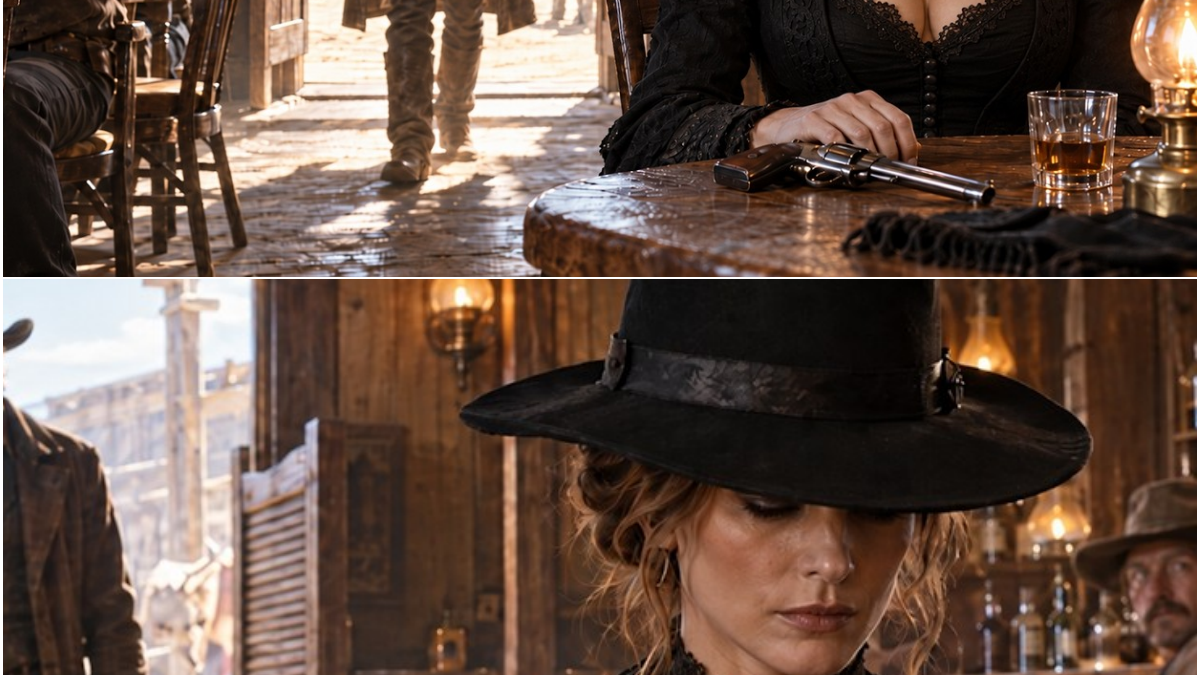
The whole town of Black Creek knew what it meant when Silas Ror rode into the street.
Conversations stopped. Men found reasons to look away. Bartenders poured his whiskey before he reached the counter, and ranchers who had once stood proudly in their doorways suddenly discovered urgent business inside.
Even Sheriff Nolan had learned to keep his eyes lowered. He had witnessed Silas beat a man until the fellow could barely stand, and afterward he had written nothing in his report.
In Black Creek, silence had become a habit, and fear had become the price of keeping a roof overhead.
But on a cold evening in October of 1886, Silas pushed open the doors of the Golden Spur Saloon and found someone who refused to follow the town’s rules.
A widow sat alone in the far corner, dressed in black beneath a dark riding coat.
Her hat shadowed her face. A small revolver rested beside an untouched glass, and her hands lay perfectly still on the table.
Her name was Clara Whitmore. The piano stopped. A poker player froze with his cards in his hand.
Near the bar, a rancher quietly moved toward the back door. Silas noticed none of them for long.
His attention had settled on the woman who had not even looked up. He smiled, the slow, familiar smile that had frightened three counties.
Then he crossed the room, pulled out the chair opposite her, and sat down without asking.
“You know who I am?” “Yes,” Clara answered. “And you’re not afraid?” Only then did she raise her gray eyes.
“You’re not the man I’m afraid of.” For the first time that evening, Silas Ror had no immediate answer.
What could a widow possibly know that would make the most feared man in Black Creek hesitate?
His boots had barely stopped scraping against the floor when Clara Whitmore’s words began to change the room.
She had not raised her voice. She had not reached for her revolver. Yet the people nearby seemed to understand that something more serious than an ordinary confrontation was taking place.
Silas studied her face. She was older than the frightened young wives he sometimes encountered in the valley, but not old.
Her expression held the stillness of someone who had spent a long time deciding what mattered and what did not.
Her black dress was plain, her riding coat worn at the cuffs, and a narrow line of dust marked the brim of her hat.
“What’s your name?” He asked. “Clara Whitmore.” Something moved across his face. It lasted less than a second, but Clara had spent seven months learning to recognize small changes in the expressions of men who thought they had nothing to fear.
Silas leaned back. “Never heard of you.” “You heard of my husband.” His hand paused near the glass.
“Thomas Whitmore.” The bartender lowered the glass he had been polishing. A man near the piano looked toward the entrance, as if considering whether the night was still young enough to leave town.
Silas picked up Clara’s whiskey and drank from it. “You should be careful what you say, mrs. Whitmore.”
“My husband was careful.” Her voice remained quiet. She spoke as though recalling ordinary details of a life that had once been safe and familiar.
“He checked his fences every night. He never rode through a wash after rain. He never trusted strangers near his cattle.
He never sat with his back to a door.” Clara looked straight into Silas’s eyes.
“He was careful the night you killed him, too.” The room seemed to draw in a single breath.
Silas’s fingers settled beside his revolver. His smile disappeared, leaving a harder expression beneath it.
“You came here for revenge?” “No.” That answer troubled him more than an accusation would have.
Anger was familiar. Anger could be provoked, redirected, and sometimes used against the person who carried it.
Clara’s calm offered him no such opening. She touched one finger to the small revolver beside her glass.
“If I came only to kill you, I would have done it before telling you my name.”
Silas looked at the weapon, then back at her. “What do you want?” Clara’s eyes hardened.
“The truth.” Seven months earlier, two riders had brought Thomas Whitmore back to his ranch across his own saddle.
They had laid him carefully on the porch and told Clara they had found him near Dry Cedar Creek after a robbery.
His shirt was stained, his wrists had been tied, and his wedding watch was missing.
The men had spoken with the practiced confidence of people who believed a simple story could settle every question.
They said the road had been dangerous. They said Thomas must have surprised someone. They said they had done what they could.
Clara had listened without interrupting. Then she had looked at their boots. Both men carried red mud along their soles and around the edges of their spurs.
There was no red mud near Dry Cedar Creek. The ground there was pale and sandy, even after rain.
But the southern spring owned by Amos Caldwell had deep red earth around its banks.
That spring had been the center of an argument for nearly a year. Caldwell was a cattle baron with money in the banks, friends in the land offices, and men who did his unpleasant work.
He had been buying ranches throughout the valley, one property at a time. Some owners accepted his offers willingly.
Others discovered that refusing him could become expensive. A rancher might find his cattle missing.
A lender might suddenly withdraw credit. A water gate might be damaged in the night.
A family might receive another offer, this time accompanied by a warning that the valley was changing and that stubborn people would be left behind.
Thomas had refused Caldwell three times. His ranch controlled a narrow stream that several smaller farms depended on during the dry months.
The water was not abundant, but it was reliable enough to keep gardens alive, fill stock troughs, and carry families through the worst weeks of summer.
Caldwell wanted the property because owning it would give him control over the stream. Thomas believed that water should not belong to one man simply because he could afford to buy the ground around it.
He said the smaller farms had depended on that creek long before Caldwell began counting the valley as part of his private holdings.
When the third offer arrived, Thomas had sent it back unsigned. Then he was gone.
Sheriff Nolan called it robbery. Amos Caldwell called it bad luck. The riders repeated their story until the town began repeating it for them.
Clara called it murder. She did not accuse Caldwell publicly. Not then. She had no proof, and she understood that an accusation without evidence would give powerful men a reason to close every door she needed to open.
Instead, she sold the ranch two months later. She did not sell it to Caldwell.
She sold it cheaply to a young family who had been struggling to keep their own small farm.
Her only condition was that the water remain open to the neighboring properties. The family agreed, and Clara made sure the agreement was written into the papers.
Afterward, she disappeared from Black Creek. People assumed grief had driven her away. Some said she had gone to live with relatives.
Others believed she had taken whatever money remained from the sale and moved eaSt. They were wrong.
Clara traveled through mining camps, cattle towns, land offices, and cheap boarding houses. She asked questions in places where nobody knew her face.
She spoke with former employees of Caldwell’s operation, men who had left his service and wanted to forget what they had seen.
She followed payment records and listened to the stories of families who had lost their land after refusing his offers.
Again and again, one name appeared. Silas Ror. Some people called him a gunman. Others called him an outlaw.
In certain towns, they spoke of him as though he were a storm that could be heard approaching but could not be stopped.
Clara learned that he had worked for Caldwell for years. He collected money, delivered warnings, escorted suspicious freight, and handled problems that Caldwell preferred not to discuss in public.
The more she learned, the clearer the arrangement became. Caldwell supplied the money and chose the targets.
Silas and other men supplied the fear. Clara followed that trail until it led her outside Prescott.
There she found a former clerk who had kept Caldwell’s books. The man was ill, frightened, and unwilling to speak openly.
He had left his position after seeing entries that connected payments to property seizures, suspicious accidents, and men who had vanished from the valley.
Before escaping, he had taken several pages from Caldwell’s ledger. He had kept them hidden, waiting for a day when someone might be able to use them.
Clara convinced him that she was not asking for gossip or a story to repeat in a saloon.
She wanted evidence that could be carried into a courtroom. After a long conversation, he gave her the pages.
They contained names, dates, sums of money, and small black marks beside completed jobs. Thomas Whitmore’s name appeared among them.
Beside it was a payment of five hundred dollars to Silas Ror, divided into two installments.
One had been recorded before Thomas’s final refusal. The other had been recorded two days after he was brought home.
The clerk could not explain every mark, but he understood enough to know what the pages meant.
He had also copied a separate entry showing that Caldwell had recently authorized a payment of three hundred dollars to another gunman.
That entry carried a black mark, too. Clara folded the pages into her coat and began the journey back to Black Creek.
She had not traveled all that way to find Silas merely to hear him deny everything.
She needed his confession, his knowledge, and the names of the men who had helped Caldwell build his private system of control.
Most importantly, she needed to learn whether the evidence she carried was only a fragment of something much larger.
Now, in the Golden Spur, she watched Silas examine the folded page she had placed before him.
He had refused to touch it at firSt. But curiosity, or perhaps suspicion, finally overcame his caution.
He picked it up and read the names. His eyes moved slowly down the sheet.
Then he stopped. For the first time since entering the saloon, the man everyone feared looked shaken.
“You stole this?” “No.” “Where did you get it?” “From a man Caldwell tried to silence.”
Silas glanced toward the doors. Clara noticed the movement. “That isn’t the name frightening you.”
He looked back at her. She tapped a line near the bottom of the page.
His own name was written there. Beside it stood another black mark, followed by the payment of three hundred dollars to a gunman named Wade Mercer.
Silas read the entry again. His jaw tightened. “Amos Caldwell is finished using you,” Clara said.
Silas stared at her. “You expect me to believe he paid somebody to kill me?”
“I expect you to recognize his handwriting.” He said nothing. Clara leaned back in her chair.
“You thought you worked for him. You were never his partner, Silas. You were a loose end.”
Behind them, a chair scraped against the floor. The people who had been drinking and playing cards began to leave.
They did not rush. They did not shout. One by one, they slipped toward the front door and disappeared into the cold evening.
The bartender crossed to the windows and closed the shutters. Then he turned the key in the front lock.
Silas stood. “What is this?” Clara’s hand closed around her revolver. “Sit down.” His eyes narrowed.
“You planning to hold a trial in a saloon?” “No.” A door opened behind the bar.
An old man stepped out carrying a Bible and a leather writing book. His hair was white, his shoulders narrow, and his face lined from years of working beneath the Arizona sun.
Justice Samuel Pike. Behind him came three people Silas recognized. One was a widow whose husband had been among the workers lost in an Ashford mine collapse.
Another was a rancher Caldwell had driven from his land. The third was a young woman whose family home had burned after her father refused to sign over a water claim.
Silas looked from one face to another. Nobody threatened him. Nobody raised a weapon. The silence was worse than shouting because it carried the weight of everything these people had endured.
Clara rose. Her revolver remained pointed toward the floor. “The deputy marshal already has another copy of those pages.”
Silas looked at her. “If you shoot your way out, the evidence still reaches Prescott.”
She stepped closer. “If you run, Caldwell’s man finds you. If you return to Caldwell, he kills you himself.”
Silas’s eyes returned to his name on the page. “But if you tell the truth, you may live long enough to watch Amos Caldwell answer for every family he ruined.”
His face hardened. “And what happens to me?” Clara held his gaze. “That will be for a judge to decide.”
Justice Pike opened his writing book. The bartender placed an ink bottle and a clean sheet of paper on the table.
Silas looked toward the locked doors, then toward the shuttered windows. Finally, he faced Clara again.
“What do you want to know?” She had waited seven months to hear those words.
She could have begun with Thomas. She could have demanded the full account of the night her husband had been taken from the world.
Instead, she asked something that surprised everyone in the room. “Who ordered the Ashford mine supports cut?”
Silas went still. Outside, a horse thundered down the street. The sound moved past the Golden Spur and faded toward the northern road.
Clara heard it. So did Silas. The fear that returned to his face told her they understood the same thing.
Someone had already ridden away to warn Amos Caldwell. Justice Pike dipped his pen into the ink.
Silas did not answer immediately. His eyes stayed on the shuttered window, where the last sound of the horse had disappeared into the night.
“Silas,” Clara said. He looked at her. “The Ashford mine.” His mouth tightened. “Caldwell ordered it.”
The widow near the kitchen doorway closed her eyes. Justice Pike began writing. “Who carried it out?”
Clara asked. “Two men named Mercer and Dodd.” Silas swallowed. “I showed them when the night crew changed.
Caldwell wanted the collapse to look like bad timber and careless work.” The widow’s hands began to shake.
“My husband was inside,” she said. Silas turned toward her. “I know.” “And our son.”
Silas looked down. “Caldwell was told the boy worked beside him.” A terrible silence settled over the saloon.
Clara wanted Silas to feel it, not the fear of a gun pointed at his chest, but the weight of the names he had spent years reducing to entries in a book.
For Silas, a man had become a job. A family had become a payment. A ruined home had become an instruction carried out and forgotten.
Now the people he had helped hurt were standing in front of him. Justice Pike continued writing.
Clara asked about the burned farmhouse next. Silas gave the name of the man who had arranged it and the date when Caldwell’s money had changed hands.
Then she asked about the rancher who disappeared from Red Bluff. Silas described the last place he had seen him and named the men who had taken him away.
She asked about a banker who had altered three land records before leaving the territory.
Silas named the clerk who had helped and the official who had signed the papers.
Every answer made Caldwell’s shadow larger. The list did not end with property. It reached into the courts, the banks, the mine offices, and the lives of people who had believed that a written deed or a signed contract would protect them.
Finally, Clara asked the question she had carried through seven months of sleepless nights. “Thomas Whitmore.”
Silas stopped breathing for a moment. The room changed. Even Justice Pike’s pen became still.
Clara stood across from him, her revolver low beside her leg. “Tell me what happened.”
Silas looked toward the floor. “There were three of us. Eli Denton, Frank Maris, and me.”
“Where are Denton and Maris?” “Denton was killed outside Santa Fe last winter. Maris drowned crossing the Verde after spring rain.”
Clara did not blink. “So you’re the only one left.” Silas nodded. “Tell me.” He rubbed both hands across his face.
“Caldwell wanted Thomas to sign the creek rights over. He had already refused.” “I know.”
“Caldwell thought another offer might change his mind.” “It wasn’t another offer.” “No.” Silas’s voice grew quieter.
“It was a threat.” Clara felt her heart pounding, but she kept her voice steady.
“What did Thomas say?” Silas stared at her for several seconds. “He said Caldwell could buy every ranch in Arizona and still wouldn’t own the rain.”
Clara’s throat tightened. Thomas had said almost the same words at their kitchen table. He had been standing beside the window, watching the last light fall across the creek.
She remembered the way he had smiled afterward, as if the thought amused him. Silas continued.
“Your husband told us that creek kept six families alive during dry summers. He said he would rather lose his ranch than sell their water.”
Clara’s fingers tightened around the revolver. “What happened next?” “He tried to ride through us.”
Silas gave a humorless breath. “Denton grabbed his bridle. Thomas hit him hard enough to break his nose.”
For the first time that evening, something almost like pride moved through Clara’s pain. Silas looked at her.
“He fought.” “Did he beg?” “No.” The word came quickly. Silas shook his head. “He never begged.”
Clara closed her eyes for one second. For seven months, strangers had told her that Thomas must have pleaded.
They had suggested that every man gave up when the danger became real. She had refused to believe them, but the uncertainty had remained like a stone she could not remove from her cheSt.
“Who shot him?” Silas looked away. Clara stepped closer. “Look at me.” Slowly, he did.
“Who shot my husband?” “I did.” The answer was smaller than the pain it carried.
Clara had imagined hearing those words a thousand times. She had imagined rage, grief, and the terrible satisfaction of finally knowing who had done it.
She had imagined drawing her revolver and ending Silas where he stood. But when the confession finally came, she felt something colder and heavier than anger.
“Say his name.” Silas frowned. “You heard me.” “Say it.” His jaw tightened. Then he forced the words out.
“I killed Thomas Whitmore.” The widow near the kitchen began to cry quietly. Justice Pike wrote every word.
Clara did not move. “Why?” Silas looked at her without a smile. “Because Caldwell paid me.”
His eyes dropped. “And because I had done it so many times that I stopped calling it murder.”
That answer hurt more than an excuse would have. Thomas had not been caught in a feud.
He had not been lost because of a personal hatred. He had been taken from his family because one man wanted water and another wanted money.
Clara turned away for a single breath. Then she faced Silas again. “Keep talking.” For the next hour, he did.
He named the men who carried messages for Caldwell. He identified a deputy who warned Caldwell before warrants arrived and a land clerk who altered property records.
He described payments hidden inside ordinary business accounts and meetings arranged in places where no one would think to look for a cattle baron.
Then he told them about a locked iron box beneath the floor of Caldwell’s branding shed.
“What’s inside?” Pike asked. “Original deeds, payment lists, letters.” “Why would Caldwell keep evidence against himself?”
Silas looked at him. “Because he trusts fear more than friendship.” He took a clean sheet from Pike and drew a rough map.
The branding shed stood near the cattle pens. Beneath its north wall, one floorboard could be lifted.
The box was hidden underneath. Clara studied the drawing. “If the marshal finds that box, Caldwell is finished.”
“If Caldwell hasn’t moved it,” Silas said. Clara glanced toward the shuttered window. “He won’t have time.”
Silas understood immediately. “You let that rider leave on purpose.” Clara nodded. “I saw him watching from across the street before you arrived.”
Silas stared at her. “You wanted Caldwell to know.” “I wanted him angry.” “That’s dangerous.”
“Yes.” “Why?” “Because Caldwell has spent years making other men commit his crimes. If he comes here himself and tries to destroy witnesses, he finally acts where people can see him.”
Silas let out a low breath. “You built a trap.” “I built a choice.” “And if he chooses violence?”
“Then everyone in this town sees who he really is.” Silas looked toward the door again.
“You think Caldwell comes alone?” “No. He’ll bring men.” “How many?” “Four, maybe five.” “Why not twenty?”
“Because twenty would make him look afraid.” Clara almost smiled. “Men like Caldwell would rather lose everything than appear frightened.”
Silas nodded once. Then his eyes dropped to his gun belt. “You planning to leave me armed?”
“No.” Clara held out her hand. “Take it off.” Silas stared at her. “You said you would get me to the marshal alive.”
“I said alive.” Her eyes lowered to the Colt. “I didn’t say comfortable.” Slowly, Silas unbuckled the belt and placed it on the table.
Clara removed the revolver. Its weight surprised her. “This gun?” Silas knew what she meant.
“Yes.” The Colt that had taken Thomas Whitmore from her rested in Clara’s hand. For half a second, every dark thought she had carried for seven months rose inside her.
Silas stood only a few feet away, unarmed. One movement would end the uncertainty that had followed her across the territory.
Instead, Clara opened the cylinder. She removed the cartridges one at a time and placed them on the table.
Then she set the empty weapon behind the bar. Silas looked at her differently. “You could have killed me.”
“I still could.” “Why didn’t you?” “Because Thomas deserves the truth more than I deserve revenge.”
Before Silas could answer, three hard knocks sounded from the ceiling. Everyone froze. A voice came through a small opening near the back stairs.
“Riders coming from the south.” Clara looked up. “How many?” There was a pause. “Five.”
Silas crossed to the shutter and looked through a narrow crack. Hoofbeats began to roll down the street, slow and deliberate.
The riders wanted Black Creek to hear them coming. Silas’s face changed. “He came himself.”
Clara moved beside him. Through the gap, she saw five riders entering town beneath the last red light of evening.
The man in the center wore a pale hat and a clean gray coat. His boots were polished, and a silver watch chain crossed his veSt.
Amos Caldwell. Beside him rode a thin man in black with one hand resting near his pistol.
Silas stared at that man. Clara noticed. “Who is he?” “Wade Mercer.” “The three hundred dollars?”
Silas nodded. “The man Caldwell paid to kill me.” Below them, the five riders stopped outside the Golden Spur.
Leather creaked. Spurs touched dirt. Then Caldwell’s voice came through the doors, calm and almost friendly.
“Silas. I know you’re in there.” Everyone inside went still. Clara raised her revolver, but Silas was no longer looking at the entrance.
His attention had shifted toward the back hallway. “What?” Clara whispered. “If Caldwell brought Mercer through the front, somebody else will be coming through the rear.”
A floorboard creaked behind the kitchen. Clara turned. The back door handle slowly began to move.
Justice Pike stepped behind the wall. The Ashford widow covered her mouth. Silas moved in front of Clara, even though he had no weapon.
The handle turned once, then stopped. A second later, the door opened. A broad man with a rifle slipped inside.
Clara raised her revolver. “Easy.” The man lifted one hand. It was Henry Boone, the town blacksmith.
Two ranchers followed him through the alley. “We came around the back,” Henry whispered. “Caldwell has another rider circling behind the stable.”
Silas looked at Clara. “Told you.” Clara lowered her revolver. “Cover the rear. Nobody shoots unless Caldwell’s men draw firSt.”
Henry frowned. “You still want them alive?” “I want them unable to call this murder.”
That ended the argument. The men moved into position. One rancher climbed the narrow stairs to the storage loft.
Another took cover behind the kitchen serving window. Henry crouched near the back hallway. The witnesses stayed out of sight.
Clara returned to the main room. Silas followed. “You trust these people?” “They have more reason to hate Caldwell than I do.”
“That wasn’t my question.” Clara looked around the dark saloon. “I trust them to remember why we’re here.”
Another knock struck the front door, harder this time. “mrs. Whitmore.” Caldwell knew she was inside.
Clara’s eyes narrowed. Silas gave a humorless smile. “Looks like you’re famous now.” “Stand where he can see you.”
Silas turned toward her. “You want me beside you?” “Yes.” “He paid a man to kill me.”
“And you killed my husband.” Silas went silent. Clara stepped toward the center of the room.
“Do not mistake this for truSt.” “I won’t.” The bartender unlocked the doors, then stepped away.
Clara stood several feet behind the entrance with her revolver held low. Silas stood beside her, unarmed.
The doors opened. Amos Caldwell entered firSt. He looked nothing like the kind of man people imagined when they spoke about cruelty.
His gray coat was clean. His pale hat carried almost no duSt. His boots were polished, and his watch chain rested perfectly across his veSt. He looked like a banker or a judge, a man who might be invited to dinner by respectable families.
Four armed men followed him. Wade Mercer entered laSt. Tall, thin, and dressed in black, he kept one hand close to his revolver.
Amos smiled at Silas. “There you are.” Silas did not answer. Caldwell looked at the empty gun belt lying on the table.
His smile widened. “Did the widow take your courage along with your Colt?” “She took my statement.”
The smile disappeared. Caldwell looked at Clara. “What statement?” “The one he signed.” Amos’s eyes moved back to Silas.
For the first time, something ugly showed beneath the gentleman’s expression. “You’ve been drinking.” “No.”
“Then you’ve become stupid.” Silas stepped forward. “You marked my name.” Amos said nothing. “You paid Wade three hundred dollars.”
Wade’s hand shifted slightly. That tiny movement told Silas everything he needed to know. He laughed once, not because anything was funny, but because the last excuse had just disappeared.
“All those years,” Silas said. “I thought I was useful to you.” “You were,” Caldwell replied, adjusting one glove.
“Until you knew too much.” Silas’s face hardened. “I was paid well.” “So was everyone who worked for me.”
Clara watched Caldwell carefully. He did not look frightened yet. He was still trying to turn the situation into a conversation in which he controlled the terms.
Then he looked directly at her. “mrs. Whitmore, grief has made you reckless.” “Grief made me patient.”
“You sold your ranch. You took your money. Whatever disagreement your husband had with me ended when he died.”
“Thomas was killed because he refused to let you own the valley’s water.” Caldwell sighed as if speaking to a difficult child.
“You believe whatever this killer tells you?” Clara’s eyes stayed on him. “I believe the ledger.”
His expression changed only slightly. But Clara saw it. “There is no ledger,” he said.
“A copy is already in Prescott.” Wade looked toward Caldwell. Clara noticed that, too. Silas smiled bitterly.
“You didn’t tell them that part, did you?” Amos ignored him. Clara continued. “Silas gave Justice Pike names, dates, payments, and the location of the iron box beneath your branding shed.”
That landed harder than anything else she had said. Caldwell’s eyes sharpened. “What box?” “The one under the north floorboard.”
For the first time, his calm broke. Just enough. Silas saw it. “So it’s still there.”
Amos turned on him. “You miserable fool.” The words came before he could stop them.
Clara felt the entire room tighten around Caldwell. His carefully maintained manners had begun to slip, and everyone present could see what lay beneath them.
Silas stepped closer. “I killed for you because you made it sound like business.” Caldwell’s jaw clenched.
“The Ashfords. The burned farm. The Whitmore killing. You called them problems.” “Careful.” “No. I’m done being careful for you.”
Amos glanced around. The saloon appeared empty except for Clara, Silas, and the bartender. His confidence began to return.
“You expect a court to believe him?” Clara answered. “No.” Caldwell smiled. Then Justice Pike stepped into the kitchen opening.
“I expect a court to believe evidence.” The Ashford widow appeared beside him. Then the young woman whose family home had burned.
A rancher emerged near the stairs. Floorboards creaked above them, and the barrel of a hunting rifle appeared over the loft rail.
Another man stepped from the rear hallway. Then another. Suddenly, Caldwell understood. The town had not abandoned Clara.
It had gathered itself around him. He slowly looked at the people surrounding the room.
“You call this justice?” “No one has sentenced you,” Clara said. “You brought armed men.”
Caldwell looked toward the doors. Two ranchers had already moved onto the porch. There was no clear escape.
Clara raised her voice just enough for every person in the room to hear. “Put your weapons on the floor.”
One of Caldwell’s riders glanced at his employer. Nobody moved. Wade Mercer smiled. It was not a nervous smile.
It was the expression of a man who believed that violence could still repair any mistake.
“You made one mistake, widow.” Clara’s eyes shifted to him. “What mistake?” “You need to stay alive long enough to testify.”
His hand moved. Silas moved firSt. He slammed into Clara, knocking her behind the table as a gunshot exploded through the saloon.
A lamp shattered. Glass rained across the floor. Men shouted, and another shot cracked from somewhere near the door.
Clara pushed herself onto one knee. Silas lay beside her. Blood spread across his upper sleeve.
Wade raised his revolver again. Clara fired. Her shot struck his gun hand. The revolver spun across the floor, and Wade dropped to his knees, shouting.
Rifles appeared from every shadow. “Guns down!” Henry Boone shouted. One rider dropped his weapon.
Another followed. The third hesitated until a rifle lever clicked from the loft. His pistol struck the floor.
Wade was already beaten. Only Amos Caldwell remained armed. He stood in the center of the room with one hand near his coat.
Clara rose slowly. Her shoulder burned from hitting the floor, and her heart pounded so hard she could hear it.
Still, she kept her revolver steady. Caldwell stared at her. “This is mob law.” “No,” Clara said, stepping around the table.
“Mob law would have killed you before you entered.” She looked toward Justice Pike. “You will face a judge.”
Amos laughed. “You think farmers and widows can hold me until a marshal arrives?” Henry stepped forward.
“These farmers survived you.” Another rancher blocked the door. Pike held up Silas’s signed statement.
“The marshal will have plenty to read when he gets here.” Amos’s hand moved closer to his revolver.
Every rifle in the room followed. Clara did not blink. “Don’t.” Caldwell looked at her, then at the rifles, then at Silas.
Silas had pushed himself against the table. Blood ran down his arm, but he remained conscious.
“You should listen to her,” Silas said. Amos sneered. “I’m supposed to take advice from a dead man?”
Silas gave him a tired smile. “No.” His eyes dropped toward Caldwell’s gun hand. “Take it from the man who knows how slow you really are.”
Something wild flashed across Caldwell’s face. His pride had nowhere left to hide. Clara saw his fingers close around the grip.
“Amos.” He looked directly at her. For one terrible second, she thought he might surrender.
Then a sound came from outside. Fast hoofbeats. A rider charging toward the saloon. Everyone turned for half a heartbeat.
That was all Caldwell needed. He ripped his revolver from his coat, but he did not aim at Clara.
He aimed at Silas. Clara understood then that Amos Caldwell would rather risk everything in front of the whole town than let the one man who knew his secrets live until sunrise.
Caldwell’s revolver cleared his coat. Silas saw the barrel turn toward him. Clara fired firSt.
Her shot struck Caldwell’s revolver and knocked it from his hand. The weapon hit the floor and slid beneath a table.
Before Caldwell could move again, Henry Boone crossed the room and drove him against the bar.
Two ranchers seized his arms. “Hold him!” Caldwell struggled for only a moment. Then he stopped.
Every rifle in the saloon was pointed toward him. The man who had controlled half the valley now stood with his cheek against a wooden bar, held by the same farmers he had spent years frightening.
Outside, the approaching horse stopped hard. Boots struck the porch. Everyone turned toward the doors.
A man wearing a dusty brown coat stepped inside with a revolver in one hand and a silver badge pinned beneath his veSt. Behind him came two armed deputies.
Clara recognized him immediately. Deputy United States Marshal Ethan Cole. He looked around the damaged saloon.
“Seems I arrived late.” “Earlier than expected,” Clara answered. Cole looked at Caldwell. “I received mrs. Whitmore’s papers yesterday morning.
After reading them, I decided tomorrow was too long to wait.” Caldwell stared at Clara.
For the first time, there was no pride in his face, only disbelief. “You planned for the marshal, too?”
Clara shook her head. “I planned for the truth to reach someone even if I died.”
Marshal Cole took Caldwell from Henry. Iron cuffs closed around the cattle baron’s wrists. Caldwell looked toward Silas.
“You think this saves you?” Silas sat against the table while Justice Pike wrapped his wounded arm.
“No.” His voice was tired. “That’s the difference between us.” Caldwell’s eyes narrowed. Silas continued.
“I finally know I deserve what comes next.” Caldwell said nothing more. The deputies searched his men, bound Wade Mercer’s wounded hand, and collected every weapon.
Justice Pike handed Cole the signed confession. The marshal read several pages in silence. Then he looked at Silas.
“You understand this statement admits to murder?” “Yes.” “You understand I’m placing you under arrest, too?”
“Yes.” Clara watched him. Silas did not ask for mercy. He did not look at her as if hoping she might forgive him.
He simply held out his good hand. The marshal locked one cuff around his wriSt.
By sunrise, Black Creek looked different. Not because its streets had changed. Not because Caldwell’s buildings had disappeared.
The town still had the same dusty roads, the same weathered porches, and the same storefronts that had stood through years of drought.
But the people who had spent years lowering their voices whenever Caldwell’s riders passed were standing openly outside their homes.
Caldwell was led through town in chains. Wade Mercer and the other gunmen followed. Silas walked last, his wounded arm resting in a sling.
Nobody cheered. Clara was grateful for that. Thomas was still gone. The Ashford men were still buried.
The families whose homes had burned could not simply return to the lives they had known.
Justice could prevent more suffering, but it could not restore everything that had already been taken.
Before Marshal Cole left, Silas stopped beside Clara. The deputy holding his chain waited. Silas looked tired beneath the morning sun.
“There’s something else.” Clara said nothing. “When Thomas died, Denton took his watch.” Her face changed.
“The silver one?” Silas nodded. “He sold it to a pawn broker in Prescott, near the freightyard.
I remember because Denton complained the man gave him almost nothing for it.” Clara’s throat tightened.
Silas looked down. “I should have told you sooner.” “You should have done many things sooner.”
“I know.” He raised his eyes. “I don’t expect you to forgive me.” “Good.” Silas accepted the answer.
Then the marshal led him toward the waiting wagon. Clara watched until he climbed inside.
She did not wave. She did not thank him. Some things could not be balanced simply because a guilty man had finally chosen one honest act.
Three hours later, Marshal Cole and six townsmen rode to Caldwell’s cattle yard. They entered the branding shed and lifted the north floorboard.
The iron box was exactly where Silas had said it would be. Inside were stolen deeds, payment records, letters, false water claims, and the names of officials Caldwell had bribed.
Some documents were old and brittle. Others were recent enough to show that the operation had continued almost until the night of the confrontation.
The box did what fear had prevented people from doing for years. It spoke. The following spring, Amos Caldwell stood trial.
His lawyers argued that Silas Ror was a killer trying to save himself. They said Clara was a widow blinded by grief.
They described the people of Black Creek as a mob that had decided to settle private grievances outside the law.
But Silas knew details that were later proven true. The ledger matched payments in Caldwell’s own records.
The stolen deeds carried genuine signatures. The letters named officials who began confessing when they realized Caldwell could no longer protect them.
And Black Creek had killed no prisoners. They had kept the accused alive for the law.
The evidence connected Caldwell to murder, fraud, bribery, and conspiracy. The court heard about the Ashford mine, the burned farmhouse, the altered land records, and the payment that had been made for Thomas Whitmore’s killing.
Caldwell’s defense tried to separate every event into an unrelated dispute. They suggested that the payments were ordinary business transactions and that the witnesses had misunderstood what they had seen.
But the dates matched. The names matched. The records matched. The people who had once been too frightened to speak stood before the court and told their stories.
Amos Caldwell was convicted of murder, fraud, bribery, and conspiracy. He would spend the rest of his life behind prison walls.
Wade Mercer received a long sentence. Two corrupt officials were arrested. Another fled the territory before he could be taken into custody.
Silas Ror pleaded guilty to the killing of Thomas Whitmore and several other crimes. His testimony spared him the gallows, but it did not spare his freedom.
He was sentenced to life in territorial prison. Clara attended only one day of his hearing.
When the sentence was read, Silas looked at her once. She gave him nothing. No anger, no kindness, no forgiveness.
Only the knowledge that Thomas’s name had finally been spoken in a courtroom where money could not silence it.
Two months later, a small package arrived at Clara’s boarding house. Inside lay Thomas’s silver watch.
The glass was cracked. One hand was missing. The case had been scratched almost beyond recognition.
But the words engraved on the back remained clear. “Come home before the light is gone.”
Clara sat alone for a long time, holding the watch in her palm. She remembered Thomas at the kitchen table, his sleeves rolled up and his hands stained from repairing a gate.
She remembered him standing beside the creek, watching water move over the stones. She remembered his stubborn belief that a person’s worth could not be measured by the amount of land or money they possessed.
For months, she had imagined what she would say when the search was finished. She had thought there would be a sentence that could contain all the things she had endured.
Now the words seemed smaller than the journey. She returned to the land that had once been hers.
The young family who owned the Whitmore ranch welcomed her without questions. Children were playing beside the creek.
Their mother filled two buckets from the water. Farther downstream, another rancher opened a narrow gate and let the stream move toward his field.
Thomas had stood against Caldwell to protect that simple thing. Water moving freely. Families surviving.
Clara walked up the hill behind the house. Thomas’s grave stood beneath an old cottonwood tree.
The branches moved gently in the afternoon breeze, and the grass around the stone had grown thick after the spring rains.
She knelt beside it. For months, she had imagined what she would say when everything was finished.
Now the words seemed smaller than the journey. She placed the silver watch against the stone.
“They know your name now.” Wind moved through the grass. Clara touched the grave once.
“Silas told the truth.” Her eyes filled. “But I did not forgive him.” She looked toward the creek below.
“I don’t think you would have asked me to.” A child laughed near the water.
For the first time in many months, the sound did not hurt. Clara remained beside Thomas until sunset turned the hills gold.
She had not won her old life back. That life was gone, and she no longer expected the world to return it simply because the truth had been revealed.
She had won something different. Caldwell could no longer buy silence. Silas could no longer hide murder behind the word work.
The land records could be examined, the water claims challenged, and the people of Black Creek could speak without wondering which rider might hear them.
The town had learned that fear ruled most easily when everyone carried it alone. In the years that followed, Clara never became a gunfighter.
She never wore a badge, and she never tried to make herself into a legend.
Instead, she learned more about deeds, water claims, contracts, and land records. She studied the words that powerful men used to hide theft inside ordinary agreements.
She learned how to recognize a false signature and how to find the missing page in a property file.
When frightened ranchers received papers they could not understand, they brought them to Clara Whitmore.
When a family was told that a stream no longer belonged to them, she helped them find the original claim.
When a powerful landowner tried to conceal a transfer beneath legal language, she knew where to look.
She did not promise that every dispute could be won. She knew too well how long a fight could last and how much it could coSt. But she made sure people understood what they were signing and what rights they still possessed.
Sometimes she traveled to neighboring towns to help families who had heard what happened in Black Creek.
Sometimes she spent whole afternoons in the county office, comparing records and asking questions that clerks would rather not answer.
She kept Thomas’s watch in a small wooden box beside her bed. The hands never moved again, but the engraving remained.
“Come home before the light is gone.” It became a reminder, not of the life she had lost, but of the promise she had kept.
She had returned to the creek. She had brought the truth home, even though it had arrived too late to save the man who had first spoken it.
People continued telling the story of the night Silas Ror entered the Golden Spur and every man in the room went quiet.
But that was not the part they remembered moSt. They remembered the widow sitting alone in the corner.
The woman who did not look up, not because she failed to notice who had entered, and not because she felt no fear, but because she had spent seven months preparing for that exact sound of boots on the floor.
They remembered that she had come without an army, without a badge, and without a promise that the night would end safely.
She had carried a few pages of a ledger, a small revolver, and the determination to make a man speak the truth.
They remembered that she had not asked the town to trust Silas. She had asked the town to stand together long enough to make sure he could not escape the law.
And they remembered what happened when Amos Caldwell arrived expecting everyone to remain silent. The people who had once hidden in their houses stepped out of the shadows.
The people who had once believed they were alone discovered that their neighbors had been afraid, too.
Their fear had not disappeared, but it no longer belonged to each person separately. Years later, when travelers asked about the old Golden Spur, somebody would inevitably tell them about Clara Whitmore.
Some would call her brave. Others would say she was stubborn. A few would insist that no sensible person should have confronted Silas Ror in a crowded saloon.
Clara never argued with any of them. She had not gone looking for a reputation.
She had gone looking for the truth about her husband, and the search had led her into a room where a powerful man expected everyone to obey him.
The story did not end with a widow becoming fearless. Clara had been afraid many times.
She had been afraid when she first saw the red mud on the riders’ boots, afraid when she entered towns where nobody knew her, and afraid when she placed the ledger pages before Silas.
She had been afraid when she heard the horse outside the saloon and understood that Caldwell had been warned.
But fear had not made her turn away. That was what Black Creek finally understood.
Courage was not the absence of fear. It was the decision to keep moving when fear had given a person every reason to stop.
Silas Ror had spent years believing that everyone else was weaker than he was. Caldwell had spent years believing that money could turn cruelty into business and business into respectability.
Both men had mistaken silence for agreement. Clara had shown them that silence could end.
And when the last of the evidence had been carried to court, when the prisoners had been taken away and the creek continued running through the valley, the people of Black Creek began speaking about Thomas Whitmore differently.
They no longer described him only as the rancher who had been robbed near Dry Cedar Creek.
They spoke of the man who had refused to sell the water that kept six families alive.
They remembered his stubbornness, his careful habits, and his belief that a valley belonged to the people who depended on it as much as it belonged to whoever held the largest deed.
His name no longer appeared only in a report written by a sheriff who had accepted the easiest explanation.
It appeared in testimony. In records. In conversations at the store and around the tables of families who still drew water from the creek.
And Clara, who had once been introduced as the widow of a murdered rancher, became known for something beyond her grief.
She was the woman who had made Black Creek look at itself. She never asked anyone to call her a hero.
She knew that the word could make ordinary people seem less responsible for what they did.
The people who stood in the Golden Spur had not needed a hero to tell them what was right.
They had needed one another to find the courage to act. Sometimes, on cold evenings, Clara still visited the Golden Spur.
The saloon had been repaired, the broken glass replaced, and the shutters no longer closed whenever a rider approached.
The piano player had returned to his music. The bartender poured drinks for customers who asked, not for men whose reputations demanded it.
Clara usually sat near the same corner table. She never placed a revolver beside her glass unless she had a reason to carry it.
She did not watch the door with the same tense attention she once had. But whenever the sound of heavy boots crossed the wooden floor, she remembered that October evening and the moment Silas Ror had stopped beside her.
She remembered his question. “You know who I am?” And her answer. “Yes.” She had known who he was.
She had also known what he had done, what he feared, and what he might be forced to reveal.
But most importantly, she had known who she was. Not merely a widow. Not merely a woman seeking revenge.
Not a frightened rancher’s wife waiting for someone else to explain what had happened. She was Clara Whitmore.
And the truth, once spoken aloud, had become something no man in Black Creek could easily put away again.
Disclaimer: This content may be created by Al for entertainment purposes. Any resemblance to real persons, events, or places is coincidental.








