Eight Gunmen Rode Into the Widow’s Yard… Only One Saw Calamity Jane Behind the Water Trough-Too Late
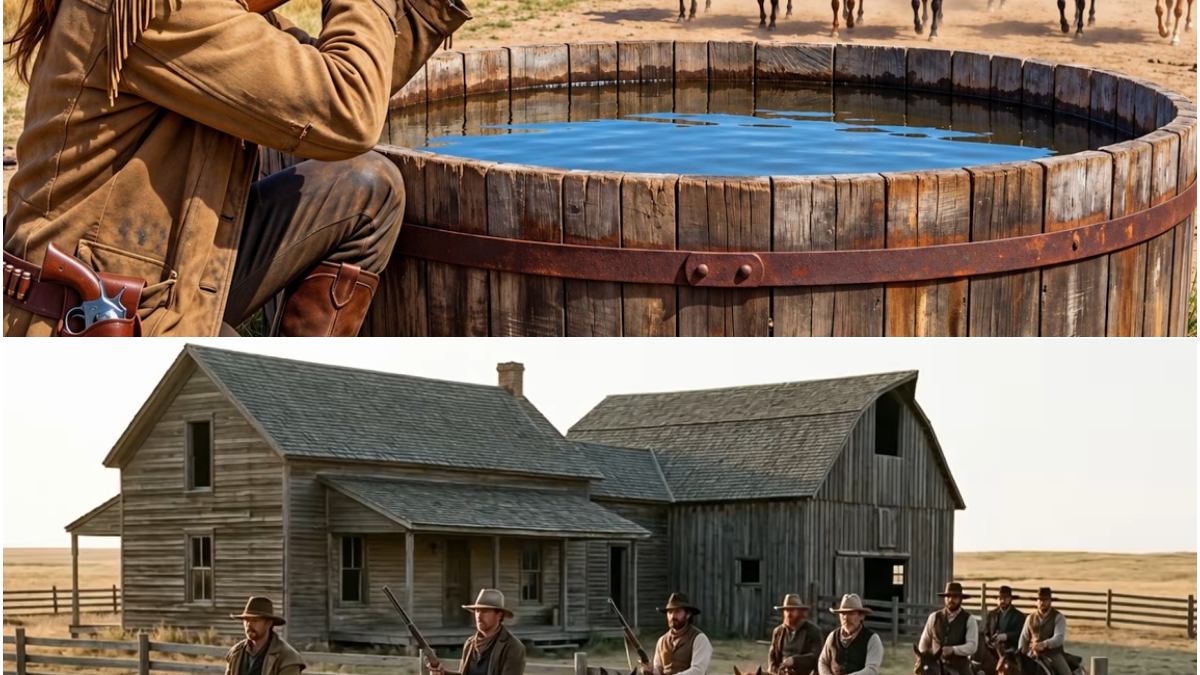
Eight armed men rode into Martha Kellerman’s yard expecting to frighten a widow. They came in at sunset, when the last orange light rested across the dry grass and the shadows from the barn stretched long enough to reach the house.
They expected a woman who had spent eight months being pushed backward, a woman whose fences had been cut, whose well had been fouled, whose nights had been disturbed by riders who always vanished before anyone could identify them.
They expected fear because fear had worked before. Seven of the men looked toward the house.
The eighth looked toward the water trough. His name was Corwin, and he had spent enough years carrying a gun for money to recognize the difference between an empty yard and a waiting yard.
The horses were too quiet. The barn doors stood open, yet no livestock stirred inside.
The porch was empty. The windows were dark. Then he saw the worn hat behind the trough.
Then the Winchester. Then the face beneath the brim. His stomach tightened. Calamity Jane. Corwin had heard stories about her, but stories were different from a woman crouched twenty yards away with a rifle resting on wet timber.
He began to turn. Jane saw him move. The other seven men had not yet understood what Corwin had understood.
What happened when eight armed riders finally discovered that the widow they had come to frighten was not standing alone?
Three days earlier, Martha Kellerman had been sitting at her kitchen table with both hands wrapped around a cup of coffee that had already gone cold.
Across from her sat Calamity Jane. Outside, late summer wind moved through the dry grass and rattled the loose hinge on the chicken run.
The sound repeated every few seconds, small and irritating, like a reminder that something on the property needed fixing.
Martha had grown accustomed to such reminders. There was always something. A fence needed mending.
The milk cow needed tending. Chickens needed feeding. The garden needed water. Taxes needed paying.
The roof above the back room needed another patch before the next hard weather came.
And then there were the men from the cattle association. At first, they had been polite.
They wanted a strip of Martha’s property because it provided the cleanest route between two large grazing areas.
They had approached her with money and smooth voices. Martha had refused. They offered again.
She refused again. After that, the politeness began to disappear. The fence along the east pasture was cut.
A month later, something foul was thrown into the shallow well near the barn. Riders began circling the property after dark.
They never came close enough to be identified. They never stayed long enough to be caught.
They simply appeared in the distance, watched the house, and disappeared down the road. Each incident could be dismissed by itself.
Together, they formed a message. Martha understood it. They wanted her gone. Eight months earlier, her husband had been lost during a hunting trip.
The coroner had called the incident an accident, and Martha had been left with too many practical problems to spend much time challenging the official explanation.
Still, something about the story had never rested properly in her mind. Her husband had known every wash, ridge, creek bed, and fence line around their property.
He had crossed that land in every kind of weather. The explanation involving a rifle discharging while he crossed a wash had never felt right to her.
But suspicion did not mend fences. It did not feed children. It did not keep a roof over a family.
So Martha had kept working. Until the cattle association began pressing her. She had gone to the sheriff.
The sheriff had listened. Then he had shrugged. No witnesses, mrs. Kellerman. No names. No proof.
Calamity Jane had heard that part two nights earlier over coffee. She had ridden onto Martha’s property intending to water her horse and leave before sunset.
Instead, she stayed for supper. Then she stayed another night. Then another. Something about a widow being slowly pushed away from her own land irritated Jane enough to change the direction of her plans.
That morning, a boy from town had brought the latest warning. Eight armed men had gathered outside the association office.
Talk around town was that they intended to finish the matter before dark. Martha had stared down into her coffee.
“I have my husband’s shotgun. Can you use it?” “I can point it,” Martha said.
“That wasn’t my question.” Martha looked toward the window. “No.” Jane nodded. “Then we don’t pretend you can.”
Martha swallowed. “What do we do?” Jane stood. “We stop thinking about eight men.” Martha frowned.
Jane picked up her hat. “We think about one yard.” For the next two hours, Jane walked the property.
She did not make a performance of it. She did not behave like the gunfighters Martha had heard about in stories.
She studied the land the way a farmer studied weather. The house stood slightly above the yard.
The barn was thirty yards away. The water trough sat another fifteen yards beyond it.
A woodpile rested near the porch. A shallow drainage cut ran behind the chicken shed.
Cottonwoods stood near the well. The county road approached from the south, bent slightly west, then opened toward the yard.
Anyone riding in would naturally look toward the porch. Jane stopped beside the trough. Martha followed.
Jane crouched. The trough was built from thick timber and nearly full. Wet wood and packed earth surrounded its base.
From that position, Jane could see the road, the corner of the barn, the gap beside the woodpile, and one side of the house.
But she could not see behind the smokehouse. Jane stood. “What is it?” Martha asked.
“There’s a blind side.” Martha looked toward the smokehouse. “Can we block it?” “Then they’ll know we’re waiting.”
Jane walked toward the house. Martha followed. “So what do we do?” Jane stopped beside the kitchen door.
“We make sure I’m not the only one watching.” Martha went pale. “No.” “You don’t have to win a gunfight.”
“I told you I can’t shoot.” “Then don’t shoot unless you have to.” Jane reached above the fireplace and took down Martha’s husband’s old double barreled shotgun.
She opened it. Two shells. Then she closed it and handed it over. Martha held it awkwardly.
Jane pointed toward the back kitchen window. “You stay low. If anybody gets behind the house, you don’t chase them.
You don’t step outside. You point this through the window and tell them to stop.”
Martha looked at her. “And if they don’t?” Jane met her eyes. “Then you make the choice.”
Martha swallowed. Jane did not soften the instruction. A woman defending her own home deserved the truth more than comfort.
By late afternoon, the light had turned copper. Jane checked the Winchester, then the revolver, then the cartridges in her pocket.
Martha brought water. Jane drank half and poured the rest over the back of her neck.
“You’re calm,” Martha said. “No. I look calm. That’s different.” Martha studied her. “Are you afraid?”
Jane looked toward the county road. “Only stupid people aren’t.” Dust appeared just before sunset.
One rider. Then three. Then all eight. Leather creaked. Bits jingled. Hooves struck hard ground in a slow rhythm.
One of the men laughed before they even entered the yard. That laugh told Jane more than the rifles did.
They were not expecting resistance. Jane slipped behind the trough. Cold mud soaked through one knee.
She rested the Winchester along the rim. Eight men entered the yard. The lead rider wore a black vest and a pale hat.
Harlon. Martha had described him before. Association muscle. The sort of man who called threats negotiations whenever the person being threatened owned less land than his employer.
He stopped twenty yards from the porch. “mrs. Kellerman.” No answer. Harlon smiled toward the men around him.
“The association is tired of asking nicely.” Still nothing. “You have until morning to sign the deed.”
He leaned forward in the saddle. “Otherwise, we start giving you reasons to leave tonight.”
Two men laughed. Corwin did not. He was studying the yard. Jane noticed immediately. The others looked toward windows, doors, and the barn.
Corwin’s eyes moved lower. Woodpile. Drainage cut. Trough. Jane lowered her head half an inch.
Too late. Corwin saw the rifle firSt. Then the hat. Then her face. His expression changed.
“That’s Calamity Jane.” Harlon turned. Jane fired. The first shot struck the rifle of the man nearest the barn.
Metal snapped from his hands. He stared at the empty space where his weapon had been.
Jane worked the lever. Her second shot caught another man high in the shoulder and threw him sideways against the barn wall.
Everything happened at once. Horses shied. Men shouted. Harlon dropped from the saddle. Two riders dove toward the woodpile.
Another ran for the cottonwoods. Corwin did the only useful thing. He did not fire where Jane had been.
He moved. “Spread out,” he shouted. “Don’t give her one line.” Jane saw him disappear behind the barn corner.
Smart. Too smart. A shot cracked from the woodpile. The round struck the top plank of the trough.
Wet splinters cut across Jane’s cheek. She shifted left. Another round slapped water behind her and sent cold spray over her back.
Jane fired once toward the woodpile. Not at a man. At the dirt directly in front of an exposed hand.
The hand vanished. “Next one isn’t dirt.” No answer. To the right, a rider tried to rush the trough with his horse between himself and Jane.
She waited. The instant he cleared the animal’s shoulder, she fired. The shot struck him low in the calf.
He dropped hard, and his weapon slid across the dirt. Jane counted. Panic lived in bad arithmetic.
The man with the broken rifle was no longer advancing. The wounded man at the barn was struggling to stay upright.
The rider on the ground was clutching his leg. Others were still moving. Harlon shouted from behind the porch steps.
“Circle the house.” That was when Jane knew Corwin had already told him about the blind side.
Inside the kitchen, Martha heard boots behind the smokehouse. Her hands tightened around the shotgun.
She could hear her own breathing. Too loud. A shadow moved past the back window.
Then a man appeared. He was crouched, revolver in hand, watching the yard rather than the glass in front of him.
Martha raised the shotgun. The barrels touched the window frame. The man froze. His eyes found hers.
For one terrible second, neither moved. Then he smiled. “Put that down, ma’am.” Martha’s hands shook.
He saw it. His smile grew. “You don’t know how to use it.” Martha remembered Jane’s words.
You don’t have to win a gunfight. You point it and tell them to stop.
Martha pulled one hammer back. The click was small. It changed the man’s face. “One more step,” she said.
Her voice shook. But it remained steady enough. “We’ll both find out.” The man stopped.
Martha lifted the barrel slightly. “Drop the revolver.” He looked toward the yard. “Drop it.”
The gun hit the dirt. “Kick it away.” He did. “Hands where I can see them.”
Outside, Jane heard Martha’s voice. One man behind the house was contained. Then Corwin fired.
He had reached the barn’s far side and found the angle Jane had feared moSt.
His bullet punched through the trough’s end plank. The wood jumped against Jane’s shoulder. Water poured through the hole.
The level behind her began dropping. Corwin fired again. Jane flattened herself. A round passed where her head had been.
Corwin was thinking. That made him dangerous. Jane crawled along the trough as water spilled into the mud.
She could no longer see him. That was worse than seeing him. Harlon shouted from the porch.
“She’s pinned.” Two men broke from the woodpile at once. Jane rose just enough and fired.
The first man dropped his revolver and grabbed his forearm. The second stopped so quickly he nearly fell.
Jane cycled the rifle. “Try it.” He looked at his wounded partner. Then at the trough.
He threw his gun down. Four men were now unwilling or unable to continue. Harlon.
Corwin. One man near the cottonwoods. And another who had been keeping low beside the barn.
Jane listened. Nothing from Corwin. No movement from the barn. Then she saw dust beneath the lower gate.
A boot. He was circling behind her. Corwin had understood the trough’s weakness. Jane could hold the road.
She could hold the woodpile. She could not turn quickly enough if he came from the north side while Harlon kept her attention forward.
Jane pulled her revolver with her left hand and kept the Winchester low in her right.
A rifle shot from the cottonwoods snapped paSt. Jane answered. The man ducked. Harlon fired from the porch.
Jane stayed down. This was what they had needed from the beginning. Not courage. Time.
If they kept her looking south, Corwin could come behind. Jane waited. One heartbeat. Two.
Three. Water continued draining from the trough. Then she heard a tiny sound behind her.
Leather against fence wire. Jane turned. Corwin was already there. Twenty five yards. Rifle rising.
His eyes met hers. He had seen her early. He had understood the trap. He had found the blind side.
He had done almost everything right. AlmoSt. Jane had moved three feet from where he thought she would be.
His first shot struck the mud beside her. Jane’s Winchester came up. “Don’t.” Corwin kept raising the rifle.
Jane fired. The bullet struck his thigh. His leg folded. He went down hard, the rifle falling from his hands.
Jane stood. Corwin looked up from the dirt. Pain had stripped the confidence from his face.
He gave one breathless laugh. “Too late.” Jane kept the rifle on him. “For you.”
Behind her, Harlon shouted and broke from the porch. Jane turned. He had his revolver raised.
Martha fired firSt. The shotgun blast struck the porch post beside him. Wood exploded across Harlon’s face.
He recoiled. Jane closed the distance with the rifle leveled. “Drop it.” Harlon hesitated. The man near the cottonwoods looked at Corwin, at Harlon, and at the others scattered across the yard.
Then he laid his rifle down. Harlon’s revolver followed. Silence came strangely after so much noise.
Horses breathing. Water spilling from the broken trough. One wounded man groaning. Martha still stood at the kitchen window with smoke drifting from the shotgun barrels.
Jane looked across the yard. Eight men. Corwin wounded in the thigh. One man wounded in the shoulder.
One in the calf. One in the forearm. Four others disarmed and surrendered. No further shots were fired.
Jane exhaled for what felt like the first time in five minutes. Then the pain in her cheek arrived all at once.
Martha came outside slowly. “You said not to shoot unless I had to.” Jane touched the scrape on her face.
“You didn’t.” Martha looked toward the shattered porch poSt. “He moved.” “Then you had to.”
The man Martha had captured remained on his knees behind the house. Jane walked across the yard.
She tied wrists, collected guns, and made the wounded men sit where she could see them.
Corwin watched her work. “You’re not going to finish us.” Jane looked at him. “Wasn’t the plan.”
Harlon spat into the dirt. “The association will own this land by winter.” Martha heard him.
Something changed in her expression. For eight months, she had heard threats in the dark.
Anonymous riders. Cut fences. Fouled water. Pressure to sell. Now the threat finally had a voice.
Jane crouched beside Harlon. “Who sent you?” He smiled. “Didn’t say that.” Jane searched his coat.
Harlon tried to twist away. She found a folded piece of paper in the inside pocket.
Two lines. Kellerman deed before sunrise. Double payment if property is cleared. At the bottom were initials Martha recognized.
A senior officer in the cattle association. Harlon stopped smiling. Jane held up the paper.
“Now you did.” The sheriff arrived after full dark. A neighboring rancher had heard the gunfire and ridden for town.
The sheriff came with two deputies and the expression of a man already irritated by the amount of paperwork waiting for him.
Then he saw eight armed men sitting in Martha Kellerman’s yard. Four wounded. Four bound.
Martha on the porch with her husband’s shotgun. Calamity Jane beside a leaking trough. His irritation disappeared.
“Good Lord.” Jane handed him the folded note. He read it once. Then again. Martha spoke before he could.
“For eight months, I told you somebody was trying to force me off this land.”
The sheriff looked at the note. “I remember.” “You said I had no proof.” He looked at Harlon.
At Corwin. At the captured weapons. Then back at Martha. “You do now.” That was the difference.
Not Jane’s reputation. Not the gunfire. Proof. One of the wounded men began talking before the sheriff finished writing names.
He gave the association office and a payment figure. Then he mentioned two other properties.
Another man interrupted him and named three more. Once the fighting had stopped, loyalty disappeared quickly.
The sheriff filled page after page. By midnight, all eight men were loaded into two wagons for town.
Corwin was the laSt. Before the deputies lifted him, he looked toward the trough. Water still dripped from the bullet hole.
He shook his head. “I saw you.” Jane leaned against the barn poSt. “You did before the reSt.”
“Didn’t help.” Jane glanced across the yard. “It almost did.” The investigation that followed spread wider than Martha’s property.
The note in Harlon’s pocket, the captured men, and their statements forced questions the association had avoided for months.
Other landowners came forward. Cut fences. Fouled wells. Night riders. Pressure to sell. Martha kept her land.
That was enough for Jane. She had no interest in staying around to hear lawyers turn simple threats into complicated language.
A week later, Jane saddled her horse before sunrise. Martha came outside carrying coffee. The air smelled of damp earth and wood smoke.
The trough had been patched badly. A pale scar of fresh timber showed where Corwin’s bullet had broken the end plank.
“You could replace that thing,” Jane said. Martha looked at it. “I could.” “You should.”
“I won’t.” Jane drank. “Sentimental over a cattle trough.” Martha smiled. “Maybe.” She looked toward the house.
Then toward the county road where eight men had appeared one week earlier, believing the outcome had already been decided.
“I spent eight months thinking I was alone.” Jane said nothing. Martha touched the edge of the patched timber.
“They were counting on that.” Jane handed back the empty cup. “Most bullies do.” Martha looked at her.
“You ever coming back this way?” Jane swung into the saddle. “Trouble seems to decide that better than I do.”
Then she rode south. Years later, Martha Kellerman still had the same water trough. The wood darkened.
One board warped. The patch never matched the reSt. Visitors occasionally asked why she kept an old thing that should have been replaced years earlier.
Martha always gave the same answer. “Eight armed men once rode into this yard believing I was alone.”
Then she would look at the pale scar in the wood. “They were wrong.” And whenever the late summer wind moved through the dry grass and rattled the loose hinge on the chicken run, Martha would sometimes pause beside the trough and remember the evening when eight riders had come expecting an easy victory.
They had brought rifles. They had brought threats. They had brought a paper promising that her home would no longer belong to her by morning.
But they had forgotten one thing. A yard was never just a collection of buildings and fences.
It was a place a person knew. Martha knew where the shadows fell. She knew the sound of every loose board.
She knew the path from the kitchen to the barn. And for three days, Jane had learned the same ground.
That was why the riders had never really understood what they were facing. They had counted eight against one.
Jane had counted distances. Martha had counted windows. Corwin had counted angles. And by the time he understood the yard, the yard had already been arranged against him.
The water trough remained beside the barn long after the association men were gone. The bullet hole was patched.
The broken porch post was replaced. The east fence was rebuilt along its proper line.
The well was cleaned. The chickens returned to their ordinary wandering. Children grew older. The ranch became quiet again.
But Martha never replaced the trough. It became a reminder of something she had nearly forgotten during those eight difficult months.
Being alone and being helpless were not the same thing. Sometimes a person simply needed one other person to see what was happening.
Jane had seen it. That was all. She had not arrived with a grand plan.
She had not intended to become part of Martha’s struggle. She had simply stopped long enough to notice.
And sometimes noticing was the first step toward changing what everyone else had decided was inevitable.
Corwin had noticed too. He had been the eighth man on the ridge in another life, the one who looked at the water trough while the others looked toward the house.
For one brief moment, he understood the truth. The house had never been the center of the danger.
The woman behind the trough was. And the woman behind the trough had never been waiting to be rescued.
She had been waiting for the right moment to make eight men understand that her land was still hers.
Disclaimer: This content may be created by Al for entertainment purposes. Any resemblance to real persons, events, or places is coincidental.








