Cowboy Rescued a Stranger in a Deadly Blizzard, Not Knowing She Owned the Largest Ranch in Montana
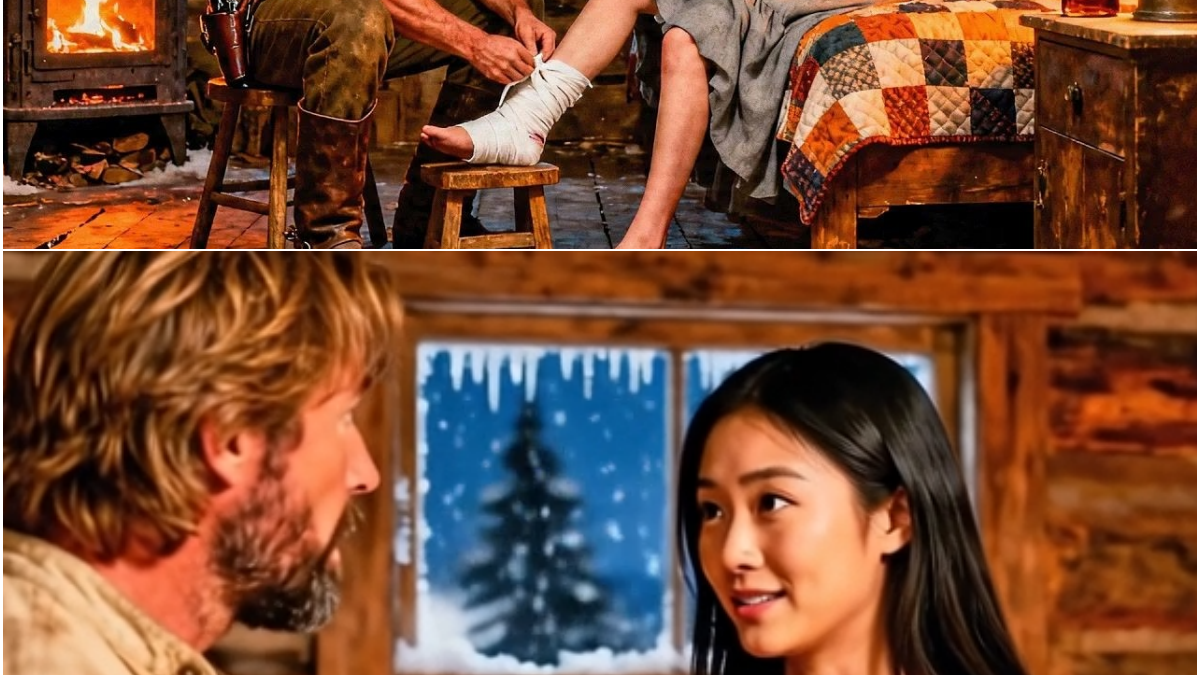
The first sound was a single nail popping from a frozen board in the cabin’s north wall, a sharp crack that seemed to split the silence.
Outside, a blizzard had swallowed the Montana territory beneath a restless ocean of snow. The wind battered the roof, rattled the shutters, and drove icy fingers through every gap in the old timber.
Arthur Hayes sat beside his stove, listening, because in the wilderness even the smallest sound could carry a warning.
At twenty eight, he had already spent three winters trying to make a life on the 160 acres granted to him under the Homestead Act.
His cabin was little more than a stubborn shelter against the land, and his supplies were running low.
The year was 1883, and this winter had tested every ounce of his patience. Then came another sound.
A thin, wavering cry rose above the wind and vanished. Arthur stared at the door.
Whatever waited outside, the storm had already made reaching it a dangerous undertaking. He knew the frontier offered no reward for foolish bravery, and he had learned that surviving often meant refusing to take unnecessary risks.
But the cry came again, weaker than before, and something inside him would not let it fade unanswered.
He pulled on his coat, wrapped a scarf across his face, and reached for his lantern.
He had no idea who was calling, or what answering that voice would demand of him.
He only knew he could not remain inside and pretend he had heard nothing. What lay beyond his door would change everything.
Arthur leaned his shoulder against the cabin door and pushed. The drift outside had packed tightly against the lower boards, and for several moments the door refused to move.
He braced his boots against the floor and shoved again. When the opening finally widened, the storm rushed inside with such force that the flames in the stove bent sideways.
Snow scattered across the floor. Arthur pulled the door shut behind him, leaving only a narrow passage through which he could fight his way into the blizzard.
The lantern offered almost no help. Its small flame trembled behind the glass, illuminating only a few feet of swirling snow.
Beyond that circle, the world had disappeared. Arthur lowered his head and followed the faint cry, moving slowly so that he would not lose his direction.
The wind pushed against his chest, and the snow reached above his ankles in places, forcing him to lift each foot with effort.
He knew the ground around his homestead well. He knew where the land rose slightly toward the fence and where the shallow drainage cut through the grass.
Even so, the storm made familiar distances seem strange. His cabin vanished behind him almost immediately, and he began counting his steps to keep from wandering too far.
Near the fence line separating his claim from the holdings of the Sterling Cattle Company, he noticed a dark shape beneath a fresh drift.
At first he thought it was a fallen branch. Then the shape moved. Arthur dropped to his knees and brushed away the snow.
A woman lay on her side, her gray prairie dress stiff with ice. One arm covered her head, and her dark hair was tangled against her cheek.
Her other hand clutched a small leather satchel so tightly that he had to work carefully to loosen her fingers.
He touched her neck and found a faint pulse. “Can you hear me?” Her lips moved, but no words came.
Arthur slipped one arm beneath her shoulders and another beneath her knees. She was so slight that he could lift her without the struggle he had expected, but her weight shifted awkwardly when he stood.
A quiet sound escaped her, and he tightened his hold. “Stay with me,” he said.
“I’m getting you inside.” The walk back was worse than the journey out. The woman’s head rested against his shoulder, and he had to keep one arm firmly beneath her while using the other to steady himself.
The lantern was no longer useful, so he abandoned it and relied on memory. He felt for the slope leading toward his porch and moved one careful step at a time.
When his boot struck the edge of the wooden platform, relief nearly took his strength from him.
He stumbled up the steps, pushed the door open, and carried the woman inside. The wind followed them into the room before he managed to shut the door and drop the heavy bar into place.
The cabin seemed unusually quiet after the storm’s roar. Arthur stood for a moment, breathing hard, then carried her to his narrow cot.
Her clothing was frozen and damp. He removed the outer layers as carefully as he could, keeping the blanket close and protecting her from the cold air.
He wrapped her in the thickest wool he owned and moved the cot nearer to the stove.
Only then did he see her ankle. It was swollen badly, bent at an unnatural angle beneath the fabric.
The skin around it had begun to darken, and Arthur understood that the injury was serious.
He knew how to treat a horse’s strained leg and how to bind a cut, but he had never set a person’s broken bone.
There was no doctor nearby. The roads were buried, the nearest settlement was far beyond the storm, and he could not leave her alone to search for help.
He had to do what he could with the supplies in his cabin. He took his whiskey from the cupboard and poured a little onto a clean rag.
He used it to wash the dirt from the scrape near her ankle, then searched for two straight pieces of kindling that could serve as splints.
From an old shirt he tore several long strips of cloth. The woman remained still while he prepared everything.
Her breathing was shallow, and her face was pale beneath the dark strands of hair that had begun to thaw.
Arthur knelt beside the cot. “This is going to hurt,” he warned her, though he was not sure she could understand.
He placed his hands carefully around her lower leg and tried to align the injury.
The moment he moved it, she cried out and opened her eyes. They were dark, alert, and filled with pain.
For an instant she seemed unable to understand where she was. Then her gaze moved from Arthur’s face to the kindling and strips of cloth beside him.
“Your hands,” she whispered. “What about them?” “You must hold the leg steady.” “I’m trying.”
“The top strap,” she said, her voice rough but controlled. “It must be tighter.” Arthur paused.
He had expected fear, confusion, or a plea for him to stop. Instead, she was giving him instructions as if they were working together on an ordinary task.
He tightened the cloth. “Here?” “Higher. There.” He followed her direction and secured the splints.
She watched every movement, occasionally telling him when to adjust the pressure. When he finished, her eyes closed, but her breathing seemed steadier.
Arthur sat back on his heels. He had rescued a stranger from a snowdrift, but he was beginning to suspect that she was not the helpless traveler he had imagined.
For the next two days, the blizzard kept them inside. Snow pressed against the windows, and the wind continued to howl around the cabin.
Arthur rationed the wood, keeping the stove hot enough to warm the room without wasting his dwindling supply.
He melted snow for water, prepared thin broth, and checked the woman’s bandages whenever she allowed him.
Her name, he learned, was Lynn. She learned his name was Arthur Hayes, and that his homestead lay near the edge of the Sterling Cattle Company’s land.
Their conversations were brief at firSt. She asked for water, thanked him for the broth, and occasionally requested that he move a chair or bring her satchel closer.
But she watched everything. She noticed the worn handle of his skillet, the patched seam in his coat, and the three books arranged on the shelf beside the window.
She observed the way he checked the stove before sitting down and how he kept his tools in a precise order.
She asked how long he had lived on the claim and whether the soil was suitable for crops.
Arthur answered as best he could, sometimes wondering why a woman recovering from such an injury was interested in the condition of his land.
She never complained about the pain, though he noticed the tension in her face when she shifted.
She spoke little, but when she did, her words were deliberate. Her quietness did not feel like shyness.
It felt like careful attention. On the third morning, the wind finally weakened. The sky cleared, and sunlight spread across the drifts.
The world outside looked almost peaceful, with the snow lying smooth over the fields and the fence posts appearing like dark marks on a blank page.
Arthur stepped outside to inspect the damage. The door was nearly buried, and several sections of fence had disappeared beneath the drifts.
His woodpile had been scattered, and the roof needed checking. He was examining the porch when he noticed a rider moving slowly across the white ground.
The man wore an expensive leather coat and sat straight in the saddle. Arthur recognized him before he reached the fence.
Jedediah Sterling owned much of the valley. His cattle company controlled broad stretches of grazing land, and his business interests reached into the town, the freight contracts, and the local bank.
He was known for speaking politely even when he was making a threat. His wealth gave him influence, and his influence made many people careful around him.
Arthur returned to the cabin and took his place near the door. His shotgun rested within reach.
Sterling dismounted and walked toward the porch. Snow clung to the edges of his coat, but he seemed unconcerned by the cold.
He knocked with his knuckles, not waiting long enough for the sound to fade before Arthur opened the door.
“Hayes,” Sterling said with a pleasant smile. “Quite a blow we had.” “It was.” Sterling’s gaze passed over Arthur’s shoulder and settled on Lynn.
She was sitting upright on the cot, wrapped in the wool blanket. Her injured leg was supported by the splints, and her satchel rested beside her.
“Well, now,” Sterling said. “Looks like you found one of my strays.” Arthur said nothing.
“I had a girl run off from the ranch kitchen two days ago. Ungrateful thing.
I expect she’s been making trouble for everyone who crosses her path. I’ll take her off your hands.”
Lynn’s fingers tightened around the blanket. “She isn’t a stray,” Arthur replied. “Her leg is broken.
She’s under my care.” Sterling’s smile remained for a moment, but the warmth vanished from his eyes.
“Is that a fact?” “Yes.” The two men held each other’s gaze. Arthur knew Sterling had the money and connections to make life difficult for a man with a small claim.
He also knew that refusing him could bring trouble that would reach far beyond the cabin.
Sterling looked at Lynn again. “You’ve had enough trouble, young lady. Come along and we’ll settle this properly.”
“I’m not going with you,” Lynn said. Her voice was quiet, but it carried clearly through the room.
Sterling’s expression hardened. “Have it your way, Hayes,” he said at laSt. “But don’t say I didn’t warn you.
Some things are more trouble than they’re worth.” He turned and walked back to his horse.
Arthur watched him mount and ride away, following the same trail he had taken toward the cabin.
When Sterling disappeared beyond the fence, Arthur closed the door. His heart was beating faster than he wanted to admit.
“He’ll be back,” he said. “I know,” Lynn answered. Arthur turned toward her. “Why does he want you?”
She looked at him for a long moment. The light from the window fell across her face, showing the strain that the last few days had placed on her.
At last, she reached for her satchel. “My father was Wei Jin,” she began. “He was a merchant in San Francisco.
He came to this country with very little and built his business through the railroad trade.
He was careful with money, and he understood how men like Sterling think.” She opened the satchel and removed an oilskin pouch.
Inside was a folded document, thick and official, with a wax seal and elegant writing.
“My father did not trust men who believed that wealth gave them the right to control everyone around them,” she continued.
“He called them paper tigers. They make a great show of strength, but much of their power depends on people being too frightened to challenge them.”
She held out the document. “A year ago, my father bought the Rocking W Ranch.”
Arthur stared at her. The Rocking W was the largest ranch in the state, with more than 50,000 acres of grazing land.
Its water rights controlled a substantial part of the valley, and its pastures supported herds that could compete with any operation in the territory.
Sterling had wanted the property for a decade, but its ownership had remained beyond his reach.
Arthur carefully unfolded the paper. The territorial seal was clear. The deed identified Wei Jin as the grantee, and a witnessed transfer established that the property would pass to his sole heir, his daughter, Lin Wei.
Lynn watched him read. “My father passed two months ago,” she said. “I came here to take possession of the ranch.
Sterling welcomed me at firSt. He offered to buy the property for a tenth of its value and said a woman like me could not possibly manage such an operation.”
“And you refused.” “Yes.” She explained that Sterling had then begun working against her. He had persuaded the ranch foreman to cooperate with him, turned several of the hands against her, and used his business connections to interfere with supplies.
Every ordinary task had become difficult. She could not rely on the people who were supposed to help her, and she could not be certain which messages or deliveries were being delayed.
She had decided to ride to Bozeman and send a telegram to her father’s lawyer in San Francisco.
Before she could reach the town, Sterling’s men had intercepted her. They rode on either side of her horse, forcing it away from the main trail and toward the hills as the storm approached.
“They knew the weather was coming,” Lynn said. “They kept pushing me farther from the road.
When the snow grew heavy, they turned back.” Arthur looked again at the deed. He understood now why Sterling had come so quickly.
Lynn was not a runaway kitchen worker. She was the legal owner of the property he had spent years trying to acquire.
Her arrival threatened his influence over the valley, and the men who had driven her into the storm had expected the problem to resolve itself without further effort.
Arthur folded the deed and handed it back. “Do you have proof of what they did?”
“I have the document, and I remember their faces. My father’s lawyer will know what to do once I can reach him.”
“Then we need to get you to Bozeman.” “My leg will not carry me there.”
“Not yet,” Arthur said. “But we can prepare.” He moved toward the stove and began thinking through the supplies they would need.
He had a horse, a small amount of feed, and enough ammunition for the shotgun.
His own claim was barely established, and he could not afford a long journey or a prolonged dispute with Sterling.
Yet the choice had already been made when he refused to open the door and hand Lynn over.
That evening, Arthur cleaned his shotgun at the small table. The metallic clicks sounded loud in the quiet cabin.
Lynn watched him from the cot. “You should have let him take me,” she said.
Arthur kept his eyes on the weapon. “No, I shouldn’t have.” “He will ruin you.”
“He can try.” “He owns the town, the freight contracts, and the bank. He can make sure your claim fails.
He can make sure no one will sell you supplies or buy what you grow.”
Arthur set the cloth aside. “Why does he believe he can take the ranch from you?”
“Because he thinks no one will help me. He believes my father’s money and documents mean nothing here unless I have people willing to stand beside me.”
Arthur considered that. “Then he has made a mistake.” Lynn studied him in the lamplight.
He was not a grand man, nor did he speak like someone accustomed to giving orders.
His coat was patched, his hands rough, and his cabin small. But there was a firmness in his expression that she had noticed from the moment he carried her inside.
“You have very little to lose,” she said. “I have my land.” “And your home.”
“Yes.” “Your future?” Arthur looked toward the window, where the darkness had settled over the snow.
“I was trying to build one,” he said. “I suppose I still am.” For a while, neither spoke.
The stove crackled, and the cabin settled around them. The next afternoon, two riders appeared near the fence.
Arthur saw them from the window and stepped outside, carrying an axe. The men were familiar faces from Sterling’s operation, both broad shouldered and confident in the way of people accustomed to having others move aside.
They stopped their horses near the porch. “Sterling sent us,” one said. He spat into the snow.
“He heard one of his prize heifers might have wandered this way. We’re going to have a look around your place.”
“There are no cattle here,” Arthur replied. “We’ll be the judge of that.” The second rider swung down from his saddle and started toward the lean-to.
Arthur shifted his grip on the axe. “You can look at the fence from where you’re standing,” he said.
“You’re not going into my cabin.” The first man laughed. “Your cabin? You’re on Sterling’s land as far as he’s concerned.”
“It’s my claim.” “Not if he decides otherwise.” The second man took another step. Then a metallic sound came from the cabin.
A rifle lever moved, and a cartridge slid into place. Both men stopped. Lynn stood in the doorway, leaning carefully against the frame.
Arthur’s Winchester was in her hands. Though her leg was injured, her posture was steady, and the rifle rested with a familiarity that made the men reconsider their approach.
“I believe,” she said calmly, “you have reached the end of your trail. Turn around.”
The riders looked at one another. They had expected a solitary homesteader and a woman unable to defend herself.
They had not expected her to be armed, alert, and willing to meet them without hesitation.
The first man pulled his horse’s head around. “This isn’t over,” he muttered. “No,” Lynn replied.
“It isn’t.” The men rode away, leaving the snow churned beneath their horses’ hooves. Arthur waited until they were beyond the fence before lowering the axe.
His knuckles were white around the handle. He had been ready for a fight, but he knew how easily a confrontation could become something neither side could control.
He turned toward Lynn. “You shouldn’t have stood on that leg.” “I didn’t have much choice.”
“You could have called for me.” “I did not know whether you could reach the door before they entered.”
Arthur looked at the rifle in her hands. She held it carefully, her injured leg supported by her other foot.
“Where did you learn to handle that?” “My father believed I should understand the tools and responsibilities of the ranch.
He taught me to shoot when I was young. He also taught me to read accounts, negotiate prices, and recognize when someone was trying to deceive me.”
“You’ve had quite an education.” “He wanted me to be prepared.” Arthur took the rifle and checked it before returning it to its place.
“We’ll need more firewood,” he said. “And cartridges.” Lynn gave a small nod. It was not a declaration, but both understood what it meant.
They would face Sterling together. Over the following days, they prepared for the journey to Bozeman.
Arthur repaired the damaged fence as far as he could, gathered the scattered wood, and checked his horse’s condition.
Lynn studied the deed and the notes she had carried from her father’s business, organizing them so that she could explain the situation clearly to the lawyer.
Arthur learned that her quiet manner concealed a careful and practical mind. She understood numbers quickly, remembered details, and asked questions that revealed problems he had not considered.
She also learned that his knowledge of the land extended well beyond the boundaries of his claim.
He knew the paths through the hills, the locations of sheltered valleys, and the places where snow remained long after the rest had melted.
They began to rely on one another in ways neither had expected. When Lynn needed to move, Arthur brought the chair close and made sure her injured leg was supported.
When Arthur returned from checking the animals, she asked about the weather and the condition of the trail.
They discussed the best route to Bozeman, the supplies they would need, and the people who might be willing to help.
Their conversations grew longer. The silence between them changed from cautious observation into a comfortable understanding.
When the weather finally allowed travel, Arthur helped Lynn onto her horse. Her ankle remained painful, and she could not ride for long without resting, but the splint had kept the injury stable.
They carried the deed in an oilskin wrapping beneath Arthur’s coat and took the safest route toward town.
The journey was slow. The snow had begun to soften, and the trails were uneven.
Arthur walked beside Lynn’s horse on the steepest sections, keeping a hand near the bridle.
When they reached a sheltered place, they stopped to rest and share the food he had packed.
Lynn watched the land as they traveled. The valley looked different from the back of a horse than it did from the window of a cabin.
She noticed the broad stretches of pasture, the narrow creeks, and the low hills that protected certain areas from the worst winds.
“My father wanted the ranch to be more than a business,” she said during one of their stops.
“He wanted it to become a place where people could work without being afraid of the person who signed their wages.”
Arthur looked across the open ground. “That’s a difficult thing to build.” “Yes,” she said.
“But it can be done.” They reached Bozeman and found a telegraph office. Arthur helped Lynn inside, where she sent a message to her father’s lawyer in San Francisco.
She included the essential details, confirmed her location, and asked for assistance in establishing her authority over the Rocking W.
The reply would take time, but the message had been sent. For the first time since the storm, Lynn had a direct connection to someone who could help her challenge Sterling through formal channels.
Arthur waited beside her while she finished. He watched the clerk prepare the message and seal the record.
The simple act of sending those words seemed to change the shape of the struggle.
The lawyer’s response arrived after several days. It confirmed that the deed was valid and that the necessary documents would be sent to support Lynn’s claim.
He also advised her to contact the proper authorities about the men who had forced her from the trail.
A United States Marshal later came to the valley and began asking questions. Sterling’s local influence could not easily reach beyond the territory’s federal officials, and the attention made him cautious.
His men stopped approaching Arthur’s cabin, and the open threats became less frequent. But the matter was not settled by a telegram or a visit from the Marshal alone.
Lynn still had to take possession of the ranch, and she had to prove that she could manage it despite the efforts of those who wanted her gone.
When she and Arthur arrived at the Rocking W, they found an operation that had been weakened from within.
The old foreman had been working with Sterling, and several ranch hands had been persuaded to follow his instructions without questioning the decisions being made.
Lynn did not dismiss everyone who had been involved. She examined the circumstances, spoke with the workers individually, and separated those who had been misled from those who had knowingly helped Sterling.
She reviewed the ranch books and compared the records with the cattle counts. The numbers revealed a pattern.
The best cattle had been sold at unusually low prices to a company whose ownership was secretly connected to Sterling.
The transactions had reduced the ranch’s income while making it easier for Sterling to argue that the Rocking W was poorly managed.
Lynn closed the arrangement and demanded an accurate account of the missing revenue. She made it clear that the ranch would operate according to written records and fair agreements, not private favors.
Arthur watched her work with growing respect. She could be patient when someone was confused and firm when someone tried to mislead her.
She understood that a ranch required more than a strong fence and healthy cattle. It required reliable workers, honest accounts, sensible purchases, and decisions made with the coming seasons in mind.
When the old foreman was dismissed, Lynn offered Arthur the position. He hesitated. “I know the land,” he said.
“But I’ve never managed a place this size.” “You know how to work with people,” she replied.
“You understand the animals, the weather, and the ground. I can handle the accounts and negotiations.
We can learn the rest together.” Arthur accepted. The change was considerable. He moved from his small homestead into the main ranch house, a broad building of log and stone that seemed impossibly grand compared with the cabin where he had spent the winter.
He found the rooms spacious and the work demanding. There were cattle to count, fences to repair, supplies to order, and men to organize.
Yet the work suited him. He rose early, rode through the pastures, and made decisions based on what he saw rather than what someone else claimed.
He treated the ranch hands fairly and expected them to take responsibility for their tasks.
He worked alongside them when necessary and did not ask anyone to do a job he was unwilling to do himself.
At first, some of the men questioned whether a homesteader could direct such a large operation.
Others were uncertain about taking orders from a woman who had arrived from San Francisco and whose authority had been challenged by Sterling.
The doubts began to fade as the ranch improved. Arthur knew which pastures offered shelter from the strongest winds.
He suggested moving the herd toward the southern ground, where the slopes and natural barriers reduced exposure during the coldest months.
Lynn examined the plan and approved it after reviewing the costs and expected benefits. Sterling left much of his herd on the open plains.
When the weather turned harsh, his cattle struggled against the conditions. The Rocking W also suffered losses, but the sheltered pastures helped preserve much of its herd.
By the time the season eased, the difference was clear. The ranch hands noticed. They saw that Arthur’s practical knowledge produced results and that Lynn was willing to listen to experience while making decisions of her own.
They also saw that wages were paid fairly and that the books were kept honestly.
Respect followed, not because Lynn demanded it, but because the workers could see what their labor was building.
As spring advanced, the valley began to change. Snow retreated from the lower ground, creeks filled with fresh water, and green shoots appeared across the pastures.
The fences that had been buried beneath winter drifts became visible again. The ranch resumed its ordinary rhythm, though the memory of Sterling’s interference remained.
Arthur’s old homestead still stood on its 160 acres. He visited it occasionally to check the cabin and maintain the property.
The place looked smaller than he remembered, but he no longer regarded it as a symbol of his failure.
It had been the beginning of a life he had not known how to imagine, and it had brought Lynn into his path.
One warm afternoon in May, Arthur stood on the porch of the Rocking W’s main house, repairing a warped step.
The board had lifted at one end, and he was setting it back into place with a hammer and a handful of nails.
He drove one nail into the wood, then another. Each strike landed cleanly, securing the board against the frame.
The sound reminded him of the winter night when a nail had popped from the north wall of his cabin.
At the time, he had heard it as another warning from a place that seemed determined to wear him down.
Now the hammer’s steady rhythm sounded different. It was the noise of a repair completed, of something made stronger through patience and work.
Lynn came out onto the porch and stood beside him. Her leg had healed well, though a slight limp remained when she walked too quickly.
She had refused to let the injury define her, and she continued to exercise it carefully, determined to regain her full strength.
She looked out over the pasture. The grass rolled toward the distant hills, and cattle grazed in the open sunlight.
Beyond the fence, the valley stretched beneath a clear sky. “My father always said this land was a promise,” she said.
Arthur set the hammer down. “What kind of promise?” “That it could provide a future for people who were willing to care for it.
Not only for the person whose name appeared on the deed, but for everyone whose work helped keep it alive.”
Arthur looked across the ranch. He thought of the men repairing fences, the families living in the valley, and the people who depended on the cattle trade.
The property was large, but its value was not measured only in acres or water rights.
It was also measured in the lives connected to it. “I think he was right,” he said.
Lynn turned toward him. “When I first arrived, I believed I had to prove I could manage the ranch alone.
I thought accepting help would make my position weaker.” “And now?” “Now I understand that a person can hold responsibility without carrying every burden alone.”
Arthur smiled slightly. “That sounds like something worth remembering.” “It is.” They stood together for a while, watching the sunlight move across the pasture.
Their partnership had begun with a decision made in a blizzard, when Arthur had opened his door to someone he did not know.
Since then, it had grown through difficult conversations, shared work, and the steady discovery of each other’s strengths.
He had learned that Lynn’s calmness was not passivity. It was discipline. She had learned that his stubbornness was not simply pride.
It was a refusal to abandon people when they needed help. Neither had planned for their lives to become connected.
Yet each had found in the other something that had been missing. Arthur had spent years believing that independence meant doing everything himself.
Lynn had spent much of her life preparing to prove that she could carry responsibility without assistance.
Their experience had shown them a different kind of strength, one that depended on trust rather than isolation.
Two weeks later, they stood before the circuit preacher in the small clapboard church in town.
The building was simple, with plain wooden pews and windows that let the afternoon light fall across the floor.
The congregation included the Rocking W ranch hands, their families, and several small homesteaders from the surrounding valley.
Some had known Arthur for years as the quiet man who kept to his own land.
Others had come to know Lynn through the changes she had brought to the ranch.
They had gathered not to celebrate wealth or influence, but to witness a promise between two people whose lives had become closely joined.
Lynn wore a simple blue dress. Arthur wore a suit that felt stiff around his shoulders and unfamiliar at the collar.
He had spent more time repairing fences than preparing for formal occasions, and he was relieved when the ceremony began.
Their vows were spoken clearly. They promised to stand beside one another through changing seasons, to share responsibility, and to treat their home as something built through mutual care.
When the preacher pronounced them husband and wife, the congregation rose in quiet celebration. The ranch hands smiled, and several of the homesteaders exchanged approving looks.
Lynn’s expression softened as Arthur took her hand. They walked out of the church into the Montana sunlight.
The air was warm, and the road beyond the doorway was dry beneath their feet.
The valley lay open before them, its hills green with spring and its distant ridges still marked by patches of snow.
Their marriage did not erase the difficulties ahead. The ranch would still face uncertain weather, changing markets, and the ordinary demands of running a large operation.
Sterling remained wealthy, and the influence he had built over many years would not disappear simply because one property had escaped his control.
But the Rocking W had a different direction now. Its decisions would be made through honest accounts, practical judgment, and a willingness to listen to the people who worked its land.
Arthur and Lynn intended to protect that principle as carefully as they protected the ranch itself.
For Arthur, the winter had begun with a sound that seemed to announce another setback.
A nail had loosened in his cabin wall, and the cold had made every weakness feel permanent.
Yet the cry beyond his door had drawn him into a decision that changed the course of his life.
He had gone outside expecting only to bring a stranger into shelter. Instead, he had found a partner whose courage matched his own, though it took a different form.
Together they had faced a man who believed that property and influence gave him the right to decide other people’s futures.
They had answered that belief not with grand speeches, but with steady action. Arthur had offered shelter when it was dangerous to do so.
Lynn had refused to surrender what was legally hers. They had trusted each other when the outcome remained uncertain, and they had built a future through work rather than intimidation.
As they walked away from the church, Arthur glanced toward the hills. The land seemed vast, as it always had, but it no longer felt like an ocean surrounding a solitary island.
There were people beside him now, and a home waiting beyond the road. Lynn squeezed his hand.
“Are you thinking about the cabin?” She asked. “Yes.” “What do you remember?” “The storm,” Arthur said.
“The sound of that first nail. And the moment I decided to open the door.”
“What do you think would have happened if you had stayed inside?” Arthur considered the question.
He could not know how the night would have unfolded, or what path either of them might have taken.
He only knew that the choice had mattered. “I think I would have kept my cabin,” he said.
“But I might never have understood what a home could become.” Lynn looked at him, and the quiet smile she gave him carried more meaning than a long speech.
They continued down the road together, toward the ranch and the life they had begun to build.
Behind them, the church door closed gently. Ahead, the valley opened beneath the bright Montana sky.
The land had offered them no guarantee, and neither expected an easy future. But they had learned that a promise was not something secured by a deed alone.
It was something renewed through every decision, every shared burden, and every act of truSt.
And when the next winter came, they would meet it together.
Disclaimer: This content may be created by Al for entertainment purposes. Any resemblance to real persons, events, or places is coincidental.








