“Come Back When You’ve Arrested a Real Man,” He Said—Calamity Jane Returned With the Mayor in Irons
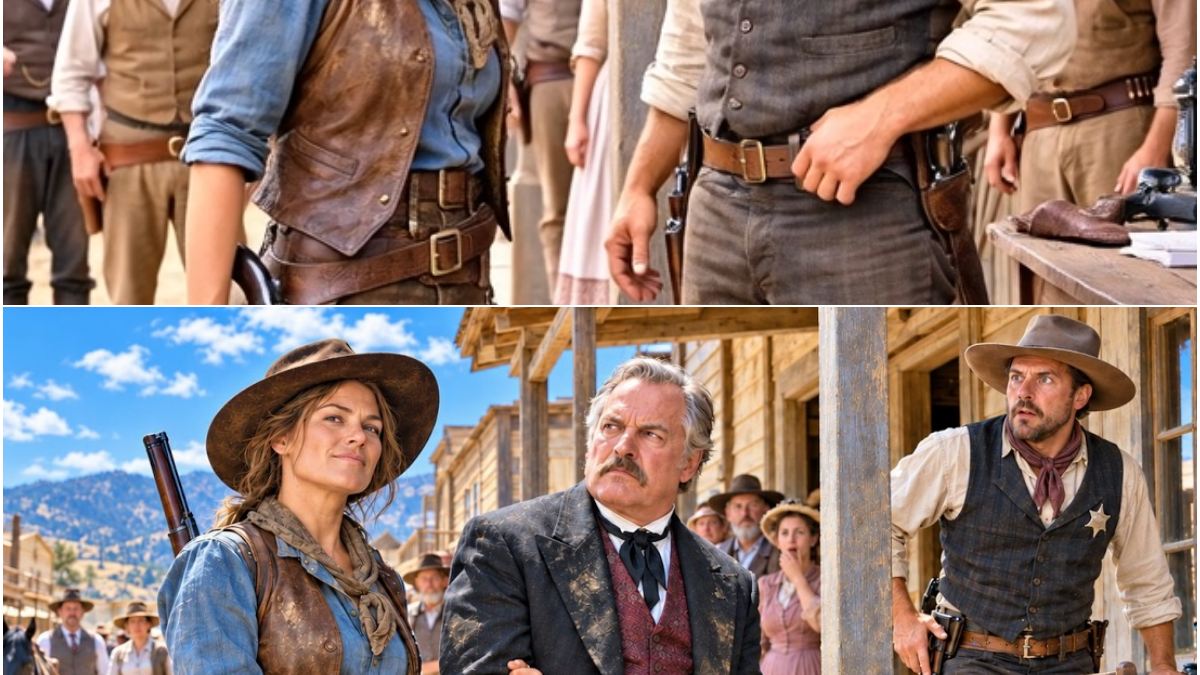
The Cheyenne coach sat crooked across the road as if it had tried to escape the ground itself and failed.
One door hung open. The team was gone. A wheel had dropped deep into the soft shoulder, and three men lay silent in the grass beside the wreck.
Half of Sherman Gulch had already ridden out to see what had happened, yet nobody had bothered to look beyond the obvious story waiting in the duSt.
Martha Jane Canary stopped her horse forty feet from the coach. That distance was enough to annoy everyone.
Men had climbed over the road, crossed through the grass, opened the strong box, and searched around the bodies for anything worth finding.
They had walked across nearly every track the coach had left behind. “Stay out of the tracks,” Jane said.
A miner looked at her and laughed. “What tracks?” Jane did not answer him. She dismounted and walked toward the strong box.
Its lid stood open. The lock had been forced. The inside was empty. She crouched and touched the bottom with two fingers.
When she lifted them, a gray powder covered her fingertips. Jane rubbed it slowly between her thumb and forefinger.
Lead. She looked at the empty box again. Nine thousand dollars in gold should have weighed roughly thirty pounds.
Lead could weigh almost exactly the same. Three men were lying in the grass, a strong box supposedly emptied of gold, and gray dust where the coins should have been.
What if the gold had never been inside that box at all? Sherman Gulch would need three days to learn why that question mattered.
The summer of 1876 had made Sherman Gulch a place where rumors traveled faster than horses.
Four hundred men lived there among a scattering of women, two hundred tents, rough cabins, supply sheds, and a sawmill that seemed to operate from dawn until long after the sun disappeared behind the Black Hills.
The main street changed character with the weather. After rain it became mud deep enough to swallow a boot.
After several dry days it turned to powder that climbed into clothes, saddles, blankets, and lungs.
The camp had grown quickly because people believed there was wealth beneath the surrounding hills.
It had also grown faster than formal government could keep pace. The Black Hills belonged to the Lakota under the Fort Laramie treaty of 1868, yet miners continued arriving after reports of gold spread through the region.
Settlements appeared almost overnight. Camp officials were chosen because somebody had to settle arguments. Rules were written because somebody had to enforce them.
Courts appeared because people wanted disputes decided before they became something worse. Sherman Gulch had Dolph Wexler.
They called him mayor because somebody had to be called something. Wexler owned the general store, the freight yard, the scales, half the storage buildings, and enough notes from struggling miners to make him one of the most influential men in camp.
If someone needed flour and did not have enough money, Wexler could extend credit. If a freighter needed a place to store goods, Wexler had a building.
If a miner needed a mule, Wexler usually knew where one could be found. He remembered every debt.
He also remembered every favor. He never seemed to hurry. His cuffs were clean even when everyone else looked as though they had slept in a dust cloud.
He shaved every morning. His boots were polished. His shirts were changed often enough that people noticed.
Wexler rarely shouted. He did not need to. Other men shouted for him. That morning, he stood outside the assay office while Sherman Gulch gathered around him.
The only man from the coach who had survived the attack was Sim Kesler, a forty four year old shotgun messenger and freighter out of Sydney.
Jane had known Sim for years. They were not close enough to call each other friends, but she knew the way he handled horses.
She knew he never overloaded a team when the road was bad. She knew he treated hired animals better than some men treated their own families.
Two winters earlier, Sim had pulled one of Jane’s wagons out of a flooded crossing.
He had refused payment. Now he sat in a wooden chair with a bandage around his head and stared at the ground.
Wexler had already decided what the camp should believe. The payroll had been stolen. Three men had been attacked.
Sim was the only man left alive. Therefore, according to the crowd, Sim had done it.
Jane watched the faces around the assay office. Most people were not interested in evidence.
They wanted certainty. Wexler raised one hand. “Three days,” he announced. His voice carried easily across the street.
“Three days for anyone to bring forward evidence. Three days for Sim Kesler to remember something useful.
If nothing changes, we settle the matter at noon on the third day.” Nobody challenged him.
Nobody volunteered to search for the men who had actually carried out the attack. The crowd seemed satisfied.
Jane was not. She walked over to Sim. “You remember any faces?” Sim slowly shook his head.
“Nothing after the second bend.” “Anything before?” He closed his eyes. “Somebody hit me.” “Where?”
“Back of the head.” “Before the coach stopped?” “I think so.” “You see who?” “No.”
“Gunshot before or after?” Sim squeezed his eyes shut. “I don’t know.” Jane crouched in front of him.
“Don’t make yourself remember what ain’t there.” Sim opened his eyes. “That’s a strange thing to hear from the only person asking.”
Jane stood. She understood something the others had missed. If Sim had been struck before the coach stopped, he might never have seen the people responsible.
That meant his lack of memory was not proof of guilt. It could have been proof that someone wanted him unable to speak.
Jane returned to the road. Most of the tracks had been destroyed by the crowd.
MoSt. She followed the road away from the coach until she reached the second bend.
There she found four separate horse tracks turning southweSt. Not southeast toward Cheyenne. Not north toward Deadwood.
SouthweSt. Jane knelt. One horse had a cracked left front shoe. It dragged a quarter inch through the dirt with every stride.
Six years around freight teams had taught Jane to notice small things. A horse with a damaged shoe left a signature.
She followed the trail for nearly an hour. The riders had not been fleeing. That was the second thing that bothered her.
Men running from pursuit usually left disorder behind them. Horses were driven too hard. Tracks scattered.
Packs shifted. Equipment fell loose. Riders took the easiest ground regardless of where it led.
These riders had done none of that. They had moved steadily. They had known where they were going.
Before she left the coach road, Jane returned to Sim’s shotgun. It had been found twenty yards away.
One barrel was empty. The other remained loaded. At first glance, that looked suspicious. Jane lifted the weapon.
She smelled the empty barrel. The powder was old. Very old. She searched the coach and found one paper shell wrapped in the same newspaper Sim used for the cartridges he normally carried.
Jane remembered his habits. Sim fired one barrel two days earlier near Kuster to clear rabbits from the roadside.
The second barrel had remained loaded. Someone had placed the shotgun near him afterward, or moved it after the attack.
That did not tell Jane who had done it. It told her the story being repeated in Sherman Gulch was incomplete.
She found Sim again before leaving. “Your shotgun was fired before yesterday.” Sim looked up.
“Rabbit outside Kuster two days back.” “One barrel.” “One barrel.” “The other is still loaded.”
“It should be.” “It is.” Sim studied her face. “You believe me?” Jane adjusted the borrowed rifle across her saddle.
“Doesn’t matter what I believe.” He almost smiled. “Seems to matter to me.” Jane looked toward the road.
“Then stay alive till noon day after tomorrow.” She returned to Sherman Gulch just before dark.
She bought hardtack with money she could barely spare and borrowed a rifle from a freighter.
The man looked at her as she checked the weapon. “Where are you going?” “Out.”
“Out where?” “If I knew, I wouldn’t need the rifle.” He laughed once and handed it over.
Jane packed coffee, hardtack, a water skin, and ammunition. She left without telling Wexler. The tracks were easy to follow until the ground hardened.
Jane slowed her horse. That was the first mistake impatient men made. They followed trails at the speed they wanted rather than the speed the people before them had traveled.
Jane followed the horses. The cracked shoe turned north at a dry creek. The trail did not lead toward Cheyenne.
It did not lead toward another mining camp. It led toward empty country. By late afternoon, Jane saw the remains of Willow Crossing.
A telegraph pole stood beside the road with no wire attached. Beyond it sat an abandoned relay station.
The main road had been changed months earlier, leaving the station unused. Jane studied the place from a distance.
Men carrying nine thousand dollars in stolen gold did not usually ride to an empty station simply because they liked the view.
Men went to empty places when somebody had told them to wait. Jane camped two miles away that night.
She did not light a fire. Her horse shifted several times. Coyotes called somewhere north of her position.
Jane slept lightly and woke three times. Each time she listened. Nothing moved. At first light, she climbed to high ground west of the station.
She lay flat in the dry grass and watched. Heat arrived early. Flies circled the horses near the small corral.
Jane ignored the sweat running beneath her hat. Four horses. One favoring a front foot.
Three men. That was wrong. Four riders had left the coach road. Only three men were here.
Somebody was missing. Jane watched for nearly an hour. Two men played cards on the porch.
The third moved in and out of the relay station. They were comfortable. That told her more than their weapons did.
Men expecting trouble kept guns close. One rifle leaned against a wall several feet away from the card table.
The man inside carried a shotgun, but left it near the doorway. They had been told to wait.
Jane considered returning to Sherman Gulch. Sixty miles. She could tell four hundred people that the trail went southweSt.
She could explain the gray powder. She could show them the four horse tracks. She could tell them three armed men were waiting at Willow Crossing.
None of it guaranteed Sim would still be alive when she returned. Jane stayed in the grass for another ten minutes.
Then she stood. She led her horse down the western slope. The sun was behind her.
Anyone looking toward her had to stare directly into the glare. One of the men noticed her at sixty yards.
He stood. His hand moved toward his gun. Jane raised the rifle. She did not aim at him.
She fired into the porch post beside his head. Wood exploded across his face. He dropped behind a water trough and overturned the card table.
The second man ran toward the corner. The third burst from the station with a shotgun.
Jane fired again. The bullet struck the door frame beside his head. He vanished back inside.
Jane stopped in the open. “One woman,” she called. No answer. “One rifle.” Silence. “Twenty men on the ridge.”
There were no twenty men. There were no men at all. But the lie worked because Jane had made herself visible.
Nobody standing alone in the open in front of three armed men should have been standing there unless somebody else was watching.
The man behind the trough looked toward the ridge. He could not see it clearly through the glare.
Jane saw doubt cross his face. That hesitation was enough. Two men ran. They took unsaddled horses through the rear of the corral.
Jane let them go. She had learned long ago that chasing armed men across open country was a poor trade when you were alone.
The third man stayed. He came around the corner with a revolver. Jane fired once.
The revolver fell from his hand. He collapsed against the wall and stopped moving. Jane waited.
Then she approached from an angle with the rifle ready. She did not celebrate. She did not say anything.
She simply stepped into the relay station. There was no gold. There was food. Whiskey.
Four bedrolls. A canvas money sack. Jane opened the sack. Lead shot spilled across the floor.
Nearly thirty pounds. She stared at it. The weight was close enough to fool anyone lifting a strong box without opening it.
She searched the room again. Under one cot she found two spare cartridges wrapped in newspaper.
Inside a crate she found a harness buckle bearing the mark of Wexler’s freight yard.
Then she searched the coat of the man who had stayed behind. A folded warehouse receipt was hidden inside the inner pocket.
Jane opened it. Sherman Gulch. Wexler Company. Thirty pounds of number four lead shot. August 9th.
Jane read the date twice. The coach had left Sherman Gulch on August 12th. Three days later.
She sat on the porch with the receipt in her hand. The lead had come from Wexler’s freight yard.
It had been prepared to imitate the weight of the payroll. The strong box at the coach had not carried nine thousand dollars in gold.
It had carried lead. The real money had been somewhere else. Jane looked toward the fourth horse.
Four riders had left the coach road. Three men had waited at Willow Crossing. The fourth rider had disappeared.
He had the real payroll. That was the piece that remained beyond her reach. But Sim had only one day left.
Jane packed the evidence. She started back. She rode hard without riding foolishly. A dead horse proved nothing.
She changed pace every few miles. She walked the steep ground. She watered carefully. She slept for two hours before dawn on the second night.
Then she rode again. At ten in the morning on the third day, Jane saw Sherman Gulch.
She had two hours. The camp had already built the structure it claimed was necessary.
A rope hung from the sawmill crane. A wooden box stood beneath it. Simple things became frightening when an entire crowd agreed what they meant.
Sim stood outside the assay office under guard. His face looked worse. The bandage around his head had darkened.
But he was standing. That mattered. Jane did not ride directly to him. She rode past Sim.
Past the sawmill. Past the rope. She stopped in front of the assay office where Wexler could not pretend not to see her.
Across her saddle lay the canvas money sack. She dropped it into the duSt. The sound was heavy.
Conversation stopped. Jane held up the warehouse receipt. “I need somebody who reads better than I do.”
A few miners laughed. Jane looked toward the freight yard. “Abel Tumi.” The seventeen year old yard clerk stepped forward reluctantly.
Ink stained two of his fingers. Jane handed him the receipt. “Read it.” Abel looked at Wexler.
Then he looked at the paper. His voice shook on the first line. By the third line, it had steadied.
“Wexler Company. Thirty pounds number four lead shot. August ninth.” The street became quiet. Jane opened the canvas sack.
Lead shot spilled into the duSt. A miner crouched and touched it. Another man stared at the receipt.
“Could have come from anywhere,” someone said. Jane looked at him. “The receipt didn’t.” That ended the laughter.
Dolph Wexler came down the steps. His hands remained in his pockets. He smiled. “My paper, certainly.
I sell lead. I sell rope. I sell coffee. That does not mean I robbed a coach.”
Jane said nothing. Wexler looked around. “Somebody bought shot from my yard. You found a receipt on a man who cannot answer questions.
Congratulations.” The crowd began murmuring again. Wexler knew exactly how to regain control. He looked directly at Jane.
“Jane, come back when you have arrested a real man.” He turned toward the assay office.
Jane watched him disappear inside. The clock showed 10:15. Sim had less than two hours.
Jane stood still for ten seconds. Then she stopped trying to make Sherman Gulch believe her.
She went looking for something that did not require belief. She found Abel in the freight yard.
He was putting the receipt away. “Who took the lead?” “I don’t know.” Jane shook her head.
“Wrong question.” Abel looked confused. “Who carried it?” He stared at her. Thirty pounds of lead did not leave a warehouse by itself.
Somebody weighed it. Somebody recorded it. Somebody handed it over. Somebody watched it leave. Abel opened the yard book.
He turned several pages. Then stopped. His own handwriting covered the entry. August 9th. Thirty pounds of lead shot.
Removed on Wexler’s verbal order. No customer charged. Loaded onto Wexler’s small freight wagon. Returned empty before dark.
Abel went pale. “He never reads this book.” “Good.” Jane closed it. “You wrote it?”
“Yes.” “You willing to say that?” Abel looked toward the store. “To who?” Jane looked toward the main street.
Three women stood near the assay office. They were connected to the three men found beside the coach.
Jane walked to them. She did not make a speech. She placed the receipt beside the yard book.
She explained the lead. She explained the four riders. She explained that Sim had been struck before he could see who had attacked the coach.
One woman stared at the pages. The older woman asked quietly, “Can that boy swear this is his writing?”
“Yes.” “Can Wexler say it isn’t?” “He can say anything.” The woman looked toward Wexler’s store.
“Then let him say it to me.” At 11:00, the three women walked together down the main street.
Jane followed several yards behind. The crowd opened for them. Wexler appeared in the doorway.
The first woman stopped. “Dolph Wexler, who drove your wagon on August ninth?” Wexler said nothing.
The second woman stepped forward. “Who took thirty pounds of lead from your yard?” Something changed in Wexler’s face.
It was small. But Jane saw it. The third woman spoke laSt. “Answer her.” Wexler looked past them.
He saw Abel holding the yard book. He saw Jane. He saw the crowd watching all three.
“This is foolish,” he said. Nobody answered. He stepped backward. Jane knew what he was going to do.
The back door. Wexler turned. Someone shouted. Jane was already running. Abel had one saddled horse in the freight yard.
It was fresh and stronger than Jane’s. She took it. Wexler had less than two minutes.
Jane caught sight of him before he reached the southern ridge. He fired once over his shoulder.
The shot missed. He fired again. The second round passed close enough for Jane to hear it.
Jane did not fire back. That was exactly what Wexler wanted. A bullet in his back would turn a suspected thief into a story about a woman taking the law into her own hands.
Jane kept riding. Wexler’s horse was handsome and heavy, used to short town trips. The freight yard horse was built for long days.
The distance closed. One mile. Then less. Wexler looked back too often. Every look cost him ground.
Two miles from Sherman Gulch, he tried to cut across a shallow wash. His horse stumbled on loose stone.
Wexler stayed mounted. But the mistake cost him. Jane came around the wash above him.
She rested the rifle across her lap. Wexler stopped. For several seconds neither spoke. Dry grass moved in the wind.
His revolver still had one round. Jane’s rifle had more. He looked toward Sherman Gulch.
Then toward Jane. “You kill me, they hang you.” “Wasn’t planning to.” “Then get out of my way.”
“No.” “You don’t have authority.” “Neither did you this morning.” Wexler stared at her. Jane held the rifle steady.
Finally, Wexler placed the revolver on the ground. Jane approached. She kept the rifle trained on him while tying his wrists in front.
She allowed him to keep his own horse. Then she took the reins. The ride back was quieter than the chase.
Wexler tried talking once. “How much?” Jane looked over. “For what?” “For the paper.” “You already paid for the lead.”
His jaw tightened. A mile passed. Then he tried again. “You think they care what happened to three freight men?”
Jane said nothing. “You think that crowd turns on me because of three grieving women and a boy with a ledger?”
Still nothing. Then Wexler said the one thing that told Jane he was afraid. “I can make you rich.”
Jane looked at him. Not because she was tempted. Because a man who started with confidence and ended with money had already run out of better arguments.
“Save your breath.” He did. They reached Sherman Gulch with minutes remaining. The street saw them firSt.
Jane rode into town. Wexler followed with his hands tied. Nobody laughed. Nobody needed to ask what had happened.
Wexler had told Jane to return when she arrested a real man. She had returned with him.
Several miners moved toward Wexler. Too many. Too quickly. Someone shouted for the rope. Then Sim Kesler stepped forward.
His hands were still tied. “If you hang him now, you’re fools.” The street stopped.
A miner shouted, “He framed you.” Sim looked at the rope. “You were ready to put me beneath that thing yesterday.”
Nobody answered. “You had less evidence then than you have now.” He turned toward Wexler.
“If you put him under it today because Jane brought a receipt and a yard book after you put me under it yesterday with nothing, then you ain’t learned one thing.”
Silence spread through the street. Sim looked at Jane. “Keep him alive.” Then he looked back at Wexler.
“Make him answer.” For the first time in three days, Sherman Gulch did something sensible.
Wexler was placed under guard. The rope was taken down. The crowd dispersed slowly. Some men looked embarrassed.
Others looked angry that the story they had believed had fallen apart. Jane did not care which feeling they carried home.
She went to Sim. He looked at her for several seconds. “You rode sixty miles for lead.”
“Lead was what I found.” “And a receipt.” “And a yard book.” Sim gave a weak smile.
“Seems like you brought half the camp back with you.” Jane shrugged. “Half the camp was already there.”
Over the next several days, the evidence was gathered. Abel copied the yard entries. The three women gave statements.
Sim described what little he remembered. The strong box was weighed. The lead was weighed.
The receipt was preserved. Jane returned to Willow Crossing with six men. The relay station was empty.
The two surviving riders had gone. Their saddles were gone too. The fourth rider remained missing.
So did the nine thousand dollars. That mystery never received a clean ending. The fourth rider had been ahead of Jane without knowing it.
He had carried the real payroll away from Willow Crossing. Nobody in Sherman Gulch could say where he went.
The money disappeared with him or with whoever had arranged the scheme. Wexler’s position weakened quickly once outside authorities began examining the evidence.
The local miners court could hold a person. It could not turn every accusation into a lawful conviction.
The Black Hills in 1876 were full of that confusion. The Fort Laramie treaty of 1868 had recognized the region as Lakota territory, while mining settlements continued expanding after reports of gold.
Camps created their own courts and officials because formal territorial institutions had not kept pace with the population.
That made men like Wexler powerful. It also made their power temporary. A person could be treated as guilty by a crowd one hour and face entirely different questions once the matter reached recognized authorities.
The evidence against Wexler was strong enough for a separate federal theft case. That case was easier to establish than the full story of the coach attack.
Witnesses were scattered. The missing rider was gone. The gold was gone. Two men who had been at Willow Crossing had disappeared.
What looked simple in the street became complicated in a courtroom. Wexler eventually went to prison on the federal theft charge.
He never faced a final conviction for the three men beside the coach. Sim Kesler returned to freighting.
That mattered to Jane. He went back to handling teams and taking long roads through country where a man could travel for hours without seeing another wagon.
Sherman Gulch changed after the incident. Not completely. Camps like Sherman Gulch did not transform overnight.
Men still argued over claims. Miners still gambled. Freighters still complained about prices. People still repeated rumors as though repetition could turn them into facts.
But something remained from those three days. Whenever someone suggested settling a serious accusation because everybody already knew what had happened, another voice sometimes asked whether everybody knew as surely as they had known about Sim Kesler.
That question was uncomfortable. It was also useful. A week later, the camp collected about sixty dollars for Jane.
She accepted it. She quietly gave part of it to the families connected to the men from the coach.
She never made a speech about it. Abel Tumi remembered the gesture years later. Jane did not.
She had spent too much of her life watching people decide what kind of person she was before asking what she had actually done.
There was a lesson in Sherman Gulch that she understood better than moSt. Her reputation could not solve the case.
Her word could not make the crowd believe her. Even the truth was not enough if she could not place something solid in front of people who wanted to doubt her.
So she brought them lead. She brought them a receipt. She brought them a yard book.
She brought them a clerk who could identify his own handwriting. She brought three women who were willing to stand in front of Wexler and ask questions he could not answer.
And she brought Wexler himself back into town. That was more useful than shouting. Years later, stories about Martha Jane Canary became larger than the people who had actually known her.
Some stories made her braver. Some made her tougher. Some made her almost impossible. Jane herself sometimes encouraged those stories because legends were easier to sell than complicated truths.
But Sherman Gulch remembered something simpler. A woman had walked away from a strong box that everybody believed contained gold.
She had touched the bottom. She had found lead duSt. Everyone else had seen an empty box.
Jane had seen a question. She followed that question sixty miles into empty country. She found three men at Willow Crossing.
She noticed that four horses had arrived but only three riders remained. She found a sack of lead.
She found Wexler’s freight mark. She found a receipt. She found Abel’s handwriting. Then she returned before noon.
The rifle helped. The horse helped. The borrowed ammunition helped. But none of those things solved the mystery.
Evidence did. And that was why Sim Kesler walked away from the sawmill crane that day.
The story might have ended there, but Jane never forgot the missing fourth rider. Long after Wexler was gone from Sherman Gulch, she occasionally remembered the four sets of tracks turning southweSt.
Four horses. Four riders. Three men at Willow Crossing. One missing. That fourth set of tracks had bothered her more than anything else.
A mystery left unfinished had a way of staying alive in a person’s mind. She knew the missing rider had carried the real gold.
She knew he had understood that the lead was only a decoy. She knew somebody had planned the entire thing before the coach ever left Sherman Gulch.
What she did not know was whether the fourth rider had been working for Wexler or for someone above him.
That answer disappeared into the same country where the tracks vanished. But there was another thing Jane knew.
She had not needed to solve every part of the story to prevent Sherman Gulch from making the wrong man pay for it.
Sometimes that was enough. Sometimes the best result a person could get was not a perfect ending.
It was simply stopping the next mistake before it became permanent. Sim Kesler understood that.
The three women understood it. Abel understood it. Even some of the miners eventually understood it.
Wexler never did. He had believed power meant controlling what people believed. Jane discovered that power could also mean refusing to let a crowd decide before the facts arrived.
On the afternoon she left Sherman Gulch, she stopped beside the road and looked back.
The sawmill smoke rose over the camp. The general store stood where it always had.
The freight yard was busy again. People had already returned to ordinary business. That was how frontier camps survived.
They moved on quickly. Jane mounted her horse. Sim stood near the freight yard. “You coming back?”
He called. Jane looked at him. “Depends where the road goes.” Sim laughed. Then Jane turned the horse weSt.
Behind her, Sherman Gulch returned to its noise. Ahead of her was another road, another camp, another set of tracks waiting to be noticed.
And somewhere beyond the hills, one missing rider still carried a secret worth nine thousand dollars.
Jane never knew where those tracks ended. But she knew exactly where hers began.
Disclaimer: This content may be created by Al for entertainment purposes. Any resemblance to real persons, events, or places is coincidental.








