Colombia’s Coc.aine Hippos Are a Huge Problem — And Nobody Can Stop Them
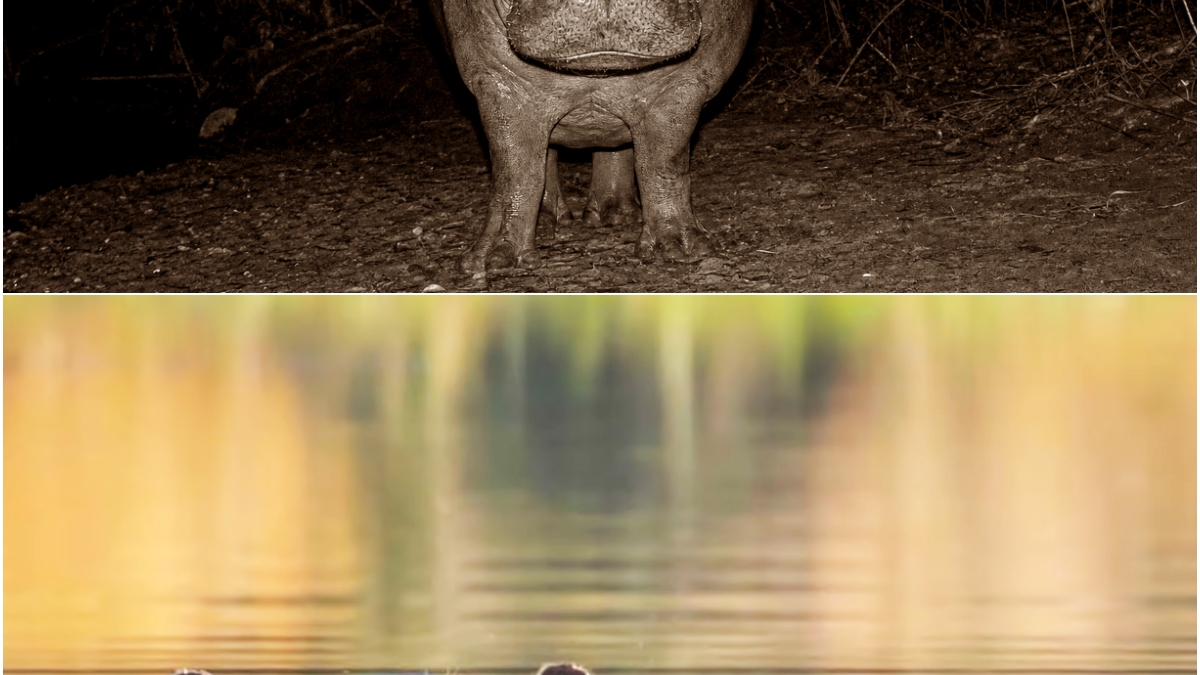
At dusk, when the last sunlight slips behind the trees and the river turns silver beneath the darkening sky, something enormous begins to move along the banks of a Colombian river.
At first, there is only a ripple in the water, a shadow beneath the surface, and the distant sound of something breathing.
Then a massive head rises from the shallows, followed by a broad back, powerful legs, and a body so large that it seems almost impossible for the river to conceal it.
A hippopotamus has come ashore to feed. But this is not Africa, and this is not a zoo.
This is Colombia, thousands of miles from the natural home of the animal now standing in the grass.
Nearby, fishermen prepare their boats for the next morning. Cattle settle beside the water. Families return home through villages where the roads run alongside wetlands that have quietly become the territory of an unexpected giant.
For years, people have watched these animals spread through the countryside, growing in number and changing the landscape around them.
They know where the hippos gather, where they cross the river, and when it is safest to stay away.
What began with four animals has become a population that may already number in the hundreds.
And while the country debates what should happen next, the hippos continue their nightly routine, feeding, swimming, resting, and reproducing.
Their original owner has been gone since 1993, but his strange inheritance is still expanding.
How did four animals become a problem that an entire country has struggled to solve, and what happens when the river can no longer accommodate them?
In daylight, the Magdalena River looks like an ordinary part of the Colombian countryside. Its broad channels wind through green landscapes, past agricultural land, small settlements, and communities whose lives have been connected to the water for generations.
Fishermen launch wooden canoes and cast their nets into familiar stretches of river. Children play near the shallows, and cattle gather along the banks to drink.
Boats move between settlements, while vehicles travel along the highways connecting the interior of the country with its larger cities.
The river is not an isolated wilderness. It is part of a landscape where people work, travel, raise families, and depend on the surrounding environment.
Yet beneath that familiar appearance, a remarkable ecological change has been taking place. An animal that evolved in African rivers is now moving through Colombian wetlands, establishing territories, raising young, and competing with native wildlife for space and resources.
The hippopotamus is not an animal that can easily be ignored. An adult male can weigh approximately three tons, with an enormous head, powerful jaws, and a body adapted for spending much of its life in water.
Despite its size, it can move surprisingly quickly over short distances, particularly when it feels threatened.
Its behavior is difficult to predict, and its territorial instincts can make close encounters dangerous.
In Africa, where hippos have lived alongside people and other wildlife for thousands of years, their presence is a familiar part of many river systems.
In Colombia, however, the circumstances are entirely different. The native ecosystem did not develop alongside hippos.
The animals have no natural population of predators capable of controlling them, and the wetlands provide abundant food and suitable places for breeding.
The result is a growing population spread across an increasingly large area. Estimates have placed the Colombian population at well over a hundred animals, with some assessments suggesting that the number may exceed 200.
They occupy rivers, lakes, marshes, and waterways connected to the Magdalena basin, moving through an environment that offers many of the conditions they need to survive.
For the people living nearby, the transformation is no longer an unusual story about an exotic animal escaping from captivity.
It has become a practical concern involving transportation, fishing, farming, public safety, and the future of the surrounding wildlife.
To understand why Colombia is facing this unusual situation, the story must return to the 1980s, when a wealthy criminal named Pablo Escobar began building a private world designed to reflect his enormous fortune.
During the height of his cocaine empire, Escobar possessed wealth on a scale that allowed him to acquire almost anything he desired.
His money supported extravagant properties, expensive vehicles, elaborate buildings, and a lifestyle that increasingly resembled that of a powerful ruler.
Among his most unusual projects was a private estate called Hacienda Nápoles, located approximately 125 miles east of Bogotá.
The property was enormous, with extensive grounds and facilities that reflected Escobar’s ambitions. He wanted more than a luxurious ranch.
He wanted a personal attraction filled with animals and objects that would make the estate unlike anything else in the region.
A private zoo became part of that vision. Elephants, rhinoceroses, giraffes, exotic birds, and other animals were brought to the property.
Among them were four hippopotamuses transported from Africa, consisting of one male and three females.
They were introduced to a landscape of warm temperatures, abundant vegetation, and numerous bodies of water.
For Escobar, the hippos were another unusual addition to an extravagant collection. For Colombia, they would eventually become the beginning of a complicated environmental problem.
When Escobar’s criminal empire collapsed and he was killed in December 1993, Hacienda Nápoles entered a new chapter.
Authorities seized the property, and the animals became part of the complicated process of dealing with an abandoned private zoo.
Many of the animals could be sold, transferred, or placed in facilities better equipped to care for them.
The hippos presented a different challenge. Their enormous size, unpredictable behavior, and aquatic habits made them difficult to capture and transport safely.
Moving them would require specialized equipment, experienced personnel, and substantial resources. Even approaching them could be dangerous.
With the country facing many other pressing concerns, the authorities did not immediately undertake a major relocation operation.
The four hippos remained on the property. At the time, leaving them in their familiar surroundings may have appeared to be a practical temporary arrangement.
They had water, food, and space. They were not wandering through towns or occupying extensive stretches of river.
Their population was small, and the immediate consequences of allowing them to remain were difficult to anticipate.
But the property was not an enclosed habitat capable of keeping them permanently contained. The hippos gradually began moving beyond the original lakes and ponds.
They explored nearby waterways and found additional places where they could rest and feed. Eventually, they reached the Magdalena River and its connected wetlands.
There, they encountered an environment that suited their needs remarkably well. The climate was warm throughout the year.
The water offered protection from the heat, while grass and other vegetation provided abundant food.
Unlike many African habitats, the region did not experience the same combination of severe seasonal drought and natural predators that can influence hippo populations.
The Colombian animals could spend their days submerged in water and their nights feeding on land.
They could travel through connected waterways and establish new territories without encountering the environmental pressures that had shaped their species in Africa.
Most importantly, they could reproduce. The original four animals had included three females and one male, giving the population a foundation for growth.
As the females matured, they began producing calves. Those calves grew up in an environment where food and water were readily available, and eventually some of the young females began reproducing themselves.
The population that emerged was not simply a collection of escaped zoo animals. It was a breeding population establishing itself outside its native range.
By 2007, the number of hippos associated with the original group had increased to approximately 16.
That same year, Hacienda Nápoles reopened as a zoo and safari park, transforming the former private estate into a tourist attraction.
Visitors could see the descendants of Escobar’s animals and learn about the unusual history of the property.
The hippos became one of its most recognizable attractions, but the animals that had already spread into the surrounding waterways presented a separate challenge.
They were no longer simply part of a managed collection. By 2014, estimates suggested that at least 40 hippos were living in the wider region.
They occupied ponds, channels, and slow-moving stretches of water connected to the Magdalena River. Their presence had become established, and their continued reproduction meant that the population could grow without additional animals being imported.
The speed of that growth became increasingly important. Female hippos can begin reproducing at a relatively young age, and under favorable conditions, they may produce a calf approximately every 18 months.
Although not every calf survives and reproduction varies between individuals, a population with several breeding females can expand considerably over time.
In Colombia, the conditions were especially favorable for continued growth. The animals had access to water and food, and the environment offered few natural checks on their numbers.
Meanwhile, the surrounding communities were beginning to develop their own relationship with the newcomers. For some residents, the hippos were frightening animals that could suddenly appear in familiar places.
For others, they became an unusual feature of the local landscape, something that made the region different from anywhere else in the country.
Tourism helped reinforce that second perception. Hacienda Nápoles developed into a major attraction, drawing visitors interested in its unusual history and wildlife.
The descendants of Escobar’s hippos became part of the property’s identity, and local businesses found opportunities to benefit from the public fascination.
Boat operators offered trips through areas where hippos could sometimes be seen. Visitors photographed the animals resting in the water or grazing beside the river.
Their story attracted international attention, turning a regional environmental issue into a subject of global curiosity.
The animals acquired a widely recognized nickname: cocaine hippos. The phrase captured the extraordinary circumstances behind their arrival and made the story easy to remember.
But it also created an unexpected problem. The hippos became entertaining symbols of an unusual historical episode, while the environmental consequences of their growing population received less attention.
For communities that had learned to live alongside them, the animals were no longer an abstract conservation issue.
People had to make everyday decisions about where to fish, when to travel, and how close to approach the water.
Fishermen learned to recognize signs of hippo activity. They became familiar with the places where animals gathered and the conditions under which encounters were more likely.
Some residents developed routines that helped them avoid dangerous situations, while others continued to use the river because their livelihoods depended on it.
There were also people who felt affection for the animals. The hippos had been born in Colombia, and generations of residents had grown accustomed to their presence.
Some viewed them as part of the local identity. Others worried that removing them would damage a tourism economy that had developed around their unusual story.
These conflicting relationships made the issue more complicated than a straightforward environmental management problem. The same animal could be a tourist attraction, a threat to a fisherman, an invasive species, and a symbol of the region’s history.
Different communities experienced different consequences, and their views about the future of the hippos did not always agree.
But while people debated what the animals meant, the hippos continued changing the river itself.
Every night, an adult hippo leaves the water to graze. It can consume more than 100 pounds of grass during a single night, moving across the banks and feeding in areas that may be some distance from its daytime resting place.
Near dawn, it returns to the water. The food it consumes does not simply disappear.
The animals digest it and release large quantities of waste, much of which enters the river directly.
When a few hippos occupy a small lake, the effects may be limited. When a growing population repeatedly uses the same waterways, however, the amount of organic material and nutrients entering the water can become significant.
The consequences are particularly important in tropical freshwater ecosystems. Waste introduces nutrients such as nitrogen and phosphorus.
In certain conditions, these nutrients encourage the rapid growth of algae and cyanobacteria. When these organisms multiply excessively, they can alter water conditions, reduce light penetration, and contribute to changes in the ecosystem.
As large quantities of algae die and decompose, microorganisms consume oxygen during the process. If oxygen levels fall far enough, fish and other aquatic organisms can experience serious stress.
This process is known as eutrophication. It is not unique to hippos. Agricultural runoff, sewage, and other sources of nutrient pollution can also contribute to it.
But the arrival of large, non-native herbivores introduces a new source of nutrients into waterways that did not evolve with those animals.
Researchers have been studying these changes in Colombia, including ecologists working with the University of Florida.
Their research has examined how hippos move nutrients from terrestrial environments into aquatic systems and how their activities may influence water chemistry.
In Africa, hippos are part of established ecological relationships. Their waste and grazing patterns have developed alongside native organisms over long periods, although even there their effects can vary according to local conditions.
In Colombia, the situation is different. Native species have not evolved alongside large populations of hippos, and scientists are still investigating the full extent of the ecological changes taking place.
The river is home to animals that already face considerable environmental pressures. Among them is the Antillean manatee, an endangered aquatic mammal that depends on freshwater habitats and suitable vegetation.
The region also supports native turtles, neotropical otters, and numerous fish species that contribute to local food systems and biodiversity.
These animals depend on functioning aquatic ecosystems. Changes in water quality can affect feeding opportunities, habitat conditions, and the survival of sensitive species.
The precise consequences of hippo activity may differ between locations, but the possibility of nutrient pollution and ecological disruption has become an important reason for concern.
The effects are not limited to the water. Hippos graze on land, trample vegetation, and create pathways between feeding areas and resting sites.
Their movements can alter riverbanks and influence the distribution of nutrients across the landscape. As the population spreads, these changes can occur in new locations, affecting habitats that have not previously supported large numbers of such animals.
At the same time, the growing population creates direct risks for people. An adult hippo is powerful enough to overturn or damage a small boat, and territorial animals may react aggressively when they encounter people or other animals near the water.
A fisherman who has used the same stretch of river for decades may suddenly find himself sharing it with a large animal whose behavior he cannot reliably predict.
Local authorities and researchers have documented encounters involving hippos charging boats and canoes, approaching livestock, and moving through areas used by residents.
Some animals have also appeared in towns. In places such as Doradal, residents have recorded hippos walking along roads after dark.
Videos of the animals moving through familiar streets have circulated widely, showing just how far the population has moved beyond the original estate.
The animals are not restricted to isolated lakes or remote wetlands. Their expanding range brings them into contact with farms, villages, roads, and other parts of everyday life.
One particularly striking incident involved a hippo struck by a vehicle on the highway connecting Bogotá and Medellín.
The collision demonstrated the potential consequences of an animal weighing several tons occupying a major transportation route.
For drivers, the danger is especially difficult to anticipate at night, when hippos are more likely to be moving between water and feeding areas.
These encounters reveal a problem that cannot be understood through population numbers alone. Even a relatively small group of animals can create serious risks when it occupies places where people regularly travel and work.
And the population was not remaining small. For years, official estimates relied heavily on population models.
Researchers used available observations and information about reproduction to calculate how the herd might be growing.
Those models suggested that approximately 90 to 100 hippos were living in the region around 2020.
Such estimates helped authorities understand the broad scale of the problem, but they depended on assumptions about the animals and their movements.
Hippos are difficult to count because they spend much of their time underwater, move between connected habitats, and may be spread across a large geographical area.
A group of researchers therefore undertook more extensive fieldwork to establish a clearer picture of the population.
They used drones, direct observations, and other tracking methods to count animals across the region.
Their work produced a substantially higher estimate than the earlier projections. The population was estimated at between 181 and 215 hippos.
Instead of approximately 100 animals, the country was potentially dealing with more than 200. The finding changed the scale of the discussion.
A population that had been treated as a relatively limited management challenge was now understood to be larger, more widely distributed, and more difficult to control.
Another detail made the results particularly concerning. Approximately one-third of the animals counted were juveniles.
That meant the population included a substantial number of young hippos that could eventually enter the breeding population themselves.
Even if authorities managed to reduce reproduction among some adults, the existing young animals represented additional potential breeders in the years ahead.
The population was not simply large. It was still developing. Researchers and Colombian officials warned that continued growth could produce several hundred animals by 2030 and potentially approach a thousand by 2035 if the population continued expanding at a rate close to 10 percent annually.
These figures were projections, not confirmed future counts. Actual growth would depend on reproduction, survival, environmental conditions, and any management measures introduced.
Nevertheless, the projections demonstrated why waiting could make control more difficult. Every new generation would add animals that might require management.
Every additional year would allow the population to spread into more waterways and establish itself in more communities.
The cost of intervention could increase, while the number of practical options could decrease. That brought Colombia to a difficult question: what should happen to the animals?
The most direct option was population reduction through controlled culling. From a population-management perspective, removing animals can reduce numbers more quickly than sterilization or relocation when a population is growing rapidly.
Some researchers have argued that culling may be necessary if the objective is to prevent continued expansion and reduce environmental impacts.
But Colombia’s experience with the method has made it politically and socially difficult. In 2009, authorities ordered the killing of an aggressive male hippo known as Pepe after the animal had wandered away from the main group.
Soldiers carried out the operation. Photographs subsequently circulated showing approximately 15 men in military clothing posing around the animal’s body, with rifles visible.
The images became a focal point of public outrage. Many people objected to the killing, while the photographs intensified criticism of the way the operation had been conducted.
Pepe became a symbol of the conflict surrounding the hippos. The public reaction was sufficiently strong that authorities eventually prohibited hippo hunting, with a ban in place by 2012.
Since then, proposals involving culling have had to contend with the memory of that incident and the possibility of renewed public opposition.
The challenge is not simply to determine whether population reduction could work biologically. Authorities must also consider animal welfare, public opinion, legal obligations, and the practical requirements of conducting operations safely.
Another complication emerged through legal proceedings. In 2021, a federal court in the United States recognized the Colombian hippos as legal persons for the limited purpose of participating in litigation through representatives.
The decision was connected to a lawsuit and did not grant the animals general legal personhood under Colombian law.
It also did not create a binding legal prohibition on Colombian authorities managing the population.
Nevertheless, the case illustrated the growing legal and ethical debate surrounding the animals. Some advocates argue that individual hippos should receive meaningful protection and that management should prioritize nonlethal methods.
Others emphasize the ecological and public-safety consequences of allowing the population to continue expanding. The disagreement reflects a broader question about how societies should respond when animals introduced by humans become established in an environment where they cause harm.
For Colombia, the debate is particularly difficult because the animals themselves did not choose to arrive in the country.
They are descendants of animals brought into captivity decades ago. Their behavior follows the instincts and biological requirements of their species, even though the environment in which they now live is entirely different from their ancestral habitat.
That history has encouraged authorities to investigate alternatives to killing. One approach has been surgical sterilization.
Beginning around November 2023, teams started efforts to sterilize some hippos in the field. The procedures require specialists to approach, sedate, and operate on enormous animals that can be difficult to restrain and monitor.
Each operation is a complicated undertaking. The animals must be located and safely approached. Veterinarians need suitable equipment and a carefully coordinated team.
Sedation introduces medical risks, and the animal’s size makes every stage of the process demanding.
Estimates have placed the cost of a surgical sterilization procedure at approximately $10,000 per animal.
The expense is only one part of the challenge. The operation also requires substantial preparation, specialized personnel, and time.
Even when a procedure is successful, it addresses only one individual. A population numbering in the hundreds cannot be controlled easily through a slow series of operations, particularly when young animals continue to mature and additional calves are born.
Authorities have also considered contraceptive injections as a less invasive approach. These treatments may reduce the need for major surgery, but they still require close access to the animals and repeated management.
Their effectiveness, duration, and practical usefulness depend on the particular contraceptive method and the conditions under which it is administered.
Animal welfare organizations have raised concerns about the risks associated with both surgical and chemical interventions.
The hippos may experience stress and medical complications, while veterinarians and field workers face significant dangers when handling them.
Sterilization may help slow population growth, but it is not automatically capable of reversing an expanding population at the required speed.
A second nonlethal option is relocation. In principle, moving some of the animals to suitable facilities outside Colombia could reduce the pressure on the local environment while providing them with managed habitats.
A proposal emerged to capture approximately 70 hippos and transport them overseas. The plan envisioned sending roughly 60 animals to an animal sanctuary in Gujarat, India, and another 10 to sanctuaries in Mexico.
Other countries, including the Philippines and Ecuador, were also mentioned in discussions about potential destinations.
The proposal attracted attention because it offered an alternative to killing and could remove a significant number of animals from the Colombian population.
But moving hippos across international borders is an enormous logistical undertaking. The animals would need to be captured, medically assessed, transported overland, and loaded into specialized aircraft.
Their size and strength require secure equipment and experienced handlers. They would also need suitable facilities at their destinations, including large water areas, adequate food, veterinary services, and long-term care.
International permits and agreements would have to be secured, and the receiving institutions would need to demonstrate that they could safely accommodate the animals.
The estimated cost of transporting approximately 70 hippos was around $3.5 million. That figure represented only part of the broader challenge.
The operation would also require careful coordination among Colombian authorities, international partners, transport companies, veterinarians, and receiving facilities.
The plan encountered difficulties involving permits, costs, and logistics. The animals remained in Colombia. Even if the relocation effort had succeeded, moving 70 hippos would not necessarily have solved the underlying problem.
The population would still contain many other animals, including young individuals that could eventually reproduce.
Relocation could reduce the number of hippos in the region, but it would not eliminate the need for long-term population management.
That left the country facing a third possibility: continued coexistence. Some residents and tourism operators have an interest in keeping the animals.
The hippos attract visitors, contribute to the area’s distinctive identity, and have become part of a story that many people find fascinating.
For those communities, the animals can represent economic opportunity as well as environmental concern. But coexistence does not mean that the consequences disappear.
The animals still require food and habitat. Their movements continue to affect vegetation and waterways.
Encounters with people remain possible, and the risk of ecological disruption persists as the population grows.
Coexistence would therefore require active management rather than simply allowing the animals to remain without intervention.
That could involve monitoring their movements, restricting access to dangerous areas, informing residents, managing livestock interactions, and protecting sensitive habitats.
It would also require continued research into the population’s ecological effects and a long-term plan for preventing further expansion.
The genetic history of the Colombian hippos adds another dimension to the problem. Every animal in the population descends from the original four individuals brought to Hacienda Nápoles.
That means the population began with an extremely narrow genetic foundation. As generations have reproduced within the same expanding population, inbreeding has become a potential concern.
A limited gene pool can increase the likelihood that harmful inherited traits will be expressed.
It may also reduce genetic diversity, potentially making a population less adaptable to environmental change and certain diseases.
Colombian officials have raised concerns about signs of genetic damage in some animals, although the extent and long-term consequences require careful scientific assessment.
This creates a complicated situation. The population is expanding, but its genetic foundation remains narrow.
The animals may be reproducing successfully in the current environment, yet that does not mean their population is genetically healthy or that its future will be predictable.
Inbreeding does not guarantee that population growth will stop, nor does it provide a reliable natural solution to the ecological problem.
It adds uncertainty to an already complicated management challenge. In 2022, Colombia formally declared the hippo an invasive species.
The decision followed technical assessments involving the Humboldt Institute and the National University of Colombia.
These assessments examined the animals’ presence, their potential environmental effects, and the need for management measures.
The declaration was an important administrative step because it recognized that the hippos were not simply an unusual attraction or a local curiosity.
They represented an introduced species with the potential to disrupt native ecosystems. However, formal classification did not automatically provide an easy solution.
Authorities still needed funding, equipment, trained personnel, public cooperation, and decisions about which management methods to use.
The animals were distributed across a large and changing landscape. Their population was growing, and their presence involved communities with different experiences and interests.
A policy decision could establish the direction of management, but implementing it required sustained work.
And the river continued changing while that work proceeded. The central difficulty is that every available option addresses only part of the problem.
Culling can reduce numbers more quickly, but it raises ethical concerns and has already triggered strong public opposition.
Sterilization can prevent some animals from reproducing, but the process is expensive, dangerous, and slow relative to the potential growth of the population.
Relocation can remove animals from the region, but it requires substantial funding, suitable destinations, international coordination, and complex transport operations.
Coexistence can accommodate the interests of people who want the animals to remain, but it does not eliminate environmental pressures or public-safety risks.
There is also no guarantee that one method alone would be sufficient. A management program might require several approaches operating together, with different methods applied to different parts of the population.
Researchers would need to assess how quickly the population was growing, identify important breeding groups, understand the animals’ distribution, and monitor the ecological consequences of their presence.
Authorities would also need to communicate clearly with local communities about the risks and the reasons behind management decisions.
Without reliable information and public cooperation, even a technically effective program could face practical difficulties.
That is why counting the animals has become so important. The estimates of 181 to 215 hippos provided a more substantial basis for planning than the earlier projections of approximately 90 to 100.
But a count is only a snapshot. The population continues to change as animals are born, mature, move, and disappear from monitored areas.
Researchers need repeated surveys to establish the actual rate of growth and determine whether management measures are making a difference.
They also need better information about the animals’ movements. A hippo observed in one wetland today may be using another waterway several days later.
Animals that occupy different sections of the river system may still belong to the same connected population.
Understanding those movements can help authorities identify areas where encounters are likely, where breeding is concentrated, and where intervention might be most practical.
The ecological research is equally important. Scientists need to determine how hippos influence nutrient levels, oxygen conditions, aquatic vegetation, and native species across different habitats.
Some effects may be concentrated in particular lakes or backwaters, while others may spread through connected waterways.
The impacts may also change with population density, seasonal conditions, and the amount of vegetation available.
Without this information, it is difficult to predict exactly where the most serious ecological consequences will occur.
The uncertainty is not evidence that the problem is harmless. It is a reason to continue monitoring and to make management decisions using the best available evidence while acknowledging what remains unknown.
The situation also raises a question about responsibility. The original animals were introduced by a private individual whose personal ambitions had little connection to the long-term ecological consequences of his collection.
But the consequences have become a national concern involving public institutions, local communities, conservation organizations, scientists, and international partners.
The people living beside the Magdalena did not create the original population. Yet they are among those most directly affected by its expansion.
Fishermen must consider the presence of hippos when using the river. Farmers may encounter them near livestock and agricultural land.
Drivers face the possibility of encountering an enormous animal on a road after dark. Native wildlife also faces potential consequences without having any influence over the decisions that brought the hippos into the country.
The story is therefore about more than an unusual collection of animals. It is about what happens when a species is introduced into an environment that lacks the relationships and conditions that normally regulate it.
It is about how a decision that initially appears manageable can become increasingly expensive and difficult when its consequences unfold over decades.
And it is about the difference between recognizing a problem and finding a workable response.
The original four hippos did not arrive in Colombia as an organized threat. They were simply animals placed in an environment where they could survive.
Their descendants have continued doing what their biology encourages them to do. They feed, swim, establish territories, and reproduce.
The unusual part is the landscape in which they are doing it, and the absence of the ecological pressures that would normally influence their population.
As the sun sets over the Magdalena, the daily pattern continues. The water becomes darker and quieter.
Hippos begin emerging from their resting places and moving toward the grass. Some travel along familiar paths, while others explore areas that have become part of their range.
The surrounding countryside settles into the evening. Fishing boats return to their landing places. Families close their doors, and traffic continues along roads connecting towns and cities.
Beneath the surface, fish and other aquatic animals continue moving through a river system that has supported generations of human and wildlife communities.
The hippos are now part of that system, but their presence remains an ecological experiment without a natural precedent in Colombia.
The country’s challenge is to determine how to manage that experiment before its consequences become more difficult to address.
There is no simple return to the landscape that existed before the animals arrived. Even removing a large portion of the population would not automatically reverse changes that have already occurred.
Restoring affected habitats would require separate efforts, and monitoring would remain necessary for years. The question is no longer whether the hippos belong to the story of Colombia.
They already do. The question is how their presence will shape the future of the river, the communities that depend on it, and the native species that evolved there long before the first hippo arrived.
Four animals were enough to begin a chain of events that has lasted for decades.
Now, with a population potentially numbering in the hundreds and projections extending toward 2030 and 2035, Colombia faces decisions that cannot be postponed indefinitely without consequences.
The river will continue flowing. The grass will continue growing along its banks. And unless reproduction is brought under control, the hippos will continue expanding into the landscape.
At dusk, another enormous animal will rise from the water and begin feeding. It will not know about population models, international permits, court decisions, or the debates taking place in government offices.
It will not understand why people are concerned about the nutrients entering the river or why its presence has become a national issue.
It will simply follow the same routine that has sustained its ancestors for generations. Somewhere nearby, a fisherman will decide whether it is safe to launch his canoe.
A farmer will check the land around his property. A researcher will examine another set of observations, looking for evidence that might help explain what is happening beneath the surface.
And somewhere in the country, officials will continue facing the difficult choices that have remained unresolved for years.
The hippos are no longer just an inheritance from a vanished private empire. They are living animals in a changing ecosystem, and their future is now connected to the decisions of an entire country.
What began as four exotic animals has become a long-term question about conservation, public safety, animal welfare, and the responsibility humans carry when they introduce wildlife into places where it does not naturally belong.
For Colombia, the next chapter will depend not only on how many hippos remain, but on how quickly the country can turn scientific understanding into practical action.
Until then, the Magdalena will continue carrying the consequences of a decision made decades ago, while the animals that began it move through the darkness, feeding and multiplying in a river that was never prepared for them.
Disclaimer: This content may be created by Al for entertainment purposes. Any resemblance to real persons, events, or places is coincidental.








